Financial Reporting for Churches: The Complete Guide to Transparent Church Financial Management
financial reporting for churches
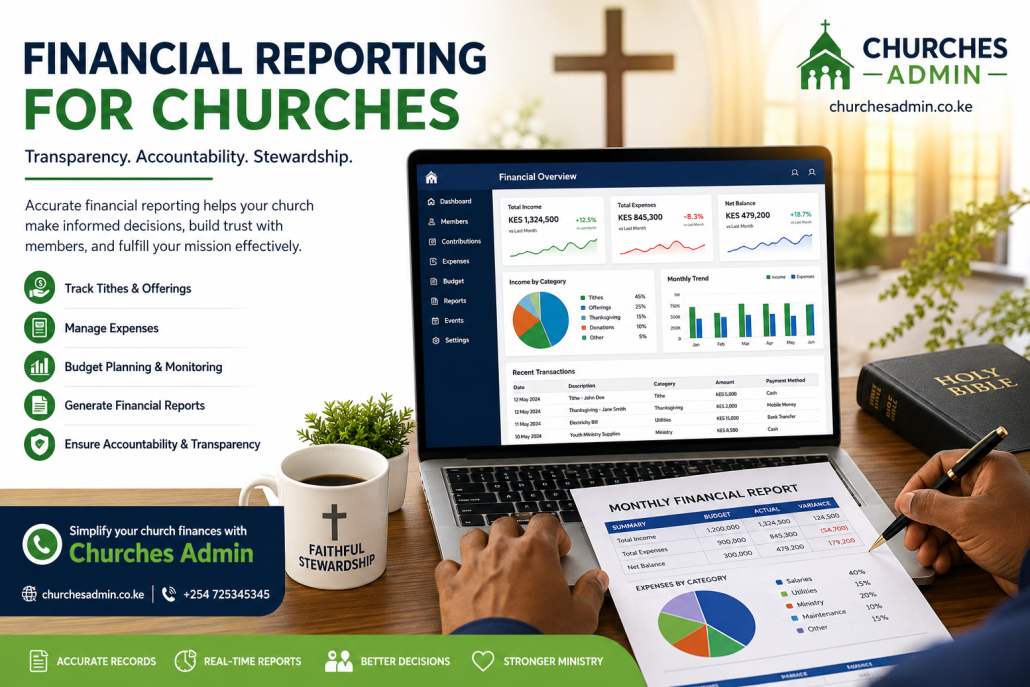
Financial reporting for churches is no longer an optional administrative task. Every church, whether small, medium, or large, must maintain accurate financial records to ensure accountability, transparency, compliance, and wise stewardship of God’s resources. Effective financial reporting for churches helps church leaders make informed decisions, strengthens donor confidence, simplifies audits, and promotes sustainable ministry growth.
In today’s digital world, churches are increasingly moving away from manual bookkeeping and spreadsheets toward dedicated Church Financial Management Software. Platforms like Churches Admin help churches automate financial reporting, track donations, manage budgets, generate detailed reports, and improve financial accountability.
If your church wants to maintain accurate records while remaining transparent with members, this comprehensive guide will help you understand everything about financial reporting for churches and why adopting modern church management software is the smartest investment.
What is Financial Reporting for Churches?
Financial reporting for churches is the systematic recording, organizing, analyzing, and presenting of all financial transactions within a church. These reports provide church leaders, finance committees, pastors, elders, donors, and auditors with a clear picture of how church funds are received and spent.
Financial reporting includes:
- Tithes reporting
- Offering reports
- Donation tracking
- Expense reports
- Budget reports
- Bank reconciliation
- Cash flow statements
- Income statements
- Balance sheets
- Ministry expenditure reports
- Project financial reports
- Annual financial statements
Unlike businesses that focus on profits, financial reporting for churches focuses on stewardship, accountability, compliance, and supporting ministry objectives.
Why Financial Reporting for Churches Matters
Churches manage funds entrusted by members who expect honesty, transparency, and accountability. Poor financial management can lead to:
- Loss of member trust
- Misuse of church funds
- Accounting errors
- Poor budgeting
- Audit challenges
- Leadership conflicts
- Tax compliance issues
- Fraud risks
Proper financial reporting for churches eliminates these risks while improving financial decision-making.
Benefits include:
- Better transparency
- Increased donor confidence
- Easier budgeting
- Accurate expenditure tracking
- Better ministry planning
- Improved accountability
- Easier auditing
- Financial sustainability
Components of Financial Reporting for Churches
A complete financial reporting for churches process consists of several essential reports.
1. Income Reports
Income reports summarize every source of church revenue.
Typical income sources include:
- Tithes
- Sunday offerings
- Special offerings
- Building fund contributions
- Missions giving
- Thanksgiving offerings
- Donations
- Fundraising income
- Event revenue
- Rental income
Accurate income reports ensure every contribution is properly recorded.
2. Expense Reports
Expense reports track how church money is spent.
Examples include:
- Staff salaries
- Utility bills
- Office supplies
- Church maintenance
- Worship equipment
- Evangelism programs
- Youth ministry
- Children’s ministry
- Mission support
- Charity programs
- Building maintenance
Proper expense reporting supports responsible stewardship.
3. Cash Flow Reports
Cash flow reports show:
- Money received
- Money spent
- Current balances
- Future financial position
Cash flow reports help church leaders avoid financial shortages.
4. Budget Reports
Budget reports compare:
- Planned spending
- Actual spending
- Budget variances
This helps ministries remain within approved budgets.
5. Balance Sheets
Balance sheets summarize church assets and liabilities.
Assets include:
- Church buildings
- Land
- Vehicles
- Equipment
- Bank balances
- Investments
Liabilities include:
- Loans
- Outstanding bills
- Contractor payments
6. Donation Reports
Donation reports monitor:
- Individual giving
- Family giving
- Ministry giving
- Annual giving
- Campaign donations
- Mission donations
These reports simplify donor appreciation and year-end summaries.
Challenges of Manual Financial Reporting for Churches
Many churches still depend on notebooks, Excel spreadsheets, and handwritten receipt books.
Unfortunately, manual systems create problems such as:
Human Errors
Manual calculations often produce:
- Incorrect totals
- Missing receipts
- Duplicate entries
- Lost records
Time Consumption
Preparing monthly reports manually may require several days.
Finance teams spend excessive time:
- Summing receipts
- Reconciling bank statements
- Matching expenses
- Preparing reports
Limited Accountability
Without centralized records:
- Transactions become difficult to verify.
- Receipts may disappear.
- Unauthorized spending can go unnoticed.
Difficult Audits
Manual systems complicate audits because documents may be:
- Missing
- Damaged
- Unorganized
Poor Data Security
Paper records can be:
- Lost
- Burned
- Stolen
- Damaged by water
Digital systems eliminate many of these risks.
Digital Financial Reporting for Churches
Modern churches are adopting church financial software because it automates financial management.
A digital financial reporting for churches solution provides:
- Real-time reports
- Automatic calculations
- Secure backups
- Multiple user access
- Audit trails
- Budget monitoring
- Receipt generation
- Donation tracking
This significantly improves efficiency.
Features of Church Financial Reporting Software
Modern church accounting software includes many useful features.
Automated Income Recording
Every donation can be recorded instantly.
Examples include:
- Tithes
- Offerings
- Mobile money
- Bank deposits
- Online giving
No manual calculations are required.
Expense Management
Finance officers can record expenses immediately after payment.
Information captured includes:
- Amount
- Vendor
- Category
- Ministry
- Payment method
- Supporting documents
Budget Management
Software compares:
Budgeted Amount
vs
Actual Spending
This helps leaders identify overspending before it becomes a problem.
Financial Dashboards
Dashboards display:
- Monthly income
- Monthly expenses
- Cash balances
- Giving trends
- Budget performance
Church leaders obtain instant financial insights.
Automated Report Generation
Reports can be generated instantly.
Examples include:
- Monthly reports
- Quarterly reports
- Annual reports
- Ministry reports
- Project reports
No manual calculations are necessary.
Financial Reporting for Churches and Accountability
One of the greatest advantages of financial reporting for churches is accountability.
Church members want assurance that:
- Their tithes are properly managed.
- Donations reach intended ministries.
- Church leaders exercise faithful stewardship.
Transparent reporting strengthens confidence and encourages consistent giving.
Financial Reporting for Churches and Stewardship
The Bible teaches faithful stewardship.
Every offering represents someone’s sacrifice.
Accurate financial reporting for churches demonstrates responsible management of God’s resources.
Church leaders become better equipped to:
- Plan ministries
- Support missions
- Maintain facilities
- Expand outreach
- Invest wisely
Why Churches Need Monthly Financial Reports
Monthly reports allow church leadership to monitor finances before problems grow.
Monthly reports should include:
- Income summary
- Expense summary
- Budget comparison
- Outstanding liabilities
- Bank balances
- Ministry expenditures
- Cash flow
Regular reporting improves financial discipline.
Annual Financial Reporting for Churches
Year-end financial reports provide a complete overview of church finances.
Annual reports typically include:
- Total annual income
- Total annual expenses
- Ministry spending
- Building projects
- Mission support
- Staff costs
- Asset valuation
- Financial position
These reports are valuable during annual general meetings and planning sessions.
Financial Reporting for Churches and Audit Preparation
Audits become straightforward when churches maintain accurate digital records.
Auditors can easily verify:
- Receipts
- Payments
- Bank reconciliations
- Supporting documents
- Donation records
- Budget approvals
This saves both time and administrative effort.
Best Practices for Financial Reporting for Churches
Churches should follow these proven practices:
- Record every transaction promptly.
- Keep digital backups of all financial records.
- Separate ministry funds by category.
- Reconcile bank accounts regularly.
- Review reports monthly.
- Approve expenditures through proper channels.
- Maintain supporting documentation.
- Restrict financial system access based on user roles.
- Conduct periodic internal audits.
- Present financial reports to church leadership consistently.
Why Churches Admin is the Best Solution for Financial Reporting for Churches
Managing church finances manually is becoming increasingly difficult as churches grow. Churches Admin provides an all-in-one church management platform that simplifies financial reporting for churches while improving accountability and transparency.
With Churches Admin, your church can:
- Record tithes and offerings instantly.
- Track donations by member, family, ministry, or project.
- Manage expenses with proper categorization.
- Prepare accurate monthly and annual financial reports.
- Monitor ministry budgets in real time.
- Generate detailed income and expenditure statements.
- Maintain secure digital financial records.
- Support audit readiness with organized documentation.
- Improve leadership decision-making using financial dashboards.
Whether your congregation has 50 members or several thousand, Churches Admin helps streamline financial management and gives church leaders confidence in every financial decision.
Website: churchesadmin.co.ke
Call or WhatsApp: +254 725345345
Financial Reporting for Churches and Donor Management
One of the most important aspects of financial reporting for churches is donor management. Every donation represents an act of faith and trust from members and supporters. Churches have a responsibility to ensure every contribution is properly recorded, acknowledged, and allocated according to the donor’s intention.
When churches implement effective financial reporting for churches, they can accurately track:
- Individual tithes
- Weekly offerings
- Thanksgiving offerings
- Building fund contributions
- Mission support donations
- Youth ministry donations
- Children’s ministry contributions
- Welfare fund donations
- Special event offerings
- Online giving
- Mobile money donations
- Bank transfers
Proper donor management makes it easier to generate annual giving statements, thank contributors, identify giving trends, and maintain complete transparency.
A church management system eliminates guesswork by ensuring every donation is linked to the correct member, family, ministry, or project. This improves accountability and builds long-term trust among church members.
Internal Financial Controls for Churches
Strong internal controls are an essential part of financial reporting for churches. Financial controls are policies and procedures that protect church resources from misuse, fraud, or accounting errors.
Some recommended internal controls include:
Segregation of Duties
No single individual should control every financial process. Instead:
- One person receives offerings.
- Another counts the money.
- Another records the transaction.
- Another approves payments.
- Another reconciles bank statements.
This minimizes opportunities for financial misconduct.
Payment Authorization
Every expense should require proper approval.
Examples include:
- Pastor approval
- Treasurer approval
- Finance committee approval
- Church board approval
This prevents unauthorized spending.
Supporting Documentation
Every financial transaction should have supporting evidence.
Examples include:
- Receipts
- Invoices
- Purchase orders
- Payment vouchers
- Supplier quotations
- Bank deposit slips
These documents simplify audits and financial verification.
Bank Reconciliation
Church bank statements should be reconciled every month.
Bank reconciliation helps identify:
- Missing deposits
- Duplicate payments
- Bank errors
- Outstanding cheques
- Unauthorized withdrawals
Regular reconciliation improves the accuracy of financial reporting for churches.
Financial Reporting for Churches and Budget Planning
Budgets provide a financial roadmap for every church.
Good financial reporting for churches makes budgeting easier because leaders understand:
- Previous year’s income
- Ministry expenses
- Operational costs
- Seasonal giving patterns
- Future financial needs
Without historical financial reports, preparing realistic budgets becomes difficult.
A typical church budget includes:
Ministry Budget
Funds allocated to:
- Evangelism
- Missions
- Youth ministry
- Children’s ministry
- Women’s ministry
- Men’s ministry
- Worship ministry
Administration Budget
Includes:
- Office expenses
- Utilities
- Staff salaries
- Communication
- Insurance
- Equipment
Development Budget
Covers:
- Building construction
- Renovations
- Vehicle purchases
- Land acquisition
- Furniture
- Technology upgrades
Welfare Budget
Supports:
- Benevolence
- Medical assistance
- Funeral support
- Community outreach
- Disaster response
Budget reports generated through church software make it easy to compare planned expenditure with actual spending.
Common Financial Reporting Mistakes Churches Should Avoid
Many churches unintentionally make financial reporting mistakes that can affect accountability and transparency.
Delayed Recording
Waiting several days before recording offerings often results in:
- Forgotten transactions
- Missing receipts
- Incorrect balances
Every transaction should be recorded immediately.
Poor Receipt Management
Receipts are essential financial evidence.
Churches should never:
- Throw away receipts
- Store receipts loosely
- Ignore supplier invoices
Digital storage protects financial records.
Mixing Personal and Church Funds
Church finances should always remain separate from personal finances.
Every payment should pass through official church accounts.
Lack of Budget Monitoring
Some churches prepare budgets but never compare them with actual spending.
Budget monitoring allows leadership to detect overspending early.
Failure to Produce Regular Reports
Financial reports should not only be prepared during annual meetings.
Church leadership benefits from:
- Weekly summaries
- Monthly reports
- Quarterly reports
- Annual statements
Frequent reporting supports better financial decisions.
Poor Record Keeping
Missing financial records create confusion during audits.
Maintain records for:
- Donations
- Expenses
- Bank statements
- Payroll
- Assets
- Supplier invoices
- Contracts
Financial Reporting for Churches During Building Projects
Building projects often involve significant financial commitments.
Accurate financial reporting for churches helps monitor:
- Construction donations
- Contractor payments
- Material purchases
- Equipment expenses
- Labour costs
- Remaining project funds
Project-specific financial reports prevent confusion between operational expenses and development projects.
Financial Reporting for Churches and Online Giving
Many churches now receive donations through:
- Mobile money
- Debit cards
- Credit cards
- Online payment platforms
- Bank transfers
- QR code payments
Digital giving requires equally effective financial reporting for churches.
Church software automatically records:
- Date
- Donor
- Amount
- Payment method
- Fund category
This improves financial accuracy while reducing manual work.
Financial Reporting for Churches and Payroll Management
Churches employing pastors, administrators, accountants, musicians, security staff, or cleaners should maintain organized payroll records.
Payroll reports include:
- Gross salary
- Allowances
- Deductions
- Taxes
- Pension contributions
- Net salary
Accurate payroll records contribute to complete financial reporting for churches.
Financial Reporting for Churches and Asset Management
Churches own valuable assets that require proper documentation.
Examples include:
- Church buildings
- Vehicles
- Musical instruments
- Computers
- Furniture
- Cameras
- Projectors
- Land
- Sound equipment
Financial reporting should monitor:
- Purchase value
- Current value
- Maintenance costs
- Depreciation
- Disposal history
Proper asset reporting protects church investments.
Financial Reporting for Churches and Ministry Performance
Financial reports also help evaluate ministry effectiveness.
Leadership can compare:
- Ministry budgets
- Ministry expenses
- Attendance growth
- Donation growth
- Event costs
- Outreach impact
This information helps church leaders allocate resources wisely.
Using Technology to Improve Financial Reporting for Churches
Technology has transformed how churches manage finances.
Modern church financial software offers:
- Cloud storage
- Mobile accessibility
- Automated calculations
- Instant reporting
- Digital receipts
- Budget tracking
- Audit trails
- User permissions
- Secure backups
- Dashboard analytics
Digital systems reduce paperwork while increasing financial accuracy.
How Churches Admin Simplifies Financial Reporting for Churches
Churches Admin has been designed specifically to help churches automate and simplify financial management. Instead of spending hours creating spreadsheets or compiling handwritten reports, finance teams can generate professional reports within minutes.
Key features include:
- Comprehensive income tracking.
- Expense management by category or ministry.
- Member contribution history.
- Automated receipt generation.
- Budget planning and monitoring.
- Financial dashboards for leadership.
- Cash flow reporting.
- Balance sheet generation.
- Ministry expenditure reports.
- Secure cloud-based record storage.
- Role-based access for finance teams.
- Exportable reports for meetings and audits.
Whether your church is a small congregation or a multi-branch ministry, Churches Admin provides the tools needed to strengthen financial accountability and improve stewardship.
Frequently Asked Questions About Financial Reporting for Churches
Why is financial reporting important for churches?
Financial reporting provides transparency, accountability, and accurate information that supports responsible stewardship of church resources.
How often should churches prepare financial reports?
Most churches should prepare:
- Weekly income summaries
- Monthly financial reports
- Quarterly reviews
- Annual financial statements
Can small churches benefit from financial reporting software?
Absolutely. Even churches with a small membership can improve record keeping, reduce errors, and save time by using dedicated church financial software.
What should be included in church financial reports?
A complete financial report should include:
- Income
- Expenses
- Budget performance
- Cash flow
- Assets
- Liabilities
- Donation summaries
- Ministry expenditures
- Bank reconciliation status
How does financial reporting improve donor confidence?
When members receive clear information about how church funds are managed, they are more likely to trust the leadership and continue supporting the ministry consistently.
Is cloud-based financial reporting secure?
Yes. Reputable church management platforms use secure cloud infrastructure, encrypted connections, automated backups, and controlled user access to protect sensitive financial information.
The Future of Financial Reporting for Churches
As churches continue to embrace digital transformation, financial reporting for churches will become increasingly automated, accurate, and accessible. Artificial intelligence, cloud computing, and real-time dashboards are making it easier for church leaders to monitor finances, identify trends, and make informed decisions.
Future innovations may include predictive budgeting, automated anomaly detection, integrated online giving reconciliation, and mobile reporting for pastors and finance committees. Churches that invest in modern financial systems today will be better prepared to manage growth, improve transparency, and strengthen member confidence in the years ahead.
Why Every Growing Church Needs Better Financial Reporting
Growth brings greater financial responsibility. As congregations expand, churches often experience increased giving, more ministry activities, larger payrolls, building projects, and additional operational expenses. Manual bookkeeping methods that worked for a small congregation can quickly become inefficient and error-prone.
A robust system for financial reporting for churches enables leaders to handle this growth confidently. With accurate reports available at any time, pastors, treasurers, finance committees, and church boards can evaluate financial health, approve strategic investments, monitor ministry performance, and ensure every shilling is accounted for. This level of transparency fosters trust among members and supports the long-term sustainability of the ministry.
Conclusion
Effective financial reporting for churches is the foundation of sound stewardship, transparency, and responsible church administration. From tracking tithes and offerings to managing budgets, expenses, payroll, assets, and ministry projects, accurate financial reporting enables church leaders to make informed decisions while maintaining the confidence of members and donors.
Manual systems are increasingly unable to meet the needs of modern churches. By adopting a dedicated church management platform such as Churches Admin, churches can automate financial processes, generate professional reports in minutes, reduce errors, strengthen internal controls, and prepare confidently for audits and annual meetings.
If your church is looking for a reliable, secure, and user-friendly solution for financial reporting for churches, Churches Admin provides everything you need in one integrated platform.
Visit: churchesadmin.co.ke
Call or WhatsApp: +254 725345345
Take the next step toward greater financial transparency, accountability, and ministry growth with Churches Admin—the smarter way to manage your church finances.
