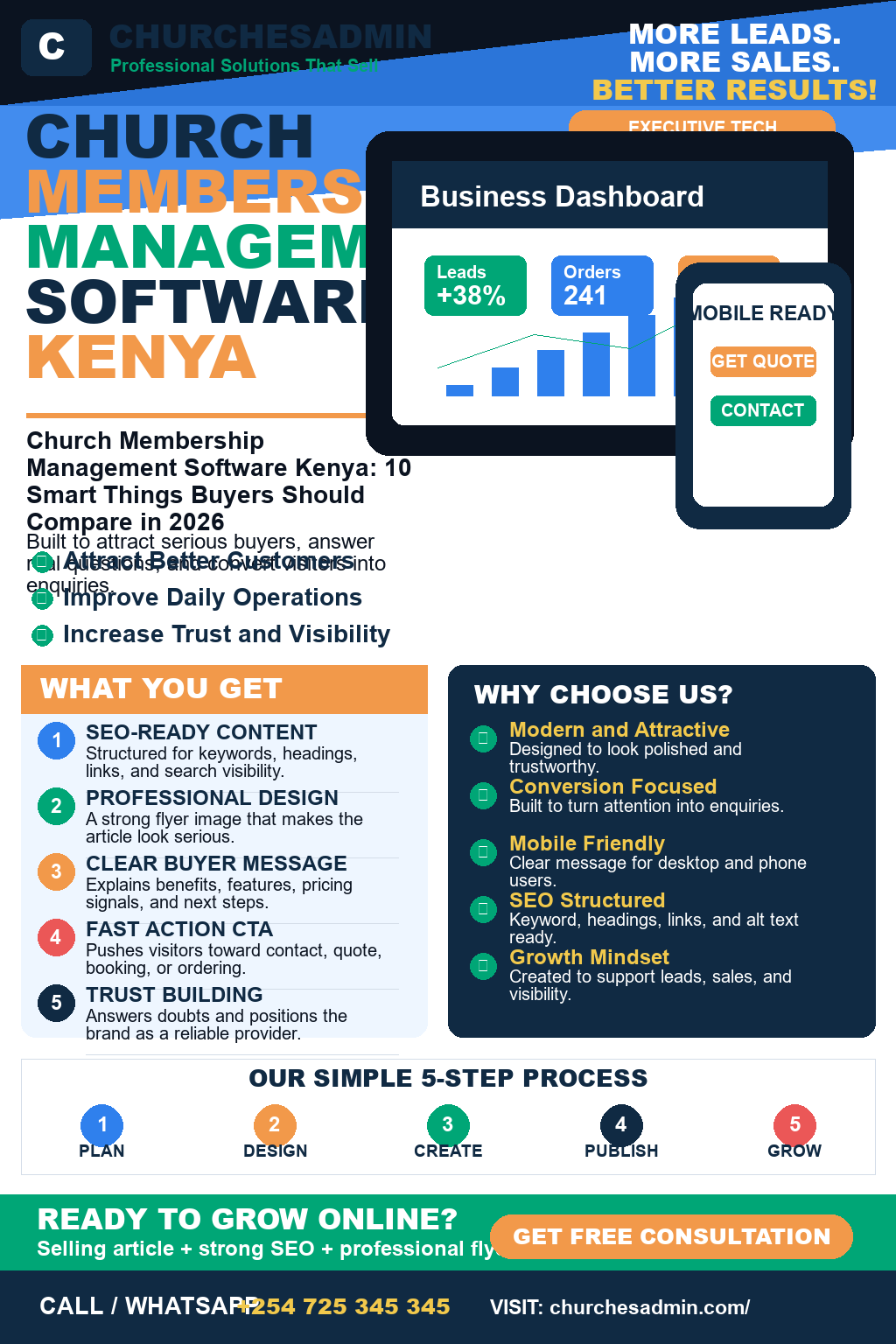
Church Donation Management Software Kenya: 10 Smart Things Buyers Should Compare in 2026

Church Donation Management Software Kenya: 10 Smart Things Buyers Should Compare in 2026

Church Donation Management Software Kenya is a strong buyer-intent keyword because the visitor is usually comparing providers, prices, features, timelines, and proof before making a decision.

Church Donation Management Software Kenya is one of the fresh buyer-focused topics ChurchesAdmin should publish around today because it matches what serious buyers are searching before they request a demo, quote, rollout plan, or implementation support.

For buyers, students, business owners, managers, administrators, founders, and decision makers looking for a practical solution, the real problem is manual work, unclear communication, weak records, missed deadlines, poor visibility, and difficulty comparing trusted providers. A useful article should answer the questions that serious buyers ask before they contact a provider or request a quotation.

Table of Contents

  • Church Donation Management Software Kenya
  • Church Donation Management Software Kenya service
  • Church Donation Management Software Kenya provider
  • Church Donation Management Software Kenya company
  • best Church Donation Management Software Kenya

Why Church Donation Management Software Kenya Matters

This search usually comes from a person who already feels the pain. They may be losing enquiries, wasting time with manual work, struggling with deadlines, missing records, or comparing suppliers before paying.

The right content should make the decision easier. It should explain the problem clearly, show the features that matter, reduce fear, and give the visitor a simple next step.

ChurchesAdmin can use this topic to attract qualified visitors who are closer to buying because they are searching around a real need.

Important Features Buyers Should Expect

  • clear onboarding – helps buyers get a clearer, faster, and more reliable outcome.
  • secure records – helps buyers get a clearer, faster, and more reliable outcome.
  • fast communication – helps buyers get a clearer, faster, and more reliable outcome.
  • mobile access – helps buyers get a clearer, faster, and more reliable outcome.
  • reports and updates – helps buyers get a clearer, faster, and more reliable outcome.
  • support after delivery – helps buyers get a clearer, faster, and more reliable outcome.
  • clear process – buyers should understand what happens before, during, and after delivery.
  • mobile friendly experience – users should be able to access the service or platform comfortably on phones.
  • useful reports or updates – clients should see progress, records, or results without repeated follow-up.
  • reliable support – the provider should support improvements after launch or delivery.

How to Compare Providers

Start with workflow fit. The provider should understand the exact users, tasks, deadlines, records, communication channels, payments, and reports involved.

Next, compare trust. Look for clear service pages, examples, practical explanations, realistic promises, visible contacts, and content that answers real questions.

Then compare long-term value. The best option is not always the lowest quote. The right provider should save time, reduce confusion, improve experience, and make future growth easier.

Mistakes to Avoid

Choosing Only by Price

Cheap work can become expensive if it creates weak design, unclear communication, poor support, missing features, or repeated revisions.

Ignoring the Real User

A solution must work for the people who use it daily. If users find it confusing, the project loses value quickly.

Publishing Thin Content

SEO pages should not only repeat keywords. They should answer buyer questions and explain the next step clearly.

How to Get Started

Write down the exact result you want. Include the users, current problem, documents, deadlines, records, payments, reports, and the main action you want visitors or customers to take.

Then contact a provider with a clear request. Share the pain points and ask for a practical plan, timeline, and support process.

Why Choose ChurchesAdmin?

ChurchesAdmin helps churches manage members, giving, attendance, events, groups, communication, and reports with less manual work.

Frequently Asked Questions

Who needs Church Donation Management Software Kenya?

Church Donation Management Software Kenya is useful for buyers, students, business owners, managers, administrators, founders, and decision makers looking for a practical solution, especially when the current process is manual, unclear, slow, or hard to scale.

What should buyers compare first?

Compare workflow fit, support, examples, communication, features, timelines, and whether the provider understands the real problem.

Can the solution be customized?

Yes. A serious provider should shape the solution around users, records, reports, content, communication, and growth plans.

Conclusion

Church Donation Management Software Kenya is worth targeting because it connects to real buying intent. The best content should educate the visitor, build confidence, and make the next enquiry easy.

Deep Buyer Guide for Church Donation Management Software Kenya

Before making a decision, buyers should separate must-have requirements from nice-to-have extras. The must-have items are the features that protect revenue, save time, improve communication, or prevent operational confusion. A buyer searching for Church Donation Management Software Kenya is rarely looking for a vague overview. They normally want a practical answer that helps them choose a provider, compare options, understand implementation, and avoid a poor purchase.

The first useful step is to define the current workflow. Write down who starts the request, who approves it, where records are stored, how payments or submissions are confirmed, and which reports management needs at the end of the week or month. This exercise exposes gaps quickly. If the current process depends on scattered spreadsheets, WhatsApp screenshots, email attachments, or one person who remembers everything, the buyer should prioritize a solution that brings those records into one controlled workflow.

The second step is to compare accountability. Good providers explain how the work will be planned, who owns each stage, what information is needed before kickoff, and how progress will be reviewed. Weak providers often jump straight to price without clarifying the operating problem. For ChurchesAdmin, the strongest content should help the reader think like a serious buyer: define the result, protect the user experience, check the support model, and make sure the final solution can keep improving after launch.

The third step is to check reporting and visibility. Many organizations do not only need a service; they need evidence that the service is working. Reports, dashboards, status updates, audit trails, and clear records reduce conflict because teams can see what happened, when it happened, and what still needs attention. This is especially important when the topic affects money, customers, students, members, tenants, voters, staff, stock, or compliance.

Future growth also matters. A good solution should allow more users, more records, more requests, more services, and better reports without forcing the organization to start again from zero. Buyers should ask whether the solution can handle new branches, new counties, new departments, new roles, new payment methods, or new reporting needs. The cheapest first option can become expensive if it blocks growth six months later.

Strong SEO content supports both trust and rankings. A long article should not fill space with repeated claims. It should answer real questions, explain trade-offs, use the focus keyword naturally, link to useful pages, and give the reader a clear next step. When visitors feel that the article understands their problem, they are more likely to enquire, request a quote, book a demo, or compare the provider seriously.

Implementation Checklist

  • Problem definition: describe the current bottleneck and the measurable result the buyer wants.
  • User roles: list administrators, managers, customers, students, members, tenants, staff, or external users who will interact with the process.
  • Data records: define the records, documents, payments, messages, reports, and approvals that must be captured.
  • Security: decide who can view, edit, approve, export, or delete sensitive records.
  • Support: confirm how training, bug fixes, updates, and improvements will be handled after launch.

These details make the buying conversation more productive. Instead of asking only for a general quote, the buyer can explain the workflow and ask for a practical rollout plan. That gives the provider enough context to recommend a sensible scope, timeline, and support path. It also helps the buyer avoid vague proposals that look cheap but leave critical work undefined.

Questions Buyers Should Ask

Buyers should ask how long implementation will take, what content or data must be prepared, how user training will work, and what happens after publishing or launch. They should also ask for examples of similar work, a clear contact path, and an explanation of what is included in the first delivery versus future improvements. These questions protect both sides because they make expectations clear before money changes hands.

Another useful question is how success will be measured. For some buyers, success means more enquiries. For others, it means faster reconciliation, fewer missing records, lower admin workload, better tenant communication, smoother elections, stronger academic support workflows, better farm records, more reliable connectivity, or clearer executive reporting. The right metric depends on the business problem, so the article should connect the keyword to outcomes that matter.

Finally, buyers should check whether the provider understands the local context. In Kenya and surrounding markets, details like M-Pesa, county operations, mobile-first users, WhatsApp communication, school and SACCO structures, landlord workflows, rural connectivity, and small-team administration can shape the success of a project. A generic solution may look good but fail in daily use if it ignores these realities.

Deep Buyer Guide for Church Donation Management Software Kenya

Before making a decision, buyers should separate must-have requirements from nice-to-have extras. The must-have items are the features that protect revenue, save time, improve communication, or prevent operational confusion. A buyer searching for Church Donation Management Software Kenya is rarely looking for a vague overview. They normally want a practical answer that helps them choose a provider, compare options, understand implementation, and avoid a poor purchase.

The first useful step is to define the current workflow. Write down who starts the request, who approves it, where records are stored, how payments or submissions are confirmed, and which reports management needs at the end of the week or month. This exercise exposes gaps quickly. If the current process depends on scattered spreadsheets, WhatsApp screenshots, email attachments, or one person who remembers everything, the buyer should prioritize a solution that brings those records into one controlled workflow.

The second step is to compare accountability. Good providers explain how the work will be planned, who owns each stage, what information is needed before kickoff, and how progress will be reviewed. Weak providers often jump straight to price without clarifying the operating problem. For ChurchesAdmin, the strongest content should help the reader think like a serious buyer: define the result, protect the user experience, check the support model, and make sure the final solution can keep improving after launch.

The third step is to check reporting and visibility. Many organizations do not only need a service; they need evidence that the service is working. Reports, dashboards, status updates, audit trails, and clear records reduce conflict because teams can see what happened, when it happened, and what still needs attention. This is especially important when the topic affects money, customers, students, members, tenants, voters, staff, stock, or compliance.

Future growth also matters. A good solution should allow more users, more records, more requests, more services, and better reports without forcing the organization to start again from zero. Buyers should ask whether the solution can handle new branches, new counties, new departments, new roles, new payment methods, or new reporting needs. The cheapest first option can become expensive if it blocks growth six months later.

Strong SEO content supports both trust and rankings. A long article should not fill space with repeated claims. It should answer real questions, explain trade-offs, use the focus keyword naturally, link to useful pages, and give the reader a clear next step. When visitors feel that the article understands their problem, they are more likely to enquire, request a quote, book a demo, or compare the provider seriously.

Implementation Checklist

  • Problem definition: describe the current bottleneck and the measurable result the buyer wants.
  • User roles: list administrators, managers, customers, students, members, tenants, staff, or external users who will interact with the process.
  • Data records: define the records, documents, payments, messages, reports, and approvals that must be captured.
  • Security: decide who can view, edit, approve, export, or delete sensitive records.
  • Support: confirm how training, bug fixes, updates, and improvements will be handled after launch.

These details make the buying conversation more productive. Instead of asking only for a general quote, the buyer can explain the workflow and ask for a practical rollout plan. That gives the provider enough context to recommend a sensible scope, timeline, and support path. It also helps the buyer avoid vague proposals that look cheap but leave critical work undefined.

Questions Buyers Should Ask

Buyers should ask how long implementation will take, what content or data must be prepared, how user training will work, and what happens after publishing or launch. They should also ask for examples of similar work, a clear contact path, and an explanation of what is included in the first delivery versus future improvements. These questions protect both sides because they make expectations clear before money changes hands.

Another useful question is how success will be measured. For some buyers, success means more enquiries. For others, it means faster reconciliation, fewer missing records, lower admin workload, better tenant communication, smoother elections, stronger academic support workflows, better farm records, more reliable connectivity, or clearer executive reporting. The right metric depends on the business problem, so the article should connect the keyword to outcomes that matter.

Finally, buyers should check whether the provider understands the local context. In Kenya and surrounding markets, details like M-Pesa, county operations, mobile-first users, WhatsApp communication, school and SACCO structures, landlord workflows, rural connectivity, and small-team administration can shape the success of a project. A generic solution may look good but fail in daily use if it ignores these realities.

Deep Buyer Guide for Church Donation Management Software Kenya

Before making a decision, buyers should separate must-have requirements from nice-to-have extras. The must-have items are the features that protect revenue, save time, improve communication, or prevent operational confusion. A buyer searching for Church Donation Management Software Kenya is rarely looking for a vague overview. They normally want a practical answer that helps them choose a provider, compare options, understand implementation, and avoid a poor purchase.

The first useful step is to define the current workflow. Write down who starts the request, who approves it, where records are stored, how payments or submissions are confirmed, and which reports management needs at the end of the week or month. This exercise exposes gaps quickly. If the current process depends on scattered spreadsheets, WhatsApp screenshots, email attachments, or one person who remembers everything, the buyer should prioritize a solution that brings those records into one controlled workflow.

The second step is to compare accountability. Good providers explain how the work will be planned, who owns each stage, what information is needed before kickoff, and how progress will be reviewed. Weak providers often jump straight to price without clarifying the operating problem. For ChurchesAdmin, the strongest content should help the reader think like a serious buyer: define the result, protect the user experience, check the support model, and make sure the final solution can keep improving after launch.

The third step is to check reporting and visibility. Many organizations do not only need a service; they need evidence that the service is working. Reports, dashboards, status updates, audit trails, and clear records reduce conflict because teams can see what happened, when it happened, and what still needs attention. This is especially important when the topic affects money, customers, students, members, tenants, voters, staff, stock, or compliance.

Future growth also matters. A good solution should allow more users, more records, more requests, more services, and better reports without forcing the organization to start again from zero. Buyers should ask whether the solution can handle new branches, new counties, new departments, new roles, new payment methods, or new reporting needs. The cheapest first option can become expensive if it blocks growth six months later.

Strong SEO content supports both trust and rankings. A long article should not fill space with repeated claims. It should answer real questions, explain trade-offs, use the focus keyword naturally, link to useful pages, and give the reader a clear next step. When visitors feel that the article understands their problem, they are more likely to enquire, request a quote, book a demo, or compare the provider seriously.

Implementation Checklist

  • Problem definition: describe the current bottleneck and the measurable result the buyer wants.
  • User roles: list administrators, managers, customers, students, members, tenants, staff, or external users who will interact with the process.
  • Data records: define the records, documents, payments, messages, reports, and approvals that must be captured.
  • Security: decide who can view, edit, approve, export, or delete sensitive records.
  • Support: confirm how training, bug fixes, updates, and improvements will be handled after launch.

These details make the buying conversation more productive. Instead of asking only for a general quote, the buyer can explain the workflow and ask for a practical rollout plan. That gives the provider enough context to recommend a sensible scope, timeline, and support path. It also helps the buyer avoid vague proposals that look cheap but leave critical work undefined.

Questions Buyers Should Ask

Buyers should ask how long implementation will take, what content or data must be prepared, how user training will work, and what happens after publishing or launch. They should also ask for examples of similar work, a clear contact path, and an explanation of what is included in the first delivery versus future improvements. These questions protect both sides because they make expectations clear before money changes hands.

Another useful question is how success will be measured. For some buyers, success means more enquiries. For others, it means faster reconciliation, fewer missing records, lower admin workload, better tenant communication, smoother elections, stronger academic support workflows, better farm records, more reliable connectivity, or clearer executive reporting. The right metric depends on the business problem, so the article should connect the keyword to outcomes that matter.

Finally, buyers should check whether the provider understands the local context. In Kenya and surrounding markets, details like M-Pesa, county operations, mobile-first users, WhatsApp communication, school and SACCO structures, landlord workflows, rural connectivity, and small-team administration can shape the success of a project. A generic solution may look good but fail in daily use if it ignores these realities.

Deep Buyer Guide for Church Donation Management Software Kenya

Before making a decision, buyers should separate must-have requirements from nice-to-have extras. The must-have items are the features that protect revenue, save time, improve communication, or prevent operational confusion. A buyer searching for Church Donation Management Software Kenya is rarely looking for a vague overview. They normally want a practical answer that helps them choose a provider, compare options, understand implementation, and avoid a poor purchase.

The first useful step is to define the current workflow. Write down who starts the request, who approves it, where records are stored, how payments or submissions are confirmed, and which reports management needs at the end of the week or month. This exercise exposes gaps quickly. If the current process depends on scattered spreadsheets, WhatsApp screenshots, email attachments, or one person who remembers everything, the buyer should prioritize a solution that brings those records into one controlled workflow.

The second step is to compare accountability. Good providers explain how the work will be planned, who owns each stage, what information is needed before kickoff, and how progress will be reviewed. Weak providers often jump straight to price without clarifying the operating problem. For ChurchesAdmin, the strongest content should help the reader think like a serious buyer: define the result, protect the user experience, check the support model, and make sure the final solution can keep improving after launch.

The third step is to check reporting and visibility. Many organizations do not only need a service; they need evidence that the service is working. Reports, dashboards, status updates, audit trails, and clear records reduce conflict because teams can see what happened, when it happened, and what still needs attention. This is especially important when the topic affects money, customers, students, members, tenants, voters, staff, stock, or compliance.

Future growth also matters. A good solution should allow more users, more records, more requests, more services, and better reports without forcing the organization to start again from zero. Buyers should ask whether the solution can handle new branches, new counties, new departments, new roles, new payment methods, or new reporting needs. The cheapest first option can become expensive if it blocks growth six months later.

Strong SEO content supports both trust and rankings. A long article should not fill space with repeated claims. It should answer real questions, explain trade-offs, use the focus keyword naturally, link to useful pages, and give the reader a clear next step. When visitors feel that the article understands their problem, they are more likely to enquire, request a quote, book a demo, or compare the provider seriously.

Implementation Checklist

  • Problem definition: describe the current bottleneck and the measurable result the buyer wants.
  • User roles: list administrators, managers, customers, students, members, tenants, staff, or external users who will interact with the process.
  • Data records: define the records, documents, payments, messages, reports, and approvals that must be captured.
  • Security: decide who can view, edit, approve, export, or delete sensitive records.
  • Support: confirm how training, bug fixes, updates, and improvements will be handled after launch.

These details make the buying conversation more productive. Instead of asking only for a general quote, the buyer can explain the workflow and ask for a practical rollout plan. That gives the provider enough context to recommend a sensible scope, timeline, and support path. It also helps the buyer avoid vague proposals that look cheap but leave critical work undefined.

Questions Buyers Should Ask

Buyers should ask how long implementation will take, what content or data must be prepared, how user training will work, and what happens after publishing or launch. They should also ask for examples of similar work, a clear contact path, and an explanation of what is included in the first delivery versus future improvements. These questions protect both sides because they make expectations clear before money changes hands.

Another useful question is how success will be measured. For some buyers, success means more enquiries. For others, it means faster reconciliation, fewer missing records, lower admin workload, better tenant communication, smoother elections, stronger academic support workflows, better farm records, more reliable connectivity, or clearer executive reporting. The right metric depends on the business problem, so the article should connect the keyword to outcomes that matter.

Finally, buyers should check whether the provider understands the local context. In Kenya and surrounding markets, details like M-Pesa, county operations, mobile-first users, WhatsApp communication, school and SACCO structures, landlord workflows, rural connectivity, and small-team administration can shape the success of a project. A generic solution may look good but fail in daily use if it ignores these realities.

Church Management System Download: The Complete Guide to Choosing and Downloading the Best Church Management System in Kenya

church management system download

church management system download

If your church is still using notebooks, spreadsheets, or paper files to manage members, offerings, attendance, and finances, it is time to consider a church management system download. Modern churches require digital solutions that simplify administration, improve accountability, and enhance communication with members.

Whether you lead a small church with 50 members or a large ministry with thousands of congregants, downloading a reliable church management system can transform the way your church operates.

At Churches Admin (churchesadmin.co.ke), we provide an all-in-one church management system designed specifically for churches in Kenya and across Africa. The software is affordable, secure, easy to use, and packed with features that every church needs.

Call us today: +254 725 345 345


Church Management System Download

Searching for a church management system download is becoming increasingly common because churches are moving away from manual administration. A modern church requires digital tools to handle member records, financial reports, attendance tracking, communication, event planning, and leadership reporting.

A quality church management system download gives your church everything in one centralized platform.

Instead of maintaining several books and Excel sheets, every record is stored securely and can be accessed whenever needed.

With Churches Admin, downloading and using your church management system is quick and straightforward.


What is a Church Management System?

A church management system is software designed to help churches manage their daily administrative activities.

Instead of using multiple books and paperwork, churches can manage everything from one dashboard.

A church management system allows churches to manage:

  • Church members
  • Visitors
  • Attendance
  • Offerings
  • Tithes
  • Financial reports
  • Church events
  • SMS communication
  • Small groups
  • Ministries
  • Staff
  • Volunteers
  • Assets
  • Reports

When searching online for a church management system download, it is important to choose software that was specifically designed for churches rather than generic accounting software.


Why Churches Need a Church Management System Download

Churches are growing every year.

As membership increases, paperwork becomes difficult to manage.

A church management system download helps churches overcome common challenges including:

  • Lost member records
  • Missing attendance reports
  • Poor financial accountability
  • Slow reporting
  • Duplicate records
  • Manual calculations
  • Difficult communication
  • Time-consuming administration

Instead of spending hours preparing reports, church leaders can generate them within seconds.


Benefits of Downloading a Church Management System

1. Centralized Member Records

Every church member has detailed information including:

  • Name
  • Phone number
  • Email
  • Family information
  • Ministry
  • Occupation
  • Baptism details
  • Membership status
  • Emergency contacts

Having all this information in one place makes administration much easier.


2. Easy Attendance Tracking

Attendance is one of the most important indicators of church growth.

A church management system download allows churches to record attendance for:

  • Sunday Services
  • Midweek Services
  • Prayer Meetings
  • Conferences
  • Youth Meetings
  • Women’s Meetings
  • Men’s Meetings
  • Cell Groups

Attendance reports are automatically generated.


3. Better Financial Management

Church finances require complete transparency.

Churches Admin allows churches to manage:

  • Tithes
  • Offerings
  • Thanksgiving
  • Building Fund
  • Mission Giving
  • Donations
  • Development Contributions
  • Welfare Contributions

Every transaction is recorded and reports can be generated instantly.


4. Faster Communication

Communication keeps members engaged.

Our church management system supports SMS communication for:

  • Church announcements
  • Prayer meetings
  • Conferences
  • Youth meetings
  • Special services
  • Fundraising campaigns
  • Holiday greetings

One message can reach hundreds or thousands of members instantly.


Features Included in Our Church Management System Download

When you download Churches Admin, you receive a complete church administration solution.

Features include:

Member Management

Maintain detailed records of every member.

Visitor Management

Track every visitor from first visit to membership.

Attendance Management

Generate attendance reports automatically.

Offering Management

Record all church offerings accurately.

Tithe Management

Monitor member giving and produce giving statements.

Financial Reports

Generate comprehensive reports instantly.

Event Management

Organize conferences, seminars, and church meetings.

Ministry Management

Manage:

  • Choir
  • Ushers
  • Youth
  • Women Ministry
  • Men Ministry
  • Sunday School
  • Children’s Ministry

Small Groups

Manage cell groups efficiently.

Volunteer Management

Track volunteer participation.

User Roles

Assign permissions to:

  • Pastor
  • Treasurer
  • Secretary
  • Administrator
  • Accountant

Church Management System Download for Small Churches

Small churches often think church software is only for large ministries.

That is not true.

A church management system download benefits even churches with fewer than 100 members.

Benefits include:

  • Organized records
  • Better accountability
  • Professional reporting
  • Easy member follow-up
  • Simple attendance tracking
  • Secure financial records

The software grows together with your ministry.


Church Management System Download for Large Churches

Large churches handle thousands of records every month.

Managing such information manually becomes impossible.

A church management system helps large churches manage:

  • Multiple branches
  • Thousands of members
  • Thousands of financial transactions
  • Multiple church services
  • Staff
  • Volunteers
  • Ministries
  • Assets
  • Church events

Everything is centralized.


Why Churches Admin is the Best Church Management System Download

Many church software solutions are generic.

Churches Admin was built specifically for churches.

Our system understands church operations and includes features churches actually need.

Advantages include:

  • Easy installation
  • User-friendly interface
  • Cloud-based access
  • Secure database
  • Fast reporting
  • Mobile-friendly design
  • Affordable pricing
  • Excellent customer support
  • Regular software updates
  • Local support in Kenya

Secure Church Data Management

Church records contain sensitive information.

Our church management system uses secure technologies to protect:

  • Member information
  • Financial records
  • Attendance history
  • Giving records
  • User accounts

Regular backups ensure your information is never lost.


Church Management System Download Saves Time

Imagine spending several hours preparing monthly reports.

Now imagine generating the same reports in less than one minute.

That is the power of a professional church management system download.

Tasks that become easier include:

  • Recording offerings
  • Updating members
  • Tracking attendance
  • Printing reports
  • Sending SMS
  • Preparing financial summaries

Church leaders spend less time on paperwork and more time on ministry.


Improve Church Accountability

Financial accountability builds trust among members.

With Churches Admin:

  • Every transaction is recorded.
  • Every report can be verified.
  • Every receipt is traceable.
  • Every donation is documented.

This improves transparency and simplifies financial audits.


Who Should Download a Church Management System?

A church management system download is suitable for:

  • Independent churches
  • Community churches
  • Pentecostal churches
  • Catholic organizations
  • Anglican churches
  • Baptist churches
  • Evangelical ministries
  • Mission organizations
  • Church networks
  • Multi-campus churches

Regardless of denomination, digital church management improves efficiency and organization.


Get Started with Churches Admin Today

If you are looking for the best church management system download in Kenya, Churches Admin provides a complete solution for managing members, finances, attendance, ministries, events, and communication from one secure platform.

Visit churchesadmin.co.ke to learn more about our church management software or contact us directly for a demo and installation assistance.

📞 Call / WhatsApp: +254 725 345 345

Cloud-Based Church Management System Download vs Desktop Church Management System Download

One of the biggest decisions churches face when looking for a church management system download is whether to choose a cloud-based solution or a desktop-based application.

Both options have advantages, but today’s churches are increasingly choosing cloud technology because of its flexibility and accessibility.

Cloud Church Management System

A cloud church management system download allows authorized users to access church records securely through the internet.

Benefits include:

  • Access from anywhere
  • Automatic software updates
  • Secure cloud backups
  • Multi-user access
  • Real-time reporting
  • Reduced IT maintenance
  • Better data security
  • Easy branch management

Pastors, accountants, secretaries, and administrators can work together without needing to be in the same office.

Desktop Church Management System

A desktop church management system download installs directly on one or more computers within the church office.

Benefits include:

  • Works without internet in some configurations
  • Local data storage
  • Familiar setup for some users
  • Lower dependency on internet connectivity

For churches planning long-term growth, cloud-enabled systems like Churches Admin provide greater scalability and convenience.


How to Download a Church Management System

Many churches search online for church management system download expecting to find software that is simple to install and easy to use.

With Churches Admin, the process is straightforward:

Step 1: Contact Churches Admin

Reach our team through:

Phone / WhatsApp: +254 725 345 345

Our experts will understand your church’s needs and recommend the most suitable package.

Step 2: Receive Your Church Management System

After registration, your church receives access to the software along with installation guidance where applicable.

Step 3: Data Migration

Already keeping records in books or Excel?

We help migrate:

  • Member records
  • Attendance data
  • Financial information
  • Ministries
  • Church departments
  • Branch information

This ensures a smooth transition to your new church management system download.

Step 4: Staff Training

Our team trains church leaders, administrators, treasurers, pastors, and secretaries so they can confidently use the system from day one.


Church Management System Download for Churches in Kenya

Churches across Kenya are embracing digital transformation. Whether your church is in Nairobi, Mombasa, Kisumu, Nakuru, Eldoret, Thika, Machakos, Nyeri, Meru, Kakamega, Kisii, or any other county, a church management system download helps streamline administration and improve service delivery.

Churches Admin is designed with local church operations in mind, making it an excellent choice for Kenyan ministries of all sizes.


Why Digital Church Management Matters

Modern ministry extends beyond Sunday services. Churches manage people, finances, outreach programs, conferences, welfare initiatives, and community projects every day.

A reliable church management system download enables church leaders to:

  • Focus more on ministry and discipleship
  • Reduce paperwork
  • Improve record accuracy
  • Make data-driven decisions
  • Strengthen member engagement
  • Increase financial transparency

Digital management is no longer a luxury—it is becoming an essential tool for effective ministry.


Reports You Can Generate

One of the greatest advantages of a church management system download is instant reporting.

Churches Admin generates reports such as:

  • Church membership reports
  • Visitor reports
  • Attendance reports
  • First-time visitor reports
  • Offering reports
  • Tithe reports
  • Donation reports
  • Ministry reports
  • Department reports
  • Branch reports
  • Event reports
  • Financial summaries
  • Monthly income reports
  • Annual financial reports
  • Member contribution statements

These reports help church leaders make informed decisions quickly.


Church Management System Download with SMS Integration

Communication is essential for church growth.

Our church management system download supports SMS integration, allowing churches to send messages directly to members.

Use SMS for:

  • Sunday service reminders
  • Prayer meeting invitations
  • Conference announcements
  • Youth fellowship updates
  • Women’s ministry meetings
  • Men’s fellowship notices
  • Fundraising campaigns
  • Holiday greetings
  • Emergency announcements
  • Birthday wishes

Fast and reliable communication helps keep members connected.


Church Management System Download with Financial Management

Managing church finances manually can lead to errors and delays.

With Churches Admin, your church management system download includes tools to manage:

  • Tithes
  • Sunday offerings
  • Thanksgiving offerings
  • Building fund
  • Missions support
  • Special donations
  • Welfare contributions
  • Development projects
  • Pledges

The system produces accurate financial reports that support accountability and transparency.


Church Management System Download with Attendance Management

Attendance tracking is important for understanding church growth.

The Churches Admin church management system download enables churches to monitor attendance across:

  • Sunday worship
  • Midweek services
  • Youth meetings
  • Bible study groups
  • Prayer meetings
  • Conferences
  • Children’s ministry
  • Cell groups
  • Choir practice

Historical attendance trends can help leaders identify growth opportunities and improve follow-up.


Church Management System Download with Member Management

A church thrives when members are cared for and connected.

Our church management system download stores comprehensive member information, including:

  • Full name
  • Phone number
  • Email address
  • Date of birth
  • Membership date
  • Marital status
  • Family information
  • Ministry involvement
  • Occupation
  • Baptism details
  • Emergency contacts

With all information securely stored, church administration becomes faster and more organized.


Common Challenges Solved by a Church Management System Download

Many churches struggle with:

  • Missing member records
  • Duplicate information
  • Lost attendance books
  • Manual financial calculations
  • Delayed reporting
  • Poor communication
  • Difficulty tracking visitors
  • Limited accountability

A professional church management system download solves these challenges by centralizing all church operations in one secure platform.


Frequently Asked Questions About Church Management System Download

Is the church management system easy to use?

Yes. Churches Admin features a user-friendly interface designed for users with varying levels of computer experience.

Can small churches use the software?

Absolutely. Our church management system download is ideal for both small congregations and large ministries.

Is my church data secure?

Yes. We prioritize data protection through secure access controls and regular backups.

Can multiple users access the system?

Yes. Authorized users such as pastors, accountants, secretaries, and administrators can access the system based on their assigned roles.

Can the software grow with our church?

Yes. As your congregation expands, the system can accommodate additional members, ministries, branches, and financial records.

Do you provide customer support?

Yes. Churches Admin offers setup assistance, user training, and ongoing technical support to help your church get the most from the software.


Why Churches Choose Churches Admin

Churches across Kenya trust Churches Admin because we provide:

  • Easy church management system download
  • Affordable pricing
  • Local customer support
  • Modern interface
  • Comprehensive reporting
  • Secure cloud technology
  • Continuous software improvements
  • Fast implementation
  • Reliable performance
  • Scalable solutions for growing ministries

Our goal is to simplify church administration so leaders can focus on serving their congregations.


Tips for Choosing the Best Church Management System Download

Before selecting any church management system download, consider whether it offers:

  • Member management
  • Attendance tracking
  • Financial management
  • Tithe and offering management
  • Visitor management
  • SMS communication
  • Ministry management
  • Event scheduling
  • Secure backups
  • User role permissions
  • Mobile accessibility
  • Regular updates
  • Responsive technical support

Choosing a complete solution today can save your church time, money, and administrative effort in the future.


Why Invest in a Church Management System Download?

Investing in a church management system download is an investment in efficiency, accountability, and long-term ministry growth.

Churches that adopt digital tools often experience:

  • Better organization
  • Improved communication
  • Faster reporting
  • Greater financial transparency
  • Stronger member engagement
  • Easier pastoral follow-up
  • More accurate record keeping
  • Better planning for future growth

With reliable software in place, church leaders spend less time on administration and more time fulfilling their mission.


How a Church Management System Download Supports Long-Term Church Growth

A church management system download is more than just software—it is a strategic investment that supports the long-term growth and sustainability of your ministry. As your congregation expands, the number of members, ministries, financial transactions, and church activities also increases. Managing this information manually becomes increasingly difficult, making a reliable church management system download essential for effective administration.

With a professional church management system download, church leaders can identify attendance trends, monitor membership growth, follow up with new visitors, and evaluate the success of church programs using accurate reports. This data helps pastors and church administrators make informed decisions that contribute to healthy church development.

The system also improves collaboration between church departments. Finance teams can accurately record tithes and offerings, ministry leaders can update attendance and activities, while administrators maintain organized member records—all from one centralized platform. This reduces duplication of work and improves efficiency throughout the church.

Another significant advantage of a church management system download is its ability to preserve historical records. Important information such as baptisms, marriages, child dedications, member contributions, and church events remains securely stored and easily accessible whenever needed. Instead of searching through filing cabinets or old notebooks, staff can retrieve records within seconds.

As technology continues to shape modern ministry, churches that embrace a dependable church management system download position themselves for future growth. They become better equipped to serve members, improve accountability, enhance communication, and manage church operations professionally. By choosing a trusted solution like Churches Admin, your ministry gains a reliable partner committed to helping your church operate more efficiently while supporting your mission of reaching and serving more people.

Conclusion

Finding the right church management system download can transform how your church manages members, finances, attendance, ministries, communication, and reporting. Instead of relying on paper files and spreadsheets, you can centralize every aspect of church administration in one secure, easy-to-use platform.

Churches Admin is built specifically for churches and provides everything your ministry needs to operate efficiently, whether you lead a small congregation, a large church, or a multi-branch ministry. With powerful features, reliable support, secure data management, and affordable pricing, Churches Admin is the ideal solution for churches looking to modernize their operations.

If you have been searching for the best church management system download in Kenya, now is the perfect time to make the transition to a smarter, more efficient way of managing your church.

Contact Churches Admin Today

Ready to simplify your church administration with a reliable church management system download?

Churches Admin is here to help you every step of the way.

Website: churchesadmin.co.ke

📞 Call / WhatsApp: +254 725 345 345

Let Churches Admin help your church improve administration, strengthen accountability, enhance communication, and support sustainable ministry growth with a professional church management system download solution.

Church Offering Management: The Complete Guide to Modern Church Giving Systems

Church Offering Management

Church Offering Management

Managing church finances is one of the most important responsibilities for any ministry. Whether your church has 50 members or 10,000 worshippers, Church Offering Management plays a vital role in ensuring transparency, accountability, and efficient stewardship of God’s resources. Churches today require reliable systems that simplify offering collection, donation tracking, financial reporting, and member contribution management.

With the rise of digital technology, manual recording in notebooks and spreadsheets is no longer enough. Churches need a modern Church Offering Management System that automates financial processes while maintaining complete accuracy.

If you’re looking for an affordable and reliable Church Offering Management solution in Kenya and beyond, Churches Admin provides everything your ministry needs to manage offerings, tithes, pledges, donations, and financial reports from one secure platform.

Website: churchesadmin.co.ke

Contact: +254 725345345


What is Church Offering Management?

Church Offering Management refers to the complete process of collecting, recording, tracking, reporting, and managing all financial contributions made to a church. These contributions include:

  • Sunday offerings
  • Tithes
  • Thanksgiving offerings
  • Mission offerings
  • Building fund contributions
  • Special fundraising donations
  • Partnership contributions
  • Conference offerings
  • Youth ministry offerings
  • Women’s ministry contributions
  • Men’s fellowship offerings
  • Children’s ministry donations

A modern Church Offering Management System helps churches manage all these financial transactions efficiently while ensuring transparency and accountability.

Instead of relying on manual records, churches can automate the entire offering management process using specialized church management software.


Why Every Church Needs Church Offering Management Software

Many churches still depend on paper records or Excel spreadsheets. While these methods may work for very small congregations, they become difficult to manage as the church grows.

A dedicated Church Offering Management solution eliminates errors and improves financial accountability.

Benefits include:

  • Faster offering recording
  • Automatic member contribution tracking
  • Accurate financial reports
  • Better accountability
  • Reduced human errors
  • Secure financial records
  • Cloud backup
  • Multi-user access
  • Easy auditing
  • Improved transparency

With Churches Admin, church leaders can access offering reports anytime from any location.


Common Challenges in Manual Church Offering Management

Churches that still use manual systems often experience numerous challenges.

Lost Records

Paper receipt books and notebooks can easily be misplaced or damaged.

Calculation Errors

Manual addition often leads to incorrect financial totals.

Delayed Reporting

Preparing monthly financial reports manually consumes valuable time.

Lack of Transparency

Without proper systems, members may question how offerings are managed.

Duplicate Entries

Manual data entry can easily result in duplicate records.

Difficult Auditing

Auditors spend significant time verifying paper records.

Limited Historical Data

Finding offering records from previous years becomes difficult.

Security Risks

Paper documents can be stolen, destroyed, or altered.

A professional Church Offering Management System eliminates these issues through automation.


Features of an Effective Church Offering Management System

An ideal Church Offering Management platform should provide complete financial management capabilities.

1. Offering Recording

Church administrators should easily record:

  • Sunday offerings
  • Midweek offerings
  • Thanksgiving offerings
  • Mission donations
  • Conference offerings
  • Fundraising contributions

Each offering should include:

  • Date
  • Service
  • Amount
  • Collection category
  • Recorded by
  • Approval status

2. Tithe Management

Most churches receive regular tithes from members.

The system should allow churches to:

  • Record tithe payments
  • Track member giving history
  • Generate tithe statements
  • View annual contributions
  • Monitor recurring giving

This makes Church Offering Management much more efficient.


3. Donation Management

Churches receive donations from:

  • Members
  • Visitors
  • Organizations
  • Sponsors
  • Well-wishers
  • Mission partners

The software should categorize every donation for proper reporting.


4. Pledge Management

Many churches conduct fundraising campaigns.

Members pledge amounts over time.

An excellent Church Offering Management System tracks:

  • Pledged amount
  • Amount paid
  • Remaining balance
  • Payment dates
  • Donor information

5. Multiple Offering Categories

Different church activities require separate financial tracking.

Examples include:

  • Building fund
  • Evangelism
  • Youth ministry
  • Choir ministry
  • Children’s ministry
  • Missions
  • Charity projects
  • Education fund
  • Equipment purchases

The system keeps every category separate while producing consolidated reports.


Benefits of Digital Church Offering Management

Digital systems improve every aspect of church financial management.

Improved Accountability

Every transaction is recorded.

Nothing is hidden.

Everything is traceable.

Better Transparency

Leaders can produce reports whenever required.

Members gain confidence in church financial management.

Accurate Reporting

Automated reports reduce human errors.

Financial statements become more reliable.

Faster Operations

Recording offerings takes only a few minutes.

Monthly reports are generated instantly.

Secure Records

Cloud storage prevents data loss.

Even after computer failure, records remain safe.


Church Offering Management and Financial Accountability

Financial accountability is essential for every ministry.

Proper Church Offering Management ensures:

  • Every offering is recorded
  • Every donation is traceable
  • Every report is accurate
  • Every transaction is documented

This strengthens trust among:

  • Church members
  • Church boards
  • Donors
  • Financial committees
  • Auditors

How Churches Admin Simplifies Church Offering Management

Churches Admin provides an all-in-one church financial management platform.

The software allows churches to:

  • Record all offerings
  • Track member giving
  • Manage donations
  • Record pledges
  • Generate financial reports
  • Print receipts
  • View dashboards
  • Monitor church income
  • Track expenses
  • Export reports

Everything is available from one centralized dashboard.


Church Offering Management for Small Churches

Small churches often believe they don’t need management software.

However, even churches with fewer than 100 members benefit significantly.

Advantages include:

  • Organized records
  • Faster reporting
  • Better budgeting
  • Secure financial history
  • Easy member contribution tracking

Affordable cloud solutions make automation accessible for every ministry.


Church Offering Management for Large Churches

Large churches process hundreds or thousands of financial transactions every month.

Manual systems become impossible to manage.

Large ministries need:

  • Multiple users
  • Department accounting
  • Branch management
  • Automated reporting
  • Financial dashboards
  • Role-based permissions
  • Audit trails

Churches Admin is designed to support churches of every size.


Managing Special Offerings

Churches conduct many special fundraising events throughout the year.

Examples include:

  • Harvest Thanksgiving
  • Building Projects
  • Mission Conferences
  • Youth Conferences
  • Women’s Conferences
  • Revival Meetings
  • Charity Drives
  • Community Outreach

A professional Church Offering Management System records each event separately, making future reporting much easier.


Member Contribution Tracking

One of the biggest advantages of digital Church Offering Management is tracking individual contributions.

Members can have complete giving histories.

Church leaders can quickly view:

  • Annual giving
  • Monthly giving
  • Tithe history
  • Donations
  • Building fund contributions
  • Mission support

This information is useful for:

  • Financial planning
  • Member statements
  • Giving reports
  • Appreciation programs

Real-Time Financial Reporting

Church leaders require updated financial information before making decisions.

Instead of waiting for month-end reports, Churches Admin provides real-time financial dashboards showing:

  • Today’s offerings
  • Weekly income
  • Monthly giving
  • Annual contributions
  • Category summaries
  • Donation trends

These insights improve financial planning and ministry growth.


Why Cloud-Based Church Offering Management is the Future

Cloud technology has transformed how churches manage finances.

Instead of storing records on one office computer, cloud-based Church Offering Management offers:

  • Access from anywhere
  • Automatic backups
  • Multi-device support
  • Enhanced security
  • Real-time synchronization
  • Easy software updates
  • Reduced IT costs

Pastors, treasurers, accountants, and finance committees can securely access financial information based on their assigned permissions.

Church Offering Reports Made Simple

One of the biggest advantages of using a modern Church Offering Management system is the ability to generate detailed reports within seconds. Financial reports help church leaders understand income trends, evaluate ministry funding, and make informed decisions.

Instead of spending hours compiling figures from notebooks or spreadsheets, a digital Church Offering Management System automatically prepares reports based on recorded transactions.

Common reports include:

  • Daily offering reports
  • Weekly income summaries
  • Monthly financial reports
  • Annual contribution reports
  • Departmental income reports
  • Building fund reports
  • Mission offering reports
  • Thanksgiving contribution reports
  • Conference offering summaries
  • Member giving reports

These reports help pastors, treasurers, finance committees, and auditors monitor the church’s financial health with confidence.


Receipt Management in Church Offering Management

Receipts provide proof of every contribution received by the church. An effective Church Offering Management solution automatically generates receipts for:

  • Tithes
  • Offerings
  • Donations
  • Pledges
  • Building fund payments
  • Mission support
  • Special fundraising events

Digital receipts reduce paperwork while making it easy to retrieve records whenever needed.

Benefits include:

  • Instant receipt generation
  • Printable receipts
  • Email receipts
  • Secure receipt history
  • Duplicate receipt printing
  • Easy verification during audits

Members also appreciate receiving official acknowledgments for their generous giving.


Online Giving and Church Offering Management

Church giving has evolved significantly. Many members now prefer to contribute through digital payment channels instead of carrying cash.

A modern Church Offering Management System can complement online giving by recording payments received through:

  • Mobile money
  • Bank transfers
  • Debit cards
  • Credit cards
  • Online payment gateways
  • Standing orders

This ensures that every contribution is captured in one centralized system regardless of how it was received.

Benefits of integrating digital giving include:

  • Faster contribution processing
  • Improved convenience
  • Increased giving opportunities
  • Accurate donor records
  • Automatic financial updates

Church Offering Management and Budget Planning

Every church operates on a budget. Proper Church Offering Management provides the financial information needed to create realistic budgets.

Church leaders can compare:

  • Expected income
  • Actual income
  • Ministry expenses
  • Department allocations
  • Building project funding
  • Mission expenditures

With accurate financial data, church leadership can confidently allocate resources where they are needed most.


Financial Forecasting Using Church Offering Management

Historical giving data is valuable for predicting future income.

A reliable Church Offering Management platform helps churches analyze:

  • Monthly giving trends
  • Seasonal donation patterns
  • Annual income growth
  • Ministry funding requirements
  • Fundraising performance

These insights support long-term ministry planning and financial sustainability.


Church Offering Management for Multiple Branches

Many churches have expanded into multiple branches across different towns, counties, or even countries.

Managing finances manually across multiple locations can be challenging.

A centralized Church Offering Management System enables headquarters to:

  • Monitor branch offerings
  • Consolidate financial reports
  • Compare branch performance
  • Track branch donations
  • Standardize financial procedures
  • Monitor ministry growth

Each branch can record its own offerings while headquarters accesses consolidated reports in real time.


Managing Building Fund Contributions

Building projects often span several months or years. During this period, churches receive contributions from:

  • Members
  • Sponsors
  • Partners
  • Visitors
  • Organizations

An advanced Church Offering Management solution keeps building fund contributions separate from general offerings.

Features include:

  • Individual contributor records
  • Payment history
  • Outstanding pledges
  • Total funds raised
  • Project progress reports
  • Contribution statements

This helps maintain complete transparency throughout the project.


Tracking Mission Support

Many churches support missionaries and outreach ministries.

Mission funds should be managed separately from general church income.

A professional Church Offering Management System allows churches to:

  • Record mission offerings
  • Track mission donors
  • Generate mission reports
  • Monitor project funding
  • Allocate mission expenses

This ensures designated funds are used for their intended purpose.


Youth Ministry Offering Management

Youth ministries frequently organize:

  • Conferences
  • Camps
  • Retreats
  • Evangelism events
  • Fundraising activities

Each activity generates income that should be properly tracked.

Digital Church Offering Management helps youth leaders record:

  • Event income
  • Participant payments
  • Donations
  • Sponsorships
  • Offering collections

Financial reports become readily available whenever needed.


Women’s and Men’s Ministry Financial Management

Women’s fellowship and men’s fellowship often receive dedicated contributions for their programs.

A comprehensive Church Offering Management platform can create separate financial categories for:

  • Women’s ministry
  • Men’s ministry
  • Choir ministry
  • Children’s ministry
  • Youth ministry
  • Evangelism department
  • Hospitality department

Each department maintains financial accountability while contributing to the church’s overall financial records.


Audit Trail and Financial Transparency

Every church should maintain a clear audit trail.

An audit trail records:

  • Who entered a transaction
  • When it was entered
  • Who edited it
  • What changes were made
  • Approval history

A secure Church Offering Management System provides these records automatically, simplifying internal reviews and external audits while strengthening accountability.


Data Security in Church Offering Management

Church financial records are highly sensitive. Protecting donor information and financial transactions is essential.

A secure Church Offering Management solution offers:

  • User authentication
  • Password protection
  • Role-based permissions
  • Data encryption
  • Automatic backups
  • Cloud security
  • Activity logs

These measures reduce the risk of data loss, fraud, and unauthorized access.


Mobile Access for Church Leaders

Church leaders are often away from the office attending meetings, conferences, outreach programs, or pastoral visits.

Cloud-based Church Offering Management allows authorized users to access financial information using:

  • Smartphones
  • Tablets
  • Laptops
  • Desktop computers

This flexibility enables leaders to review reports, verify contributions, and monitor finances from virtually anywhere with an internet connection.


Member Contribution Statements

Members occasionally request statements showing their annual giving for personal records or accountability.

A Church Offering Management System can generate detailed contribution statements that include:

  • Tithe history
  • Offering history
  • Donations
  • Building fund contributions
  • Mission support
  • Special event giving

Providing these statements strengthens trust between the church and its members.


Why Churches Should Stop Using Manual Offering Books

Manual record keeping presents several disadvantages:

  • Slow calculations
  • Missing records
  • Filing challenges
  • Human errors
  • Difficult reporting
  • Limited access
  • Time-consuming audits
  • Poor data security

Replacing paper records with a digital Church Offering Management platform improves efficiency and allows church staff to focus more on ministry.


Best Practices for Effective Church Offering Management

To maximize the benefits of a Church Offering Management System, churches should adopt the following practices:

  1. Record offerings immediately after every service.
  2. Reconcile physical collections with recorded amounts.
  3. Assign role-based permissions to finance staff.
  4. Perform regular financial reviews.
  5. Back up financial data automatically.
  6. Train finance teams on proper system usage.
  7. Separate ministry funds into appropriate categories.
  8. Maintain clear documentation for every transaction.
  9. Generate monthly and annual financial reports.
  10. Conduct periodic internal and external audits.

These practices promote accuracy, accountability, and transparency.


Why Choose Churches Admin for Church Offering Management?

Churches Admin is designed specifically to meet the financial management needs of churches of all sizes. Whether your congregation is small, medium, or large, the platform simplifies offering management while enhancing accountability.

Key benefits include:

  • Easy-to-use interface
  • Secure cloud-based access
  • Comprehensive offering recording
  • Tithe and donation management
  • Pledge tracking
  • Departmental financial management
  • Real-time dashboards
  • Detailed financial reports
  • Member contribution history
  • Receipt generation
  • Audit trails
  • Multi-user access with permissions
  • Automatic data backups
  • Scalable for growing churches

With Churches Admin, your ministry can spend less time on administration and more time serving the congregation.


Frequently Asked Questions (FAQs)

What is Church Offering Management?

Church Offering Management is the process of recording, tracking, reporting, and managing all financial contributions received by a church, including offerings, tithes, donations, pledges, and special collections.


Why is Church Offering Management important?

It promotes transparency, improves accountability, reduces errors, simplifies financial reporting, and helps church leaders make informed decisions based on accurate financial data.


Can small churches benefit from Church Offering Management software?

Absolutely. Even small congregations gain from organized records, faster reporting, secure data storage, and improved stewardship of church finances.


Does Churches Admin support multiple branches?

Yes. Churches Admin enables churches with multiple branches to manage offerings centrally while allowing each branch to maintain its own financial records.


Can I generate contribution statements for members?

Yes. The system provides comprehensive member giving statements covering tithes, offerings, donations, pledges, and other contributions.


Is Churches Admin secure?

Yes. Churches Admin uses secure user authentication, role-based permissions, encrypted data storage, audit trails, and cloud backups to protect church financial information.


Final Thoughts

Strong financial stewardship is a cornerstone of effective ministry. A reliable Church Offering Management system empowers churches to manage offerings, tithes, donations, and pledges with greater efficiency, accuracy, and transparency. By moving away from manual processes and embracing digital tools, churches can strengthen accountability, improve financial planning, and build greater trust with members and donors.

Whether your church serves a small local congregation or operates across multiple branches, investing in a modern Church Offering Management System is a practical step toward sustainable ministry growth. From automated reporting and secure record keeping to member contribution tracking and real-time financial insights, the right solution transforms how church finances are managed.

If you are looking for an affordable, secure, and feature-rich Church Offering Management solution, Churches Admin is ready to help your ministry streamline financial operations and focus on its mission.

Contact Churches Admin Today

Website: https://churchesadmin.co.ke

Phone: +254 725345345

Experience a smarter way to manage church offerings, improve financial accountability, and support your ministry with a complete Church Offering Management solution built for today’s churches.

Church Database Software Reviews: A Complete Guide to Choosing the Best Church Management Solution

church database software reviews

Church Database Software Reviews help pastors, church administrators, ministry leaders, and church boards compare different church management systems before making an investment. Reading Church Database Software Reviews allows churches to understand the strengths, features, usability, pricing, customer support, security, and scalability of various platforms. As churches increasingly adopt digital solutions for membership management, attendance tracking, volunteer coordination, event management, and financial reporting, choosing the right software has become more important than ever. Reliable Church Database Software Reviews highlight real-world experiences and key features that matter most, helping churches select a solution that supports long-term ministry growth, improves administration, and strengthens communication across the congregation.


Table of Contents

  • Introduction
  • Why Church Database Software Reviews Matter
  • What to Look for in Church Database Software Reviews
  • Essential Features Every Church Database Should Have
  • Comparing Different Types of Church Database Software
  • Benefits of Reading Church Database Software Reviews
  • Choosing the Right Church Management Platform
  • Church Database Software Reviews in Kenya
  • Why Churches Admin Receives Positive Reviews
  • Future Trends in Church Database Software

Introduction

Church Database Software Reviews have become an important part of the software selection process for churches of every size. With dozens of church management platforms available, it can be difficult to determine which system best meets the needs of a congregation. Reviews provide valuable insights into ease of use, reliability, customer support, security, reporting capabilities, cloud accessibility, and overall user satisfaction.

Whether a church is replacing manual record keeping or upgrading from an older system, reading detailed reviews helps leaders make informed decisions. Instead of focusing only on price, churches should evaluate how well a platform supports ministry activities such as member management, attendance tracking, visitor follow-up, volunteer scheduling, communication, and giving management.

A well-reviewed church management platform often delivers greater long-term value by reducing administrative work and improving ministry effectiveness.


Why Church Database Software Reviews Matter

Choosing church management software is a long-term investment.

Reading Church Database Software Reviews helps churches:

  • Compare available solutions.
  • Understand user experiences.
  • Evaluate software reliability.
  • Review customer support.
  • Compare features.
  • Identify strengths and weaknesses.
  • Avoid costly mistakes.
  • Make informed decisions.

Reviews provide practical information that marketing materials often do not include.


What to Look for in Church Database Software Reviews

When evaluating Church Database Software Reviews, churches should pay attention to several important areas.

Ease of Use

A church management platform should be easy to learn.

Look for reviews discussing:

  • Simple navigation.
  • User-friendly interface.
  • Fast setup.
  • Easy member searches.
  • Efficient workflows.
  • Minimal training requirements.

Easy-to-use software improves adoption across the church.


Member Management

Good reviews should evaluate how well the software manages:

  • Member profiles.
  • Family records.
  • Contact information.
  • Ministry participation.
  • Membership history.
  • Digital directories.

Strong member management improves church administration.


Attendance Tracking

Reviews should examine attendance features such as:

  • Service attendance.
  • Bible study attendance.
  • Youth meetings.
  • Children’s ministry.
  • Small groups.
  • Attendance reports.

Reliable attendance tracking helps churches monitor growth.


Visitor Management

Visitor follow-up is critical for church growth.

Reviews should discuss:

  • Visitor registration.
  • Contact management.
  • Follow-up reminders.
  • Visit history.
  • Communication tools.
  • Reporting.

Effective visitor management helps churches retain new attendees.


Volunteer Coordination

Volunteer management features should include:

  • Volunteer registration.
  • Ministry assignments.
  • Scheduling.
  • Availability tracking.
  • Communication.
  • Reporting.

Organized volunteers strengthen ministry operations.


Giving Management

Financial management reviews should evaluate:

  • Tithe recording.
  • Offering management.
  • Donation tracking.
  • Receipt generation.
  • Financial reporting.
  • Giving history.

Reliable financial tools improve accountability.


Cloud Accessibility

Modern Church Database Software Reviews often evaluate:

  • Browser compatibility.
  • Mobile access.
  • Cloud storage.
  • Remote administration.
  • Automatic backups.
  • Multi-user support.

Cloud platforms offer greater flexibility than desktop software.


Security Features

Reviews should discuss:

  • Data encryption.
  • Role-based permissions.
  • Secure authentication.
  • Audit logs.
  • Automatic backups.
  • Security updates.

Strong security protects confidential member information.


Essential Features Every Church Database Should Have

Regardless of the software provider, the best Church Database Software Reviews consistently recommend solutions that include:

  • Member management.
  • Attendance tracking.
  • Visitor management.
  • Volunteer coordination.
  • Event management.
  • Giving management.
  • Communication tools.
  • Reporting dashboards.
  • Cloud accessibility.
  • Secure data protection.

These features help churches manage daily ministry operations efficiently.


Comparing Different Types of Church Database Software

Churches can choose between several types of systems.

These include:

  • Desktop software.
  • Cloud-based platforms.
  • Web-based systems.
  • Mobile-first applications.
  • Multi-campus solutions.
  • Denominational management systems.

Most modern Church Database Software Reviews recommend cloud-based platforms because of their flexibility, security, and scalability.


Benefits of Reading Church Database Software Reviews

Churches that study Church Database Software Reviews before making a purchase benefit from:

  • Better software selection.
  • Improved long-term value.
  • Reduced implementation risks.
  • Greater user satisfaction.
  • Stronger ministry support.
  • Better scalability.
  • Improved communication.
  • More informed purchasing decisions.

Reviews help churches invest confidently in the right solution.


Choosing the Right Church Management Platform

When selecting software, churches should evaluate:

  • Ease of use.
  • Feature completeness.
  • Customer support.
  • Security.
  • Reporting.
  • Mobile compatibility.
  • Cloud access.
  • Scalability.
  • Pricing.
  • Vendor reputation.

Choosing software that grows with the church provides lasting value.


Church Database Software Reviews in Kenya

Demand for Church Database Software Reviews continues growing across Kenya as churches adopt digital administration.

Churches in Nairobi, Mombasa, Kisumu, Nakuru, Eldoret, Thika, Meru, Nyeri, and other regions are researching cloud-based church management platforms before investing in long-term ministry technology.


Why Churches Admin Receives Positive Reviews

Churches seeking reliable Church Database Software Reviews often value solutions that combine ease of use, powerful features, and dependable support.

Churches Admin offers:

  • Member management.
  • Attendance tracking.
  • Visitor management.
  • Volunteer coordination.
  • Ministry management.
  • Event management.
  • Giving management.
  • Financial reporting.
  • Secure cloud access.
  • Automated notifications.
  • Role-based user management.
  • Technical support.

These features help churches improve administration while supporting ministry growth.


Future Trends in Church Database Software

The future of Church Database Software Reviews will increasingly focus on platforms that offer:

  • Artificial intelligence.
  • Mobile-first experiences.
  • Automated communication.
  • Online giving integration.
  • Advanced analytics.
  • Cloud-native architecture.
  • Enhanced cybersecurity.
  • Better user experience.

Churches will continue prioritizing solutions that simplify administration while strengthening ministry effectiveness.

How Church Database Software Reviews Help Different Church Users

Church Database Software Reviews provide valuable information for pastors, church administrators, ministry leaders, finance teams, volunteers, church boards, and denominational leaders. Reading Church Database Software Reviews helps decision-makers understand how different platforms perform in real ministry environments before investing in a long-term church management solution.

Instead of relying solely on marketing materials, churches can evaluate usability, customer support, security, reporting capabilities, cloud accessibility, scalability, and overall user satisfaction. This allows leaders to choose software that best supports the needs of their congregation.


Benefits for Pastors

Pastors require software that simplifies administration while supporting pastoral care.

Reading Church Database Software Reviews helps pastors evaluate:

  • Ease of accessing member records.
  • Attendance monitoring.
  • Family management.
  • Visitor follow-up.
  • Ministry participation.
  • Communication tools.
  • Reporting capabilities.
  • Overall user experience.

The right platform enables pastors to spend more time ministering to people and less time handling paperwork.


Benefits for Church Administrators

Church administrators manage many operational tasks every week.

Professional Church Database Software Reviews help administrators compare:

  • Member registration features.
  • Record management.
  • Event scheduling.
  • Volunteer coordination.
  • Administrative reports.
  • Communication tools.
  • Ease of implementation.
  • Workflow efficiency.

Well-informed software decisions improve daily church administration.


Benefits for Ministry Leaders

Each ministry department has unique administrative needs.

Using Church Database Software Reviews, ministry leaders can evaluate:

  • Group management.
  • Attendance tracking.
  • Volunteer scheduling.
  • Event coordination.
  • Communication features.
  • Ministry reporting.
  • Member engagement.
  • Mobile accessibility.

The right software helps ministries remain organized and effective.


Benefits for Finance Teams

Church finance teams require reliable financial management tools.

Reading Church Database Software Reviews allows finance teams to assess:

  • Tithe management.
  • Offering recording.
  • Donation tracking.
  • Financial reporting.
  • Receipt generation.
  • Audit capabilities.
  • Security.
  • Integration with accounting systems.

Reliable financial features improve accountability and stewardship.


Benefits for Church Boards

Church boards often approve technology investments.

Professional Church Database Software Reviews help board members evaluate:

  • Long-term value.
  • Software reliability.
  • Security.
  • Customer support.
  • Cost effectiveness.
  • Scalability.
  • Vendor reputation.
  • Return on investment.

Independent reviews help boards make informed purchasing decisions.


Benefits for Church Members

Although members may never use administrative features directly, they benefit from churches choosing highly rated software.

Good Church Database Software Reviews often highlight systems that improve:

  • Church communication.
  • Event registration.
  • Member engagement.
  • Volunteer coordination.
  • Giving experiences.
  • Response times.
  • Information accuracy.
  • Overall church organization.

Better administration creates a better member experience.


Improving Church Administration Through Better Software Selection

One of the biggest advantages of reading Church Database Software Reviews is making smarter software choices.

Modern church management platforms automate:

  • Member registration.
  • Attendance recording.
  • Visitor follow-up.
  • Volunteer scheduling.
  • Event registration.
  • Communication.
  • Giving records.
  • Report generation.
  • Document management.
  • Ministry analytics.

Selecting software based on reliable reviews reduces implementation risks and improves long-term satisfaction.


Security and Reliability in Church Database Software Reviews

Churches manage confidential member information that requires strong protection.

Professional Church Database Software Reviews frequently evaluate software based on its security capabilities.

Role-Based User Permissions

Good reviews examine whether the software supports:

  • Senior Pastor access.
  • Administrator roles.
  • Finance permissions.
  • Ministry leader access.
  • Volunteer restrictions.
  • System administration.

Role-based security protects sensitive church information.


Data Protection

High-quality Church Database Software Reviews evaluate:

  • Data encryption.
  • Secure authentication.
  • Automatic backups.
  • Cloud security.
  • User monitoring.
  • Privacy controls.

Reliable software helps churches safeguard valuable ministry records.


System Reliability

Churches require dependable software every week.

Reviews commonly assess:

  • System uptime.
  • Performance.
  • Speed.
  • Cloud reliability.
  • Software updates.
  • Technical stability.

Reliable systems reduce disruptions during ministry operations.


Customer Support

One of the most important review categories is customer support.

Churches often evaluate:

  • Response times.
  • Training resources.
  • Technical assistance.
  • Knowledge base.
  • Onboarding support.
  • Ongoing maintenance.

Excellent support improves the overall software experience.


Integrating Church Database Software with Other Church Systems

Many Church Database Software Reviews also evaluate integration capabilities.

Professional platforms often integrate with:

  • Accounting software.
  • SMS services.
  • Email marketing tools.
  • Online giving platforms.
  • Church websites.
  • Mobile applications.
  • Event registration systems.
  • Cloud storage.
  • Business reporting tools.
  • Communication platforms.

Integrated systems improve efficiency while reducing duplicate administrative work.


Why Churches Admin Stands Out in Church Database Software Reviews

Churches looking through Church Database Software Reviews often prioritize software that combines comprehensive functionality with ease of use.

Churches Admin provides:

  • Member management.
  • Attendance tracking.
  • Visitor management.
  • Volunteer coordination.
  • Ministry management.
  • Event management.
  • Giving management.
  • Financial reporting.
  • Secure cloud access.
  • Automated notifications.
  • Role-based user management.
  • Technical support.

Its comprehensive feature set makes it suitable for churches of different sizes while supporting long-term ministry growth.


Church Database Software Reviews for Churches in Kenya

Demand for Church Database Software Reviews continues increasing across Kenya as churches evaluate modern cloud-based administration platforms.

These reviews help:

  • Local churches.
  • Growing congregations.
  • Multi-campus ministries.
  • Church denominations.
  • Mission organizations.
  • Youth ministries.
  • Campus fellowships.
  • Faith-based organizations.
  • Regional church networks.
  • National church bodies.

Churches across Nairobi, Mombasa, Kisumu, Nakuru, Eldoret, Thika, Meru, Nyeri, and other regions are increasingly using software reviews to guide technology investments.


Future Trends Highlighted in Church Database Software Reviews

Technology continues changing how churches evaluate management systems.

Artificial Intelligence

Future reviews will increasingly compare AI-powered features such as:

  • Member engagement insights.
  • Automated communication.
  • Attendance forecasting.
  • Ministry analytics.
  • Administrative automation.

Mobile-First Church Management

Software reviews will increasingly emphasize mobile accessibility, allowing leaders and members to manage church activities from smartphones and tablets.


Online Giving Integration

Future reviews will focus on secure digital giving options, improved payment processing, and comprehensive financial reporting.


Advanced Ministry Analytics

Church leaders will increasingly value software offering dashboards that measure:

  • Membership growth.
  • Attendance trends.
  • Giving patterns.
  • Volunteer engagement.
  • Ministry performance.

Enhanced User Experience

Future Church Database Software Reviews will place even greater emphasis on intuitive interfaces, faster performance, and simplified workflows.


Cloud-Native Platforms

Cloud-based systems will continue receiving positive reviews because they provide:

  • Automatic updates.
  • Secure backups.
  • Remote access.
  • Better collaboration.
  • Scalability.
  • Lower maintenance costs.

Getting Started After Reading Church Database Software Reviews

Once churches have evaluated different Church Database Software Reviews, they should:

  1. Define ministry requirements.
  2. Compare available platforms.
  3. Request demonstrations.
  4. Evaluate security features.
  5. Review customer support.
  6. Train church staff.
  7. Import member data.
  8. Launch the platform.
  9. Monitor adoption.
  10. Continuously improve administration.

A structured evaluation process helps churches select software that supports both current needs and future growth.


Conclusion

Church Database Software Reviews play an important role in helping churches choose reliable, secure, and scalable church management platforms. By evaluating usability, features, security, customer support, reporting, and cloud capabilities, churches can invest confidently in technology that improves administration and strengthens ministry.

For churches throughout Kenya, Churches Admin provides a comprehensive cloud-based church management platform that combines member management, attendance tracking, visitor management, giving management, ministry coordination, reporting, and secure cloud access in one solution. As digital transformation continues shaping church administration, selecting software based on trustworthy Church Database Software Reviews helps churches build stronger ministries and better serve their congregations.

How Church Database Software Reviews Help Different Church Users

Church Database Software Reviews provide valuable information for pastors, church administrators, ministry leaders, finance teams, volunteers, church boards, and denominational leaders. Reading Church Database Software Reviews helps decision-makers understand how different platforms perform in real ministry environments before investing in a long-term church management solution.

Instead of relying solely on marketing materials, churches can evaluate usability, customer support, security, reporting capabilities, cloud accessibility, scalability, and overall user satisfaction. This allows leaders to choose software that best supports the needs of their congregation.


Benefits for Pastors

Pastors require software that simplifies administration while supporting pastoral care.

Reading Church Database Software Reviews helps pastors evaluate:

  • Ease of accessing member records.
  • Attendance monitoring.
  • Family management.
  • Visitor follow-up.
  • Ministry participation.
  • Communication tools.
  • Reporting capabilities.
  • Overall user experience.

The right platform enables pastors to spend more time ministering to people and less time handling paperwork.


Benefits for Church Administrators

Church administrators manage many operational tasks every week.

Professional Church Database Software Reviews help administrators compare:

  • Member registration features.
  • Record management.
  • Event scheduling.
  • Volunteer coordination.
  • Administrative reports.
  • Communication tools.
  • Ease of implementation.
  • Workflow efficiency.

Well-informed software decisions improve daily church administration.


Benefits for Ministry Leaders

Each ministry department has unique administrative needs.

Using Church Database Software Reviews, ministry leaders can evaluate:

  • Group management.
  • Attendance tracking.
  • Volunteer scheduling.
  • Event coordination.
  • Communication features.
  • Ministry reporting.
  • Member engagement.
  • Mobile accessibility.

The right software helps ministries remain organized and effective.


Benefits for Finance Teams

Church finance teams require reliable financial management tools.

Reading Church Database Software Reviews allows finance teams to assess:

  • Tithe management.
  • Offering recording.
  • Donation tracking.
  • Financial reporting.
  • Receipt generation.
  • Audit capabilities.
  • Security.
  • Integration with accounting systems.

Reliable financial features improve accountability and stewardship.


Benefits for Church Boards

Church boards often approve technology investments.

Professional Church Database Software Reviews help board members evaluate:

  • Long-term value.
  • Software reliability.
  • Security.
  • Customer support.
  • Cost effectiveness.
  • Scalability.
  • Vendor reputation.
  • Return on investment.

Independent reviews help boards make informed purchasing decisions.


Benefits for Church Members

Although members may never use administrative features directly, they benefit from churches choosing highly rated software.

Good Church Database Software Reviews often highlight systems that improve:

  • Church communication.
  • Event registration.
  • Member engagement.
  • Volunteer coordination.
  • Giving experiences.
  • Response times.
  • Information accuracy.
  • Overall church organization.

Better administration creates a better member experience.


Improving Church Administration Through Better Software Selection

One of the biggest advantages of reading Church Database Software Reviews is making smarter software choices.

Modern church management platforms automate:

  • Member registration.
  • Attendance recording.
  • Visitor follow-up.
  • Volunteer scheduling.
  • Event registration.
  • Communication.
  • Giving records.
  • Report generation.
  • Document management.
  • Ministry analytics.

Selecting software based on reliable reviews reduces implementation risks and improves long-term satisfaction.


Security and Reliability in Church Database Software Reviews

Churches manage confidential member information that requires strong protection.

Professional Church Database Software Reviews frequently evaluate software based on its security capabilities.

Role-Based User Permissions

Good reviews examine whether the software supports:

  • Senior Pastor access.
  • Administrator roles.
  • Finance permissions.
  • Ministry leader access.
  • Volunteer restrictions.
  • System administration.

Role-based security protects sensitive church information.


Data Protection

High-quality Church Database Software Reviews evaluate:

  • Data encryption.
  • Secure authentication.
  • Automatic backups.
  • Cloud security.
  • User monitoring.
  • Privacy controls.

Reliable software helps churches safeguard valuable ministry records.


System Reliability

Churches require dependable software every week.

Reviews commonly assess:

  • System uptime.
  • Performance.
  • Speed.
  • Cloud reliability.
  • Software updates.
  • Technical stability.

Reliable systems reduce disruptions during ministry operations.


Customer Support

One of the most important review categories is customer support.

Churches often evaluate:

  • Response times.
  • Training resources.
  • Technical assistance.
  • Knowledge base.
  • Onboarding support.
  • Ongoing maintenance.

Excellent support improves the overall software experience.


Integrating Church Database Software with Other Church Systems

Many Church Database Software Reviews also evaluate integration capabilities.

Professional platforms often integrate with:

  • Accounting software.
  • SMS services.
  • Email marketing tools.
  • Online giving platforms.
  • Church websites.
  • Mobile applications.
  • Event registration systems.
  • Cloud storage.
  • Business reporting tools.
  • Communication platforms.

Integrated systems improve efficiency while reducing duplicate administrative work.


Why Churches Admin Stands Out in Church Database Software Reviews

Churches looking through Church Database Software Reviews often prioritize software that combines comprehensive functionality with ease of use.

Churches Admin provides:

  • Member management.
  • Attendance tracking.
  • Visitor management.
  • Volunteer coordination.
  • Ministry management.
  • Event management.
  • Giving management.
  • Financial reporting.
  • Secure cloud access.
  • Automated notifications.
  • Role-based user management.
  • Technical support.

Its comprehensive feature set makes it suitable for churches of different sizes while supporting long-term ministry growth.


Church Database Software Reviews for Churches in Kenya

Demand for Church Database Software Reviews continues increasing across Kenya as churches evaluate modern cloud-based administration platforms.

These reviews help:

  • Local churches.
  • Growing congregations.
  • Multi-campus ministries.
  • Church denominations.
  • Mission organizations.
  • Youth ministries.
  • Campus fellowships.
  • Faith-based organizations.
  • Regional church networks.
  • National church bodies.

Churches across Nairobi, Mombasa, Kisumu, Nakuru, Eldoret, Thika, Meru, Nyeri, and other regions are increasingly using software reviews to guide technology investments.


Future Trends Highlighted in Church Database Software Reviews

Technology continues changing how churches evaluate management systems.

Artificial Intelligence

Future reviews will increasingly compare AI-powered features such as:

  • Member engagement insights.
  • Automated communication.
  • Attendance forecasting.
  • Ministry analytics.
  • Administrative automation.

Mobile-First Church Management

Software reviews will increasingly emphasize mobile accessibility, allowing leaders and members to manage church activities from smartphones and tablets.


Online Giving Integration

Future reviews will focus on secure digital giving options, improved payment processing, and comprehensive financial reporting.


Advanced Ministry Analytics

Church leaders will increasingly value software offering dashboards that measure:

  • Membership growth.
  • Attendance trends.
  • Giving patterns.
  • Volunteer engagement.
  • Ministry performance.

Enhanced User Experience

Future Church Database Software Reviews will place even greater emphasis on intuitive interfaces, faster performance, and simplified workflows.


Cloud-Native Platforms

Cloud-based systems will continue receiving positive reviews because they provide:

  • Automatic updates.
  • Secure backups.
  • Remote access.
  • Better collaboration.
  • Scalability.
  • Lower maintenance costs.

Getting Started After Reading Church Database Software Reviews

Once churches have evaluated different Church Database Software Reviews, they should:

  1. Define ministry requirements.
  2. Compare available platforms.
  3. Request demonstrations.
  4. Evaluate security features.
  5. Review customer support.
  6. Train church staff.
  7. Import member data.
  8. Launch the platform.
  9. Monitor adoption.
  10. Continuously improve administration.

A structured evaluation process helps churches select software that supports both current needs and future growth.


Conclusion

Church Database Software Reviews play an important role in helping churches choose reliable, secure, and scalable church management platforms. By evaluating usability, features, security, customer support, reporting, and cloud capabilities, churches can invest confidently in technology that improves administration and strengthens ministry.

For churches throughout Kenya, Churches Admin provides a comprehensive cloud-based church management platform that combines member management, attendance tracking, visitor management, giving management, ministry coordination, reporting, and secure cloud access in one solution. As digital transformation continues shaping church administration, selecting software based on trustworthy Church Database Software Reviews helps churches build stronger ministries and better serve their congregations.

Church Database Software for Mac: The Complete Guide to Managing Church Membership on macOS

church database software for mac

Church Database Software for Mac is becoming increasingly popular as churches and ministries adopt Apple computers for administration, communication, and ministry management. Whether using an iMac, MacBook Air, MacBook Pro, or Mac mini, modern Church Database Software for Mac enables churches to manage member records, attendance, visitor follow-up, volunteer coordination, giving, events, and ministry activities from a secure, cloud-based platform. Instead of relying on paper files or spreadsheets, churches can centralize their information, improve communication, and streamline administrative work. The best Church Database Software for Mac works seamlessly through a web browser or dedicated application, allowing pastors, church administrators, and ministry leaders to access church information anytime and from anywhere.


Table of Contents

  • Introduction
  • What Is Church Database Software for Mac?
  • Why Churches Using Mac Computers Need Church Database Software
  • Essential Features of Church Database Software for Mac
  • Benefits of Using Church Database Software for Mac
  • How to Choose the Best Church Database Software for Mac
  • Cloud-Based Church Management for macOS
  • Church Database Software for Mac in Kenya
  • Why Churches Admin Is the Ideal Solution
  • Future Trends in Church Database Software for Mac

Introduction

Church Database Software for Mac allows churches to manage ministry operations efficiently while taking advantage of the reliability, security, and performance of Apple’s macOS platform. Churches today manage thousands of records, including member profiles, attendance, volunteer schedules, ministry groups, financial contributions, and event registrations. Managing this information manually becomes increasingly difficult as congregations grow.

Modern cloud-based church management platforms eliminate the need for locally installed software by allowing Mac users to access church data securely through Safari, Chrome, or other web browsers. This gives pastors and administrators flexibility to work from the office, home, or while traveling.

Using professional church software helps reduce administrative work, improve pastoral care, and strengthen communication throughout the congregation.


What Is Church Database Software for Mac?

Church Database Software for Mac is a church management platform designed to work efficiently on Apple computers running macOS.

Typical capabilities include:

  • Member management.
  • Family records.
  • Attendance tracking.
  • Visitor management.
  • Volunteer coordination.
  • Ministry management.
  • Event planning.
  • Giving management.
  • Communication tools.
  • Reporting dashboards.

Cloud-based systems ensure full compatibility across Mac devices without complicated installations.


Why Churches Using Mac Computers Need Church Database Software

Churches that use Mac computers require software that performs reliably on macOS.

Using Church Database Software for Mac helps churches:

  • Organize member records.
  • Improve communication.
  • Track attendance.
  • Coordinate volunteers.
  • Manage ministries.
  • Schedule church events.
  • Reduce paperwork.
  • Improve administration.

Digital church management enables church leaders to spend more time serving members and less time managing paperwork.


Essential Features of Church Database Software for Mac

Member Management

Professional Church Database Software for Mac should include:

  • Member registration.
  • Family profiles.
  • Contact management.
  • Membership history.
  • Ministry participation.
  • Member directories.

Organized records improve church administration and pastoral care.


Attendance Tracking

Attendance tracking should support:

  • Sunday worship services.
  • Bible study meetings.
  • Youth fellowship.
  • Children’s ministry.
  • Small groups.
  • Prayer meetings.

Attendance reports help church leaders understand congregation engagement.


Visitor Management

Visitor follow-up remains essential for church growth.

The software should support:

  • Visitor registration.
  • Contact information.
  • Follow-up reminders.
  • Visit history.
  • Communication records.
  • Ministry assignments.

Effective visitor management strengthens member retention.


Volunteer Management

Volunteer coordination should include:

  • Volunteer registration.
  • Ministry assignments.
  • Service schedules.
  • Availability tracking.
  • Team communication.
  • Volunteer reporting.

Organized volunteer management improves ministry efficiency.


Event Management

Churches organize numerous ministry activities throughout the year.

Professional software should manage:

  • Conferences.
  • Seminars.
  • Retreats.
  • Revival meetings.
  • Youth camps.
  • Outreach programs.

Event management simplifies planning and coordination.


Giving Management

Giving management should include:

  • Tithe records.
  • Offering management.
  • Donation tracking.
  • Receipt generation.
  • Financial reports.
  • Giving history.

Accurate financial records improve stewardship and accountability.


Cloud Accessibility

Modern Church Database Software for Mac should provide:

  • Safari compatibility.
  • Chrome compatibility.
  • Secure cloud access.
  • Mobile support.
  • Automatic backups.
  • Multi-user access.

Cloud technology ensures seamless access across all Apple devices.


Security Features

Professional software should include:

  • Role-based permissions.
  • Secure authentication.
  • Data encryption.
  • Audit logs.
  • Automatic backups.
  • User activity monitoring.

Strong security protects confidential church information.


Benefits of Using Church Database Software for Mac

Churches implementing Church Database Software for Mac enjoy numerous benefits.

Major advantages include:

  • Better organization.
  • Faster member searches.
  • Improved communication.
  • Better attendance tracking.
  • Simplified administration.
  • Reduced paperwork.
  • Stronger pastoral care.
  • Better ministry planning.

Digital church management helps improve efficiency while supporting ministry growth.


How to Choose the Best Church Database Software for Mac

When selecting Church Database Software for Mac, churches should evaluate:

  • macOS compatibility.
  • Ease of use.
  • Member management features.
  • Attendance tracking.
  • Security.
  • Cloud accessibility.
  • Reporting capabilities.
  • Mobile compatibility.
  • Scalability.
  • Technical support.

Choosing cloud-based software ensures long-term compatibility with future macOS updates.


Cloud-Based Church Management for macOS

Cloud-based church management provides many advantages.

These include:

  • Access from any Mac device.
  • Secure cloud storage.
  • Automatic software updates.
  • Remote administration.
  • Easy collaboration.
  • Lower IT costs.

Cloud technology has become the preferred solution for churches using Apple devices.


Church Database Software for Mac in Kenya

Demand for Church Database Software for Mac continues growing across Kenya as churches adopt Apple computers alongside cloud-based ministry management platforms.

Churches in Nairobi, Mombasa, Kisumu, Nakuru, Eldoret, Thika, Meru, Nyeri, and other regions are using browser-based church management systems that work seamlessly on macOS to improve member management, communication, attendance tracking, and ministry coordination.


Why Churches Admin Is the Ideal Solution

Churches seeking reliable Church Database Software for Mac can rely on Churches Admin, a modern cloud-based church management platform that works perfectly on Mac computers through any modern web browser.

Churches Admin provides:

  • Member management.
  • Attendance tracking.
  • Visitor management.
  • Volunteer coordination.
  • Ministry management.
  • Event management.
  • Giving management.
  • Financial reporting.
  • Secure cloud access.
  • Automated notifications.
  • Role-based user management.
  • Technical support.

Churches Admin enables churches to simplify administration, strengthen communication, improve member engagement, and support long-term ministry growth.


Future Trends in Church Database Software for Mac

Technology continues transforming church administration.

The future of Church Database Software for Mac includes:

  • Artificial intelligence.
  • Mobile-first church management.
  • Automated communication.
  • Online giving integration.
  • Advanced ministry analytics.
  • Cloud-native platforms.
  • Smart volunteer management.
  • Enhanced cybersecurity.

These innovations will continue improving church administration and ministry effectiveness.

Benefits of Church Database Software for Mac for Different Church Users

Church Database Software for Mac benefits pastors, church administrators, ministry leaders, finance teams, volunteers, church members, and denominational organizations by providing a centralized platform for managing church information. With Church Database Software for Mac, churches can organize member records, monitor attendance, coordinate ministries, improve communication, and manage financial contributions without relying on paper files or disconnected spreadsheets.

As Apple devices become increasingly popular in churches, cloud-based Church Database Software for Mac ensures that ministry leaders can securely access church information from any MacBook, iMac, Mac mini, or other Apple device running macOS.


Benefits for Pastors

Pastors require accurate information to effectively shepherd their congregations.

Using Church Database Software for Mac, pastors can:

  • View complete member profiles.
  • Access family records.
  • Monitor attendance.
  • Record pastoral visits.
  • Track ministry participation.
  • Follow up with visitors.
  • Communicate with members.
  • Strengthen pastoral care.

Having accurate member information helps pastors make informed ministry decisions.


Benefits for Church Administrators

Church administrators manage daily church operations.

Professional Church Database Software for Mac helps administrators:

  • Register new members.
  • Update church records.
  • Organize family information.
  • Coordinate ministries.
  • Schedule church events.
  • Generate reports.
  • Reduce paperwork.
  • Improve administrative efficiency.

Digital administration improves organization while reducing repetitive manual work.


Benefits for Ministry Leaders

Ministry leaders oversee different departments within the church.

Using Church Database Software for Mac, ministry leaders can:

  • Manage ministry groups.
  • Track attendance.
  • Coordinate volunteers.
  • Schedule meetings.
  • Monitor member participation.
  • Send ministry updates.
  • Organize activities.
  • Improve ministry planning.

Organized information supports effective ministry leadership.


Benefits for Finance Teams

Church finance departments require accurate contribution records.

Professional Church Database Software for Mac enables finance teams to:

  • Record tithes.
  • Track offerings.
  • Manage donations.
  • Generate receipts.
  • Produce financial reports.
  • Improve accountability.
  • Support budgeting.
  • Maintain financial transparency.

Reliable financial records strengthen stewardship and reporting.


Benefits for Volunteers

Volunteers are essential to church operations.

The software allows volunteers to:

  • Receive ministry schedules.
  • View assignments.
  • Register for church events.
  • Coordinate with ministry leaders.
  • Track participation.
  • Receive announcements.
  • Improve communication.
  • Stay organized.

Volunteer management becomes more efficient with centralized information.


Benefits for Church Members

Church members enjoy improved communication and better engagement.

Professional Church Database Software for Mac allows members to:

  • Receive announcements.
  • Register for events.
  • Update personal information.
  • Join ministry groups.
  • Receive church news.
  • Stay connected.
  • Participate more actively.
  • Strengthen church relationships.

Improved communication helps create a stronger church community.


Benefits for Multi-Campus Churches

Churches operating multiple campuses require centralized administration.

Using Church Database Software for Mac, multi-campus churches can:

  • Share member information securely.
  • Monitor attendance across locations.
  • Coordinate ministry activities.
  • Generate centralized reports.
  • Improve communication.
  • Standardize administration.
  • Support leadership teams.
  • Monitor church growth.

A unified system improves consistency across every campus.


Improving Church Administration Through Automation

Automation is one of the greatest advantages of Church Database Software for Mac.

Modern systems automate:

  • Member registration.
  • Attendance recording.
  • Visitor follow-up.
  • Volunteer scheduling.
  • Event registration.
  • Member communication.
  • Giving records.
  • Report generation.
  • Document storage.
  • Ministry analytics.

Automation reduces administrative workload while improving consistency and efficiency.

Many churches throughout Kenya are embracing cloud-based church management platforms to simplify operations and improve ministry effectiveness.


Security, Compliance and Data Protection

Church records contain confidential information that must be protected.

Professional Church Database Software for Mac should provide enterprise-grade security.

Role-Based User Access

Different church workers require different permission levels.

Common user roles include:

  • Senior Pastor.
  • Associate Pastor.
  • Church Administrator.
  • Finance Officer.
  • Ministry Leader.
  • Volunteer Coordinator.
  • Reception Officer.
  • System Administrator.

Role-based permissions ensure users only access information relevant to their responsibilities.


Secure Member Records

Professional software securely stores:

  • Member profiles.
  • Family records.
  • Attendance history.
  • Giving records.
  • Ministry participation.
  • Volunteer information.
  • Event registrations.
  • User activity logs.

Centralized storage improves organization while protecting sensitive ministry information.


Audit Trails

Every important system activity should be recorded automatically.

Church administrators can review:

  • Member registrations.
  • Attendance updates.
  • Giving entries.
  • User logins.
  • Ministry assignments.
  • Record modifications.

Audit trails strengthen accountability and simplify administration.


Cloud Backup and Disaster Recovery

Automatic cloud backups protect church information from:

  • Hardware failures.
  • Data loss.
  • Cybersecurity threats.
  • Accidental deletion.
  • Natural disasters.

Reliable backup systems ensure church records remain available when needed.


Data Security

Modern Church Database Software for Mac uses encrypted communication, secure authentication, automatic backups, role-based permissions, continuous monitoring, and regular software updates to safeguard member information and ministry records.


Integrating Church Database Software for Mac with Other Systems

Professional church management software integrates with:

  • Accounting software.
  • SMS platforms.
  • Email services.
  • Online giving systems.
  • Church websites.
  • Mobile applications.
  • Event registration platforms.
  • Cloud storage services.
  • Business intelligence tools.
  • Communication platforms.

Integration improves efficiency while reducing duplicate data entry.


Why Churches Admin Is the Ideal Solution

Churches looking for dependable Church Database Software for Mac can rely on Churches Admin, a cloud-based church management solution designed to work seamlessly on macOS through Safari, Chrome, Edge, and other modern browsers.

Churches Admin provides:

  • Member management.
  • Attendance tracking.
  • Visitor management.
  • Volunteer coordination.
  • Ministry management.
  • Event management.
  • Giving management.
  • Financial reporting.
  • Secure cloud access.
  • Automated notifications.
  • Role-based user management.
  • Technical support.

Churches Admin helps churches simplify administration, improve communication, strengthen member engagement, and support sustainable ministry growth.


Church Database Software for Mac in Kenya

Demand for Church Database Software for Mac continues increasing across Kenya as more churches adopt Apple devices alongside cloud-based ministry management solutions.

The software is ideal for:

  • Local churches.
  • Growing congregations.
  • Multi-campus churches.
  • Church denominations.
  • Youth ministries.
  • Mission organizations.
  • Campus ministries.
  • Faith-based organizations.
  • Regional church networks.
  • National church bodies.

Whether serving congregations in Nairobi, Mombasa, Kisumu, Nakuru, Eldoret, Thika, Meru, Nyeri, or other parts of Kenya, professional church management software improves administration, strengthens communication, and enhances ministry effectiveness.


Future Trends in Church Database Software for Mac

Technology continues transforming church administration.

Artificial Intelligence

AI will enhance:

  • Member engagement.
  • Attendance analysis.
  • Ministry reporting.
  • Administrative automation.
  • Communication support.

Native Apple Experience

Future Church Database Software for Mac will offer even better compatibility with macOS, including faster performance, improved browser optimization, and tighter integration with Apple devices.


Online Giving Integration

Modern church platforms will continue integrating with secure digital payment solutions, making contributions easier while improving financial reporting.


Advanced Ministry Analytics

Interactive dashboards will provide insights into:

  • Membership growth.
  • Attendance trends.
  • Volunteer participation.
  • Giving patterns.
  • Ministry effectiveness.

Smart Communication

Automated SMS, email, and push notifications will improve communication between church leaders, ministry teams, volunteers, and members.


Cloud-Native Church Administration

Cloud technology will continue improving scalability, secure backups, automatic updates, remote access, and collaboration across all ministry departments.


Getting Started with Church Database Software for Mac

Successfully implementing Church Database Software for Mac requires careful planning.

Churches should:

  1. Review existing member records.
  2. Gather accurate church data.
  3. Import member information.
  4. Configure user roles and permissions.
  5. Organize ministry departments.
  6. Train church staff and volunteers.
  7. Test all features thoroughly.
  8. Launch the platform.
  9. Monitor system usage.
  10. Improve administration through ongoing reporting and analytics.

A structured implementation process ensures a successful transition to digital church management.


Conclusion

Church Database Software for Mac provides churches with a powerful solution for organizing member records, improving communication, simplifying administration, and strengthening ministry operations on macOS devices. By centralizing attendance tracking, volunteer coordination, event management, financial reporting, and member information in one secure cloud-based platform, churches can reduce administrative burdens while enhancing pastoral care and member engagement.

For churches across Kenya, Churches Admin offers a comprehensive cloud-based solution that works seamlessly on Mac computers. With secure cloud access, advanced reporting, attendance tracking, giving management, and ministry coordination tools, Churches Admin helps churches operate more efficiently while preparing for sustainable long-term growth.

Benefits of Church Database Software for Mac for Different Church Users

Church Database Software for Mac benefits pastors, church administrators, ministry leaders, finance teams, volunteers, church members, and denominational organizations by providing a centralized platform for managing church information. With Church Database Software for Mac, churches can organize member records, monitor attendance, coordinate ministries, improve communication, and manage financial contributions without relying on paper files or disconnected spreadsheets.

As Apple devices become increasingly popular in churches, cloud-based Church Database Software for Mac ensures that ministry leaders can securely access church information from any MacBook, iMac, Mac mini, or other Apple device running macOS.


Benefits for Pastors

Pastors require accurate information to effectively shepherd their congregations.

Using Church Database Software for Mac, pastors can:

  • View complete member profiles.
  • Access family records.
  • Monitor attendance.
  • Record pastoral visits.
  • Track ministry participation.
  • Follow up with visitors.
  • Communicate with members.
  • Strengthen pastoral care.

Having accurate member information helps pastors make informed ministry decisions.


Benefits for Church Administrators

Church administrators manage daily church operations.

Professional Church Database Software for Mac helps administrators:

  • Register new members.
  • Update church records.
  • Organize family information.
  • Coordinate ministries.
  • Schedule church events.
  • Generate reports.
  • Reduce paperwork.
  • Improve administrative efficiency.

Digital administration improves organization while reducing repetitive manual work.


Benefits for Ministry Leaders

Ministry leaders oversee different departments within the church.

Using Church Database Software for Mac, ministry leaders can:

  • Manage ministry groups.
  • Track attendance.
  • Coordinate volunteers.
  • Schedule meetings.
  • Monitor member participation.
  • Send ministry updates.
  • Organize activities.
  • Improve ministry planning.

Organized information supports effective ministry leadership.


Benefits for Finance Teams

Church finance departments require accurate contribution records.

Professional Church Database Software for Mac enables finance teams to:

  • Record tithes.
  • Track offerings.
  • Manage donations.
  • Generate receipts.
  • Produce financial reports.
  • Improve accountability.
  • Support budgeting.
  • Maintain financial transparency.

Reliable financial records strengthen stewardship and reporting.


Benefits for Volunteers

Volunteers are essential to church operations.

The software allows volunteers to:

  • Receive ministry schedules.
  • View assignments.
  • Register for church events.
  • Coordinate with ministry leaders.
  • Track participation.
  • Receive announcements.
  • Improve communication.
  • Stay organized.

Volunteer management becomes more efficient with centralized information.


Benefits for Church Members

Church members enjoy improved communication and better engagement.

Professional Church Database Software for Mac allows members to:

  • Receive announcements.
  • Register for events.
  • Update personal information.
  • Join ministry groups.
  • Receive church news.
  • Stay connected.
  • Participate more actively.
  • Strengthen church relationships.

Improved communication helps create a stronger church community.


Benefits for Multi-Campus Churches

Churches operating multiple campuses require centralized administration.

Using Church Database Software for Mac, multi-campus churches can:

  • Share member information securely.
  • Monitor attendance across locations.
  • Coordinate ministry activities.
  • Generate centralized reports.
  • Improve communication.
  • Standardize administration.
  • Support leadership teams.
  • Monitor church growth.

A unified system improves consistency across every campus.


Improving Church Administration Through Automation

Automation is one of the greatest advantages of Church Database Software for Mac.

Modern systems automate:

  • Member registration.
  • Attendance recording.
  • Visitor follow-up.
  • Volunteer scheduling.
  • Event registration.
  • Member communication.
  • Giving records.
  • Report generation.
  • Document storage.
  • Ministry analytics.

Automation reduces administrative workload while improving consistency and efficiency.

Many churches throughout Kenya are embracing cloud-based church management platforms to simplify operations and improve ministry effectiveness.


Security, Compliance and Data Protection

Church records contain confidential information that must be protected.

Professional Church Database Software for Mac should provide enterprise-grade security.

Role-Based User Access

Different church workers require different permission levels.

Common user roles include:

  • Senior Pastor.
  • Associate Pastor.
  • Church Administrator.
  • Finance Officer.
  • Ministry Leader.
  • Volunteer Coordinator.
  • Reception Officer.
  • System Administrator.

Role-based permissions ensure users only access information relevant to their responsibilities.


Secure Member Records

Professional software securely stores:

  • Member profiles.
  • Family records.
  • Attendance history.
  • Giving records.
  • Ministry participation.
  • Volunteer information.
  • Event registrations.
  • User activity logs.

Centralized storage improves organization while protecting sensitive ministry information.


Audit Trails

Every important system activity should be recorded automatically.

Church administrators can review:

  • Member registrations.
  • Attendance updates.
  • Giving entries.
  • User logins.
  • Ministry assignments.
  • Record modifications.

Audit trails strengthen accountability and simplify administration.


Cloud Backup and Disaster Recovery

Automatic cloud backups protect church information from:

  • Hardware failures.
  • Data loss.
  • Cybersecurity threats.
  • Accidental deletion.
  • Natural disasters.

Reliable backup systems ensure church records remain available when needed.


Data Security

Modern Church Database Software for Mac uses encrypted communication, secure authentication, automatic backups, role-based permissions, continuous monitoring, and regular software updates to safeguard member information and ministry records.


Integrating Church Database Software for Mac with Other Systems

Professional church management software integrates with:

  • Accounting software.
  • SMS platforms.
  • Email services.
  • Online giving systems.
  • Church websites.
  • Mobile applications.
  • Event registration platforms.
  • Cloud storage services.
  • Business intelligence tools.
  • Communication platforms.

Integration improves efficiency while reducing duplicate data entry.


Why Churches Admin Is the Ideal Solution

Churches looking for dependable Church Database Software for Mac can rely on Churches Admin, a cloud-based church management solution designed to work seamlessly on macOS through Safari, Chrome, Edge, and other modern browsers.

Churches Admin provides:

  • Member management.
  • Attendance tracking.
  • Visitor management.
  • Volunteer coordination.
  • Ministry management.
  • Event management.
  • Giving management.
  • Financial reporting.
  • Secure cloud access.
  • Automated notifications.
  • Role-based user management.
  • Technical support.

Churches Admin helps churches simplify administration, improve communication, strengthen member engagement, and support sustainable ministry growth.


Church Database Software for Mac in Kenya

Demand for Church Database Software for Mac continues increasing across Kenya as more churches adopt Apple devices alongside cloud-based ministry management solutions.

The software is ideal for:

  • Local churches.
  • Growing congregations.
  • Multi-campus churches.
  • Church denominations.
  • Youth ministries.
  • Mission organizations.
  • Campus ministries.
  • Faith-based organizations.
  • Regional church networks.
  • National church bodies.

Whether serving congregations in Nairobi, Mombasa, Kisumu, Nakuru, Eldoret, Thika, Meru, Nyeri, or other parts of Kenya, professional church management software improves administration, strengthens communication, and enhances ministry effectiveness.


Future Trends in Church Database Software for Mac

Technology continues transforming church administration.

Artificial Intelligence

AI will enhance:

  • Member engagement.
  • Attendance analysis.
  • Ministry reporting.
  • Administrative automation.
  • Communication support.

Native Apple Experience

Future Church Database Software for Mac will offer even better compatibility with macOS, including faster performance, improved browser optimization, and tighter integration with Apple devices.


Online Giving Integration

Modern church platforms will continue integrating with secure digital payment solutions, making contributions easier while improving financial reporting.


Advanced Ministry Analytics

Interactive dashboards will provide insights into:

  • Membership growth.
  • Attendance trends.
  • Volunteer participation.
  • Giving patterns.
  • Ministry effectiveness.

Smart Communication

Automated SMS, email, and push notifications will improve communication between church leaders, ministry teams, volunteers, and members.


Cloud-Native Church Administration

Cloud technology will continue improving scalability, secure backups, automatic updates, remote access, and collaboration across all ministry departments.


Getting Started with Church Database Software for Mac

Successfully implementing Church Database Software for Mac requires careful planning.

Churches should:

  1. Review existing member records.
  2. Gather accurate church data.
  3. Import member information.
  4. Configure user roles and permissions.
  5. Organize ministry departments.
  6. Train church staff and volunteers.
  7. Test all features thoroughly.
  8. Launch the platform.
  9. Monitor system usage.
  10. Improve administration through ongoing reporting and analytics.

A structured implementation process ensures a successful transition to digital church management.


Conclusion

Church Database Software for Mac provides churches with a powerful solution for organizing member records, improving communication, simplifying administration, and strengthening ministry operations on macOS devices. By centralizing attendance tracking, volunteer coordination, event management, financial reporting, and member information in one secure cloud-based platform, churches can reduce administrative burdens while enhancing pastoral care and member engagement.

For churches across Kenya, Churches Admin offers a comprehensive cloud-based solution that works seamlessly on Mac computers. With secure cloud access, advanced reporting, attendance tracking, giving management, and ministry coordination tools, Churches Admin helps churches operate more efficiently while preparing for sustainable long-term growth.

Church Database Software Solutions: The Complete Guide to Modern Church Member and Ministry Management

church database software solutions

Church Database Software Solutions help churches, ministries, denominations, and faith-based organizations organize member information, improve communication, manage ministries, and simplify church administration. Modern Church Database Software Solutions provide centralized platforms for storing member records, tracking attendance, coordinating volunteers, managing events, recording giving, and generating reports that support informed ministry decisions. As churches continue to embrace digital transformation, investing in reliable Church Database Software Solutions enables leaders to reduce administrative work, improve pastoral care, strengthen member engagement, and build healthier, more connected congregations. Whether serving a small local church or a large multi-campus ministry, the right church database solution helps improve efficiency while supporting long-term ministry growth.


Table of Contents

  • Introduction
  • What Are Church Database Software Solutions?
  • Why Churches Need Church Database Software Solutions
  • Essential Features of Church Database Software Solutions
  • Benefits of Church Database Software Solutions
  • Choosing the Right Church Database Software
  • Cloud-Based Church Database Software Solutions
  • Church Database Software Solutions in Kenya
  • Why Churches Admin Is the Ideal Solution
  • Future Trends in Church Database Software Solutions

Introduction

Church Database Software Solutions have become essential for churches seeking to manage growing congregations effectively. Every church handles large amounts of information, including member profiles, family records, attendance, visitor information, volunteer assignments, ministry participation, financial contributions, and event registrations. Managing all this information manually often leads to duplication, errors, lost records, and unnecessary administrative work.

A modern church database centralizes this information into one secure system that allows pastors, administrators, and ministry leaders to access accurate records quickly. This improves communication, strengthens pastoral care, supports strategic planning, and enhances the overall ministry experience.

Cloud-based solutions also enable church leaders to access information securely from anywhere, making administration more flexible and efficient.


What Are Church Database Software Solutions?

Church Database Software Solutions are digital platforms designed to organize and manage church membership records and ministry operations.

Typical features include:

  • Member management.
  • Family records.
  • Attendance tracking.
  • Visitor management.
  • Volunteer coordination.
  • Ministry groups.
  • Event management.
  • Giving management.
  • Communication tools.
  • Reporting dashboards.

These solutions provide one centralized source of information for the entire church.


Why Churches Need Church Database Software Solutions

As churches grow, administrative responsibilities increase.

Using Church Database Software Solutions helps churches:

  • Organize member information.
  • Improve communication.
  • Track attendance.
  • Manage volunteers.
  • Coordinate ministries.
  • Follow up with visitors.
  • Reduce paperwork.
  • Improve administration.

Digital systems improve efficiency while helping church leaders focus more on ministry.


Essential Features of Church Database Software Solutions

Member Management

Professional Church Database Software Solutions should provide:

  • Member registration.
  • Family profiles.
  • Contact information.
  • Membership history.
  • Ministry participation.
  • Member directories.

Organized records improve pastoral care and communication.


Attendance Tracking

Attendance management should support:

  • Sunday worship services.
  • Bible studies.
  • Youth meetings.
  • Children’s ministry.
  • Small groups.
  • Special services.

Attendance reports provide valuable insights into church participation.


Visitor Management

The software should support:

  • Visitor registration.
  • Contact management.
  • Follow-up reminders.
  • Visit history.
  • Communication records.
  • Ministry assignments.

Visitor follow-up helps churches build lasting relationships with new attendees.


Volunteer Management

Volunteer coordination should include:

  • Volunteer registration.
  • Ministry assignments.
  • Service schedules.
  • Availability tracking.
  • Team communication.
  • Volunteer reports.

Effective volunteer management strengthens ministry operations.


Event Management

Churches organize many activities throughout the year.

Professional software should manage:

  • Conferences.
  • Retreats.
  • Revival meetings.
  • Youth camps.
  • Training seminars.
  • Outreach events.

Event management simplifies planning and coordination.


Giving Management

Giving management features include:

  • Tithe recording.
  • Offering management.
  • Donation tracking.
  • Receipt generation.
  • Financial reporting.
  • Giving history.

Accurate records improve financial stewardship.


Cloud Accessibility

Modern Church Database Software Solutions should provide:

  • Remote access.
  • Secure cloud storage.
  • Automatic backups.
  • Mobile compatibility.
  • Multi-user access.
  • Automatic software updates.

Cloud technology improves accessibility and collaboration.


Security Features

Professional software should include:

  • Role-based permissions.
  • Secure authentication.
  • Data encryption.
  • Audit trails.
  • Automatic backups.
  • User activity monitoring.

These features help protect confidential church information.


Benefits of Church Database Software Solutions

Churches implementing Church Database Software Solutions enjoy numerous benefits.

These include:

  • Better member organization.
  • Improved communication.
  • Faster record retrieval.
  • Better attendance tracking.
  • Reduced paperwork.
  • Improved ministry planning.
  • Better financial accountability.
  • Stronger member engagement.

Digital management enables churches to operate more efficiently while strengthening ministry effectiveness.


Choosing the Right Church Database Software

When selecting Church Database Software Solutions, churches should consider:

  • Ease of use.
  • Member management features.
  • Attendance tracking.
  • Security.
  • Cloud accessibility.
  • Reporting tools.
  • Mobile compatibility.
  • Scalability.
  • Integration capabilities.
  • Technical support.

Selecting scalable software ensures it continues meeting ministry needs as the church grows.


Cloud-Based Church Database Software Solutions

Cloud-based church management systems provide several advantages.

These include:

  • Remote administration.
  • Secure backups.
  • Automatic updates.
  • Easy collaboration.
  • Lower IT costs.
  • Greater scalability.

Cloud technology has become the preferred solution for modern church administration.


Church Database Software Solutions in Kenya

Demand for Church Database Software Solutions continues increasing across Kenya as churches modernize their administration.

Churches in Nairobi, Mombasa, Kisumu, Nakuru, Eldoret, Thika, Meru, Nyeri, and many other regions are implementing cloud-based systems to improve member management, attendance tracking, communication, financial accountability, and ministry coordination.


Why Churches Admin Is the Ideal Solution

Churches looking for comprehensive Church Database Software Solutions can benefit from Churches Admin, a cloud-based church management platform designed to meet the needs of modern ministries.

Churches Admin provides:

  • Member management.
  • Attendance tracking.
  • Visitor management.
  • Volunteer coordination.
  • Ministry management.
  • Event management.
  • Giving management.
  • Financial reporting.
  • Secure cloud access.
  • Automated notifications.
  • Role-based user management.
  • Technical support.

Churches Admin helps churches improve administration, strengthen communication, enhance member engagement, and support sustainable ministry growth.


Future Trends in Church Database Software Solutions

Technology continues shaping the future of church management.

The future of Church Database Software Solutions includes:

  • Artificial intelligence.
  • Automated member communication.
  • Mobile-first administration.
  • Online giving integration.
  • Advanced ministry analytics.
  • Cloud-native platforms.
  • Smart volunteer management.
  • Enhanced cybersecurity.

These innovations will continue improving church administration and ministry effectiveness.

Benefits of Church Database Software Solutions for Different Church Users

Church Database Software Solutions provide valuable benefits for pastors, church administrators, ministry leaders, finance teams, volunteers, church members, and denominational leaders. By centralizing member records, attendance, communication, giving, volunteer management, and ministry activities, Church Database Software Solutions help churches improve administration while strengthening ministry effectiveness.

As churches continue to grow, relying on paper files or spreadsheets becomes increasingly inefficient. Modern Church Database Software Solutions automate repetitive administrative tasks, improve data accuracy, strengthen communication, and provide church leaders with real-time access to important ministry information.


Benefits for Pastors

Pastors need quick access to accurate member information to provide effective pastoral care.

Using Church Database Software Solutions, pastors can:

  • Access member profiles.
  • View family information.
  • Monitor attendance.
  • Record pastoral visits.
  • Track ministry involvement.
  • Follow up with visitors.
  • Improve communication.
  • Strengthen member relationships.

Accurate information enables pastors to provide more personalized ministry and support.


Benefits for Church Administrators

Church administrators coordinate daily church operations.

Professional Church Database Software Solutions help administrators:

  • Register new members.
  • Update church records.
  • Manage family profiles.
  • Organize ministry departments.
  • Schedule church events.
  • Generate reports.
  • Reduce paperwork.
  • Improve efficiency.

Digital administration saves time while improving data accuracy.


Benefits for Ministry Leaders

Each church ministry requires organized member information.

Using Church Database Software Solutions, ministry leaders can:

  • Manage ministry groups.
  • Track attendance.
  • Assign volunteers.
  • Schedule activities.
  • Monitor participation.
  • Communicate with members.
  • Organize ministry events.
  • Improve planning.

Centralized information supports stronger ministry leadership.


Benefits for Finance Teams

Church finance departments benefit from organized contribution management.

Professional Church Database Software Solutions help finance teams:

  • Record tithes.
  • Track offerings.
  • Monitor donations.
  • Generate receipts.
  • Produce giving reports.
  • Improve financial accountability.
  • Support budgeting.
  • Prepare financial summaries.

Accurate financial records strengthen stewardship and transparency.


Benefits for Volunteers

Volunteers are essential to church ministry.

Using Church Database Software Solutions, volunteers can:

  • View ministry schedules.
  • Receive assignments.
  • Coordinate with ministry leaders.
  • Register for events.
  • Track participation.
  • Receive ministry updates.
  • Improve communication.
  • Stay organized.

Volunteer management becomes more efficient and reliable.


Benefits for Church Members

Church members experience better engagement through organized administration.

Professional Church Database Software Solutions enable members to:

  • Receive church announcements.
  • Register for events.
  • Update personal information.
  • Join ministry groups.
  • Receive ministry updates.
  • Stay connected.
  • Participate more actively.
  • Strengthen church relationships.

Better communication encourages greater member participation.


Benefits for Denominations and Church Networks

Regional and national church organizations oversee multiple congregations.

Using Church Database Software Solutions, denominational leaders can:

  • Monitor membership growth.
  • Compare attendance trends.
  • Coordinate regional events.
  • Analyze ministry performance.
  • Improve reporting.
  • Standardize administration.
  • Strengthen communication.
  • Support long-term planning.

Centralized reporting improves oversight and strategic decision-making.


Improving Church Administration Through Automation

Automation is one of the greatest advantages of Church Database Software Solutions.

Modern systems automate:

  • Member registration.
  • Attendance tracking.
  • Visitor follow-up.
  • Volunteer scheduling.
  • Event registration.
  • Member communication.
  • Giving records.
  • Report generation.
  • Document storage.
  • Ministry analytics.

Automation reduces administrative workload while improving consistency and efficiency.

Churches across Kenya continue adopting cloud-based management systems to simplify administration and improve ministry delivery.


Security, Compliance and Data Protection

Church databases contain confidential member information.

Professional Church Database Software Solutions should provide enterprise-level security.

Role-Based User Access

Different church workers require different permissions.

Typical roles include:

  • Senior Pastor.
  • Associate Pastor.
  • Church Administrator.
  • Finance Officer.
  • Ministry Leader.
  • Volunteer Coordinator.
  • Reception Officer.
  • System Administrator.

Role-based permissions ensure secure access to sensitive church information.


Secure Member Records

Professional software securely stores:

  • Member profiles.
  • Family records.
  • Attendance history.
  • Giving records.
  • Volunteer information.
  • Ministry participation.
  • Event registrations.
  • User activity logs.

Digital record management improves organization while protecting important ministry data.


Audit Trails

Every significant activity should be recorded automatically.

Church administrators can review:

  • Member registrations.
  • Attendance updates.
  • Giving entries.
  • User logins.
  • Ministry assignments.
  • System changes.

Audit trails improve accountability and simplify internal reviews.


Cloud Backup and Disaster Recovery

Automatic cloud backups protect church records against:

  • Hardware failure.
  • Data loss.
  • Cybersecurity incidents.
  • Accidental deletion.
  • Natural disasters.

Reliable backup systems help ensure ministry continuity.


Data Security

Modern Church Database Software Solutions use encrypted communication, secure authentication, automatic backups, role-based permissions, continuous monitoring, and regular software updates to protect church records and member information.


Integrating Church Database Software Solutions with Other Systems

Professional church management platforms integrate with:

  • Accounting software.
  • SMS gateways.
  • Email platforms.
  • Online giving systems.
  • Church websites.
  • Mobile applications.
  • Event registration platforms.
  • Cloud storage.
  • Business intelligence tools.
  • Communication platforms.

System integration improves workflow efficiency while eliminating duplicate data entry.


Why Churches Admin Is the Ideal Solution

Churches seeking reliable Church Database Software Solutions can rely on Churches Admin, a comprehensive cloud-based platform designed specifically for church administration.

Churches Admin provides:

  • Member management.
  • Attendance tracking.
  • Visitor management.
  • Volunteer coordination.
  • Ministry management.
  • Event management.
  • Giving management.
  • Financial reporting.
  • Secure cloud access.
  • Automated notifications.
  • Role-based user management.
  • Technical support.

Churches Admin enables ministries to simplify administration, strengthen member engagement, improve communication, and support sustainable church growth.


Church Database Software Solutions for Churches in Kenya

Demand for Church Database Software Solutions continues growing throughout Kenya as churches modernize their operations.

The software is ideal for:

  • Local churches.
  • Growing congregations.
  • Multi-campus churches.
  • Church denominations.
  • Youth ministries.
  • Mission organizations.
  • Campus ministries.
  • Faith-based organizations.
  • Regional church networks.
  • National church bodies.

Whether serving churches in Nairobi, Mombasa, Kisumu, Nakuru, Eldoret, Thika, Meru, Nyeri, or other regions, professional church database software helps improve administration, strengthen communication, and enhance ministry effectiveness.


Future Trends in Church Database Software Solutions

Technology continues transforming church management.

Artificial Intelligence

AI will support:

  • Member engagement.
  • Ministry reporting.
  • Attendance analysis.
  • Administrative automation.
  • Communication assistance.

Mobile Church Management

Church leaders and members will increasingly use smartphones to manage attendance, access member records, register for events, and receive ministry updates.


Online Giving Integration

Future church platforms will integrate seamlessly with digital payment systems, making tithes, offerings, and donations easier to manage while improving financial reporting.


Advanced Ministry Analytics

Interactive dashboards will provide deeper insights into:

  • Membership growth.
  • Attendance patterns.
  • Volunteer participation.
  • Giving trends.
  • Ministry effectiveness.

Smart Communication

Automated SMS, email, and mobile notifications will improve communication with members, ministry teams, and volunteers.


Cloud-Native Church Administration

Cloud technology will continue improving scalability, secure backups, remote access, automatic updates, and collaboration across all church departments.


Getting Started with Church Database Software Solutions

Successfully implementing Church Database Software Solutions involves careful planning.

Churches should:

  1. Review existing member records.
  2. Collect accurate member information.
  3. Import church data into the system.
  4. Configure user roles and permissions.
  5. Organize ministry departments.
  6. Train staff and volunteers.
  7. Test all system features.
  8. Launch the platform.
  9. Monitor data quality.
  10. Continuously improve administration using reports and analytics.

Following a structured implementation process helps churches maximize the value of their software investment.


Conclusion

Church Database Software Solutions provide churches with an efficient way to organize member records, improve communication, strengthen pastoral care, simplify administration, and support ministry growth. By combining membership management, attendance tracking, volunteer coordination, event management, financial reporting, and communication tools into one secure cloud-based platform, churches can reduce administrative burdens while improving member engagement.

For churches across Kenya, Churches Admin offers a comprehensive church management solution designed to support ministries of every size. With secure cloud access, powerful reporting, member management, attendance tracking, and ministry coordination tools, Churches Admin enables churches to operate more effectively and prepare for sustainable long-term growth.

Benefits of Church Database Software Solutions for Different Church Users

Church Database Software Solutions provide valuable benefits for pastors, church administrators, ministry leaders, finance teams, volunteers, church members, and denominational leaders. By centralizing member records, attendance, communication, giving, volunteer management, and ministry activities, Church Database Software Solutions help churches improve administration while strengthening ministry effectiveness.

As churches continue to grow, relying on paper files or spreadsheets becomes increasingly inefficient. Modern Church Database Software Solutions automate repetitive administrative tasks, improve data accuracy, strengthen communication, and provide church leaders with real-time access to important ministry information.


Benefits for Pastors

Pastors need quick access to accurate member information to provide effective pastoral care.

Using Church Database Software Solutions, pastors can:

  • Access member profiles.
  • View family information.
  • Monitor attendance.
  • Record pastoral visits.
  • Track ministry involvement.
  • Follow up with visitors.
  • Improve communication.
  • Strengthen member relationships.

Accurate information enables pastors to provide more personalized ministry and support.


Benefits for Church Administrators

Church administrators coordinate daily church operations.

Professional Church Database Software Solutions help administrators:

  • Register new members.
  • Update church records.
  • Manage family profiles.
  • Organize ministry departments.
  • Schedule church events.
  • Generate reports.
  • Reduce paperwork.
  • Improve efficiency.

Digital administration saves time while improving data accuracy.


Benefits for Ministry Leaders

Each church ministry requires organized member information.

Using Church Database Software Solutions, ministry leaders can:

  • Manage ministry groups.
  • Track attendance.
  • Assign volunteers.
  • Schedule activities.
  • Monitor participation.
  • Communicate with members.
  • Organize ministry events.
  • Improve planning.

Centralized information supports stronger ministry leadership.


Benefits for Finance Teams

Church finance departments benefit from organized contribution management.

Professional Church Database Software Solutions help finance teams:

  • Record tithes.
  • Track offerings.
  • Monitor donations.
  • Generate receipts.
  • Produce giving reports.
  • Improve financial accountability.
  • Support budgeting.
  • Prepare financial summaries.

Accurate financial records strengthen stewardship and transparency.


Benefits for Volunteers

Volunteers are essential to church ministry.

Using Church Database Software Solutions, volunteers can:

  • View ministry schedules.
  • Receive assignments.
  • Coordinate with ministry leaders.
  • Register for events.
  • Track participation.
  • Receive ministry updates.
  • Improve communication.
  • Stay organized.

Volunteer management becomes more efficient and reliable.


Benefits for Church Members

Church members experience better engagement through organized administration.

Professional Church Database Software Solutions enable members to:

  • Receive church announcements.
  • Register for events.
  • Update personal information.
  • Join ministry groups.
  • Receive ministry updates.
  • Stay connected.
  • Participate more actively.
  • Strengthen church relationships.

Better communication encourages greater member participation.


Benefits for Denominations and Church Networks

Regional and national church organizations oversee multiple congregations.

Using Church Database Software Solutions, denominational leaders can:

  • Monitor membership growth.
  • Compare attendance trends.
  • Coordinate regional events.
  • Analyze ministry performance.
  • Improve reporting.
  • Standardize administration.
  • Strengthen communication.
  • Support long-term planning.

Centralized reporting improves oversight and strategic decision-making.


Improving Church Administration Through Automation

Automation is one of the greatest advantages of Church Database Software Solutions.

Modern systems automate:

  • Member registration.
  • Attendance tracking.
  • Visitor follow-up.
  • Volunteer scheduling.
  • Event registration.
  • Member communication.
  • Giving records.
  • Report generation.
  • Document storage.
  • Ministry analytics.

Automation reduces administrative workload while improving consistency and efficiency.

Churches across Kenya continue adopting cloud-based management systems to simplify administration and improve ministry delivery.


Security, Compliance and Data Protection

Church databases contain confidential member information.

Professional Church Database Software Solutions should provide enterprise-level security.

Role-Based User Access

Different church workers require different permissions.

Typical roles include:

  • Senior Pastor.
  • Associate Pastor.
  • Church Administrator.
  • Finance Officer.
  • Ministry Leader.
  • Volunteer Coordinator.
  • Reception Officer.
  • System Administrator.

Role-based permissions ensure secure access to sensitive church information.


Secure Member Records

Professional software securely stores:

  • Member profiles.
  • Family records.
  • Attendance history.
  • Giving records.
  • Volunteer information.
  • Ministry participation.
  • Event registrations.
  • User activity logs.

Digital record management improves organization while protecting important ministry data.


Audit Trails

Every significant activity should be recorded automatically.

Church administrators can review:

  • Member registrations.
  • Attendance updates.
  • Giving entries.
  • User logins.
  • Ministry assignments.
  • System changes.

Audit trails improve accountability and simplify internal reviews.


Cloud Backup and Disaster Recovery

Automatic cloud backups protect church records against:

  • Hardware failure.
  • Data loss.
  • Cybersecurity incidents.
  • Accidental deletion.
  • Natural disasters.

Reliable backup systems help ensure ministry continuity.


Data Security

Modern Church Database Software Solutions use encrypted communication, secure authentication, automatic backups, role-based permissions, continuous monitoring, and regular software updates to protect church records and member information.


Integrating Church Database Software Solutions with Other Systems

Professional church management platforms integrate with:

  • Accounting software.
  • SMS gateways.
  • Email platforms.
  • Online giving systems.
  • Church websites.
  • Mobile applications.
  • Event registration platforms.
  • Cloud storage.
  • Business intelligence tools.
  • Communication platforms.

System integration improves workflow efficiency while eliminating duplicate data entry.


Why Churches Admin Is the Ideal Solution

Churches seeking reliable Church Database Software Solutions can rely on Churches Admin, a comprehensive cloud-based platform designed specifically for church administration.

Churches Admin provides:

  • Member management.
  • Attendance tracking.
  • Visitor management.
  • Volunteer coordination.
  • Ministry management.
  • Event management.
  • Giving management.
  • Financial reporting.
  • Secure cloud access.
  • Automated notifications.
  • Role-based user management.
  • Technical support.

Churches Admin enables ministries to simplify administration, strengthen member engagement, improve communication, and support sustainable church growth.


Church Database Software Solutions for Churches in Kenya

Demand for Church Database Software Solutions continues growing throughout Kenya as churches modernize their operations.

The software is ideal for:

  • Local churches.
  • Growing congregations.
  • Multi-campus churches.
  • Church denominations.
  • Youth ministries.
  • Mission organizations.
  • Campus ministries.
  • Faith-based organizations.
  • Regional church networks.
  • National church bodies.

Whether serving churches in Nairobi, Mombasa, Kisumu, Nakuru, Eldoret, Thika, Meru, Nyeri, or other regions, professional church database software helps improve administration, strengthen communication, and enhance ministry effectiveness.


Future Trends in Church Database Software Solutions

Technology continues transforming church management.

Artificial Intelligence

AI will support:

  • Member engagement.
  • Ministry reporting.
  • Attendance analysis.
  • Administrative automation.
  • Communication assistance.

Mobile Church Management

Church leaders and members will increasingly use smartphones to manage attendance, access member records, register for events, and receive ministry updates.


Online Giving Integration

Future church platforms will integrate seamlessly with digital payment systems, making tithes, offerings, and donations easier to manage while improving financial reporting.


Advanced Ministry Analytics

Interactive dashboards will provide deeper insights into:

  • Membership growth.
  • Attendance patterns.
  • Volunteer participation.
  • Giving trends.
  • Ministry effectiveness.

Smart Communication

Automated SMS, email, and mobile notifications will improve communication with members, ministry teams, and volunteers.


Cloud-Native Church Administration

Cloud technology will continue improving scalability, secure backups, remote access, automatic updates, and collaboration across all church departments.


Getting Started with Church Database Software Solutions

Successfully implementing Church Database Software Solutions involves careful planning.

Churches should:

  1. Review existing member records.
  2. Collect accurate member information.
  3. Import church data into the system.
  4. Configure user roles and permissions.
  5. Organize ministry departments.
  6. Train staff and volunteers.
  7. Test all system features.
  8. Launch the platform.
  9. Monitor data quality.
  10. Continuously improve administration using reports and analytics.

Following a structured implementation process helps churches maximize the value of their software investment.


Conclusion

Church Database Software Solutions provide churches with an efficient way to organize member records, improve communication, strengthen pastoral care, simplify administration, and support ministry growth. By combining membership management, attendance tracking, volunteer coordination, event management, financial reporting, and communication tools into one secure cloud-based platform, churches can reduce administrative burdens while improving member engagement.

For churches across Kenya, Churches Admin offers a comprehensive church management solution designed to support ministries of every size. With secure cloud access, powerful reporting, member management, attendance tracking, and ministry coordination tools, Churches Admin enables churches to operate more effectively and prepare for sustainable long-term growth.

Church Database Software for Managing Member Data: The Complete Guide to Organizing Church Membership and Ministry Records

church database software for managing data

Church Database Software for Managing Data is an essential solution for churches, ministries, pastors, and church administrators seeking an efficient way to organize member information, track attendance, manage ministries, improve communication, and strengthen pastoral care. Modern Church Database Software for Managing Data enables churches to store member profiles, family records, visitor information, volunteer assignments, giving records, event registrations, and ministry participation in one secure cloud-based platform. As churches continue to grow, relying on paper records and spreadsheets becomes inefficient and increases the risk of errors and lost information. Implementing reliable Church Database Software for Managing Data helps churches improve administration, strengthen member engagement, and support long-term ministry growth while allowing leaders to focus more on serving people than managing paperwork.


Table of Contents

  • Introduction
  • What Is Church Database Software for Managing Data?
  • Why Churches Need Church Database Software
  • Essential Features of Church Database Software for Managing Data
  • Benefits of Using Church Database Software
  • How to Choose the Right Church Database Software
  • Cloud-Based Church Management
  • Church Database Software for Managing Data in Kenya
  • Why Churches Admin Is the Ideal Solution
  • Future Trends in Church Database Software

Introduction

Church Database Software for Managing  Data has become one of the most valuable digital tools for modern churches. Every church manages large amounts of information, including member registrations, family records, attendance, ministry groups, volunteer schedules, visitor follow-up, giving records, and communication. Managing these records manually can be time-consuming and prone to mistakes.

A centralized church database allows leaders to access accurate information quickly, improve communication, monitor church growth, and organize ministry activities more effectively. Whether serving a small congregation or a large denomination, having reliable member data improves decision-making and ministry effectiveness.

Digital church management systems also support remote administration, secure cloud storage, automated communication, and detailed reporting, making them an important investment for growing ministries.


What Is Church Database Software for Managing Data?

Church Database Software for Managing Data is a digital platform designed to securely store and organize church membership information while supporting daily ministry operations.

Typical features include:

  • Member registration.
  • Family profiles.
  • Attendance tracking.
  • Visitor management.
  • Volunteer coordination.
  • Ministry groups.
  • Event management.
  • Giving records.
  • Communication tools.
  • Reporting dashboards.

By storing all church information in one location, administrators can manage ministry activities more efficiently.


Why Churches Need Church Database Software

As churches grow, administrative work also increases.

Using Church Database Software for Managing Data helps churches:

  • Organize member records.
  • Track attendance.
  • Improve communication.
  • Follow up with visitors.
  • Coordinate volunteers.
  • Manage church events.
  • Reduce paperwork.
  • Improve ministry administration.

Digital systems improve efficiency while helping church leaders provide better pastoral care.


Essential Features of Church Database Software for Managing Data

Member Registration

Every church requires organized membership records.

Professional Church Database Software for Managing Data should provide:

  • Member profiles.
  • Family information.
  • Contact details.
  • Membership history.
  • Ministry participation.
  • Digital member directories.

Accurate records improve communication and pastoral support.


Attendance Tracking

Attendance management should include:

  • Sunday services.
  • Midweek services.
  • Bible study groups.
  • Youth meetings.
  • Children’s ministry.
  • Small group attendance.

Attendance reports help church leaders understand participation trends.


Visitor Management

Following up with visitors is important for church growth.

The software should support:

  • Visitor registration.
  • Contact management.
  • Follow-up reminders.
  • Visit history.
  • Ministry assignments.
  • Communication records.

Visitor tracking helps churches welcome and retain new members.


Volunteer Management

Volunteer coordination should include:

  • Volunteer registration.
  • Ministry assignments.
  • Service schedules.
  • Availability management.
  • Team communication.
  • Volunteer history.

Organized volunteer management strengthens ministry operations.


Event Management

Churches regularly organize activities and special programs.

The software should help manage:

  • Conferences.
  • Revival meetings.
  • Seminars.
  • Outreach events.
  • Youth conferences.
  • Training programs.

Event management simplifies planning and participation.


Giving Management

Financial records should include:

  • Tithes.
  • Offerings.
  • Donations.
  • Receipt generation.
  • Giving history.
  • Financial reports.

Accurate giving records improve accountability.


Cloud Accessibility

Modern church management software should provide:

  • Secure remote access.
  • Automatic backups.
  • Mobile compatibility.
  • Multi-user support.
  • Cloud storage.
  • Automatic updates.

Cloud technology allows church leaders to access information from anywhere.


Security Features

Professional Church Database Software for Managing Data should include:

  • Role-based permissions.
  • Secure authentication.
  • Data encryption.
  • Audit logs.
  • Automatic backups.
  • User activity monitoring.

Strong security protects confidential member information.


Benefits of Using Church Database Software

Churches implementing Church Database Software for Managing Data experience many advantages.

Major benefits include:

  • Better organization.
  • Faster member searches.
  • Improved communication.
  • Better attendance tracking.
  • Simplified administration.
  • Reduced paperwork.
  • Stronger pastoral care.
  • Improved ministry growth.

Digital management allows church leaders to spend more time serving members instead of maintaining manual records.


How to Choose the Right Church Database Software

When selecting Church Database Software for Managing Data, consider:

  • Ease of use.
  • Member management features.
  • Attendance tracking.
  • Security.
  • Cloud accessibility.
  • Reporting capabilities.
  • Mobile compatibility.
  • Scalability.
  • Integration options.
  • Technical support.

Choosing software that can grow alongside the church provides long-term value.


Cloud-Based Church Management

Cloud-based church management systems provide numerous benefits.

These include:

  • Remote administration.
  • Automatic backups.
  • Secure cloud storage.
  • Easy collaboration.
  • Lower IT costs.
  • Better scalability.

Cloud technology has become the preferred solution for modern churches.


Church Database Software for Managing Data in Kenya

Demand for Church Database Software for Managing Data continues increasing across Kenya as churches adopt digital ministry tools.

Churches in Nairobi, Mombasa, Kisumu, Nakuru, Eldoret, Thika, Meru, Nyeri, and many other towns are implementing cloud-based systems to improve member management, communication, attendance tracking, and ministry coordination.


Why Churches Admin Is the Ideal Solution

Churches looking for reliable Church Database Software for Managing Data can benefit from Churches Admin, a comprehensive cloud-based church management platform.

Churches Admin provides:

  • Member management.
  • Attendance tracking.
  • Visitor management.
  • Volunteer coordination.
  • Ministry management.
  • Event management.
  • Giving management.
  • Financial reporting.
  • Secure cloud access.
  • Automated notifications.
  • Role-based user management.
  • Technical support.

Churches Admin helps ministries improve administration, strengthen communication, increase member engagement, and support sustainable church growth.


Future Trends in Church Database Software

Technology continues transforming church administration.

The future of Church Database Software for Managing Data includes:

  • Artificial intelligence.
  • Mobile-first church management.
  • Automated member communication.
  • Online giving integration.
  • Advanced ministry analytics.
  • Cloud-native platforms.
  • Digital volunteer coordination.
  • Enhanced cybersecurity.

These innovations will continue improving church administration and ministry effectiveness.

Benefits of Church Database Software for Managing Member Data for Different Church Users

Church Database Software for Managing Member Data provides valuable benefits for pastors, church administrators, ministry leaders, finance teams, volunteers, church members, and denominational leaders. By centralizing member records, attendance, ministry participation, communication, giving records, and event information, Church Database Software for Managing Member Data helps churches improve administration while strengthening ministry effectiveness.

As congregations continue to grow, manual record keeping becomes increasingly difficult. Modern Church Database Software for Managing Member Data automates administrative processes, improves communication, protects sensitive information, and gives church leaders quick access to accurate member data whenever they need it.


Benefits for Pastors

Pastors rely on accurate member information to provide effective pastoral care.

Using Church Database Software for Managing Member Data, pastors can:

  • Access member profiles.
  • View family information.
  • Monitor attendance.
  • Track ministry involvement.
  • Follow up with visitors.
  • Record pastoral visits.
  • Improve communication.
  • Strengthen member relationships.

Well-organized member data helps pastors provide more personalized ministry and care.


Benefits for Church Administrators

Church administrators coordinate many daily church activities.

Professional Church Database Software for Managing Member Data enables administrators to:

  • Register new members.
  • Update member records.
  • Organize family profiles.
  • Manage ministry departments.
  • Schedule church activities.
  • Generate administrative reports.
  • Reduce paperwork.
  • Improve operational efficiency.

Digital administration saves time while improving data accuracy.


Benefits for Ministry Leaders

Every ministry requires organized member information.

Using Church Database Software for Managing Member Data, ministry leaders can:

  • Manage ministry groups.
  • Track attendance.
  • Assign volunteers.
  • Schedule meetings.
  • Monitor participation.
  • Communicate with members.
  • Organize ministry activities.
  • Improve planning.

Organized data supports stronger ministry leadership.


Benefits for Finance Teams

Church finance departments require organized contribution records.

Church Database Software for Managing Member Data helps finance teams:

  • Record tithes.
  • Track offerings.
  • Monitor donations.
  • Generate receipts.
  • Prepare giving reports.
  • Improve financial accountability.
  • Support budgeting.
  • Produce financial summaries.

Accurate records improve transparency and stewardship.


Benefits for Volunteers

Church volunteers serve across many departments.

The software enables volunteers to:

  • Receive ministry schedules.
  • View assignments.
  • Register for events.
  • Coordinate with leaders.
  • Track participation.
  • Receive ministry updates.
  • Improve communication.
  • Stay organized.

Volunteer coordination becomes simpler and more efficient.


Benefits for Church Members

Members benefit from improved communication and organized church administration.

Professional Church Database Software for Managing Member Data enables members to:

  • Receive church announcements.
  • Register for events.
  • Update personal information.
  • Join ministry groups.
  • Receive ministry updates.
  • Stay connected.
  • Access church communication.
  • Participate more actively.

Strong communication strengthens church relationships and member engagement.


Benefits for Denominations and Church Networks

Church networks and denominations often oversee multiple congregations.

Using Church Database Software for Managing Member Data, denominational leaders can:

  • Monitor church membership.
  • Review attendance trends.
  • Analyze ministry growth.
  • Coordinate regional events.
  • Improve reporting.
  • Standardize administration.
  • Strengthen communication.
  • Support strategic planning.

Centralized reporting improves decision-making across multiple churches.


Improving Church Administration Through Automation

Automation is one of the greatest strengths of Church Database Software for Managing Member Data.

Modern systems automate:

  • Member registration.
  • Attendance recording.
  • Visitor follow-up.
  • Volunteer scheduling.
  • Event registration.
  • Member communication.
  • Giving records.
  • Report generation.
  • Document management.
  • Ministry analytics.

Automation reduces repetitive administrative work while improving accuracy and consistency.

Churches throughout Kenya continue embracing digital church management to improve ministry efficiency and member engagement.


Security, Compliance and Data Protection

Church records contain confidential personal information that must be protected.

Professional Church Database Software for Managing Member Data should provide enterprise-grade security.

Role-Based User Access

Different users require different permissions.

Typical user roles include:

  • Senior Pastor.
  • Associate Pastor.
  • Church Administrator.
  • Finance Officer.
  • Ministry Leader.
  • Volunteer Coordinator.
  • Reception Officer.
  • System Administrator.

Role-based permissions ensure users access only the information relevant to their responsibilities.


Secure Member Records

Professional software securely stores:

  • Member profiles.
  • Family records.
  • Attendance history.
  • Giving records.
  • Ministry participation.
  • Volunteer information.
  • Event registrations.
  • User activity logs.

Digital storage improves organization while protecting valuable ministry records.


Audit Trails

Every important system activity should be recorded automatically.

Church administrators can review:

  • Member registrations.
  • Attendance updates.
  • Giving entries.
  • User logins.
  • Ministry assignments.
  • Record modifications.

Audit trails improve accountability and simplify administrative reviews.


Cloud Backup and Disaster Recovery

Automatic cloud backups protect church information against:

  • Hardware failure.
  • Data loss.
  • Cybersecurity incidents.
  • Accidental deletion.
  • Natural disasters.

Reliable backups ensure church records remain available whenever needed.


Data Security

Modern Church Database Software for Managing Member Data uses encrypted communication, secure authentication, automatic backups, role-based permissions, continuous monitoring, and regular software updates to protect member information and ministry records.


Integrating Church Database Software for Managing Member Data with Other Systems

Professional church management platforms integrate with many other tools.

Common integrations include:

  • Accounting software.
  • SMS platforms.
  • Email services.
  • Online giving platforms.
  • Church websites.
  • Mobile applications.
  • Event registration systems.
  • Cloud storage.
  • Business intelligence tools.
  • Communication platforms.

Integration improves efficiency while reducing duplicate data entry.


Why Churches Admin Is the Ideal Solution

Churches looking for professional Church Database Software for Managing Member Data can rely on Churches Admin, a comprehensive cloud-based church management platform designed to simplify church administration.

Churches Admin provides:

  • Member management.
  • Attendance tracking.
  • Visitor management.
  • Volunteer coordination.
  • Ministry management.
  • Event management.
  • Giving management.
  • Financial reporting.
  • Secure cloud access.
  • Automated notifications.
  • Role-based user management.
  • Technical support.

Churches Admin helps churches improve administration, strengthen communication, increase member engagement, and support long-term ministry growth.


Church Database Software for Managing Member Data for the Kenyan Church

Demand for Church Database Software for Managing Member Data continues growing across Kenya as churches modernize their administration.

The software is suitable for:

  • Local churches.
  • Growing congregations.
  • Large ministries.
  • Church denominations.
  • Youth ministries.
  • Campus fellowships.
  • Mission organizations.
  • Faith-based institutions.
  • Regional church networks.
  • National church organizations.

Whether serving congregations in Nairobi, Mombasa, Kisumu, Nakuru, Eldoret, Thika, Meru, Nyeri, or other parts of Kenya, professional church database software improves ministry administration, strengthens communication, and supports sustainable church growth.


Future Trends in Church Database Software

Technology continues transforming church management.

Artificial Intelligence

AI will improve:

  • Member engagement.
  • Attendance analysis.
  • Ministry reporting.
  • Administrative automation.
  • Communication support.

Mobile Church Administration

Church leaders and members will increasingly use smartphones to access member records, register for events, receive announcements, and coordinate ministry activities.


Online Giving Integration

Future church platforms will offer seamless integration with digital payment methods, simplifying tithes, offerings, donations, and financial reporting.


Advanced Ministry Analytics

Interactive dashboards will provide valuable insights into:

  • Membership growth.
  • Attendance trends.
  • Volunteer participation.
  • Giving patterns.
  • Ministry effectiveness.

Smart Member Communication

Automated SMS, email, and mobile notifications will help churches communicate more effectively with members and ministry teams.


Cloud-Native Church Management

Cloud technology will continue improving scalability, secure backups, automatic updates, remote access, and collaboration across ministry departments.


Getting Started with Church Database Software for Managing Member Data

Successfully implementing Church Database Software for Managing Member Data requires careful preparation.

Church leaders should:

  1. Review existing member records.
  2. Gather accurate member information.
  3. Import church data into the system.
  4. Configure user roles and permissions.
  5. Organize ministry groups.
  6. Train church staff and volunteers.
  7. Test the system thoroughly.
  8. Launch the platform.
  9. Monitor data quality regularly.
  10. Continuously improve administration using reports and analytics.

A structured implementation process ensures smooth adoption and long-term success.


Conclusion

Church Database Software for Managing Member Data is an essential tool for churches seeking to organize member information, improve communication, simplify administration, and strengthen ministry operations. By centralizing membership records, attendance tracking, volunteer management, giving records, and event coordination into one secure cloud-based platform, churches can reduce administrative workload while improving member engagement and pastoral care.

For churches across Kenya, Churches Admin provides a comprehensive church management solution designed to support growing ministries with secure member management, attendance tracking, financial reporting, ministry coordination, and cloud-based accessibility. As churches continue embracing digital transformation, investing in professional Church Database Software for Managing Member Data helps build stronger ministries, improve organization, and prepare churches for sustainable future growth.

Benefits of Church Database Software for Managing Member Data for Different Church Users

Church Database Software for Managing Member Data provides valuable benefits for pastors, church administrators, ministry leaders, finance teams, volunteers, church members, and denominational leaders. By centralizing member records, attendance, ministry participation, communication, giving records, and event information, Church Database Software for Managing Member Data helps churches improve administration while strengthening ministry effectiveness.

As congregations continue to grow, manual record keeping becomes increasingly difficult. Modern Church Database Software for Managing Member Data automates administrative processes, improves communication, protects sensitive information, and gives church leaders quick access to accurate member data whenever they need it.


Benefits for Pastors

Pastors rely on accurate member information to provide effective pastoral care.

Using Church Database Software for Managing Member Data, pastors can:

  • Access member profiles.
  • View family information.
  • Monitor attendance.
  • Track ministry involvement.
  • Follow up with visitors.
  • Record pastoral visits.
  • Improve communication.
  • Strengthen member relationships.

Well-organized member data helps pastors provide more personalized ministry and care.


Benefits for Church Administrators

Church administrators coordinate many daily church activities.

Professional Church Database Software for Managing Data enables administrators to:

  • Register new members.
  • Update member records.
  • Organize family profiles.
  • Manage ministry departments.
  • Schedule church activities.
  • Generate administrative reports.
  • Reduce paperwork.
  • Improve operational efficiency.

Digital administration saves time while improving data accuracy.


Benefits for Ministry Leaders

Every ministry requires organized member information.

Using Church Database Software for Managing Data, ministry leaders can:

  • Manage ministry groups.
  • Track attendance.
  • Assign volunteers.
  • Schedule meetings.
  • Monitor participation.
  • Communicate with members.
  • Organize ministry activities.
  • Improve planning.

Organized data supports stronger ministry leadership.


Benefits for Finance Teams

Church finance departments require organized contribution records.

Church Database Software for Managing Data helps finance teams:

  • Record tithes.
  • Track offerings.
  • Monitor donations.
  • Generate receipts.
  • Prepare giving reports.
  • Improve financial accountability.
  • Support budgeting.
  • Produce financial summaries.

Accurate records improve transparency and stewardship.


Benefits for Volunteers

Church volunteers serve across many departments.

The software enables volunteers to:

  • Receive ministry schedules.
  • View assignments.
  • Register for events.
  • Coordinate with leaders.
  • Track participation.
  • Receive ministry updates.
  • Improve communication.
  • Stay organized.

Volunteer coordination becomes simpler and more efficient.


Benefits for Church Members

Members benefit from improved communication and organized church administration.

Professional Church Database Software for Managing Data enables members to:

  • Receive church announcements.
  • Register for events.
  • Update personal information.
  • Join ministry groups.
  • Receive ministry updates.
  • Stay connected.
  • Access church communication.
  • Participate more actively.

Strong communication strengthens church relationships and member engagement.


Benefits for Denominations and Church Networks

Church networks and denominations often oversee multiple congregations.

Using Church Database Software for Managing Data, denominational leaders can:

  • Monitor church membership.
  • Review attendance trends.
  • Analyze ministry growth.
  • Coordinate regional events.
  • Improve reporting.
  • Standardize administration.
  • Strengthen communication.
  • Support strategic planning.

Centralized reporting improves decision-making across multiple churches.


Improving Church Administration Through Automation

Automation is one of the greatest strengths of Church Database Software for Managing Data.

Modern systems automate:

  • Member registration.
  • Attendance recording.
  • Visitor follow-up.
  • Volunteer scheduling.
  • Event registration.
  • Member communication.
  • Giving records.
  • Report generation.
  • Document management.
  • Ministry analytics.

Automation reduces repetitive administrative work while improving accuracy and consistency.

Churches throughout Kenya continue embracing digital church management to improve ministry efficiency and member engagement.


Security, Compliance and Data Protection

Church records contain confidential personal information that must be protected.

Professional Church Database Software for Managing  Data should provide enterprise-grade security.

Role-Based User Access

Different users require different permissions.

Typical user roles include:

  • Senior Pastor.
  • Associate Pastor.
  • Church Administrator.
  • Finance Officer.
  • Ministry Leader.
  • Volunteer Coordinator.
  • Reception Officer.
  • System Administrator.

Role-based permissions ensure users access only the information relevant to their responsibilities.


Secure Member Records

Professional software securely stores:

  • Member profiles.
  • Family records.
  • Attendance history.
  • Giving records.
  • Ministry participation.
  • Volunteer information.
  • Event registrations.
  • User activity logs.

Digital storage improves organization while protecting valuable ministry records.


Audit Trails

Every important system activity should be recorded automatically.

Church administrators can review:

  • Member registrations.
  • Attendance updates.
  • Giving entries.
  • User logins.
  • Ministry assignments.
  • Record modifications.

Audit trails improve accountability and simplify administrative reviews.


Cloud Backup and Disaster Recovery

Automatic cloud backups protect church information against:

  • Hardware failure.
  • Data loss.
  • Cybersecurity incidents.
  • Accidental deletion.
  • Natural disasters.

Reliable backups ensure church records remain available whenever needed.


Data Security

Modern Church Database Software for Managing Data uses encrypted communication, secure authentication, automatic backups, role-based permissions, continuous monitoring, and regular software updates to protect member information and ministry records.


Integrating Church Database Software for Managing Data with Other Systems

Professional church management platforms integrate with many other tools.

Common integrations include:

  • Accounting software.
  • SMS platforms.
  • Email services.
  • Online giving platforms.
  • Church websites.
  • Mobile applications.
  • Event registration systems.
  • Cloud storage.
  • Business intelligence tools.
  • Communication platforms.

Integration improves efficiency while reducing duplicate data entry.


Why Churches Admin Is the Ideal Solution

Churches looking for professional Church Database Software for Managing Data can rely on Churches Admin, a comprehensive cloud-based church management platform designed to simplify church administration.

Churches Admin provides:

  • Member management.
  • Attendance tracking.
  • Visitor management.
  • Volunteer coordination.
  • Ministry management.
  • Event management.
  • Giving management.
  • Financial reporting.
  • Secure cloud access.
  • Automated notifications.
  • Role-based user management.
  • Technical support.

Churches Admin helps churches improve administration, strengthen communication, increase member engagement, and support long-term ministry growth.


Church Database Software for Managing Data for the Kenyan Church

Demand for Church Database Software for Managing Data continues growing across Kenya as churches modernize their administration.

The software is suitable for:

  • Local churches.
  • Growing congregations.
  • Large ministries.
  • Church denominations.
  • Youth ministries.
  • Campus fellowships.
  • Mission organizations.
  • Faith-based institutions.
  • Regional church networks.
  • National church organizations.

Whether serving congregations in Nairobi, Mombasa, Kisumu, Nakuru, Eldoret, Thika, Meru, Nyeri, or other parts of Kenya, professional church database software improves ministry administration, strengthens communication, and supports sustainable church growth.


Future Trends in Church Database Software

Technology continues transforming church management.

Artificial Intelligence

AI will improve:

  • Member engagement.
  • Attendance analysis.
  • Ministry reporting.
  • Administrative automation.
  • Communication support.

Mobile Church Administration

Church leaders and members will increasingly use smartphones to access member records, register for events, receive announcements, and coordinate ministry activities.


Online Giving Integration

Future church platforms will offer seamless integration with digital payment methods, simplifying tithes, offerings, donations, and financial reporting.


Advanced Ministry Analytics

Interactive dashboards will provide valuable insights into:

  • Membership growth.
  • Attendance trends.
  • Volunteer participation.
  • Giving patterns.
  • Ministry effectiveness.

Smart Member Communication

Automated SMS, email, and mobile notifications will help churches communicate more effectively with members and ministry teams.


Cloud-Native Church Management

Cloud technology will continue improving scalability, secure backups, automatic updates, remote access, and collaboration across ministry departments.


Getting Started with Church Database Software for Managing Data

Successfully implementing Church Database Software for Managing Data requires careful preparation.

Church leaders should:

  1. Review existing member records.
  2. Gather accurate member information.
  3. Import church data into the system.
  4. Configure user roles and permissions.
  5. Organize ministry groups.
  6. Train church staff and volunteers.
  7. Test the system thoroughly.
  8. Launch the platform.
  9. Monitor data quality regularly.
  10. Continuously improve administration using reports and analytics.

A structured implementation process ensures smooth adoption and long-term success.


Conclusion

Church Database Software for Managing Data is an essential tool for churches seeking to organize member information, improve communication, simplify administration, and strengthen ministry operations. By centralizing membership records, attendance tracking, volunteer management, giving records, and event coordination into one secure cloud-based platform, churches can reduce administrative workload while improving member engagement and pastoral care.

For churches across Kenya, Churches Admin provides a comprehensive church management solution designed to support growing ministries with secure member management, attendance tracking, financial reporting, ministry coordination, and cloud-based accessibility. As churches continue embracing digital transformation, investing in professional Church Database Software for Managing Data helps build stronger ministries, improve organization, and prepare churches for sustainable future growth.

Free Church Database Software: The Complete Guide to Managing Church Membership and Ministry Records

free church database software

Free Church Database Software is a popular search term among churches, ministries, pastors, and church administrators looking for affordable tools to organize member records, attendance, groups, giving, communication, and ministry activities. While free church database solutions can help small congregations get started, they often come with limitations such as restricted storage, fewer features, limited support, and reduced security. As churches grow, many eventually transition to professional church management platforms that provide advanced tools for member management, financial reporting, event planning, volunteer coordination, and secure cloud access. Whether your church is small or has thousands of members, choosing the right Free Church Database Software helps improve administration, strengthen communication, and support ministry growth.


Table of Contents

  • Introduction
  • What Is Free Church Database Software?
  • Why Churches Need Church Database Software
  • Features to Look for in Free Church Database Software
  • Advantages and Limitations of Free Church Database Software
  • How to Choose the Right Church Database Software
  • Cloud-Based Church Management
  • Free Church Database Software in Kenya
  • Why Churches Admin Is the Ideal Long-Term Solution
  • Future Trends in Church Database Software

Introduction

Free Church Database Software allows churches to replace paper records and spreadsheets with a digital system that stores important ministry information in one place. Churches manage member registrations, attendance records, pastoral care, giving records, volunteer schedules, small groups, events, and communication every week. Doing this manually becomes difficult as congregations grow.

Many churches begin with free software because it reduces initial costs. However, as ministry activities expand, churches often need additional features such as role-based access, cloud backups, financial reporting, event management, and automated communication.

Choosing the right software helps church leaders spend less time on administration and more time serving their congregation.


What Is Free Church Database Software?

Free Church Database Software is a digital application designed to help churches organize member information and ministry activities.

Typical features include:

  • Member database.
  • Family records.
  • Attendance tracking.
  • Ministry groups.
  • Volunteer management.
  • Visitor records.
  • Event management.
  • Giving records.
  • Communication tools.
  • Basic reporting.

The software centralizes church information, making it easier to manage ministry operations.


Why Churches Need Church Database Software

Church administration involves many responsibilities.

Using Free Church Database Software helps churches:

  • Organize member records.
  • Track attendance.
  • Improve communication.
  • Manage volunteers.
  • Record visitor information.
  • Schedule ministry activities.
  • Reduce paperwork.
  • Improve administration.

Digital systems help church leaders manage growing congregations more effectively.


Features to Look for in Free Church Database Software

Member Management

A church database should provide:

  • Member registration.
  • Family profiles.
  • Contact information.
  • Membership history.
  • Ministry involvement.
  • Member directories.

Organized member records improve pastoral care and administration.


Attendance Tracking

Attendance management should support:

  • Sunday services.
  • Midweek services.
  • Bible studies.
  • Youth meetings.
  • Children’s ministry.
  • Small groups.

Attendance reports help church leaders understand congregation participation.


Visitor Management

Churches should record visitor information for follow-up.

Features include:

  • Visitor registration.
  • Contact details.
  • Follow-up reminders.
  • Visit history.
  • Ministry assignment.
  • Communication records.

Visitor tracking helps churches welcome and retain new members.


Volunteer Management

The software should support:

  • Volunteer registration.
  • Ministry assignments.
  • Service schedules.
  • Availability tracking.
  • Team communication.
  • Performance records.

Volunteer coordination improves ministry organization.


Event Management

Churches regularly organize events.

The software should help manage:

  • Conferences.
  • Seminars.
  • Prayer meetings.
  • Outreach programs.
  • Youth events.
  • Training sessions.

Event management simplifies planning and coordination.


Giving Records

Financial management features may include:

  • Offering records.
  • Tithe tracking.
  • Donation history.
  • Receipt generation.
  • Financial reports.
  • Contribution summaries.

These tools improve financial accountability.


Cloud Accessibility

Modern church software should provide:

  • Remote access.
  • Automatic backups.
  • Secure cloud storage.
  • Mobile compatibility.
  • Multi-user access.
  • Automatic updates.

Cloud technology enables church leaders to work from anywhere.


Security Features

Professional church software should include:

  • Role-based permissions.
  • Secure authentication.
  • Data encryption.
  • Audit logs.
  • Automatic backups.
  • User activity monitoring.

Security protects sensitive member information.


Advantages and Limitations of Free Church Database Software

Advantages

Using Free Church Database Software offers several benefits:

  • Low startup cost.
  • Easy implementation.
  • Basic member management.
  • Simple attendance tracking.
  • Digital record keeping.
  • Improved organization.

These advantages make free software attractive for small churches.

Limitations

Free software may also have limitations:

  • Limited storage.
  • Fewer users.
  • Restricted features.
  • Minimal technical support.
  • Limited reporting.
  • Reduced customization.
  • Fewer integrations.
  • Limited scalability.

As churches grow, these limitations often make professional software a better long-term investment.


How to Choose the Right Church Database Software

When selecting Free Church Database Software, consider:

  • Ease of use.
  • Member management features.
  • Attendance tracking.
  • Security.
  • Cloud access.
  • Reporting capabilities.
  • Scalability.
  • Mobile support.
  • Technical support.
  • Future ministry needs.

Choosing software that can grow with your church reduces future migration challenges.


Cloud-Based Church Management

Cloud-based church management systems provide:

  • Remote administration.
  • Automatic backups.
  • Secure storage.
  • Easy collaboration.
  • Lower infrastructure costs.
  • Better scalability.

Cloud technology has become the preferred approach for modern church administration.


Free Church Database Software in Kenya

Many churches across Kenya are moving from manual record keeping to digital church management systems.

Churches in Nairobi, Mombasa, Kisumu, Nakuru, Eldoret, Thika, Meru, Nyeri, and other regions are adopting cloud-based church software to improve member management, communication, event planning, and financial administration.


Why Churches Admin Is the Ideal Long-Term Solution

While many churches begin with Free Church Database Software, growing ministries often require a more complete platform.

Churches Admin provides:

  • Member management.
  • Attendance tracking.
  • Visitor management.
  • Ministry management.
  • Volunteer coordination.
  • Event management.
  • Giving management.
  • Financial reporting.
  • Secure cloud access.
  • Automated notifications.
  • Role-based user management.
  • Technical support.

Churches Admin helps ministries simplify administration, strengthen member engagement, and support sustainable church growth.


Future Trends in Church Database Software

The future of Free Church Database Software and church management platforms includes:

  • Artificial intelligence.
  • Mobile-first church management.
  • Automated member communication.
  • Online giving integration.
  • Advanced ministry analytics.
  • Cloud-native platforms.
  • Digital volunteer management.
  • Enhanced cybersecurity.

These innovations will continue improving church administration and ministry effectiveness.

Benefits of Free Church Database Software for Different Church Users

Free Church Database Software provides valuable benefits for pastors, church administrators, ministry leaders, finance teams, volunteers, and church members. By organizing member information, attendance records, ministry activities, communication, and giving records in one centralized system, Free Church Database Software helps churches improve administration while supporting effective ministry.

As churches continue to grow, managing member records manually becomes increasingly difficult. Modern Free Church Database Software helps automate routine administrative tasks, improve communication, reduce paperwork, and strengthen member engagement.


Benefits for Pastors

Pastors require accurate member information to provide effective pastoral care.

Using Free Church Database Software, pastors can:

  • Access member profiles.
  • Track attendance.
  • View family information.
  • Monitor ministry involvement.
  • Follow up with visitors.
  • Improve communication.
  • Support pastoral care.
  • Strengthen member relationships.

Better information helps pastors serve their congregations more effectively.


Benefits for Church Administrators

Church administrators manage many day-to-day activities.

Professional Free Church Database Software enables administrators to:

  • Register new members.
  • Maintain church records.
  • Organize ministry groups.
  • Manage volunteers.
  • Schedule church events.
  • Produce reports.
  • Reduce paperwork.
  • Improve operational efficiency.

Digital administration saves time while improving record accuracy.


Benefits for Ministry Leaders

Ministry leaders coordinate various church departments.

Using Free Church Database Software, ministry leaders can:

  • Manage group members.
  • Track attendance.
  • Schedule meetings.
  • Assign volunteers.
  • Monitor ministry growth.
  • Communicate with members.
  • Organize activities.
  • Improve ministry planning.

Organized information strengthens ministry effectiveness.


Benefits for Finance Teams

Church finance teams require organized contribution records.

Free Church Database Software helps finance teams:

  • Record offerings.
  • Track tithes.
  • Monitor donations.
  • Generate giving reports.
  • Produce receipts.
  • Support financial accountability.
  • Prepare financial summaries.
  • Improve budgeting.

Accurate financial records improve transparency and trust.


Benefits for Volunteers

Volunteers play an important role in church operations.

The software enables volunteers to:

  • View service schedules.
  • Receive ministry assignments.
  • Access event information.
  • Coordinate with leaders.
  • Track volunteer participation.
  • Improve communication.
  • Stay organized.
  • Support church activities.

Organized volunteer management improves ministry coordination.


Benefits for Church Members

Church members also benefit from improved administration.

Professional Free Church Database Software allows members to:

  • Receive church announcements.
  • Register for events.
  • Update contact information.
  • Stay connected with ministry groups.
  • Receive ministry updates.
  • Improve communication.
  • Participate more actively.
  • Strengthen church engagement.

Effective communication helps build a stronger church community.


Improving Church Administration Through Automation

Automation is one of the greatest advantages of Free Church Database Software.

Modern systems automate:

  • Member registration.
  • Attendance tracking.
  • Visitor follow-up.
  • Event registration.
  • Volunteer scheduling.
  • Communication.
  • Giving records.
  • Report generation.
  • Document storage.
  • Ministry analytics.

Automation reduces administrative workload while improving ministry efficiency.

Many churches across Kenya are adopting digital church management systems to better serve their congregations.


Security, Compliance and Data Protection

Church databases contain sensitive member information.

Professional Free Church Database Software should provide strong security features.

Role-Based User Access

Different church workers require different permissions.

Common user roles include:

  • Senior Pastor.
  • Associate Pastor.
  • Church Administrator.
  • Finance Officer.
  • Ministry Leader.
  • Volunteer.
  • Reception Officer.
  • System Administrator.

Role-based permissions protect confidential information while improving accountability.


Secure Member Records

Professional software securely stores:

  • Member profiles.
  • Family information.
  • Attendance records.
  • Giving history.
  • Volunteer records.
  • Ministry assignments.
  • Event participation.
  • User activity logs.

Digital storage improves organization while reducing reliance on paper files.


Audit Trails

Important church activities should be recorded automatically.

Administrators can review:

  • Member registrations.
  • Attendance updates.
  • Giving records.
  • User logins.
  • Ministry assignments.
  • System changes.

Audit trails improve transparency and simplify administration.


Cloud Backup and Disaster Recovery

Automatic cloud backups protect church information against:

  • Hardware failure.
  • Data loss.
  • Cybersecurity incidents.
  • Accidental deletion.
  • Natural disasters.

Reliable backups ensure ministry records remain safe.


Data Security

Modern Free Church Database Software uses encrypted communication, secure authentication, automatic backups, role-based permissions, continuous monitoring, and regular software updates to protect member information and church records.


Integrating Free Church Database Software with Other Systems

Professional church management software can integrate with:

  • Accounting software.
  • SMS platforms.
  • Email services.
  • Online giving platforms.
  • Event registration systems.
  • Church websites.
  • Mobile applications.
  • Cloud storage.
  • Business intelligence tools.
  • Communication platforms.

Integration improves efficiency while reducing duplicate data entry.


Why Churches Admin Is the Ideal Long-Term Solution

Although many churches begin with Free Church Database Software, growing ministries often require more advanced features.

Churches Admin provides:

  • Member management.
  • Attendance tracking.
  • Visitor management.
  • Volunteer coordination.
  • Ministry management.
  • Event management.
  • Giving management.
  • Financial reporting.
  • Secure cloud access.
  • Automated notifications.
  • Role-based user management.
  • Technical support.

Churches Admin helps churches simplify administration, improve communication, strengthen member engagement, and support long-term ministry growth.


Free Church Database Software for the Kenyan Church

Demand for Free Church Database Software continues increasing across Kenya as churches embrace digital transformation.

The software is suitable for:

  • Small churches.
  • Growing congregations.
  • Large ministries.
  • Denominations.
  • Church networks.
  • Youth ministries.
  • Campus ministries.
  • Mission organizations.
  • Faith-based organizations.
  • Non-profit ministries.

Whether serving congregations in Nairobi, Mombasa, Kisumu, Nakuru, Eldoret, Thika, Meru, Nyeri, or other parts of Kenya, church database software improves organization, communication, and ministry effectiveness.


Future Trends in Church Database Software

Technology continues transforming church administration.

Artificial Intelligence

AI will improve:

  • Member engagement.
  • Communication automation.
  • Attendance analysis.
  • Ministry reporting.
  • Administrative support.

Mobile Church Management

Church leaders and members will increasingly use mobile applications to access member information, register for events, receive announcements, and manage ministry activities.


Online Giving Integration

Future church platforms will provide seamless integration with digital payment systems, making giving easier and improving financial accountability.


Advanced Ministry Analytics

Interactive dashboards will provide insights into:

  • Membership growth.
  • Attendance trends.
  • Volunteer participation.
  • Giving patterns.
  • Ministry performance.

Smart Communication

Automated SMS, email, and mobile notifications will improve member engagement and ensure timely communication.


Cloud-Native Church Management

Cloud technology will continue improving remote access, automatic updates, secure backups, scalability, and collaboration between church leaders and ministry teams.


Getting Started with Free Church Database Software

Successfully implementing Free Church Database Software requires careful planning.

Church leaders should:

  1. Assess current record-keeping processes.
  2. Gather member information.
  3. Import existing records.
  4. Configure user roles and permissions.
  5. Train church staff and volunteers.
  6. Set up attendance and ministry groups.
  7. Test the system.
  8. Launch the platform.
  9. Monitor usage and data quality.
  10. Upgrade to a more advanced solution as the church grows.

A well-planned implementation helps maximize the benefits of digital church administration.


Conclusion

Free Church Database Software provides churches with an affordable way to organize member records, track attendance, improve communication, and streamline ministry administration. While free solutions are ideal for smaller congregations, growing churches often need more advanced features such as cloud access, financial reporting, volunteer management, event planning, and enhanced security.

For churches across Kenya, Churches Admin offers a comprehensive church management platform that supports membership management, attendance tracking, giving management, ministry coordination, and secure cloud-based administration. As churches continue to grow and embrace digital transformation, investing in a complete church management system helps strengthen ministry effectiveness, improve member engagement, and support long-term church growth.

Benefits of Free Church Database Software for Different Church Users

Free Church Database Software provides valuable benefits for pastors, church administrators, ministry leaders, finance teams, volunteers, and church members. By organizing member information, attendance records, ministry activities, communication, and giving records in one centralized system, Free Church Database Software helps churches improve administration while supporting effective ministry.

As churches continue to grow, managing member records manually becomes increasingly difficult. Modern Free Church Database Software helps automate routine administrative tasks, improve communication, reduce paperwork, and strengthen member engagement.


Benefits for Pastors

Pastors require accurate member information to provide effective pastoral care.

Using Free Church Database Software, pastors can:

  • Access member profiles.
  • Track attendance.
  • View family information.
  • Monitor ministry involvement.
  • Follow up with visitors.
  • Improve communication.
  • Support pastoral care.
  • Strengthen member relationships.

Better information helps pastors serve their congregations more effectively.


Benefits for Church Administrators

Church administrators manage many day-to-day activities.

Professional Free Church Database Software enables administrators to:

  • Register new members.
  • Maintain church records.
  • Organize ministry groups.
  • Manage volunteers.
  • Schedule church events.
  • Produce reports.
  • Reduce paperwork.
  • Improve operational efficiency.

Digital administration saves time while improving record accuracy.


Benefits for Ministry Leaders

Ministry leaders coordinate various church departments.

Using Free Church Database Software, ministry leaders can:

  • Manage group members.
  • Track attendance.
  • Schedule meetings.
  • Assign volunteers.
  • Monitor ministry growth.
  • Communicate with members.
  • Organize activities.
  • Improve ministry planning.

Organized information strengthens ministry effectiveness.


Benefits for Finance Teams

Church finance teams require organized contribution records.

Free Church Database Software helps finance teams:

  • Record offerings.
  • Track tithes.
  • Monitor donations.
  • Generate giving reports.
  • Produce receipts.
  • Support financial accountability.
  • Prepare financial summaries.
  • Improve budgeting.

Accurate financial records improve transparency and trust.


Benefits for Volunteers

Volunteers play an important role in church operations.

The software enables volunteers to:

  • View service schedules.
  • Receive ministry assignments.
  • Access event information.
  • Coordinate with leaders.
  • Track volunteer participation.
  • Improve communication.
  • Stay organized.
  • Support church activities.

Organized volunteer management improves ministry coordination.


Benefits for Church Members

Church members also benefit from improved administration.

Professional Free Church Database Software allows members to:

  • Receive church announcements.
  • Register for events.
  • Update contact information.
  • Stay connected with ministry groups.
  • Receive ministry updates.
  • Improve communication.
  • Participate more actively.
  • Strengthen church engagement.

Effective communication helps build a stronger church community.


Improving Church Administration Through Automation

Automation is one of the greatest advantages of Free Church Database Software.

Modern systems automate:

  • Member registration.
  • Attendance tracking.
  • Visitor follow-up.
  • Event registration.
  • Volunteer scheduling.
  • Communication.
  • Giving records.
  • Report generation.
  • Document storage.
  • Ministry analytics.

Automation reduces administrative workload while improving ministry efficiency.

Many churches across Kenya are adopting digital church management systems to better serve their congregations.


Security, Compliance and Data Protection

Church databases contain sensitive member information.

Professional Free Church Database Software should provide strong security features.

Role-Based User Access

Different church workers require different permissions.

Common user roles include:

  • Senior Pastor.
  • Associate Pastor.
  • Church Administrator.
  • Finance Officer.
  • Ministry Leader.
  • Volunteer.
  • Reception Officer.
  • System Administrator.

Role-based permissions protect confidential information while improving accountability.


Secure Member Records

Professional software securely stores:

  • Member profiles.
  • Family information.
  • Attendance records.
  • Giving history.
  • Volunteer records.
  • Ministry assignments.
  • Event participation.
  • User activity logs.

Digital storage improves organization while reducing reliance on paper files.


Audit Trails

Important church activities should be recorded automatically.

Administrators can review:

  • Member registrations.
  • Attendance updates.
  • Giving records.
  • User logins.
  • Ministry assignments.
  • System changes.

Audit trails improve transparency and simplify administration.


Cloud Backup and Disaster Recovery

Automatic cloud backups protect church information against:

  • Hardware failure.
  • Data loss.
  • Cybersecurity incidents.
  • Accidental deletion.
  • Natural disasters.

Reliable backups ensure ministry records remain safe.


Data Security

Modern Free Church Database Software uses encrypted communication, secure authentication, automatic backups, role-based permissions, continuous monitoring, and regular software updates to protect member information and church records.


Integrating Free Church Database Software with Other Systems

Professional church management software can integrate with:

  • Accounting software.
  • SMS platforms.
  • Email services.
  • Online giving platforms.
  • Event registration systems.
  • Church websites.
  • Mobile applications.
  • Cloud storage.
  • Business intelligence tools.
  • Communication platforms.

Integration improves efficiency while reducing duplicate data entry.


Why Churches Admin Is the Ideal Long-Term Solution

Although many churches begin with Free Church Database Software, growing ministries often require more advanced features.

Churches Admin provides:

  • Member management.
  • Attendance tracking.
  • Visitor management.
  • Volunteer coordination.
  • Ministry management.
  • Event management.
  • Giving management.
  • Financial reporting.
  • Secure cloud access.
  • Automated notifications.
  • Role-based user management.
  • Technical support.

Churches Admin helps churches simplify administration, improve communication, strengthen member engagement, and support long-term ministry growth.


Free Church Database Software for the Kenyan Church

Demand for Free Church Database Software continues increasing across Kenya as churches embrace digital transformation.

The software is suitable for:

  • Small churches.
  • Growing congregations.
  • Large ministries.
  • Denominations.
  • Church networks.
  • Youth ministries.
  • Campus ministries.
  • Mission organizations.
  • Faith-based organizations.
  • Non-profit ministries.

Whether serving congregations in Nairobi, Mombasa, Kisumu, Nakuru, Eldoret, Thika, Meru, Nyeri, or other parts of Kenya, church database software improves organization, communication, and ministry effectiveness.


Future Trends in Church Database Software

Technology continues transforming church administration.

Artificial Intelligence

AI will improve:

  • Member engagement.
  • Communication automation.
  • Attendance analysis.
  • Ministry reporting.
  • Administrative support.

Mobile Church Management

Church leaders and members will increasingly use mobile applications to access member information, register for events, receive announcements, and manage ministry activities.


Online Giving Integration

Future church platforms will provide seamless integration with digital payment systems, making giving easier and improving financial accountability.


Advanced Ministry Analytics

Interactive dashboards will provide insights into:

  • Membership growth.
  • Attendance trends.
  • Volunteer participation.
  • Giving patterns.
  • Ministry performance.

Smart Communication

Automated SMS, email, and mobile notifications will improve member engagement and ensure timely communication.


Cloud-Native Church Management

Cloud technology will continue improving remote access, automatic updates, secure backups, scalability, and collaboration between church leaders and ministry teams.


Getting Started with Free Church Database Software

Successfully implementing Free Church Database Software requires careful planning.

Church leaders should:

  1. Assess current record-keeping processes.
  2. Gather member information.
  3. Import existing records.
  4. Configure user roles and permissions.
  5. Train church staff and volunteers.
  6. Set up attendance and ministry groups.
  7. Test the system.
  8. Launch the platform.
  9. Monitor usage and data quality.
  10. Upgrade to a more advanced solution as the church grows.

A well-planned implementation helps maximize the benefits of digital church administration.


Conclusion

Free Church Database Software provides churches with an affordable way to organize member records, track attendance, improve communication, and streamline ministry administration. While free solutions are ideal for smaller congregations, growing churches often need more advanced features such as cloud access, financial reporting, volunteer management, event planning, and enhanced security.

For churches across Kenya, Churches Admin offers a comprehensive church management platform that supports membership management, attendance tracking, giving management, ministry coordination, and secure cloud-based administration. As churches continue to grow and embrace digital transformation, investing in a complete church management system helps strengthen ministry effectiveness, improve member engagement, and support long-term church growth.

Church Member Database Kenya: 10 Smart Things Buyers Should Compare in 2026

Church Member Database Kenya: 10 Smart Things Buyers Should Compare in 2026

Church Member Database Kenya is a strong buyer-intent keyword because the visitor is usually comparing providers, prices, features, timelines, and proof before making a decision.

Church Member Database Kenya is one of the fresh buyer-focused topics ChurchesAdmin should publish around today because it matches what serious buyers are searching before they request a demo, quote, rollout plan, or implementation support.

For buyers, students, business owners, managers, administrators, founders, and decision makers looking for a practical solution, the real problem is manual work, unclear communication, weak records, missed deadlines, poor visibility, and difficulty comparing trusted providers. A useful article should answer the questions that serious buyers ask before they contact a provider or request a quotation.

Table of Contents

  • Church Member Database Kenya
  • Church Member Database Kenya service
  • Church Member Database Kenya provider
  • Church Member Database Kenya company
  • best Church Member Database Kenya

Why Church Member Database Kenya Matters

This search usually comes from a person who already feels the pain. They may be losing enquiries, wasting time with manual work, struggling with deadlines, missing records, or comparing suppliers before paying.

The right content should make the decision easier. It should explain the problem clearly, show the features that matter, reduce fear, and give the visitor a simple next step.

ChurchesAdmin can use this topic to attract qualified visitors who are closer to buying because they are searching around a real need.

Important Features Buyers Should Expect

  • clear onboarding – helps buyers get a clearer, faster, and more reliable outcome.
  • secure records – helps buyers get a clearer, faster, and more reliable outcome.
  • fast communication – helps buyers get a clearer, faster, and more reliable outcome.
  • mobile access – helps buyers get a clearer, faster, and more reliable outcome.
  • reports and updates – helps buyers get a clearer, faster, and more reliable outcome.
  • support after delivery – helps buyers get a clearer, faster, and more reliable outcome.
  • clear process – buyers should understand what happens before, during, and after delivery.
  • mobile friendly experience – users should be able to access the service or platform comfortably on phones.
  • useful reports or updates – clients should see progress, records, or results without repeated follow-up.
  • reliable support – the provider should support improvements after launch or delivery.

How to Compare Providers

Start with workflow fit. The provider should understand the exact users, tasks, deadlines, records, communication channels, payments, and reports involved.

Next, compare trust. Look for clear service pages, examples, practical explanations, realistic promises, visible contacts, and content that answers real questions.

Then compare long-term value. The best option is not always the lowest quote. The right provider should save time, reduce confusion, improve experience, and make future growth easier.

Mistakes to Avoid

Choosing Only by Price

Cheap work can become expensive if it creates weak design, unclear communication, poor support, missing features, or repeated revisions.

Ignoring the Real User

A solution must work for the people who use it daily. If users find it confusing, the project loses value quickly.

Publishing Thin Content

SEO pages should not only repeat keywords. They should answer buyer questions and explain the next step clearly.

How to Get Started

Write down the exact result you want. Include the users, current problem, documents, deadlines, records, payments, reports, and the main action you want visitors or customers to take.

Then contact a provider with a clear request. Share the pain points and ask for a practical plan, timeline, and support process.

Why Choose ChurchesAdmin?

ChurchesAdmin helps churches manage members, giving, attendance, events, groups, communication, and reports with less manual work.

Frequently Asked Questions

Who needs Church Member Database Kenya?

Church Member Database Kenya is useful for buyers, students, business owners, managers, administrators, founders, and decision makers looking for a practical solution, especially when the current process is manual, unclear, slow, or hard to scale.

What should buyers compare first?

Compare workflow fit, support, examples, communication, features, timelines, and whether the provider understands the real problem.

Can the solution be customized?

Yes. A serious provider should shape the solution around users, records, reports, content, communication, and growth plans.

Conclusion

Church Member Database Kenya is worth targeting because it connects to real buying intent. The best content should educate the visitor, build confidence, and make the next enquiry easy.

Deep Buyer Guide for Church Member Database Kenya

Before making a decision, buyers should separate must-have requirements from nice-to-have extras. The must-have items are the features that protect revenue, save time, improve communication, or prevent operational confusion. A buyer searching for Church Member Database Kenya is rarely looking for a vague overview. They normally want a practical answer that helps them choose a provider, compare options, understand implementation, and avoid a poor purchase.

The first useful step is to define the current workflow. Write down who starts the request, who approves it, where records are stored, how payments or submissions are confirmed, and which reports management needs at the end of the week or month. This exercise exposes gaps quickly. If the current process depends on scattered spreadsheets, WhatsApp screenshots, email attachments, or one person who remembers everything, the buyer should prioritize a solution that brings those records into one controlled workflow.

The second step is to compare accountability. Good providers explain how the work will be planned, who owns each stage, what information is needed before kickoff, and how progress will be reviewed. Weak providers often jump straight to price without clarifying the operating problem. For ChurchesAdmin, the strongest content should help the reader think like a serious buyer: define the result, protect the user experience, check the support model, and make sure the final solution can keep improving after launch.

The third step is to check reporting and visibility. Many organizations do not only need a service; they need evidence that the service is working. Reports, dashboards, status updates, audit trails, and clear records reduce conflict because teams can see what happened, when it happened, and what still needs attention. This is especially important when the topic affects money, customers, students, members, tenants, voters, staff, stock, or compliance.

Future growth also matters. A good solution should allow more users, more records, more requests, more services, and better reports without forcing the organization to start again from zero. Buyers should ask whether the solution can handle new branches, new counties, new departments, new roles, new payment methods, or new reporting needs. The cheapest first option can become expensive if it blocks growth six months later.

Strong SEO content supports both trust and rankings. A long article should not fill space with repeated claims. It should answer real questions, explain trade-offs, use the focus keyword naturally, link to useful pages, and give the reader a clear next step. When visitors feel that the article understands their problem, they are more likely to enquire, request a quote, book a demo, or compare the provider seriously.

Implementation Checklist

  • Problem definition: describe the current bottleneck and the measurable result the buyer wants.
  • User roles: list administrators, managers, customers, students, members, tenants, staff, or external users who will interact with the process.
  • Data records: define the records, documents, payments, messages, reports, and approvals that must be captured.
  • Security: decide who can view, edit, approve, export, or delete sensitive records.
  • Support: confirm how training, bug fixes, updates, and improvements will be handled after launch.

These details make the buying conversation more productive. Instead of asking only for a general quote, the buyer can explain the workflow and ask for a practical rollout plan. That gives the provider enough context to recommend a sensible scope, timeline, and support path. It also helps the buyer avoid vague proposals that look cheap but leave critical work undefined.

Questions Buyers Should Ask

Buyers should ask how long implementation will take, what content or data must be prepared, how user training will work, and what happens after publishing or launch. They should also ask for examples of similar work, a clear contact path, and an explanation of what is included in the first delivery versus future improvements. These questions protect both sides because they make expectations clear before money changes hands.

Another useful question is how success will be measured. For some buyers, success means more enquiries. For others, it means faster reconciliation, fewer missing records, lower admin workload, better tenant communication, smoother elections, stronger academic support workflows, better farm records, more reliable connectivity, or clearer executive reporting. The right metric depends on the business problem, so the article should connect the keyword to outcomes that matter.

Finally, buyers should check whether the provider understands the local context. In Kenya and surrounding markets, details like M-Pesa, county operations, mobile-first users, WhatsApp communication, school and SACCO structures, landlord workflows, rural connectivity, and small-team administration can shape the success of a project. A generic solution may look good but fail in daily use if it ignores these realities.

Deep Buyer Guide for Church Member Database Kenya

Before making a decision, buyers should separate must-have requirements from nice-to-have extras. The must-have items are the features that protect revenue, save time, improve communication, or prevent operational confusion. A buyer searching for Church Member Database Kenya is rarely looking for a vague overview. They normally want a practical answer that helps them choose a provider, compare options, understand implementation, and avoid a poor purchase.

The first useful step is to define the current workflow. Write down who starts the request, who approves it, where records are stored, how payments or submissions are confirmed, and which reports management needs at the end of the week or month. This exercise exposes gaps quickly. If the current process depends on scattered spreadsheets, WhatsApp screenshots, email attachments, or one person who remembers everything, the buyer should prioritize a solution that brings those records into one controlled workflow.

The second step is to compare accountability. Good providers explain how the work will be planned, who owns each stage, what information is needed before kickoff, and how progress will be reviewed. Weak providers often jump straight to price without clarifying the operating problem. For ChurchesAdmin, the strongest content should help the reader think like a serious buyer: define the result, protect the user experience, check the support model, and make sure the final solution can keep improving after launch.

The third step is to check reporting and visibility. Many organizations do not only need a service; they need evidence that the service is working. Reports, dashboards, status updates, audit trails, and clear records reduce conflict because teams can see what happened, when it happened, and what still needs attention. This is especially important when the topic affects money, customers, students, members, tenants, voters, staff, stock, or compliance.

Future growth also matters. A good solution should allow more users, more records, more requests, more services, and better reports without forcing the organization to start again from zero. Buyers should ask whether the solution can handle new branches, new counties, new departments, new roles, new payment methods, or new reporting needs. The cheapest first option can become expensive if it blocks growth six months later.

Strong SEO content supports both trust and rankings. A long article should not fill space with repeated claims. It should answer real questions, explain trade-offs, use the focus keyword naturally, link to useful pages, and give the reader a clear next step. When visitors feel that the article understands their problem, they are more likely to enquire, request a quote, book a demo, or compare the provider seriously.

Implementation Checklist

  • Problem definition: describe the current bottleneck and the measurable result the buyer wants.
  • User roles: list administrators, managers, customers, students, members, tenants, staff, or external users who will interact with the process.
  • Data records: define the records, documents, payments, messages, reports, and approvals that must be captured.
  • Security: decide who can view, edit, approve, export, or delete sensitive records.
  • Support: confirm how training, bug fixes, updates, and improvements will be handled after launch.

These details make the buying conversation more productive. Instead of asking only for a general quote, the buyer can explain the workflow and ask for a practical rollout plan. That gives the provider enough context to recommend a sensible scope, timeline, and support path. It also helps the buyer avoid vague proposals that look cheap but leave critical work undefined.

Questions Buyers Should Ask

Buyers should ask how long implementation will take, what content or data must be prepared, how user training will work, and what happens after publishing or launch. They should also ask for examples of similar work, a clear contact path, and an explanation of what is included in the first delivery versus future improvements. These questions protect both sides because they make expectations clear before money changes hands.

Another useful question is how success will be measured. For some buyers, success means more enquiries. For others, it means faster reconciliation, fewer missing records, lower admin workload, better tenant communication, smoother elections, stronger academic support workflows, better farm records, more reliable connectivity, or clearer executive reporting. The right metric depends on the business problem, so the article should connect the keyword to outcomes that matter.

Finally, buyers should check whether the provider understands the local context. In Kenya and surrounding markets, details like M-Pesa, county operations, mobile-first users, WhatsApp communication, school and SACCO structures, landlord workflows, rural connectivity, and small-team administration can shape the success of a project. A generic solution may look good but fail in daily use if it ignores these realities.

Deep Buyer Guide for Church Member Database Kenya

Before making a decision, buyers should separate must-have requirements from nice-to-have extras. The must-have items are the features that protect revenue, save time, improve communication, or prevent operational confusion. A buyer searching for Church Member Database Kenya is rarely looking for a vague overview. They normally want a practical answer that helps them choose a provider, compare options, understand implementation, and avoid a poor purchase.

The first useful step is to define the current workflow. Write down who starts the request, who approves it, where records are stored, how payments or submissions are confirmed, and which reports management needs at the end of the week or month. This exercise exposes gaps quickly. If the current process depends on scattered spreadsheets, WhatsApp screenshots, email attachments, or one person who remembers everything, the buyer should prioritize a solution that brings those records into one controlled workflow.

The second step is to compare accountability. Good providers explain how the work will be planned, who owns each stage, what information is needed before kickoff, and how progress will be reviewed. Weak providers often jump straight to price without clarifying the operating problem. For ChurchesAdmin, the strongest content should help the reader think like a serious buyer: define the result, protect the user experience, check the support model, and make sure the final solution can keep improving after launch.

The third step is to check reporting and visibility. Many organizations do not only need a service; they need evidence that the service is working. Reports, dashboards, status updates, audit trails, and clear records reduce conflict because teams can see what happened, when it happened, and what still needs attention. This is especially important when the topic affects money, customers, students, members, tenants, voters, staff, stock, or compliance.

Future growth also matters. A good solution should allow more users, more records, more requests, more services, and better reports without forcing the organization to start again from zero. Buyers should ask whether the solution can handle new branches, new counties, new departments, new roles, new payment methods, or new reporting needs. The cheapest first option can become expensive if it blocks growth six months later.

Strong SEO content supports both trust and rankings. A long article should not fill space with repeated claims. It should answer real questions, explain trade-offs, use the focus keyword naturally, link to useful pages, and give the reader a clear next step. When visitors feel that the article understands their problem, they are more likely to enquire, request a quote, book a demo, or compare the provider seriously.

Implementation Checklist

  • Problem definition: describe the current bottleneck and the measurable result the buyer wants.
  • User roles: list administrators, managers, customers, students, members, tenants, staff, or external users who will interact with the process.
  • Data records: define the records, documents, payments, messages, reports, and approvals that must be captured.
  • Security: decide who can view, edit, approve, export, or delete sensitive records.
  • Support: confirm how training, bug fixes, updates, and improvements will be handled after launch.

These details make the buying conversation more productive. Instead of asking only for a general quote, the buyer can explain the workflow and ask for a practical rollout plan. That gives the provider enough context to recommend a sensible scope, timeline, and support path. It also helps the buyer avoid vague proposals that look cheap but leave critical work undefined.

Questions Buyers Should Ask

Buyers should ask how long implementation will take, what content or data must be prepared, how user training will work, and what happens after publishing or launch. They should also ask for examples of similar work, a clear contact path, and an explanation of what is included in the first delivery versus future improvements. These questions protect both sides because they make expectations clear before money changes hands.

Another useful question is how success will be measured. For some buyers, success means more enquiries. For others, it means faster reconciliation, fewer missing records, lower admin workload, better tenant communication, smoother elections, stronger academic support workflows, better farm records, more reliable connectivity, or clearer executive reporting. The right metric depends on the business problem, so the article should connect the keyword to outcomes that matter.

Finally, buyers should check whether the provider understands the local context. In Kenya and surrounding markets, details like M-Pesa, county operations, mobile-first users, WhatsApp communication, school and SACCO structures, landlord workflows, rural connectivity, and small-team administration can shape the success of a project. A generic solution may look good but fail in daily use if it ignores these realities.

Deep Buyer Guide for Church Member Database Kenya

Before making a decision, buyers should separate must-have requirements from nice-to-have extras. The must-have items are the features that protect revenue, save time, improve communication, or prevent operational confusion. A buyer searching for Church Member Database Kenya is rarely looking for a vague overview. They normally want a practical answer that helps them choose a provider, compare options, understand implementation, and avoid a poor purchase.

The first useful step is to define the current workflow. Write down who starts the request, who approves it, where records are stored, how payments or submissions are confirmed, and which reports management needs at the end of the week or month. This exercise exposes gaps quickly. If the current process depends on scattered spreadsheets, WhatsApp screenshots, email attachments, or one person who remembers everything, the buyer should prioritize a solution that brings those records into one controlled workflow.

The second step is to compare accountability. Good providers explain how the work will be planned, who owns each stage, what information is needed before kickoff, and how progress will be reviewed. Weak providers often jump straight to price without clarifying the operating problem. For ChurchesAdmin, the strongest content should help the reader think like a serious buyer: define the result, protect the user experience, check the support model, and make sure the final solution can keep improving after launch.

The third step is to check reporting and visibility. Many organizations do not only need a service; they need evidence that the service is working. Reports, dashboards, status updates, audit trails, and clear records reduce conflict because teams can see what happened, when it happened, and what still needs attention. This is especially important when the topic affects money, customers, students, members, tenants, voters, staff, stock, or compliance.

Future growth also matters. A good solution should allow more users, more records, more requests, more services, and better reports without forcing the organization to start again from zero. Buyers should ask whether the solution can handle new branches, new counties, new departments, new roles, new payment methods, or new reporting needs. The cheapest first option can become expensive if it blocks growth six months later.

Strong SEO content supports both trust and rankings. A long article should not fill space with repeated claims. It should answer real questions, explain trade-offs, use the focus keyword naturally, link to useful pages, and give the reader a clear next step. When visitors feel that the article understands their problem, they are more likely to enquire, request a quote, book a demo, or compare the provider seriously.

Implementation Checklist

  • Problem definition: describe the current bottleneck and the measurable result the buyer wants.
  • User roles: list administrators, managers, customers, students, members, tenants, staff, or external users who will interact with the process.
  • Data records: define the records, documents, payments, messages, reports, and approvals that must be captured.
  • Security: decide who can view, edit, approve, export, or delete sensitive records.
  • Support: confirm how training, bug fixes, updates, and improvements will be handled after launch.

These details make the buying conversation more productive. Instead of asking only for a general quote, the buyer can explain the workflow and ask for a practical rollout plan. That gives the provider enough context to recommend a sensible scope, timeline, and support path. It also helps the buyer avoid vague proposals that look cheap but leave critical work undefined.

Questions Buyers Should Ask

Buyers should ask how long implementation will take, what content or data must be prepared, how user training will work, and what happens after publishing or launch. They should also ask for examples of similar work, a clear contact path, and an explanation of what is included in the first delivery versus future improvements. These questions protect both sides because they make expectations clear before money changes hands.

Another useful question is how success will be measured. For some buyers, success means more enquiries. For others, it means faster reconciliation, fewer missing records, lower admin workload, better tenant communication, smoother elections, stronger academic support workflows, better farm records, more reliable connectivity, or clearer executive reporting. The right metric depends on the business problem, so the article should connect the keyword to outcomes that matter.

Finally, buyers should check whether the provider understands the local context. In Kenya and surrounding markets, details like M-Pesa, county operations, mobile-first users, WhatsApp communication, school and SACCO structures, landlord workflows, rural connectivity, and small-team administration can shape the success of a project. A generic solution may look good but fail in daily use if it ignores these realities.

Community marketplace Kenya

Community Marketplace in Kenya: Helping Local People Find Trusted Products and Services

Community marketplaces work best when local people can compare trusted shops and services in one place.

Kenyan buyers increasingly need a trusted place to compare real shops, business spaces, products, and services before they make contact or pay. That is why the idea of a digital mall in Kenya matters. A useful digital mall is not only a product catalogue. It is a structured discovery system where buyers can browse by category, check seller context, understand location, compare details, and choose the right next action.

Why this matters for community marketplaces and local discovery

community marketplaces and local discovery depends on trust. Buyers want clarity before they call, message, request a quote, or send money. Sellers want serious inquiries from people who already understand the offer. A digital mall helps both sides because listings become easier to compare and easier to act on.

JAAT is built around county digital malls, shop spaces, business spaces, and buyer-ready listings. That structure helps businesses move beyond scattered social media posts and thin classified adverts. A shop can publish products with photos, prices, county details, and contact options. A service provider can publish a business space with scope, coverage, quote requests, and support notes.

What sellers should publish

A strong seller listing should answer the buyer’s first questions before the buyer has to ask them. Product sellers should publish clear names, photos, condition, price, stock notes, county, delivery details, payment mode, and warranty or support terms. Service providers should explain the scope, areas served, quote requirements, timelines, and what the buyer should prepare before requesting help.

This is especially useful for Kenyan SMEs because many buyers compare quickly. If one listing is vague and another listing is clear, the clear listing earns more confidence. Better content also helps search engines understand the page, which can support long-term visibility.

How buyers benefit

Buyers benefit because they can compare options in one flow instead of chasing disconnected posts. They can search by category, review a shop or business space, check county information, and decide whether to call, WhatsApp, request a quote, or use a payment option where available. That makes online shopping feel closer to a managed mall experience.

The safest habit is to compare more than price. Buyers should check the seller, listing detail, location, delivery, quote terms, and payment instructions. For services, the buyer should confirm scope in writing. For products, the buyer should confirm stock and condition before paying.

Why JAAT is a strong fit

JAAT is designed for Kenyan shopping behavior. It supports product discovery, service discovery, county malls, direct contact, quote-first decisions, and M-Pesa-ready commerce. That makes it useful for sellers who want a better storefront and buyers who want a clearer comparison path.

For community marketplaces and local discovery, the platform can become a practical discovery layer: not a random feed, but a structured digital mall where each listing has a stronger chance of being understood, compared, and acted on.

Final thought

Kenya’s online market is growing, but trust and structure still decide whether buyers take action. A mall-style platform gives sellers more presence and gives buyers more confidence. That is why JAAT should be watched as a serious digital mall in Kenya for shops, businesses, products, services, and county-based discovery.