Church Contribution Management System: Kenya Guide 2026
Church Contribution Management System: Recording Every Gift With Care and Accountability
Church contribution management system matters most at the moment a member asks a simple question: “How much have I given this year?” A deacon in a growing church in Kiambu wants to know whether his building fund pledge is complete. A widow wants confirmation that her thanksgiving offering was received. A diaspora member who sends tithe by M-Pesa every month wants a statement. The treasurer searches envelopes, M-Pesa messages and three exercise books and cannot give a confident answer. Every gift was given in faith; the records do not reflect that care.
Church contribution management system brings every contribution — tithe, offering, pledge, thanksgiving, harambee and special fund — into one organised record, so the church can account for every shilling and every member can see their own giving.
This guide covers the types of contributions churches receive, how to record them accurately, how to handle M-Pesa and cash, pledges and designated funds, member statements, confidentiality and reporting, and what a good church contribution management system should do for church leaders and members.
Why Contribution Records Matter
Contributions are the lifeblood of most Kenyan churches, and how they are recorded reflects the church’s integrity.
Members give tithes and offerings out of conviction, and many give sacrificially. They trust that their gifts will be recorded faithfully and used for the purposes they were given. Church contribution management system is how a church honours that trust.
Accurate records in church contribution management system protect church leaders. Treasurers, pastors and finance committees who can show exactly what was received and how it was allocated are protected from suspicion and accusation.
Records also support planning. A church that knows its regular giving patterns, the status of pledges and the balance of each fund can plan ministry, building projects and welfare support realistically.
Finally, good records serve members. A member who can see their giving history, confirm a pledge or download a statement feels respected, which strengthens the relationship between the church and its people, a spiritual as well as practical benefit of church contribution management system.
Types of Contributions Churches Receive
Most churches receive several kinds of contributions, and each should be recorded clearly.
Tithes are regular contributions, often a portion of a member’s income. Offerings are given during services and at other times. Thanksgiving offerings mark specific blessings or occasions. Church contribution management system should keep each category distinct.
Pledges, which church contribution management system must track closely, are commitments to give a set amount over time, often for building projects, missions or special appeals. Harambee contributions are collected at fundraising events for specific causes.
Designated funds include building funds, missions funds, welfare or benevolence funds, youth and children’s ministry funds, choir funds and funds for particular projects.
Other income may include contributions from other churches, partners or events. Keeping each type separate allows the church to report accurately and to use designated gifts only for their stated purpose, a basic principle of church contribution management system.
Recording Contributions by Member
The heart of contribution management is knowing who gave what, when and for which purpose.
Each contribution should be recorded with the member’s name or identifier, the date, the amount, the category or fund, the payment method and a reference. Church contribution management system should link every contribution to the right member record.
Envelope systems remain common in Kenyan churches, and church contribution management system must support them. Members write their name, the amount and the purpose on an envelope, and the church records each envelope after the service. Recording envelopes promptly and accurately is essential.
Anonymous gifts, such as loose offerings in the plate, should be recorded as general contributions without a member name, alongside the service or date.
Members who give on behalf of their household, or families who give together, should be recorded consistently so statements make sense to them.
Keep member details up to date, including phone numbers used for M-Pesa giving. When a member changes numbers or a family member gives on their behalf, updating the record keeps future gifts correctly matched.
Church Contribution Management System: M-Pesa Giving
Church contribution management system must handle M-Pesa well, because it has become one of the most common ways Kenyan Christians give.
Members give through the church’s Paybill or Till, often using an account reference such as their name, member number or the fund they are giving to. Clear instructions on account references — for example, a code for tithe, building fund or missions — make it far easier to allocate each gift correctly.
M-Pesa giving allows members to give when they are travelling, unwell or living abroad, which has increased giving in many churches that use church contribution management system.
Every M-Pesa contribution should be matched to the correct member and fund, with the transaction reference recorded. Payments with unclear references need follow-up rather than guessing.
Ensure that all M-Pesa giving goes into accounts registered in the church’s name, never into personal numbers of pastors, treasurers or other leaders. Official church accounts protect members, leaders and the church’s reputation, which is fundamental to trustworthy church contribution management system.
Cash Offerings and Envelopes
Despite the growth of M-Pesa, cash remains a major part of church giving.
Cash offerings should be counted by at least two authorised people, recorded on a counting sheet, signed and banked promptly. Church contribution management system should allow the counted totals and envelope details to be entered and matched against bank deposits.
Envelopes should be recorded individually against each member, with the total matched to the counted cash.
Loose cash without envelopes should be recorded in church contribution management system as general offering for that service.
Detailed counting and banking procedures are covered in treasurer guidance, but the principle for contribution records is simple: every cash gift that can be linked to a member should be, and every total should reconcile to the bank.
Pledges and Commitments
Pledges are a significant part of giving in many Kenyan churches, especially for building projects and special appeals.
When a member pledges, record the amount, the purpose, the date of the pledge and any agreed payment schedule. Church contribution management system should track each pledge against payments made, showing what has been paid and what remains.
Members should be able to see the status of their own pledges in church contribution management system, which encourages completion and avoids confusion.
Report pledge totals to leadership: total pledged, total received and outstanding, without singling out individuals publicly.
Handle unfulfilled pledges with grace. Circumstances change, and members who cannot complete a pledge should be able to speak to the church privately. Pressure, public naming or shaming has no place in church contribution management system, and it damages the trust that makes giving possible.
Building Funds and Special Projects
Building projects are among the largest undertakings in a church’s life, and their funds need particular care.
Record building fund contributions separately from general offerings, including pledges, harambee proceeds and individual gifts. Church contribution management system should show the building fund’s total income, spending and balance at any time.
Report progress from church contribution management system to members regularly: amount raised, amount spent, what has been built and what remains. Transparency sustains giving over long projects.
Spend designated building funds only on the building project, as members intended, unless the church’s governing body agrees a change through its proper process and communicates it openly.
Keep supporting records for building expenditure — contracts, invoices, receipts and approvals — so the church can account fully for every contribution, which is central to honest church contribution management system.
Harambees and Fundraising Events
Harambees bring the church community together to raise funds for a specific purpose, and they generate many contributions in a short time.
Record every contribution at a harambee, whether cash, M-Pesa, cheque or pledge, with the contributor’s name where given. Church contribution management system should allow harambee contributions to be recorded quickly and totalled accurately.
Separate cash collected on the day from pledges made on the day in church contribution management system, since pledges must be tracked until paid.
Announce totals honestly, distinguishing between money received and money pledged, so the congregation understands the real position.
Where guests from other churches or the community contribute, record their names and contacts with their permission so they can be thanked and receive a receipt, even if they are not members.
Thank contributors and report later on how the funds were used. A harambee that ends with a clear account builds confidence for the next one.
Welfare and Benevolence Funds
Many Kenyan churches run welfare or benevolence funds to support members facing illness, bereavement, school fees or other hardship.
Contributions to welfare funds should be recorded separately from general giving, and the fund’s balance should be clear at all times. Church contribution management system that tracks welfare contributions and disbursements separately helps leaders respond quickly when a member is in need.
Disbursements from welfare funds should follow agreed criteria and approvals, and be recorded with the reason and the approving leaders.
Protect the dignity and privacy of members who receive support. Their names and circumstances should be known only to those who need to know, and should never be shared publicly without their consent, a principle of compassionate church contribution management system.
Report welfare fund activity to leadership and, in aggregate, to the congregation, so givers see the difference their contributions make without exposing those who were helped.
Diaspora and Remote Givers
Many Kenyan churches have members living abroad or in other towns who continue to support their home church.
Remote members often give by M-Pesa, bank transfer or international transfer services, and they value clear instructions, reliable receipts and regular statements. Church contribution management system that records international and remote gifts accurately helps the church stay connected to members who cannot attend in person.
Provide clear details for each giving channel, including account references for different funds, so remote gifts are allocated correctly.
Send remote givers regular updates on church life, projects and how contributions are being used. Feeling informed and valued keeps diaspora members engaged with their home church and supports faithful church contribution management system.
Designated and Restricted Funds
When members give for a specific purpose, the church has a responsibility to use the gift as intended.
Designated funds — missions, welfare, youth ministry, choir, specific projects — should be tracked separately, with their own income, spending and balance. Church contribution management system should prevent designated money from being mixed invisibly into general funds.
Communicate clearly what each fund in church contribution management system is for, so members know where their gift will go.
Where the church’s leadership decides to redirect a designated fund, it should follow its governance process and inform members openly. Respecting designations honours the giver’s intention and the church’s integrity, which lies at the core of church contribution management system.
Receipts and Acknowledging Every Gift
Acknowledging contributions is both good practice and good pastoral care.
Members who give by M-Pesa receive a transaction message, but a receipt from the church confirms that the gift was received and recorded for the intended purpose. Church contribution management system that sends receipts automatically for M-Pesa and recorded envelope gifts saves the treasurer hours of manual work.
For larger gifts, special offerings and building fund contributions, a personal note of thanks from the pastor or finance committee can mean a great deal to the giver.
Receipts should show the date, amount, purpose and a reference, so members can match them against their own records and raise questions if something looks wrong.
Consistent acknowledgement builds confidence. Members who know every gift is received and recorded are more likely to keep giving through official channels, which strengthens church contribution management system over time.
Member Contribution Statements
Contribution statements are one of the most valued services a church can offer its members.
A statement shows each member their contributions over a period — by date, amount and category — with totals for tithes, offerings, pledges and special funds. Church contribution management system should produce statements easily, for individual members or for the whole congregation at once.
Many members want annual statements for their own records, budgeting or personal planning. Some employers or institutions may ask for proof of giving for their own purposes.
Statements from church contribution management system also help catch errors. A member who notices a missing contribution can raise it, and the church can check and correct its records.
Deliver statements privately — by email, SMS link, secure member access or sealed envelope — never publicly. A member’s giving is a personal matter between them and the church, a principle that must guide church contribution management system.
Confidentiality of Giving
Confidentiality is one of the most important principles in managing church contributions.
Individual giving records should be visible only to the few people who need them: the treasurer, authorised finance staff and, where the church’s policy allows, the senior pastor. Church contribution management system with role-based access helps enforce this.
Never read out individual contributions from the pulpit, publish giving lists on noticeboards or share them in WhatsApp groups unless the giver has clearly agreed. Public disclosure can embarrass members, create pressure and damage trust.
Leaders who can see individual giving in church contribution management system should not treat members differently because of it. Pastoral care, leadership roles and respect should not depend on the size of a person’s gifts.
Report to the congregation in aggregate: total tithes, offerings and fund balances, without naming individuals, which is how responsible church contribution management system protects both members and the church.
Data Protection and Sensitive Information
Church contribution records contain particularly sensitive personal information.
Under the Data Protection Act 2019, information revealing a person’s religious beliefs is treated as sensitive personal data, and church membership and giving records can reveal exactly that. Churches should collect only what they need, store it securely and restrict access. Church contribution management system providers should explain how they protect this information.
Confirm your church’s obligations — including consent, access, retention and any registration requirements — with a qualified legal professional or the Office of the Data Protection Commissioner.
Keep physical records such as envelopes and counting sheets secure alongside church contribution management system, and dispose of them safely when they are no longer needed.
Tell members how their information is used and protected. Clear communication builds confidence and encourages members to keep their details up to date.
Public Contribution Pages
Many churches now share contribution information publicly, for example to show how to give or to report progress on a project.
A public page can explain the church’s official giving channels — Paybill, Till, bank details and references for each fund — so members and visitors know exactly how to give. Church contribution management system that supports public contribution pages makes giving easier while keeping records connected to the church’s internal system.
Progress on building projects or appeals can be shared publicly in aggregate, such as the amount raised against the target, without revealing individual gifts.
Make sure public pages linked to church contribution management system always show the church’s official accounts, so members are protected from scams that use fake numbers in the church’s name.
Church Contribution Management System Reports for Leadership
Church leaders need clear, regular reports to make decisions.
Useful reports include total contributions by category and fund for the week, month and year to date; comparisons with previous periods; pledge totals and fulfilment; designated fund balances; giving by service or branch; and trends over time. Church contribution management system should produce these without manual spreadsheets.
Present church contribution management system reports in aggregate unless there is a clear, authorised reason to review individual records.
Explain trends as well as totals. A fall in giving may reflect economic hardship in the congregation, a change in services or a communication gap, and understanding the cause guides the right response.
Keep reports consistent in format from month to month, so leaders can compare periods easily, a practical strength of church contribution management system.
Contributions Across Multiple Branches
Churches with several branches need contribution records that work at both branch and church-wide level.
Each branch should record its own contributions accurately, while the central church can see consolidated totals and branch comparisons. Church contribution management system should support this structure without mixing up branch records.
Agree clearly which contributions stay with the branch and which are remitted to the central church, and record remittances accurately in church contribution management system.
Branch reports should use the same categories and formats, so leaders can compare fairly and support branches that are struggling.
Share consolidated reports with branch leaders as well as central leadership, so every branch sees how its giving contributes to the church’s wider mission.
Reconciling Contributions With the Bank
Contribution records are only trustworthy if they match the money actually received.
Every week or month, reconcile recorded contributions against bank deposits and M-Pesa statements. Every deposit should match recorded contributions, and every recorded contribution should appear in the bank or M-Pesa records. Church contribution management system should make reconciliation straightforward.
Investigate differences in church contribution management system immediately. Unidentified M-Pesa payments, cash totals that do not match envelopes and missing deposits should be resolved while they are fresh.
Have a second authorised person review reconciliations. Two-person review protects treasurers and gives the church confidence in its figures.
Training Treasurers and Finance Teams
The people who record contributions are as important as the system they use.
Treasurers, assistant treasurers, counters and church secretaries should understand the church’s contribution categories, fund designations, M-Pesa references, envelope procedures, confidentiality rules and reconciliation routine. Church contribution management system delivers its value only when the team using it is trained and confident.
Rotate counting duties where the church’s size allows, and make sure more than one person knows how to record and reconcile contributions. A church that depends on a single volunteer is vulnerable when that person is away or steps down.
Hold a short refresher whenever procedures change — a new M-Pesa reference, a new fund or a new branch — and document procedures so new volunteers can learn them quickly.
Support finance volunteers rather than blaming them when errors occur. Most discrepancies are honest mistakes, and a culture where errors are reported and corrected openly produces far more accurate records than one built on fear. Clear roles, training and review protect every person involved in church contribution management system.
When volunteers step down, hand over access, records and outstanding tasks formally, and remove their system access promptly. A clean handover keeps contribution records complete and protects the departing volunteer from later questions about church contribution management system.
Giving Without Pressure
How a church talks about giving matters as much as how it records it.
Encourage giving through teaching and gratitude, not pressure. Members should give freely, according to their conviction and ability. Church contribution management system is a tool for faithful stewardship, not for pressuring members.
Be sensitive to members facing hardship, unemployment, illness or bereavement, which church contribution management system should never ignore. Their value to the church does not depend on their giving.
Avoid practices that embarrass or exclude, such as publicly ranking givers or linking church roles to contribution levels.
Thank members for their faithfulness, share how contributions are making a difference, and let generosity grow from trust and transparency, which is the healthiest foundation for church contribution management system.
Tax and Legal Considerations
Churches have legal and financial obligations that depend on how they are registered and organised.
Registration with the relevant authorities, governance documents, annual returns and accounting requirements vary with the church’s legal structure. Church contribution management system should keep records complete enough to meet those obligations.
Questions about the tax treatment of church income, any tax exemption status or the tax position of donations should be confirmed with KRA or a qualified tax professional rather than assumed.
Governance questions — who may authorise spending, how designated funds may be redirected, how accounts are approved — should follow the church’s constitution and be confirmed with a qualified advocate where necessary.
Moving From Books to a System
Many churches still record contributions in exercise books and spreadsheets, and moving to a system is worth planning carefully.
Start with an accurate member list, contribution categories and fund structure. Decide on a clear start date, such as the beginning of a month or year. Church contribution management system works best when it starts from clean information.
Enter pledges that are still active in church contribution management system, with amounts already paid, so members’ pledge statements are correct from the first day.
Train the treasurer, finance team and secretaries who will record contributions, and keep the old books archived securely.
Tell members about the change, explain any new M-Pesa references for different funds and let them know how they will receive statements. Clear communication helps members adapt quickly and trust the new church contribution management system.
Choosing a Church Contribution Management System
Church contribution management system options vary, and churches should choose based on their size, structure and needs.
Look for member-linked contribution records, clear categories and designated funds, M-Pesa and cash recording, pledge tracking, member statements, public contribution pages, role-based access, multi-branch support and reports for leadership.
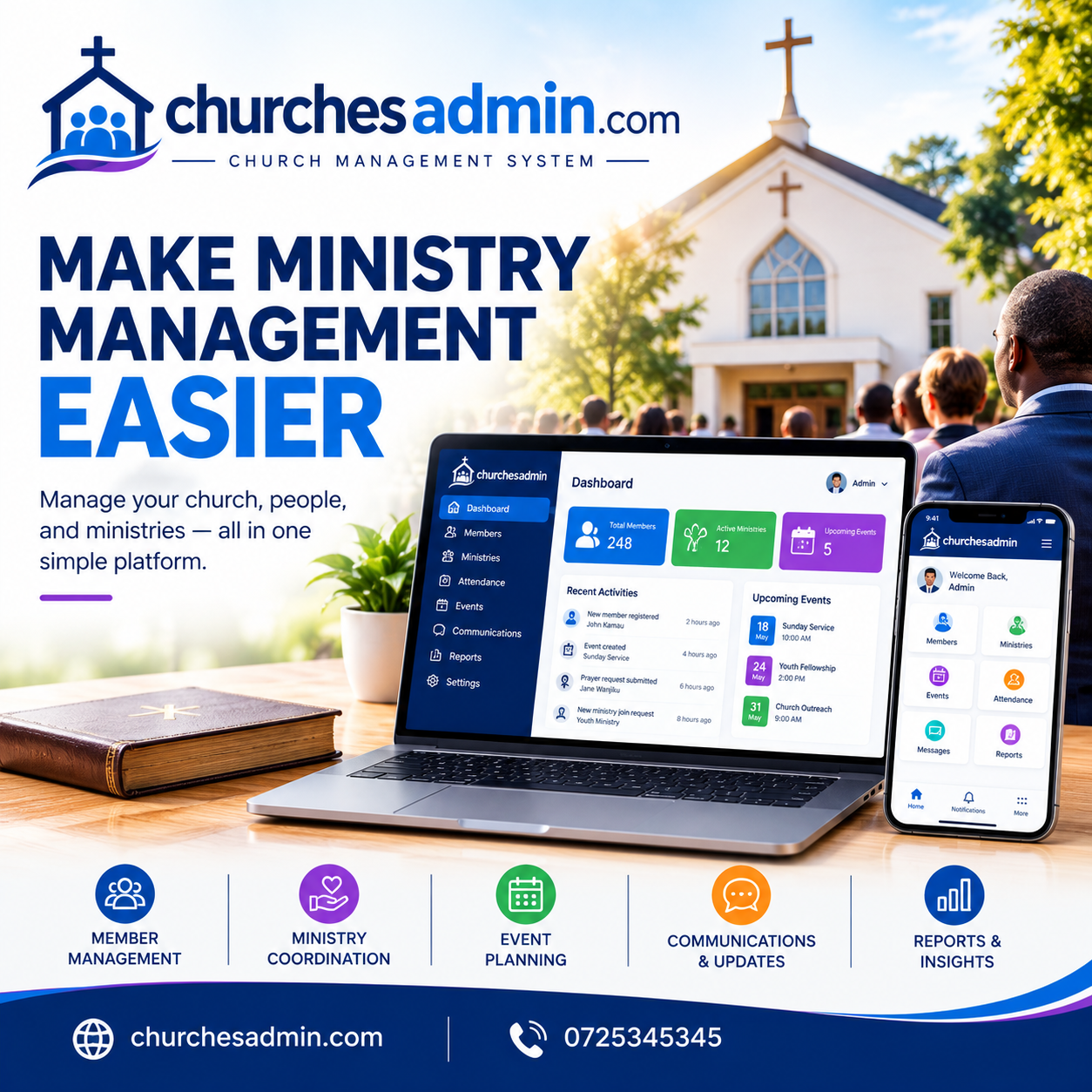
Check how the system protects confidentiality and sensitive data, how easily statements can be produced and delivered, and whether data can be exported. Churches Admin, for example, brings contributions, pledges, expenses and treasurer records together with member, attendance and multi-branch records, and includes public contribution pages connected to the church’s internal records.
Confirm pricing, support and data ownership. Churches Admin offers a 7-day free trial; check the current pricing page before deciding.
Mistakes Churches Make
The first is recording contributions in several notebooks, so no one can produce a complete member statement.
The second is allowing giving into leaders’ personal M-Pesa numbers — the most damaging mistake in church contribution management system.
The third is mixing designated funds with general offerings, so building or welfare money is spent on other purposes, a failure church contribution management system should prevent.
The fourth is announcing or publishing individual contributions, which embarrasses members and damages trust.
The fifth is failing to reconcile church contribution management system records with bank and M-Pesa statements.
The sixth is pressuring members over unfulfilled pledges, which undermines the spirit of giving and has no place in church contribution management system.
Frequently Asked Questions
What is a church contribution management system?
Software that records tithes, offerings, pledges and special fund contributions by member and fund, handles M-Pesa and cash, produces member statements and reports to leadership — the core of church contribution management system.
How should M-Pesa giving be recorded?
Through the church’s official Paybill or Till, with clear references for each fund, matched to the correct member and recorded with the transaction reference.
Can members see their own giving?
They should be able to receive private statements showing their contributions by date and category, as good church contribution management system provides.
Should individual giving be announced publicly?
No. Report totals in aggregate and keep individual giving confidential unless the giver has clearly agreed otherwise.
How should pledges be tracked?
Record the amount, purpose and schedule, track payments against each pledge and let members see their own progress, a key feature of church contribution management system.
Can designated funds be used for other purposes?
Only through the church’s proper governance process and with open communication to members.
Is church giving data sensitive?
Yes. Information revealing religious belief is sensitive personal data under the Data Protection Act 2019, so access must be restricted, which responsible church contribution management system enforces.
What is the single most important principle?
Every gift recorded faithfully against the right member and purpose, kept confidential and reconciled to the bank. Everything else in church contribution management system builds on that.