Church Accounting Software Kenya: 10 Smart Things Buyers Should Compare in 2026

Church Accounting Software Kenya: 10 Smart Things Buyers Should Compare in 2026

Church Accounting Software Kenya is a strong buyer-intent keyword because the visitor is usually comparing providers, prices, features, timelines, and proof before making a decision.

Church Accounting Software Kenya is one of the fresh buyer-focused topics ChurchesAdmin should publish around today because it matches what serious buyers are searching before they request a demo, quote, rollout plan, or implementation support.

For buyers, students, business owners, managers, administrators, founders, and decision makers looking for a practical solution, the real problem is manual work, unclear communication, weak records, missed deadlines, poor visibility, and difficulty comparing trusted providers. A useful article should answer the questions that serious buyers ask before they contact a provider or request a quotation.

Table of Contents

  • Church Accounting Software Kenya
  • Church Accounting Software Kenya service
  • Church Accounting Software Kenya provider
  • Church Accounting Software Kenya company
  • best Church Accounting Software Kenya

Why Church Accounting Software Kenya Matters

This search usually comes from a person who already feels the pain. They may be losing enquiries, wasting time with manual work, struggling with deadlines, missing records, or comparing suppliers before paying.

The right content should make the decision easier. It should explain the problem clearly, show the features that matter, reduce fear, and give the visitor a simple next step.

ChurchesAdmin can use this topic to attract qualified visitors who are closer to buying because they are searching around a real need.

Important Features Buyers Should Expect

  • clear onboarding – helps buyers get a clearer, faster, and more reliable outcome.
  • secure records – helps buyers get a clearer, faster, and more reliable outcome.
  • fast communication – helps buyers get a clearer, faster, and more reliable outcome.
  • mobile access – helps buyers get a clearer, faster, and more reliable outcome.
  • reports and updates – helps buyers get a clearer, faster, and more reliable outcome.
  • support after delivery – helps buyers get a clearer, faster, and more reliable outcome.
  • clear process – buyers should understand what happens before, during, and after delivery.
  • mobile friendly experience – users should be able to access the service or platform comfortably on phones.
  • useful reports or updates – clients should see progress, records, or results without repeated follow-up.
  • reliable support – the provider should support improvements after launch or delivery.

How to Compare Providers

Start with workflow fit. The provider should understand the exact users, tasks, deadlines, records, communication channels, payments, and reports involved.

Next, compare trust. Look for clear service pages, examples, practical explanations, realistic promises, visible contacts, and content that answers real questions.

Then compare long-term value. The best option is not always the lowest quote. The right provider should save time, reduce confusion, improve experience, and make future growth easier.

Mistakes to Avoid

Choosing Only by Price

Cheap work can become expensive if it creates weak design, unclear communication, poor support, missing features, or repeated revisions.

Ignoring the Real User

A solution must work for the people who use it daily. If users find it confusing, the project loses value quickly.

Publishing Thin Content

SEO pages should not only repeat keywords. They should answer buyer questions and explain the next step clearly.

How to Get Started

Write down the exact result you want. Include the users, current problem, documents, deadlines, records, payments, reports, and the main action you want visitors or customers to take.

Then contact a provider with a clear request. Share the pain points and ask for a practical plan, timeline, and support process.

Why Choose ChurchesAdmin?

ChurchesAdmin helps churches manage members, giving, attendance, events, groups, communication, and reports with less manual work.

Frequently Asked Questions

Who needs Church Accounting Software Kenya?

Church Accounting Software Kenya is useful for buyers, students, business owners, managers, administrators, founders, and decision makers looking for a practical solution, especially when the current process is manual, unclear, slow, or hard to scale.

What should buyers compare first?

Compare workflow fit, support, examples, communication, features, timelines, and whether the provider understands the real problem.

Can the solution be customized?

Yes. A serious provider should shape the solution around users, records, reports, content, communication, and growth plans.

Conclusion

Church Accounting Software Kenya is worth targeting because it connects to real buying intent. The best content should educate the visitor, build confidence, and make the next enquiry easy.

Deep Buyer Guide for Church Accounting Software Kenya

Before making a decision, buyers should separate must-have requirements from nice-to-have extras. The must-have items are the features that protect revenue, save time, improve communication, or prevent operational confusion. A buyer searching for Church Accounting Software Kenya is rarely looking for a vague overview. They normally want a practical answer that helps them choose a provider, compare options, understand implementation, and avoid a poor purchase.

The first useful step is to define the current workflow. Write down who starts the request, who approves it, where records are stored, how payments or submissions are confirmed, and which reports management needs at the end of the week or month. This exercise exposes gaps quickly. If the current process depends on scattered spreadsheets, WhatsApp screenshots, email attachments, or one person who remembers everything, the buyer should prioritize a solution that brings those records into one controlled workflow.

The second step is to compare accountability. Good providers explain how the work will be planned, who owns each stage, what information is needed before kickoff, and how progress will be reviewed. Weak providers often jump straight to price without clarifying the operating problem. For ChurchesAdmin, the strongest content should help the reader think like a serious buyer: define the result, protect the user experience, check the support model, and make sure the final solution can keep improving after launch.

The third step is to check reporting and visibility. Many organizations do not only need a service; they need evidence that the service is working. Reports, dashboards, status updates, audit trails, and clear records reduce conflict because teams can see what happened, when it happened, and what still needs attention. This is especially important when the topic affects money, customers, students, members, tenants, voters, staff, stock, or compliance.

Future growth also matters. A good solution should allow more users, more records, more requests, more services, and better reports without forcing the organization to start again from zero. Buyers should ask whether the solution can handle new branches, new counties, new departments, new roles, new payment methods, or new reporting needs. The cheapest first option can become expensive if it blocks growth six months later.

Strong SEO content supports both trust and rankings. A long article should not fill space with repeated claims. It should answer real questions, explain trade-offs, use the focus keyword naturally, link to useful pages, and give the reader a clear next step. When visitors feel that the article understands their problem, they are more likely to enquire, request a quote, book a demo, or compare the provider seriously.

Implementation Checklist

  • Problem definition: describe the current bottleneck and the measurable result the buyer wants.
  • User roles: list administrators, managers, customers, students, members, tenants, staff, or external users who will interact with the process.
  • Data records: define the records, documents, payments, messages, reports, and approvals that must be captured.
  • Security: decide who can view, edit, approve, export, or delete sensitive records.
  • Support: confirm how training, bug fixes, updates, and improvements will be handled after launch.

These details make the buying conversation more productive. Instead of asking only for a general quote, the buyer can explain the workflow and ask for a practical rollout plan. That gives the provider enough context to recommend a sensible scope, timeline, and support path. It also helps the buyer avoid vague proposals that look cheap but leave critical work undefined.

Questions Buyers Should Ask

Buyers should ask how long implementation will take, what content or data must be prepared, how user training will work, and what happens after publishing or launch. They should also ask for examples of similar work, a clear contact path, and an explanation of what is included in the first delivery versus future improvements. These questions protect both sides because they make expectations clear before money changes hands.

Another useful question is how success will be measured. For some buyers, success means more enquiries. For others, it means faster reconciliation, fewer missing records, lower admin workload, better tenant communication, smoother elections, stronger academic support workflows, better farm records, more reliable connectivity, or clearer executive reporting. The right metric depends on the business problem, so the article should connect the keyword to outcomes that matter.

Finally, buyers should check whether the provider understands the local context. In Kenya and surrounding markets, details like M-Pesa, county operations, mobile-first users, WhatsApp communication, school and SACCO structures, landlord workflows, rural connectivity, and small-team administration can shape the success of a project. A generic solution may look good but fail in daily use if it ignores these realities.

Deep Buyer Guide for Church Accounting Software Kenya

Before making a decision, buyers should separate must-have requirements from nice-to-have extras. The must-have items are the features that protect revenue, save time, improve communication, or prevent operational confusion. A buyer searching for Church Accounting Software Kenya is rarely looking for a vague overview. They normally want a practical answer that helps them choose a provider, compare options, understand implementation, and avoid a poor purchase.

The first useful step is to define the current workflow. Write down who starts the request, who approves it, where records are stored, how payments or submissions are confirmed, and which reports management needs at the end of the week or month. This exercise exposes gaps quickly. If the current process depends on scattered spreadsheets, WhatsApp screenshots, email attachments, or one person who remembers everything, the buyer should prioritize a solution that brings those records into one controlled workflow.

The second step is to compare accountability. Good providers explain how the work will be planned, who owns each stage, what information is needed before kickoff, and how progress will be reviewed. Weak providers often jump straight to price without clarifying the operating problem. For ChurchesAdmin, the strongest content should help the reader think like a serious buyer: define the result, protect the user experience, check the support model, and make sure the final solution can keep improving after launch.

The third step is to check reporting and visibility. Many organizations do not only need a service; they need evidence that the service is working. Reports, dashboards, status updates, audit trails, and clear records reduce conflict because teams can see what happened, when it happened, and what still needs attention. This is especially important when the topic affects money, customers, students, members, tenants, voters, staff, stock, or compliance.

Future growth also matters. A good solution should allow more users, more records, more requests, more services, and better reports without forcing the organization to start again from zero. Buyers should ask whether the solution can handle new branches, new counties, new departments, new roles, new payment methods, or new reporting needs. The cheapest first option can become expensive if it blocks growth six months later.

Strong SEO content supports both trust and rankings. A long article should not fill space with repeated claims. It should answer real questions, explain trade-offs, use the focus keyword naturally, link to useful pages, and give the reader a clear next step. When visitors feel that the article understands their problem, they are more likely to enquire, request a quote, book a demo, or compare the provider seriously.

Implementation Checklist

  • Problem definition: describe the current bottleneck and the measurable result the buyer wants.
  • User roles: list administrators, managers, customers, students, members, tenants, staff, or external users who will interact with the process.
  • Data records: define the records, documents, payments, messages, reports, and approvals that must be captured.
  • Security: decide who can view, edit, approve, export, or delete sensitive records.
  • Support: confirm how training, bug fixes, updates, and improvements will be handled after launch.

These details make the buying conversation more productive. Instead of asking only for a general quote, the buyer can explain the workflow and ask for a practical rollout plan. That gives the provider enough context to recommend a sensible scope, timeline, and support path. It also helps the buyer avoid vague proposals that look cheap but leave critical work undefined.

Questions Buyers Should Ask

Buyers should ask how long implementation will take, what content or data must be prepared, how user training will work, and what happens after publishing or launch. They should also ask for examples of similar work, a clear contact path, and an explanation of what is included in the first delivery versus future improvements. These questions protect both sides because they make expectations clear before money changes hands.

Another useful question is how success will be measured. For some buyers, success means more enquiries. For others, it means faster reconciliation, fewer missing records, lower admin workload, better tenant communication, smoother elections, stronger academic support workflows, better farm records, more reliable connectivity, or clearer executive reporting. The right metric depends on the business problem, so the article should connect the keyword to outcomes that matter.

Finally, buyers should check whether the provider understands the local context. In Kenya and surrounding markets, details like M-Pesa, county operations, mobile-first users, WhatsApp communication, school and SACCO structures, landlord workflows, rural connectivity, and small-team administration can shape the success of a project. A generic solution may look good but fail in daily use if it ignores these realities.

Deep Buyer Guide for Church Accounting Software Kenya

Before making a decision, buyers should separate must-have requirements from nice-to-have extras. The must-have items are the features that protect revenue, save time, improve communication, or prevent operational confusion. A buyer searching for Church Accounting Software Kenya is rarely looking for a vague overview. They normally want a practical answer that helps them choose a provider, compare options, understand implementation, and avoid a poor purchase.

The first useful step is to define the current workflow. Write down who starts the request, who approves it, where records are stored, how payments or submissions are confirmed, and which reports management needs at the end of the week or month. This exercise exposes gaps quickly. If the current process depends on scattered spreadsheets, WhatsApp screenshots, email attachments, or one person who remembers everything, the buyer should prioritize a solution that brings those records into one controlled workflow.

The second step is to compare accountability. Good providers explain how the work will be planned, who owns each stage, what information is needed before kickoff, and how progress will be reviewed. Weak providers often jump straight to price without clarifying the operating problem. For ChurchesAdmin, the strongest content should help the reader think like a serious buyer: define the result, protect the user experience, check the support model, and make sure the final solution can keep improving after launch.

The third step is to check reporting and visibility. Many organizations do not only need a service; they need evidence that the service is working. Reports, dashboards, status updates, audit trails, and clear records reduce conflict because teams can see what happened, when it happened, and what still needs attention. This is especially important when the topic affects money, customers, students, members, tenants, voters, staff, stock, or compliance.

Future growth also matters. A good solution should allow more users, more records, more requests, more services, and better reports without forcing the organization to start again from zero. Buyers should ask whether the solution can handle new branches, new counties, new departments, new roles, new payment methods, or new reporting needs. The cheapest first option can become expensive if it blocks growth six months later.

Strong SEO content supports both trust and rankings. A long article should not fill space with repeated claims. It should answer real questions, explain trade-offs, use the focus keyword naturally, link to useful pages, and give the reader a clear next step. When visitors feel that the article understands their problem, they are more likely to enquire, request a quote, book a demo, or compare the provider seriously.

Implementation Checklist

  • Problem definition: describe the current bottleneck and the measurable result the buyer wants.
  • User roles: list administrators, managers, customers, students, members, tenants, staff, or external users who will interact with the process.
  • Data records: define the records, documents, payments, messages, reports, and approvals that must be captured.
  • Security: decide who can view, edit, approve, export, or delete sensitive records.
  • Support: confirm how training, bug fixes, updates, and improvements will be handled after launch.

These details make the buying conversation more productive. Instead of asking only for a general quote, the buyer can explain the workflow and ask for a practical rollout plan. That gives the provider enough context to recommend a sensible scope, timeline, and support path. It also helps the buyer avoid vague proposals that look cheap but leave critical work undefined.

Questions Buyers Should Ask

Buyers should ask how long implementation will take, what content or data must be prepared, how user training will work, and what happens after publishing or launch. They should also ask for examples of similar work, a clear contact path, and an explanation of what is included in the first delivery versus future improvements. These questions protect both sides because they make expectations clear before money changes hands.

Another useful question is how success will be measured. For some buyers, success means more enquiries. For others, it means faster reconciliation, fewer missing records, lower admin workload, better tenant communication, smoother elections, stronger academic support workflows, better farm records, more reliable connectivity, or clearer executive reporting. The right metric depends on the business problem, so the article should connect the keyword to outcomes that matter.

Finally, buyers should check whether the provider understands the local context. In Kenya and surrounding markets, details like M-Pesa, county operations, mobile-first users, WhatsApp communication, school and SACCO structures, landlord workflows, rural connectivity, and small-team administration can shape the success of a project. A generic solution may look good but fail in daily use if it ignores these realities.

Deep Buyer Guide for Church Accounting Software Kenya

Before making a decision, buyers should separate must-have requirements from nice-to-have extras. The must-have items are the features that protect revenue, save time, improve communication, or prevent operational confusion. A buyer searching for Church Accounting Software Kenya is rarely looking for a vague overview. They normally want a practical answer that helps them choose a provider, compare options, understand implementation, and avoid a poor purchase.

The first useful step is to define the current workflow. Write down who starts the request, who approves it, where records are stored, how payments or submissions are confirmed, and which reports management needs at the end of the week or month. This exercise exposes gaps quickly. If the current process depends on scattered spreadsheets, WhatsApp screenshots, email attachments, or one person who remembers everything, the buyer should prioritize a solution that brings those records into one controlled workflow.

The second step is to compare accountability. Good providers explain how the work will be planned, who owns each stage, what information is needed before kickoff, and how progress will be reviewed. Weak providers often jump straight to price without clarifying the operating problem. For ChurchesAdmin, the strongest content should help the reader think like a serious buyer: define the result, protect the user experience, check the support model, and make sure the final solution can keep improving after launch.

The third step is to check reporting and visibility. Many organizations do not only need a service; they need evidence that the service is working. Reports, dashboards, status updates, audit trails, and clear records reduce conflict because teams can see what happened, when it happened, and what still needs attention. This is especially important when the topic affects money, customers, students, members, tenants, voters, staff, stock, or compliance.

Future growth also matters. A good solution should allow more users, more records, more requests, more services, and better reports without forcing the organization to start again from zero. Buyers should ask whether the solution can handle new branches, new counties, new departments, new roles, new payment methods, or new reporting needs. The cheapest first option can become expensive if it blocks growth six months later.

Strong SEO content supports both trust and rankings. A long article should not fill space with repeated claims. It should answer real questions, explain trade-offs, use the focus keyword naturally, link to useful pages, and give the reader a clear next step. When visitors feel that the article understands their problem, they are more likely to enquire, request a quote, book a demo, or compare the provider seriously.

Implementation Checklist

  • Problem definition: describe the current bottleneck and the measurable result the buyer wants.
  • User roles: list administrators, managers, customers, students, members, tenants, staff, or external users who will interact with the process.
  • Data records: define the records, documents, payments, messages, reports, and approvals that must be captured.
  • Security: decide who can view, edit, approve, export, or delete sensitive records.
  • Support: confirm how training, bug fixes, updates, and improvements will be handled after launch.

These details make the buying conversation more productive. Instead of asking only for a general quote, the buyer can explain the workflow and ask for a practical rollout plan. That gives the provider enough context to recommend a sensible scope, timeline, and support path. It also helps the buyer avoid vague proposals that look cheap but leave critical work undefined.

Questions Buyers Should Ask

Buyers should ask how long implementation will take, what content or data must be prepared, how user training will work, and what happens after publishing or launch. They should also ask for examples of similar work, a clear contact path, and an explanation of what is included in the first delivery versus future improvements. These questions protect both sides because they make expectations clear before money changes hands.

Another useful question is how success will be measured. For some buyers, success means more enquiries. For others, it means faster reconciliation, fewer missing records, lower admin workload, better tenant communication, smoother elections, stronger academic support workflows, better farm records, more reliable connectivity, or clearer executive reporting. The right metric depends on the business problem, so the article should connect the keyword to outcomes that matter.

Finally, buyers should check whether the provider understands the local context. In Kenya and surrounding markets, details like M-Pesa, county operations, mobile-first users, WhatsApp communication, school and SACCO structures, landlord workflows, rural connectivity, and small-team administration can shape the success of a project. A generic solution may look good but fail in daily use if it ignores these realities.

Church Attendance Management System: The Complete Guide to Smarter Church Attendance Tracking

Church Attendance Management System

Church Attendance Management System

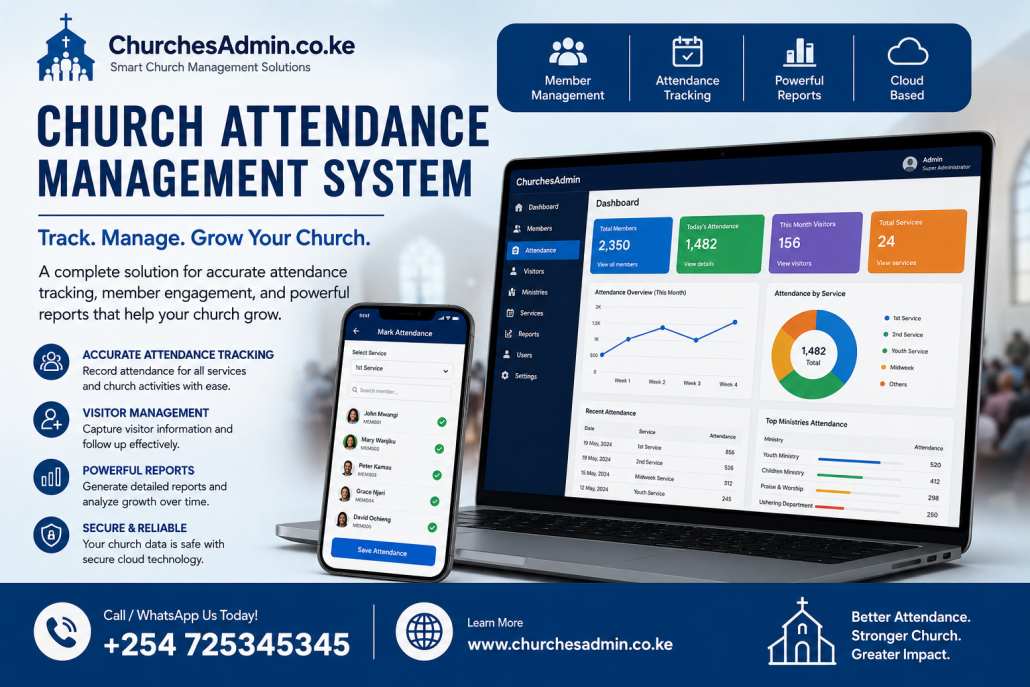
Churches today are embracing technology to improve ministry, strengthen member relationships, and simplify administration. One of the most important tools for modern churches is a Church Attendance Management System. Whether you lead a small congregation or oversee a large ministry with multiple branches, keeping accurate attendance records helps church leaders understand growth, identify members who need support, and make informed ministry decisions.

At ChurchesAdmin.co.ke, we provide an advanced Church Attendance Management System designed specifically for churches in Kenya and beyond. Our solution makes attendance recording simple, accurate, and accessible from anywhere.

Contact us today: +254 725345345


What is a Church Attendance Management System?

A Church Attendance Management System is software that enables churches to digitally record, monitor, analyze, and report attendance for various church activities. Instead of relying on paper registers or Excel spreadsheets, churches can securely store attendance records in a centralized cloud-based platform.

The system allows church administrators, pastors, ushers, and ministry leaders to:

  • Record Sunday service attendance
  • Track midweek fellowship participation
  • Monitor youth attendance
  • Manage children’s ministry attendance
  • Record choir attendance
  • Track departmental meetings
  • Manage Bible study attendance
  • Generate attendance reports
  • Monitor church growth trends

A modern Church Attendance Management System eliminates manual errors while providing valuable insights into member engagement.


Why Every Church Needs a Church Attendance Management System

Church attendance is more than counting people. Every attendance record tells a story about church growth, member involvement, discipleship, and ministry effectiveness.

Without a reliable Church Attendance Management System, churches often experience:

  • Lost attendance records
  • Inaccurate counting
  • Duplicate entries
  • Difficulty following absent members
  • Time-consuming report preparation
  • Poor decision-making
  • Limited historical data

A digital solution removes these challenges and improves efficiency.


The Growing Need for Digital Church Attendance

Churches across Kenya are rapidly moving away from manual attendance books.

Traditional attendance methods often involve:

  • Paper registers
  • Exercise books
  • Attendance sheets
  • Manual headcounts
  • Excel files

While these methods may work for smaller churches, they become difficult as congregations grow.

A professional Church Attendance Management System automates the entire process while reducing administrative workload.


Benefits of a Church Attendance Management System

1. Accurate Attendance Recording

Manual counting can easily produce errors.

A Church Attendance Management System records attendance accurately for every service and event.

Church leaders can trust the data for ministry planning.


2. Faster Check-In Process

Long queues can discourage members.

With digital attendance:

  • Members check in quickly
  • QR code attendance becomes possible
  • Mobile attendance recording is easier
  • Ushers work efficiently

The entire attendance process becomes seamless.


3. Real-Time Attendance Monitoring

Church leaders no longer need to wait until the end of service.

A Church Attendance Management System updates attendance instantly.

Pastors can monitor attendance live from any location.


4. Better Member Follow-Up

Attendance is one of the strongest indicators of member engagement.

The system identifies:

  • Members who missed services
  • First-time visitors
  • Returning visitors
  • Regular attendees
  • Members requiring pastoral care

This improves discipleship and member retention.


5. Easy Report Generation

Church administrators spend less time preparing reports.

The Church Attendance Management System generates reports automatically.

Reports may include:

  • Weekly attendance
  • Monthly attendance
  • Annual attendance
  • Department attendance
  • Branch attendance
  • Service attendance
  • Visitor reports

Features of ChurchesAdmin.co.ke Church Attendance Management System

At ChurchesAdmin.co.ke, our solution includes everything churches need.

Member Attendance Recording

Record attendance using:

  • Member search
  • Mobile devices
  • Tablets
  • Computers

Attendance is saved instantly.


Visitor Attendance Management

Visitors are important.

The system captures:

  • Visitor names
  • Phone numbers
  • Location
  • Invitation source
  • Service attended

This helps churches follow up effectively.


Multiple Service Attendance

Many churches have:

  • First Service
  • Second Service
  • Youth Service
  • Evening Service

Our Church Attendance Management System tracks attendance separately for every service.


Department Attendance

Attendance can be managed for:

  • Choir
  • Women’s Ministry
  • Men’s Fellowship
  • Youth Ministry
  • Children’s Church
  • Prayer Groups
  • Bible Study
  • Evangelism Team

Each ministry receives independent attendance reports.


Branch Management

Multi-branch churches can monitor attendance across all branches.

Head office administrators can compare:

  • Branch growth
  • Attendance trends
  • Member engagement

All from one dashboard.


How the Church Attendance Management System Works

The process is simple.

Step 1

Register church members.

Every member receives a digital profile.


Step 2

Create church services.

Examples:

  • Sunday Worship
  • Midweek Fellowship
  • Overnight Prayer
  • Bible Study
  • Revival Meeting

Step 3

Record attendance.

Attendance can be marked within seconds.


Step 4

Generate reports.

Church leaders access comprehensive reports immediately.


Why ChurchesAdmin.co.ke is Different

Many attendance solutions are generic.

ChurchesAdmin.co.ke is built specifically for churches.

This means it understands church operations such as:

  • Church membership
  • Ministries
  • Visitors
  • Pastoral care
  • Church branches
  • Church events
  • Church leadership

Everything is designed around church administration.


Challenges Solved by a Church Attendance Management System

Manual Registers

Paper registers become damaged or lost.

Digital records remain secure.


Time Wastage

Manual attendance consumes valuable ministry time.

Automation saves hours every week.


Missing Historical Records

Church leaders often need attendance data from previous years.

Our Church Attendance Management System stores attendance history permanently.


Poor Member Follow-Up

Members who stop attending often go unnoticed.

The system quickly identifies absentee members.


Attendance Analytics That Help Church Growth

Data is powerful.

A Church Attendance Management System helps churches answer important questions.

Examples include:

  • Which services attract the largest attendance?
  • Which ministries are growing?
  • Which branches need support?
  • Which members have become inactive?
  • Which events attract visitors?
  • Which Sundays have the highest attendance?

These insights improve planning.


Mobile-Friendly Church Attendance

Modern churches require mobility.

ChurchesAdmin.co.ke works on:

  • Smartphones
  • Tablets
  • Laptops
  • Desktop computers

Attendance can be recorded from anywhere.


Cloud-Based Church Attendance Management System

Cloud technology offers many benefits.

These include:

  • Automatic backups
  • Secure storage
  • Remote access
  • Multi-user access
  • Fast performance
  • No local server requirements

Your attendance data remains safe.


Security of Attendance Records

Church attendance data is confidential.

Our system protects information using:

  • Secure login
  • User permissions
  • Encrypted storage
  • Regular backups
  • Controlled access

Only authorized church officials access attendance records.


Churches That Benefit from a Church Attendance Management System

The system works for:

  • Small churches
  • Medium churches
  • Mega churches
  • Cathedral churches
  • Denominational headquarters
  • Church networks
  • Independent ministries
  • Campus ministries
  • International churches
  • Community churches

Regardless of church size, the benefits remain significant.


Integrating Attendance with Other Church Functions

Attendance works best when connected with other administrative functions.

The ChurchesAdmin.co.ke platform integrates attendance with:

  • Member management
  • Visitor management
  • Event management
  • Church directory
  • Ministry management
  • Leadership records
  • Communication tools
  • Reporting dashboards

This creates one centralized system for managing your entire church.


Why Digital Attendance Improves Ministry

Attendance is not simply about numbers-it reflects engagement, discipleship, and opportunities for pastoral care. By using a Church Attendance Management System, leaders can identify attendance patterns, recognize growing ministries, follow up with members who have been absent, and make informed decisions backed by reliable data.

Instead of spending hours compiling registers, pastors and administrators can focus on serving the congregation while the system handles attendance recording and reporting efficiently.


Ready to modernize your church attendance process?

ChurchesAdmin.co.ke offers an affordable, secure, and easy-to-use Church Attendance Management System built specifically for churches.

Call us today: +254 725345345

Stay tuned for Part 2, where we’ll cover advanced features, implementation steps, reporting capabilities, best practices, FAQs, and why ChurchesAdmin.co.ke is the ideal Church Attendance Management System for churches seeking sustainable growth.

Advanced Reporting Capabilities of a Church Attendance Management System

One of the greatest advantages of implementing a Church Attendance Management System is the ability to generate comprehensive reports instantly. Church leaders no longer have to spend hours adding figures from attendance books or comparing spreadsheets. Instead, reports are available with just a few clicks, enabling informed decision-making and better ministry planning.

With ChurchesAdmin.co.ke, church administrators can generate reports such as:

  • Daily attendance reports
  • Weekly attendance reports
  • Monthly attendance reports
  • Quarterly attendance reports
  • Annual attendance reports
  • Branch attendance summaries
  • Department attendance reports
  • Visitor attendance reports
  • New member attendance reports
  • Youth ministry attendance reports
  • Children’s church attendance reports
  • Choir attendance reports
  • Bible study attendance reports
  • Women’s ministry attendance reports
  • Men’s fellowship attendance reports

These reports help church leadership identify trends, measure ministry effectiveness, and plan future programs with confidence.


Church Attendance Trends and Growth Analysis

A modern Church Attendance Management System is much more than an attendance register. It serves as a valuable analytical tool that allows churches to monitor growth over time.

With historical attendance data, church leaders can identify:

  • Seasonal attendance fluctuations
  • Growth during evangelism campaigns
  • Attendance after special conferences
  • Holiday attendance patterns
  • Ministry participation levels
  • Service popularity
  • New member retention
  • Long-term church growth

This information allows pastors to make strategic ministry decisions based on actual data rather than assumptions.


Managing Multiple Church Branches with Ease

Many churches today operate multiple branches in different towns, counties, or even countries. Managing attendance manually across these locations can be extremely challenging.

The Church Attendance Management System from ChurchesAdmin.co.ke enables headquarters to oversee attendance across every branch from one centralized dashboard.

Branch pastors can:

  • Record attendance independently
  • Generate branch-specific reports
  • Monitor member participation
  • Track ministry attendance
  • Submit attendance instantly

Meanwhile, senior leadership can compare attendance performance across branches and identify where additional support or resources may be needed.


Improve Pastoral Care Through Attendance Tracking

Attendance records provide valuable insight into member engagement. When attendance begins to decline, it often indicates that a member may need encouragement, prayer, or pastoral support.

Using a Church Attendance Management System, pastors can quickly identify:

  • Members absent for several weeks
  • New believers who have stopped attending
  • Families with declining participation
  • Members who frequently attend
  • Individuals requiring follow-up visits

This proactive approach strengthens relationships and demonstrates genuine care for the congregation.


Better Visitor Management

Visitors are an essential part of church growth. Every first-time guest represents an opportunity to welcome someone into your church family.

The Church Attendance Management System helps churches manage visitor information efficiently by recording:

  • Full names
  • Phone numbers
  • Email addresses
  • Home location
  • Invitation source
  • Date of visit
  • Service attended
  • Follow-up status

Church leaders can then organize timely follow-up calls, welcome messages, or home visits, increasing the likelihood of visitors becoming active members.


Attendance Management for Every Church Ministry

Church life extends beyond Sunday services. Ministries meet throughout the week, and each requires proper attendance tracking.

ChurchesAdmin.co.ke allows churches to record attendance for:

  • Sunday Worship Services
  • Midweek Fellowships
  • Prayer Meetings
  • Overnight Kesha Services
  • Bible Study Classes
  • Leadership Meetings
  • Youth Fellowship
  • Children’s Church
  • Choir Practice
  • Praise and Worship Team
  • Evangelism Outreach
  • Women’s Fellowship
  • Men’s Fellowship
  • Marriage Ministry
  • Couples Fellowship
  • Ushering Department
  • Hospitality Team
  • Media Department
  • Church Board Meetings
  • Cell Groups
  • Home Fellowships

Every ministry leader can access attendance records relevant to their department while maintaining centralized reporting.


Mobile Attendance Recording

Today’s church leaders need flexibility. Services may be held outdoors, in schools, tents, or multiple campuses.

A cloud-based Church Attendance Management System allows attendance to be recorded using:

  • Android phones
  • iPhones
  • Tablets
  • Laptops
  • Desktop computers

This means attendance can be captured from virtually any location with internet access.


Eliminate Manual Errors

Paper registers often lead to:

  • Missing names
  • Duplicate entries
  • Incorrect totals
  • Illegible handwriting
  • Lost attendance books

A digital Church Attendance Management System eliminates these issues through automated record keeping and validation.

Church administrators save countless hours while improving data accuracy.


Secure Cloud Storage

Attendance records represent important church information and should never be lost.

ChurchesAdmin.co.ke stores attendance data securely in the cloud, providing:

  • Automatic backups
  • Secure login authentication
  • User access controls
  • Encrypted data storage
  • Reliable uptime
  • Disaster recovery protection

Even if a computer is damaged or replaced, attendance records remain safe and accessible.


Easy-to-Use Dashboard

Not every church administrator is a technology expert. That’s why ChurchesAdmin.co.ke has been designed with simplicity in mind.

The dashboard provides quick access to:

  • Today’s attendance
  • Recent services
  • Attendance summaries
  • Member statistics
  • Visitor counts
  • Department reports
  • Upcoming church events

Everything is organized for easy navigation.


Save Time Every Week

Manual attendance management consumes valuable administrative hours.

By switching to a Church Attendance Management System, churches reduce the time spent on:

  • Counting attendees
  • Preparing reports
  • Filing attendance sheets
  • Searching historical records
  • Identifying absent members
  • Compiling statistics

This allows church staff to focus more on ministry and less on paperwork.


Why ChurchesAdmin.co.ke is the Best Church Attendance Management System

ChurchesAdmin.co.ke has been developed specifically for churches, making it an ideal solution for ministries of all sizes.

Our platform offers:

  • Easy member registration
  • Visitor management
  • Ministry attendance tracking
  • Branch management
  • Attendance analytics
  • Cloud access
  • Secure user permissions
  • Fast report generation
  • Mobile compatibility
  • Reliable customer support
  • Affordable pricing
  • Regular system updates

Whether your church has 50 members or 50,000, our system scales with your ministry.


Frequently Asked Questions

Is the Church Attendance Management System suitable for small churches?

Yes. Small churches benefit from organized attendance records and simplified reporting just as much as larger congregations.

Can multiple users access the system?

Yes. Different users can be assigned roles and permissions based on their responsibilities.

Can attendance be recorded using a smartphone?

Absolutely. The system is fully optimized for mobile devices.

Is my church data secure?

Yes. ChurchesAdmin.co.ke uses secure cloud infrastructure, encrypted connections, and regular backups to protect your information.

Can I generate attendance reports for specific ministries?

Yes. Reports can be filtered by ministry, service, department, branch, or date range.

Can historical attendance records be viewed?

Yes. The system maintains long-term attendance history for easy reference and analysis.

Is training provided?

Yes. We provide onboarding and support to ensure your church staff can use the system confidently.


Best Practices for Using a Church Attendance Management System

To get the most value from your Church Attendance Management System, churches should:

  • Record attendance consistently for every service.
  • Keep member information updated.
  • Train ushers and ministry leaders on the attendance process.
  • Review attendance reports regularly.
  • Follow up promptly with absent members and first-time visitors.
  • Use attendance trends when planning church programs.
  • Regularly back up and review administrative settings.
  • Encourage every department to maintain accurate attendance records.

These practices improve data quality and help church leaders make informed decisions.


Future-Proof Your Church Administration

As churches continue to grow, administrative demands increase. Investing in a reliable Church Attendance Management System today prepares your ministry for the future by creating a solid digital foundation.

Instead of relying on paper records that are difficult to manage and analyze, churches can benefit from real-time reporting, centralized data, and improved member engagement. A modern attendance system also supports transparency, accountability, and long-term planning, making it an essential tool for churches that desire sustainable growth.


Conclusion

An effective Church Attendance Management System is no longer a luxury-it is an essential solution for churches that want to improve administration, strengthen pastoral care, and make data-driven ministry decisions. Accurate attendance records enable leaders to monitor growth, engage members more effectively, and plan impactful programs with confidence.

At ChurchesAdmin.co.ke, we are committed to helping churches simplify attendance management through a secure, cloud-based, and easy-to-use platform built specifically for ministry. From member attendance tracking and visitor management to detailed reporting and multi-branch support, our solution provides everything your church needs to manage attendance professionally and efficiently.

Whether you are a local congregation, a growing ministry, or a denomination with multiple branches, our Church Attendance Management System is designed to support your mission and grow with your church.

Ready to transform how your church manages attendance?

Contact ChurchesAdmin.co.ke today and schedule a free demonstration.

?? Call/WhatsApp: +254 725345345

Experience a smarter way to manage attendance, strengthen member engagement, and support the continued growth of your church with the trusted Church Attendance Management System from ChurchesAdmin.co.ke.

Church Financial Reporting System: The Complete Guide to Transparent Church Financial Management in Kenya

Church Financial Reporting System

Church Financial Reporting System

Church Financial Reporting System solutions have become an essential component of modern church administration. As churches continue to grow, managing financial records manually through paper ledgers, spreadsheets, and disconnected accounting tools becomes increasingly difficult. Churches handle a wide range of financial activities including tithes, offerings, donations, fundraising campaigns, mission support, ministry budgets, operational expenses, salaries, utility payments, and construction projects. Without a centralized reporting system, maintaining financial accuracy and transparency becomes a significant challenge.

Financial stewardship is one of the greatest responsibilities entrusted to church leadership. Members expect church finances to be managed with integrity, transparency, and accountability. Accurate financial reporting strengthens trust within the congregation while enabling church leaders to make informed decisions regarding ministry expansion, budgeting, community outreach, and resource allocation.

A modern Church Financial Reporting System centralizes every financial transaction into one secure platform. Church treasurers, accountants, finance committees, and pastors can record contributions, monitor income and expenses, reconcile accounts, prepare financial statements, and generate real-time reports through one integrated system.

Across Kenya, churches of all sizes—from local congregations to large multi-campus ministries—are adopting digital financial management solutions to improve operational efficiency and accountability. Whether serving a small rural church or a large urban congregation in Nairobi, Mombasa, Kisumu, Nakuru, Eldoret, or elsewhere, implementing a Church Financial Reporting System enables churches to strengthen financial governance while supporting sustainable ministry growth.


Table of Contents


Understanding Church Financial Reporting

Church financial reporting involves recording, organizing, monitoring, and presenting financial information in a clear and accurate manner. Every offering received, donation made, ministry expense incurred, and budget allocation should be documented to support responsible stewardship and informed decision-making.

A Church Financial Reporting System provides a centralized financial database where every transaction is securely stored and categorized. Instead of relying on paper receipts or scattered spreadsheets, finance teams maintain complete digital records that are easily searchable and available whenever reports are required.

The system supports daily financial operations while automatically generating reports that summarize income, expenses, ministry budgets, cash flow, account balances, and financial trends.

Whether managing a local congregation or a national ministry organization, centralized financial reporting improves accountability while reducing administrative work.


Why Digital Financial Reporting Matters

Manual accounting processes often consume significant time and increase the risk of calculation errors, duplicate entries, and missing financial information.

A Church Financial Reporting System automates financial recordkeeping while improving reporting accuracy and transparency.

Church finance teams can record offerings, reconcile bank accounts, generate receipts, prepare monthly financial statements, monitor ministry budgets, and review expenditure reports without manually compiling information from multiple sources.

Digital financial management also allows church leadership to monitor financial performance in real time while providing finance committees with accurate reports for meetings and decision-making.

For churches operating multiple branches across Kenya, centralized reporting ensures financial consistency while simplifying consolidated reporting.


Key Features of Modern Church Financial Reporting Systems

A comprehensive Church Financial Reporting System includes powerful features that simplify church accounting and financial oversight.

Contribution Recording

Record tithes, offerings, donations, fundraising contributions, mission support, and other income sources accurately.

Expense Management

Track ministry expenses, salaries, utilities, maintenance costs, outreach spending, equipment purchases, and operational costs.

Budget Management

Create ministry budgets, monitor expenditure, compare actual spending with planned budgets, and control financial performance.

Bank Reconciliation

Reconcile bank transactions with recorded financial activities automatically.

Financial Statements

Generate income statements, cash flow reports, balance summaries, expenditure reports, and ministry financial reports.

Audit Trail

Maintain detailed records of every financial transaction, approval, modification, and adjustment.

Multi-Branch Reporting

Consolidate financial information from multiple church campuses into one centralized reporting system.

Leadership Dashboards

Provide pastors, finance committees, and church boards with real-time financial insights.


Common Financial Management Challenges

Church finance teams frequently encounter challenges that affect reporting quality.

Manual bookkeeping often results in delayed financial reports and calculation errors.

Paper receipts can become misplaced or damaged.

Reconciling bank statements manually requires significant effort.

Tracking designated funds, ministry budgets, and donor contributions becomes increasingly complex as churches grow.

Preparing reports for finance committee meetings can consume valuable administrative time.

A Church Financial Reporting System addresses these challenges by centralizing financial information, automating reporting, and maintaining complete audit trails.

The result is improved transparency, stronger financial accountability, and more efficient church administration.


Churches and Ministries That Benefit

A Church Financial Reporting System supports many different faith-based organizations.

Local Churches

Congregations improve financial reporting and stewardship while simplifying daily accounting.

Multi-Campus Churches

Church headquarters consolidate financial reports across multiple branches.

Mission Organizations

Mission agencies monitor donations, outreach budgets, and project expenditures.

Christian Schools

Faith-based educational institutions manage chapel funds, donations, and operational budgets.

Ministries

Youth ministries, conferences, outreach programs, and discipleship initiatives monitor financial performance effectively.

Faith-Based Non-Profit Organizations

Religious organizations strengthen donor accountability and improve financial governance.


How a Church Financial Reporting System Works

A Church Financial Reporting System begins by recording every financial transaction within the church.

Income from tithes, offerings, donations, fundraising events, and ministry activities is entered into the system alongside operational expenses, ministry expenditures, salaries, utility costs, and project spending.

The software automatically categorizes transactions, updates financial records, reconciles accounts, and generates reports showing current financial performance.

Interactive dashboards display income trends, expenditure summaries, budget utilization, cash flow, donor contributions, and ministry financial performance.

Finance teams and church leadership gain immediate access to accurate financial information that supports effective stewardship and strategic planning.


Choosing the Right Solution

Selecting the right Church Financial Reporting System requires evaluating financial reporting capabilities, security, scalability, budgeting tools, audit features, ease of use, and integration with other church management functions.

The ideal platform should support contribution management, expense tracking, budgeting, financial reporting, bank reconciliation, audit trails, leadership dashboards, and multi-branch administration.

For churches throughout Kenya, compatibility with mobile access, cloud deployment, and local financial workflows is particularly valuable.

Solutions such as ChurchesAdmin combine Church Financial Reporting System capabilities with member management, attendance tracking, contribution recording, event management, pastoral care, ministry administration, volunteer coordination, communication tools, and comprehensive church analytics. This enables churches to manage both ministry and financial operations through one integrated platform.

Benefits for Different Stakeholders

A Church Financial Reporting System delivers value to every department within a church by improving transparency, accountability, and financial decision-making. Whether serving senior pastors, church boards, finance committees, treasurers, ministry leaders, or congregation members, the system provides reliable financial information that supports responsible stewardship and sustainable ministry growth.

Senior Pastors and Church Leadership

Church leaders are responsible for ensuring that financial resources are managed wisely and used to advance the church’s mission. A Church Financial Reporting System provides real-time dashboards showing income, expenditure, budget performance, ministry spending, cash flow, donation trends, and financial health.

Instead of waiting for manually prepared reports, pastors can instantly access accurate financial summaries before leadership meetings or board discussions. This allows leadership teams to evaluate ministry performance, allocate resources effectively, and make informed strategic decisions.

For churches operating multiple branches across Nairobi, Mombasa, Kisumu, Nakuru, Eldoret, and other parts of Kenya, centralized reporting makes it easier to monitor finances across every campus while maintaining consistent financial oversight.


Church Treasurers and Finance Teams

Church treasurers handle a wide range of financial responsibilities, including recording offerings, reconciling accounts, preparing reports, monitoring expenses, managing budgets, and ensuring accountability.

A Church Financial Reporting System automates many of these routine tasks, reducing manual work while improving financial accuracy.

Finance teams can monitor:

  • Daily offerings
  • Tithes and donations
  • Ministry budgets
  • Operational expenses
  • Bank balances
  • Cash flow
  • Outstanding commitments
  • Project expenditures
  • Financial forecasts
  • Historical financial performance

Automated reporting allows finance departments to spend less time compiling spreadsheets and more time analyzing financial performance and supporting ministry planning.


Church Boards and Finance Committees

Church boards require clear financial information to provide effective governance.

A Church Financial Reporting System enables board members to review comprehensive reports showing revenue, expenditure, project spending, reserve funds, ministry budgets, and financial trends.

Reliable reporting strengthens decision-making while increasing confidence that church resources are being managed responsibly.

Committee meetings become more productive because financial information is readily available in organized reports rather than scattered across multiple documents.


Ministry Leaders

Every ministry operates within an approved budget.

A Church Financial Reporting System allows ministry leaders to monitor their allocated funds, review spending, plan future activities, and submit financial requests using accurate budget information.

Youth ministries, missions, women’s ministries, men’s fellowships, children’s departments, worship teams, and outreach programs all benefit from greater financial visibility.

This encourages responsible stewardship while improving ministry planning.


Church Members

Financial transparency builds trust throughout the congregation.

A Church Financial Reporting System enables churches to prepare accurate financial summaries that demonstrate how offerings, donations, and special contributions are used to support ministry activities.

Transparent reporting strengthens member confidence while encouraging continued generosity and partnership in the church’s mission.


Improving Efficiency Through Automation

Automation significantly improves church financial administration.

A Church Financial Reporting System automates numerous accounting and reporting processes, including:

  • Contribution recording
  • Digital receipt generation
  • Budget monitoring
  • Expense categorization
  • Bank reconciliation
  • Financial statement preparation
  • Cash flow reporting
  • Audit trail creation
  • Leadership dashboards
  • Monthly financial reporting

These automated workflows eliminate repetitive manual tasks while improving reporting consistency and reducing accounting errors.

Finance teams no longer need to manually compile reports from multiple spreadsheets or paper records because the system updates financial information in real time.

Automation enables churches to maintain accurate financial records regardless of congregation size.


Improving Financial Visibility

Timely financial information supports better leadership decisions.

A Church Financial Reporting System provides interactive dashboards displaying important financial indicators, including:

  • Monthly income
  • Total offerings
  • Donation trends
  • Ministry expenditures
  • Budget utilization
  • Cash flow
  • Project funding
  • Operational expenses
  • Financial growth
  • Historical comparisons

Church leadership can monitor financial performance continuously instead of waiting for end-of-month reports.

This enables proactive budgeting, stronger financial planning, and more effective resource allocation across ministries.

Accurate reporting also improves transparency during annual general meetings, leadership retreats, and financial presentations.


Compliance, Security and Risk Management

Church financial information requires strong protection and accountability.

A secure Church Financial Reporting System incorporates advanced security features such as:

  • Role-based user permissions
  • Multi-level approval workflows
  • Secure authentication
  • Encrypted financial records
  • Automated backups
  • Audit trails
  • Activity logs
  • Secure cloud storage
  • Disaster recovery capabilities
  • Permission-based reporting

These controls ensure financial records remain secure while maintaining accountability for every transaction.

Comprehensive audit trails simplify financial reviews and support internal governance processes.

For churches across Kenya, secure digital financial management reduces operational risk while strengthening stewardship.


Why ChurchesAdmin is the Ideal Solution

Modern churches require more than standalone accounting software. They need one integrated platform capable of managing ministry and financial operations together.

ChurchesAdmin combines Church Financial Reporting System capabilities with contribution management, member administration, attendance tracking, ministry coordination, volunteer management, pastoral care, communication tools, event planning, leadership dashboards, and comprehensive church analytics.

Instead of maintaining separate accounting systems and church administration tools, church leaders manage every aspect of ministry from one centralized platform.

ChurchesAdmin is suitable for:

  • Local churches
  • Multi-campus churches
  • Pentecostal churches
  • Anglican churches
  • Catholic parishes
  • Baptist churches
  • Evangelical ministries
  • Christian schools
  • Mission organizations
  • Faith-based non-profit organizations

Its scalable architecture enables churches of every size to improve financial accountability while supporting long-term ministry growth.


Future Trends in Church Financial Reporting

Technology continues transforming church financial management through intelligent automation and cloud computing.

Future Church Financial Reporting System solutions are expected to include:

  • Artificial intelligence for financial forecasting
  • Automated budget recommendations
  • Predictive cash flow analysis
  • Mobile finance dashboards
  • Cloud-native accounting
  • Smart donation analytics
  • AI-powered financial reporting
  • Automated compliance monitoring
  • Digital approval workflows
  • Business intelligence dashboards

These innovations will help churches strengthen financial planning, improve transparency, simplify reporting, and support sustainable ministry growth.

Churches adopting modern financial technologies today will be better prepared for future ministry opportunities.


Getting Started

Implementing a Church Financial Reporting System begins by reviewing the church’s financial structure and reporting requirements.

Church leadership should assess:

  • Number of church branches
  • Income sources
  • Contribution methods
  • Ministry budgets
  • Expense categories
  • Reporting requirements
  • Approval workflows
  • Existing accounting processes
  • Financial committee structure
  • Future ministry expansion plans

Selecting a scalable platform ensures the system continues supporting the church as financial operations grow.

Successful implementation should include financial data migration, chart of accounts configuration, budget setup, staff training, reporting customization, workflow configuration, and continuous monitoring.

Churches that implement the system effectively typically achieve improved financial transparency, stronger stewardship, better budgeting, faster reporting, enhanced accountability, and greater confidence among members and leadership.


Conclusion

A Church Financial Reporting System is a vital tool for churches seeking to strengthen stewardship, improve financial accountability, and simplify administration. By automating financial recording, budgeting, reporting, reconciliation, and analytics, churches reduce administrative burdens while providing leadership with reliable financial information for informed decision-making.

For churches, ministries, and faith-based organizations across Kenya, ChurchesAdmin provides a comprehensive Church Financial Reporting System that integrates financial management with member administration, ministry coordination, attendance tracking, communication, and reporting in one centralized platform.

As churches continue embracing digital transformation, investing in a modern financial reporting solution will help build stronger governance, greater transparency, and sustainable ministry growth for years to come.

Benefits for Different Stakeholders

A Church Financial Reporting System delivers value to every department within a church by improving transparency, accountability, and financial decision-making. Whether serving senior pastors, church boards, finance committees, treasurers, ministry leaders, or congregation members, the system provides reliable financial information that supports responsible stewardship and sustainable ministry growth.

Senior Pastors and Church Leadership

Church leaders are responsible for ensuring that financial resources are managed wisely and used to advance the church’s mission. A Church Financial Reporting System provides real-time dashboards showing income, expenditure, budget performance, ministry spending, cash flow, donation trends, and financial health.

Instead of waiting for manually prepared reports, pastors can instantly access accurate financial summaries before leadership meetings or board discussions. This allows leadership teams to evaluate ministry performance, allocate resources effectively, and make informed strategic decisions.

For churches operating multiple branches across Nairobi, Mombasa, Kisumu, Nakuru, Eldoret, and other parts of Kenya, centralized reporting makes it easier to monitor finances across every campus while maintaining consistent financial oversight.


Church Treasurers and Finance Teams

Church treasurers handle a wide range of financial responsibilities, including recording offerings, reconciling accounts, preparing reports, monitoring expenses, managing budgets, and ensuring accountability.

A Church Financial Reporting System automates many of these routine tasks, reducing manual work while improving financial accuracy.

Finance teams can monitor:

  • Daily offerings
  • Tithes and donations
  • Ministry budgets
  • Operational expenses
  • Bank balances
  • Cash flow
  • Outstanding commitments
  • Project expenditures
  • Financial forecasts
  • Historical financial performance

Automated reporting allows finance departments to spend less time compiling spreadsheets and more time analyzing financial performance and supporting ministry planning.


Church Boards and Finance Committees

Church boards require clear financial information to provide effective governance.

A Church Financial Reporting System enables board members to review comprehensive reports showing revenue, expenditure, project spending, reserve funds, ministry budgets, and financial trends.

Reliable reporting strengthens decision-making while increasing confidence that church resources are being managed responsibly.

Committee meetings become more productive because financial information is readily available in organized reports rather than scattered across multiple documents.


Ministry Leaders

Every ministry operates within an approved budget.

A Church Financial Reporting System allows ministry leaders to monitor their allocated funds, review spending, plan future activities, and submit financial requests using accurate budget information.

Youth ministries, missions, women’s ministries, men’s fellowships, children’s departments, worship teams, and outreach programs all benefit from greater financial visibility.

This encourages responsible stewardship while improving ministry planning.


Church Members

Financial transparency builds trust throughout the congregation.

A Church Financial Reporting System enables churches to prepare accurate financial summaries that demonstrate how offerings, donations, and special contributions are used to support ministry activities.

Transparent reporting strengthens member confidence while encouraging continued generosity and partnership in the church’s mission.


Improving Efficiency Through Automation

Automation significantly improves church financial administration.

A Church Financial Reporting System automates numerous accounting and reporting processes, including:

  • Contribution recording
  • Digital receipt generation
  • Budget monitoring
  • Expense categorization
  • Bank reconciliation
  • Financial statement preparation
  • Cash flow reporting
  • Audit trail creation
  • Leadership dashboards
  • Monthly financial reporting

These automated workflows eliminate repetitive manual tasks while improving reporting consistency and reducing accounting errors.

Finance teams no longer need to manually compile reports from multiple spreadsheets or paper records because the system updates financial information in real time.

Automation enables churches to maintain accurate financial records regardless of congregation size.


Improving Financial Visibility

Timely financial information supports better leadership decisions.

A Church Financial Reporting System provides interactive dashboards displaying important financial indicators, including:

  • Monthly income
  • Total offerings
  • Donation trends
  • Ministry expenditures
  • Budget utilization
  • Cash flow
  • Project funding
  • Operational expenses
  • Financial growth
  • Historical comparisons

Church leadership can monitor financial performance continuously instead of waiting for end-of-month reports.

This enables proactive budgeting, stronger financial planning, and more effective resource allocation across ministries.

Accurate reporting also improves transparency during annual general meetings, leadership retreats, and financial presentations.


Compliance, Security and Risk Management

Church financial information requires strong protection and accountability.

A secure Church Financial Reporting System incorporates advanced security features such as:

  • Role-based user permissions
  • Multi-level approval workflows
  • Secure authentication
  • Encrypted financial records
  • Automated backups
  • Audit trails
  • Activity logs
  • Secure cloud storage
  • Disaster recovery capabilities
  • Permission-based reporting

These controls ensure financial records remain secure while maintaining accountability for every transaction.

Comprehensive audit trails simplify financial reviews and support internal governance processes.

For churches across Kenya, secure digital financial management reduces operational risk while strengthening stewardship.


Why ChurchesAdmin is the Ideal Solution

Modern churches require more than standalone accounting software. They need one integrated platform capable of managing ministry and financial operations together.

ChurchesAdmin combines Church Financial Reporting System capabilities with contribution management, member administration, attendance tracking, ministry coordination, volunteer management, pastoral care, communication tools, event planning, leadership dashboards, and comprehensive church analytics.

Instead of maintaining separate accounting systems and church administration tools, church leaders manage every aspect of ministry from one centralized platform.

ChurchesAdmin is suitable for:

  • Local churches
  • Multi-campus churches
  • Pentecostal churches
  • Anglican churches
  • Catholic parishes
  • Baptist churches
  • Evangelical ministries
  • Christian schools
  • Mission organizations
  • Faith-based non-profit organizations

Its scalable architecture enables churches of every size to improve financial accountability while supporting long-term ministry growth.


Future Trends in Church Financial Reporting

Technology continues transforming church financial management through intelligent automation and cloud computing.

Future Church Financial Reporting System solutions are expected to include:

  • Artificial intelligence for financial forecasting
  • Automated budget recommendations
  • Predictive cash flow analysis
  • Mobile finance dashboards
  • Cloud-native accounting
  • Smart donation analytics
  • AI-powered financial reporting
  • Automated compliance monitoring
  • Digital approval workflows
  • Business intelligence dashboards

These innovations will help churches strengthen financial planning, improve transparency, simplify reporting, and support sustainable ministry growth.

Churches adopting modern financial technologies today will be better prepared for future ministry opportunities.


Getting Started

Implementing a Church Financial Reporting System begins by reviewing the church’s financial structure and reporting requirements.

Church leadership should assess:

  • Number of church branches
  • Income sources
  • Contribution methods
  • Ministry budgets
  • Expense categories
  • Reporting requirements
  • Approval workflows
  • Existing accounting processes
  • Financial committee structure
  • Future ministry expansion plans

Selecting a scalable platform ensures the system continues supporting the church as financial operations grow.

Successful implementation should include financial data migration, chart of accounts configuration, budget setup, staff training, reporting customization, workflow configuration, and continuous monitoring.

Churches that implement the system effectively typically achieve improved financial transparency, stronger stewardship, better budgeting, faster reporting, enhanced accountability, and greater confidence among members and leadership.


Conclusion

A Church Financial Reporting System is a vital tool for churches seeking to strengthen stewardship, improve financial accountability, and simplify administration. By automating financial recording, budgeting, reporting, reconciliation, and analytics, churches reduce administrative burdens while providing leadership with reliable financial information for informed decision-making.

For churches, ministries, and faith-based organizations across Kenya, ChurchesAdmin provides a comprehensive Church Financial Reporting System that integrates financial management with member administration, ministry coordination, attendance tracking, communication, and reporting in one centralized platform.

As churches continue embracing digital transformation, investing in a modern financial reporting solution will help build stronger governance, greater transparency, and sustainable ministry growth for years to come.

Church Member Management Software: The Complete Guide for Modern Churches in Kenya

Church Member Management Software

Church Member Management Software

Running a growing church comes with many responsibilities. As the number of members increases, managing attendance, member records, communication, finances, ministries, and reports becomes increasingly challenging. Traditional paper records and spreadsheets often lead to lost information, duplicate records, and unnecessary administrative work.

This is where Church Member Management Software becomes an essential tool. Modern churches are embracing technology to simplify administration while allowing pastors and church leaders to focus more on ministry rather than paperwork.

If you are looking for the best Church Member Management Software in Kenya, ChurchesAdmin.co.ke offers a complete cloud-based solution designed specifically for churches of all sizes. Whether your church has 50 members or over 20,000 members, ChurchesAdmin helps you organize every aspect of church administration efficiently.

For more information or to schedule a demonstration, contact +254 725345345.


What is Church Member Management Software?

Church Member Management Software is a digital platform designed to help churches store, organize, update, and manage member information from one centralized system.

Instead of maintaining physical files, notebooks, or multiple Excel sheets, churches can keep all member records safely in one secure database.

A quality Church Member Management Software allows churches to:

  • Register members
  • Track attendance
  • Manage ministries
  • Record baptisms
  • Record confirmations
  • Track marriages
  • Store family relationships
  • Manage small groups
  • Send SMS and email communication
  • Generate reports
  • Monitor church growth

The software eliminates repetitive administrative work while improving accuracy and accountability.


Why Every Church Needs Church Member Management Software

Churches continue to grow every year. As congregations expand, administration becomes more complex.

Without reliable Church Member Management Software, churches often experience:

  • Missing member records
  • Duplicate registrations
  • Poor attendance tracking
  • Lost visitor information
  • Communication challenges
  • Difficulty generating reports
  • Inaccurate statistics
  • Time-consuming administration

Using Church Member Management Software solves these problems by automating daily operations.


Common Problems Churches Face Without Church Member Management Software

Many churches still depend on manual processes.

These create challenges including:

Lost Member Records

Paper files can easily get damaged or misplaced.

A digital Church Member Management Software stores records securely in the cloud.


Duplicate Member Entries

Different church departments may register the same person multiple times.

Good Church Member Management Software prevents duplicate registrations.


Difficult Attendance Tracking

Attendance books become difficult to analyze after several months.

Modern software automatically generates attendance reports.


Poor Communication

Church announcements become difficult when contact information is outdated.

A reliable Church Member Management Software keeps member contacts updated.


Slow Reporting

Preparing church statistics manually may take days.

With Church Member Management Software, reports are generated within seconds.


Features of the Best Church Member Management Software

When selecting a system, churches should consider comprehensive functionality.

Member Registration

Every church member should have an individual profile containing:

  • Full name
  • Phone number
  • Email address
  • Physical address
  • Date of birth
  • Gender
  • Marital status
  • Occupation
  • Ministry
  • Membership status
  • Baptism information
  • Confirmation records
  • Emergency contacts
  • Family information

ChurchesAdmin provides unlimited member registration.


Family Management

Families form the foundation of every church.

The software allows churches to:

  • Link spouses
  • Link children
  • Create family groups
  • View household members
  • Track family participation

This makes pastoral care much easier.


Attendance Management

Attendance monitoring helps church leadership understand growth trends.

The software records attendance for:

  • Sunday services
  • Midweek services
  • Youth meetings
  • Women’s fellowship
  • Men’s fellowship
  • Choir practice
  • Cell groups
  • Bible studies
  • Conferences
  • Special events

Attendance reports can be generated instantly.


Visitor Management

Visitors are future members.

The system helps churches:

  • Register first-time visitors
  • Capture contact details
  • Schedule follow-up
  • Assign follow-up teams
  • Track return visits
  • Convert visitors into members

Proper visitor management significantly improves church growth.


Ministry Management

Most churches have several ministries.

Examples include:

  • Youth Ministry
  • Children’s Ministry
  • Women’s Ministry
  • Men’s Ministry
  • Choir
  • Praise Team
  • Ushers
  • Media Team
  • Evangelism Team
  • Hospitality

Church Member Management Software allows members to belong to multiple ministries.


Benefits of Church Member Management Software

Better Organization

Everything is stored in one location.

Church leaders spend less time searching for records.


Improved Communication

Churches can communicate through:

  • SMS
  • Email
  • Notices
  • Announcements
  • Event reminders

Members stay informed.


Accurate Reports

Church leadership can instantly know:

  • Total membership
  • Active members
  • New members
  • Visitors
  • Attendance trends
  • Ministry participation

This supports informed decision-making.


Enhanced Security

Unlike paper files, digital systems include:

  • User accounts
  • Password protection
  • Backup systems
  • Access permissions
  • Cloud security

Member information remains protected.


Faster Administration

Routine tasks become automated.

Church administrators complete work in minutes instead of hours.


How ChurchesAdmin Church Member Management Software Works

ChurchesAdmin has been designed specifically for churches in Kenya and across Africa.

The platform allows administrators to log in securely from any location with internet access.

After logging in, administrators can:

  • Register members
  • Edit records
  • Manage attendance
  • Send SMS
  • Generate reports
  • Manage events
  • Update ministries
  • Track church growth

Everything is accessible through one easy dashboard.


Who Can Use Church Member Management Software?

The software is ideal for:

  • Churches
  • Cathedrals
  • Ministries
  • Christian organizations
  • Church networks
  • Denominations
  • Church branches
  • Bible schools
  • Christian fellowships

Whether your church is small or large, Church Member Management Software improves operational efficiency.


Cloud-Based Church Member Management Software

Cloud technology has transformed church administration.

Unlike traditional desktop software, cloud-based Church Member Management Software offers numerous advantages.

These include:

  • Access from anywhere
  • Automatic backups
  • Higher security
  • Multi-user support
  • Automatic updates
  • Lower maintenance costs
  • Real-time synchronization

Church leaders can access church information even while traveling.


Why Churches in Kenya Are Adopting Church Member Management Software

Churches throughout Kenya are rapidly embracing digital transformation.

Several factors contribute to this shift:

  • Growing congregations
  • Increased administrative work
  • Mobile technology adoption
  • Demand for accountability
  • Faster communication
  • Better reporting
  • Improved member engagement

ChurchesAdmin has become a trusted solution because it understands the unique administrative needs of Kenyan churches.


Member Profiles That Grow With Your Church

Every member’s journey is unique. A powerful Church Member Management Software should allow churches to maintain a complete history of each individual from the day they first visit until they become active leaders within the congregation.

Instead of storing only basic contact details, ChurchesAdmin enables churches to build comprehensive member profiles that evolve over time. Leaders can update records whenever members change addresses, phone numbers, ministries, or family status. Historical information remains available for reference, helping pastors provide more personalized pastoral care.

Complete member profiles also make it easier to identify long-serving members, recognize volunteers, monitor ministry involvement, and understand the overall health of the congregation. This centralized approach reduces paperwork while ensuring information is always current and accessible.


Why Choose ChurchesAdmin?

ChurchesAdmin has been built specifically for church administration rather than adapting generic business software for ministry use. The platform combines ease of use with powerful management features, making it suitable for churches of every denomination and size.

Key advantages include:

  • Easy-to-use interface
  • Secure cloud hosting
  • Unlimited member records
  • Attendance tracking
  • Visitor management
  • Ministry management
  • Family management
  • SMS communication
  • Comprehensive reporting
  • Dedicated customer support
  • Affordable pricing for churches

For inquiries, demonstrations, or implementation support, contact +254 725345345.

Advanced Reporting Capabilities in Church Member Management Software

One of the greatest advantages of using Church Member Management Software is the ability to generate accurate and detailed reports instantly. Church leaders no longer have to spend hours compiling information manually from different books or spreadsheets. Instead, the software automatically gathers data and presents it in easy-to-understand reports.

Reports can help pastors, administrators, elders, and church boards make informed decisions based on actual church data rather than assumptions.

Examples of reports generated by Church Member Management Software include:

  • Total registered members
  • Active members
  • Inactive members
  • New members joined this month
  • Visitors received
  • Baptism reports
  • Confirmation reports
  • Attendance summaries
  • Ministry participation
  • Age distribution
  • Gender statistics
  • Family reports
  • Leadership reports
  • Department performance
  • Membership growth trends
  • Anniversary reports
  • Birthday reports

These reports are valuable during annual meetings, leadership retreats, financial planning sessions, and strategic planning.


Event Management Made Easy

Churches organize numerous activities throughout the year. Without proper planning, it becomes difficult to coordinate volunteers, communicate with members, and monitor attendance.

A modern Church Member Management Software simplifies event management by allowing churches to organize:

  • Sunday services
  • Crusades
  • Revival meetings
  • Prayer conferences
  • Youth camps
  • Children’s camps
  • Leadership seminars
  • Marriage seminars
  • Evangelism outreaches
  • Choir festivals
  • Fundraising events
  • Community outreach programs
  • Bible study sessions
  • Women’s conferences
  • Men’s conferences

Church administrators can schedule events, notify members, register participants, assign volunteers, and monitor attendance from one centralized platform.


Volunteer Management

Every successful church depends on committed volunteers. Managing volunteers manually often leads to scheduling conflicts, poor communication, and burnout.

With Church Member Management Software, churches can effectively organize volunteers according to their ministries and availability.

Volunteer management features include:

  • Volunteer registration
  • Ministry assignment
  • Service schedules
  • Availability tracking
  • Leadership assignment
  • Performance notes
  • Skills database
  • Volunteer communication

Church leaders can quickly identify members willing to serve and ensure responsibilities are distributed fairly.


Small Group and Cell Group Management

Many churches encourage members to participate in home fellowships or cell groups. These groups promote discipleship, accountability, and spiritual growth.

Church Member Management Software helps churches manage these groups efficiently.

Administrators can:

  • Create cell groups
  • Assign leaders
  • Register members
  • Record attendance
  • Monitor growth
  • Schedule meetings
  • Track multiplication of groups
  • Generate reports

Pastors can quickly determine which groups are thriving and which require additional support.


Children’s Ministry Management

Children represent the future of every church. Managing children’s ministry manually can become challenging, especially in large congregations.

A robust Church Member Management Software enables churches to maintain children’s records separately while linking them to parents or guardians.

Information may include:

  • Child’s name
  • Parent information
  • Date of birth
  • Class assignment
  • Attendance history
  • Emergency contacts
  • Allergy information
  • Baptism records
  • Special notes

This ensures better organization and improved child safety.


Youth Ministry Administration

Youth ministries continue growing rapidly in modern churches.

The software helps youth leaders manage:

  • Youth registrations
  • Small groups
  • Attendance
  • Leadership teams
  • Mentorship programs
  • Training sessions
  • Youth camps
  • Conferences
  • Volunteer participation

Comprehensive reports help leaders understand youth engagement and participation.


Communication Tools That Strengthen Church Relationships

Communication is one of the pillars of successful church administration.

Using Church Member Management Software, churches can communicate quickly through:

  • Bulk SMS
  • Email notifications
  • Birthday greetings
  • Anniversary messages
  • Prayer meeting reminders
  • Event invitations
  • Volunteer schedules
  • Ministry announcements
  • Emergency notices
  • Follow-up reminders

Timely communication increases member engagement and participation.


Birthday and Anniversary Management

Recognizing important milestones helps members feel appreciated.

The software automatically tracks:

  • Birthdays
  • Wedding anniversaries
  • Membership anniversaries
  • Baptism anniversaries

Church administrators can generate monthly celebration reports and send personalized greetings automatically.


Follow-Up Management

Church growth depends heavily on effective follow-up.

After registering first-time visitors, Church Member Management Software enables churches to monitor every stage of the follow-up process.

Follow-up activities may include:

  • First phone call
  • Welcome SMS
  • Home visitation
  • Counseling appointment
  • Small group assignment
  • Membership class registration
  • Baptism preparation
  • Ministry placement

Church leaders can identify visitors who require additional attention before they become regular members.


Pastoral Care Management

Pastors care for members during different stages of life.

The software assists in organizing pastoral care by recording:

  • Counseling sessions
  • Prayer requests
  • Hospital visits
  • Home visits
  • Bereavement support
  • Marriage counseling
  • Family support
  • Spiritual guidance

Pastoral notes remain confidential and accessible only to authorized users.


Leadership Management

Large churches often have multiple leadership structures.

These include:

  • Senior pastors
  • Associate pastors
  • Elders
  • Deacons
  • Ministry leaders
  • Cell leaders
  • Department heads
  • Administrative staff

Church Member Management Software allows churches to assign leadership roles and define access permissions according to responsibilities.


Secure Data Storage

Church member information is confidential.

ChurchesAdmin prioritizes data protection through:

  • Secure cloud servers
  • Encrypted connections
  • Password protection
  • User authentication
  • Role-based permissions
  • Automatic backups
  • Audit logs
  • Disaster recovery mechanisms

This ensures member information remains protected against unauthorized access and accidental loss.


Multi-Branch Church Management

Many denominations operate multiple branches across different towns and counties.

A powerful Church Member Management Software allows headquarters to monitor all branches from one centralized system.

Features include:

  • Branch registration
  • Branch statistics
  • Branch administrators
  • Branch reports
  • Combined reporting
  • Independent branch management
  • Leadership oversight

Whether your church has two branches or one hundred, ChurchesAdmin simplifies administration.


Mobile Accessibility

Modern church administration should not be limited to office computers.

Cloud-based Church Member Management Software allows authorized users to access church information using:

  • Smartphones
  • Tablets
  • Laptops
  • Desktop computers

This flexibility enables pastors to access member information during home visits, conferences, outreach programs, or while traveling.


Easy Data Migration

Many churches worry about moving from paper records or spreadsheets.

ChurchesAdmin provides support during migration.

Existing data can be imported from:

  • Excel spreadsheets
  • CSV files
  • Previous software
  • Manual records

This minimizes disruption and accelerates implementation.


Easy User Training

Technology should simplify work rather than complicate it.

ChurchesAdmin is designed with an intuitive interface that requires minimal training.

Training typically covers:

  • Member registration
  • Attendance recording
  • Report generation
  • Ministry management
  • SMS communication
  • User administration
  • Dashboard navigation

Most administrators become comfortable using the system within a short period.


Scalability for Growing Churches

Your church may have fifty members today and several thousand members in the future.

A scalable Church Member Management Software grows together with your ministry.

As membership increases, the system continues to perform efficiently without requiring expensive upgrades or complete replacements.


Reducing Administrative Costs

Manual administration often requires:

  • Printing forms
  • Filing cabinets
  • Paper registers
  • Physical storage
  • Additional administrative staff

Digital management significantly reduces these operational costs while improving efficiency.


Improving Decision Making

Church leaders make better decisions when they have accurate information.

The software provides valuable insights into:

  • Attendance trends
  • Membership growth
  • Ministry performance
  • Visitor conversion
  • Volunteer participation
  • Age demographics
  • Gender distribution
  • Branch performance

These insights help leadership plan future ministry activities confidently.


Compliance and Record Keeping

Churches are increasingly expected to maintain organized records for governance, accountability, and internal audits.

Church Member Management Software helps churches maintain accurate historical records that can be retrieved whenever needed.

Digital records also improve transparency within church leadership.


Why ChurchesAdmin Stands Above Other Church Member Management Software

Although many church management systems exist, ChurchesAdmin has been developed with African churches in mind.

Benefits include:

  • Affordable pricing
  • Cloud-based platform
  • Easy implementation
  • Unlimited member records
  • Local customer support
  • Secure hosting
  • Automatic backups
  • Mobile accessibility
  • User-friendly dashboard
  • Fast report generation
  • SMS integration
  • Multi-branch support
  • Family management
  • Visitor management
  • Ministry administration
  • Attendance tracking

ChurchesAdmin focuses on solving real administrative challenges faced by churches every day.


Frequently Asked Questions About Church Member Management Software

Is ChurchesAdmin suitable for small churches?

Yes. Whether your church has 30 members or 30,000 members, ChurchesAdmin scales to meet your administrative needs.

Can multiple administrators use the system simultaneously?

Yes. Authorized users can log in securely from different locations with role-based permissions.

Is the software cloud-based?

Yes. ChurchesAdmin is a secure cloud-based Church Member Management Software, allowing access from anywhere with an internet connection.

Can we import our existing member records?

Absolutely. Existing records from spreadsheets and other systems can be imported to save time and preserve historical data.

Is member information secure?

Yes. The platform uses secure authentication, encrypted connections, automated backups, and controlled user permissions to protect sensitive information.

Can the software manage multiple church branches?

Yes. ChurchesAdmin supports centralized administration for churches with multiple branches while allowing each branch to maintain its own records.

Does the software support communication with members?

Yes. Churches can send bulk SMS, announcements, reminders, and other important messages to members directly through the system.

Is technical support available?

Yes. ChurchesAdmin offers dedicated support to assist with setup, training, and ongoing use of the platform.


The Future of Church Administration

Technology is reshaping how churches manage administration, communicate with members, and plan ministry activities. Churches that embrace digital solutions are better positioned to serve growing congregations efficiently while maintaining accurate records and improving accountability.

A modern Church Member Management Software is no longer a luxury—it is an essential ministry tool. By automating routine administrative tasks, church leaders gain more time to focus on discipleship, evangelism, pastoral care, and community outreach.

As churches continue to expand, investing in reliable software today lays a strong foundation for sustainable growth tomorrow.


Conclusion

Managing a church should never be overwhelmed by paperwork, scattered records, or outdated filing systems. A reliable Church Member Management Software provides the tools churches need to organize member information, monitor attendance, coordinate ministries, manage volunteers, communicate effectively, and generate comprehensive reports with ease.

ChurchesAdmin.co.ke delivers an all-in-one cloud-based Church Member Management Software tailored for churches in Kenya and beyond. Whether you are leading a small congregation or overseeing multiple branches, the platform helps improve efficiency, accountability, and member engagement while supporting long-term church growth.

By choosing ChurchesAdmin, your church gains a secure, scalable, and easy-to-use solution that simplifies administration and empowers ministry.

Ready to modernize your church administration?

Visit ChurchesAdmin.co.ke today to learn more about our Church Member Management Software or contact us directly on +254 725345345 to schedule a personalized demonstration. Let ChurchesAdmin help your church save time, improve organization, and focus on what matters most—serving God and growing His Kingdom.

Ministry Member Management Software: The Complete Guide to Modern Church Membership Management in Kenya

Ministry Member Management Software

Ministry Member Management Software

Ministry Member Management Software has become an essential solution for churches seeking to strengthen member engagement, improve pastoral care, and simplify church administration. As congregations continue to grow, managing member information through paper files, spreadsheets, and manual registers becomes increasingly difficult. Important records can easily become outdated, communication becomes inconsistent, and ministry leaders spend valuable time performing administrative tasks instead of focusing on discipleship and outreach.

Churches today manage far more than membership lists. They oversee baptisms, new member registration, ministry involvement, attendance, volunteer schedules, pastoral visits, giving records, small groups, leadership development, event participation, and community outreach. Coordinating all these activities manually often leads to duplicate records, incomplete information, delayed follow-ups, and limited visibility into the overall health of the congregation.

A modern Ministry Member Management Software platform centralizes every aspect of church membership into one secure and integrated system. Church administrators can register members, update profiles, assign ministry groups, monitor attendance, track volunteer involvement, manage pastoral care, communicate with members, and generate comprehensive reports from a single dashboard.

Across Kenya, churches of every size—from local congregations and independent ministries to multi-campus churches and denominations—are embracing digital church management to improve efficiency and member engagement. Whether serving a congregation in Nairobi, Mombasa, Kisumu, Nakuru, Eldoret, or any other region, implementing Ministry Member Management Software enables churches to build stronger relationships while supporting sustainable ministry growth.


Table of Contents


Understanding Ministry Member Management

Managing church membership involves much more than maintaining a directory of names and phone numbers. Church leaders must understand who their members are, where they serve, how often they attend, what ministries they belong to, and how they are growing spiritually.

Ministry Member Management Software provides a centralized database where every member’s information is securely stored and easily accessible. Instead of relying on paper records or scattered spreadsheets, churches maintain complete digital profiles containing personal details, family relationships, ministry involvement, attendance history, volunteer assignments, pastoral care notes, and communication records.

The software allows authorized church leaders to update information in real time while ensuring that every department works with the same accurate data. This improves collaboration across ministries and reduces administrative duplication.

Whether managing a church of one hundred members or several thousand worshippers, centralized membership management strengthens organization and pastoral oversight.


Why Digital Membership Management Matters

Churches that depend on manual recordkeeping often struggle with outdated information, inconsistent communication, and limited visibility into member engagement.

Ministry Member Management Software automates many administrative processes while providing leadership with accurate information for decision-making.

Church administrators can register new members, assign ministry groups, record attendance, update family information, schedule follow-ups, and generate reports without relying on paper forms.

Digital member management also strengthens pastoral care by helping church leaders identify inactive members, monitor ministry participation, coordinate volunteer service, and maintain meaningful relationships across the congregation.

For churches operating multiple branches throughout Kenya, centralized membership management ensures consistency while improving collaboration between campuses.


Key Features of Modern Ministry Member Management Software

A comprehensive Ministry Member Management Software platform includes numerous features designed to support church administration and ministry growth.

Member Registration

Create comprehensive digital member profiles containing personal information, contact details, family records, baptism history, and ministry involvement.

Ministry Assignment

Assign members to departments such as choir, youth ministry, ushers, children’s ministry, men’s fellowship, women’s fellowship, missions, and leadership teams.

Attendance Tracking

Monitor attendance across worship services, Bible studies, prayer meetings, conferences, and ministry events.

Volunteer Management

Coordinate volunteer schedules, responsibilities, availability, and ministry assignments.

Pastoral Care

Record pastoral visits, counseling sessions, prayer requests, follow-up activities, and member care notes.

Communication Tools

Send announcements, devotionals, prayer updates, event invitations, and ministry notices through SMS, email, or mobile notifications.

Reporting and Analytics

Generate reports showing church growth, attendance trends, ministry participation, volunteer engagement, and membership statistics.

Multi-Branch Management

Manage member information across multiple church campuses through one centralized platform.


Common Church Administration Challenges

Churches frequently encounter administrative challenges that affect ministry effectiveness.

Paper records can become outdated, damaged, or misplaced.

Tracking member involvement across multiple ministries becomes increasingly difficult as congregations grow.

Communication delays may cause members to miss important church activities.

Volunteer scheduling often becomes complicated without centralized information.

Preparing leadership reports manually consumes valuable administrative time.

Ministry Member Management Software addresses these challenges by centralizing member records, automating administrative processes, and improving collaboration between church departments.

The result is stronger organization, better communication, and more effective ministry leadership.


Churches and Ministries That Benefit

Ministry Member Management Software supports a wide variety of churches and faith-based organizations.

Local Churches

Congregations maintain organized member records and improve pastoral care.

Multi-Campus Churches

Leadership manages member information consistently across several branches.

Youth Ministries

Youth leaders coordinate attendance, volunteer service, discipleship programs, and events.

Christian Schools

School chaplaincies manage student fellowship groups and spiritual development activities.

Mission Organizations

Mission agencies coordinate volunteers, outreach teams, and ministry participation.

Faith-Based Non-Profit Organizations

Religious organizations improve communication, volunteer management, and member engagement.


How Ministry Member Management Software Works

A Ministry Member Management Software platform begins by creating digital profiles for every church member.

These profiles contain personal details, family information, ministry assignments, attendance records, volunteer activities, pastoral notes, and communication history.

Church leaders update information continuously as members join ministries, attend services, volunteer for events, or participate in church programs.

Interactive dashboards provide real-time visibility into church growth, ministry engagement, attendance trends, volunteer participation, and member activity.

Authorized users can generate reports instantly while maintaining accurate historical records that support informed ministry decisions.


Choosing the Right Solution

Selecting the right Ministry Member Management Software requires evaluating scalability, security, reporting capabilities, mobile accessibility, communication tools, and ease of use.

The ideal platform should support member registration, attendance tracking, ministry management, volunteer coordination, pastoral care, reporting, communication, and multi-branch administration.

For churches throughout Kenya, compatibility with mobile devices, cloud access, and local church administration practices is particularly valuable.

Solutions such as ChurchesAdmin combine Ministry Member Management Software with attendance management, contribution tracking, event planning, volunteer coordination, pastoral care, communication tools, leadership dashboards, and comprehensive church analytics. This enables churches to manage every aspect of ministry through one centralized platform.

Benefits for Different Stakeholders

A Ministry Member Management Software solution creates value for every person involved in church leadership and ministry. From senior pastors and church administrators to ministry leaders, volunteers, and congregation members, centralized member management improves organization, communication, pastoral care, and long-term church growth.

Senior Pastors and Church Leadership

Church leaders require accurate information to shepherd their congregations effectively. Ministry Member Management Software provides real-time visibility into church membership, ministry participation, attendance patterns, volunteer engagement, pastoral care activities, and overall church growth.

Instead of relying on manual reports or outdated membership records, pastors can access dashboards showing active members, new member registrations, ministry involvement, visitor follow-ups, and attendance trends.

For churches with multiple branches across Nairobi, Mombasa, Kisumu, Nakuru, Eldoret, and other regions of Kenya, centralized reporting makes it easier to monitor ministry performance and make informed leadership decisions.


Church Administrators

Church administration involves maintaining member records, coordinating departments, organizing church events, preparing reports, updating contact information, and supporting ministry leaders.

A Ministry Member Management Software platform centralizes these responsibilities into one integrated system. Administrators can register new members, update member profiles, assign ministry groups, monitor attendance, manage communication, and generate reports without maintaining multiple spreadsheets or paper files.

Automation reduces repetitive administrative work while improving the accuracy and consistency of church records.


Ministry Leaders

Youth leaders, choir directors, Bible study coordinators, ushers, Sunday school teachers, women’s fellowship leaders, men’s fellowship coordinators, and other ministry heads all benefit from centralized member information.

A Ministry Member Management Software solution enables ministry leaders to monitor participation, organize volunteers, communicate with members, and track ministry growth.

Leaders can identify members who regularly participate, follow up with inactive members, coordinate ministry schedules, and evaluate program effectiveness using accurate historical data.

This strengthens discipleship while improving ministry planning and accountability.


Volunteers

Church volunteers support many administrative and ministry activities.

A Ministry Member Management Software platform simplifies volunteer coordination by allowing leaders to assign responsibilities, schedule service rotations, record participation, and communicate with volunteers efficiently.

Volunteers spend less time handling paperwork and more time serving the congregation.

The platform also improves coordination during conferences, outreach programs, youth events, prayer meetings, and other church activities.


Church Members

Members experience stronger engagement through organized church administration.

A Ministry Member Management Software solution helps churches maintain accurate contact information, provide timely communication, organize ministry participation, and strengthen pastoral care.

Members receive updates regarding church events, ministry activities, prayer meetings, conferences, and volunteer opportunities while church leaders can provide more personalized care based on accurate member information.

Improved communication and structured follow-up strengthen relationships throughout the church community.


Improving Efficiency Through Automation

Automation has become essential for growing churches.

A Ministry Member Management Software platform automates many administrative and ministry processes, including:

  • Member registration
  • Attendance tracking
  • Ministry assignments
  • Volunteer scheduling
  • Visitor registration
  • Member communication
  • Event participation tracking
  • Leadership reporting
  • Pastoral follow-up reminders
  • Membership analytics

These automated workflows reduce administrative workloads while improving operational consistency.

Instead of updating records manually or preparing reports individually, church staff can rely on the system to maintain accurate information automatically.

Automation allows churches to support larger congregations without proportionally increasing administrative staff.


Improving Ministry Visibility

Reliable information supports effective ministry leadership.

A Ministry Member Management Software platform provides interactive dashboards displaying real-time insights into church activities and member engagement.

Leadership can monitor:

  • Active membership
  • Attendance trends
  • Ministry participation
  • Volunteer involvement
  • Visitor follow-up
  • Small group participation
  • New member registrations
  • Branch performance
  • Church growth statistics
  • Historical engagement trends

These insights help pastors evaluate ministry effectiveness, allocate resources wisely, strengthen discipleship programs, and improve long-term strategic planning.

Real-time reporting also improves transparency during leadership meetings and church board discussions.


Compliance, Security and Risk Management

Churches maintain confidential personal information that must be handled responsibly.

A secure Ministry Member Management Software solution includes advanced security features such as:

  • Role-based user permissions
  • Secure user authentication
  • Encrypted member records
  • Automated backups
  • Activity logs
  • Audit trails
  • Secure cloud storage
  • Disaster recovery capabilities
  • Permission-based reporting
  • Data integrity monitoring

These security measures protect sensitive member information while ensuring accountability for every administrative activity.

Secure digital recordkeeping also reduces the risks associated with paper files and supports long-term organizational continuity.

For churches throughout Kenya, protecting member information helps strengthen trust and responsible stewardship.


Why ChurchesAdmin is the Ideal Solution

Growing churches require an integrated platform that manages every aspect of ministry—not just membership records.

ChurchesAdmin combines Ministry Member Management Software capabilities with attendance management, ministry administration, contribution tracking, event management, volunteer coordination, pastoral care, communication tools, visitor management, leadership dashboards, and comprehensive church analytics.

Instead of using separate systems for membership, attendance, and communication, church leaders manage every aspect of ministry from one centralized platform.

ChurchesAdmin is suitable for:

  • Local churches
  • Multi-campus churches
  • Pentecostal churches
  • Anglican churches
  • Catholic parishes
  • Baptist churches
  • Evangelical ministries
  • Christian schools
  • Mission organizations
  • Faith-based non-profit organizations

Its scalable architecture supports both small congregations and rapidly growing ministries while providing complete visibility into church operations.


Future Trends in Ministry Member Management

Technology continues reshaping church administration through intelligent automation and cloud-based solutions.

Future Ministry Member Management Software platforms are expected to include:

  • Artificial intelligence for member engagement insights
  • Predictive pastoral care recommendations
  • Mobile self-service member portals
  • Digital discipleship tracking
  • Cloud-native church management
  • AI-powered ministry reporting
  • Smart volunteer scheduling
  • Advanced communication automation
  • Business intelligence dashboards
  • Automated member follow-up workflows

These innovations will enable churches to strengthen relationships, improve ministry effectiveness, and simplify administration while focusing more on spiritual growth.

Churches that embrace these technologies today will be better prepared to serve future generations.


Getting Started

Implementing Ministry Member Management Software begins by evaluating the church’s structure, ministries, and administrative processes.

Church leaders should assess:

  • Number of active members
  • Church branches
  • Ministry departments
  • Volunteer teams
  • Attendance procedures
  • Communication methods
  • Pastoral care workflows
  • Reporting requirements
  • Leadership structure
  • Future church growth plans

Selecting a scalable platform ensures the software continues supporting the church as membership and ministry activities expand.

Successful implementation should include member data migration, ministry configuration, volunteer training, communication setup, workflow customization, reporting configuration, and continuous performance monitoring.

Churches that implement the system effectively typically experience improved member engagement, stronger pastoral care, more efficient administration, better communication, and sustainable ministry growth.


Conclusion

A Ministry Member Management Software solution is an essential investment for churches seeking to strengthen relationships, improve pastoral care, and streamline administration. By centralizing member records, attendance, ministry participation, volunteer coordination, communication, and reporting, churches reduce administrative burdens while creating stronger connections within the congregation.

For churches, ministries, and faith-based organizations across Kenya, ChurchesAdmin provides a comprehensive Ministry Member Management Software platform that supports effective church leadership, simplifies daily operations, enhances member engagement, and prepares ministries for future growth.

As churches continue embracing digital transformation, investing in modern membership management technology will help build healthier congregations, stronger ministries, and more connected church communities.

Benefits for Different Stakeholders

A Ministry Member Management Software solution creates value for every person involved in church leadership and ministry. From senior pastors and church administrators to ministry leaders, volunteers, and congregation members, centralized member management improves organization, communication, pastoral care, and long-term church growth.

Senior Pastors and Church Leadership

Church leaders require accurate information to shepherd their congregations effectively. Ministry Member Management Software provides real-time visibility into church membership, ministry participation, attendance patterns, volunteer engagement, pastoral care activities, and overall church growth.

Instead of relying on manual reports or outdated membership records, pastors can access dashboards showing active members, new member registrations, ministry involvement, visitor follow-ups, and attendance trends.

For churches with multiple branches across Nairobi, Mombasa, Kisumu, Nakuru, Eldoret, and other regions of Kenya, centralized reporting makes it easier to monitor ministry performance and make informed leadership decisions.


Church Administrators

Church administration involves maintaining member records, coordinating departments, organizing church events, preparing reports, updating contact information, and supporting ministry leaders.

A Ministry Member Management Software platform centralizes these responsibilities into one integrated system. Administrators can register new members, update member profiles, assign ministry groups, monitor attendance, manage communication, and generate reports without maintaining multiple spreadsheets or paper files.

Automation reduces repetitive administrative work while improving the accuracy and consistency of church records.


Ministry Leaders

Youth leaders, choir directors, Bible study coordinators, ushers, Sunday school teachers, women’s fellowship leaders, men’s fellowship coordinators, and other ministry heads all benefit from centralized member information.

A Ministry Member Management Software solution enables ministry leaders to monitor participation, organize volunteers, communicate with members, and track ministry growth.

Leaders can identify members who regularly participate, follow up with inactive members, coordinate ministry schedules, and evaluate program effectiveness using accurate historical data.

This strengthens discipleship while improving ministry planning and accountability.


Volunteers

Church volunteers support many administrative and ministry activities.

A Ministry Member Management Software platform simplifies volunteer coordination by allowing leaders to assign responsibilities, schedule service rotations, record participation, and communicate with volunteers efficiently.

Volunteers spend less time handling paperwork and more time serving the congregation.

The platform also improves coordination during conferences, outreach programs, youth events, prayer meetings, and other church activities.


Church Members

Members experience stronger engagement through organized church administration.

A Ministry Member Management Software solution helps churches maintain accurate contact information, provide timely communication, organize ministry participation, and strengthen pastoral care.

Members receive updates regarding church events, ministry activities, prayer meetings, conferences, and volunteer opportunities while church leaders can provide more personalized care based on accurate member information.

Improved communication and structured follow-up strengthen relationships throughout the church community.


Improving Efficiency Through Automation

Automation has become essential for growing churches.

A Ministry Member Management Software platform automates many administrative and ministry processes, including:

  • Member registration
  • Attendance tracking
  • Ministry assignments
  • Volunteer scheduling
  • Visitor registration
  • Member communication
  • Event participation tracking
  • Leadership reporting
  • Pastoral follow-up reminders
  • Membership analytics

These automated workflows reduce administrative workloads while improving operational consistency.

Instead of updating records manually or preparing reports individually, church staff can rely on the system to maintain accurate information automatically.

Automation allows churches to support larger congregations without proportionally increasing administrative staff.


Improving Ministry Visibility

Reliable information supports effective ministry leadership.

A Ministry Member Management Software platform provides interactive dashboards displaying real-time insights into church activities and member engagement.

Leadership can monitor:

  • Active membership
  • Attendance trends
  • Ministry participation
  • Volunteer involvement
  • Visitor follow-up
  • Small group participation
  • New member registrations
  • Branch performance
  • Church growth statistics
  • Historical engagement trends

These insights help pastors evaluate ministry effectiveness, allocate resources wisely, strengthen discipleship programs, and improve long-term strategic planning.

Real-time reporting also improves transparency during leadership meetings and church board discussions.


Compliance, Security and Risk Management

Churches maintain confidential personal information that must be handled responsibly.

A secure Ministry Member Management Software solution includes advanced security features such as:

  • Role-based user permissions
  • Secure user authentication
  • Encrypted member records
  • Automated backups
  • Activity logs
  • Audit trails
  • Secure cloud storage
  • Disaster recovery capabilities
  • Permission-based reporting
  • Data integrity monitoring

These security measures protect sensitive member information while ensuring accountability for every administrative activity.

Secure digital recordkeeping also reduces the risks associated with paper files and supports long-term organizational continuity.

For churches throughout Kenya, protecting member information helps strengthen trust and responsible stewardship.


Why ChurchesAdmin is the Ideal Solution

Growing churches require an integrated platform that manages every aspect of ministry—not just membership records.

ChurchesAdmin combines Ministry Member Management Software capabilities with attendance management, ministry administration, contribution tracking, event management, volunteer coordination, pastoral care, communication tools, visitor management, leadership dashboards, and comprehensive church analytics.

Instead of using separate systems for membership, attendance, and communication, church leaders manage every aspect of ministry from one centralized platform.

ChurchesAdmin is suitable for:

  • Local churches
  • Multi-campus churches
  • Pentecostal churches
  • Anglican churches
  • Catholic parishes
  • Baptist churches
  • Evangelical ministries
  • Christian schools
  • Mission organizations
  • Faith-based non-profit organizations

Its scalable architecture supports both small congregations and rapidly growing ministries while providing complete visibility into church operations.


Future Trends in Ministry Member Management

Technology continues reshaping church administration through intelligent automation and cloud-based solutions.

Future Ministry Member Management Software platforms are expected to include:

  • Artificial intelligence for member engagement insights
  • Predictive pastoral care recommendations
  • Mobile self-service member portals
  • Digital discipleship tracking
  • Cloud-native church management
  • AI-powered ministry reporting
  • Smart volunteer scheduling
  • Advanced communication automation
  • Business intelligence dashboards
  • Automated member follow-up workflows

These innovations will enable churches to strengthen relationships, improve ministry effectiveness, and simplify administration while focusing more on spiritual growth.

Churches that embrace these technologies today will be better prepared to serve future generations.


Getting Started

Implementing Ministry Member Management Software begins by evaluating the church’s structure, ministries, and administrative processes.

Church leaders should assess:

  • Number of active members
  • Church branches
  • Ministry departments
  • Volunteer teams
  • Attendance procedures
  • Communication methods
  • Pastoral care workflows
  • Reporting requirements
  • Leadership structure
  • Future church growth plans

Selecting a scalable platform ensures the software continues supporting the church as membership and ministry activities expand.

Successful implementation should include member data migration, ministry configuration, volunteer training, communication setup, workflow customization, reporting configuration, and continuous performance monitoring.

Churches that implement the system effectively typically experience improved member engagement, stronger pastoral care, more efficient administration, better communication, and sustainable ministry growth.


Conclusion

A Ministry Member Management Software solution is an essential investment for churches seeking to strengthen relationships, improve pastoral care, and streamline administration. By centralizing member records, attendance, ministry participation, volunteer coordination, communication, and reporting, churches reduce administrative burdens while creating stronger connections within the congregation.

For churches, ministries, and faith-based organizations across Kenya, ChurchesAdmin provides a comprehensive Ministry Member Management Software platform that supports effective church leadership, simplifies daily operations, enhances member engagement, and prepares ministries for future growth.

As churches continue embracing digital transformation, investing in modern membership management technology will help build healthier congregations, stronger ministries, and more connected church communities.

Church Attendance Management Platform: The Complete Guide to Digital Church Attendance Tracking in Kenya

Church Attendance Management Platform

Church Attendance Management Platform

Church Attendance Management Platform solutions are transforming how churches manage worship attendance, member participation, ministry engagement, and congregation records. As churches continue to grow, relying on paper registers, manual headcounts, or spreadsheets to track attendance becomes increasingly inefficient and inaccurate. Modern churches require digital tools that provide real-time visibility into congregation participation while simplifying administrative work.

Attendance information is much more than a record of who attended a service. It provides valuable insights into church growth, ministry effectiveness, member engagement, pastoral care, event participation, and outreach success. Accurate attendance data helps church leaders identify members who may require follow-up, evaluate ministry programs, allocate resources effectively, and make informed leadership decisions.

A modern Church Attendance Management Platform centralizes attendance tracking across worship services, prayer meetings, Bible study groups, youth fellowships, Sunday school classes, choir rehearsals, conferences, and special events. Church administrators can record attendance digitally, generate reports instantly, monitor attendance trends, and maintain accurate historical records through one secure platform.

Across Kenya, churches of all sizes—from local congregations to multi-campus ministries—are embracing digital church management solutions to improve operational efficiency and strengthen member engagement. Implementing a Church Attendance Management Platform enables church leaders to streamline administration while focusing more on ministry and community impact.


Table of Contents


Understanding Church Attendance Management

Church attendance management involves recording member participation across various services, ministries, events, and fellowship activities. While attendance tracking has traditionally relied on manual registers or paper forms, growing congregations require more efficient methods of maintaining accurate records.

A Church Attendance Management Platform provides a centralized environment where attendance is recorded digitally and linked to each member’s profile. Instead of manually counting attendees or filing paper attendance sheets, church administrators can capture attendance using mobile devices, tablets, or computers.

The system maintains attendance histories for every member, allowing pastors and ministry leaders to identify attendance patterns, follow up with absent members, evaluate ministry engagement, and measure church growth over time.

Whether managing a congregation of one hundred members or several thousand worshippers across multiple campuses, centralized attendance management improves organization and reporting.


Why Digital Attendance Tracking Matters

Manual attendance systems often create unnecessary administrative work.

Paper attendance sheets can be misplaced, damaged, or difficult to analyze. Manual counting is time-consuming and prone to errors, especially during large services or conferences.

A Church Attendance Management Platform automates attendance recording while providing accurate reports and real-time visibility into congregation participation.

Church leaders can quickly identify attendance trends, compare participation across ministries, evaluate special events, and monitor overall church growth.

Digital attendance management also improves pastoral care by helping leaders identify members who have missed services consistently and may require encouragement or support.

For churches operating multiple branches across Kenya, centralized attendance tracking ensures consistency while simplifying reporting.


Key Features of Modern Church Attendance Management Platforms

A comprehensive Church Attendance Management Platform includes numerous features designed to simplify attendance administration.

Digital Attendance Recording

Record attendance using mobile devices, tablets, computers, or self-check-in systems.

Member Attendance History

Maintain complete attendance records linked to each member profile.

Ministry Attendance Tracking

Monitor participation across youth ministry, choir, Bible study, Sunday school, men’s fellowship, women’s fellowship, and other church groups.

Event Attendance Management

Track attendance for conferences, seminars, crusades, retreats, leadership meetings, and outreach events.

Attendance Reporting

Generate detailed reports showing attendance trends, ministry participation, service statistics, and church growth indicators.

Multi-Campus Support

Manage attendance across multiple church branches from one centralized platform.

Visitor Tracking

Record first-time visitors, returning guests, and follow-up activities to strengthen church outreach.

Leadership Dashboards

Provide pastors and ministry leaders with real-time attendance insights through interactive dashboards.


Common Attendance Management Challenges

Church administrators frequently encounter attendance management challenges that affect reporting accuracy and ministry planning.

Manual registers often contain incomplete information or handwriting that is difficult to interpret.

Attendance summaries require significant administrative effort, delaying access to important information.

Tracking member participation across multiple ministries becomes increasingly difficult as congregations grow.

Paper-based records make historical analysis and trend identification almost impossible.

A Church Attendance Management Platform addresses these challenges by centralizing attendance records, automating reporting, and providing complete visibility into congregation participation.

This enables church leaders to make informed ministry decisions while reducing administrative workload.


Churches and Ministries That Benefit

A Church Attendance Management Platform supports churches and faith-based organizations of all sizes.

Local Churches

Congregations automate attendance recording and strengthen member follow-up.

Multi-Campus Churches

Church leadership monitors attendance across several branches through one centralized platform.

Ministries

Youth ministries, women’s fellowships, men’s ministries, choir departments, and Bible study groups monitor member participation efficiently.

Christian Schools

School chaplaincies track chapel attendance and spiritual development activities.

Mission Organizations

Mission agencies monitor attendance during outreach programs, training sessions, and conferences.

Faith-Based Organizations

Non-profit ministries improve event management, volunteer coordination, and participant reporting.


How the Platform Works

A Church Attendance Management Platform begins by creating digital member profiles containing personal information, ministry involvement, and attendance history.

During services or church activities, attendance is recorded electronically using mobile devices, tablets, QR codes, barcodes, or administrator check-in screens.

The system automatically updates attendance records, generates participation statistics, and maintains historical attendance data.

Church leaders can monitor attendance by service, ministry, department, branch, or event while identifying attendance trends over time.

Interactive dashboards display congregation growth, visitor statistics, ministry engagement, and attendance performance, helping leadership make informed ministry decisions.


Choosing the Right Solution

Selecting the right Church Attendance Management Platform requires evaluating scalability, ease of use, reporting capabilities, mobile accessibility, security, and ministry management features.

The ideal platform should support digital attendance recording, visitor tracking, ministry management, reporting, communication tools, member profiles, and multi-campus administration.

For churches operating throughout Kenya, compatibility with mobile devices, cloud access, and local church administration practices is particularly valuable.

Solutions such as ChurchesAdmin combine Church Attendance Management Platform capabilities with member management, ministry administration, event planning, volunteer coordination, contribution tracking, communication tools, pastoral care, and comprehensive church reporting. This enables church leaders to manage every aspect of ministry through one centralized platform.

Benefits for Different Stakeholders

A Church Attendance Management Platform provides significant benefits for everyone involved in church leadership and ministry. From senior pastors and church administrators to ministry leaders, volunteers, and congregation members, centralized attendance management improves organization, communication, accountability, and pastoral care.

Senior Pastors and Church Leadership

Church leaders rely on accurate attendance information to understand the health and growth of the congregation. A Church Attendance Management Platform provides real-time dashboards showing worship attendance, ministry participation, visitor trends, branch performance, and member engagement.

Instead of waiting for manual attendance summaries, pastors can immediately review attendance statistics after each service or event. This enables leadership to identify growth opportunities, evaluate ministry effectiveness, monitor outreach programs, and make informed strategic decisions.

For churches operating multiple branches across Nairobi, Mombasa, Kisumu, Nakuru, Eldoret, and other parts of Kenya, centralized reporting provides a complete view of attendance across the entire ministry.


Church Administrators

Church administrators often spend many hours collecting attendance sheets, preparing reports, updating member records, and organizing historical attendance information.

A Church Attendance Management Platform automates these administrative processes by recording attendance digitally, generating reports instantly, and maintaining accurate attendance histories for every member.

Administrators can monitor attendance across multiple services, Bible study groups, youth ministries, prayer meetings, conferences, and special events from one centralized dashboard.

Automation reduces paperwork while improving reporting accuracy and saving valuable administrative time.


Ministry Leaders

Every ministry within the church benefits from better attendance visibility.

A Church Attendance Management Platform enables youth leaders, choir directors, Sunday school coordinators, women’s ministry leaders, men’s fellowship coordinators, and Bible study facilitators to monitor participation within their respective ministries.

Leaders can identify members who attend consistently, recognize those who may require encouragement, evaluate program participation, and improve ministry planning using reliable attendance data.

Historical attendance trends also help ministries measure growth and assess the success of various church programs.


Volunteers

Church volunteers play a vital role in supporting church administration.

A Church Attendance Management Platform simplifies attendance recording by providing easy-to-use mobile or tablet-based check-in tools.

Instead of managing paper attendance registers, volunteers can record attendance quickly and accurately, allowing them to focus on welcoming worshippers and supporting ministry activities.

The platform also reduces repetitive administrative work while improving data quality.


Church Members

Church members experience better engagement through organized attendance management.

A Church Attendance Management Platform helps pastors identify members who have been absent for extended periods, allowing timely pastoral follow-up and encouragement.

Visitors can also be recorded accurately, making it easier for follow-up teams to welcome newcomers and help them become active members of the church community.

Improved communication and proactive pastoral care strengthen relationships within the congregation.


Improving Efficiency Through Automation

Automation has become one of the most valuable features of modern church management.

A Church Attendance Management Platform automates numerous attendance-related processes, including:

  • Worship service attendance recording
  • Ministry attendance tracking
  • Visitor registration
  • Member attendance history
  • Attendance reporting
  • Branch reporting
  • Event participation tracking
  • Attendance analytics
  • Follow-up notifications
  • Leadership dashboards

These automated workflows reduce manual administrative work while improving reporting accuracy.

Instead of manually counting attendance and preparing reports after every service, church staff can access real-time attendance statistics immediately after check-in is completed.

Automation enables churches to manage larger congregations efficiently without increasing administrative workloads.


Improving Ministry Visibility

Effective ministry planning depends on accurate information.

A Church Attendance Management Platform provides church leadership with comprehensive dashboards showing attendance patterns across every ministry and event.

Key insights include:

  • Weekly attendance
  • Monthly attendance trends
  • Visitor numbers
  • Ministry participation
  • Branch performance
  • Event attendance
  • Member engagement
  • Volunteer participation
  • Growth trends
  • Historical attendance comparisons

These reports help church leaders identify successful ministry programs, evaluate outreach efforts, allocate resources effectively, and improve member engagement.

Real-time information supports better decision-making while strengthening long-term ministry planning.


Compliance, Security and Risk Management

Churches manage confidential member information that must be protected.

A secure Church Attendance Management Platform incorporates advanced security features such as:

  • Role-based user permissions
  • Secure user authentication
  • Encrypted member records
  • Automated backups
  • Attendance audit trails
  • Activity logs
  • Secure cloud storage
  • Disaster recovery capabilities
  • Permission-based reporting
  • Data integrity monitoring

These controls ensure attendance records remain accurate, secure, and accessible only to authorized church leaders.

Digital records also reduce the risk of lost attendance books while improving organizational continuity.

For churches throughout Kenya, secure data management strengthens trust and supports responsible stewardship of member information.


Why ChurchesAdmin is the Ideal Solution

Growing churches require more than simple attendance registers—they need an integrated ministry management platform.

ChurchesAdmin combines Church Attendance Management Platform capabilities with member management, ministry administration, visitor management, contribution tracking, event management, volunteer coordination, pastoral care, communication tools, reporting dashboards, and comprehensive church analytics.

Instead of maintaining separate systems for attendance, membership, and communication, church leaders can manage every aspect of ministry through one centralized platform.

ChurchesAdmin is suitable for:

  • Local churches
  • Multi-campus ministries
  • Pentecostal churches
  • Anglican churches
  • Catholic parishes
  • Baptist churches
  • Community churches
  • Christian schools
  • Mission organizations
  • Faith-based ministries

Its scalable architecture supports both growing congregations and established ministries while maintaining complete visibility into church operations.


Future Trends in Church Attendance Management

Technology continues transforming church administration through automation, cloud computing, and intelligent analytics.

Future Church Attendance Management Platform solutions are expected to include:

  • Artificial intelligence for attendance forecasting
  • Facial recognition check-in
  • QR code and mobile self-check-in
  • Digital member engagement analytics
  • Cloud-native church management
  • Mobile ministry dashboards
  • Automated pastoral follow-up recommendations
  • Smart visitor engagement workflows
  • AI-powered reporting
  • Advanced ministry performance analytics

These innovations will help churches strengthen member engagement, improve ministry planning, and simplify administrative operations.

Churches embracing digital transformation today will be better prepared to meet the needs of future generations.


Getting Started

Implementing a Church Attendance Management Platform begins by evaluating the church’s ministry structure and attendance processes.

Church leaders should assess:

  • Number of active members
  • Number of weekly services
  • Ministry departments
  • Church branches
  • Visitor follow-up procedures
  • Reporting requirements
  • Volunteer responsibilities
  • Existing attendance methods
  • Communication channels
  • Future church growth plans

Selecting a scalable platform ensures that the system continues supporting the church as membership grows.

Successful implementation should include member data migration, ministry configuration, volunteer training, attendance workflow setup, reporting customization, and ongoing performance monitoring.

Churches that implement the platform effectively typically experience improved attendance reporting, stronger member engagement, better pastoral care, and more efficient church administration.


Conclusion

A Church Attendance Management Platform is an essential solution for churches seeking to improve organization, strengthen pastoral care, and make informed ministry decisions. By automating attendance recording, reporting, member tracking, and ministry analytics, churches reduce administrative work while gaining valuable insights into congregation engagement.

For churches, ministries, and faith-based organizations across Kenya, ChurchesAdmin provides a comprehensive Church Attendance Management Platform that simplifies church administration, improves attendance visibility, strengthens member follow-up, and supports sustainable ministry growth.

As churches continue embracing digital transformation, investing in a modern attendance management platform positions ministries to serve their congregations more effectively while preparing for future growth.

Benefits for Different Stakeholders

A Church Attendance Management Platform provides significant benefits for everyone involved in church leadership and ministry. From senior pastors and church administrators to ministry leaders, volunteers, and congregation members, centralized attendance management improves organization, communication, accountability, and pastoral care.

Senior Pastors and Church Leadership

Church leaders rely on accurate attendance information to understand the health and growth of the congregation. A Church Attendance Management Platform provides real-time dashboards showing worship attendance, ministry participation, visitor trends, branch performance, and member engagement.

Instead of waiting for manual attendance summaries, pastors can immediately review attendance statistics after each service or event. This enables leadership to identify growth opportunities, evaluate ministry effectiveness, monitor outreach programs, and make informed strategic decisions.

For churches operating multiple branches across Nairobi, Mombasa, Kisumu, Nakuru, Eldoret, and other parts of Kenya, centralized reporting provides a complete view of attendance across the entire ministry.


Church Administrators

Church administrators often spend many hours collecting attendance sheets, preparing reports, updating member records, and organizing historical attendance information.

A Church Attendance Management Platform automates these administrative processes by recording attendance digitally, generating reports instantly, and maintaining accurate attendance histories for every member.

Administrators can monitor attendance across multiple services, Bible study groups, youth ministries, prayer meetings, conferences, and special events from one centralized dashboard.

Automation reduces paperwork while improving reporting accuracy and saving valuable administrative time.


Ministry Leaders

Every ministry within the church benefits from better attendance visibility.

A Church Attendance Management Platform enables youth leaders, choir directors, Sunday school coordinators, women’s ministry leaders, men’s fellowship coordinators, and Bible study facilitators to monitor participation within their respective ministries.

Leaders can identify members who attend consistently, recognize those who may require encouragement, evaluate program participation, and improve ministry planning using reliable attendance data.

Historical attendance trends also help ministries measure growth and assess the success of various church programs.


Volunteers

Church volunteers play a vital role in supporting church administration.

A Church Attendance Management Platform simplifies attendance recording by providing easy-to-use mobile or tablet-based check-in tools.

Instead of managing paper attendance registers, volunteers can record attendance quickly and accurately, allowing them to focus on welcoming worshippers and supporting ministry activities.

The platform also reduces repetitive administrative work while improving data quality.


Church Members

Church members experience better engagement through organized attendance management.

A Church Attendance Management Platform helps pastors identify members who have been absent for extended periods, allowing timely pastoral follow-up and encouragement.

Visitors can also be recorded accurately, making it easier for follow-up teams to welcome newcomers and help them become active members of the church community.

Improved communication and proactive pastoral care strengthen relationships within the congregation.


Improving Efficiency Through Automation

Automation has become one of the most valuable features of modern church management.

A Church Attendance Management Platform automates numerous attendance-related processes, including:

  • Worship service attendance recording
  • Ministry attendance tracking
  • Visitor registration
  • Member attendance history
  • Attendance reporting
  • Branch reporting
  • Event participation tracking
  • Attendance analytics
  • Follow-up notifications
  • Leadership dashboards

These automated workflows reduce manual administrative work while improving reporting accuracy.

Instead of manually counting attendance and preparing reports after every service, church staff can access real-time attendance statistics immediately after check-in is completed.

Automation enables churches to manage larger congregations efficiently without increasing administrative workloads.


Improving Ministry Visibility

Effective ministry planning depends on accurate information.

A Church Attendance Management Platform provides church leadership with comprehensive dashboards showing attendance patterns across every ministry and event.

Key insights include:

  • Weekly attendance
  • Monthly attendance trends
  • Visitor numbers
  • Ministry participation
  • Branch performance
  • Event attendance
  • Member engagement
  • Volunteer participation
  • Growth trends
  • Historical attendance comparisons

These reports help church leaders identify successful ministry programs, evaluate outreach efforts, allocate resources effectively, and improve member engagement.

Real-time information supports better decision-making while strengthening long-term ministry planning.


Compliance, Security and Risk Management

Churches manage confidential member information that must be protected.

A secure Church Attendance Management Platform incorporates advanced security features such as:

  • Role-based user permissions
  • Secure user authentication
  • Encrypted member records
  • Automated backups
  • Attendance audit trails
  • Activity logs
  • Secure cloud storage
  • Disaster recovery capabilities
  • Permission-based reporting
  • Data integrity monitoring

These controls ensure attendance records remain accurate, secure, and accessible only to authorized church leaders.

Digital records also reduce the risk of lost attendance books while improving organizational continuity.

For churches throughout Kenya, secure data management strengthens trust and supports responsible stewardship of member information.


Why ChurchesAdmin is the Ideal Solution

Growing churches require more than simple attendance registers—they need an integrated ministry management platform.

ChurchesAdmin combines Church Attendance Management Platform capabilities with member management, ministry administration, visitor management, contribution tracking, event management, volunteer coordination, pastoral care, communication tools, reporting dashboards, and comprehensive church analytics.

Instead of maintaining separate systems for attendance, membership, and communication, church leaders can manage every aspect of ministry through one centralized platform.

ChurchesAdmin is suitable for:

  • Local churches
  • Multi-campus ministries
  • Pentecostal churches
  • Anglican churches
  • Catholic parishes
  • Baptist churches
  • Community churches
  • Christian schools
  • Mission organizations
  • Faith-based ministries

Its scalable architecture supports both growing congregations and established ministries while maintaining complete visibility into church operations.


Future Trends in Church Attendance Management

Technology continues transforming church administration through automation, cloud computing, and intelligent analytics.

Future Church Attendance Management Platform solutions are expected to include:

  • Artificial intelligence for attendance forecasting
  • Facial recognition check-in
  • QR code and mobile self-check-in
  • Digital member engagement analytics
  • Cloud-native church management
  • Mobile ministry dashboards
  • Automated pastoral follow-up recommendations
  • Smart visitor engagement workflows
  • AI-powered reporting
  • Advanced ministry performance analytics

These innovations will help churches strengthen member engagement, improve ministry planning, and simplify administrative operations.

Churches embracing digital transformation today will be better prepared to meet the needs of future generations.


Getting Started

Implementing a Church Attendance Management Platform begins by evaluating the church’s ministry structure and attendance processes.

Church leaders should assess:

  • Number of active members
  • Number of weekly services
  • Ministry departments
  • Church branches
  • Visitor follow-up procedures
  • Reporting requirements
  • Volunteer responsibilities
  • Existing attendance methods
  • Communication channels
  • Future church growth plans

Selecting a scalable platform ensures that the system continues supporting the church as membership grows.

Successful implementation should include member data migration, ministry configuration, volunteer training, attendance workflow setup, reporting customization, and ongoing performance monitoring.

Churches that implement the platform effectively typically experience improved attendance reporting, stronger member engagement, better pastoral care, and more efficient church administration.


Conclusion

A Church Attendance Management Platform is an essential solution for churches seeking to improve organization, strengthen pastoral care, and make informed ministry decisions. By automating attendance recording, reporting, member tracking, and ministry analytics, churches reduce administrative work while gaining valuable insights into congregation engagement.

For churches, ministries, and faith-based organizations across Kenya, ChurchesAdmin provides a comprehensive Church Attendance Management Platform that simplifies church administration, improves attendance visibility, strengthens member follow-up, and supports sustainable ministry growth.

As churches continue embracing digital transformation, investing in a modern attendance management platform positions ministries to serve their congregations more effectively while preparing for future growth.

Church Member Management System Kenya: 10 Smart Things Buyers Should Compare in 2026

Church Member Management System Kenya: 10 Smart Things Buyers Should Compare in 2026

Church Member Management System Kenya is a strong buyer-intent keyword because the visitor is usually comparing providers, prices, features, timelines, and proof before making a decision.

Church Member Management System Kenya is one of the fresh buyer-focused topics ChurchesAdmin should publish around today because it matches what serious buyers are searching before they request a demo, quote, rollout plan, or implementation support.

For buyers, students, business owners, managers, administrators, founders, and decision makers looking for a practical solution, the real problem is manual work, unclear communication, weak records, missed deadlines, poor visibility, and difficulty comparing trusted providers. A useful article should answer the questions that serious buyers ask before they contact a provider or request a quotation.

Table of Contents

  • Church Member Management System Kenya
  • Church Member Management System Kenya service
  • Church Member Management System Kenya provider
  • Church Member Management System Kenya company
  • best Church Member Management System Kenya

Why Church Member Management System Kenya Matters

This search usually comes from a person who already feels the pain. They may be losing enquiries, wasting time with manual work, struggling with deadlines, missing records, or comparing suppliers before paying.

The right content should make the decision easier. It should explain the problem clearly, show the features that matter, reduce fear, and give the visitor a simple next step.

ChurchesAdmin can use this topic to attract qualified visitors who are closer to buying because they are searching around a real need.

Important Features Buyers Should Expect

  • clear onboarding – helps buyers get a clearer, faster, and more reliable outcome.
  • secure records – helps buyers get a clearer, faster, and more reliable outcome.
  • fast communication – helps buyers get a clearer, faster, and more reliable outcome.
  • mobile access – helps buyers get a clearer, faster, and more reliable outcome.
  • reports and updates – helps buyers get a clearer, faster, and more reliable outcome.
  • support after delivery – helps buyers get a clearer, faster, and more reliable outcome.
  • clear process – buyers should understand what happens before, during, and after delivery.
  • mobile friendly experience – users should be able to access the service or platform comfortably on phones.
  • useful reports or updates – clients should see progress, records, or results without repeated follow-up.
  • reliable support – the provider should support improvements after launch or delivery.

How to Compare Providers

Start with workflow fit. The provider should understand the exact users, tasks, deadlines, records, communication channels, payments, and reports involved.

Next, compare trust. Look for clear service pages, examples, practical explanations, realistic promises, visible contacts, and content that answers real questions.

Then compare long-term value. The best option is not always the lowest quote. The right provider should save time, reduce confusion, improve experience, and make future growth easier.

Mistakes to Avoid

Choosing Only by Price

Cheap work can become expensive if it creates weak design, unclear communication, poor support, missing features, or repeated revisions.

Ignoring the Real User

A solution must work for the people who use it daily. If users find it confusing, the project loses value quickly.

Publishing Thin Content

SEO pages should not only repeat keywords. They should answer buyer questions and explain the next step clearly.

How to Get Started

Write down the exact result you want. Include the users, current problem, documents, deadlines, records, payments, reports, and the main action you want visitors or customers to take.

Then contact a provider with a clear request. Share the pain points and ask for a practical plan, timeline, and support process.

Why Choose ChurchesAdmin?

ChurchesAdmin helps churches manage members, giving, attendance, events, groups, communication, and reports with less manual work.

Frequently Asked Questions

Who needs Church Member Management System Kenya?

Church Member Management System Kenya is useful for buyers, students, business owners, managers, administrators, founders, and decision makers looking for a practical solution, especially when the current process is manual, unclear, slow, or hard to scale.

What should buyers compare first?

Compare workflow fit, support, examples, communication, features, timelines, and whether the provider understands the real problem.

Can the solution be customized?

Yes. A serious provider should shape the solution around users, records, reports, content, communication, and growth plans.

Conclusion

Church Member Management System Kenya is worth targeting because it connects to real buying intent. The best content should educate the visitor, build confidence, and make the next enquiry easy.

Deep Buyer Guide for Church Member Management System Kenya

Before making a decision, buyers should separate must-have requirements from nice-to-have extras. The must-have items are the features that protect revenue, save time, improve communication, or prevent operational confusion. A buyer searching for Church Member Management System Kenya is rarely looking for a vague overview. They normally want a practical answer that helps them choose a provider, compare options, understand implementation, and avoid a poor purchase.

The first useful step is to define the current workflow. Write down who starts the request, who approves it, where records are stored, how payments or submissions are confirmed, and which reports management needs at the end of the week or month. This exercise exposes gaps quickly. If the current process depends on scattered spreadsheets, WhatsApp screenshots, email attachments, or one person who remembers everything, the buyer should prioritize a solution that brings those records into one controlled workflow.

The second step is to compare accountability. Good providers explain how the work will be planned, who owns each stage, what information is needed before kickoff, and how progress will be reviewed. Weak providers often jump straight to price without clarifying the operating problem. For ChurchesAdmin, the strongest content should help the reader think like a serious buyer: define the result, protect the user experience, check the support model, and make sure the final solution can keep improving after launch.

The third step is to check reporting and visibility. Many organizations do not only need a service; they need evidence that the service is working. Reports, dashboards, status updates, audit trails, and clear records reduce conflict because teams can see what happened, when it happened, and what still needs attention. This is especially important when the topic affects money, customers, students, members, tenants, voters, staff, stock, or compliance.

Future growth also matters. A good solution should allow more users, more records, more requests, more services, and better reports without forcing the organization to start again from zero. Buyers should ask whether the solution can handle new branches, new counties, new departments, new roles, new payment methods, or new reporting needs. The cheapest first option can become expensive if it blocks growth six months later.

Strong SEO content supports both trust and rankings. A long article should not fill space with repeated claims. It should answer real questions, explain trade-offs, use the focus keyword naturally, link to useful pages, and give the reader a clear next step. When visitors feel that the article understands their problem, they are more likely to enquire, request a quote, book a demo, or compare the provider seriously.

Implementation Checklist

  • Problem definition: describe the current bottleneck and the measurable result the buyer wants.
  • User roles: list administrators, managers, customers, students, members, tenants, staff, or external users who will interact with the process.
  • Data records: define the records, documents, payments, messages, reports, and approvals that must be captured.
  • Security: decide who can view, edit, approve, export, or delete sensitive records.
  • Support: confirm how training, bug fixes, updates, and improvements will be handled after launch.

These details make the buying conversation more productive. Instead of asking only for a general quote, the buyer can explain the workflow and ask for a practical rollout plan. That gives the provider enough context to recommend a sensible scope, timeline, and support path. It also helps the buyer avoid vague proposals that look cheap but leave critical work undefined.

Questions Buyers Should Ask

Buyers should ask how long implementation will take, what content or data must be prepared, how user training will work, and what happens after publishing or launch. They should also ask for examples of similar work, a clear contact path, and an explanation of what is included in the first delivery versus future improvements. These questions protect both sides because they make expectations clear before money changes hands.

Another useful question is how success will be measured. For some buyers, success means more enquiries. For others, it means faster reconciliation, fewer missing records, lower admin workload, better tenant communication, smoother elections, stronger academic support workflows, better farm records, more reliable connectivity, or clearer executive reporting. The right metric depends on the business problem, so the article should connect the keyword to outcomes that matter.

Finally, buyers should check whether the provider understands the local context. In Kenya and surrounding markets, details like M-Pesa, county operations, mobile-first users, WhatsApp communication, school and SACCO structures, landlord workflows, rural connectivity, and small-team administration can shape the success of a project. A generic solution may look good but fail in daily use if it ignores these realities.

Deep Buyer Guide for Church Member Management System Kenya

Before making a decision, buyers should separate must-have requirements from nice-to-have extras. The must-have items are the features that protect revenue, save time, improve communication, or prevent operational confusion. A buyer searching for Church Member Management System Kenya is rarely looking for a vague overview. They normally want a practical answer that helps them choose a provider, compare options, understand implementation, and avoid a poor purchase.

The first useful step is to define the current workflow. Write down who starts the request, who approves it, where records are stored, how payments or submissions are confirmed, and which reports management needs at the end of the week or month. This exercise exposes gaps quickly. If the current process depends on scattered spreadsheets, WhatsApp screenshots, email attachments, or one person who remembers everything, the buyer should prioritize a solution that brings those records into one controlled workflow.

The second step is to compare accountability. Good providers explain how the work will be planned, who owns each stage, what information is needed before kickoff, and how progress will be reviewed. Weak providers often jump straight to price without clarifying the operating problem. For ChurchesAdmin, the strongest content should help the reader think like a serious buyer: define the result, protect the user experience, check the support model, and make sure the final solution can keep improving after launch.

The third step is to check reporting and visibility. Many organizations do not only need a service; they need evidence that the service is working. Reports, dashboards, status updates, audit trails, and clear records reduce conflict because teams can see what happened, when it happened, and what still needs attention. This is especially important when the topic affects money, customers, students, members, tenants, voters, staff, stock, or compliance.

Future growth also matters. A good solution should allow more users, more records, more requests, more services, and better reports without forcing the organization to start again from zero. Buyers should ask whether the solution can handle new branches, new counties, new departments, new roles, new payment methods, or new reporting needs. The cheapest first option can become expensive if it blocks growth six months later.

Strong SEO content supports both trust and rankings. A long article should not fill space with repeated claims. It should answer real questions, explain trade-offs, use the focus keyword naturally, link to useful pages, and give the reader a clear next step. When visitors feel that the article understands their problem, they are more likely to enquire, request a quote, book a demo, or compare the provider seriously.

Implementation Checklist

  • Problem definition: describe the current bottleneck and the measurable result the buyer wants.
  • User roles: list administrators, managers, customers, students, members, tenants, staff, or external users who will interact with the process.
  • Data records: define the records, documents, payments, messages, reports, and approvals that must be captured.
  • Security: decide who can view, edit, approve, export, or delete sensitive records.
  • Support: confirm how training, bug fixes, updates, and improvements will be handled after launch.

These details make the buying conversation more productive. Instead of asking only for a general quote, the buyer can explain the workflow and ask for a practical rollout plan. That gives the provider enough context to recommend a sensible scope, timeline, and support path. It also helps the buyer avoid vague proposals that look cheap but leave critical work undefined.

Questions Buyers Should Ask

Buyers should ask how long implementation will take, what content or data must be prepared, how user training will work, and what happens after publishing or launch. They should also ask for examples of similar work, a clear contact path, and an explanation of what is included in the first delivery versus future improvements. These questions protect both sides because they make expectations clear before money changes hands.

Another useful question is how success will be measured. For some buyers, success means more enquiries. For others, it means faster reconciliation, fewer missing records, lower admin workload, better tenant communication, smoother elections, stronger academic support workflows, better farm records, more reliable connectivity, or clearer executive reporting. The right metric depends on the business problem, so the article should connect the keyword to outcomes that matter.

Finally, buyers should check whether the provider understands the local context. In Kenya and surrounding markets, details like M-Pesa, county operations, mobile-first users, WhatsApp communication, school and SACCO structures, landlord workflows, rural connectivity, and small-team administration can shape the success of a project. A generic solution may look good but fail in daily use if it ignores these realities.

Deep Buyer Guide for Church Member Management System Kenya

Before making a decision, buyers should separate must-have requirements from nice-to-have extras. The must-have items are the features that protect revenue, save time, improve communication, or prevent operational confusion. A buyer searching for Church Member Management System Kenya is rarely looking for a vague overview. They normally want a practical answer that helps them choose a provider, compare options, understand implementation, and avoid a poor purchase.

The first useful step is to define the current workflow. Write down who starts the request, who approves it, where records are stored, how payments or submissions are confirmed, and which reports management needs at the end of the week or month. This exercise exposes gaps quickly. If the current process depends on scattered spreadsheets, WhatsApp screenshots, email attachments, or one person who remembers everything, the buyer should prioritize a solution that brings those records into one controlled workflow.

The second step is to compare accountability. Good providers explain how the work will be planned, who owns each stage, what information is needed before kickoff, and how progress will be reviewed. Weak providers often jump straight to price without clarifying the operating problem. For ChurchesAdmin, the strongest content should help the reader think like a serious buyer: define the result, protect the user experience, check the support model, and make sure the final solution can keep improving after launch.

The third step is to check reporting and visibility. Many organizations do not only need a service; they need evidence that the service is working. Reports, dashboards, status updates, audit trails, and clear records reduce conflict because teams can see what happened, when it happened, and what still needs attention. This is especially important when the topic affects money, customers, students, members, tenants, voters, staff, stock, or compliance.

Future growth also matters. A good solution should allow more users, more records, more requests, more services, and better reports without forcing the organization to start again from zero. Buyers should ask whether the solution can handle new branches, new counties, new departments, new roles, new payment methods, or new reporting needs. The cheapest first option can become expensive if it blocks growth six months later.

Strong SEO content supports both trust and rankings. A long article should not fill space with repeated claims. It should answer real questions, explain trade-offs, use the focus keyword naturally, link to useful pages, and give the reader a clear next step. When visitors feel that the article understands their problem, they are more likely to enquire, request a quote, book a demo, or compare the provider seriously.

Implementation Checklist

  • Problem definition: describe the current bottleneck and the measurable result the buyer wants.
  • User roles: list administrators, managers, customers, students, members, tenants, staff, or external users who will interact with the process.
  • Data records: define the records, documents, payments, messages, reports, and approvals that must be captured.
  • Security: decide who can view, edit, approve, export, or delete sensitive records.
  • Support: confirm how training, bug fixes, updates, and improvements will be handled after launch.

These details make the buying conversation more productive. Instead of asking only for a general quote, the buyer can explain the workflow and ask for a practical rollout plan. That gives the provider enough context to recommend a sensible scope, timeline, and support path. It also helps the buyer avoid vague proposals that look cheap but leave critical work undefined.

Questions Buyers Should Ask

Buyers should ask how long implementation will take, what content or data must be prepared, how user training will work, and what happens after publishing or launch. They should also ask for examples of similar work, a clear contact path, and an explanation of what is included in the first delivery versus future improvements. These questions protect both sides because they make expectations clear before money changes hands.

Another useful question is how success will be measured. For some buyers, success means more enquiries. For others, it means faster reconciliation, fewer missing records, lower admin workload, better tenant communication, smoother elections, stronger academic support workflows, better farm records, more reliable connectivity, or clearer executive reporting. The right metric depends on the business problem, so the article should connect the keyword to outcomes that matter.

Finally, buyers should check whether the provider understands the local context. In Kenya and surrounding markets, details like M-Pesa, county operations, mobile-first users, WhatsApp communication, school and SACCO structures, landlord workflows, rural connectivity, and small-team administration can shape the success of a project. A generic solution may look good but fail in daily use if it ignores these realities.

Deep Buyer Guide for Church Member Management System Kenya

Before making a decision, buyers should separate must-have requirements from nice-to-have extras. The must-have items are the features that protect revenue, save time, improve communication, or prevent operational confusion. A buyer searching for Church Member Management System Kenya is rarely looking for a vague overview. They normally want a practical answer that helps them choose a provider, compare options, understand implementation, and avoid a poor purchase.

The first useful step is to define the current workflow. Write down who starts the request, who approves it, where records are stored, how payments or submissions are confirmed, and which reports management needs at the end of the week or month. This exercise exposes gaps quickly. If the current process depends on scattered spreadsheets, WhatsApp screenshots, email attachments, or one person who remembers everything, the buyer should prioritize a solution that brings those records into one controlled workflow.

The second step is to compare accountability. Good providers explain how the work will be planned, who owns each stage, what information is needed before kickoff, and how progress will be reviewed. Weak providers often jump straight to price without clarifying the operating problem. For ChurchesAdmin, the strongest content should help the reader think like a serious buyer: define the result, protect the user experience, check the support model, and make sure the final solution can keep improving after launch.

The third step is to check reporting and visibility. Many organizations do not only need a service; they need evidence that the service is working. Reports, dashboards, status updates, audit trails, and clear records reduce conflict because teams can see what happened, when it happened, and what still needs attention. This is especially important when the topic affects money, customers, students, members, tenants, voters, staff, stock, or compliance.

Future growth also matters. A good solution should allow more users, more records, more requests, more services, and better reports without forcing the organization to start again from zero. Buyers should ask whether the solution can handle new branches, new counties, new departments, new roles, new payment methods, or new reporting needs. The cheapest first option can become expensive if it blocks growth six months later.

Strong SEO content supports both trust and rankings. A long article should not fill space with repeated claims. It should answer real questions, explain trade-offs, use the focus keyword naturally, link to useful pages, and give the reader a clear next step. When visitors feel that the article understands their problem, they are more likely to enquire, request a quote, book a demo, or compare the provider seriously.

Implementation Checklist

  • Problem definition: describe the current bottleneck and the measurable result the buyer wants.
  • User roles: list administrators, managers, customers, students, members, tenants, staff, or external users who will interact with the process.
  • Data records: define the records, documents, payments, messages, reports, and approvals that must be captured.
  • Security: decide who can view, edit, approve, export, or delete sensitive records.
  • Support: confirm how training, bug fixes, updates, and improvements will be handled after launch.

These details make the buying conversation more productive. Instead of asking only for a general quote, the buyer can explain the workflow and ask for a practical rollout plan. That gives the provider enough context to recommend a sensible scope, timeline, and support path. It also helps the buyer avoid vague proposals that look cheap but leave critical work undefined.

Questions Buyers Should Ask

Buyers should ask how long implementation will take, what content or data must be prepared, how user training will work, and what happens after publishing or launch. They should also ask for examples of similar work, a clear contact path, and an explanation of what is included in the first delivery versus future improvements. These questions protect both sides because they make expectations clear before money changes hands.

Another useful question is how success will be measured. For some buyers, success means more enquiries. For others, it means faster reconciliation, fewer missing records, lower admin workload, better tenant communication, smoother elections, stronger academic support workflows, better farm records, more reliable connectivity, or clearer executive reporting. The right metric depends on the business problem, so the article should connect the keyword to outcomes that matter.

Finally, buyers should check whether the provider understands the local context. In Kenya and surrounding markets, details like M-Pesa, county operations, mobile-first users, WhatsApp communication, school and SACCO structures, landlord workflows, rural connectivity, and small-team administration can shape the success of a project. A generic solution may look good but fail in daily use if it ignores these realities.

Deep Buyer Guide for Church Member Management System Kenya

Before making a decision, buyers should separate must-have requirements from nice-to-have extras. The must-have items are the features that protect revenue, save time, improve communication, or prevent operational confusion. A buyer searching for Church Member Management System Kenya is rarely looking for a vague overview. They normally want a practical answer that helps them choose a provider, compare options, understand implementation, and avoid a poor purchase.

The first useful step is to define the current workflow. Write down who starts the request, who approves it, where records are stored, how payments or submissions are confirmed, and which reports management needs at the end of the week or month. This exercise exposes gaps quickly. If the current process depends on scattered spreadsheets, WhatsApp screenshots, email attachments, or one person who remembers everything, the buyer should prioritize a solution that brings those records into one controlled workflow.

The second step is to compare accountability. Good providers explain how the work will be planned, who owns each stage, what information is needed before kickoff, and how progress will be reviewed. Weak providers often jump straight to price without clarifying the operating problem. For ChurchesAdmin, the strongest content should help the reader think like a serious buyer: define the result, protect the user experience, check the support model, and make sure the final solution can keep improving after launch.

The third step is to check reporting and visibility. Many organizations do not only need a service; they need evidence that the service is working. Reports, dashboards, status updates, audit trails, and clear records reduce conflict because teams can see what happened, when it happened, and what still needs attention. This is especially important when the topic affects money, customers, students, members, tenants, voters, staff, stock, or compliance.

Future growth also matters. A good solution should allow more users, more records, more requests, more services, and better reports without forcing the organization to start again from zero. Buyers should ask whether the solution can handle new branches, new counties, new departments, new roles, new payment methods, or new reporting needs. The cheapest first option can become expensive if it blocks growth six months later.

Strong SEO content supports both trust and rankings. A long article should not fill space with repeated claims. It should answer real questions, explain trade-offs, use the focus keyword naturally, link to useful pages, and give the reader a clear next step. When visitors feel that the article understands their problem, they are more likely to enquire, request a quote, book a demo, or compare the provider seriously.

Implementation Checklist

  • Problem definition: describe the current bottleneck and the measurable result the buyer wants.
  • User roles: list administrators, managers, customers, students, members, tenants, staff, or external users who will interact with the process.
  • Data records: define the records, documents, payments, messages, reports, and approvals that must be captured.
  • Security: decide who can view, edit, approve, export, or delete sensitive records.
  • Support: confirm how training, bug fixes, updates, and improvements will be handled after launch.

These details make the buying conversation more productive. Instead of asking only for a general quote, the buyer can explain the workflow and ask for a practical rollout plan. That gives the provider enough context to recommend a sensible scope, timeline, and support path. It also helps the buyer avoid vague proposals that look cheap but leave critical work undefined.

Questions Buyers Should Ask

Buyers should ask how long implementation will take, what content or data must be prepared, how user training will work, and what happens after publishing or launch. They should also ask for examples of similar work, a clear contact path, and an explanation of what is included in the first delivery versus future improvements. These questions protect both sides because they make expectations clear before money changes hands.

Another useful question is how success will be measured. For some buyers, success means more enquiries. For others, it means faster reconciliation, fewer missing records, lower admin workload, better tenant communication, smoother elections, stronger academic support workflows, better farm records, more reliable connectivity, or clearer executive reporting. The right metric depends on the business problem, so the article should connect the keyword to outcomes that matter.

Finally, buyers should check whether the provider understands the local context. In Kenya and surrounding markets, details like M-Pesa, county operations, mobile-first users, WhatsApp communication, school and SACCO structures, landlord workflows, rural connectivity, and small-team administration can shape the success of a project. A generic solution may look good but fail in daily use if it ignores these realities.

Church Branch Reporting Software: 10 Smart Things Buyers Should Compare in 2026

Church Branch Reporting Software: 10 Smart Things Buyers Should Compare in 2026

Church Branch Reporting Software is a strong buyer-intent keyword because the visitor is usually comparing providers, prices, features, timelines, and proof before making a decision.

Church Branch Reporting Software is one of the fresh buyer-focused topics ChurchesAdmin should publish around today because it matches what serious buyers are searching before they request a demo, quote, rollout plan, or implementation support.

For buyers, students, business owners, managers, administrators, founders, and decision makers looking for a practical solution, the real problem is manual work, unclear communication, weak records, missed deadlines, poor visibility, and difficulty comparing trusted providers. A useful article should answer the questions that serious buyers ask before they contact a provider or request a quotation.

Table of Contents

  • Church Branch Reporting Software
  • Church Branch Reporting Software service
  • Church Branch Reporting Software provider
  • Church Branch Reporting Software company
  • best Church Branch Reporting Software

Why Church Branch Reporting Software Matters

This search usually comes from a person who already feels the pain. They may be losing enquiries, wasting time with manual work, struggling with deadlines, missing records, or comparing suppliers before paying.

The right content should make the decision easier. It should explain the problem clearly, show the features that matter, reduce fear, and give the visitor a simple next step.

ChurchesAdmin can use this topic to attract qualified visitors who are closer to buying because they are searching around a real need.

Important Features Buyers Should Expect

  • clear onboarding – helps buyers get a clearer, faster, and more reliable outcome.
  • secure records – helps buyers get a clearer, faster, and more reliable outcome.
  • fast communication – helps buyers get a clearer, faster, and more reliable outcome.
  • mobile access – helps buyers get a clearer, faster, and more reliable outcome.
  • reports and updates – helps buyers get a clearer, faster, and more reliable outcome.
  • support after delivery – helps buyers get a clearer, faster, and more reliable outcome.
  • clear process – buyers should understand what happens before, during, and after delivery.
  • mobile friendly experience – users should be able to access the service or platform comfortably on phones.
  • useful reports or updates – clients should see progress, records, or results without repeated follow-up.
  • reliable support – the provider should support improvements after launch or delivery.

How to Compare Providers

Start with workflow fit. The provider should understand the exact users, tasks, deadlines, records, communication channels, payments, and reports involved.

Next, compare trust. Look for clear service pages, examples, practical explanations, realistic promises, visible contacts, and content that answers real questions.

Then compare long-term value. The best option is not always the lowest quote. The right provider should save time, reduce confusion, improve experience, and make future growth easier.

Mistakes to Avoid

Choosing Only by Price

Cheap work can become expensive if it creates weak design, unclear communication, poor support, missing features, or repeated revisions.

Ignoring the Real User

A solution must work for the people who use it daily. If users find it confusing, the project loses value quickly.

Publishing Thin Content

SEO pages should not only repeat keywords. They should answer buyer questions and explain the next step clearly.

How to Get Started

Write down the exact result you want. Include the users, current problem, documents, deadlines, records, payments, reports, and the main action you want visitors or customers to take.

Then contact a provider with a clear request. Share the pain points and ask for a practical plan, timeline, and support process.

Why Choose ChurchesAdmin?

ChurchesAdmin helps churches manage members, giving, attendance, events, groups, communication, and reports with less manual work.

Frequently Asked Questions

Who needs Church Branch Reporting Software?

Church Branch Reporting Software is useful for buyers, students, business owners, managers, administrators, founders, and decision makers looking for a practical solution, especially when the current process is manual, unclear, slow, or hard to scale.

What should buyers compare first?

Compare workflow fit, support, examples, communication, features, timelines, and whether the provider understands the real problem.

Can the solution be customized?

Yes. A serious provider should shape the solution around users, records, reports, content, communication, and growth plans.

Conclusion

Church Branch Reporting Software is worth targeting because it connects to real buying intent. The best content should educate the visitor, build confidence, and make the next enquiry easy.

Deep Buyer Guide for Church Branch Reporting Software

Before making a decision, buyers should separate must-have requirements from nice-to-have extras. The must-have items are the features that protect revenue, save time, improve communication, or prevent operational confusion. A buyer searching for Church Branch Reporting Software is rarely looking for a vague overview. They normally want a practical answer that helps them choose a provider, compare options, understand implementation, and avoid a poor purchase.

The first useful step is to define the current workflow. Write down who starts the request, who approves it, where records are stored, how payments or submissions are confirmed, and which reports management needs at the end of the week or month. This exercise exposes gaps quickly. If the current process depends on scattered spreadsheets, WhatsApp screenshots, email attachments, or one person who remembers everything, the buyer should prioritize a solution that brings those records into one controlled workflow.

The second step is to compare accountability. Good providers explain how the work will be planned, who owns each stage, what information is needed before kickoff, and how progress will be reviewed. Weak providers often jump straight to price without clarifying the operating problem. For ChurchesAdmin, the strongest content should help the reader think like a serious buyer: define the result, protect the user experience, check the support model, and make sure the final solution can keep improving after launch.

The third step is to check reporting and visibility. Many organizations do not only need a service; they need evidence that the service is working. Reports, dashboards, status updates, audit trails, and clear records reduce conflict because teams can see what happened, when it happened, and what still needs attention. This is especially important when the topic affects money, customers, students, members, tenants, voters, staff, stock, or compliance.

Future growth also matters. A good solution should allow more users, more records, more requests, more services, and better reports without forcing the organization to start again from zero. Buyers should ask whether the solution can handle new branches, new counties, new departments, new roles, new payment methods, or new reporting needs. The cheapest first option can become expensive if it blocks growth six months later.

Strong SEO content supports both trust and rankings. A long article should not fill space with repeated claims. It should answer real questions, explain trade-offs, use the focus keyword naturally, link to useful pages, and give the reader a clear next step. When visitors feel that the article understands their problem, they are more likely to enquire, request a quote, book a demo, or compare the provider seriously.

Implementation Checklist

  • Problem definition: describe the current bottleneck and the measurable result the buyer wants.
  • User roles: list administrators, managers, customers, students, members, tenants, staff, or external users who will interact with the process.
  • Data records: define the records, documents, payments, messages, reports, and approvals that must be captured.
  • Security: decide who can view, edit, approve, export, or delete sensitive records.
  • Support: confirm how training, bug fixes, updates, and improvements will be handled after launch.

These details make the buying conversation more productive. Instead of asking only for a general quote, the buyer can explain the workflow and ask for a practical rollout plan. That gives the provider enough context to recommend a sensible scope, timeline, and support path. It also helps the buyer avoid vague proposals that look cheap but leave critical work undefined.

Questions Buyers Should Ask

Buyers should ask how long implementation will take, what content or data must be prepared, how user training will work, and what happens after publishing or launch. They should also ask for examples of similar work, a clear contact path, and an explanation of what is included in the first delivery versus future improvements. These questions protect both sides because they make expectations clear before money changes hands.

Another useful question is how success will be measured. For some buyers, success means more enquiries. For others, it means faster reconciliation, fewer missing records, lower admin workload, better tenant communication, smoother elections, stronger academic support workflows, better farm records, more reliable connectivity, or clearer executive reporting. The right metric depends on the business problem, so the article should connect the keyword to outcomes that matter.

Finally, buyers should check whether the provider understands the local context. In Kenya and surrounding markets, details like M-Pesa, county operations, mobile-first users, WhatsApp communication, school and SACCO structures, landlord workflows, rural connectivity, and small-team administration can shape the success of a project. A generic solution may look good but fail in daily use if it ignores these realities.

Deep Buyer Guide for Church Branch Reporting Software

Before making a decision, buyers should separate must-have requirements from nice-to-have extras. The must-have items are the features that protect revenue, save time, improve communication, or prevent operational confusion. A buyer searching for Church Branch Reporting Software is rarely looking for a vague overview. They normally want a practical answer that helps them choose a provider, compare options, understand implementation, and avoid a poor purchase.

The first useful step is to define the current workflow. Write down who starts the request, who approves it, where records are stored, how payments or submissions are confirmed, and which reports management needs at the end of the week or month. This exercise exposes gaps quickly. If the current process depends on scattered spreadsheets, WhatsApp screenshots, email attachments, or one person who remembers everything, the buyer should prioritize a solution that brings those records into one controlled workflow.

The second step is to compare accountability. Good providers explain how the work will be planned, who owns each stage, what information is needed before kickoff, and how progress will be reviewed. Weak providers often jump straight to price without clarifying the operating problem. For ChurchesAdmin, the strongest content should help the reader think like a serious buyer: define the result, protect the user experience, check the support model, and make sure the final solution can keep improving after launch.

The third step is to check reporting and visibility. Many organizations do not only need a service; they need evidence that the service is working. Reports, dashboards, status updates, audit trails, and clear records reduce conflict because teams can see what happened, when it happened, and what still needs attention. This is especially important when the topic affects money, customers, students, members, tenants, voters, staff, stock, or compliance.

Future growth also matters. A good solution should allow more users, more records, more requests, more services, and better reports without forcing the organization to start again from zero. Buyers should ask whether the solution can handle new branches, new counties, new departments, new roles, new payment methods, or new reporting needs. The cheapest first option can become expensive if it blocks growth six months later.

Strong SEO content supports both trust and rankings. A long article should not fill space with repeated claims. It should answer real questions, explain trade-offs, use the focus keyword naturally, link to useful pages, and give the reader a clear next step. When visitors feel that the article understands their problem, they are more likely to enquire, request a quote, book a demo, or compare the provider seriously.

Implementation Checklist

  • Problem definition: describe the current bottleneck and the measurable result the buyer wants.
  • User roles: list administrators, managers, customers, students, members, tenants, staff, or external users who will interact with the process.
  • Data records: define the records, documents, payments, messages, reports, and approvals that must be captured.
  • Security: decide who can view, edit, approve, export, or delete sensitive records.
  • Support: confirm how training, bug fixes, updates, and improvements will be handled after launch.

These details make the buying conversation more productive. Instead of asking only for a general quote, the buyer can explain the workflow and ask for a practical rollout plan. That gives the provider enough context to recommend a sensible scope, timeline, and support path. It also helps the buyer avoid vague proposals that look cheap but leave critical work undefined.

Questions Buyers Should Ask

Buyers should ask how long implementation will take, what content or data must be prepared, how user training will work, and what happens after publishing or launch. They should also ask for examples of similar work, a clear contact path, and an explanation of what is included in the first delivery versus future improvements. These questions protect both sides because they make expectations clear before money changes hands.

Another useful question is how success will be measured. For some buyers, success means more enquiries. For others, it means faster reconciliation, fewer missing records, lower admin workload, better tenant communication, smoother elections, stronger academic support workflows, better farm records, more reliable connectivity, or clearer executive reporting. The right metric depends on the business problem, so the article should connect the keyword to outcomes that matter.

Finally, buyers should check whether the provider understands the local context. In Kenya and surrounding markets, details like M-Pesa, county operations, mobile-first users, WhatsApp communication, school and SACCO structures, landlord workflows, rural connectivity, and small-team administration can shape the success of a project. A generic solution may look good but fail in daily use if it ignores these realities.

Deep Buyer Guide for Church Branch Reporting Software

Before making a decision, buyers should separate must-have requirements from nice-to-have extras. The must-have items are the features that protect revenue, save time, improve communication, or prevent operational confusion. A buyer searching for Church Branch Reporting Software is rarely looking for a vague overview. They normally want a practical answer that helps them choose a provider, compare options, understand implementation, and avoid a poor purchase.

The first useful step is to define the current workflow. Write down who starts the request, who approves it, where records are stored, how payments or submissions are confirmed, and which reports management needs at the end of the week or month. This exercise exposes gaps quickly. If the current process depends on scattered spreadsheets, WhatsApp screenshots, email attachments, or one person who remembers everything, the buyer should prioritize a solution that brings those records into one controlled workflow.

The second step is to compare accountability. Good providers explain how the work will be planned, who owns each stage, what information is needed before kickoff, and how progress will be reviewed. Weak providers often jump straight to price without clarifying the operating problem. For ChurchesAdmin, the strongest content should help the reader think like a serious buyer: define the result, protect the user experience, check the support model, and make sure the final solution can keep improving after launch.

The third step is to check reporting and visibility. Many organizations do not only need a service; they need evidence that the service is working. Reports, dashboards, status updates, audit trails, and clear records reduce conflict because teams can see what happened, when it happened, and what still needs attention. This is especially important when the topic affects money, customers, students, members, tenants, voters, staff, stock, or compliance.

Future growth also matters. A good solution should allow more users, more records, more requests, more services, and better reports without forcing the organization to start again from zero. Buyers should ask whether the solution can handle new branches, new counties, new departments, new roles, new payment methods, or new reporting needs. The cheapest first option can become expensive if it blocks growth six months later.

Strong SEO content supports both trust and rankings. A long article should not fill space with repeated claims. It should answer real questions, explain trade-offs, use the focus keyword naturally, link to useful pages, and give the reader a clear next step. When visitors feel that the article understands their problem, they are more likely to enquire, request a quote, book a demo, or compare the provider seriously.

Implementation Checklist

  • Problem definition: describe the current bottleneck and the measurable result the buyer wants.
  • User roles: list administrators, managers, customers, students, members, tenants, staff, or external users who will interact with the process.
  • Data records: define the records, documents, payments, messages, reports, and approvals that must be captured.
  • Security: decide who can view, edit, approve, export, or delete sensitive records.
  • Support: confirm how training, bug fixes, updates, and improvements will be handled after launch.

These details make the buying conversation more productive. Instead of asking only for a general quote, the buyer can explain the workflow and ask for a practical rollout plan. That gives the provider enough context to recommend a sensible scope, timeline, and support path. It also helps the buyer avoid vague proposals that look cheap but leave critical work undefined.

Questions Buyers Should Ask

Buyers should ask how long implementation will take, what content or data must be prepared, how user training will work, and what happens after publishing or launch. They should also ask for examples of similar work, a clear contact path, and an explanation of what is included in the first delivery versus future improvements. These questions protect both sides because they make expectations clear before money changes hands.

Another useful question is how success will be measured. For some buyers, success means more enquiries. For others, it means faster reconciliation, fewer missing records, lower admin workload, better tenant communication, smoother elections, stronger academic support workflows, better farm records, more reliable connectivity, or clearer executive reporting. The right metric depends on the business problem, so the article should connect the keyword to outcomes that matter.

Finally, buyers should check whether the provider understands the local context. In Kenya and surrounding markets, details like M-Pesa, county operations, mobile-first users, WhatsApp communication, school and SACCO structures, landlord workflows, rural connectivity, and small-team administration can shape the success of a project. A generic solution may look good but fail in daily use if it ignores these realities.

Deep Buyer Guide for Church Branch Reporting Software

Before making a decision, buyers should separate must-have requirements from nice-to-have extras. The must-have items are the features that protect revenue, save time, improve communication, or prevent operational confusion. A buyer searching for Church Branch Reporting Software is rarely looking for a vague overview. They normally want a practical answer that helps them choose a provider, compare options, understand implementation, and avoid a poor purchase.

The first useful step is to define the current workflow. Write down who starts the request, who approves it, where records are stored, how payments or submissions are confirmed, and which reports management needs at the end of the week or month. This exercise exposes gaps quickly. If the current process depends on scattered spreadsheets, WhatsApp screenshots, email attachments, or one person who remembers everything, the buyer should prioritize a solution that brings those records into one controlled workflow.

The second step is to compare accountability. Good providers explain how the work will be planned, who owns each stage, what information is needed before kickoff, and how progress will be reviewed. Weak providers often jump straight to price without clarifying the operating problem. For ChurchesAdmin, the strongest content should help the reader think like a serious buyer: define the result, protect the user experience, check the support model, and make sure the final solution can keep improving after launch.

The third step is to check reporting and visibility. Many organizations do not only need a service; they need evidence that the service is working. Reports, dashboards, status updates, audit trails, and clear records reduce conflict because teams can see what happened, when it happened, and what still needs attention. This is especially important when the topic affects money, customers, students, members, tenants, voters, staff, stock, or compliance.

Future growth also matters. A good solution should allow more users, more records, more requests, more services, and better reports without forcing the organization to start again from zero. Buyers should ask whether the solution can handle new branches, new counties, new departments, new roles, new payment methods, or new reporting needs. The cheapest first option can become expensive if it blocks growth six months later.

Strong SEO content supports both trust and rankings. A long article should not fill space with repeated claims. It should answer real questions, explain trade-offs, use the focus keyword naturally, link to useful pages, and give the reader a clear next step. When visitors feel that the article understands their problem, they are more likely to enquire, request a quote, book a demo, or compare the provider seriously.

Implementation Checklist

  • Problem definition: describe the current bottleneck and the measurable result the buyer wants.
  • User roles: list administrators, managers, customers, students, members, tenants, staff, or external users who will interact with the process.
  • Data records: define the records, documents, payments, messages, reports, and approvals that must be captured.
  • Security: decide who can view, edit, approve, export, or delete sensitive records.
  • Support: confirm how training, bug fixes, updates, and improvements will be handled after launch.

These details make the buying conversation more productive. Instead of asking only for a general quote, the buyer can explain the workflow and ask for a practical rollout plan. That gives the provider enough context to recommend a sensible scope, timeline, and support path. It also helps the buyer avoid vague proposals that look cheap but leave critical work undefined.

Questions Buyers Should Ask

Buyers should ask how long implementation will take, what content or data must be prepared, how user training will work, and what happens after publishing or launch. They should also ask for examples of similar work, a clear contact path, and an explanation of what is included in the first delivery versus future improvements. These questions protect both sides because they make expectations clear before money changes hands.

Another useful question is how success will be measured. For some buyers, success means more enquiries. For others, it means faster reconciliation, fewer missing records, lower admin workload, better tenant communication, smoother elections, stronger academic support workflows, better farm records, more reliable connectivity, or clearer executive reporting. The right metric depends on the business problem, so the article should connect the keyword to outcomes that matter.

Finally, buyers should check whether the provider understands the local context. In Kenya and surrounding markets, details like M-Pesa, county operations, mobile-first users, WhatsApp communication, school and SACCO structures, landlord workflows, rural connectivity, and small-team administration can shape the success of a project. A generic solution may look good but fail in daily use if it ignores these realities.

Deep Buyer Guide for Church Branch Reporting Software

Before making a decision, buyers should separate must-have requirements from nice-to-have extras. The must-have items are the features that protect revenue, save time, improve communication, or prevent operational confusion. A buyer searching for Church Branch Reporting Software is rarely looking for a vague overview. They normally want a practical answer that helps them choose a provider, compare options, understand implementation, and avoid a poor purchase.

The first useful step is to define the current workflow. Write down who starts the request, who approves it, where records are stored, how payments or submissions are confirmed, and which reports management needs at the end of the week or month. This exercise exposes gaps quickly. If the current process depends on scattered spreadsheets, WhatsApp screenshots, email attachments, or one person who remembers everything, the buyer should prioritize a solution that brings those records into one controlled workflow.

The second step is to compare accountability. Good providers explain how the work will be planned, who owns each stage, what information is needed before kickoff, and how progress will be reviewed. Weak providers often jump straight to price without clarifying the operating problem. For ChurchesAdmin, the strongest content should help the reader think like a serious buyer: define the result, protect the user experience, check the support model, and make sure the final solution can keep improving after launch.

The third step is to check reporting and visibility. Many organizations do not only need a service; they need evidence that the service is working. Reports, dashboards, status updates, audit trails, and clear records reduce conflict because teams can see what happened, when it happened, and what still needs attention. This is especially important when the topic affects money, customers, students, members, tenants, voters, staff, stock, or compliance.

Future growth also matters. A good solution should allow more users, more records, more requests, more services, and better reports without forcing the organization to start again from zero. Buyers should ask whether the solution can handle new branches, new counties, new departments, new roles, new payment methods, or new reporting needs. The cheapest first option can become expensive if it blocks growth six months later.

Strong SEO content supports both trust and rankings. A long article should not fill space with repeated claims. It should answer real questions, explain trade-offs, use the focus keyword naturally, link to useful pages, and give the reader a clear next step. When visitors feel that the article understands their problem, they are more likely to enquire, request a quote, book a demo, or compare the provider seriously.

Implementation Checklist

  • Problem definition: describe the current bottleneck and the measurable result the buyer wants.
  • User roles: list administrators, managers, customers, students, members, tenants, staff, or external users who will interact with the process.
  • Data records: define the records, documents, payments, messages, reports, and approvals that must be captured.
  • Security: decide who can view, edit, approve, export, or delete sensitive records.
  • Support: confirm how training, bug fixes, updates, and improvements will be handled after launch.

These details make the buying conversation more productive. Instead of asking only for a general quote, the buyer can explain the workflow and ask for a practical rollout plan. That gives the provider enough context to recommend a sensible scope, timeline, and support path. It also helps the buyer avoid vague proposals that look cheap but leave critical work undefined.

Questions Buyers Should Ask

Buyers should ask how long implementation will take, what content or data must be prepared, how user training will work, and what happens after publishing or launch. They should also ask for examples of similar work, a clear contact path, and an explanation of what is included in the first delivery versus future improvements. These questions protect both sides because they make expectations clear before money changes hands.

Another useful question is how success will be measured. For some buyers, success means more enquiries. For others, it means faster reconciliation, fewer missing records, lower admin workload, better tenant communication, smoother elections, stronger academic support workflows, better farm records, more reliable connectivity, or clearer executive reporting. The right metric depends on the business problem, so the article should connect the keyword to outcomes that matter.

Finally, buyers should check whether the provider understands the local context. In Kenya and surrounding markets, details like M-Pesa, county operations, mobile-first users, WhatsApp communication, school and SACCO structures, landlord workflows, rural connectivity, and small-team administration can shape the success of a project. A generic solution may look good but fail in daily use if it ignores these realities.

Church Attendance Software Kenya: 10 Smart Things Buyers Should Compare in 2026

Church Attendance Software Kenya: 10 Smart Things Buyers Should Compare in 2026

Church Attendance Software Kenya is a strong buyer-intent keyword because the visitor is usually comparing providers, prices, features, timelines, and proof before making a decision.

Church Attendance Software Kenya is one of the fresh buyer-focused topics ChurchesAdmin should publish around today because it matches what serious buyers are searching before they request a demo, quote, rollout plan, or implementation support.

For buyers, students, business owners, managers, administrators, founders, and decision makers looking for a practical solution, the real problem is manual work, unclear communication, weak records, missed deadlines, poor visibility, and difficulty comparing trusted providers. A useful article should answer the questions that serious buyers ask before they contact a provider or request a quotation.

Table of Contents

  • Church Attendance Software Kenya
  • Church Attendance Software Kenya service
  • Church Attendance Software Kenya provider
  • Church Attendance Software Kenya company
  • best Church Attendance Software Kenya

Why Church Attendance Software Kenya Matters

This search usually comes from a person who already feels the pain. They may be losing enquiries, wasting time with manual work, struggling with deadlines, missing records, or comparing suppliers before paying.

The right content should make the decision easier. It should explain the problem clearly, show the features that matter, reduce fear, and give the visitor a simple next step.

ChurchesAdmin can use this topic to attract qualified visitors who are closer to buying because they are searching around a real need.

Important Features Buyers Should Expect

  • clear onboarding – helps buyers get a clearer, faster, and more reliable outcome.
  • secure records – helps buyers get a clearer, faster, and more reliable outcome.
  • fast communication – helps buyers get a clearer, faster, and more reliable outcome.
  • mobile access – helps buyers get a clearer, faster, and more reliable outcome.
  • reports and updates – helps buyers get a clearer, faster, and more reliable outcome.
  • support after delivery – helps buyers get a clearer, faster, and more reliable outcome.
  • clear process – buyers should understand what happens before, during, and after delivery.
  • mobile friendly experience – users should be able to access the service or platform comfortably on phones.
  • useful reports or updates – clients should see progress, records, or results without repeated follow-up.
  • reliable support – the provider should support improvements after launch or delivery.

How to Compare Providers

Start with workflow fit. The provider should understand the exact users, tasks, deadlines, records, communication channels, payments, and reports involved.

Next, compare trust. Look for clear service pages, examples, practical explanations, realistic promises, visible contacts, and content that answers real questions.

Then compare long-term value. The best option is not always the lowest quote. The right provider should save time, reduce confusion, improve experience, and make future growth easier.

Mistakes to Avoid

Choosing Only by Price

Cheap work can become expensive if it creates weak design, unclear communication, poor support, missing features, or repeated revisions.

Ignoring the Real User

A solution must work for the people who use it daily. If users find it confusing, the project loses value quickly.

Publishing Thin Content

SEO pages should not only repeat keywords. They should answer buyer questions and explain the next step clearly.

How to Get Started

Write down the exact result you want. Include the users, current problem, documents, deadlines, records, payments, reports, and the main action you want visitors or customers to take.

Then contact a provider with a clear request. Share the pain points and ask for a practical plan, timeline, and support process.

Why Choose ChurchesAdmin?

ChurchesAdmin helps churches manage members, giving, attendance, events, groups, communication, and reports with less manual work.

Frequently Asked Questions

Who needs Church Attendance Software Kenya?

Church Attendance Software Kenya is useful for buyers, students, business owners, managers, administrators, founders, and decision makers looking for a practical solution, especially when the current process is manual, unclear, slow, or hard to scale.

What should buyers compare first?

Compare workflow fit, support, examples, communication, features, timelines, and whether the provider understands the real problem.

Can the solution be customized?

Yes. A serious provider should shape the solution around users, records, reports, content, communication, and growth plans.

Conclusion

Church Attendance Software Kenya is worth targeting because it connects to real buying intent. The best content should educate the visitor, build confidence, and make the next enquiry easy.

Deep Buyer Guide for Church Attendance Software Kenya

Before making a decision, buyers should separate must-have requirements from nice-to-have extras. The must-have items are the features that protect revenue, save time, improve communication, or prevent operational confusion. A buyer searching for Church Attendance Software Kenya is rarely looking for a vague overview. They normally want a practical answer that helps them choose a provider, compare options, understand implementation, and avoid a poor purchase.

The first useful step is to define the current workflow. Write down who starts the request, who approves it, where records are stored, how payments or submissions are confirmed, and which reports management needs at the end of the week or month. This exercise exposes gaps quickly. If the current process depends on scattered spreadsheets, WhatsApp screenshots, email attachments, or one person who remembers everything, the buyer should prioritize a solution that brings those records into one controlled workflow.

The second step is to compare accountability. Good providers explain how the work will be planned, who owns each stage, what information is needed before kickoff, and how progress will be reviewed. Weak providers often jump straight to price without clarifying the operating problem. For ChurchesAdmin, the strongest content should help the reader think like a serious buyer: define the result, protect the user experience, check the support model, and make sure the final solution can keep improving after launch.

The third step is to check reporting and visibility. Many organizations do not only need a service; they need evidence that the service is working. Reports, dashboards, status updates, audit trails, and clear records reduce conflict because teams can see what happened, when it happened, and what still needs attention. This is especially important when the topic affects money, customers, students, members, tenants, voters, staff, stock, or compliance.

Future growth also matters. A good solution should allow more users, more records, more requests, more services, and better reports without forcing the organization to start again from zero. Buyers should ask whether the solution can handle new branches, new counties, new departments, new roles, new payment methods, or new reporting needs. The cheapest first option can become expensive if it blocks growth six months later.

Strong SEO content supports both trust and rankings. A long article should not fill space with repeated claims. It should answer real questions, explain trade-offs, use the focus keyword naturally, link to useful pages, and give the reader a clear next step. When visitors feel that the article understands their problem, they are more likely to enquire, request a quote, book a demo, or compare the provider seriously.

Implementation Checklist

  • Problem definition: describe the current bottleneck and the measurable result the buyer wants.
  • User roles: list administrators, managers, customers, students, members, tenants, staff, or external users who will interact with the process.
  • Data records: define the records, documents, payments, messages, reports, and approvals that must be captured.
  • Security: decide who can view, edit, approve, export, or delete sensitive records.
  • Support: confirm how training, bug fixes, updates, and improvements will be handled after launch.

These details make the buying conversation more productive. Instead of asking only for a general quote, the buyer can explain the workflow and ask for a practical rollout plan. That gives the provider enough context to recommend a sensible scope, timeline, and support path. It also helps the buyer avoid vague proposals that look cheap but leave critical work undefined.

Questions Buyers Should Ask

Buyers should ask how long implementation will take, what content or data must be prepared, how user training will work, and what happens after publishing or launch. They should also ask for examples of similar work, a clear contact path, and an explanation of what is included in the first delivery versus future improvements. These questions protect both sides because they make expectations clear before money changes hands.

Another useful question is how success will be measured. For some buyers, success means more enquiries. For others, it means faster reconciliation, fewer missing records, lower admin workload, better tenant communication, smoother elections, stronger academic support workflows, better farm records, more reliable connectivity, or clearer executive reporting. The right metric depends on the business problem, so the article should connect the keyword to outcomes that matter.

Finally, buyers should check whether the provider understands the local context. In Kenya and surrounding markets, details like M-Pesa, county operations, mobile-first users, WhatsApp communication, school and SACCO structures, landlord workflows, rural connectivity, and small-team administration can shape the success of a project. A generic solution may look good but fail in daily use if it ignores these realities.

Deep Buyer Guide for Church Attendance Software Kenya

Before making a decision, buyers should separate must-have requirements from nice-to-have extras. The must-have items are the features that protect revenue, save time, improve communication, or prevent operational confusion. A buyer searching for Church Attendance Software Kenya is rarely looking for a vague overview. They normally want a practical answer that helps them choose a provider, compare options, understand implementation, and avoid a poor purchase.

The first useful step is to define the current workflow. Write down who starts the request, who approves it, where records are stored, how payments or submissions are confirmed, and which reports management needs at the end of the week or month. This exercise exposes gaps quickly. If the current process depends on scattered spreadsheets, WhatsApp screenshots, email attachments, or one person who remembers everything, the buyer should prioritize a solution that brings those records into one controlled workflow.

The second step is to compare accountability. Good providers explain how the work will be planned, who owns each stage, what information is needed before kickoff, and how progress will be reviewed. Weak providers often jump straight to price without clarifying the operating problem. For ChurchesAdmin, the strongest content should help the reader think like a serious buyer: define the result, protect the user experience, check the support model, and make sure the final solution can keep improving after launch.

The third step is to check reporting and visibility. Many organizations do not only need a service; they need evidence that the service is working. Reports, dashboards, status updates, audit trails, and clear records reduce conflict because teams can see what happened, when it happened, and what still needs attention. This is especially important when the topic affects money, customers, students, members, tenants, voters, staff, stock, or compliance.

Future growth also matters. A good solution should allow more users, more records, more requests, more services, and better reports without forcing the organization to start again from zero. Buyers should ask whether the solution can handle new branches, new counties, new departments, new roles, new payment methods, or new reporting needs. The cheapest first option can become expensive if it blocks growth six months later.

Strong SEO content supports both trust and rankings. A long article should not fill space with repeated claims. It should answer real questions, explain trade-offs, use the focus keyword naturally, link to useful pages, and give the reader a clear next step. When visitors feel that the article understands their problem, they are more likely to enquire, request a quote, book a demo, or compare the provider seriously.

Implementation Checklist

  • Problem definition: describe the current bottleneck and the measurable result the buyer wants.
  • User roles: list administrators, managers, customers, students, members, tenants, staff, or external users who will interact with the process.
  • Data records: define the records, documents, payments, messages, reports, and approvals that must be captured.
  • Security: decide who can view, edit, approve, export, or delete sensitive records.
  • Support: confirm how training, bug fixes, updates, and improvements will be handled after launch.

These details make the buying conversation more productive. Instead of asking only for a general quote, the buyer can explain the workflow and ask for a practical rollout plan. That gives the provider enough context to recommend a sensible scope, timeline, and support path. It also helps the buyer avoid vague proposals that look cheap but leave critical work undefined.

Questions Buyers Should Ask

Buyers should ask how long implementation will take, what content or data must be prepared, how user training will work, and what happens after publishing or launch. They should also ask for examples of similar work, a clear contact path, and an explanation of what is included in the first delivery versus future improvements. These questions protect both sides because they make expectations clear before money changes hands.

Another useful question is how success will be measured. For some buyers, success means more enquiries. For others, it means faster reconciliation, fewer missing records, lower admin workload, better tenant communication, smoother elections, stronger academic support workflows, better farm records, more reliable connectivity, or clearer executive reporting. The right metric depends on the business problem, so the article should connect the keyword to outcomes that matter.

Finally, buyers should check whether the provider understands the local context. In Kenya and surrounding markets, details like M-Pesa, county operations, mobile-first users, WhatsApp communication, school and SACCO structures, landlord workflows, rural connectivity, and small-team administration can shape the success of a project. A generic solution may look good but fail in daily use if it ignores these realities.

Deep Buyer Guide for Church Attendance Software Kenya

Before making a decision, buyers should separate must-have requirements from nice-to-have extras. The must-have items are the features that protect revenue, save time, improve communication, or prevent operational confusion. A buyer searching for Church Attendance Software Kenya is rarely looking for a vague overview. They normally want a practical answer that helps them choose a provider, compare options, understand implementation, and avoid a poor purchase.

The first useful step is to define the current workflow. Write down who starts the request, who approves it, where records are stored, how payments or submissions are confirmed, and which reports management needs at the end of the week or month. This exercise exposes gaps quickly. If the current process depends on scattered spreadsheets, WhatsApp screenshots, email attachments, or one person who remembers everything, the buyer should prioritize a solution that brings those records into one controlled workflow.

The second step is to compare accountability. Good providers explain how the work will be planned, who owns each stage, what information is needed before kickoff, and how progress will be reviewed. Weak providers often jump straight to price without clarifying the operating problem. For ChurchesAdmin, the strongest content should help the reader think like a serious buyer: define the result, protect the user experience, check the support model, and make sure the final solution can keep improving after launch.

The third step is to check reporting and visibility. Many organizations do not only need a service; they need evidence that the service is working. Reports, dashboards, status updates, audit trails, and clear records reduce conflict because teams can see what happened, when it happened, and what still needs attention. This is especially important when the topic affects money, customers, students, members, tenants, voters, staff, stock, or compliance.

Future growth also matters. A good solution should allow more users, more records, more requests, more services, and better reports without forcing the organization to start again from zero. Buyers should ask whether the solution can handle new branches, new counties, new departments, new roles, new payment methods, or new reporting needs. The cheapest first option can become expensive if it blocks growth six months later.

Strong SEO content supports both trust and rankings. A long article should not fill space with repeated claims. It should answer real questions, explain trade-offs, use the focus keyword naturally, link to useful pages, and give the reader a clear next step. When visitors feel that the article understands their problem, they are more likely to enquire, request a quote, book a demo, or compare the provider seriously.

Implementation Checklist

  • Problem definition: describe the current bottleneck and the measurable result the buyer wants.
  • User roles: list administrators, managers, customers, students, members, tenants, staff, or external users who will interact with the process.
  • Data records: define the records, documents, payments, messages, reports, and approvals that must be captured.
  • Security: decide who can view, edit, approve, export, or delete sensitive records.
  • Support: confirm how training, bug fixes, updates, and improvements will be handled after launch.

These details make the buying conversation more productive. Instead of asking only for a general quote, the buyer can explain the workflow and ask for a practical rollout plan. That gives the provider enough context to recommend a sensible scope, timeline, and support path. It also helps the buyer avoid vague proposals that look cheap but leave critical work undefined.

Questions Buyers Should Ask

Buyers should ask how long implementation will take, what content or data must be prepared, how user training will work, and what happens after publishing or launch. They should also ask for examples of similar work, a clear contact path, and an explanation of what is included in the first delivery versus future improvements. These questions protect both sides because they make expectations clear before money changes hands.

Another useful question is how success will be measured. For some buyers, success means more enquiries. For others, it means faster reconciliation, fewer missing records, lower admin workload, better tenant communication, smoother elections, stronger academic support workflows, better farm records, more reliable connectivity, or clearer executive reporting. The right metric depends on the business problem, so the article should connect the keyword to outcomes that matter.

Finally, buyers should check whether the provider understands the local context. In Kenya and surrounding markets, details like M-Pesa, county operations, mobile-first users, WhatsApp communication, school and SACCO structures, landlord workflows, rural connectivity, and small-team administration can shape the success of a project. A generic solution may look good but fail in daily use if it ignores these realities.

Deep Buyer Guide for Church Attendance Software Kenya

Before making a decision, buyers should separate must-have requirements from nice-to-have extras. The must-have items are the features that protect revenue, save time, improve communication, or prevent operational confusion. A buyer searching for Church Attendance Software Kenya is rarely looking for a vague overview. They normally want a practical answer that helps them choose a provider, compare options, understand implementation, and avoid a poor purchase.

The first useful step is to define the current workflow. Write down who starts the request, who approves it, where records are stored, how payments or submissions are confirmed, and which reports management needs at the end of the week or month. This exercise exposes gaps quickly. If the current process depends on scattered spreadsheets, WhatsApp screenshots, email attachments, or one person who remembers everything, the buyer should prioritize a solution that brings those records into one controlled workflow.

The second step is to compare accountability. Good providers explain how the work will be planned, who owns each stage, what information is needed before kickoff, and how progress will be reviewed. Weak providers often jump straight to price without clarifying the operating problem. For ChurchesAdmin, the strongest content should help the reader think like a serious buyer: define the result, protect the user experience, check the support model, and make sure the final solution can keep improving after launch.

The third step is to check reporting and visibility. Many organizations do not only need a service; they need evidence that the service is working. Reports, dashboards, status updates, audit trails, and clear records reduce conflict because teams can see what happened, when it happened, and what still needs attention. This is especially important when the topic affects money, customers, students, members, tenants, voters, staff, stock, or compliance.

Future growth also matters. A good solution should allow more users, more records, more requests, more services, and better reports without forcing the organization to start again from zero. Buyers should ask whether the solution can handle new branches, new counties, new departments, new roles, new payment methods, or new reporting needs. The cheapest first option can become expensive if it blocks growth six months later.

Strong SEO content supports both trust and rankings. A long article should not fill space with repeated claims. It should answer real questions, explain trade-offs, use the focus keyword naturally, link to useful pages, and give the reader a clear next step. When visitors feel that the article understands their problem, they are more likely to enquire, request a quote, book a demo, or compare the provider seriously.

Implementation Checklist

  • Problem definition: describe the current bottleneck and the measurable result the buyer wants.
  • User roles: list administrators, managers, customers, students, members, tenants, staff, or external users who will interact with the process.
  • Data records: define the records, documents, payments, messages, reports, and approvals that must be captured.
  • Security: decide who can view, edit, approve, export, or delete sensitive records.
  • Support: confirm how training, bug fixes, updates, and improvements will be handled after launch.

These details make the buying conversation more productive. Instead of asking only for a general quote, the buyer can explain the workflow and ask for a practical rollout plan. That gives the provider enough context to recommend a sensible scope, timeline, and support path. It also helps the buyer avoid vague proposals that look cheap but leave critical work undefined.

Questions Buyers Should Ask

Buyers should ask how long implementation will take, what content or data must be prepared, how user training will work, and what happens after publishing or launch. They should also ask for examples of similar work, a clear contact path, and an explanation of what is included in the first delivery versus future improvements. These questions protect both sides because they make expectations clear before money changes hands.

Another useful question is how success will be measured. For some buyers, success means more enquiries. For others, it means faster reconciliation, fewer missing records, lower admin workload, better tenant communication, smoother elections, stronger academic support workflows, better farm records, more reliable connectivity, or clearer executive reporting. The right metric depends on the business problem, so the article should connect the keyword to outcomes that matter.

Finally, buyers should check whether the provider understands the local context. In Kenya and surrounding markets, details like M-Pesa, county operations, mobile-first users, WhatsApp communication, school and SACCO structures, landlord workflows, rural connectivity, and small-team administration can shape the success of a project. A generic solution may look good but fail in daily use if it ignores these realities.

Deep Buyer Guide for Church Attendance Software Kenya

Before making a decision, buyers should separate must-have requirements from nice-to-have extras. The must-have items are the features that protect revenue, save time, improve communication, or prevent operational confusion. A buyer searching for Church Attendance Software Kenya is rarely looking for a vague overview. They normally want a practical answer that helps them choose a provider, compare options, understand implementation, and avoid a poor purchase.

The first useful step is to define the current workflow. Write down who starts the request, who approves it, where records are stored, how payments or submissions are confirmed, and which reports management needs at the end of the week or month. This exercise exposes gaps quickly. If the current process depends on scattered spreadsheets, WhatsApp screenshots, email attachments, or one person who remembers everything, the buyer should prioritize a solution that brings those records into one controlled workflow.

The second step is to compare accountability. Good providers explain how the work will be planned, who owns each stage, what information is needed before kickoff, and how progress will be reviewed. Weak providers often jump straight to price without clarifying the operating problem. For ChurchesAdmin, the strongest content should help the reader think like a serious buyer: define the result, protect the user experience, check the support model, and make sure the final solution can keep improving after launch.

The third step is to check reporting and visibility. Many organizations do not only need a service; they need evidence that the service is working. Reports, dashboards, status updates, audit trails, and clear records reduce conflict because teams can see what happened, when it happened, and what still needs attention. This is especially important when the topic affects money, customers, students, members, tenants, voters, staff, stock, or compliance.

Future growth also matters. A good solution should allow more users, more records, more requests, more services, and better reports without forcing the organization to start again from zero. Buyers should ask whether the solution can handle new branches, new counties, new departments, new roles, new payment methods, or new reporting needs. The cheapest first option can become expensive if it blocks growth six months later.

Strong SEO content supports both trust and rankings. A long article should not fill space with repeated claims. It should answer real questions, explain trade-offs, use the focus keyword naturally, link to useful pages, and give the reader a clear next step. When visitors feel that the article understands their problem, they are more likely to enquire, request a quote, book a demo, or compare the provider seriously.

Implementation Checklist

  • Problem definition: describe the current bottleneck and the measurable result the buyer wants.
  • User roles: list administrators, managers, customers, students, members, tenants, staff, or external users who will interact with the process.
  • Data records: define the records, documents, payments, messages, reports, and approvals that must be captured.
  • Security: decide who can view, edit, approve, export, or delete sensitive records.
  • Support: confirm how training, bug fixes, updates, and improvements will be handled after launch.

These details make the buying conversation more productive. Instead of asking only for a general quote, the buyer can explain the workflow and ask for a practical rollout plan. That gives the provider enough context to recommend a sensible scope, timeline, and support path. It also helps the buyer avoid vague proposals that look cheap but leave critical work undefined.

Questions Buyers Should Ask

Buyers should ask how long implementation will take, what content or data must be prepared, how user training will work, and what happens after publishing or launch. They should also ask for examples of similar work, a clear contact path, and an explanation of what is included in the first delivery versus future improvements. These questions protect both sides because they make expectations clear before money changes hands.

Another useful question is how success will be measured. For some buyers, success means more enquiries. For others, it means faster reconciliation, fewer missing records, lower admin workload, better tenant communication, smoother elections, stronger academic support workflows, better farm records, more reliable connectivity, or clearer executive reporting. The right metric depends on the business problem, so the article should connect the keyword to outcomes that matter.

Finally, buyers should check whether the provider understands the local context. In Kenya and surrounding markets, details like M-Pesa, county operations, mobile-first users, WhatsApp communication, school and SACCO structures, landlord workflows, rural connectivity, and small-team administration can shape the success of a project. A generic solution may look good but fail in daily use if it ignores these realities.

Church Event Registration System: 10 Smart Things Buyers Should Compare in 2026

Church Event Registration System: 10 Smart Things Buyers Should Compare in 2026

Church Event Registration System is a strong buyer-intent keyword because the visitor is usually comparing providers, prices, features, timelines, and proof before making a decision.

Church Event Registration System is one of the fresh buyer-focused topics ChurchesAdmin should publish around today because it matches what serious buyers are searching before they request a demo, quote, rollout plan, or implementation support.

For buyers, students, business owners, managers, administrators, founders, and decision makers looking for a practical solution, the real problem is manual work, unclear communication, weak records, missed deadlines, poor visibility, and difficulty comparing trusted providers. A useful article should answer the questions that serious buyers ask before they contact a provider or request a quotation.

Table of Contents

  • Church Event Registration System
  • Church Event Registration System service
  • Church Event Registration System provider
  • Church Event Registration System company
  • best Church Event Registration System

Why Church Event Registration System Matters

This search usually comes from a person who already feels the pain. They may be losing enquiries, wasting time with manual work, struggling with deadlines, missing records, or comparing suppliers before paying.

The right content should make the decision easier. It should explain the problem clearly, show the features that matter, reduce fear, and give the visitor a simple next step.

ChurchesAdmin can use this topic to attract qualified visitors who are closer to buying because they are searching around a real need.

Important Features Buyers Should Expect

  • clear onboarding – helps buyers get a clearer, faster, and more reliable outcome.
  • secure records – helps buyers get a clearer, faster, and more reliable outcome.
  • fast communication – helps buyers get a clearer, faster, and more reliable outcome.
  • mobile access – helps buyers get a clearer, faster, and more reliable outcome.
  • reports and updates – helps buyers get a clearer, faster, and more reliable outcome.
  • support after delivery – helps buyers get a clearer, faster, and more reliable outcome.
  • clear process – buyers should understand what happens before, during, and after delivery.
  • mobile friendly experience – users should be able to access the service or platform comfortably on phones.
  • useful reports or updates – clients should see progress, records, or results without repeated follow-up.
  • reliable support – the provider should support improvements after launch or delivery.

How to Compare Providers

Start with workflow fit. The provider should understand the exact users, tasks, deadlines, records, communication channels, payments, and reports involved.

Next, compare trust. Look for clear service pages, examples, practical explanations, realistic promises, visible contacts, and content that answers real questions.

Then compare long-term value. The best option is not always the lowest quote. The right provider should save time, reduce confusion, improve experience, and make future growth easier.

Mistakes to Avoid

Choosing Only by Price

Cheap work can become expensive if it creates weak design, unclear communication, poor support, missing features, or repeated revisions.

Ignoring the Real User

A solution must work for the people who use it daily. If users find it confusing, the project loses value quickly.

Publishing Thin Content

SEO pages should not only repeat keywords. They should answer buyer questions and explain the next step clearly.

How to Get Started

Write down the exact result you want. Include the users, current problem, documents, deadlines, records, payments, reports, and the main action you want visitors or customers to take.

Then contact a provider with a clear request. Share the pain points and ask for a practical plan, timeline, and support process.

Why Choose ChurchesAdmin?

ChurchesAdmin helps churches manage members, giving, attendance, events, groups, communication, and reports with less manual work.

Frequently Asked Questions

Who needs Church Event Registration System?

Church Event Registration System is useful for buyers, students, business owners, managers, administrators, founders, and decision makers looking for a practical solution, especially when the current process is manual, unclear, slow, or hard to scale.

What should buyers compare first?

Compare workflow fit, support, examples, communication, features, timelines, and whether the provider understands the real problem.

Can the solution be customized?

Yes. A serious provider should shape the solution around users, records, reports, content, communication, and growth plans.

Conclusion

Church Event Registration System is worth targeting because it connects to real buying intent. The best content should educate the visitor, build confidence, and make the next enquiry easy.

Deep Buyer Guide for Church Event Registration System

Before making a decision, buyers should separate must-have requirements from nice-to-have extras. The must-have items are the features that protect revenue, save time, improve communication, or prevent operational confusion. A buyer searching for Church Event Registration System is rarely looking for a vague overview. They normally want a practical answer that helps them choose a provider, compare options, understand implementation, and avoid a poor purchase.

The first useful step is to define the current workflow. Write down who starts the request, who approves it, where records are stored, how payments or submissions are confirmed, and which reports management needs at the end of the week or month. This exercise exposes gaps quickly. If the current process depends on scattered spreadsheets, WhatsApp screenshots, email attachments, or one person who remembers everything, the buyer should prioritize a solution that brings those records into one controlled workflow.

The second step is to compare accountability. Good providers explain how the work will be planned, who owns each stage, what information is needed before kickoff, and how progress will be reviewed. Weak providers often jump straight to price without clarifying the operating problem. For ChurchesAdmin, the strongest content should help the reader think like a serious buyer: define the result, protect the user experience, check the support model, and make sure the final solution can keep improving after launch.

The third step is to check reporting and visibility. Many organizations do not only need a service; they need evidence that the service is working. Reports, dashboards, status updates, audit trails, and clear records reduce conflict because teams can see what happened, when it happened, and what still needs attention. This is especially important when the topic affects money, customers, students, members, tenants, voters, staff, stock, or compliance.

Future growth also matters. A good solution should allow more users, more records, more requests, more services, and better reports without forcing the organization to start again from zero. Buyers should ask whether the solution can handle new branches, new counties, new departments, new roles, new payment methods, or new reporting needs. The cheapest first option can become expensive if it blocks growth six months later.

Strong SEO content supports both trust and rankings. A long article should not fill space with repeated claims. It should answer real questions, explain trade-offs, use the focus keyword naturally, link to useful pages, and give the reader a clear next step. When visitors feel that the article understands their problem, they are more likely to enquire, request a quote, book a demo, or compare the provider seriously.

Implementation Checklist

  • Problem definition: describe the current bottleneck and the measurable result the buyer wants.
  • User roles: list administrators, managers, customers, students, members, tenants, staff, or external users who will interact with the process.
  • Data records: define the records, documents, payments, messages, reports, and approvals that must be captured.
  • Security: decide who can view, edit, approve, export, or delete sensitive records.
  • Support: confirm how training, bug fixes, updates, and improvements will be handled after launch.

These details make the buying conversation more productive. Instead of asking only for a general quote, the buyer can explain the workflow and ask for a practical rollout plan. That gives the provider enough context to recommend a sensible scope, timeline, and support path. It also helps the buyer avoid vague proposals that look cheap but leave critical work undefined.

Questions Buyers Should Ask

Buyers should ask how long implementation will take, what content or data must be prepared, how user training will work, and what happens after publishing or launch. They should also ask for examples of similar work, a clear contact path, and an explanation of what is included in the first delivery versus future improvements. These questions protect both sides because they make expectations clear before money changes hands.

Another useful question is how success will be measured. For some buyers, success means more enquiries. For others, it means faster reconciliation, fewer missing records, lower admin workload, better tenant communication, smoother elections, stronger academic support workflows, better farm records, more reliable connectivity, or clearer executive reporting. The right metric depends on the business problem, so the article should connect the keyword to outcomes that matter.

Finally, buyers should check whether the provider understands the local context. In Kenya and surrounding markets, details like M-Pesa, county operations, mobile-first users, WhatsApp communication, school and SACCO structures, landlord workflows, rural connectivity, and small-team administration can shape the success of a project. A generic solution may look good but fail in daily use if it ignores these realities.

Deep Buyer Guide for Church Event Registration System

Before making a decision, buyers should separate must-have requirements from nice-to-have extras. The must-have items are the features that protect revenue, save time, improve communication, or prevent operational confusion. A buyer searching for Church Event Registration System is rarely looking for a vague overview. They normally want a practical answer that helps them choose a provider, compare options, understand implementation, and avoid a poor purchase.

The first useful step is to define the current workflow. Write down who starts the request, who approves it, where records are stored, how payments or submissions are confirmed, and which reports management needs at the end of the week or month. This exercise exposes gaps quickly. If the current process depends on scattered spreadsheets, WhatsApp screenshots, email attachments, or one person who remembers everything, the buyer should prioritize a solution that brings those records into one controlled workflow.

The second step is to compare accountability. Good providers explain how the work will be planned, who owns each stage, what information is needed before kickoff, and how progress will be reviewed. Weak providers often jump straight to price without clarifying the operating problem. For ChurchesAdmin, the strongest content should help the reader think like a serious buyer: define the result, protect the user experience, check the support model, and make sure the final solution can keep improving after launch.

The third step is to check reporting and visibility. Many organizations do not only need a service; they need evidence that the service is working. Reports, dashboards, status updates, audit trails, and clear records reduce conflict because teams can see what happened, when it happened, and what still needs attention. This is especially important when the topic affects money, customers, students, members, tenants, voters, staff, stock, or compliance.

Future growth also matters. A good solution should allow more users, more records, more requests, more services, and better reports without forcing the organization to start again from zero. Buyers should ask whether the solution can handle new branches, new counties, new departments, new roles, new payment methods, or new reporting needs. The cheapest first option can become expensive if it blocks growth six months later.

Strong SEO content supports both trust and rankings. A long article should not fill space with repeated claims. It should answer real questions, explain trade-offs, use the focus keyword naturally, link to useful pages, and give the reader a clear next step. When visitors feel that the article understands their problem, they are more likely to enquire, request a quote, book a demo, or compare the provider seriously.

Implementation Checklist

  • Problem definition: describe the current bottleneck and the measurable result the buyer wants.
  • User roles: list administrators, managers, customers, students, members, tenants, staff, or external users who will interact with the process.
  • Data records: define the records, documents, payments, messages, reports, and approvals that must be captured.
  • Security: decide who can view, edit, approve, export, or delete sensitive records.
  • Support: confirm how training, bug fixes, updates, and improvements will be handled after launch.

These details make the buying conversation more productive. Instead of asking only for a general quote, the buyer can explain the workflow and ask for a practical rollout plan. That gives the provider enough context to recommend a sensible scope, timeline, and support path. It also helps the buyer avoid vague proposals that look cheap but leave critical work undefined.

Questions Buyers Should Ask

Buyers should ask how long implementation will take, what content or data must be prepared, how user training will work, and what happens after publishing or launch. They should also ask for examples of similar work, a clear contact path, and an explanation of what is included in the first delivery versus future improvements. These questions protect both sides because they make expectations clear before money changes hands.

Another useful question is how success will be measured. For some buyers, success means more enquiries. For others, it means faster reconciliation, fewer missing records, lower admin workload, better tenant communication, smoother elections, stronger academic support workflows, better farm records, more reliable connectivity, or clearer executive reporting. The right metric depends on the business problem, so the article should connect the keyword to outcomes that matter.

Finally, buyers should check whether the provider understands the local context. In Kenya and surrounding markets, details like M-Pesa, county operations, mobile-first users, WhatsApp communication, school and SACCO structures, landlord workflows, rural connectivity, and small-team administration can shape the success of a project. A generic solution may look good but fail in daily use if it ignores these realities.

Deep Buyer Guide for Church Event Registration System

Before making a decision, buyers should separate must-have requirements from nice-to-have extras. The must-have items are the features that protect revenue, save time, improve communication, or prevent operational confusion. A buyer searching for Church Event Registration System is rarely looking for a vague overview. They normally want a practical answer that helps them choose a provider, compare options, understand implementation, and avoid a poor purchase.

The first useful step is to define the current workflow. Write down who starts the request, who approves it, where records are stored, how payments or submissions are confirmed, and which reports management needs at the end of the week or month. This exercise exposes gaps quickly. If the current process depends on scattered spreadsheets, WhatsApp screenshots, email attachments, or one person who remembers everything, the buyer should prioritize a solution that brings those records into one controlled workflow.

The second step is to compare accountability. Good providers explain how the work will be planned, who owns each stage, what information is needed before kickoff, and how progress will be reviewed. Weak providers often jump straight to price without clarifying the operating problem. For ChurchesAdmin, the strongest content should help the reader think like a serious buyer: define the result, protect the user experience, check the support model, and make sure the final solution can keep improving after launch.

The third step is to check reporting and visibility. Many organizations do not only need a service; they need evidence that the service is working. Reports, dashboards, status updates, audit trails, and clear records reduce conflict because teams can see what happened, when it happened, and what still needs attention. This is especially important when the topic affects money, customers, students, members, tenants, voters, staff, stock, or compliance.

Future growth also matters. A good solution should allow more users, more records, more requests, more services, and better reports without forcing the organization to start again from zero. Buyers should ask whether the solution can handle new branches, new counties, new departments, new roles, new payment methods, or new reporting needs. The cheapest first option can become expensive if it blocks growth six months later.

Strong SEO content supports both trust and rankings. A long article should not fill space with repeated claims. It should answer real questions, explain trade-offs, use the focus keyword naturally, link to useful pages, and give the reader a clear next step. When visitors feel that the article understands their problem, they are more likely to enquire, request a quote, book a demo, or compare the provider seriously.

Implementation Checklist

  • Problem definition: describe the current bottleneck and the measurable result the buyer wants.
  • User roles: list administrators, managers, customers, students, members, tenants, staff, or external users who will interact with the process.
  • Data records: define the records, documents, payments, messages, reports, and approvals that must be captured.
  • Security: decide who can view, edit, approve, export, or delete sensitive records.
  • Support: confirm how training, bug fixes, updates, and improvements will be handled after launch.

These details make the buying conversation more productive. Instead of asking only for a general quote, the buyer can explain the workflow and ask for a practical rollout plan. That gives the provider enough context to recommend a sensible scope, timeline, and support path. It also helps the buyer avoid vague proposals that look cheap but leave critical work undefined.

Questions Buyers Should Ask

Buyers should ask how long implementation will take, what content or data must be prepared, how user training will work, and what happens after publishing or launch. They should also ask for examples of similar work, a clear contact path, and an explanation of what is included in the first delivery versus future improvements. These questions protect both sides because they make expectations clear before money changes hands.

Another useful question is how success will be measured. For some buyers, success means more enquiries. For others, it means faster reconciliation, fewer missing records, lower admin workload, better tenant communication, smoother elections, stronger academic support workflows, better farm records, more reliable connectivity, or clearer executive reporting. The right metric depends on the business problem, so the article should connect the keyword to outcomes that matter.

Finally, buyers should check whether the provider understands the local context. In Kenya and surrounding markets, details like M-Pesa, county operations, mobile-first users, WhatsApp communication, school and SACCO structures, landlord workflows, rural connectivity, and small-team administration can shape the success of a project. A generic solution may look good but fail in daily use if it ignores these realities.

Deep Buyer Guide for Church Event Registration System

Before making a decision, buyers should separate must-have requirements from nice-to-have extras. The must-have items are the features that protect revenue, save time, improve communication, or prevent operational confusion. A buyer searching for Church Event Registration System is rarely looking for a vague overview. They normally want a practical answer that helps them choose a provider, compare options, understand implementation, and avoid a poor purchase.

The first useful step is to define the current workflow. Write down who starts the request, who approves it, where records are stored, how payments or submissions are confirmed, and which reports management needs at the end of the week or month. This exercise exposes gaps quickly. If the current process depends on scattered spreadsheets, WhatsApp screenshots, email attachments, or one person who remembers everything, the buyer should prioritize a solution that brings those records into one controlled workflow.

The second step is to compare accountability. Good providers explain how the work will be planned, who owns each stage, what information is needed before kickoff, and how progress will be reviewed. Weak providers often jump straight to price without clarifying the operating problem. For ChurchesAdmin, the strongest content should help the reader think like a serious buyer: define the result, protect the user experience, check the support model, and make sure the final solution can keep improving after launch.

The third step is to check reporting and visibility. Many organizations do not only need a service; they need evidence that the service is working. Reports, dashboards, status updates, audit trails, and clear records reduce conflict because teams can see what happened, when it happened, and what still needs attention. This is especially important when the topic affects money, customers, students, members, tenants, voters, staff, stock, or compliance.

Future growth also matters. A good solution should allow more users, more records, more requests, more services, and better reports without forcing the organization to start again from zero. Buyers should ask whether the solution can handle new branches, new counties, new departments, new roles, new payment methods, or new reporting needs. The cheapest first option can become expensive if it blocks growth six months later.

Strong SEO content supports both trust and rankings. A long article should not fill space with repeated claims. It should answer real questions, explain trade-offs, use the focus keyword naturally, link to useful pages, and give the reader a clear next step. When visitors feel that the article understands their problem, they are more likely to enquire, request a quote, book a demo, or compare the provider seriously.

Implementation Checklist

  • Problem definition: describe the current bottleneck and the measurable result the buyer wants.
  • User roles: list administrators, managers, customers, students, members, tenants, staff, or external users who will interact with the process.
  • Data records: define the records, documents, payments, messages, reports, and approvals that must be captured.
  • Security: decide who can view, edit, approve, export, or delete sensitive records.
  • Support: confirm how training, bug fixes, updates, and improvements will be handled after launch.

These details make the buying conversation more productive. Instead of asking only for a general quote, the buyer can explain the workflow and ask for a practical rollout plan. That gives the provider enough context to recommend a sensible scope, timeline, and support path. It also helps the buyer avoid vague proposals that look cheap but leave critical work undefined.

Questions Buyers Should Ask

Buyers should ask how long implementation will take, what content or data must be prepared, how user training will work, and what happens after publishing or launch. They should also ask for examples of similar work, a clear contact path, and an explanation of what is included in the first delivery versus future improvements. These questions protect both sides because they make expectations clear before money changes hands.

Another useful question is how success will be measured. For some buyers, success means more enquiries. For others, it means faster reconciliation, fewer missing records, lower admin workload, better tenant communication, smoother elections, stronger academic support workflows, better farm records, more reliable connectivity, or clearer executive reporting. The right metric depends on the business problem, so the article should connect the keyword to outcomes that matter.

Finally, buyers should check whether the provider understands the local context. In Kenya and surrounding markets, details like M-Pesa, county operations, mobile-first users, WhatsApp communication, school and SACCO structures, landlord workflows, rural connectivity, and small-team administration can shape the success of a project. A generic solution may look good but fail in daily use if it ignores these realities.

Deep Buyer Guide for Church Event Registration System

Before making a decision, buyers should separate must-have requirements from nice-to-have extras. The must-have items are the features that protect revenue, save time, improve communication, or prevent operational confusion. A buyer searching for Church Event Registration System is rarely looking for a vague overview. They normally want a practical answer that helps them choose a provider, compare options, understand implementation, and avoid a poor purchase.

The first useful step is to define the current workflow. Write down who starts the request, who approves it, where records are stored, how payments or submissions are confirmed, and which reports management needs at the end of the week or month. This exercise exposes gaps quickly. If the current process depends on scattered spreadsheets, WhatsApp screenshots, email attachments, or one person who remembers everything, the buyer should prioritize a solution that brings those records into one controlled workflow.

The second step is to compare accountability. Good providers explain how the work will be planned, who owns each stage, what information is needed before kickoff, and how progress will be reviewed. Weak providers often jump straight to price without clarifying the operating problem. For ChurchesAdmin, the strongest content should help the reader think like a serious buyer: define the result, protect the user experience, check the support model, and make sure the final solution can keep improving after launch.

The third step is to check reporting and visibility. Many organizations do not only need a service; they need evidence that the service is working. Reports, dashboards, status updates, audit trails, and clear records reduce conflict because teams can see what happened, when it happened, and what still needs attention. This is especially important when the topic affects money, customers, students, members, tenants, voters, staff, stock, or compliance.

Future growth also matters. A good solution should allow more users, more records, more requests, more services, and better reports without forcing the organization to start again from zero. Buyers should ask whether the solution can handle new branches, new counties, new departments, new roles, new payment methods, or new reporting needs. The cheapest first option can become expensive if it blocks growth six months later.

Strong SEO content supports both trust and rankings. A long article should not fill space with repeated claims. It should answer real questions, explain trade-offs, use the focus keyword naturally, link to useful pages, and give the reader a clear next step. When visitors feel that the article understands their problem, they are more likely to enquire, request a quote, book a demo, or compare the provider seriously.

Implementation Checklist

  • Problem definition: describe the current bottleneck and the measurable result the buyer wants.
  • User roles: list administrators, managers, customers, students, members, tenants, staff, or external users who will interact with the process.
  • Data records: define the records, documents, payments, messages, reports, and approvals that must be captured.
  • Security: decide who can view, edit, approve, export, or delete sensitive records.
  • Support: confirm how training, bug fixes, updates, and improvements will be handled after launch.

These details make the buying conversation more productive. Instead of asking only for a general quote, the buyer can explain the workflow and ask for a practical rollout plan. That gives the provider enough context to recommend a sensible scope, timeline, and support path. It also helps the buyer avoid vague proposals that look cheap but leave critical work undefined.

Questions Buyers Should Ask

Buyers should ask how long implementation will take, what content or data must be prepared, how user training will work, and what happens after publishing or launch. They should also ask for examples of similar work, a clear contact path, and an explanation of what is included in the first delivery versus future improvements. These questions protect both sides because they make expectations clear before money changes hands.

Another useful question is how success will be measured. For some buyers, success means more enquiries. For others, it means faster reconciliation, fewer missing records, lower admin workload, better tenant communication, smoother elections, stronger academic support workflows, better farm records, more reliable connectivity, or clearer executive reporting. The right metric depends on the business problem, so the article should connect the keyword to outcomes that matter.

Finally, buyers should check whether the provider understands the local context. In Kenya and surrounding markets, details like M-Pesa, county operations, mobile-first users, WhatsApp communication, school and SACCO structures, landlord workflows, rural connectivity, and small-team administration can shape the success of a project. A generic solution may look good but fail in daily use if it ignores these realities.