Church Ministry Performance Dashboard – Complete Guide to Measuring Ministry Growth and Church Performance
Church Ministry Performance Dashboard – Complete Guide to Measuring Ministry Growth and Church Performance

Church Ministry Performance Dashboard

Churches operate multiple ministries that work together to fulfill the Great Commission and serve their congregations. Children’s ministry, youth ministry, men’s fellowship, women’s fellowship, worship teams, evangelism, missions, discipleship, media, hospitality, prayer ministry, finance, and community outreach all contribute to the overall health and growth of the church. As ministries expand, church leaders require accurate information to evaluate progress, allocate resources effectively, and make informed decisions.

Many churches throughout Kenya still monitor ministry performance using paper reports, spreadsheets, handwritten summaries, and manual presentations during leadership meetings. While these approaches may provide basic information, they often lack real-time visibility, consistency, and comprehensive reporting. Leaders may struggle to measure attendance trends, volunteer engagement, ministry growth, financial performance, outreach effectiveness, and discipleship progress across multiple departments.

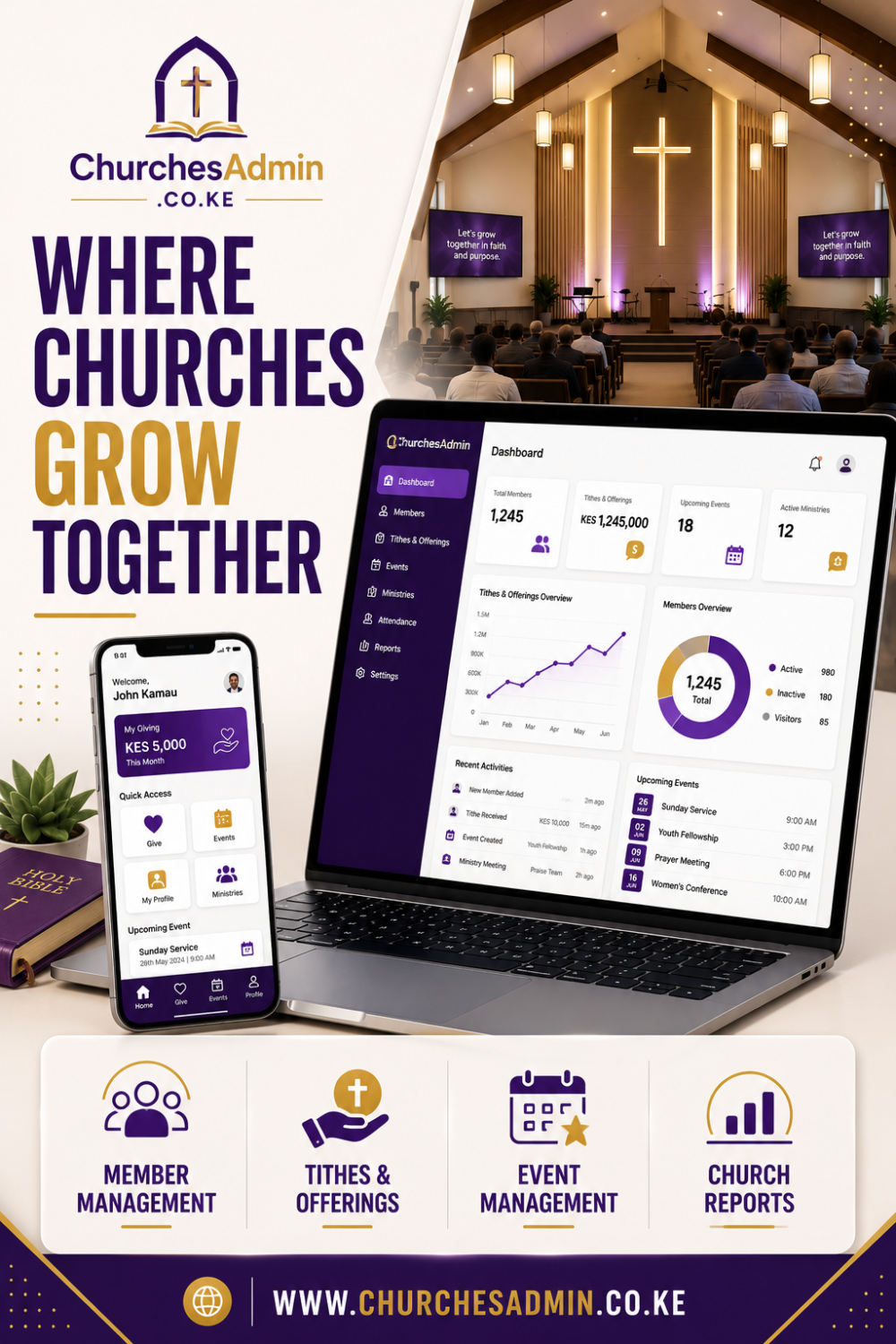
A Church Ministry Performance Dashboard provides a centralized digital platform that transforms church data into real-time visual insights. Instead of collecting reports from multiple ministries manually, pastors and church leaders can monitor the health and performance of every department through interactive dashboards that update automatically.

Modern churches require more than monthly reports.

Real-time ministry analytics.

Attendance monitoring.

Volunteer performance.

Department reporting.

Financial summaries.

Member engagement.

Outreach statistics.

Leadership insights.

Everything becomes more effective when ministry information is centralized within one integrated dashboard.

A Church Ministry Performance Dashboard consolidates information from every ministry.

Attendance records synchronize automatically.

Financial reports update continuously.

Volunteer participation becomes measurable.

Event performance remains visible.

Pastoral care statistics become accessible.

Church executives gain immediate visibility into ministry activities through one secure platform.

Historical information also becomes invaluable.

Church leaders evaluate ministry growth, attendance trends, volunteer development, giving patterns, outreach impact, discipleship progress, leadership effectiveness, and church expansion over several years.

These insights support strategic planning while strengthening long-term ministry development.

Security remains equally important.

Leadership reports, financial summaries, member information, and ministry analytics remain protected through encrypted databases, secure authentication, role-based permissions, and automated backups.

Whether serving a local congregation, regional ministry, denomination, cathedral, or multi-campus church, implementing a Church Ministry Performance Dashboard creates a professional leadership environment that strengthens decision-making, improves accountability, simplifies reporting, and supports sustainable church growth throughout Kenya.


Table of Contents

  • Understanding Church Ministry Performance Dashboard
  • Why Ministry Performance Monitoring Matters
  • Core Features of Church Ministry Performance Dashboard
  • Ministry Analytics and Reporting
  • Attendance and Member Engagement Monitoring
  • Leadership Decision Support
  • Financial and Ministry Performance Insights
  • Challenges of Manual Ministry Reporting

Understanding Church Ministry Performance Dashboard

Every church ministry generates valuable operational information.

Attendance.

Volunteer participation.

Financial contributions.

Prayer requests.

Event registrations.

Cell group activity.

Discipleship programs.

Community outreach.

Leadership development.

Managing this information manually becomes increasingly difficult as churches grow.

A Church Ministry Performance Dashboard centralizes ministry reporting into one intelligent platform.

Department information remains synchronized.

Performance indicators update automatically.

Leadership dashboards remain current.

Church executives access accurate reports without waiting for manual submissions.

Historical ministry information also strengthens leadership.

Church executives review attendance growth, ministry participation, volunteer engagement, giving trends, outreach activities, and organizational performance through meaningful visual reports.

These insights support informed leadership while improving ministry planning.


Why Ministry Performance Monitoring Matters

Healthy churches consistently evaluate ministry effectiveness.

Without organized reporting, church leaders frequently struggle to identify ministry strengths, declining participation, volunteer shortages, attendance patterns, financial trends, and opportunities for improvement.

Manual reporting often delays important decisions.

A Church Ministry Performance Dashboard eliminates these challenges through centralized analytics.

Leadership receives accurate information.

Departments become measurable.

Church objectives remain visible.

Strategic planning improves.

The church therefore strengthens accountability while supporting sustainable ministry growth.


Core Features of Church Ministry Performance Dashboard

A professional ministry dashboard combines numerous reporting capabilities.

Real-time dashboards.

Attendance analytics.

Financial summaries.

Volunteer reporting.

Department performance.

Event analytics.

Cell group reporting.

Member engagement.

Giving trends.

Pastoral care metrics.

Leadership reports.

Cloud synchronization.

Role-based permissions.

Mobile accessibility.

Historical analytics.

Interactive charts.

These capabilities provide church leaders with complete operational visibility.


Ministry Analytics and Reporting

Every ministry contributes differently to church growth.

A Church Ministry Performance Dashboard enables church leaders to compare ministry activities using meaningful performance indicators.

Attendance growth.

Volunteer participation.

Program effectiveness.

Leadership engagement.

Discipleship progress.

Community outreach.

Everything becomes measurable through centralized reporting.

Leaders identify successful ministries while supporting departments requiring additional attention.


Attendance and Member Engagement Monitoring

Attendance remains one of the strongest indicators of ministry health.

A Church Ministry Performance Dashboard consolidates attendance information from worship services, cell groups, Bible studies, conferences, youth meetings, children’s ministry, leadership meetings, and special events.

Church leaders identify attendance trends immediately while improving pastoral follow-up and member engagement.


Leadership Decision Support

Church leadership requires accurate information.

A Church Ministry Performance Dashboard transforms operational data into strategic insights.

Church executives evaluate organizational performance, compare ministry growth, monitor leadership objectives, allocate resources effectively, and make informed ministry decisions using real-time analytics.

Leadership therefore becomes proactive rather than reactive.


Financial and Ministry Performance Insights

Financial stewardship supports ministry effectiveness.

A Church Ministry Performance Dashboard integrates giving trends, budget performance, offering summaries, campaign progress, and ministry expenditure alongside operational metrics.

Church leaders therefore evaluate financial health while monitoring ministry performance from one centralized dashboard.


Challenges of Manual Ministry Reporting

Many churches continue preparing ministry reports through spreadsheets, notebooks, paper summaries, and individual departmental presentations.

Although manageable initially, these methods become increasingly inefficient as churches expand.

Reports become delayed.

Information becomes inconsistent.

Historical comparisons become difficult.

Leadership meetings consume unnecessary time.

Decision-making slows.

A Church Ministry Performance Dashboard eliminates these challenges through centralized reporting, real-time analytics, automated dashboards, leadership insights, ministry comparisons, and scalable church performance monitoring.

For churches, ministries, denominations, dioceses, and Christian organizations throughout Kenya, implementing a Church Ministry Performance Dashboard creates a professional reporting environment that strengthens leadership, improves accountability, simplifies administration, enhances strategic planning, and supports sustainable church growth.

Benefits for Church Leaders and Senior Pastors

Church leaders are responsible for ensuring that every ministry contributes effectively to the overall mission and vision of the church. Children’s ministry, youth ministry, worship teams, evangelism, men’s and women’s fellowships, prayer ministry, discipleship programs, media teams, hospitality, and outreach initiatives all require continuous monitoring to ensure they remain healthy and productive.

A Church Ministry Performance Dashboard gives pastors, bishops, elders, executive pastors, church administrators, and ministry directors complete visibility into the performance of every ministry through one centralized platform.

Instead of collecting handwritten reports, spreadsheets, PowerPoint presentations, or verbal updates during leadership meetings, church executives can access real-time ministry insights from a single dashboard.

Attendance.

Member engagement.

Volunteer participation.

Giving trends.

Outreach activities.

Department performance.

Leadership development.

Event participation.

Everything updates automatically.

One of the greatest advantages is improved strategic decision-making.

Church leaders can immediately identify ministries experiencing growth, departments requiring additional support, attendance changes, volunteer shortages, or new opportunities for expansion.

Rather than relying on assumptions, every leadership decision is supported by accurate and current information.

Historical reporting also strengthens long-term planning.

Church leaders compare annual ministry growth, outreach effectiveness, volunteer engagement, discipleship progress, leadership development, and church expansion over several years.

These insights enable churches to allocate resources wisely while strengthening overall ministry effectiveness.

As churches continue growing throughout Kenya, a Church Ministry Performance Dashboard provides the leadership intelligence needed to support informed decisions and sustainable ministry growth.


Benefits for Ministry Leaders and Department Heads

Every ministry leader wants to understand how their department is performing.

Attendance.

Volunteer commitment.

Program participation.

Event success.

Budget utilization.

Member engagement.

These indicators help leaders continually improve their ministries.

A Church Ministry Performance Dashboard enables department heads to monitor performance through interactive dashboards that update automatically.

Children’s ministry leaders monitor class attendance.

Youth leaders evaluate participation.

Evangelism teams review outreach activities.

Prayer coordinators monitor ministry engagement.

Worship leaders evaluate volunteer scheduling.

Every ministry receives meaningful performance information.

Department leaders also spend less time preparing manual reports.

Performance data becomes available instantly.

Leadership meetings become more productive because reports remain accurate, standardized, and consistently updated.

These improvements strengthen accountability while encouraging continuous ministry improvement.


Benefits for Church Administrators and Finance Teams

Church administrators coordinate numerous operational activities every day.

Collecting reports.

Preparing leadership summaries.

Monitoring attendance.

Compiling financial information.

Supporting ministry departments.

Preparing board meetings.

Managing these responsibilities manually consumes considerable administrative time.

A Church Ministry Performance Dashboard automates much of this reporting process.

Attendance information synchronizes automatically.

Financial summaries remain updated.

Volunteer participation becomes measurable.

Department statistics remain available.

Leadership reports generate instantly.

Church administrators therefore spend less time collecting information and more time supporting ministry operations.

Finance teams also benefit because financial information integrates with ministry reporting.

Church leaders can evaluate ministry performance alongside financial stewardship, enabling more informed budgeting and resource allocation.


Benefits for Church Members

Although church members may not access leadership dashboards directly, they benefit greatly from data-driven ministry leadership.

A Church Ministry Performance Dashboard helps church leaders identify ministries that require additional support, improve member engagement, strengthen pastoral care, and allocate resources where they create the greatest impact.

Members experience better organized ministries.

Improved communication.

More effective discipleship.

Better volunteer coordination.

Stronger outreach.

Improved event planning.

Healthier church growth.

As ministry performance improves, the entire congregation benefits from stronger leadership and more effective service delivery.


Improving Ministry Management Through Automation

Traditional ministry reporting often depends upon spreadsheets, handwritten reports, emails, printed summaries, and manual calculations.

Preparing leadership reports frequently consumes many hours every month.

A Church Ministry Performance Dashboard automates these responsibilities.

Attendance statistics update automatically.

Financial summaries synchronize continuously.

Volunteer activity remains measurable.

Ministry reports generate instantly.

Leadership dashboards remain current.

Performance indicators calculate automatically.

Automation significantly reduces administrative effort while improving reporting consistency across every ministry.

As churches expand into multiple campuses or establish additional ministries, automation enables leadership teams to monitor increasing organizational complexity without increasing reporting workloads.


Compliance, Security, and Leadership Accountability

Leadership information often includes confidential organizational data.

Financial reports.

Attendance records.

Volunteer statistics.

Department performance.

Strategic objectives.

Leadership evaluations.

Member engagement.

A Church Ministry Performance Dashboard protects this information through encrypted databases, secure authentication, role-based user permissions, automated backups, and comprehensive audit trails.

Every report.

Every dashboard update.

Every ministry record.

Every financial summary.

Every leadership review.

Everything remains securely documented.

Only authorized leaders receive access according to their responsibilities.

Historical information also supports board meetings, annual reporting, ministry evaluations, strategic planning, leadership transitions, and organizational accountability.

These capabilities strengthen governance while protecting sensitive church information.


Why ChurchesAdmin Is the Ideal Solution

ChurchesAdmin is designed specifically to help churches, ministries, dioceses, denominations, and Christian organizations manage ministry performance through one integrated church management platform.

A Church Ministry Performance Dashboard becomes significantly more valuable when integrated with member management, attendance tracking, financial reporting, volunteer management, event administration, communication tools, pastoral care, cell groups, prayer ministry, and leadership reporting.

ChurchesAdmin combines all these capabilities into one centralized cloud-based solution.

Senior pastors receive real-time ministry insights.

Department leaders monitor performance continuously.

Church administrators generate reports automatically.

Finance committees evaluate stewardship alongside ministry growth.

Church executives make informed strategic decisions using reliable operational data.

Whether serving a local congregation or a denomination with multiple churches throughout Kenya, ChurchesAdmin provides the scalability required to support growing ministry operations.

By centralizing ministry reporting and automating performance monitoring, ChurchesAdmin helps churches improve leadership effectiveness, strengthen accountability, simplify administration, enhance ministry planning, and support sustainable church growth.


Future Trends

Church leadership will increasingly rely on artificial intelligence, predictive analytics, cloud computing, and business intelligence technologies.

Future Church Ministry Performance Dashboard solutions will automatically identify ministry trends, forecast attendance growth, recommend leadership actions, and highlight departments requiring additional support.

Artificial intelligence may help church leaders predict volunteer shortages, identify disengaged members, evaluate ministry effectiveness, and recommend resource allocation strategies.

Cloud-based dashboards will continue improving accessibility, allowing church executives to monitor ministry performance securely from anywhere.

Mobile applications will provide pastors and ministry leaders with instant access to reports, dashboards, attendance analytics, financial summaries, and ministry statistics directly from their smartphones.

As churches throughout Kenya continue embracing digital transformation, intelligent ministry dashboards will become essential tools for strategic leadership and organizational growth.


Getting Started

Implementing a Church Ministry Performance Dashboard begins by evaluating how ministry performance is currently measured.

Church leaders should review attendance reporting, volunteer management, financial monitoring, ministry objectives, leadership reporting, communication workflows, and long-term strategic goals.

The next step involves selecting a platform capable of integrating ministry reporting with member management, attendance tracking, financial management, volunteer coordination, event administration, communication tools, and pastoral care.

Training senior pastors, ministry directors, department leaders, administrators, finance teams, and executive committees is equally important.

Every leadership team should understand how centralized dashboards improve visibility, accountability, and decision-making.

ChurchesAdmin provides complete implementation services including dashboard configuration, ministry integration, reporting setup, leadership analytics, staff training, and ongoing technical support.

By implementing a Church Ministry Performance Dashboard, churches throughout Kenya can strengthen leadership, improve accountability, automate reporting, enhance ministry oversight, support data-driven decision-making, and establish a scalable digital foundation for sustainable church growth.
Benefits for Church Leaders and Senior Pastors

Church leaders are responsible for ensuring that every ministry contributes effectively to the overall mission and vision of the church. Children’s ministry, youth ministry, worship teams, evangelism, men’s and women’s fellowships, prayer ministry, discipleship programs, media teams, hospitality, and outreach initiatives all require continuous monitoring to ensure they remain healthy and productive.

A Church Ministry Performance Dashboard gives pastors, bishops, elders, executive pastors, church administrators, and ministry directors complete visibility into the performance of every ministry through one centralized platform.

Instead of collecting handwritten reports, spreadsheets, PowerPoint presentations, or verbal updates during leadership meetings, church executives can access real-time ministry insights from a single dashboard.

Attendance.

Member engagement.

Volunteer participation.

Giving trends.

Outreach activities.

Department performance.

Leadership development.

Event participation.

Everything updates automatically.

One of the greatest advantages is improved strategic decision-making.

Church leaders can immediately identify ministries experiencing growth, departments requiring additional support, attendance changes, volunteer shortages, or new opportunities for expansion.

Rather than relying on assumptions, every leadership decision is supported by accurate and current information.

Historical reporting also strengthens long-term planning.

Church leaders compare annual ministry growth, outreach effectiveness, volunteer engagement, discipleship progress, leadership development, and church expansion over several years.

These insights enable churches to allocate resources wisely while strengthening overall ministry effectiveness.

As churches continue growing throughout Kenya, a Church Ministry Performance Dashboard provides the leadership intelligence needed to support informed decisions and sustainable ministry growth.


Benefits for Ministry Leaders and Department Heads

Every ministry leader wants to understand how their department is performing.

Attendance.

Volunteer commitment.

Program participation.

Event success.

Budget utilization.

Member engagement.

These indicators help leaders continually improve their ministries.

A Church Ministry Performance Dashboard enables department heads to monitor performance through interactive dashboards that update automatically.

Children’s ministry leaders monitor class attendance.

Youth leaders evaluate participation.

Evangelism teams review outreach activities.

Prayer coordinators monitor ministry engagement.

Worship leaders evaluate volunteer scheduling.

Every ministry receives meaningful performance information.

Department leaders also spend less time preparing manual reports.

Performance data becomes available instantly.

Leadership meetings become more productive because reports remain accurate, standardized, and consistently updated.

These improvements strengthen accountability while encouraging continuous ministry improvement.


Benefits for Church Administrators and Finance Teams

Church administrators coordinate numerous operational activities every day.

Collecting reports.

Preparing leadership summaries.

Monitoring attendance.

Compiling financial information.

Supporting ministry departments.

Preparing board meetings.

Managing these responsibilities manually consumes considerable administrative time.

A Church Ministry Performance Dashboard automates much of this reporting process.

Attendance information synchronizes automatically.

Financial summaries remain updated.

Volunteer participation becomes measurable.

Department statistics remain available.

Leadership reports generate instantly.

Church administrators therefore spend less time collecting information and more time supporting ministry operations.

Finance teams also benefit because financial information integrates with ministry reporting.

Church leaders can evaluate ministry performance alongside financial stewardship, enabling more informed budgeting and resource allocation.


Benefits for Church Members

Although church members may not access leadership dashboards directly, they benefit greatly from data-driven ministry leadership.

A Church Ministry Performance Dashboard helps church leaders identify ministries that require additional support, improve member engagement, strengthen pastoral care, and allocate resources where they create the greatest impact.

Members experience better organized ministries.

Improved communication.

More effective discipleship.

Better volunteer coordination.

Stronger outreach.

Improved event planning.

Healthier church growth.

As ministry performance improves, the entire congregation benefits from stronger leadership and more effective service delivery.


Improving Ministry Management Through Automation

Traditional ministry reporting often depends upon spreadsheets, handwritten reports, emails, printed summaries, and manual calculations.

Preparing leadership reports frequently consumes many hours every month.

A Church Ministry Performance Dashboard automates these responsibilities.

Attendance statistics update automatically.

Financial summaries synchronize continuously.

Volunteer activity remains measurable.

Ministry reports generate instantly.

Leadership dashboards remain current.

Performance indicators calculate automatically.

Automation significantly reduces administrative effort while improving reporting consistency across every ministry.

As churches expand into multiple campuses or establish additional ministries, automation enables leadership teams to monitor increasing organizational complexity without increasing reporting workloads.


Compliance, Security, and Leadership Accountability

Leadership information often includes confidential organizational data.

Financial reports.

Attendance records.

Volunteer statistics.

Department performance.

Strategic objectives.

Leadership evaluations.

Member engagement.

A Church Ministry Performance Dashboard protects this information through encrypted databases, secure authentication, role-based user permissions, automated backups, and comprehensive audit trails.

Every report.

Every dashboard update.

Every ministry record.

Every financial summary.

Every leadership review.

Everything remains securely documented.

Only authorized leaders receive access according to their responsibilities.

Historical information also supports board meetings, annual reporting, ministry evaluations, strategic planning, leadership transitions, and organizational accountability.

These capabilities strengthen governance while protecting sensitive church information.


Why ChurchesAdmin Is the Ideal Solution

ChurchesAdmin is designed specifically to help churches, ministries, dioceses, denominations, and Christian organizations manage ministry performance through one integrated church management platform.

A Church Ministry Performance Dashboard becomes significantly more valuable when integrated with member management, attendance tracking, financial reporting, volunteer management, event administration, communication tools, pastoral care, cell groups, prayer ministry, and leadership reporting.

ChurchesAdmin combines all these capabilities into one centralized cloud-based solution.

Senior pastors receive real-time ministry insights.

Department leaders monitor performance continuously.

Church administrators generate reports automatically.

Finance committees evaluate stewardship alongside ministry growth.

Church executives make informed strategic decisions using reliable operational data.

Whether serving a local congregation or a denomination with multiple churches throughout Kenya, ChurchesAdmin provides the scalability required to support growing ministry operations.

By centralizing ministry reporting and automating performance monitoring, ChurchesAdmin helps churches improve leadership effectiveness, strengthen accountability, simplify administration, enhance ministry planning, and support sustainable church growth.


Future Trends

Church leadership will increasingly rely on artificial intelligence, predictive analytics, cloud computing, and business intelligence technologies.

Future Church Ministry Performance Dashboard solutions will automatically identify ministry trends, forecast attendance growth, recommend leadership actions, and highlight departments requiring additional support.

Artificial intelligence may help church leaders predict volunteer shortages, identify disengaged members, evaluate ministry effectiveness, and recommend resource allocation strategies.

Cloud-based dashboards will continue improving accessibility, allowing church executives to monitor ministry performance securely from anywhere.

Mobile applications will provide pastors and ministry leaders with instant access to reports, dashboards, attendance analytics, financial summaries, and ministry statistics directly from their smartphones.

As churches throughout Kenya continue embracing digital transformation, intelligent ministry dashboards will become essential tools for strategic leadership and organizational growth.


Getting Started

Implementing a Church Ministry Performance Dashboard begins by evaluating how ministry performance is currently measured.

Church leaders should review attendance reporting, volunteer management, financial monitoring, ministry objectives, leadership reporting, communication workflows, and long-term strategic goals.

The next step involves selecting a platform capable of integrating ministry reporting with member management, attendance tracking, financial management, volunteer coordination, event administration, communication tools, and pastoral care.

Training senior pastors, ministry directors, department leaders, administrators, finance teams, and executive committees is equally important.

Every leadership team should understand how centralized dashboards improve visibility, accountability, and decision-making.

ChurchesAdmin provides complete implementation services including dashboard configuration, ministry integration, reporting setup, leadership analytics, staff training, and ongoing technical support.

By implementing a Church Ministry Performance Dashboard, churches throughout Kenya can strengthen leadership, improve accountability, automate reporting, enhance ministry oversight, support data-driven decision-making, and establish a scalable digital foundation for sustainable church growth.

Church Cell Group Management System – Complete Guide to Managing Small Groups and Church Fellowship

Church Cell Group Management System – Complete Guide to Managing Small Groups and Church Fellowship

Church Cell Group Management System

Healthy churches are built through meaningful relationships, discipleship, and consistent fellowship. While Sunday services bring the congregation together for worship, church cell groups create smaller communities where members grow spiritually, build friendships, study the Bible, pray together, and receive personal pastoral care. As churches continue expanding, managing numerous cell groups manually becomes increasingly challenging.

Many churches throughout Kenya still organize cell groups using notebooks, spreadsheets, WhatsApp groups, paper attendance registers, or informal communication. Although these methods may work for a few groups, they become difficult to manage as membership grows. Leaders may struggle to track attendance, monitor group growth, communicate effectively, assign new members, organize meetings, and evaluate ministry performance.

A Church Cell Group Management System provides a centralized digital platform that enables churches to organize, coordinate, monitor, and grow their small group ministry from one secure location. Instead of relying on disconnected administrative processes, churches can manage cell leaders, members, attendance, communication, meeting schedules, pastoral follow-up, reporting, and discipleship activities through one integrated system.

Modern churches require more than simple attendance registers.

Cell group organization.

Member assignment.

Leadership management.

Attendance tracking.

Bible study planning.

Prayer coordination.

Communication.

Pastoral oversight.

Reporting.

Everything becomes more effective when cell ministry operates from one centralized platform.

A Church Cell Group Management System synchronizes every aspect of small group administration.

Members join cell groups digitally.

Attendance updates automatically.

Cell leaders receive notifications.

Pastors monitor group health.

Meeting schedules remain organized.

Leadership dashboards provide real-time ministry insights.

Historical information also becomes valuable.

Church leaders evaluate cell group growth, attendance trends, discipleship participation, leadership development, member retention, outreach activities, and ministry effectiveness over several years.

These insights support strategic planning while strengthening long-term discipleship.

Security remains equally important.

Member information, pastoral notes, and leadership records remain protected through encrypted databases, secure authentication, role-based permissions, and automated backups.

Whether serving a local congregation, regional ministry, cathedral, denomination, or multi-campus church, implementing a Church Cell Group Management System creates a professional small group management environment that strengthens discipleship, improves communication, simplifies administration, and supports sustainable church growth throughout Kenya.

Table of Contents
Understanding Church Cell Group Management System
Why Cell Group Management Matters
Core Features of Church Cell Group Management System
Cell Group Organization and Member Management
Attendance and Discipleship Tracking
Cell Leader Coordination
Communication and Member Engagement
Reporting and Cell Group Analytics
Challenges of Manual Cell Group Administration
Understanding Church Cell Group Management System

Cell groups provide one of the strongest foundations for church growth.

They create opportunities for Bible study.

Prayer.

Fellowship.

Mentorship.

Evangelism.

Community outreach.

Pastoral care.

Managing numerous groups manually becomes increasingly difficult as churches expand.

A Church Cell Group Management System centralizes every aspect of small group administration into one intelligent platform.

Cell groups remain organized.

Members stay connected.

Attendance becomes measurable.

Leaders receive assignments.

Pastors monitor ministry progress.

Communication improves significantly.

Church leaders therefore gain complete visibility into the health of every cell group while reducing administrative complexity.

Historical information also strengthens ministry planning.

Church leaders evaluate attendance growth, leadership development, member engagement, outreach participation, multiplication of new groups, and discipleship effectiveness through detailed reporting.

These insights support continuous ministry improvement while strengthening the overall mission of the church.

Why Cell Group Management Matters

Small groups help churches build stronger relationships and provide personalized spiritual care.

Without organized management, churches frequently experience inconsistent attendance tracking, communication challenges, member isolation, leadership overload, and limited visibility into group health.

Manual administration often slows ministry growth.

A Church Cell Group Management System eliminates these challenges through centralized coordination.

Cell leaders remain informed.

Members stay connected.

Attendance remains accurate.

Pastoral care improves.

Church leadership gains measurable insights into discipleship progress.

The church therefore strengthens community while supporting sustainable spiritual growth.

Core Features of Church Cell Group Management System

A professional cell group management platform combines numerous ministry capabilities.

Cell group organization.

Member registration.

Leader management.

Attendance tracking.

Bible study scheduling.

Prayer requests.

Communication tools.

Meeting calendars.

Visitor tracking.

Pastoral follow-up.

Reporting dashboards.

Cloud synchronization.

Role-based security.

Mobile accessibility.

Discipleship records.

Growth analytics.

These capabilities provide everything needed to strengthen church small group ministry.

Cell Group Organization and Member Management

Every successful cell ministry begins with organized member management.

A Church Cell Group Management System enables churches to assign members to appropriate cell groups based on location, demographics, language, ministry interests, or leadership structures.

Member profiles remain organized.

Family relationships remain connected.

Transfers between groups become simple.

Church leaders maintain accurate records while supporting balanced group growth.

Attendance and Discipleship Tracking

Attendance provides valuable insights into spiritual engagement.

A Church Cell Group Management System enables leaders to record attendance digitally during every meeting.

Church leaders identify active members, visitors, inactive members, and follow-up opportunities through real-time attendance reports.

Discipleship progress also becomes measurable through structured reporting.

Cell Leader Coordination

Cell leaders require ongoing communication and support.

A Church Cell Group Management System helps churches coordinate leader meetings, assign responsibilities, distribute Bible study materials, monitor leadership performance, and strengthen ministry collaboration.

Leadership communication improves while reducing administrative burdens.

Communication and Member Engagement

Strong communication keeps members connected.

A Church Cell Group Management System enables churches to notify members regarding upcoming meetings, prayer gatherings, Bible studies, outreach programs, leadership training, and fellowship activities.

Communication remains organized.

Members stay informed.

Participation increases significantly.

Reporting and Cell Group Analytics

Every cell group generates valuable ministry information.

A Church Cell Group Management System transforms attendance records, membership growth, leadership activity, outreach participation, and discipleship information into meaningful reports.

Interactive dashboards help church leaders evaluate ministry performance while supporting strategic planning.

Challenges of Manual Cell Group Administration

Many churches continue managing cell groups through notebooks, spreadsheets, messaging groups, and paper attendance registers.

Although manageable initially, these methods become increasingly inefficient as churches grow.

Attendance becomes difficult to monitor.

Communication becomes inconsistent.

Leadership coordination becomes challenging.

Reporting consumes valuable administrative time.

Pastoral follow-up becomes less effective.

A Church Cell Group Management System eliminates these challenges through centralized member management, attendance tracking, communication, reporting, leadership coordination, and scalable discipleship administration.

For churches, ministries, denominations, dioceses, and Christian organizations throughout Kenya, implementing a Church Cell Group Management System creates a professional small group management environment that improves discipleship, strengthens fellowship, simplifies administration, enhances pastoral care, and supports sustainable church growth.

Benefits for Church Leaders and Senior Pastors

Healthy cell groups are one of the strongest indicators of a growing and spiritually mature church. They provide opportunities for discipleship, pastoral care, evangelism, leadership development, and meaningful relationships that cannot always be achieved during large worship services. As churches expand across multiple communities, coordinating dozens or even hundreds of cell groups becomes increasingly complex.

A Church Cell Group Management System gives pastors, bishops, elders, church administrators, and ministry directors complete visibility into the health and performance of every cell group through one centralized platform.

Instead of relying on notebooks, spreadsheets, WhatsApp groups, or manual attendance records, church leaders can oversee their entire cell ministry from one dashboard.

Cell groups.

Group leaders.

Members.

Attendance.

Bible studies.

Prayer meetings.

Outreach activities.

Leadership reports.

Everything remains synchronized automatically.

One of the greatest advantages is improved discipleship oversight.

Church leaders can immediately identify growing cell groups, declining attendance, inactive members, leadership vacancies, and opportunities to establish new groups.

Decision-making also becomes significantly stronger.

Leadership teams monitor attendance trends, member participation, leadership development, outreach performance, visitor integration, and group multiplication using real-time dashboards.

Historical reporting enables churches to compare ministry growth across months and years while identifying strategies that strengthen discipleship.

As churches throughout Kenya continue expanding, a Church Cell Group Management System provides the organizational structure necessary to strengthen pastoral oversight while supporting sustainable church growth.


Benefits for Cell Leaders and Ministry Coordinators

Cell leaders serve as the frontline shepherds of the congregation.

They organize meetings.

Lead Bible studies.

Pray for members.

Visit families.

Follow up on absentees.

Welcome visitors.

Coordinate outreach.

Managing these responsibilities manually often becomes overwhelming.

A Church Cell Group Management System simplifies daily ministry administration.

Meeting schedules remain organized.

Attendance updates instantly.

Prayer requests remain documented.

Visitor follow-up becomes easier.

Member communication improves.

Leadership reports become available automatically.

Ministry coordinators also gain better oversight.

Every cell group’s activity remains visible.

Leadership meetings become easier to organize.

Training schedules remain coordinated.

Responsibilities stay clearly assigned.

These improvements reduce administrative workloads while allowing leaders to focus more on spiritual mentorship and discipleship.


Benefits for Church Members

Church members benefit significantly from belonging to well-organized cell groups.

A Church Cell Group Management System helps members connect with groups based on location, language, family status, age group, ministry interests, or other church-defined criteria.

Members receive meeting reminders automatically.

Bible study schedules remain accessible.

Prayer requests can be submitted easily.

Communication with leaders becomes more consistent.

Visitors are welcomed more effectively.

New believers integrate into church life more quickly because follow-up activities remain organized.

Members also experience stronger pastoral care because leaders can monitor attendance, identify prolonged absences, and provide timely encouragement when needed.

These improvements strengthen fellowship while creating a greater sense of belonging throughout the congregation.


Improving Cell Ministry Through Automation

Traditional cell group administration often requires repetitive manual work.

Updating attendance registers.

Preparing meeting schedules.

Assigning members.

Sending reminders.

Preparing reports.

Following up on visitors.

Tracking leadership activities.

A Church Cell Group Management System automates these responsibilities.

Attendance synchronizes automatically.

Meeting reminders are sent digitally.

Member assignments remain updated.

Leader reports generate instantly.

Prayer requests become organized.

Follow-up activities remain visible.

Automation significantly reduces administrative effort while improving consistency throughout the entire discipleship process.

As churches continue growing, automation enables leadership teams to coordinate hundreds of cell groups without increasing administrative complexity.


Compliance, Security, and Pastoral Accountability

Cell group records often contain confidential information.

Member profiles.

Family information.

Prayer requests.

Counselling notes.

Attendance histories.

Pastoral follow-up.

Leadership evaluations.

A Church Cell Group Management System protects this information using encrypted databases, secure authentication, role-based access controls, automated backups, and comprehensive audit trails.

Every attendance record.

Every member transfer.

Every prayer request.

Every leadership assignment.

Every pastoral update.

Everything remains securely documented.

Only authorized church leaders receive access according to their ministry responsibilities.

Historical records also support leadership transitions, ministry evaluations, annual planning, discipleship reporting, and long-term pastoral care.

These capabilities strengthen governance while protecting member confidentiality.


Why ChurchesAdmin Is the Ideal Solution

ChurchesAdmin is designed specifically to help churches, ministries, dioceses, denominations, and Christian organizations strengthen discipleship through one integrated church management platform.

A Church Cell Group Management System becomes significantly more valuable when integrated with member management, attendance tracking, pastoral care, communication tools, ministry administration, event management, volunteer coordination, financial management, and reporting.

ChurchesAdmin combines all these capabilities into one centralized cloud-based solution.

Church leaders monitor the health of every cell group through real-time dashboards.

Cell leaders organize meetings and manage attendance efficiently.

Church administrators coordinate member assignments and leadership structures.

Pastors receive meaningful reports that support better pastoral care and discipleship planning.

Whether serving a local congregation or a denomination with multiple churches across Kenya, ChurchesAdmin provides the scalability required to support growing cell group ministries.

By centralizing cell group administration and automating discipleship workflows, ChurchesAdmin helps churches improve organization, strengthen fellowship, simplify administration, increase member engagement, and support sustainable spiritual growth.


Future Trends

Small group ministry continues evolving alongside digital technology.

Future Church Cell Group Management System solutions will incorporate artificial intelligence, predictive analytics, cloud computing, and mobile ministry applications.

Artificial intelligence may recommend suitable cell groups for new members, identify members requiring pastoral follow-up, predict attendance patterns, and recommend leadership development opportunities.

Cloud-based platforms will continue improving accessibility, allowing pastors and cell leaders to manage ministry securely from anywhere.

Mobile applications will enable members to register for cell groups, record attendance, submit prayer requests, access Bible study materials, communicate with leaders, and receive ministry updates directly from their smartphones.

Advanced analytics will provide deeper insights into discipleship growth, leadership effectiveness, outreach performance, and member retention.

As churches throughout Kenya continue embracing digital transformation, intelligent cell group management platforms will become essential tools for strengthening discipleship and expanding church communities.


Getting Started

Implementing a Church Cell Group Management System begins by evaluating how cell groups are currently organized, monitored, and supported.

Church leaders should review member assignments, attendance processes, leadership structures, communication methods, pastoral follow-up procedures, reporting requirements, and long-term discipleship objectives.

The next step involves selecting a platform capable of integrating cell group management with member records, attendance tracking, communication, pastoral care, ministry administration, reporting, and leadership development.

Training pastors, cell leaders, administrators, ministry coordinators, and volunteers is equally important.

Every ministry leader should understand how centralized cell group management strengthens discipleship while improving operational efficiency.

ChurchesAdmin provides complete implementation services including member migration, cell group configuration, attendance tracking, leadership management, reporting dashboards, communication tools, staff training, and ongoing technical support.

By implementing a Church Cell Group Management System, churches throughout Kenya can strengthen discipleship, improve pastoral care, simplify administration, increase member engagement, enhance leadership coordination, and establish a scalable digital foundation for sustainable church growth.

Prayer Request Management Software – Complete Guide to Organizing Prayer Ministry and Pastoral Care

Prayer Request Management Software – Complete Guide to Organizing Prayer Ministry and Pastoral Care

Prayer Request Management Software

Prayer is one of the most important ministries within every church. It strengthens faith, builds relationships with God, encourages believers during difficult times, and unites congregations around shared spiritual needs. Every week churches receive numerous prayer requests relating to health, families, finances, education, employment, marriages, thanksgiving, spiritual growth, and community challenges. Managing these requests effectively requires organization, confidentiality, timely follow-up, and coordinated pastoral care.

Many churches throughout Kenya still record prayer requests using notebooks, paper forms, WhatsApp messages, emails, phone calls, or verbal communication. While these methods may be suitable for smaller congregations, they become increasingly difficult to manage as churches grow. Prayer requests may be forgotten, duplicated, delayed, or not assigned to appropriate prayer teams. Follow-up becomes inconsistent, making it difficult for church leaders to provide continuous pastoral support.

A Prayer Request Management Software provides a centralized digital platform that enables churches to receive, organize, assign, monitor, and follow up on prayer requests through one secure system. Instead of relying on scattered communication channels, churches can maintain organized prayer records while strengthening ministry coordination and pastoral care.

Modern churches require more than handwritten prayer lists.

Prayer request submission.

Prayer team coordination.

Pastoral follow-up.

Confidential request management.

Prayer status tracking.

Department coordination.

Communication.

Reporting.

Member engagement.

Everything becomes more effective when prayer ministry operates from one centralized platform.

A Prayer Request Management Software organizes every stage of prayer ministry.

Prayer requests are submitted digitally.

Prayer teams receive assignments automatically.

Pastors monitor follow-up activities.

Members receive updates.

Prayer outcomes remain documented.

Leadership gains visibility through real-time dashboards.

Historical prayer information also becomes valuable.

Churches evaluate prayer ministry activity, follow-up effectiveness, pastoral engagement, member participation, answered prayers, and ministry growth over several years.

These insights support stronger pastoral care while helping churches continually improve their prayer ministry.

Security is especially important.

Prayer requests often contain highly personal information requiring confidentiality.

A Prayer Request Management Software protects sensitive information through secure authentication, encrypted databases, role-based permissions, and automated backups.

Whether serving a local congregation, regional ministry, cathedral, denomination, or multi-campus church, implementing a Prayer Request Management Software creates a professional prayer ministry environment that strengthens pastoral care, improves communication, simplifies administration, and supports spiritual growth throughout Kenya.


Table of Contents

  • Understanding Prayer Request Management Software
  • Why Prayer Request Management Matters
  • Core Features of Prayer Request Management Software
  • Prayer Request Submission and Organization
  • Prayer Team Coordination
  • Pastoral Follow-Up and Care
  • Communication and Member Engagement
  • Reporting and Prayer Ministry Analytics
  • Challenges of Manual Prayer Request Management

Understanding Prayer Request Management Software

Prayer ministry touches every aspect of church life.

Members request prayer during illness.

Families seek spiritual guidance.

Students request examination prayers.

Businesses seek wisdom.

Communities request support during crises.

Pastors coordinate prayer for many different needs simultaneously.

Managing these requests manually becomes increasingly difficult as congregations grow.

A Prayer Request Management Software centralizes prayer ministry into one intelligent platform.

Prayer requests remain organized.

Prayer categories become searchable.

Follow-up activities remain documented.

Prayer teams receive assignments.

Pastoral visits become easier to coordinate.

Church leaders therefore gain complete visibility into prayer ministry while reducing administrative complexity.

Historical prayer information also strengthens ministry.

Church leaders review prayer activity, answered prayers, member engagement, pastoral care, volunteer participation, and ministry effectiveness over time.

These insights support continuous ministry improvement while strengthening spiritual care.


Why Prayer Request Management Matters

Prayer ministry depends upon timely response and compassionate follow-up.

Without organized systems, churches frequently experience delayed responses, forgotten requests, inconsistent follow-up, duplicated efforts, and communication challenges.

Manual administration often limits ministry effectiveness.

A Prayer Request Management Software eliminates these challenges through centralized coordination.

Prayer requests become organized.

Pastors remain informed.

Prayer teams coordinate effectively.

Members receive ongoing support.

Communication improves.

Churches therefore strengthen pastoral care while building stronger relationships throughout the congregation.


Core Features of Prayer Request Management Software

A professional prayer management platform combines numerous ministry capabilities.

Digital prayer request submission.

Prayer categorization.

Prayer team assignment.

Pastoral follow-up.

Confidential request management.

Member communication.

Status tracking.

Answered prayer records.

Prayer reminders.

Department coordination.

Reporting dashboards.

Cloud synchronization.

Role-based security.

Mobile accessibility.

Historical records.

These capabilities create an organized environment that strengthens prayer ministry and pastoral care.


Prayer Request Submission and Organization

Receiving prayer requests should be simple and accessible.

A Prayer Request Management Software enables members to submit prayer requests through digital forms, church portals, or mobile devices.

Prayer requests remain categorized according to health, family, finances, employment, education, thanksgiving, spiritual growth, bereavement, missions, or community outreach.

Church leaders organize requests efficiently while ensuring every need receives appropriate attention.


Prayer Team Coordination

Prayer ministry often involves numerous pastors, elders, intercessors, and prayer teams.

A Prayer Request Management Software automatically assigns requests to appropriate ministry leaders while monitoring follow-up progress.

Prayer schedules remain organized.

Responsibilities become visible.

Prayer coverage improves significantly.

Churches therefore coordinate prayer ministry more effectively while ensuring no request is overlooked.


Pastoral Follow-Up and Care

Prayer frequently leads to broader pastoral care.

A Prayer Request Management Software enables pastors to record visits, counselling sessions, phone calls, encouragement, testimonies, and answered prayers alongside every request.

Pastoral care therefore becomes more intentional and measurable.

Members receive continuous spiritual support throughout every stage of their journey.


Communication and Member Engagement

Prayer ministry depends upon effective communication.

A Prayer Request Management Software enables churches to acknowledge prayer requests, provide follow-up updates, encourage members, notify prayer teams, and celebrate answered prayers through organized communication tools.

Members remain connected while strengthening confidence in the church’s pastoral ministry.


Reporting and Prayer Ministry Analytics

Prayer ministry generates valuable ministry information.

A Prayer Request Management Software transforms prayer activity into meaningful reports.

Church leaders evaluate prayer request volumes, response times, pastoral engagement, prayer team participation, answered prayer trends, and ministry effectiveness through interactive dashboards.

Historical reporting supports strategic ministry planning while strengthening pastoral care.


Challenges of Manual Prayer Request Management

Many churches continue managing prayer requests through notebooks, WhatsApp groups, emails, paper forms, and verbal communication.

Although manageable initially, these methods become increasingly inefficient as churches grow.

Prayer requests become difficult to track.

Follow-up becomes inconsistent.

Confidentiality becomes harder to maintain.

Communication becomes fragmented.

Reporting becomes nearly impossible.

A Prayer Request Management Software eliminates these challenges through centralized prayer management, pastoral coordination, automated communication, secure information management, reporting, and scalable ministry administration.

For churches, ministries, denominations, dioceses, and Christian organizations throughout Kenya, implementing a Prayer Request Management Software creates a professional prayer ministry environment that strengthens pastoral care, improves organization, enhances communication, simplifies administration, and supports sustainable church growth.

Benefits for Church Leaders and Pastors

Prayer ministry is one of the most personal and spiritually significant responsibilities within every church. Pastors, bishops, elders, prayer coordinators, and ministry leaders are entrusted with supporting members through seasons of joy, uncertainty, healing, thanksgiving, grief, and spiritual growth. As congregations grow, ensuring that every prayer request receives timely attention becomes increasingly challenging without organized systems.

A Prayer Request Management Software gives church leaders complete visibility into every prayer request through one centralized platform.

Instead of relying on handwritten notes, WhatsApp conversations, emails, or verbal messages, leaders can manage prayer ministry from one secure dashboard.

Prayer requests.

Prayer categories.

Follow-up activities.

Pastoral visits.

Prayer team assignments.

Answered prayers.

Member communication.

Everything remains organized and continuously updated.

One of the greatest advantages is improved pastoral care.

Pastors can quickly identify urgent prayer needs, organize hospital visits, schedule counselling sessions, assign prayer partners, and monitor ongoing follow-up activities.

Church leaders also gain greater visibility into the spiritual needs of the congregation.

Recurring family challenges.

Health concerns.

Youth requests.

Marriage counselling.

Bereavement support.

Community outreach.

These insights help church leadership strengthen ministry planning while ensuring no member feels forgotten.

Historical reporting also supports long-term ministry development.

Church leaders can evaluate prayer activity, response times, pastoral engagement, member participation, and ministry effectiveness over several years.

As churches continue growing throughout Kenya, a Prayer Request Management Software provides the organizational structure required to strengthen prayer ministry while improving pastoral care.


Benefits for Prayer Teams and Church Administrators

Prayer teams often receive dozens or even hundreds of prayer requests every week.

Without proper organization, requests may be duplicated, overlooked, delayed, or assigned to multiple people unnecessarily.

A Prayer Request Management Software simplifies prayer coordination through intelligent workflow management.

Prayer requests are categorized automatically.

Prayer partners receive assignments instantly.

Follow-up reminders are generated automatically.

Prayer status updates remain visible.

Church administrators also benefit significantly.

Every request remains searchable.

Prayer histories remain accessible.

Follow-up records remain organized.

Prayer meetings become easier to prepare.

Administrative workloads decrease while ministry effectiveness improves.

Prayer coordinators can easily monitor pending requests, completed follow-ups, ongoing counselling, and answered prayers from one centralized dashboard.

These improvements strengthen accountability while ensuring every member receives consistent spiritual support.


Benefits for Church Members

Church members want confidence that their church genuinely cares for them during every stage of life.

A Prayer Request Management Software strengthens this confidence by ensuring prayer requests receive organized follow-up and compassionate pastoral attention.

Members can submit prayer requests conveniently through digital forms, church portals, or mobile devices.

Requests reach pastors and prayer teams quickly.

Members receive acknowledgements confirming their requests have been received.

Pastoral communication becomes more personal.

Follow-up becomes more consistent.

Answered prayers can also be documented, allowing members to celebrate God’s faithfulness while encouraging the wider church community.

Families benefit because ongoing prayer needs remain connected to their profiles, enabling church leaders to provide long-term spiritual support rather than one-time responses.

These improvements help members feel seen, valued, and spiritually supported throughout their faith journey.


Improving Prayer Ministry Through Automation

Traditional prayer request management often depends upon notebooks, emails, messaging applications, and manual follow-up.

These methods require continuous administrative effort.

Recording requests.

Assigning prayer teams.

Sending reminders.

Tracking follow-up.

Preparing reports.

Updating records.

A Prayer Request Management Software automates the complete prayer ministry workflow.

Prayer requests are captured digitally.

Assignments update automatically.

Prayer reminders are sent consistently.

Follow-up activities remain documented.

Pastoral notes synchronize instantly.

Reports generate in real time.

Automation significantly reduces administrative work while improving consistency across the entire prayer ministry.

As congregations continue expanding, churches can support larger numbers of members without proportionally increasing administrative responsibilities.


Compliance, Security, and Confidentiality

Prayer requests often contain highly confidential information.

Medical conditions.

Family challenges.

Marriage difficulties.

Financial struggles.

Employment concerns.

Personal testimonies.

Counselling notes.

A Prayer Request Management Software protects this sensitive information through encrypted databases, secure authentication, role-based access controls, automated backups, and comprehensive audit logs.

Every prayer request.

Every pastoral note.

Every follow-up activity.

Every assignment.

Every communication.

Everything remains securely documented.

Only authorized pastors, elders, counsellors, or prayer leaders receive access to confidential requests according to their ministry responsibilities.

Historical records also support ministry continuity, leadership transitions, pastoral accountability, and long-term member care.

These capabilities strengthen trust while protecting member privacy.


Why ChurchesAdmin Is the Ideal Solution

ChurchesAdmin is designed specifically to help churches, ministries, denominations, dioceses, and Christian organizations strengthen pastoral care through one integrated church management platform.

A Prayer Request Management Software becomes significantly more valuable when integrated with member management, pastoral care, communication tools, ministry coordination, attendance tracking, counselling records, volunteer management, and reporting.

ChurchesAdmin combines all these capabilities within one centralized cloud-based platform.

Pastors receive immediate visibility into member prayer needs.

Prayer coordinators organize intercessory teams efficiently.

Church administrators monitor follow-up activities.

Church leaders generate reports that support better pastoral planning.

Members experience more responsive and organized spiritual care.

Whether serving a local congregation or a denomination with multiple churches across Kenya, ChurchesAdmin provides the scalability required to support growing prayer ministries.

By centralizing prayer request management and automating follow-up processes, ChurchesAdmin helps churches strengthen pastoral care, improve communication, simplify administration, and build stronger relationships throughout the congregation.


Future Trends

Prayer ministry will increasingly benefit from digital transformation, artificial intelligence, cloud computing, and mobile ministry platforms.

Future Prayer Request Management Software solutions may automatically prioritize urgent requests, recommend pastoral follow-up schedules, identify recurring prayer needs, and assist prayer coordinators in organizing ministry activities more effectively.

Artificial intelligence may help summarize prayer trends, identify members requiring additional pastoral support, and recommend follow-up based on previous interactions.

Cloud-based platforms will continue improving accessibility, allowing pastors and prayer leaders to manage prayer ministry securely from anywhere.

Mobile applications will enable members to submit prayer requests, receive encouragement, track follow-up, share testimonies, and receive prayer updates directly from their smartphones.

As churches throughout Kenya continue embracing digital transformation, intelligent prayer management systems will become increasingly valuable for strengthening pastoral ministry and deepening member engagement.


Getting Started

Implementing a Prayer Request Management Software begins by reviewing how prayer requests are currently received, assigned, followed up, and documented.

Church leaders should evaluate prayer ministry workflows, pastoral care procedures, communication channels, confidentiality requirements, reporting needs, and long-term ministry objectives.

The next step involves selecting a platform capable of integrating prayer request management with member records, pastoral care, church communication, ministry coordination, attendance management, and reporting.

Training pastors, prayer coordinators, elders, counsellors, church administrators, and ministry leaders is equally important.

Everyone involved should understand how centralized prayer management strengthens ministry while improving member care.

ChurchesAdmin provides complete implementation services including prayer ministry configuration, member integration, workflow setup, reporting dashboards, communication tools, staff training, and ongoing technical support.

By implementing a Prayer Request Management Software, churches throughout Kenya can improve pastoral care, strengthen prayer ministry, simplify administration, enhance confidentiality, increase member engagement, and establish a scalable digital foundation for long-term spiritual growth.

Church Event Registration System – Complete Guide to Managing Church Events and Registrations

Church Event Registration System – Complete Guide to Managing Church Events and Registrations

Church Event Registration System

Churches organize numerous events throughout the year to strengthen worship, fellowship, discipleship, leadership development, evangelism, and community outreach. From conferences and crusades to youth camps, leadership seminars, Bible study programs, prayer meetings, retreats, weddings, community outreach events, and fundraising activities, successful church events require careful planning and organized registration processes.

Many churches throughout Kenya still manage event registrations using paper forms, spreadsheets, messaging applications, manual attendance lists, or physical registration desks. While these methods may be sufficient for smaller gatherings, they quickly become inefficient as attendance increases. Church administrators often struggle with duplicate registrations, incomplete attendee records, delayed confirmations, communication challenges, and inaccurate attendance reporting.

A Church Event Registration System provides a centralized digital platform that simplifies every stage of event registration and attendee management. Instead of manually recording participant information, churches can automate registrations, attendee confirmations, communication, volunteer coordination, check-ins, attendance monitoring, reporting, and follow-up activities within one integrated system.

Modern churches require more than printed registration forms.

Online registration.

Event scheduling.

Attendee management.

Volunteer coordination.

Communication.

QR code check-in.

Capacity management.

Department coordination.

Reporting.

Everything becomes more efficient when event administration operates from one centralized platform.

A Church Event Registration System synchronizes every aspect of event management.

Members register online.

Attendance lists update automatically.

Confirmation messages are sent instantly.

Volunteers receive assignments.

Capacity limits remain visible.

Leaders monitor registrations through real-time dashboards.

Historical event information also becomes an invaluable ministry resource.

Churches evaluate event attendance, ministry participation, volunteer involvement, conference growth, outreach effectiveness, leadership development, and member engagement over several years.

These insights support better event planning while strengthening long-term ministry strategies.

Security is equally important.

Attendee information remains protected through encrypted databases, secure authentication, role-based permissions, and automatic backups.

Whether organizing local church services, regional conferences, denominational conventions, youth camps, marriage seminars, leadership retreats, or nationwide crusades, implementing a Church Event Registration System creates a professional event management environment that improves organization, strengthens communication, simplifies administration, and supports sustainable church growth throughout Kenya.


Table of Contents

  • Understanding Church Event Registration System
  • Why Event Registration Matters
  • Core Features of Church Event Registration System
  • Event Planning and Registration Management
  • Attendee Check-In and Attendance Tracking
  • Volunteer and Ministry Coordination
  • Communication and Event Notifications
  • Reporting and Event Analytics
  • Challenges of Manual Event Registration

Understanding Church Event Registration System

Church events provide opportunities for worship, discipleship, fellowship, leadership development, evangelism, and community engagement.

As participation grows, managing registrations manually becomes increasingly difficult.

A Church Event Registration System centralizes every stage of event administration into one intelligent platform.

Attendees register digitally.

Participant profiles remain organized.

Attendance updates automatically.

Volunteer schedules synchronize.

Event communication becomes streamlined.

Church leaders therefore gain complete visibility into every event while reducing administrative complexity.

Historical records also strengthen future planning.

Church leaders evaluate attendance trends, registration growth, ministry participation, event success, volunteer engagement, and resource utilization over multiple years.

These insights support continuous improvement while strengthening ministry impact.


Why Event Registration Matters

Successful church events begin with organized registration.

Without structured registration processes, churches frequently experience long queues, inaccurate attendance lists, communication delays, duplicate registrations, and inefficient event planning.

Manual registration methods often increase administrative workloads.

A Church Event Registration System eliminates these challenges through intelligent automation.

Registration becomes faster.

Communication improves.

Attendance remains accurate.

Church leaders gain measurable insights into event participation.

Ministry teams therefore spend less time managing administration and more time serving attendees.


Core Features of Church Event Registration System

A professional event management platform combines numerous operational capabilities.

Online registration.

Event calendars.

QR code check-in.

Attendance tracking.

Volunteer coordination.

Department management.

Capacity control.

Confirmation notifications.

Reminder messages.

Guest registration.

Visitor management.

Reporting dashboards.

Cloud synchronization.

Role-based security.

Document management.

Mobile accessibility.

These capabilities create an organized environment that supports successful church events.


Event Planning and Registration Management

Every successful church event begins with careful planning.

A Church Event Registration System enables churches to create event pages, define registration requirements, establish attendance limits, assign ministry teams, and monitor registrations through centralized dashboards.

Registration remains organized.

Participant information becomes accurate.

Church leaders coordinate events with greater confidence.


Attendee Check-In and Attendance Tracking

Managing attendance manually often creates delays and confusion.

A Church Event Registration System simplifies attendee check-in through digital attendance tools.

Participants can be verified quickly.

Attendance updates automatically.

Late arrivals remain recorded.

Event participation becomes measurable.

Church leaders gain accurate attendance reports immediately after every event.


Volunteer and Ministry Coordination

Church events depend heavily on volunteers.

Hospitality.

Ushering.

Media.

Security.

Registration.

Prayer teams.

Children’s ministry.

Transport.

A Church Event Registration System enables churches to assign volunteers, monitor responsibilities, coordinate departments, and communicate schedules from one centralized platform.

Volunteer coordination becomes significantly more efficient.


Communication and Event Notifications

Effective communication improves event participation.

A Church Event Registration System automatically sends registration confirmations, reminder messages, schedule updates, venue information, speaker announcements, and follow-up communication.

Church members remain informed throughout the event lifecycle.

Communication consistency strengthens attendee experiences while improving participation.


Reporting and Event Analytics

Every church event generates valuable ministry information.

A Church Event Registration System transforms registration data into meaningful reports.

Church leaders evaluate attendance trends, registration growth, volunteer participation, ministry engagement, event performance, and resource utilization through interactive dashboards.

Historical reporting supports better planning while strengthening future ministry events.


Challenges of Manual Event Registration

Many churches continue managing event registrations through notebooks, spreadsheets, printed forms, messaging groups, and paper attendance sheets.

Although manageable initially, these methods become increasingly inefficient as attendance grows.

Registration becomes slower.

Communication becomes inconsistent.

Attendance records become inaccurate.

Volunteer coordination becomes difficult.

Reporting consumes valuable administrative time.

A Church Event Registration System eliminates these challenges through centralized registration management, digital attendance tracking, volunteer coordination, automated communication, reporting, and scalable event administration.

For churches, ministries, denominations, dioceses, and Christian organizations throughout Kenya, implementing a Church Event Registration System creates a professional event management environment that improves organization, strengthens communication, simplifies administration, enhances attendee experiences, and supports sustainable church growth.

Benefits for Church Leaders and Pastors

Every successful church event reflects careful planning, effective leadership, and excellent coordination. Whether organizing a leadership conference, youth camp, evangelism outreach, prayer conference, discipleship class, marriage seminar, fundraiser, or annual convention, church leaders must ensure that every participant has a smooth and organized experience.

A Church Event Registration System gives pastors, bishops, church administrators, ministry directors, and event coordinators complete visibility into every stage of event management through one centralized platform.

Instead of relying on paper registration forms, spreadsheets, messaging groups, or manual attendance sheets, church leaders can oversee registrations from a single dashboard.

Registered attendees.

Event capacity.

Volunteer assignments.

Department responsibilities.

Attendance.

Check-ins.

Communication.

Reports.

Everything updates automatically.

One of the greatest advantages is improved event planning.

Church leaders know exactly how many people have registered before the event begins.

Venue planning becomes more accurate.

Seating arrangements improve.

Catering requirements become easier to estimate.

Resource allocation becomes more efficient.

Decision-making also improves significantly.

Leadership teams monitor registration trends, attendance projections, volunteer participation, ministry involvement, and event performance using real-time reports.

Historical event analytics allow churches to compare conferences, seminars, retreats, and outreach programs across multiple years.

These insights support better planning while helping churches continuously improve future events.

As churches continue expanding throughout Kenya, a Church Event Registration System provides the organizational structure needed to deliver professional, well-coordinated, and impactful church events.


Benefits for Church Administrators and Event Coordinators

Church administrators often carry the responsibility of managing registrations, communicating with attendees, coordinating volunteers, preparing attendance lists, and ensuring every event runs smoothly.

Manual registration processes consume significant time.

Forms require sorting.

Attendance lists require updating.

Confirmation messages must be sent individually.

Reports take hours to prepare.

A Church Event Registration System automates these responsibilities.

Online registrations update instantly.

Attendee lists synchronize automatically.

Reminder notifications send before every event.

Check-in records update in real time.

Attendance reports generate automatically.

Church administrators spend less time performing repetitive administrative work while gaining more time to focus on organizing successful ministry events.

Event coordinators also benefit from improved visibility.

Every registration remains searchable.

Capacity limits remain visible.

Volunteer schedules stay organized.

Department responsibilities become easier to coordinate.

These improvements strengthen operational efficiency while reducing administrative pressure.


Benefits for Volunteers and Church Members

Volunteers play an essential role during church events.

Registration teams.

Hospitality.

Ushering.

Security.

Media.

Prayer teams.

Children’s ministry.

Transport.

Every department depends on effective coordination.

A Church Event Registration System provides volunteers with clear schedules, assignments, event information, and communication through one organized platform.

Responsibilities become transparent.

Schedules remain current.

Departments collaborate more effectively.

Church members also enjoy a significantly better experience.

Online registration becomes simple.

Confirmation messages arrive immediately.

Event reminders reduce missed attendance.

Digital check-in speeds up event entry.

Members receive timely updates regarding speakers, schedules, venues, accommodation, transportation, and program changes.

These improvements increase participation while creating a more welcoming and organized event experience.


Improving Event Management Through Automation

Traditional event registration often requires repetitive manual work.

Collecting registration forms.

Updating spreadsheets.

Preparing attendance lists.

Sending reminders.

Verifying attendees.

Recording attendance.

Preparing reports.

A Church Event Registration System automates the complete registration process.

Online registrations update immediately.

Attendance records synchronize automatically.

QR code check-ins verify participants instantly.

Volunteer assignments remain organized.

Capacity monitoring updates continuously.

Communication becomes automated.

Reports generate in real time.

Automation significantly reduces administrative workloads while improving operational consistency.

As churches organize larger conferences, conventions, youth camps, leadership summits, and outreach events, automation enables event teams to manage increasing attendance without increasing administrative complexity.


Compliance, Security, and Event Accountability

Church events often involve collecting valuable participant information.

Names.

Contact details.

Church affiliations.

Emergency contacts.

Accommodation preferences.

Volunteer assignments.

Attendance records.

Payment information for ticketed events.

A Church Event Registration System protects this information through encrypted databases, secure authentication, role-based user permissions, automated backups, and comprehensive audit trails.

Every registration.

Every attendance record.

Every volunteer assignment.

Every communication.

Every administrative update.

Everything remains securely documented.

Church leaders maintain complete accountability while protecting participant privacy.

Historical records also simplify event reporting, financial reconciliation, attendance verification, ministry evaluations, leadership reviews, and long-term event planning.

These capabilities strengthen governance while reducing administrative risk.


Why ChurchesAdmin Is the Ideal Solution

ChurchesAdmin is designed specifically to help churches, ministries, dioceses, denominations, Christian organizations, and faith-based institutions manage church events through one integrated digital platform.

A Church Event Registration System becomes significantly more valuable when integrated with member management, attendance tracking, volunteer coordination, communication tools, financial management, ministry administration, reporting, and pastoral oversight.

ChurchesAdmin combines all these capabilities into one centralized cloud-based system.

Church leaders can create events, monitor registrations, coordinate volunteers, track attendance, communicate with participants, generate reports, and evaluate event performance from one dashboard.

Church administrators automate registration workflows while reducing paperwork.

Volunteers receive organized schedules and clear assignments.

Church members enjoy convenient online registration and efficient event experiences.

Whether organizing a local church seminar or a national denominational conference across Kenya, ChurchesAdmin provides the scalability required to manage events of every size.

By centralizing event administration and automating registration processes, ChurchesAdmin helps churches improve organization, strengthen communication, simplify administration, increase participation, and maximize ministry impact.


Future Trends

Church event management continues evolving through artificial intelligence, cloud computing, mobile technology, and predictive analytics.

Future Church Event Registration System solutions will automatically forecast attendance, recommend volunteer allocations, optimize seating arrangements, and personalize attendee communication.

Artificial intelligence may assist churches by predicting registration trends, identifying capacity requirements, recommending follow-up strategies, and automating attendee support.

Cloud-based event platforms will continue improving accessibility, allowing church leaders to manage registrations securely from anywhere.

Mobile applications will enable members to register for events, receive digital tickets, complete QR code check-ins, view schedules, receive announcements, and provide event feedback directly from their smartphones.

As churches throughout Kenya continue embracing digital transformation, intelligent event registration platforms will become essential tools for delivering organized, engaging, and impactful ministry events.


Getting Started

Implementing a Church Event Registration System begins by reviewing how church events are currently planned and managed.

Church leaders should evaluate registration procedures, volunteer coordination, attendance tracking, communication methods, reporting requirements, venue management, and long-term ministry objectives.

The next step involves selecting a platform capable of integrating event registration with member management, attendance tracking, communication, volunteer administration, financial reporting, ministry coordination, and pastoral oversight.

Training church administrators, event coordinators, ministry leaders, volunteers, and registration teams is equally important.

Everyone involved should understand how digital registration improves organization, efficiency, and participant experiences.

ChurchesAdmin provides complete implementation services including event setup, online registration configuration, QR code check-in, volunteer management, reporting dashboards, communication tools, staff training, and ongoing technical support.

By implementing a Church Event Registration System, churches throughout Kenya can improve event organization, automate registrations, strengthen communication, simplify administration, increase attendance, enhance participant experiences, and establish a scalable digital foundation for successful church events.

Church Offering Reconciliation Software – Complete Guide to Accurate Church Giving and Financial Reconciliation

Church Offering Reconciliation Software – Complete Guide to Accurate Church Giving and Financial Reconciliation

Church Offering Reconciliation Software

Financial stewardship is one of the most important responsibilities entrusted to every church. Offerings, tithes, special contributions, missions giving, building funds, thanksgiving offerings, and other donations enable churches to support ministry, maintain facilities, fund outreach programs, and serve their communities. As congregations continue growing, accurately recording, reconciling, and reporting these financial contributions becomes increasingly important.

Many churches throughout Kenya still reconcile offerings manually using paper registers, calculators, spreadsheets, handwritten summaries, and disconnected accounting records. While these methods may work for smaller congregations, they become increasingly difficult as donation volumes increase. Manual reconciliation often leads to delays, calculation errors, duplicate entries, missing records, and unnecessary administrative workloads.

A Church Offering Reconciliation Software provides a centralized digital platform that automates the reconciliation of church offerings while ensuring every financial contribution is accurately recorded, verified, balanced, and reported.

Modern churches require more than basic bookkeeping.

Offering reconciliation.

Tithe management.

Donation verification.

Bank reconciliation.

Giving records.

Financial reporting.

Audit preparation.

Treasury oversight.

Everything becomes easier when financial information is managed through one integrated system.

A Church Offering Reconciliation Software synchronizes every stage of the reconciliation process.

Offerings are recorded digitally.

Cash collections are verified.

Mobile money transactions synchronize automatically.

Bank deposits are reconciled.

Financial reports update continuously.

Church treasurers monitor reconciliation status through real-time dashboards.

Historical reconciliation records also become invaluable.

Churches evaluate monthly giving, seasonal donation trends, department collections, campaign performance, donor participation, and financial growth over many years.

These insights support responsible stewardship while strengthening long-term financial planning.

Security is equally important.

Financial records remain protected through encrypted databases, role-based permissions, secure authentication, automated backups, and comprehensive audit trails.

Whether serving a local congregation, regional ministry, denomination, cathedral, or multi-campus church, implementing a Church Offering Reconciliation Software creates a professional financial management environment that improves accuracy, strengthens accountability, simplifies reconciliation, and supports sustainable ministry growth throughout Kenya.


Table of Contents

  • Understanding Church Offering Reconciliation Software
  • Why Offering Reconciliation Matters
  • Core Features of Church Offering Reconciliation Software
  • Offering Recording and Verification
  • Bank and Payment Reconciliation
  • Financial Reporting and Audit Support
  • Security and Financial Accountability
  • Challenges of Manual Offering Reconciliation

Understanding Church Offering Reconciliation Software

Every church receives financial contributions through multiple channels.

Sunday offerings.

Tithes.

Special offerings.

Building funds.

Mission support.

Online giving.

Bank transfers.

M-Pesa.

Cheques.

Managing these contributions manually becomes increasingly complex as churches grow.

A Church Offering Reconciliation Software centralizes financial reconciliation into one intelligent platform.

Every contribution is recorded.

Payment methods remain categorized.

Deposits become traceable.

Bank records synchronize.

Financial balances remain accurate.

Treasurers therefore gain complete visibility into church giving without relying on manual calculations.

Historical records also strengthen financial management.

Church leaders evaluate giving trends, campaign performance, donor participation, ministry funding, and annual financial growth through detailed reporting.

These insights support informed financial decisions while improving stewardship.


Why Offering Reconciliation Matters

Church members trust leadership to manage financial resources responsibly.

Accurate reconciliation demonstrates accountability while protecting church finances.

Without organized reconciliation processes, churches frequently experience delayed reporting, calculation errors, incomplete records, and difficulties preparing financial statements.

A Church Offering Reconciliation Software eliminates these challenges through intelligent automation.

Financial records remain synchronized.

Deposits become verifiable.

Giving reports remain accurate.

Church leadership gains confidence in every financial report.

Transparency improves while strengthening trust throughout the congregation.


Core Features of Church Offering Reconciliation Software

A professional reconciliation platform combines numerous financial management capabilities.

Offering recording.

Tithe management.

Donation categorization.

M-Pesa integration.

Bank reconciliation.

Cash reconciliation.

Cheque management.

Deposit tracking.

Financial dashboards.

Giving reports.

Audit trails.

Approval workflows.

Role-based permissions.

Cloud synchronization.

Historical reporting.

Real-time reconciliation.

Automated calculations.

These capabilities simplify church financial administration while improving accountability.


Offering Recording and Verification

Every contribution deserves accurate documentation.

A Church Offering Reconciliation Software enables churches to record offerings digitally while verifying collection totals against counting sheets and treasury reports.

Cash collections.

Mobile payments.

Cheques.

Electronic transfers.

Special offerings.

Everything remains categorized accurately.

Verification procedures strengthen financial accuracy while reducing reconciliation errors.


Bank and Payment Reconciliation

Church finances often involve multiple payment channels.

A Church Offering Reconciliation Software automatically reconciles recorded offerings with bank deposits, M-Pesa transactions, electronic transfers, and financial statements.

Treasurers immediately identify unmatched transactions, outstanding deposits, or reconciliation differences.

These capabilities significantly reduce reconciliation time while improving financial accuracy.


Financial Reporting and Audit Support

Financial transparency is essential for every church.

A Church Offering Reconciliation Software transforms reconciliation data into meaningful financial reports.

Church leaders evaluate giving trends, offering categories, reconciliation summaries, donor participation, bank balances, and ministry funding through interactive dashboards.

Historical reporting simplifies annual audits while supporting responsible financial stewardship.


Security and Financial Accountability

Church finances require strong internal controls.

A Church Offering Reconciliation Software protects financial information through secure authentication, encrypted databases, automated backups, role-based permissions, approval workflows, and detailed audit logs.

Every financial transaction.

Every reconciliation.

Every report.

Every approval.

Everything remains securely documented.

These controls strengthen accountability while protecting church financial information.


Challenges of Manual Offering Reconciliation

Many churches continue reconciling offerings using calculators, notebooks, spreadsheets, printed reports, and handwritten records.

Although manageable initially, these methods become increasingly inefficient as churches grow.

Calculation errors increase.

Reporting slows.

Duplicate records appear.

Bank reconciliation becomes time-consuming.

Audit preparation becomes difficult.

A Church Offering Reconciliation Software eliminates these challenges through centralized reconciliation, automated verification, intelligent reporting, secure financial management, and scalable church accounting.

For churches, ministries, denominations, dioceses, and Christian organizations throughout Kenya, implementing a Church Offering Reconciliation Software creates a professional financial reconciliation environment that improves stewardship, strengthens accountability, simplifies financial administration, supports transparent reporting, and establishes a strong foundation for responsible church financial management.

Benefits for Church Leaders and Finance Committees

Financial stewardship is one of the greatest responsibilities entrusted to church leadership. Every offering, tithe, thanksgiving gift, mission contribution, building fund donation, and special collection represents the generosity and faithfulness of church members. Church leaders must therefore ensure that every contribution is recorded accurately, reconciled properly, and reported transparently.

A Church Offering Reconciliation Software gives pastors, bishops, church treasurers, finance committees, accountants, and administrators complete visibility into every stage of the reconciliation process.

Instead of comparing paper records, bank statements, calculators, and spreadsheets manually, leaders manage reconciliation from one centralized dashboard.

Cash collections.

M-Pesa payments.

Bank transfers.

Cheque deposits.

Special offerings.

Tithes.

Mission funds.

Departmental collections.

Everything remains synchronized automatically.

One of the greatest advantages is financial accuracy.

Every offering received is matched against deposits, payment records, and reconciliation reports, reducing the likelihood of human error while improving financial integrity.

Leadership also benefits from real-time financial visibility.

Church executives can monitor offering trends, daily collections, outstanding reconciliations, departmental income, campaign performance, and church giving from one secure platform.

Historical reporting strengthens long-term financial planning.

Church leaders evaluate annual giving trends, seasonal offering patterns, fundraising performance, donor participation, and ministry funding over several years.

These insights support responsible stewardship while enabling better budgeting and ministry planning.

For churches throughout Kenya, a Church Offering Reconciliation Software provides the financial control necessary to strengthen accountability and build greater confidence among church members.


Benefits for Church Treasurers and Financial Administrators

Church treasurers often spend many hours reconciling offerings manually.

Comparing counting sheets.

Verifying bank deposits.

Reviewing M-Pesa transactions.

Preparing reports.

Investigating discrepancies.

Calculating balances.

These repetitive activities consume valuable administrative time.

A Church Offering Reconciliation Software automates much of this work.

Offering records synchronize automatically.

Deposits match against bank transactions.

Payment summaries generate instantly.

Reconciliation reports update continuously.

Treasurers can immediately identify missing deposits, unmatched transactions, or reconciliation differences before they become larger financial problems.

Financial administrators also benefit from improved organization.

Every transaction remains searchable.

Historical reports remain accessible.

Approval workflows become standardized.

Financial information remains consistent across every department.

These capabilities significantly reduce administrative workloads while improving reporting accuracy.


Benefits for Church Members and Donors

Church members want confidence that their financial contributions are managed responsibly.

A Church Offering Reconciliation Software strengthens transparency by ensuring every contribution is accurately recorded and reconciled.

Members benefit because offering records remain accurate.

Donation acknowledgements become easier to produce.

Giving histories remain available whenever required.

Special campaign contributions remain properly allocated.

The software also improves communication.

Churches can provide accurate financial updates, campaign progress reports, annual giving summaries, and contribution statements based on verified financial information.

These improvements strengthen trust between church leadership and the congregation while encouraging continued generosity and faithful stewardship.


Improving Financial Efficiency Through Automation

Traditional reconciliation often requires repetitive manual work.

Recording offerings.

Calculating totals.

Preparing summaries.

Comparing bank deposits.

Matching payment records.

Investigating discrepancies.

Producing reports.

A Church Offering Reconciliation Software automates the entire reconciliation workflow.

Offering records synchronize immediately.

Bank reconciliation updates automatically.

M-Pesa transactions import directly.

Reports generate in real time.

Approval workflows become digital.

Financial dashboards remain continuously updated.

Automation significantly reduces reconciliation time while improving consistency across every financial process.

As churches continue growing, automation enables finance teams to manage larger transaction volumes without proportionally increasing administrative workloads.

This scalability becomes essential for churches serving expanding congregations throughout Kenya.


Compliance, Security, and Financial Accountability

Church financial information requires strong protection.

Offering records.

Bank reconciliations.

Donation histories.

Treasury reports.

Approval records.

Audit documentation.

A Church Offering Reconciliation Software protects these records through encrypted databases, secure authentication, role-based user permissions, automated backups, and detailed audit trails.

Every offering entry.

Every reconciliation adjustment.

Every approval.

Every report.

Every financial update.

Everything remains securely documented.

Church leaders maintain complete accountability while protecting sensitive financial information from unauthorized access.

Historical financial records also simplify annual audits, regulatory reporting, internal reviews, leadership transitions, and long-term financial planning.

These capabilities strengthen governance while supporting responsible stewardship of church resources.


Why ChurchesAdmin Is the Ideal Solution

ChurchesAdmin is designed specifically to help churches, ministries, dioceses, denominations, Christian organizations, and faith-based institutions modernize financial administration through one integrated management platform.

A Church Offering Reconciliation Software becomes significantly more valuable when integrated with church accounting, member giving records, tithes, donations, event collections, M-Pesa integration, bank reconciliation, budgeting, financial reporting, and audit management.

ChurchesAdmin combines all these capabilities into one centralized cloud-based platform.

Church treasurers reconcile offerings quickly and accurately.

Finance committees monitor reconciliation progress through real-time dashboards.

Church leaders access reliable financial reports that support strategic ministry decisions.

Administrators automate financial workflows while reducing manual workloads.

Whether serving a local congregation, regional ministry, or denomination with multiple churches throughout Kenya, ChurchesAdmin provides the scalability required to manage growing financial operations efficiently.

By centralizing offering reconciliation and automating financial administration, ChurchesAdmin helps churches improve transparency, strengthen accountability, simplify reporting, and support responsible stewardship of God’s resources.


Future Trends

Church financial management continues evolving through artificial intelligence, cloud computing, predictive analytics, and intelligent financial automation.

Future Church Offering Reconciliation Software solutions will automatically identify reconciliation discrepancies, predict giving trends, forecast ministry income, and generate intelligent financial recommendations.

Artificial intelligence may help classify donations, detect unusual financial activity, recommend reconciliation adjustments, and automate routine treasury reporting.

Cloud-based reconciliation platforms will continue improving accessibility, allowing authorized church leaders to review financial information securely from anywhere.

Mobile applications will enable treasurers to verify collections, approve reconciliations, monitor dashboards, and review financial reports directly from their smartphones.

As churches throughout Kenya continue embracing digital transformation, intelligent financial reconciliation systems will become essential tools for strengthening stewardship, improving accountability, and supporting sustainable ministry growth.


Getting Started

Implementing a Church Offering Reconciliation Software begins by evaluating current reconciliation procedures and identifying opportunities for improvement.

Church leaders should review offering collection processes, counting procedures, M-Pesa reconciliation, bank reconciliation, financial reporting, approval workflows, audit requirements, and long-term financial objectives.

The next step involves selecting a platform capable of integrating offering reconciliation with church accounting, member giving records, budgeting, bank management, financial reporting, communication, and audit preparation.

Training finance committees, treasurers, accountants, administrators, and church leaders is equally important.

Every finance team should understand how automated reconciliation improves accuracy, transparency, and accountability.

ChurchesAdmin provides complete implementation services including financial data migration, offering configuration, M-Pesa integration, reconciliation workflows, reporting dashboards, staff training, and ongoing technical support.

By implementing a Church Offering Reconciliation Software, churches throughout Kenya can improve financial accuracy, automate reconciliation, strengthen accountability, simplify audits, enhance transparency, and establish a scalable digital foundation for responsible church financial management.

Church Leadership Management Platform – Complete Guide to Effective Church Leadership Administration

Church Leadership Management Platform – Complete Guide to Effective Church Leadership Administration

Church Leadership Management Platform

Strong leadership is the foundation of every thriving church. Pastors, bishops, elders, deacons, ministry directors, department heads, administrators, and volunteer leaders work together to guide the congregation, oversee ministries, provide pastoral care, and fulfill the church’s mission. As churches grow, coordinating leadership responsibilities becomes increasingly complex, requiring structured systems that support collaboration, accountability, communication, and strategic decision-making.

Many churches throughout Kenya still manage leadership activities using notebooks, spreadsheets, messaging applications, printed reports, and manual filing systems. While these approaches may work for smaller congregations, they become increasingly inefficient as leadership teams expand. Meetings become difficult to coordinate, responsibilities overlap, communication becomes inconsistent, and important decisions are not always documented effectively.

A Church Leadership Management Platform provides a centralized digital solution that enables church leadership teams to organize responsibilities, coordinate ministries, schedule meetings, assign tasks, monitor progress, communicate efficiently, and access critical church information from one secure platform.

Modern churches require more than administrative records.

Leadership collaboration.

Strategic planning.

Task management.

Committee coordination.

Pastoral oversight.

Decision tracking.

Communication.

Reporting.

Accountability.

Everything becomes more effective when leadership operates from one integrated platform.

A Church Leadership Management Platform connects every leadership function into one organized management system.

Leadership meetings are scheduled digitally.

Responsibilities are assigned automatically.

Committee reports remain accessible.

Department activities synchronize continuously.

Leadership communication improves.

Church executives monitor ministry progress through real-time dashboards.

Historical leadership information also becomes an invaluable resource.

Churches preserve leadership decisions, committee reports, strategic plans, ministry evaluations, annual objectives, governance records, and organizational development over many years.

These records strengthen continuity while supporting future leadership transitions.

Data security is equally important.

Leadership information remains protected through secure authentication, encrypted databases, role-based permissions, and automated backups.

Whether serving a local congregation, regional ministry, cathedral, denomination, or multi-campus church, implementing a Church Leadership Management Platform creates a modern leadership environment that strengthens governance, improves collaboration, simplifies administration, and supports sustainable church growth throughout Kenya.


Table of Contents

  • Understanding Church Leadership Management Platform
  • Why Leadership Management Matters
  • Core Features of Church Leadership Management Platform
  • Leadership Team Administration
  • Committee and Department Coordination
  • Leadership Communication and Collaboration
  • Decision Tracking and Strategic Planning
  • Leadership Reporting and Performance Analytics
  • Challenges of Manual Leadership Administration

Understanding Church Leadership Management Platform

Church leadership involves numerous responsibilities extending far beyond preaching.

Pastoral care.

Strategic planning.

Committee meetings.

Financial oversight.

Volunteer leadership.

Department supervision.

Ministry coordination.

Community engagement.

Managing these responsibilities manually becomes increasingly difficult as churches grow.

A Church Leadership Management Platform centralizes leadership administration into one intelligent digital environment.

Leadership profiles remain organized.

Committee structures become visible.

Responsibilities remain assigned.

Meetings stay coordinated.

Church reports become centralized.

Communication improves significantly.

Church leaders therefore gain complete visibility into organizational leadership while reducing administrative complexity.

Historical leadership information also strengthens governance.

Leadership teams evaluate ministry development, organizational growth, committee performance, strategic objectives, and church progress over many years.

These insights support better leadership decisions while preserving institutional knowledge.


Why Leadership Management Matters

Strong churches require organized leadership.

Without structured leadership administration, churches often experience communication gaps, duplicated responsibilities, inconsistent follow-up, scheduling conflicts, and reduced organizational efficiency.

Manual systems frequently limit leadership effectiveness.

A Church Leadership Management Platform eliminates these challenges through centralized coordination.

Leadership teams collaborate more effectively.

Departments remain aligned.

Responsibilities become clear.

Meetings become productive.

Communication remains organized.

Church governance strengthens while supporting healthier ministry development.


Core Features of Church Leadership Management Platform

A professional leadership management platform combines numerous administrative capabilities.

Leadership profiles.

Committee management.

Department administration.

Task assignments.

Meeting scheduling.

Strategic planning.

Document management.

Communication tools.

Calendar synchronization.

Decision tracking.

Performance reporting.

Volunteer leadership.

Role-based permissions.

Cloud synchronization.

Governance records.

Analytics dashboards.

Mobile accessibility.

These capabilities provide everything needed to strengthen church leadership and administration.


Leadership Team Administration

Church leadership requires organized management structures.

A Church Leadership Management Platform enables churches to maintain comprehensive leadership profiles including pastors, elders, deacons, ministry directors, committee members, department heads, administrators, and volunteers.

Leadership appointments remain documented.

Responsibilities become visible.

Reporting relationships remain organized.

Leadership transitions become easier to manage.

This centralized structure strengthens accountability while supporting organizational continuity.


Committee and Department Coordination

Churches often operate multiple committees and ministries simultaneously.

Finance committees.

Mission committees.

Youth leadership.

Children’s ministry.

Worship teams.

Evangelism.

Administration.

Outreach.

A Church Leadership Management Platform coordinates every department within one centralized environment.

Department activities remain synchronized.

Committee meetings stay organized.

Responsibilities remain clearly assigned.

Cross-department collaboration improves significantly.


Leadership Communication and Collaboration

Effective communication is essential for healthy church leadership.

A Church Leadership Management Platform enables leadership teams to communicate efficiently regarding meetings, ministry updates, strategic initiatives, policy decisions, and organizational priorities.

Announcements remain organized.

Meeting reminders send automatically.

Leadership documents remain easily accessible.

Collaboration improves while reducing communication delays.


Decision Tracking and Strategic Planning

Church leadership regularly makes decisions that influence future ministry.

A Church Leadership Management Platform documents leadership resolutions, meeting outcomes, strategic initiatives, action plans, and organizational objectives.

Leaders monitor implementation progress while ensuring important decisions remain accessible for future reference.

Strategic planning therefore becomes measurable and accountable.


Leadership Reporting and Performance Analytics

Leadership activities generate valuable organizational information.

A Church Leadership Management Platform transforms leadership data into meaningful reports.

Church executives evaluate committee effectiveness, ministry progress, leadership participation, departmental performance, strategic objective completion, and organizational development.

Interactive dashboards support informed leadership decisions while strengthening church governance.


Challenges of Manual Leadership Administration

Many churches continue coordinating leadership activities using notebooks, paper files, spreadsheets, email chains, and messaging groups.

Although manageable initially, these methods become increasingly inefficient as leadership teams expand.

Communication becomes fragmented.

Responsibilities become unclear.

Committee records become difficult to retrieve.

Meeting follow-up becomes inconsistent.

Strategic planning becomes difficult to measure.

A Church Leadership Management Platform eliminates these challenges through centralized leadership administration, committee management, task coordination, communication tools, strategic planning, reporting, and scalable church governance.

For churches, ministries, denominations, dioceses, and Christian organizations throughout Kenya, implementing a Church Leadership Management Platform creates a professional leadership environment that improves collaboration, strengthens governance, simplifies administration, enhances accountability, and supports sustainable ministry growth.

Benefits for Church Leaders and Senior Pastors

Strong leadership is essential for every growing church. While spiritual guidance remains the primary responsibility of pastors and church leaders, effective administration, communication, planning, and accountability are equally important. As congregations expand and ministries become more diverse, leadership teams require organized systems that support informed decision-making and coordinated ministry.

A Church Leadership Management Platform gives pastors, bishops, elders, executive pastors, church administrators, and ministry directors complete visibility into church leadership activities through one centralized system.

Instead of managing meetings through notebooks, spreadsheets, emails, and messaging applications, leaders can oversee church governance from a single digital platform.

Leadership teams.

Committee structures.

Department activities.

Strategic initiatives.

Meeting schedules.

Assigned responsibilities.

Progress reports.

Church objectives.

Everything remains synchronized automatically.

One of the greatest advantages is improved leadership coordination.

Senior pastors gain real-time visibility into ministry progress across every department.

Department leaders understand their responsibilities clearly.

Committee members remain informed.

Church executives monitor organizational performance without requesting multiple reports.

Strategic planning also becomes significantly stronger.

Church leaders can evaluate ministry growth, departmental performance, leadership participation, volunteer development, financial stewardship, and congregation engagement using real-time reports.

Historical leadership reports help churches review annual objectives, ministry achievements, committee effectiveness, and organizational development over several years.

These insights support better leadership decisions while strengthening the long-term vision of the church.

As churches continue expanding throughout Kenya, a Church Leadership Management Platform provides the operational structure required to strengthen leadership, improve governance, and support sustainable ministry growth.


Benefits for Church Administrators and Department Leaders

Church administrators coordinate much of the daily work that supports ministry.

Scheduling meetings.

Preparing reports.

Managing departments.

Organizing committees.

Communicating with leaders.

Monitoring projects.

Following up on decisions.

Manual administration often creates unnecessary complexity.

A Church Leadership Management Platform simplifies these responsibilities through centralized leadership management.

Meeting schedules remain organized.

Committee members receive notifications.

Tasks are assigned automatically.

Reports remain accessible.

Department activities synchronize continuously.

Church administrators spend less time coordinating paperwork and more time supporting ministry operations.

Department leaders also benefit.

Every ministry can monitor responsibilities, deadlines, volunteer assignments, meeting outcomes, and departmental objectives from one centralized system.

Leadership collaboration improves because everyone works from accurate and current information.

These improvements reduce misunderstandings while strengthening organizational efficiency.


Benefits for Ministry Leaders and Volunteers

Ministry leaders and volunteers serve as the operational foundation of every church.

Youth ministries.

Children’s ministry.

Worship teams.

Media departments.

Evangelism.

Hospitality.

Prayer ministries.

Administration.

Every department depends on effective leadership.

A Church Leadership Management Platform provides ministry leaders with clear visibility into responsibilities, ministry calendars, assigned tasks, meetings, training sessions, and organizational priorities.

Volunteers receive timely communication.

Responsibilities remain clearly defined.

Leadership expectations become transparent.

Department collaboration improves significantly.

Church members serving in leadership roles also gain confidence because important information remains organized and easily accessible.

These improvements strengthen teamwork while encouraging greater participation in ministry.


Improving Church Governance Through Automation

Church leadership involves numerous recurring administrative activities.

Scheduling meetings.

Preparing agendas.

Assigning responsibilities.

Following up on action items.

Managing committees.

Updating reports.

Monitoring ministry progress.

Preparing annual plans.

Performing these tasks manually consumes valuable leadership time.

A Church Leadership Management Platform automates many of these responsibilities.

Leadership calendars synchronize automatically.

Meeting reminders send automatically.

Task assignments remain visible.

Department reports update continuously.

Strategic objectives remain measurable.

Communication improves across every leadership level.

Automation reduces administrative burdens while enabling leaders to devote more time to discipleship, pastoral care, teaching, evangelism, and vision development.

As churches continue growing, automation enables leadership teams to manage increasingly complex organizations without increasing administrative overhead.


Compliance, Security, and Church Governance

Leadership information represents one of the church’s most valuable administrative resources.

Meeting minutes.

Committee reports.

Strategic plans.

Leadership appointments.

Policy documents.

Financial approvals.

Organizational records.

A Church Leadership Management Platform protects this information using encrypted databases, secure authentication, role-based access controls, automated backups, and detailed audit trails.

Every leadership decision.

Every committee meeting.

Every document update.

Every assignment.

Every communication.

Everything remains securely documented.

Church executives maintain complete accountability while ensuring confidential leadership information remains protected.

Historical governance records also support audits, leadership transitions, constitutional compliance, strategic reviews, and organizational continuity.

These capabilities strengthen transparency while improving responsible church administration.


Why ChurchesAdmin Is the Ideal Solution

ChurchesAdmin is designed specifically to help churches, ministries, dioceses, denominations, Christian organizations, and faith-based institutions strengthen church leadership through one integrated management platform.

A Church Leadership Management Platform becomes significantly more powerful when integrated with member management, ministry administration, attendance tracking, financial management, communication tools, volunteer coordination, event management, reporting, and pastoral care.

ChurchesAdmin combines all these capabilities into one centralized cloud-based platform.

Senior pastors can monitor ministry performance through real-time dashboards.

Church administrators coordinate leadership activities efficiently.

Department leaders manage ministry responsibilities from one system.

Committee members collaborate more effectively through organized communication and shared information.

Whether serving a local church, a regional ministry, or a denomination with multiple congregations throughout Kenya, ChurchesAdmin provides the scalability required to support growing leadership structures.

By centralizing leadership administration and automating governance processes, ChurchesAdmin helps churches improve collaboration, strengthen accountability, simplify administration, and maximize ministry effectiveness.


Future Trends

Church leadership continues evolving through digital transformation, artificial intelligence, predictive analytics, and cloud-based collaboration.

Future Church Leadership Management Platform solutions will assist church leaders by identifying ministry priorities, recommending volunteer placements, forecasting ministry growth, and automating leadership reporting.

Artificial intelligence may summarize leadership meetings, recommend follow-up actions, identify ministries requiring additional support, and analyze congregation engagement trends.

Cloud-based leadership platforms will continue improving accessibility, enabling church executives to collaborate securely from anywhere.

Mobile applications will allow pastors and ministry leaders to review reports, approve requests, assign responsibilities, monitor ministry progress, and communicate with leadership teams directly from their smartphones.

As churches throughout Kenya increasingly embrace technology, leadership platforms will become essential tools for strengthening governance while expanding ministry impact.


Getting Started

Implementing a Church Leadership Management Platform begins by evaluating existing leadership structures and administrative processes.

Church leaders should review committee coordination, leadership communication, meeting management, ministry reporting, departmental collaboration, governance procedures, strategic planning, and organizational objectives.

The next step involves selecting a platform capable of integrating leadership administration with member management, ministry coordination, communication tools, financial reporting, attendance management, volunteer administration, and pastoral oversight.

Leadership training is equally important.

Pastors, bishops, elders, administrators, committee chairpersons, and department heads should understand how centralized leadership management improves governance and operational efficiency.

ChurchesAdmin provides complete implementation services including leadership setup, committee configuration, ministry organization, reporting dashboards, user training, communication tools, and ongoing technical support.

By implementing a Church Leadership Management Platform, churches throughout Kenya can strengthen governance, improve leadership collaboration, simplify administration, increase accountability, enhance ministry effectiveness, and establish a scalable digital foundation for sustainable church growth.

Ministry Program Management System – Complete Guide to Organizing Church Ministries and Programs

Ministry Program Management System – Complete Guide to Organizing Church Ministries and Programs

Ministry Program Management System

Church ministry extends far beyond Sunday worship services. Every thriving church operates numerous ministries, outreach programs, discipleship initiatives, conferences, seminars, youth activities, women’s fellowships, men’s fellowships, children’s ministries, worship teams, evangelism campaigns, community outreach projects, leadership development programs, and special church events. Managing these activities effectively requires organization, coordination, communication, and accurate planning.

Many churches throughout Kenya still coordinate ministry programs using notebooks, spreadsheets, printed schedules, messaging applications, or manual calendars. While these methods may work for smaller congregations, they become increasingly difficult as ministry activities expand. Program conflicts, volunteer scheduling challenges, poor communication, missed deadlines, and incomplete reporting often reduce ministry effectiveness.

A Ministry Program Management System provides a centralized digital platform that enables churches to plan, organize, coordinate, monitor, and evaluate every ministry program from one secure system. Instead of relying on disconnected administrative processes, church leaders can manage events, volunteers, departments, attendance, communication, resources, budgets, and ministry reports within one integrated platform.

Modern churches require more than calendars and event lists.

Program planning.

Volunteer coordination.

Budget management.

Attendance tracking.

Communication.

Resource allocation.

Task management.

Follow-up.

Reporting.

Everything becomes easier when ministry activities operate within one centralized management system.

A Ministry Program Management System synchronizes every stage of ministry planning.

Programs are scheduled digitally.

Volunteers receive assignments automatically.

Departments remain informed.

Attendance updates continuously.

Resources become easier to allocate.

Church leaders monitor ministry progress in real time.

Historical ministry information also becomes extremely valuable.

Churches evaluate attendance trends, volunteer participation, outreach effectiveness, leadership development, ministry growth, event success, and community engagement over several years.

These insights support better planning while strengthening long-term ministry impact.

Whether serving a local congregation, a growing ministry, a denomination with multiple churches, or a large cathedral, implementing a Ministry Program Management System creates a professional ministry management environment that improves organization, strengthens collaboration, simplifies administration, and supports sustainable ministry growth throughout Kenya.


Table of Contents

  • Understanding Ministry Program Management System
  • Why Ministry Program Management Matters
  • Core Features of Ministry Program Management System
  • Ministry Planning and Event Scheduling
  • Volunteer and Team Coordination
  • Resource and Budget Management
  • Communication and Member Engagement
  • Reporting and Ministry Analytics
  • Challenges of Manual Ministry Program Management

Understanding Ministry Program Management System

Church ministries involve numerous people working together toward common spiritual goals.

Pastors.

Department leaders.

Volunteers.

Church staff.

Worship teams.

Youth leaders.

Children’s ministry.

Evangelism teams.

Mission committees.

Administration.

Coordinating these activities manually becomes increasingly difficult as ministry expands.

A Ministry Program Management System centralizes ministry administration into one intelligent platform.

Programs remain organized.

Departments collaborate effectively.

Volunteers receive assignments.

Budgets remain visible.

Attendance updates automatically.

Reports generate continuously.

Church leaders therefore gain complete visibility into ministry operations while reducing administrative complexity.

Historical information further strengthens ministry planning.

Church leaders review ministry growth, volunteer engagement, attendance trends, outreach activities, leadership participation, and program effectiveness over time.

These insights support informed decisions while improving ministry impact.


Why Ministry Program Management Matters

Successful ministries depend upon organization.

Without structured planning, churches frequently experience scheduling conflicts, communication challenges, volunteer shortages, duplicated activities, and ineffective resource utilization.

Manual administration often slows ministry development.

A Ministry Program Management System eliminates these challenges through centralized coordination.

Programs become organized.

Volunteers remain informed.

Departments collaborate efficiently.

Communication improves.

Leadership gains measurable insights into ministry performance.

Churches therefore spend less time managing administrative activities and more time serving people through ministry.


Core Features of Ministry Program Management System

A professional ministry management platform combines numerous operational capabilities.

Program scheduling.

Event calendars.

Volunteer management.

Department administration.

Task assignments.

Attendance tracking.

Communication tools.

Budget monitoring.

Resource allocation.

Document management.

Registration management.

Prayer requests.

Meeting schedules.

Reporting dashboards.

Cloud synchronization.

Role-based security.

Business intelligence.

These capabilities create an organized environment that supports efficient ministry administration.


Ministry Planning and Event Scheduling

Every successful ministry begins with effective planning.

A Ministry Program Management System enables churches to organize conferences, worship services, seminars, leadership meetings, outreach campaigns, youth programs, discipleship classes, and community initiatives through centralized digital scheduling.

Ministry calendars synchronize automatically.

Departments remain informed.

Scheduling conflicts decrease significantly.

Church leaders coordinate multiple activities with greater confidence.


Volunteer and Team Coordination

Volunteers serve as the foundation of many church ministries.

A Ministry Program Management System simplifies volunteer management by recording ministry assignments, availability, leadership responsibilities, training history, attendance, and service participation.

Church leaders identify active volunteers while balancing responsibilities fairly across ministry teams.

Volunteer coordination becomes significantly more efficient.


Resource and Budget Management

Church programs require careful management of facilities, equipment, finances, transportation, teaching materials, and ministry resources.

A Ministry Program Management System helps leaders allocate resources effectively while monitoring ministry budgets throughout each program.

Managers identify resource requirements early while reducing unnecessary expenditure.

Budget reporting improves financial accountability across every ministry.


Communication and Member Engagement

Effective communication strengthens ministry participation.

A Ministry Program Management System enables churches to notify volunteers, ministry leaders, members, and participants regarding upcoming meetings, events, schedule changes, training sessions, and ministry opportunities.

Communication remains organized.

Departments stay connected.

Members participate more actively.

These improvements strengthen engagement throughout the congregation.


Reporting and Ministry Analytics

Every ministry generates valuable information.

A Ministry Program Management System transforms attendance records, volunteer participation, event performance, ministry growth, outreach activities, and financial information into meaningful reports.

Church leaders evaluate ministry effectiveness through interactive dashboards.

Historical reporting supports strategic ministry planning while strengthening organizational accountability.


Challenges of Manual Ministry Program Management

Many churches continue coordinating ministry programs using notebooks, printed schedules, spreadsheets, messaging groups, and manual calendars.

Although manageable initially, these methods become increasingly inefficient as ministry activities expand.

Programs overlap.

Communication becomes inconsistent.

Volunteer coordination becomes difficult.

Resources become harder to manage.

Reporting consumes valuable administrative time.

A Ministry Program Management System eliminates these challenges through centralized planning, volunteer coordination, communication management, attendance tracking, resource allocation, reporting, and scalable ministry administration.

For churches, ministries, Christian organizations, dioceses, and denominations throughout Kenya, implementing a Ministry Program Management System creates a professional operational environment that improves ministry coordination, strengthens volunteer engagement, simplifies administration, enhances communication, and supports sustainable church growth.

Benefits for Church Leaders and Pastors

Every ministry program exists to fulfill the church’s mission of making disciples, serving the community, and nurturing spiritual growth. As ministries expand, church leaders must coordinate multiple departments, volunteers, events, resources, and activities while ensuring every program aligns with the church’s vision.

A Ministry Program Management System gives pastors, bishops, ministry directors, and church leaders complete visibility over every ministry initiative through one centralized platform.

Instead of managing separate calendars, spreadsheets, notebooks, and messaging groups, leaders can oversee all ministry programs from a single dashboard.

Upcoming events.

Department activities.

Volunteer assignments.

Attendance.

Budgets.

Resources.

Tasks.

Program progress.

Everything remains synchronized automatically.

One of the greatest advantages is improved ministry planning.

Church leaders can organize annual ministry calendars, avoid scheduling conflicts, allocate resources efficiently, and ensure every department works toward common ministry objectives.

Decision-making also becomes significantly stronger.

Real-time reports help leaders evaluate ministry participation, volunteer engagement, attendance growth, outreach impact, leadership development, and program effectiveness.

Historical analytics allow churches to compare ministry performance across months and years.

These insights support strategic planning while helping leadership invest more effectively in ministries that produce the greatest spiritual impact.

As churches continue growing throughout Kenya, a Ministry Program Management System provides the operational structure needed to strengthen ministry leadership while supporting sustainable church growth.


Benefits for Ministry Leaders and Department Heads

Every church ministry has leaders responsible for organizing volunteers, planning activities, communicating with members, and ensuring programs run successfully.

Managing these responsibilities manually often becomes overwhelming.

Schedules change.

Volunteers become unavailable.

Resources are forgotten.

Communication is delayed.

Reports become difficult to prepare.

A Ministry Program Management System simplifies ministry leadership through intelligent automation.

Department leaders can schedule meetings.

Assign responsibilities.

Monitor task completion.

Track attendance.

Manage ministry resources.

Communicate with volunteers.

Generate reports.

Everything remains organized within one platform.

Volunteer coordination also improves significantly.

Leaders know who is serving.

Who requires training.

Who has upcoming assignments.

Who has completed previous responsibilities.

These capabilities strengthen accountability while reducing administrative stress.

Ministry leaders therefore spend more time mentoring people and less time managing paperwork.


Benefits for Volunteers and Church Members

Volunteers are the heartbeat of every successful ministry.

Whether serving in worship, ushering, children’s ministry, youth ministry, media, hospitality, evangelism, missions, or administration, volunteers perform best when ministry activities are organized clearly.

A Ministry Program Management System gives volunteers immediate access to ministry schedules, assignments, meetings, training sessions, and upcoming events.

Automatic notifications remind volunteers of responsibilities before every program.

Communication becomes clearer.

Schedules remain updated.

Role assignments become transparent.

Church members also benefit.

Programs become easier to discover.

Event registration becomes simpler.

Communication improves.

Members receive accurate information regarding ministry opportunities, conferences, outreach activities, Bible studies, leadership training, and fellowship events.

These improvements encourage greater participation while strengthening member engagement throughout the church.


Improving Ministry Through Automation

Manual ministry administration often involves repetitive work.

Planning programs.

Preparing schedules.

Assigning volunteers.

Sending reminders.

Managing attendance.

Updating calendars.

Preparing reports.

Tracking ministry progress.

These responsibilities consume valuable leadership time.

A Ministry Program Management System automates these administrative processes.

Program calendars synchronize automatically.

Volunteer assignments update instantly.

Attendance records generate continuously.

Task reminders send automatically.

Reports become available in real time.

Communication remains consistent across every ministry.

Automation reduces administrative workloads while improving organizational consistency.

As ministry activities continue expanding, churches can coordinate larger programs without proportionally increasing administrative staff.

This scalability enables sustainable ministry growth while maintaining operational excellence.


Compliance, Security, and Ministry Accountability

Churches manage valuable organizational information that requires responsible stewardship.

Volunteer records.

Program budgets.

Meeting minutes.

Attendance records.

Department documents.

Leadership information.

Financial reports.

A Ministry Program Management System protects this information using encrypted databases, secure authentication, role-based user permissions, automated backups, and comprehensive audit trails.

Every ministry activity.

Every volunteer assignment.

Every event update.

Every budget adjustment.

Every communication.

Everything remains securely documented.

Church leaders maintain complete accountability while protecting confidential ministry information.

Historical records also support leadership transitions, ministry evaluations, annual reporting, financial accountability, and long-term strategic planning.

These capabilities strengthen governance while reducing operational risk.


Why ChurchesAdmin Is the Ideal Solution

ChurchesAdmin is designed specifically to help churches, ministries, dioceses, Christian organizations, denominations, and faith-based institutions manage ministry programs through one integrated digital platform.

A Ministry Program Management System becomes significantly more valuable when integrated with member management, volunteer coordination, attendance tracking, church communication, event registration, financial management, resource allocation, reporting, and pastoral administration.

ChurchesAdmin combines all these capabilities into one centralized cloud-based system.

Church leaders can plan ministry calendars, coordinate departments, assign volunteers, monitor attendance, manage church resources, communicate with members, generate reports, and evaluate ministry performance from one dashboard.

Department leaders gain organized planning tools that simplify ministry coordination.

Volunteers receive clear schedules and automatic notifications.

Church members remain informed and actively engaged in ministry opportunities.

Whether serving a local congregation, a regional ministry, or a denomination with multiple churches across Kenya, ChurchesAdmin provides the scalability required to support growing ministries.

By centralizing ministry administration and automating operational workflows, ChurchesAdmin helps churches improve organization, strengthen collaboration, increase volunteer engagement, and maximize ministry impact.


Future Trends

Church ministry management continues evolving alongside digital technology.

Future Ministry Program Management System solutions will incorporate artificial intelligence, predictive analytics, cloud computing, mobile ministry applications, and intelligent communication platforms.

Artificial intelligence may recommend volunteer assignments based on experience and availability, predict attendance for upcoming events, identify ministries requiring additional support, and automate ministry scheduling.

Cloud-based systems will continue improving accessibility, allowing church leaders to manage ministry activities securely from any location.

Mobile applications will enable volunteers to accept assignments, register for ministry events, receive notifications, submit reports, and communicate directly with ministry leaders.

Advanced analytics will provide deeper insights into ministry growth, volunteer engagement, outreach effectiveness, discipleship progress, and community impact.

As churches throughout Kenya continue embracing digital transformation, organizations investing in intelligent ministry management platforms will strengthen operational efficiency while expanding their ministry influence.


Getting Started

Implementing a Ministry Program Management System begins by evaluating how ministry programs are currently planned and coordinated.

Church leaders should review event scheduling, volunteer management, communication processes, attendance tracking, budgeting, resource allocation, reporting requirements, and long-term ministry objectives.

The next step involves selecting a platform capable of integrating ministry planning with member management, volunteer coordination, church communication, attendance, financial reporting, event registration, and pastoral oversight.

Training ministry leaders, church administrators, department heads, and volunteers is equally important.

Every ministry should understand how centralized management improves organization and supports effective service.

ChurchesAdmin provides complete implementation services including ministry setup, volunteer migration, department configuration, event management, reporting dashboards, staff training, and ongoing technical support.

By implementing a Ministry Program Management System, churches throughout Kenya can improve ministry coordination, strengthen volunteer engagement, simplify administration, enhance communication, increase operational efficiency, and establish a scalable digital foundation for sustainable ministry growth.

Church Member Directory Software – Complete Guide to Modern Church Membership Management

Church Member Directory Software – Complete Guide to Modern Church Membership Management

Church Member Directory Software

A church is more than a building where people gather for worship. It is a living community of believers connected through faith, fellowship, discipleship, service, and spiritual growth. As congregations grow, maintaining accurate member information becomes increasingly important for effective ministry, pastoral care, communication, and administration.

Many churches throughout Kenya still rely on paper membership registers, notebooks, filing cabinets, spreadsheets, or disconnected databases to manage member information. While these methods may work for smaller congregations, they become increasingly difficult to maintain as membership grows. Duplicate records, outdated contact information, missing family details, and slow record retrieval often make church administration inefficient.

A Church Member Directory Software provides a centralized digital platform that organizes every member’s information into one secure and searchable system. Instead of relying on manual record keeping, church leaders can instantly access member profiles, family relationships, ministry involvement, attendance history, communication records, giving history, baptism records, and other important information.

Modern churches require accurate information to serve members effectively.

Member registration.

Family management.

Visitor follow-up.

Ministry assignments.

Pastoral care.

Communication.

Volunteer coordination.

Small groups.

Event participation.

Everything becomes easier when information is organized in one system.

A Church Member Directory Software ensures every member has a complete digital profile that can be updated whenever necessary.

Church administrators gain immediate visibility into congregation demographics.

Pastors identify members requiring visitation.

Department leaders monitor ministry participation.

Communication teams reach members more efficiently.

Historical information also becomes valuable.

Churches preserve records of baptisms, confirmations, weddings, ministry service, leadership positions, attendance, and community involvement for many years.

These records strengthen long-term ministry planning while preserving valuable church history.

Data security is equally important.

Sensitive member information remains protected through secure authentication, role-based permissions, encrypted databases, and automatic backups.

Whether serving a small local congregation, a growing ministry, a denomination with multiple branches, or a large cathedral, implementing Church Member Directory Software creates a modern membership management environment that strengthens pastoral care, improves communication, simplifies administration, and supports sustainable church growth throughout Kenya.


Table of Contents

  • Understanding Church Member Directory Software
  • Why Church Member Directories Matter
  • Core Features of Church Member Directory Software
  • Member Registration and Profile Management
  • Family and Household Management
  • Ministry and Volunteer Records
  • Member Search and Information Access
  • Reporting and Membership Analytics
  • Challenges of Manual Church Member Records

Understanding Church Member Directory Software

Church membership forms the foundation of every ministry.

Every congregation consists of individuals and families who participate in worship, fellowship, discipleship, outreach, leadership, and community service.

Managing this growing community manually becomes increasingly difficult.

A Church Member Directory Software centralizes all member information into one intelligent platform.

Every member receives a digital profile.

Contact information remains updated.

Family relationships remain connected.

Church attendance synchronizes automatically.

Volunteer participation becomes measurable.

Communication records remain organized.

Church leaders therefore gain complete visibility into congregation information without searching through multiple record books or spreadsheets.

The software also improves collaboration.

Pastors.

Church administrators.

Department leaders.

Cell group leaders.

Finance teams.

Youth ministries.

Everyone works from one accurate source of information.

Historical member information remains valuable for long-term ministry.

Church leaders review membership growth, ministry participation, demographic trends, leadership development, and pastoral care activities over several years.

These insights support informed ministry planning while strengthening church administration.


Why Church Member Directories Matter

Effective ministry depends on knowing the people being served.

Without organized membership records, churches often struggle to maintain communication, follow up with visitors, coordinate ministries, and provide effective pastoral care.

Manual record keeping frequently results in outdated information.

Duplicate records.

Missing family details.

Lost contact information.

Slow record retrieval.

A Church Member Directory Software eliminates these challenges through centralized member management.

Church leaders instantly access member profiles.

Pastoral visits become easier to organize.

Communication improves.

Department coordination becomes more efficient.

Members receive better support because information remains accurate and accessible.


Core Features of Church Member Directory Software

A professional church directory platform combines numerous ministry management capabilities.

Digital member registration.

Member profiles.

Family management.

Household records.

Visitor tracking.

Attendance history.

Ministry assignments.

Volunteer management.

Leadership records.

Communication tools.

Birthdays and anniversaries.

Prayer requests.

Pastoral visitation records.

Giving integration.

Document management.

Reporting dashboards.

Cloud synchronization.

Role-based security.

Together these capabilities transform traditional membership administration into a modern digital ministry.


Member Registration and Profile Management

Every member deserves an accurate and complete church profile.

A Church Member Directory Software enables churches to register members digitally while maintaining comprehensive personal information.

Names.

Photographs.

Contact information.

Occupation.

Education.

Baptism details.

Confirmation records.

Membership dates.

Emergency contacts.

Prayer requests.

Church leaders update information easily while maintaining accurate congregation records.

Digital profiles also improve pastoral care because important member information remains immediately available.


Family and Household Management

Churches serve families rather than individuals alone.

Parents.

Children.

Couples.

Extended family members.

Households.

A Church Member Directory Software links family members together within one household profile.

Churches therefore understand family relationships more effectively.

Children’s ministry.

Youth ministry.

Marriage ministry.

Family events.

Pastoral care.

Everything becomes easier to coordinate when family information remains connected.


Ministry and Volunteer Records

Churches depend heavily on volunteers.

Worship teams.

Ushering.

Media.

Children’s ministry.

Youth ministry.

Evangelism.

Hospitality.

Administration.

A Church Member Directory Software records ministry participation, leadership roles, volunteer schedules, training history, and service records.

Church leaders identify active volunteers while encouraging greater ministry involvement.

Historical records support leadership development and succession planning.


Member Search and Information Access

Quick access to member information significantly improves ministry efficiency.

A Church Member Directory Software provides powerful search capabilities.

Church leaders locate members instantly using names, phone numbers, ministries, locations, occupations, family relationships, or membership status.

Information retrieval becomes immediate.

Pastoral visits become easier.

Communication improves.

Administrative efficiency increases considerably.


Reporting and Membership Analytics

Membership information generates valuable ministry insights.

A Church Member Directory Software transforms congregation data into meaningful reports.

Church leaders evaluate membership growth, attendance trends, ministry participation, visitor conversion, family demographics, volunteer engagement, and leadership development.

Interactive dashboards support strategic ministry planning while improving organizational effectiveness.


Challenges of Manual Church Member Records

Many churches continue maintaining paper registers, notebooks, spreadsheets, filing cabinets, and disconnected databases.

Although manageable initially, these systems become increasingly inefficient as congregations grow.

Member information becomes outdated.

Records become duplicated.

Families become disconnected.

Communication becomes difficult.

Pastoral follow-up slows.

Ministry coordination becomes inefficient.

A Church Member Directory Software eliminates these challenges through centralized membership administration, digital family management, ministry tracking, intelligent reporting, secure information management, and scalable church administration.

For churches, ministries, denominations, cathedrals, and faith-based organizations throughout Kenya, implementing Church Member Directory Software creates a professional membership management environment that improves pastoral care, strengthens communication, simplifies administration, supports ministry growth, and establishes a strong foundation for effective church leadership.

Benefits for Church Leaders and Pastors

Church leadership extends far beyond organizing worship services. Pastors, bishops, elders, administrators, and ministry leaders are responsible for shepherding people, strengthening relationships, coordinating ministries, supporting families, and ensuring every member feels connected to the church community. As congregations continue growing, managing member information manually becomes increasingly difficult.

A Church Member Directory Software provides church leaders with complete visibility into their congregation through one centralized platform.

Instead of searching through paper registers, spreadsheets, or filing cabinets, leaders can instantly access complete member profiles.

Personal information.

Family relationships.

Membership status.

Ministry involvement.

Attendance history.

Communication records.

Giving history.

Pastoral notes.

Volunteer activities.

Everything remains organized within one secure system.

One of the greatest advantages is improved pastoral care.

Pastors can quickly identify new members requiring follow-up, elderly members needing visitation, inactive members requiring encouragement, or families experiencing major life events.

This enables more intentional ministry while strengthening relationships throughout the congregation.

Church planning also improves significantly.

Leadership teams can evaluate congregation growth, ministry participation, demographic trends, volunteer engagement, and membership retention using accurate reports instead of assumptions.

These insights support strategic planning while helping church leaders allocate resources more effectively.

As churches continue expanding throughout Kenya, a Church Member Directory Software provides the digital foundation needed to strengthen leadership, improve administration, and support sustainable ministry growth.


Benefits for Church Administrators

Church administrators manage much of the daily operational work that keeps ministries functioning smoothly.

Member registration.

Updating contact information.

Preparing reports.

Managing communication.

Organizing records.

Supporting pastors.

Coordinating departments.

Manual administration often becomes repetitive and time-consuming.

A Church Member Directory Software automates many of these responsibilities.

Member records remain centralized.

Information updates instantly.

Duplicate records are eliminated.

Family profiles remain connected.

Communication lists generate automatically.

Administrative efficiency increases significantly because staff spend less time searching for information and more time supporting ministry activities.

Church administrators also benefit from improved record accuracy.

Membership information remains current.

Historical records remain accessible.

Department leaders work with consistent information.

These improvements strengthen operational efficiency while reducing administrative workloads.


Benefits for Church Members

Members also benefit greatly from organized church administration.

A Church Member Directory Software helps churches provide more personal and responsive ministry.

Member information remains accurate.

Pastors communicate more effectively.

Prayer requests receive timely follow-up.

Families remain connected to ministry opportunities.

Members no longer need to repeatedly update their information because changes are stored centrally.

Communication also becomes more effective.

Members receive announcements, event invitations, ministry updates, prayer notifications, birthday greetings, and important church information through organized communication channels.

Families benefit because household information remains connected.

Parents, children, and spouses remain associated within one family profile, simplifying children’s ministry, youth ministry, marriage ministry, and pastoral care activities.

These improvements strengthen member engagement while helping every individual feel valued within the church community.


Improving Ministry Through Digital Automation

Manual membership administration frequently requires repetitive administrative work.

Registering members.

Updating contact information.

Searching records.

Preparing communication lists.

Tracking ministry involvement.

Generating reports.

Managing visitor follow-up.

These activities consume valuable staff and volunteer time.

A Church Member Directory Software automates many of these responsibilities.

Member registration becomes digital.

Records update automatically.

Communication lists synchronize instantly.

Family information remains connected.

Reports generate automatically.

Search functions locate members within seconds.

Pastoral teams therefore spend less time performing administrative work and more time focusing on ministry, discipleship, counselling, evangelism, and community outreach.

Automation also improves consistency because every department works from one accurate database.

As congregations continue growing, digital administration enables churches to scale ministry effectively without significantly increasing administrative workloads.


Compliance, Security, and Member Information Protection

Churches are entrusted with sensitive personal information.

Names.

Addresses.

Phone numbers.

Family relationships.

Prayer requests.

Pastoral counselling notes.

Giving history.

Volunteer information.

A Church Member Directory Software protects this information through encrypted databases, secure authentication, role-based access controls, automated backups, and detailed audit trails.

Every member update.

Every profile change.

Every communication.

Every ministry assignment.

Every administrative activity.

Everything remains securely documented.

Authorized church leaders receive access only to information relevant to their ministry responsibilities.

These security measures strengthen accountability while protecting member privacy and ensuring responsible stewardship of church information.

Historical records also support leadership transitions, ministry planning, audits, and long-term church administration.


Why ChurchesAdmin Is the Ideal Solution

ChurchesAdmin is designed specifically to help churches, ministries, denominations, dioceses, Christian organizations, and faith-based institutions modernize church administration through one integrated management platform.

A Church Member Directory Software becomes significantly more valuable when integrated with attendance management, giving management, communication tools, event management, volunteer coordination, ministry administration, financial reporting, and pastoral care.

ChurchesAdmin combines all these capabilities into one centralized cloud-based platform.

Church leaders can manage member profiles, family records, ministry assignments, attendance, giving history, communication, reports, and church operations from a single dashboard.

Pastors gain immediate access to accurate member information that supports effective pastoral care.

Church administrators automate daily administrative tasks while improving efficiency.

Department leaders coordinate volunteers and ministry participation more effectively.

Whether serving a local congregation with a few hundred members or managing multiple churches across Kenya, ChurchesAdmin provides the scalability required to support continuous ministry growth.

By centralizing church administration and automating member management, ChurchesAdmin helps churches strengthen relationships, improve communication, simplify administration, and build healthier, more connected congregations.


Future Trends

Church administration continues evolving alongside digital technology.

Future Church Member Directory Software solutions will incorporate artificial intelligence, predictive analytics, cloud computing, mobile ministry applications, and intelligent communication tools.

Artificial intelligence may help identify members requiring pastoral follow-up, recommend ministry involvement opportunities, predict attendance trends, and personalize member communication.

Cloud-based church management systems will continue improving accessibility, allowing pastors and ministry leaders to access member information securely from anywhere.

Mobile applications will enable members to update personal information, join ministries, submit prayer requests, register for church events, and receive announcements directly from their smartphones.

Advanced analytics will help church leaders better understand congregation growth, member engagement, volunteer participation, and ministry effectiveness.

As churches throughout Kenya continue embracing digital transformation, organizations investing in intelligent church management platforms will strengthen ministry impact while improving operational efficiency.


Getting Started

Implementing a Church Member Directory Software begins by evaluating current membership management practices.

Church leaders should review member registration procedures, family records, communication methods, pastoral care processes, ministry coordination, reporting requirements, and long-term administrative goals.

The next step involves selecting a platform capable of integrating member directories with attendance management, giving records, communication tools, volunteer management, event administration, financial reporting, and pastoral oversight.

Training church staff and ministry leaders is equally important.

Pastors, administrators, secretaries, department leaders, and volunteers should understand how centralized member management improves ministry effectiveness and administrative efficiency.

ChurchesAdmin provides complete implementation services including member data migration, family record setup, ministry configuration, user training, reporting dashboards, communication tools, and ongoing technical support.

By implementing Church Member Directory Software, churches throughout Kenya can strengthen pastoral care, improve communication, simplify administration, increase member engagement, support ministry growth, and establish a scalable digital foundation for long-term church development.

Starlink support for churches Kenya

Starlink Support for Churches in Kenya: KYC, Payment, and Reactivation Checks

Starlink support for churches in Kenya matters when livestreaming, admin work, online giving, and communication depend on the connection.

When a Starlink account stops working, the first reaction is usually to blame the router, dish, or cable. Sometimes the real issue is account status, KYC verification, payment confirmation, service plan status, or reactivation steps. That is why support content should separate installation problems from account problems.

What users should check first

  • Whether the Starlink account shows suspended or inactive
  • Whether KYC or identity verification is pending
  • Whether the subscription payment has gone through
  • Whether the service address and plan are correct
  • Whether the router and dish are powered correctly
  • Whether obstruction or cable damage is causing a separate issue

Spacekits Starlink support for suspended accounts explains the practical KYC, payment, and reactivation checks Kenyan users should run before replacing equipment or booking unnecessary repairs.

Why proper support matters

Homes, offices, shops, schools, churches, farms, lodges, and warehouses depend on internet for daily work. A suspended connection can affect payments, CCTV, WhatsApp communication, cloud tools, online classes, bookings, and customer support. A clear checklist helps users recover faster and know when expert help is needed.

Final thought

Not every Starlink outage is an installation fault. Account, KYC, payment, and activation checks should come before expensive troubleshooting. Spacekits can help users understand the difference and plan the right next step.

CHURCH OPERATIONS MANAGEMENT PLATFORM – COMPLETE SEO ARTICLE

CHURCH OPERATIONS MANAGEMENT PLATFORM – COMPLETE SEO ARTICLE

Church Operations Management Platform

Modern churches across Africa face unprecedented operational challenges. From managing growing congregations to tracking finances transparently, coordinating volunteers, and maintaining meaningful member engagement, the administrative demands can overwhelm even the most dedicated church leadership. A Church Operations Management Platform has emerged as the essential solution for congregations seeking to balance spiritual mission with practical efficiency. Whether you lead a small neighborhood church or oversee a large multi-campus ministry, implementing a comprehensive Church Operations Management Platform can revolutionize how your organization functions.

The Kenyan church landscape has transformed dramatically over the past fifteen years. Congregations are growing, expectations for transparency have increased, and the demand for professional administration has never been higher. Church members increasingly expect the same level of service and communication quality they receive from secular organizations. Simultaneously, church leaders are discovering that traditional paper-based systems and disconnected spreadsheets create bottlenecks that hinder ministry effectiveness. This is where a modern Church Operations Management Platform becomes indispensable, consolidating administrative functions into a unified system that serves both leadership and congregation.

A Church Operations Management Platform does more than simply organize data—it transforms how your church operates at every level. It enables transparent financial management that builds congregational trust. It streamlines volunteer coordination that maximizes ministry impact. It facilitates communication that strengthens community bonds. It provides visibility into operations that allows leadership to make informed decisions. For churches across Kenya and throughout Africa, implementing a comprehensive Church Operations Management Platform represents an investment in organizational health and ministry effectiveness.


Table of Contents

  1. Understanding Church Operations Management in the Digital Age
  2. Core Functions of an Effective Church Operations Management Platform
  3. Financial Management and Transparency Through Technology
  4. Member Engagement and Communication Systems
  5. Volunteer Coordination and Ministry Organization
  6. Event and Facility Scheduling Made Simple
  7. Benefits for Church Leaders, Ministers, and Members
  8. Automating Administrative Workflows and Reducing Manual Work
  9. Compliance, Data Security, and Confidentiality
  10. Why ChurchesAdmin’s Platform is the Ideal Solution for African Churches
  11. Implementing Your Church Operations Management Platform Successfully
  12. The Future of Church Administration Technology

Understanding Church Operations Management in the Digital Age

A Church Operations Management Platform represents a fundamental evolution in how religious organizations handle their administrative responsibilities. At its core, a Church Operations Management Platform is a comprehensive software solution designed to centralize and streamline every operational aspect of church life—from accounting and member records to event coordination and volunteer management. For church leaders, especially in African contexts where many churches operate with limited administrative staff, this platform transforms what was once an overwhelming burden into a manageable, organized system.

The necessity of a Church Operations Management Platform has become increasingly apparent as congregations grow and member expectations evolve. Twenty years ago, many churches operated successfully with minimal documentation, relying on the pastor’s knowledge and small groups of dedicated volunteers. Today’s reality is different. Congregations expect professional financial reporting, organized communication, coordinated events, and responsive leadership. These expectations aren’t unreasonable—they reflect how people interact with organizations across every sector. A Church Operations Management Platform enables your church to meet these expectations while freeing leadership to focus on spiritual matters rather than administrative details.

Consider the typical church administrator or pastor managing operations without a Church Operations Management Platform. They likely maintain multiple systems—perhaps a spreadsheet for finances, a separate list for members, another for volunteers, and perhaps a third document tracking facility bookings. Communication happens through inconsistent channels: some announcements via email, others via social media, others verbally. Records are scattered across filing cabinets and various computers. Finding information requires searching through multiple sources. Creating reports for leadership or congregational meetings means piecing together data from disparate systems. This fragmented approach consumes enormous time and creates risks of errors and inconsistencies. A Church Operations Management Platform eliminates this fragmentation, providing a single source of truth for all operational information.

The impact of poor church administration extends beyond inconvenience. When finances aren’t properly tracked, churches cannot demonstrate good stewardship to their members, potentially damaging trust. When member information is scattered across multiple systems, communication becomes inefficient and some people inevitably get missed. When volunteers aren’t properly coordinated, ministries suffer and burnout increases. When facility scheduling isn’t centralized, conflicts arise and resources are wasted. These operational failures directly undermine ministry effectiveness. A Church Operations Management Platform addresses all these issues simultaneously, creating a foundation for organizational health.

Core Functions of an Effective Church Operations Management Platform

A comprehensive Church Operations Management Platform serves multiple essential functions that work together to streamline church operations. Understanding these core functions helps church leaders appreciate the full value the platform provides to their organization.

Member Database and Records Management forms the foundation of a Church Operations Management Platform. Rather than maintaining member information across multiple spreadsheets or paper records, a centralized database stores all member details in one secure location. This includes contact information, attendance history, giving records, family relationships, prayer requests, small group assignments, and ministry participation. For a church seeking to provide personalized pastoral care, this consolidated information is invaluable. A pastor or staff member can quickly see a member’s history, know about their family situation, understand their giving patterns, and recall their specific needs. A Church Operations Management Platform transforms member data from scattered information into actionable intelligence.

Financial Management and Giving Tracking represent critical functions within any Church Operations Management Platform. Churches handle member tithes and offerings, often in cash, creating accountability and record-keeping challenges. A robust Church Operations Management Platform provides secure giving records that members can access, transparent financial reporting for leadership, automated receipt generation, and giving analytics that reveal trends. Members gain confidence knowing their contributions are properly documented and securely handled. Leadership gains visibility into financial health, can identify giving trends, and can plan budgets with accurate data. A Church Operations Management Platform transforms financial management from a trust issue into a transparency asset.

Event Management and Scheduling capabilities within a Church Operations Management Platform address a common source of operational friction. Churches host numerous events—services, prayer meetings, youth groups, children’s ministries, community outreach, special celebrations. Without a centralized Church Operations Management Platform, scheduling these events across limited facilities creates conflicts, duplication, and confusion. The platform provides a unified calendar that prevents double-bookings, enables members to register for events, sends automated reminders, and tracks attendance. Organizations from corporations to schools use sophisticated event management platforms because they work. Churches implementing a Church Operations Management Platform benefit from the same efficiency.

Volunteer Management and Ministry Coordination functions enable churches to leverage their human resources effectively. A Church Operations Management Platform maintains volunteer profiles, tracks volunteer skills and availability, coordinates volunteer assignments for various ministries, sends reminders about upcoming volunteer commitments, and recognizes volunteer contributions. This systematic approach to volunteer management increases participation, reduces volunteer burnout, and ensures ministries have adequate staffing. Many church ministries struggle because volunteers lack clear assignments or understanding of their roles. A Church Operations Management Platform solves these problems through organized, transparent volunteer management.

Communication and Announcement Distribution capabilities within a Church Operations Management Platform ensure important information reaches members reliably. Whether you’re announcing service times, requesting prayer for a member, promoting an upcoming event, or sharing spiritual content, a Church Operations Management Platform enables multi-channel communication—email, SMS, app notifications—reaching members through their preferred channels. This eliminates the communication gaps that occur when some members miss announcements distributed through single channels. A Church Operations Management Platform ensures consistent, comprehensive communication throughout your congregation.

Financial Management and Transparency Through Technology

One of the most significant benefits a Church Operations Management Platform provides is transparent, professional financial management. In many churches, particularly across African communities, members have experienced situations where church finances lacked transparency, creating doubt about how funds were used. This damages trust and can negatively impact giving. A modern Church Operations Management Platform addresses these concerns directly by making financial management transparent, professional, and auditable.

A Church Operations Management Platform automates giving record-keeping. When members give tithes or offerings, the gift is immediately recorded, categorized, and associated with the giver’s member record. Digital giving options—including mobile payments relevant to the African context where mobile money is prevalent—are integrated directly into the platform. Members can see their own giving records anytime, providing personal accountability and enabling them to plan their giving. Leadership can generate comprehensive giving reports anytime, knowing exactly how much has been received, from whom, and when.

Beyond recording, a Church Operations Management Platform enables sophisticated financial analysis. Leadership can view giving trends over time, understand seasonal patterns (perhaps giving increases before major holidays or after successful missions programs), identify which giving channels are most productive, and understand member giving patterns. This data enables informed decision-making about budgeting, fundraising campaigns, and resource allocation. When leadership presents the annual budget to the congregation, they can do so with confidence, backed by accurate historical data. A Church Operations Management Platform transforms church finances from mystery to managed system.

Expense tracking within a Church Operations Management Platform provides equal benefits. Church funds go to numerous purposes—facility maintenance, staff salaries, programs, charitable outreach, missions support, and more. A Church Operations Management Platform tracks these expenses, categorizes them, and enables detailed reporting. When the annual financial report shows expenses by category, members understand exactly how their tithes were used. This transparency builds trust and confidence. Additionally, expense tracking enables identification of cost-saving opportunities. Perhaps one utility bill is consistently higher than expected, or one vendor’s prices have escalated significantly. A Church Operations Management Platform highlights these patterns, enabling corrective action.

Budget management becomes sophisticated when implemented through a Church Operations Management Platform. Rather than simply planning annual budgets and hoping actual spending aligns, leaders can use the platform to track actual spending against budget targets continuously. If a category is trending over budget, this is identified early, enabling course correction before overspending occurs. If a category is tracking significantly under budget, perhaps those funds can be redirected to higher-priority needs. This active budget management transforms the annual budget from a static plan into a dynamic tool guiding financial decisions throughout the year.

For churches in Kenya and across Africa, a Church Operations Management Platform also simplifies regulatory compliance. Many jurisdictions require churches to maintain financial records and file reports. A Church Operations Management Platform automatically maintains complete, accurate records that satisfy regulatory requirements, eliminating the stress and potential legal exposure of paper-based or incomplete systems. This compliance capability is particularly valuable for growing churches seeking to formalize their operations.

Member Engagement and Communication Systems

A Church Operations Management Platform serves as the communication hub connecting church leadership with the congregation. Effective communication is essential for building community, maintaining engagement, and ensuring members feel connected to their church family. Yet many churches struggle with communication—some members miss announcements, others feel uninformed, and leadership struggles to reach everyone with time-sensitive information.

A Church Operations Management Platform solves these challenges through integrated communication tools. When leadership creates an announcement—whether about upcoming events, prayer requests, or spiritual messages—the platform distributes it through multiple channels. Members can receive email notifications, SMS messages, app notifications, or see announcements in their member portal, depending on their preferences and the communication method the church selects. This multi-channel approach ensures announcements reach members reliably, regardless of which communication channels they actively monitor.

Member portals within a Church Operations Management Platform provide individual members with a personalized connection to their church. Members log in to see upcoming events, register for activities, view giving records, update their family information, submit prayer requests, and access spiritual content. This engagement capability transforms the relationship between church and member from one-directional (church announces, members receive) to interactive. Members can actively participate in church life through their device, increasing engagement and strengthening community bonds.

Group communication features within a Church Operations Management Platform enable small group leaders, ministry coordinators, and other church leaders to communicate with their specific groups. A youth pastor can send announcements specifically to youth group members. A children’s ministry leader can communicate with parents of children in their program. A small group leader can coordinate with group members. This targeted communication is far more effective than broadcasting to the entire congregation. A Church Operations Management Platform enables this sophisticated, targeted communication structure.

Prayer request management within a Church Operations Management Platform honors one of the church’s most important functions—intercession. Members can submit prayer requests through the platform, choosing whether to keep requests private or share them with the congregation. Prayer coordinators can access all prayer requests, organize them by category, and distribute them to members who specifically pray for certain types of requests. Leadership can see which topics the congregation is praying about, providing insight into member concerns and needs. This systematic approach to prayer requests ensures no prayer request is forgotten and maximizes the spiritual impact of congregational intercession.

Volunteer Coordination and Ministry Organization

Every church ministry depends on volunteers. From Sunday services to small groups, from children’s programs to outreach activities, churches accomplish their mission through dedicated volunteers. Yet volunteer management is notoriously challenging. Volunteers show up sporadically, communication about volunteer shifts is often unclear, nobody tracks who has been assigned what responsibility, and potential volunteers don’t know how to get involved. These organizational gaps limit ministry effectiveness and create frustration for both volunteers and leadership.

A Church Operations Management Platform transforms volunteer management from chaos into organization. The platform maintains profiles for every volunteer, capturing information about their skills, interests, availability, and past ministry involvement. Rather than leadership guessing who might be available for a particular volunteer role, the Church Operations Management Platform identifies volunteers with relevant skills and appropriate availability. When assigning a volunteer to a role, the system sends them a notification with details about the commitment, enabling them to confirm their availability immediately rather than weeks later.

Volunteer scheduling within a Church Operations Management Platform prevents the common problem of either under-staffing critical ministries or having too many volunteers for limited roles. A children’s ministry leader knows exactly how many volunteers are needed for each Sunday. The Church Operations Management Platform shows which volunteers have committed for which Sundays, identifying gaps where additional volunteers are needed. Automated reminders are sent to volunteers before their assigned shift, reducing no-shows. After the event, the platform records that the volunteer fulfilled their commitment, maintaining an accurate history of volunteer contributions. This systematic approach ensures ministries are adequately staffed while respecting volunteers’ limited availability.

Volunteer recognition is another critical function within a Church Operations Management Platform. Many volunteers feel unappreciated because their contributions go unnoticed. A Church Operations Management Platform maintains volunteer history, automatically recognizing milestone achievements—perhaps a volunteer’s fifth anniversary of service or their one-hundredth volunteer hour. The platform can generate volunteer recognition reports that leadership uses to acknowledge contributions in services or newsletters. This recognition, made possible by systematic tracking, increases volunteer satisfaction and retention. Churches that value their volunteers, as demonstrated through consistent recognition, retain volunteers and expand their volunteer base.

Event and Facility Scheduling Made Simple

Churches operate multiple facilities—sanctuary, fellowship hall, children’s rooms, kitchen, office space—serving multiple purposes simultaneously. Without organization, facility management becomes chaotic. Two events are scheduled in the same room on the same date. Someone forgets to unlock a facility for an event. A facility is left dirty after an event, creating problems for the next user. Equipment is borrowed without anyone tracking who has it or when it should be returned. These organizational failures create frustration and undermine operational efficiency.

A Church Operations Management Platform maintains a comprehensive facility calendar that prevents double-bookings and ensures every facility is properly prepared for its scheduled use. When someone needs to schedule an event, they can see facility availability directly, reducing email exchanges and back-and-forth negotiation. Event details are recorded in the platform—expected attendance, equipment needed, setup requirements, any special instructions. Staff or volunteers preparing the facility can see these details, knowing exactly how the space should be configured. After the event, cleanup instructions ensure the facility is prepared for the next user. This organized approach to facility management maximizes facility utilization while preventing conflicts and ensuring facilities are properly maintained.

Event management capabilities within a Church Operations Management Platform extend beyond facility scheduling to encompass every aspect of event coordination. When planning a special event—perhaps a church anniversary celebration, holiday service, community outreach activity, or missions fundraiser—leadership needs to coordinate numerous details: facilities, volunteers, equipment, communication with attendees, registrations, and follow-up. A Church Operations Management Platform serves as the central hub for all event coordination. Different team members can access relevant information, update their areas of responsibility, and see how their role connects to the broader event. This coordinated approach ensures events are well-organized, well-promoted, and well-executed.

Member registration for events through a Church Operations Management Platform provides numerous benefits. When members register in advance, leadership knows expected attendance, can plan adequately, and can send pre-event communications. The platform can send reminder notices before the event, reducing no-shows. Post-event, the platform records who attended, providing data about member engagement. For children’s events, registration captures necessary health and emergency information, which is required for safe, responsible ministry. For events requiring fees (perhaps a church dinner or seminar), the Church Operations Management Platform can process payments, eliminating cash handling and record-keeping challenges.


Benefits for Church Leaders, Ministers, and Members

The benefits of implementing a Church Operations Management Platform extend across the entire church ecosystem, affecting leaders, staff, volunteers, and members in positive ways.

For Church Administrators and Staff: A Church Operations Management Platform eliminates tedious manual tasks that consume countless hours. Rather than manually entering member information from handwritten cards, the information is captured digitally once and accessible throughout the platform. Rather than creating reports by hand, pulling numbers from multiple sources, reports are generated with a click, drawing from the unified database. Rather than chasing volunteers to confirm whether they’ll serve on a particular Sunday, automated reminders and confirmations handle this communication. These time savings are substantial. A church administrator working with a comprehensive Church Operations Management Platform might accomplish in ten hours what previously required twenty hours. This reclaimed time can be invested in strategic activities that advance the church’s mission rather than consumed by administrative drudgery.

For Pastors and Ministry Leaders: A Church Operations Management Platform provides the information and tools needed to lead effectively. A pastor preparing for a pastoral visit can review member history, understand family situations, and recall previous conversations with the member. A small group leader planning for the next meeting can see who attended the previous meeting and know what topics were discussed. A youth pastor can access youth member information, understand which youth are engaged and which might be drifting away, and coordinate with volunteers who support the youth ministry. This information transforms leadership from reactive (responding to crises) to proactive (anticipating needs and opportunities). Ministry leaders with visibility into their area through a Church Operations Management Platform make better decisions and have greater ministry impact.

For Volunteers: A Church Operations Management Platform clarifies volunteer roles and expectations. Rather than receiving vague instructions about “helping with Sunday service,” volunteers see specific assignments: “Greet members at the east entrance at 8:45 AM.” Rather than wondering whether their volunteer commitment was noted, they see a confirmed record of their assignments. Rather than feeling invisible, they see their contribution recognized in volunteer histories and appreciation communications. Volunteers know exactly what’s expected, feel valued, and experience greater satisfaction. Research consistently shows that people volunteer more consistently and enthusiastically when they have clear roles, clear expectations, and feel their contribution is valued. A Church Operations Management Platform enables churches to create this positive volunteer experience.

For Members: A Church Operations Management Platform provides members with access and engagement they increasingly expect. Members can see upcoming events, register for activities, access financial records, update their family information, and stay informed through reliable communication. This individual portal access transforms their relationship with the church from passive attendance to active participation. Members who engage through multiple channels—attending services, registering for events, giving electronically, participating in small groups, receiving communications—develop stronger connections to the church community. Research on church engagement demonstrates that members who engage across multiple ministry channels show higher commitment and greater spiritual growth. A Church Operations Management Platform enables and facilitates this multi-channel engagement.

For Church Growth: A Church Operations Management Platform supports healthy church growth. As congregations grow, the systems that worked for small churches fail. What could be managed through personal knowledge and informal coordination requires formal systems. A Church Operations Management Platform enables churches to grow while maintaining the personal, caring community that makes churches valuable. Growing churches that struggle with administrative systems often experience conflict, lose members, and fail to reach their potential. Churches that implement a Church Operations Management Platform before critical growth transitions position themselves to grow smoothly, maintaining community while expanding ministry.


Automating Administrative Workflows and Reducing Manual Work

Administrative work is essential but generally doesn’t advance a church’s spiritual mission directly. The time spent on administration—data entry, record-keeping, scheduling, communication logistics—comes at the expense of time available for spiritual leadership and ministry. A Church Operations Management Platform eliminates much of this manual work through intelligent automation.

Consider the typical workflow when a member joins a church. Without a Church Operations Management Platform, this might involve: filling out paper forms, manually entering data into a spreadsheet, printing a membership card, mailing welcome materials, manually adding the member to various volunteer or group lists, and ensuring the member receives future communications. This process, involving multiple manual steps across different people, might take weeks to complete. During this time, the new member might not receive communications, might not feel welcomed, and might drift away.

With a Church Operations Management Platform, the workflow is radically simplified. The member fills out their information once—either in person on a tablet or online through the member portal. The information is automatically entered into the database. The platform automatically generates a membership certificate. Welcome communications are automatically sent. The member is automatically added to appropriate groups based on their profile (age, family situation, interests). The platform automatically sends the new member a welcome gift announcement. This entire process happens immediately and completely, with virtually no manual intervention. The new member feels welcomed, receives consistent communication, and quickly becomes integrated into church life.

Attendance tracking within a Church Operations Management Platform illustrates another automation benefit. Rather than manually checking off attendance on a paper list, attendance can be recorded electronically through various means—QR codes, check-in tablets, mobile app check-in, or manual entry. The Church Operations Management Platform automatically records attendance, updates member attendance histories, can flag members with declining attendance for pastoral attention, and generates attendance reports. This automation not only saves time but also improves accuracy and enables data-driven pastoral care.

Giving record-keeping demonstrates another example of automation value. When a member gives cash, the donation is entered into the Church Operations Management Platform once, automatically updating the member’s giving record, the overall financial record, and any relevant reports. When a member gives electronically, the integration between the Church Operations Management Platform and payment processors means the donation is automatically recorded—no manual entry required. This automation eliminates errors, ensures accurate records, and frees staff from tedious data entry.

Automated reminders and notifications, built into the Church Operations Management Platform, improve attendance and participation. Volunteers receive reminders about upcoming commitments. Members receive reminders about registered events. Group leaders receive reminders that it’s time to plan the next meeting. These automated reminders, triggered based on time or other conditions, ensure nothing falls through the cracks while reducing the administrative burden of manual reminder communication.

Reports that previously required hours of manual compilation can be generated instantly from a Church Operations Management Platform. A pastoral care report showing members with recent major life events, members with declining attendance, members with unmet prayer requests, or members in financial need can be generated with one click. A financial report showing giving trends, expense comparisons, budget status, and financial forecasts can be generated instantly. Ministry leaders who would previously have spent hours creating reports can instead spend that time acting on the insights those reports reveal.


Compliance, Data Security, and Confidentiality

Churches handle sensitive information—member personal details, financial records, family situations, health information, prayer requests. This information must be protected with appropriate security and confidentiality measures. Additionally, churches face increasing regulatory requirements around data protection, financial reporting, and safeguarding vulnerable people.

A professional Church Operations Management Platform incorporates security features that protect sensitive information from unauthorized access. This includes encryption of data both in transit and at rest, user authentication systems that ensure only authorized people can access sensitive information, role-based access controls that limit what each user can see (for example, financial staff can access financial information but not prayer requests), and audit logs that record every access to sensitive data.

For churches operating in Kenya and across Africa, data protection and confidentiality are increasingly important. The trend toward digital operations means churches accumulate digital records containing sensitive personal information. Churches have an ethical and legal responsibility to protect this information. A Church Operations Management Platform designed with security in mind provides appropriate protections, whereas homegrown solutions using spreadsheets or disconnected systems often lack adequate security, creating risks that sensitive information could be exposed.

Confidentiality protocols within a Church Operations Management Platform ensure that sensitive information is accessible only to those with legitimate need. Prayer requests, for example, might be confidential to the staff member who recorded them, shared with a prayer ministry team, or shared publicly depending on the member’s preference. A member’s health information might be accessible only to the pastoral care team. Financial information might be accessible only to financial staff and leadership. These granular confidentiality controls, built into the Church Operations Management Platform, ensure sensitive information is protected while being available to those who need it for ministry purposes.

Compliance with financial reporting requirements becomes easier with a Church Operations Management Platform. Many jurisdictions require charitable organizations (including churches) to maintain accurate financial records and file periodic reports. A Church Operations Management Platform maintains complete, accurate financial records and can generate compliance reports automatically, eliminating the stress and errors associated with manual record-keeping and report generation.

Data backup and disaster recovery capabilities within a Church Operations Management Platform ensure that critical church information is not lost due to hardware failure, accidental deletion, or other disasters. Cloud-based platforms automatically maintain multiple backups, geographically distributed to protect against regional disasters. This means church information is safer in a professional Church Operations Management Platform than in a filing cabinet or on a single computer that might fail.


Why ChurchesAdmin’s Platform is the Ideal Solution for African Churches

ChurchesAdmin understands the unique context and needs of churches across Africa. The Church Operations Management Platform offered through ChurchesAdmin is specifically designed for African churches, incorporating features and approaches that reflect African church realities and expectations.

African churches often operate with limited administrative staff and budgets, yet face the same operational challenges as churches anywhere. ChurchesAdmin’s Church Operations Management Platform is designed to be efficient and affordable, not requiring extensive training or technical expertise to implement. The interface is intuitive, features are focused on what churches actually need rather than unnecessary complexity, and implementation is straightforward. Churches can begin seeing benefits quickly rather than spending months in implementation and training.

The Church Operations Management Platform from ChurchesAdmin recognizes that financial giving in African churches often involves cash and mobile money rather than exclusively bank transfers or credit cards. The platform integrates mobile payment options prevalent in Africa—M-Pesa in Kenya, for example—enabling seamless capturing of giving through the methods members actually use. This inclusion of mobile money integration makes the platform practically relevant for African churches where digital payment adoption is high but varied.

Language support within ChurchesAdmin’s Church Operations Management Platform reflects African church realities. The platform supports English, Swahili, and other African languages, eliminating language barriers that might prevent staff or volunteers from using the system effectively. This attention to language is not a minor feature—it’s essential for churches where staff speak different languages or where the primary language isn’t English.

Community focus is embedded in ChurchesAdmin’s approach to their Church Operations Management Platform. The company recognizes that African churches value community, fellowship, and collective decision-making. The platform’s design supports these values—group coordination features, volunteer management that recognizes collective contribution, communication tools that build community, and reporting that supports transparent, participatory church governance. Rather than imposing a Western corporate model, the Church Operations Management Platform is designed to support the community-oriented approach that characterizes African church culture.

Support and training from ChurchesAdmin for their Church Operations Management Platform is tailored to African church context. Rather than assuming technical sophistication, the company provides patient, clear training. Support is available through multiple channels—email, phone, and in-person when possible. The support team understands African church operations, speaks relevant languages, and can troubleshoot issues in context. This locally-aware support makes implementation successful and ongoing use sustainable.


Implementing Your Church Operations Management Platform Successfully

Successful implementation of a Church Operations Management Platform requires thoughtful planning and inclusive approach. Rather than attempting to implement everything simultaneously, effective implementation follows a phased approach that builds momentum and confidence.

Phase One: Planning and Team Formation. Before beginning implementation, assemble an implementation team including church leadership, administrative staff, a technology-minded member who can serve as technical lead, and if possible, a few volunteers who will be heavy platform users. This team defines success for your church—what problems are you solving, what outcomes will demonstrate success, what timeline is realistic for your church. The team also plans communication to the broader congregation, explaining why the Church Operations Management Platform is being implemented and how it will benefit the church community.

Phase Two: Core Member Database. Begin implementation by establishing the member database. This is the foundation that enables all other platform functions. Gather existing member information—from membership cards, email lists, attendance records, financial records—and systematically enter it into the Church Operations Management Platform. Rather than hiring data entry staff, many churches make this a volunteer project, engaging congregation members in populating the database. This volunteer participation creates ownership and ensures data accuracy (volunteers catch inconsistencies in the data they’re entering). Once the member database is established and relatively complete, the platform immediately becomes valuable for basic functions like communication and event registration.

Phase Three: Financial Management. Implement giving and expense tracking once the member database is established. Begin capturing all giving—whether through new electronic giving options enabled by the platform or by entering existing giving records. As giving data accumulates, the platform becomes increasingly valuable for financial visibility and reporting. Simultaneously, implement expense tracking, capturing church expenditures in the platform. Within a few months, leadership has several months of financial data, enabling them to see trends and create realistic budgets.

Phase Four: Volunteer Coordination. With the member database and basic financial functions working, expand the platform to include volunteer coordination. Document all volunteer roles, create volunteer profiles, and begin assigning volunteers systematically through the platform. This phase often generates enthusiasm as volunteers see their contributions recognized and appreciate the clarity around their assignments.

Phase Five: Event Management and Expansion. Implement event management features, using the platform to coordinate church events, member registrations, and facility scheduling. Once core functions are working smoothly, continue expanding to additional features the Church Operations Management Platform offers—prayer request management, group coordination, member portal features, advanced reporting, and more.

This phased approach prevents overwhelming your organization with too much change simultaneously. Each phase builds on the previous one, creating momentum. Early success with core functions builds confidence that enables successful expansion to additional features.


The Future of Church Administration Technology

The evolution of Church Operations Management Platform technology will continue enhancing the tools available to churches. Several emerging trends will shape the future of these platforms.

Artificial intelligence and machine learning will increasingly provide intelligent insights within Church Operations Management Platforms. For example, an AI-powered Church Operations Management Platform might identify members who seem to be disengaging and alert pastoral staff so they can reach out proactively. The platform might predict which members might be interested in specific ministries based on their profile and participation history. These predictive capabilities transform the platform from a record-keeping system to an active tool supporting pastoral care and ministry effectiveness.

Mobile-first design and mobile app capabilities will continue improving in Church Operations Management Platforms. Members and volunteers increasingly expect mobile access—checking the calendar of events, registering for activities, seeing their volunteer assignment, updating their information—through a mobile app rather than a desktop website. Platforms that provide excellent mobile experiences will enable greater engagement.

Integration with other church tools and platforms will expand. Many churches use specialized tools for online giving, livestream services, online learning platforms, and other functions. Future Church Operations Management Platforms will integrate with these specialized tools, creating an ecosystem where information flows seamlessly between systems rather than requiring manual coordination.

Virtual and hybrid ministry capabilities will become increasingly important in Church Operations Management Platforms. Churches that offer both in-person and online services, or entirely online communities, need platforms that support both modalities. Platforms that enable online giving, online event registration, virtual small group coordination, and hybrid worship experiences will serve churches navigating this evolving landscape.


Getting Started with Your Church Operations Management Platform

Beginning your Church Operations Management Platform journey doesn’t require massive upfront investment or extensive technical preparation. Start by assessing your current operational challenges. What administrative tasks consume the most time? Where do you experience the most confusion or frustration? Which functions would benefit most from better organization? These questions help you prioritize features and determine where to focus initial implementation.

Select a platform specifically designed for churches rather than attempting to adapt generic business tools. A Church Operations Management Platform built for churches includes features churches need and workflows that match church operations. ChurchesAdmin, for example, builds their Church Operations Management Platform specifically for churches, meaning every feature is designed with church operations in mind.

Begin with a small implementation team and a clear scope for Phase One. Define what success looks like for your church. Establish realistic timelines—most church implementations take six to twelve months to fully mature rather than three months. Communicate clearly with your congregation about what’s being implemented, why, and how it will benefit them.

Start with the functions that will generate the most immediate value and that your church is most motivated to improve. For some churches, this might be giving and financial transparency. For others, it might be volunteer coordination or member communication. Allow this initial success to build momentum for expanding to additional functions.

Invest in training your team and volunteers who will use the Church Operations Management Platform regularly. Time spent on training upfront saves far more time through efficient future usage. Support from the platform provider should include comprehensive training resources.