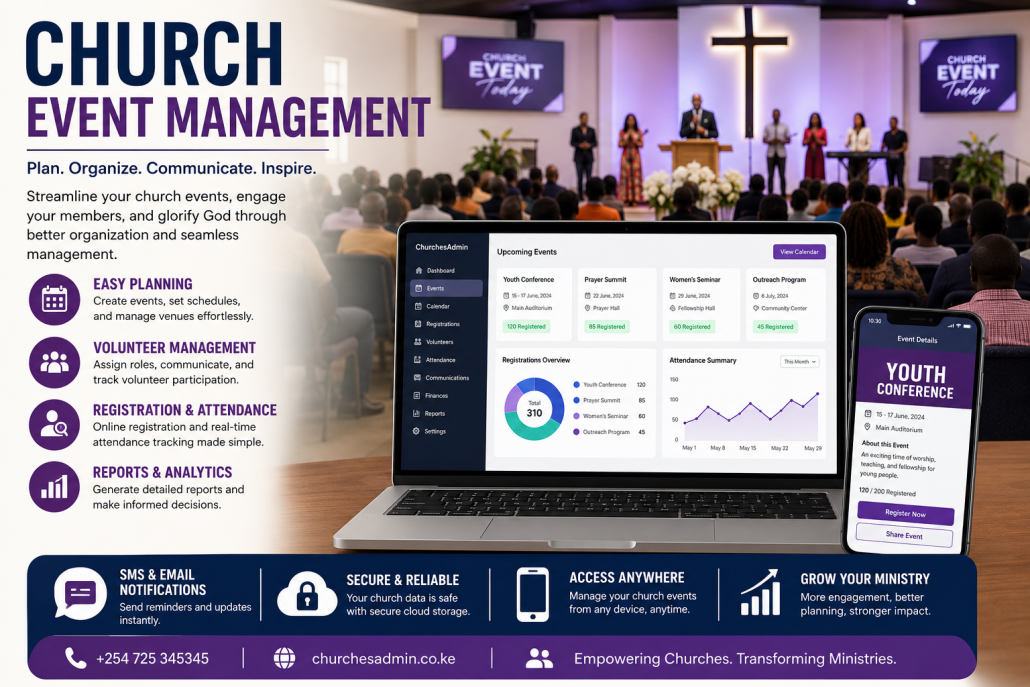
Ministry Administration Platform: A Complete Guide to Streamlining Church and Ministry Operations
Ministry Administration Platform

Effective ministry requires more than passionate leadership and committed volunteers. Behind every successful church, denomination, fellowship, or faith-based organization is an efficient administrative system that keeps ministries organized, communication flowing, members engaged, and daily operations running smoothly. As ministries continue to grow across Kenya, managing administrative responsibilities using paper files, spreadsheets, and disconnected systems becomes increasingly difficult. A Ministry Administration Platform provides a centralized digital solution that simplifies administration, improves communication, enhances collaboration, and supports sustainable ministry growth.
Churches today oversee a wide range of administrative responsibilities, including member management, volunteer coordination, event planning, attendance tracking, financial reporting, ministry scheduling, communication, pastoral care, document management, and leadership reporting. Without a centralized system, managing these activities consumes valuable time that could otherwise be devoted to ministry. A modern Ministry Administration Platform brings these essential functions together into one integrated environment that improves efficiency and accountability.
Across Kenya, churches are expanding through multiple branches, community outreach programs, youth ministries, women’s ministries, men’s fellowships, children’s departments, and mission activities. As these ministries grow, leaders require accurate information, organized records, and efficient communication to coordinate activities effectively. A professional Ministry Administration Platform enables church leaders to manage every ministry department from one secure and centralized platform while maintaining visibility into ministry performance and member engagement.
Traditional administrative methods often create duplicate records, communication delays, inconsistent reporting, misplaced documents, and unnecessary manual work. These challenges reduce operational efficiency and make strategic planning more difficult. A comprehensive Ministry Administration Platform automates repetitive administrative processes while providing church leadership with real-time information for informed decision-making.
Ministry administration extends beyond organizing schedules and maintaining records. Church leaders must coordinate volunteers, oversee ministry departments, monitor attendance, manage church events, communicate with members, allocate resources, supervise outreach programs, and evaluate ministry performance. A centralized Ministry Administration Platform integrates all these responsibilities into one scalable solution that supports both small congregations and large multi-campus ministries.
Whether serving independent churches, denominational headquarters, youth ministries, campus fellowships, mission organizations, or regional church networks throughout Kenya, implementing a Ministry Administration Platform enables churches to strengthen administration, improve collaboration, enhance member engagement, and support long-term ministry development.
Table of Contents
- Understanding Ministry Administration
- Why Digital Ministry Management Matters
- Core Features of a Ministry Administration Platform
- Managing Ministry Operations Efficiently
- Communication and Ministry Coordination
- Reporting and Leadership Insights
- Improving Church Administration
- Security and Ministry Data Protection
- Applications Across Different Church Ministries
Understanding Ministry Administration
Ministry administration involves organizing the daily activities that keep churches and faith-based organizations operating effectively. Ministry Administration Platform centralizes member information, ministry departments, volunteer records, attendance, communication, event planning, reporting, and leadership oversight into one integrated system.
Rather than managing separate spreadsheets, notebooks, and manual files, church leaders gain access to a centralized dashboard where every ministry activity can be monitored in real time. This improves operational efficiency while ensuring information remains accurate and accessible.
As churches continue to grow throughout Kenya, centralized ministry administration becomes increasingly important for maintaining effective leadership and supporting church expansion.
Why Digital Ministry Management Matters
Manual ministry administration often leads to duplicate information, communication delays, inconsistent reporting, and increased administrative workloads. Ministry Administration Platform digitizes administrative operations while improving organization, collaboration, and ministry effectiveness.
Churches benefit through:
- Better organizational structure
- Improved communication
- Faster information access
- Better ministry coordination
- Reduced paperwork
- Improved reporting
- Enhanced member engagement
- Greater operational efficiency
Digital administration enables ministry leaders to focus more on serving people rather than managing paperwork.
Core Features of a Ministry Administration Platform
A modern Ministry Administration Platform combines church administration, ministry management, communication, reporting, attendance, and leadership oversight into one centralized solution.
Core features include:
- Member management
- Ministry department management
- Volunteer coordination
- Attendance tracking
- Event planning
- Communication tools
- Task management
- Document management
- Pastoral care records
- Dashboard analytics
- Multi-branch church support
- Role-based permissions
- Audit logs
- Mobile accessibility
- Reporting dashboards
These capabilities improve ministry organization while supporting effective church leadership.
Managing Ministry Operations Efficiently
Churches oversee multiple ministries that require careful coordination. Ministry Administration Platform enables leaders to manage every ministry activity from one integrated dashboard.
Leaders can monitor:
- Ministry departments
- Volunteer assignments
- Church events
- Attendance
- Outreach activities
- Leadership meetings
- Pastoral visits
- Member participation
- Ministry schedules
- Resource allocation
Centralized management improves collaboration while strengthening ministry performance.
Communication and Ministry Coordination
Strong communication is essential for successful ministry. Ministry Administration Platform centralizes communication between church leadership, ministry teams, volunteers, and congregation members.
Communication capabilities include:
- Church announcements
- Ministry updates
- Volunteer schedules
- Event invitations
- Prayer requests
- Leadership communication
- Department notices
- Member follow-up
Consistent communication strengthens ministry coordination and congregation engagement.
Reporting and Leadership Insights
Church leaders require accurate information to evaluate ministry growth and make strategic decisions. Ministry Administration Platform generates comprehensive reports using real-time ministry data.
Reports include:
- Membership growth
- Attendance trends
- Volunteer participation
- Ministry activity
- Outreach performance
- Event participation
- Department reports
- Leadership dashboards
- Church analytics
- Ministry summaries
These reports support informed leadership while improving long-term ministry planning.
Improving Church Administration
Automation simplifies repetitive administrative work while improving consistency across church operations. Ministry Administration Platform automates many day-to-day administrative processes.
Churches can automate:
- Member registration
- Ministry assignments
- Attendance recording
- Volunteer scheduling
- Event registration
- Communication
- Report generation
- Administrative workflows
Automation improves productivity while allowing ministry teams to focus on serving their communities.
Security and Ministry Data Protection
Churches maintain confidential member and ministry information that requires secure management. Ministry Administration Platform includes enterprise-grade security features that protect church records while supporting accountability and responsible administration.
Security capabilities include:
- Role-based permissions
- Secure authentication
- Data encryption
- Audit logging
- Backup systems
- Secure document storage
- Administrative controls
- Historical record management
These security measures help churches protect valuable ministry information while maintaining operational confidence.
Applications Across Different Church Ministries
Ministry Administration Platform supports a wide range of ministries across Kenya.
Local churches coordinate members, volunteers, and ministry departments efficiently.
Multi-campus churches manage multiple congregations from one centralized platform.
Youth ministries organize young members, leaders, and outreach activities.
Children’s ministries manage attendance, volunteers, and family engagement.
Mission organizations coordinate field teams, outreach programs, and reporting.
Denominational headquarters oversee regional churches, ministry departments, and leadership activities.
For churches seeking a comprehensive administration solution, ChurchesAdmin provides advanced Ministry Administration Platform capabilities that integrate membership management, ministry coordination, volunteer administration, attendance tracking, communication, event management, pastoral care, reporting, and operational analytics into one centralized church management platform. Churches across Kenya can improve administration, strengthen ministry collaboration, and support sustainable church growth.
Benefits of Ministry Administration Platform for Different Stakeholders
A modern Ministry Administration Platform benefits everyone involved in church leadership and ministry operations. Senior pastors gain greater visibility into church activities, church administrators simplify daily management, ministry leaders coordinate teams more effectively, volunteers receive better organization, and church members experience improved communication and engagement. By centralizing administration, churches strengthen accountability while improving ministry effectiveness.
As churches continue expanding across Kenya, implementing a Ministry Administration Platform enables ministries to manage growing congregations and multiple departments without increasing administrative complexity.
Church Leadership
Church leaders require accurate information to guide ministry growth and make informed decisions. Ministry Administration Platform provides centralized oversight of church operations, ministry activities, member engagement, and leadership reporting.
Key benefits include:
- Better ministry visibility
- Improved strategic planning
- Accurate reporting
- Stronger pastoral oversight
- Faster decision-making
- Improved communication
- Reduced administrative workload
- Better ministry growth management
Leadership teams can monitor church performance through real-time dashboards and reports.
Church Administrators
Managing ministry operations manually often results in duplicated work, inconsistent records, and delayed communication. Ministry Administration Platform simplifies administration by organizing all operational activities in one centralized system.
Church administrators can:
- Manage member records
- Coordinate ministries
- Schedule church activities
- Track attendance
- Manage church documents
- Generate reports
- Organize events
- Oversee multiple church branches
Automation improves productivity while reducing repetitive administrative work.
Ministry Leaders
Each ministry requires organized planning and effective communication.
Using Ministry Administration Platform, ministry leaders can:
- Coordinate volunteers
- Monitor attendance
- Schedule meetings
- Manage ministry events
- Track member participation
- Assign responsibilities
- Communicate with teams
- Review ministry reports
Centralized coordination improves collaboration while supporting ministry growth.
Volunteers
Volunteers serve more effectively when ministry activities are well organized.
Benefits include:
- Clear ministry schedules
- Volunteer assignments
- Event notifications
- Better communication
- Ministry updates
- Training reminders
- Improved coordination
- Easier collaboration
Well-organized volunteer management strengthens ministry effectiveness.
Church Members
Church members benefit from improved communication and organized ministry administration.
Advantages include:
- Better engagement
- Faster communication
- Easier event registration
- Improved pastoral follow-up
- Ministry participation
- Accurate member records
- Timely announcements
- Better church experience
Professional administration helps members remain connected to church life.
Improving Efficiency Through Automation
Automation reduces repetitive administrative work while improving consistency across ministry operations. Ministry Administration Platform automates essential church management processes.
Automated Member Registration
The platform simplifies the onboarding process for new members.
Automation includes:
- Member registration
- Profile creation
- Family records
- Ministry assignments
- Membership updates
- Contact verification
- Digital documentation
- Historical records
Automated registration improves accuracy while reducing paperwork.
Automated Ministry Coordination
The platform streamlines ministry planning through automated workflows.
Automation supports:
- Volunteer scheduling
- Ministry calendars
- Team assignments
- Leadership notifications
- Department coordination
- Resource allocation
- Event preparation
- Follow-up activities
Automation helps ministry leaders coordinate activities more efficiently.
Automated Communication
The system automatically delivers important ministry information.
Notifications include:
- Church announcements
- Ministry meetings
- Volunteer reminders
- Prayer requests
- Event invitations
- Department updates
- Leadership notices
- Member communication
Automated communication strengthens ministry engagement while reducing manual follow-up.
Automated Reporting
Church leaders can generate reports instantly using real-time ministry information.
Reports include:
- Membership growth
- Attendance trends
- Volunteer participation
- Ministry performance
- Event participation
- Department activity
- Leadership summaries
- Church dashboards
Automated reporting supports informed decision-making and long-term ministry planning.
Compliance, Security and Risk Management
Churches manage confidential information that requires responsible protection. Ministry Administration Platform incorporates enterprise-grade security controls that protect ministry records while strengthening accountability.
Role-Based User Permissions
Different church workers require different access levels.
Typical user roles include:
- Senior Pastors
- Associate Pastors
- Church Administrators
- Ministry Leaders
- Department Heads
- Volunteers
- System Administrators
Role-based permissions ensure sensitive information remains accessible only to authorized users.
Secure Ministry Records
The platform securely stores:
- Member profiles
- Ministry records
- Volunteer information
- Attendance history
- Church documents
- Event records
- Communication history
- Administrative reports
Secure record management protects valuable ministry information while maintaining operational integrity.
Audit Trails
Every administrative activity is recorded automatically.
Audit logs include:
- Member registrations
- Ministry updates
- Attendance records
- User logins
- Administrative changes
- Leadership actions
Detailed audit records improve transparency and simplify administrative reviews.
Backup and Disaster Recovery
Reliable ministry administration depends on secure information protection.
Modern platforms provide:
- Automated backups
- Secure cloud storage
- Historical records
- Disaster recovery procedures
- Data restoration capabilities
These features ensure church information remains protected against unexpected incidents.
Reducing Administrative Risks
Professional Ministry Administration Platform helps churches reduce risks such as:
- Duplicate records
- Communication delays
- Lost documents
- Administrative errors
- Unauthorized access
- Inconsistent reporting
Centralized ministry management strengthens operational efficiency while supporting sustainable church growth.
Why ChurchesAdmin is the Ideal Ministry Administration Platform
Managing church administration requires more than maintaining membership records. Churches need an integrated platform that combines ministry coordination, volunteer management, attendance tracking, communication, event planning, reporting, pastoral care, and leadership oversight into one centralized solution.
ChurchesAdmin provides a comprehensive Ministry Administration Platform designed specifically for churches, ministries, denominations, mission organizations, and faith-based institutions seeking to modernize administration.
Core capabilities include:
- Member management
- Ministry coordination
- Volunteer administration
- Attendance tracking
- Event management
- Church communication
- Pastoral care records
- Dashboard analytics
- Multi-branch support
- Role-based access control
- Audit logging
- Leadership reporting
Whether serving a local congregation, a regional ministry, or a multi-campus church, ChurchesAdmin provides scalable tools that simplify administration while strengthening ministry collaboration and church growth across Kenya.
Future Trends in Ministry Administration Platform
Church technology continues evolving, and Ministry Administration Platform solutions will increasingly integrate advanced digital technologies that improve ministry effectiveness.
Artificial Intelligence
AI-powered ministry platforms will support:
- Member engagement analysis
- Attendance forecasting
- Automated pastoral follow-up
- Intelligent reporting
- Ministry performance insights
Artificial intelligence will help church leaders make more informed ministry decisions.
Member Self-Service Portals
Future platforms will allow members to:
- Update personal information
- Register for ministries
- Volunteer for events
- Access announcements
- Receive ministry resources
Self-service capabilities will improve engagement while reducing administrative workloads.
Cloud-Based Church Administration
Cloud technology will provide:
- Remote administration
- Multi-campus coordination
- Secure online access
- Real-time updates
- Automatic software upgrades
Cloud-based solutions will improve flexibility while supporting expanding ministries.
Integrated Ministry Ecosystems
Future platforms will integrate seamlessly with:
- Online giving systems
- Church websites
- Live streaming platforms
- Communication tools
- Event registration systems
Integrated technologies will strengthen digital ministry experiences.
Greater Automation
Future Ministry Administration Platform solutions will automate:
- Ministry scheduling
- Volunteer coordination
- Attendance reporting
- Leadership dashboards
- Administrative workflows
Automation will continue improving efficiency while reducing administrative workloads.
Getting Started with Ministry Administration Platform
Implementing a Ministry Administration Platform begins with reviewing existing administrative processes, member records, ministry structures, volunteer lists, attendance records, communication methods, and leadership reporting. Church administrators should organize ministry departments, member information, event calendars, volunteer assignments, and operational procedures before migrating to a centralized platform.
The next step involves configuring user roles, importing member data, creating ministry departments, establishing communication workflows, enabling attendance tracking, and setting up reporting dashboards. Church staff, ministry leaders, and administrators should receive training on daily platform operations, ministry coordination, reporting, communication tools, and user management to maximize efficiency.
After implementation, church leadership should continuously update ministry records, monitor participation trends, evaluate volunteer engagement, review ministry performance reports, strengthen data security, and optimize administrative workflows as the church grows. For churches throughout Kenya, adopting a Ministry Administration Platform provides a scalable foundation for efficient administration, stronger collaboration, and sustainable ministry development.
Conclusion
Strong administration forms the foundation of an effective and growing ministry. Manual processes often lead to communication gaps, inconsistent records, administrative delays, and reduced visibility into ministry activities. Ministry Administration Platform enables churches to centralize administration, automate routine tasks, improve communication, and strengthen ministry coordination.
By integrating membership management, ministry coordination, volunteer administration, attendance tracking, communication, event planning, reporting, and operational analytics into one centralized platform, churches can improve efficiency while allowing leaders to devote more time to discipleship, outreach, and pastoral care. This strengthens collaboration, improves decision-making, and prepares ministries for long-term growth.
Whether serving local congregations, denominational headquarters, youth ministries, mission organizations, or multi-campus churches, organizations that implement Ministry Administration Platform position themselves for sustainable ministry success. With ChurchesAdmin, churches across Kenya can confidently modernize administration, improve ministry effectiveness, and build stronger, more connected faith communities.
Benefits of Ministry Administration Platform for Different Stakeholders
A modern Ministry Administration Platform benefits everyone involved in church leadership and ministry operations. Senior pastors gain greater visibility into church activities, church administrators simplify daily management, ministry leaders coordinate teams more effectively, volunteers receive better organization, and church members experience improved communication and engagement. By centralizing administration, churches strengthen accountability while improving ministry effectiveness.
As churches continue expanding across Kenya, implementing a Ministry Administration Platform enables ministries to manage growing congregations and multiple departments without increasing administrative complexity.
Church Leadership
Church leaders require accurate information to guide ministry growth and make informed decisions. Ministry Administration Platform provides centralized oversight of church operations, ministry activities, member engagement, and leadership reporting.
Key benefits include:
- Better ministry visibility
- Improved strategic planning
- Accurate reporting
- Stronger pastoral oversight
- Faster decision-making
- Improved communication
- Reduced administrative workload
- Better ministry growth management
Leadership teams can monitor church performance through real-time dashboards and reports.
Church Administrators
Managing ministry operations manually often results in duplicated work, inconsistent records, and delayed communication. Ministry Administration Platform simplifies administration by organizing all operational activities in one centralized system.
Church administrators can:
- Manage member records
- Coordinate ministries
- Schedule church activities
- Track attendance
- Manage church documents
- Generate reports
- Organize events
- Oversee multiple church branches
Automation improves productivity while reducing repetitive administrative work.
Ministry Leaders
Each ministry requires organized planning and effective communication.
Using Ministry Administration Platform, ministry leaders can:
- Coordinate volunteers
- Monitor attendance
- Schedule meetings
- Manage ministry events
- Track member participation
- Assign responsibilities
- Communicate with teams
- Review ministry reports
Centralized coordination improves collaboration while supporting ministry growth.
Volunteers
Volunteers serve more effectively when ministry activities are well organized.
Benefits include:
- Clear ministry schedules
- Volunteer assignments
- Event notifications
- Better communication
- Ministry updates
- Training reminders
- Improved coordination
- Easier collaboration
Well-organized volunteer management strengthens ministry effectiveness.
Church Members
Church members benefit from improved communication and organized ministry administration.
Advantages include:
- Better engagement
- Faster communication
- Easier event registration
- Improved pastoral follow-up
- Ministry participation
- Accurate member records
- Timely announcements
- Better church experience
Professional administration helps members remain connected to church life.
Improving Efficiency Through Automation
Automation reduces repetitive administrative work while improving consistency across ministry operations. Ministry Administration Platform automates essential church management processes.
Automated Member Registration
The platform simplifies the onboarding process for new members.
Automation includes:
- Member registration
- Profile creation
- Family records
- Ministry assignments
- Membership updates
- Contact verification
- Digital documentation
- Historical records
Automated registration improves accuracy while reducing paperwork.
Automated Ministry Coordination
The platform streamlines ministry planning through automated workflows.
Automation supports:
- Volunteer scheduling
- Ministry calendars
- Team assignments
- Leadership notifications
- Department coordination
- Resource allocation
- Event preparation
- Follow-up activities
Automation helps ministry leaders coordinate activities more efficiently.
Automated Communication
The system automatically delivers important ministry information.
Notifications include:
- Church announcements
- Ministry meetings
- Volunteer reminders
- Prayer requests
- Event invitations
- Department updates
- Leadership notices
- Member communication
Automated communication strengthens ministry engagement while reducing manual follow-up.
Automated Reporting
Church leaders can generate reports instantly using real-time ministry information.
Reports include:
- Membership growth
- Attendance trends
- Volunteer participation
- Ministry performance
- Event participation
- Department activity
- Leadership summaries
- Church dashboards
Automated reporting supports informed decision-making and long-term ministry planning.
Compliance, Security and Risk Management
Churches manage confidential information that requires responsible protection. Ministry Administration Platform incorporates enterprise-grade security controls that protect ministry records while strengthening accountability.
Role-Based User Permissions
Different church workers require different access levels.
Typical user roles include:
- Senior Pastors
- Associate Pastors
- Church Administrators
- Ministry Leaders
- Department Heads
- Volunteers
- System Administrators
Role-based permissions ensure sensitive information remains accessible only to authorized users.
Secure Ministry Records
The platform securely stores:
- Member profiles
- Ministry records
- Volunteer information
- Attendance history
- Church documents
- Event records
- Communication history
- Administrative reports
Secure record management protects valuable ministry information while maintaining operational integrity.
Audit Trails
Every administrative activity is recorded automatically.
Audit logs include:
- Member registrations
- Ministry updates
- Attendance records
- User logins
- Administrative changes
- Leadership actions
Detailed audit records improve transparency and simplify administrative reviews.
Backup and Disaster Recovery
Reliable ministry administration depends on secure information protection.
Modern platforms provide:
- Automated backups
- Secure cloud storage
- Historical records
- Disaster recovery procedures
- Data restoration capabilities
These features ensure church information remains protected against unexpected incidents.
Reducing Administrative Risks
Professional Ministry Administration Platform helps churches reduce risks such as:
- Duplicate records
- Communication delays
- Lost documents
- Administrative errors
- Unauthorized access
- Inconsistent reporting
Centralized ministry management strengthens operational efficiency while supporting sustainable church growth.
Why ChurchesAdmin is the Ideal Ministry Administration Platform
Managing church administration requires more than maintaining membership records. Churches need an integrated platform that combines ministry coordination, volunteer management, attendance tracking, communication, event planning, reporting, pastoral care, and leadership oversight into one centralized solution.
ChurchesAdmin provides a comprehensive Ministry Administration Platform designed specifically for churches, ministries, denominations, mission organizations, and faith-based institutions seeking to modernize administration.
Core capabilities include:
- Member management
- Ministry coordination
- Volunteer administration
- Attendance tracking
- Event management
- Church communication
- Pastoral care records
- Dashboard analytics
- Multi-branch support
- Role-based access control
- Audit logging
- Leadership reporting
Whether serving a local congregation, a regional ministry, or a multi-campus church, ChurchesAdmin provides scalable tools that simplify administration while strengthening ministry collaboration and church growth across Kenya.
Future Trends in Ministry Administration Platform
Church technology continues evolving, and Ministry Administration Platform solutions will increasingly integrate advanced digital technologies that improve ministry effectiveness.
Artificial Intelligence
AI-powered ministry platforms will support:
- Member engagement analysis
- Attendance forecasting
- Automated pastoral follow-up
- Intelligent reporting
- Ministry performance insights
Artificial intelligence will help church leaders make more informed ministry decisions.
Member Self-Service Portals
Future platforms will allow members to:
- Update personal information
- Register for ministries
- Volunteer for events
- Access announcements
- Receive ministry resources
Self-service capabilities will improve engagement while reducing administrative workloads.
Cloud-Based Church Administration
Cloud technology will provide:
- Remote administration
- Multi-campus coordination
- Secure online access
- Real-time updates
- Automatic software upgrades
Cloud-based solutions will improve flexibility while supporting expanding ministries.
Integrated Ministry Ecosystems
Future platforms will integrate seamlessly with:
- Online giving systems
- Church websites
- Live streaming platforms
- Communication tools
- Event registration systems
Integrated technologies will strengthen digital ministry experiences.
Greater Automation
Future Ministry Administration Platform solutions will automate:
- Ministry scheduling
- Volunteer coordination
- Attendance reporting
- Leadership dashboards
- Administrative workflows
Automation will continue improving efficiency while reducing administrative workloads.
Getting Started with Ministry Administration Platform
Implementing a Ministry Administration Platform begins with reviewing existing administrative processes, member records, ministry structures, volunteer lists, attendance records, communication methods, and leadership reporting. Church administrators should organize ministry departments, member information, event calendars, volunteer assignments, and operational procedures before migrating to a centralized platform.
The next step involves configuring user roles, importing member data, creating ministry departments, establishing communication workflows, enabling attendance tracking, and setting up reporting dashboards. Church staff, ministry leaders, and administrators should receive training on daily platform operations, ministry coordination, reporting, communication tools, and user management to maximize efficiency.
After implementation, church leadership should continuously update ministry records, monitor participation trends, evaluate volunteer engagement, review ministry performance reports, strengthen data security, and optimize administrative workflows as the church grows. For churches throughout Kenya, adopting a Ministry Administration Platform provides a scalable foundation for efficient administration, stronger collaboration, and sustainable ministry development.
Conclusion
Strong administration forms the foundation of an effective and growing ministry. Manual processes often lead to communication gaps, inconsistent records, administrative delays, and reduced visibility into ministry activities. Ministry Administration Platform enables churches to centralize administration, automate routine tasks, improve communication, and strengthen ministry coordination.
By integrating membership management, ministry coordination, volunteer administration, attendance tracking, communication, event planning, reporting, and operational analytics into one centralized platform, churches can improve efficiency while allowing leaders to devote more time to discipleship, outreach, and pastoral care. This strengthens collaboration, improves decision-making, and prepares ministries for long-term growth.
Whether serving local congregations, denominational headquarters, youth ministries, mission organizations, or multi-campus churches, organizations that implement Ministry Administration Platform position themselves for sustainable ministry success. With ChurchesAdmin, churches across Kenya can confidently modernize administration, improve ministry effectiveness, and build stronger, more connected faith communities.