Church Tithes Management: The Complete Guide to Efficient Church Tithe Tracking and Administration

church tithes management

church tithes management

Managing church finances is one of the greatest responsibilities entrusted to church leaders. Among the most important aspects of financial stewardship is church tithes management. Whether your church has 50 members or thousands of worshippers attending weekly services, having an organized church tithes management system ensures accountability, transparency, and proper stewardship of God’s resources.

Modern churches are increasingly replacing paper records and spreadsheets with digital church tithes management software. A reliable church management system simplifies recording tithes, generating financial reports, tracking donor contributions, and ensuring every offering is properly accounted for.

At ChurchesAdmin.co.ke, we provide an all-in-one church tithes management solution designed specifically for churches in Kenya and beyond. Our software enables churches to manage members, tithes, offerings, events, finances, visitor management, communication, and much more from one secure platform.

If you’d like to learn more about our church management solution, contact us today on +254 725345345.


What is Church Tithes Management?

Church tithes management refers to the systematic process of collecting, recording, tracking, managing, reporting, and safeguarding church tithes and offerings. It includes every financial contribution made by members and visitors to support church ministry.

Effective church tithes management involves:

  • Recording member tithes
  • Tracking offerings
  • Managing special contributions
  • Recording thanksgiving offerings
  • Tracking missions giving
  • Managing building fund donations
  • Producing financial statements
  • Monitoring church income
  • Maintaining donor histories
  • Ensuring financial accountability

Without an organized church tithes management system, churches risk inaccurate financial records, misplaced donations, reporting errors, and reduced transparency.


Why Church Tithes Management Matters

Many churches still rely on notebooks or Excel spreadsheets to record contributions. While these methods may work for smaller congregations, they become increasingly difficult as the church grows.

Proper church tithes management provides:

Financial Accountability

Members deserve confidence that every tithe is handled responsibly. A structured church tithes management process builds trust.

Accurate Records

Every contribution is recorded with:

  • Date
  • Member name
  • Contribution amount
  • Payment method
  • Fund category
  • Receipt number

This eliminates guesswork.

Faster Reporting

Church leaders can instantly generate:

  • Daily income reports
  • Weekly reports
  • Monthly reports
  • Annual financial reports
  • Donor summaries
  • Ministry fund reports

instead of spending hours compiling spreadsheets.

Better Stewardship

Biblical stewardship involves wisely managing every resource God entrusts to the church. Modern church tithes management supports this mission through accuracy and accountability.


Challenges Churches Face Without Church Tithes Management Software

Many churches experience common financial challenges because they lack a centralized church tithes management system.

These challenges include:

Lost Records

Paper books can be misplaced.

Excel files may become corrupted.

Computers may fail.

Without cloud-based church tithes management, years of giving history can disappear.


Duplicate Entries

Manual recording often leads to duplicate transactions, affecting financial accuracy.


Human Errors

Simple mistakes include:

  • Wrong amounts
  • Wrong dates
  • Wrong member names
  • Missing receipts
  • Missing categories

Modern church tithes management software reduces these errors significantly.


Slow Reporting

Preparing monthly reports manually may take several days.

With automated church tithes management, reports are generated instantly.


Lack of Transparency

Church members appreciate openness regarding finances.

Proper church tithes management improves financial transparency while protecting confidential donor information.


Features Every Church Tithes Management System Should Have

Not every financial system is designed for churches.

A dedicated church tithes management solution should include church-specific features.

1. Member Giving Records

Every member should have a complete giving profile showing:

  • Total tithes
  • Monthly giving
  • Annual giving
  • Special donations
  • Building fund contributions
  • Missions support

Historical giving records are invaluable during audits and financial planning.


2. Multiple Giving Categories

Churches receive different types of contributions, including:

  • Tithes
  • Sunday offerings
  • Thanksgiving offerings
  • Seed offerings
  • Missions support
  • Development fund
  • Building fund
  • Youth ministry contributions
  • Women’s ministry donations
  • Men’s fellowship donations

An effective church tithes management system separates these automatically.


3. Receipt Generation

Members appreciate official receipts.

Modern church tithes management software automatically generates:

  • Printable receipts
  • Digital receipts
  • Email receipts
  • SMS confirmations

4. Financial Reports

Reports should include:

  • Income summaries
  • Daily collections
  • Weekly collections
  • Monthly giving
  • Annual giving
  • Fund balances
  • Department income
  • Individual contribution history

Good church tithes management software generates these reports in seconds.


5. User Permissions

Not everyone should access church financial information.

Different permissions should exist for:

  • Treasurer
  • Accountant
  • Senior pastor
  • Finance committee
  • Church administrator
  • Auditors

Secure church tithes management protects sensitive financial records.


6. Cloud Backup

Cloud-based church tithes management prevents data loss.

Benefits include:

  • Automatic backups
  • Secure storage
  • Remote access
  • Disaster recovery
  • Multiple device support

Benefits of Digital Church Tithes Management

Digital transformation is changing churches worldwide.

Moving from manual records to digital church tithes management offers numerous advantages.

Saves Time

Recording contributions becomes much faster.

Instead of spending hours updating ledgers, church staff complete entries in minutes.


Improves Accuracy

Automated calculations eliminate common accounting mistakes.

This improves financial confidence.


Better Decision Making

Church leaders gain insights into:

  • Monthly giving trends
  • Seasonal giving patterns
  • Budget performance
  • Ministry funding
  • Financial growth

Data-driven leadership becomes possible.


Better Member Service

Members may request:

  • Contribution statements
  • Annual giving summaries
  • Donation receipts

Modern church tithes management provides these instantly.


Church Tithes Management Best Practices

Every church should establish financial procedures that promote accountability.

Recommended practices include:

Record Every Contribution Immediately

Avoid waiting until the end of the week.

Real-time recording improves accuracy.


Separate Financial Duties

Different people should handle:

  • Collection
  • Counting
  • Recording
  • Depositing
  • Reporting

This strengthens internal controls.


Conduct Regular Audits

Periodic financial reviews improve accountability.

A quality church tithes management system simplifies auditing.


Maintain Member Privacy

Contribution records should remain confidential.

Only authorized personnel should access donor information.


Backup Data Frequently

Cloud-based systems perform automatic backups, ensuring records remain secure.


How ChurchesAdmin.co.ke Simplifies Church Tithes Management

ChurchesAdmin.co.ke is more than just accounting software.

It is a complete church administration platform that integrates church tithes management with every aspect of church operations.

Our solution includes:

  • Church member management
  • Visitor management
  • Financial management
  • Church accounting
  • Attendance tracking
  • Event management
  • Communication tools
  • Ministry management
  • Reports and analytics
  • Online accessibility
  • Secure cloud storage

This integration eliminates duplicate work while giving church leaders complete visibility into church operations.


Why Churches in Kenya Need Modern Church Tithes Management

Churches across Kenya are experiencing significant growth. As congregations expand, managing finances manually becomes increasingly difficult.

Whether your church is located in:

  • Nairobi
  • Mombasa
  • Kisumu
  • Nakuru
  • Eldoret
  • Kiambu
  • Machakos
  • Nyeri
  • Meru
  • Kakamega

or any other county, implementing a professional church tithes management system can greatly improve financial administration.

Digital records also make it easier to prepare reports for church boards, finance committees, and annual general meetings while ensuring transparency and accountability.

Building an Effective Church Giving System for Long-Term Growth

As churches continue to grow, financial administration becomes more complex. New members join regularly, ministries expand, outreach activities increase, and multiple projects require funding. Managing these responsibilities efficiently requires a structured process supported by reliable technology.

An organized approach to handling donations does more than improve bookkeeping—it strengthens trust, enhances accountability, and allows church leaders to focus more on ministry rather than paperwork.


A Simple Workflow for Managing Church Contributions

Every church, regardless of size, benefits from having a standardized financial workflow. Establishing clear procedures ensures consistency while reducing errors and misunderstandings.

A practical workflow may include the following steps:

Step 1: Collection

Contributions may be received through several channels including:

  • Sunday services
  • Midweek fellowships
  • Conferences
  • Revival meetings
  • Youth gatherings
  • Women’s and men’s fellowships
  • Online giving platforms
  • Mobile money services
  • Bank deposits

Each contribution should be acknowledged and directed into the appropriate church fund.


Step 2: Verification

Once collections have been received, the finance team should verify the total amount before it is entered into the system.

Good practices include:

  • Counting funds in the presence of multiple authorized individuals
  • Recording totals immediately
  • Comparing physical collections with recorded entries
  • Preparing deposit slips promptly

Verification minimizes discrepancies and strengthens internal controls.


Step 3: Recording

After verification, contributions should be entered into the church management system.

Information commonly recorded includes:

  • Date
  • Contributor (where applicable)
  • Amount
  • Payment method
  • Ministry or fund
  • Reference number
  • Notes if necessary

Digital records eliminate many of the challenges associated with handwritten ledgers.


Step 4: Banking

Funds should be deposited without unnecessary delays.

Prompt banking:

  • Improves security
  • Reduces cash-handling risks
  • Simplifies reconciliation
  • Provides accurate financial records

Step 5: Reporting

Regular reports help church leadership understand financial performance and make informed decisions.

Reports can be reviewed:

  • Weekly
  • Monthly
  • Quarterly
  • Annually

These reports become valuable during budgeting, planning, and annual meetings.


Supporting Different Types of Church Giving

Every church receives contributions for different purposes. Organizing them into separate categories makes financial reporting much clearer.

Examples include:

General Giving

These funds support everyday church operations including utilities, salaries, maintenance, and ministry activities.


Building Projects

Construction and renovation projects often involve separate fundraising campaigns.

Tracking these contributions independently helps maintain transparency.


Missions Support

Many churches support missionaries, church planting, evangelism, and community outreach.

Separate reporting allows members to see how these funds are being utilized.


Welfare and Benevolence

Churches frequently assist members and surrounding communities during times of need.

Proper financial records help ensure these funds are distributed responsibly.


Special Events

Annual conferences, youth camps, leadership seminars, and conventions often require dedicated budgeting.

Keeping event finances separate makes reconciliation much easier.


Integrating Financial Management with Church Administration

Financial records should not exist in isolation.

When financial information connects with the rest of church administration, leaders gain a more complete picture of ministry operations.

For example, integration allows administrators to:

  • Link contributions to member profiles
  • Generate annual giving statements
  • View ministry participation
  • Monitor attendance alongside engagement
  • Improve communication with members
  • Prepare comprehensive reports

Instead of using several unrelated systems, churches benefit from managing everything within one platform.


Using Mobile Technology to Improve Giving

Digital payment methods have transformed how people contribute.

Many church members today prefer cashless giving because it is fast, secure, and convenient.

Common payment channels include:

  • Mobile money
  • Debit cards
  • Credit cards
  • Online banking
  • Bank transfers

Supporting multiple payment options encourages consistent giving while making reconciliation easier for finance teams.


Financial Transparency Builds Trust

One of the greatest responsibilities of church leadership is maintaining trust.

Members give generously because they believe in the mission of the church. Demonstrating careful stewardship encourages continued confidence.

Transparency can be strengthened by:

  • Presenting regular financial summaries
  • Providing receipts where appropriate
  • Conducting independent audits
  • Following approved financial procedures
  • Maintaining complete documentation

Clear reporting reassures members that resources are being managed responsibly.


Data Security Matters

Financial information is among the most sensitive data a church handles.

Protecting this information should be a priority.

Modern cloud-based systems help safeguard records through:

  • Secure user authentication
  • Encrypted databases
  • Automatic backups
  • Controlled access permissions
  • Activity logs
  • Disaster recovery options

These safeguards reduce the risk of data loss and unauthorized access.


Common Mistakes Churches Should Avoid

Even well-intentioned churches can encounter challenges if financial processes are not clearly defined.

Some common mistakes include:

Relying on One Individual

When only one person handles collections, recording, deposits, and reporting, accountability is reduced.

Shared responsibilities create stronger internal controls.


Delaying Data Entry

Waiting several days before recording contributions increases the possibility of forgotten details or missing information.

Recording transactions promptly improves accuracy.


Mixing Personal and Church Funds

Church finances should always remain separate from personal accounts.

Dedicated church bank accounts and proper authorization procedures help maintain professionalism.


Ignoring Regular Reconciliation

Comparing bank statements with internal records should become a routine practice.

Regular reconciliation quickly identifies inconsistencies before they become larger issues.


Failing to Back Up Data

Digital records should always be protected with reliable backups.

Cloud storage provides an additional layer of security against hardware failure or accidental deletion.


Planning for Future Growth

As congregations expand, administrative demands increase.

Choosing scalable software today prevents unnecessary migration challenges later.

A growing church may eventually require features such as:

  • Multiple branch management
  • Multi-campus reporting
  • Department budgeting
  • Payroll support
  • Asset management
  • Event registration
  • Volunteer coordination
  • Communication tools
  • Document storage
  • Attendance analytics

Planning ahead saves both time and resources.


Why ChurchesAdmin.co.ke is an Excellent Choice

ChurchesAdmin.co.ke has been designed specifically for churches seeking a comprehensive administration platform rather than a generic accounting application.

The platform brings together essential functions in one secure environment, including:

  • Member management
  • Visitor management
  • Financial administration
  • Attendance tracking
  • Event scheduling
  • Ministry management
  • Communication tools
  • Reporting and analytics
  • Secure cloud access
  • Multi-user support

Because everything is connected, church leaders spend less time managing paperwork and more time serving their congregation.

Whether your church is small, medium-sized, or rapidly expanding, the system adapts to your operational needs while remaining simple to use.


Frequently Asked Questions

Is the system suitable for small churches?

Yes. Small congregations benefit from organized record keeping just as much as larger ministries. The platform scales as your church grows.


Can multiple finance team members access the system?

Yes. User accounts can be assigned different permission levels depending on responsibilities.


Is historical giving information preserved?

Yes. Previous contribution records remain available, making it easy to generate reports and review past financial activity.


Can reports be generated quickly?

Absolutely. Financial summaries, contribution histories, and income reports can be produced within seconds.


Can the software be accessed from different locations?

Yes. Since the platform is cloud-based, authorized users can securely access information from the office, home, or while traveling.


Strengthening Ministry Through Better Financial Planning

Effective financial management is about more than balancing income and expenses—it is about creating a strong foundation for ministry. When church leaders have access to accurate financial information, they can plan confidently for future projects, outreach programs, discipleship initiatives, and community support activities. Reliable records make it easier to prepare annual budgets, evaluate ministry performance, and allocate resources where they are needed most.

A well-organized system also improves communication between pastors, finance committees, church boards, and ministry leaders. Instead of relying on assumptions or incomplete records, decision-makers can use up-to-date reports to guide discussions and make informed choices. This collaborative approach promotes accountability while ensuring that every financial decision supports the church’s mission and vision.

As churches embrace digital transformation, administrative tasks become simpler and more efficient. Staff and volunteers spend less time handling paperwork and more time serving members, organizing events, and supporting ministry activities. Automated reporting, secure cloud storage, and centralized record management reduce repetitive work while improving accuracy across all financial operations.

Ultimately, investing in modern church administration technology is an investment in the future of the ministry. With organized records, transparent financial practices, and dependable reporting tools, churches are better equipped to grow sustainably, respond to community needs, and remain faithful stewards of the resources entrusted to them. This long-term approach creates a stronger, more resilient church that is prepared to serve both its congregation and the wider community for many years to come.

Final Thoughts

Strong financial stewardship is an essential part of effective church leadership. Organized processes, accurate records, timely reporting, and secure data management help churches operate with integrity while supporting their ministry goals.

Moving from manual record keeping to an integrated digital solution allows church leaders to spend less time on administration and more time focusing on discipleship, outreach, worship, and community impact.

Whether your congregation is just beginning its digital journey or looking to replace outdated systems, investing in modern church administration software is a practical step toward greater efficiency and accountability.

At ChurchesAdmin.co.ke, we are committed to helping churches simplify administration through reliable, secure, and easy-to-use technology. Our platform combines financial management, member records, attendance, visitor management, communication, and reporting into one powerful solution that supports churches of every size.

If you’re ready to modernize your church’s administration and improve financial accountability, ChurchesAdmin.co.ke is here to help.

Contact us today

Website: ChurchesAdmin.co.ke
Phone: +254 725345345

Empower your church with smarter administration, stronger stewardship, and the technology needed to support ministry today and into the future.
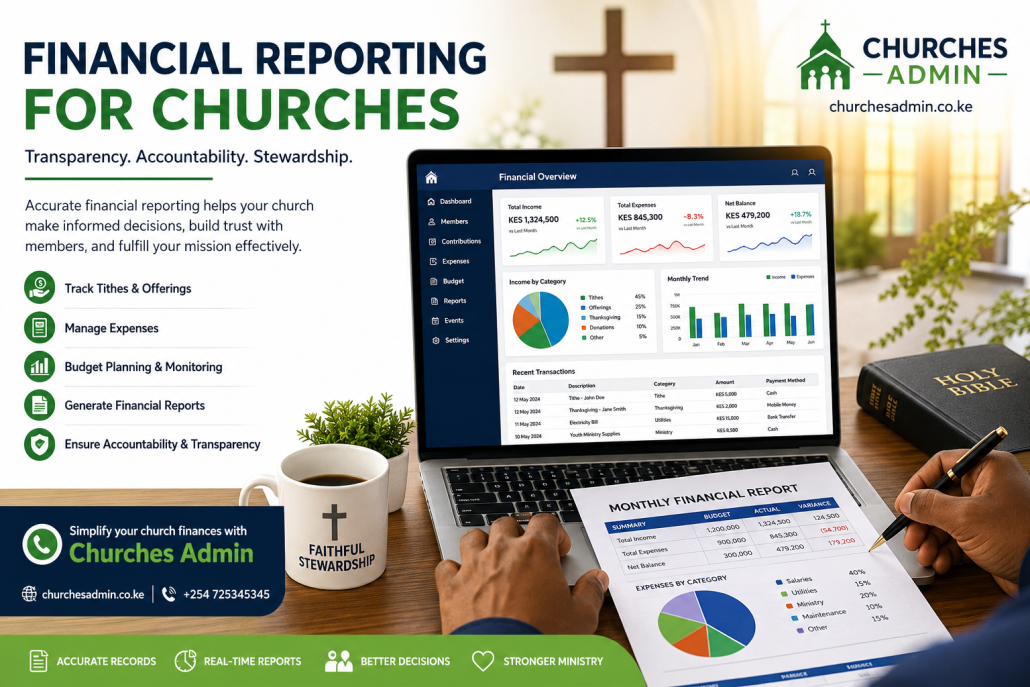
Financial Reporting for Churches: The Complete Guide to Transparent Church Financial Management

financial reporting for churches

financial reporting for churches

Financial reporting for churches is no longer an optional administrative task. Every church, whether small, medium, or large, must maintain accurate financial records to ensure accountability, transparency, compliance, and wise stewardship of God’s resources. Effective financial reporting for churches helps church leaders make informed decisions, strengthens donor confidence, simplifies audits, and promotes sustainable ministry growth.

In today’s digital world, churches are increasingly moving away from manual bookkeeping and spreadsheets toward dedicated Church Financial Management Software. Platforms like Churches Admin help churches automate financial reporting, track donations, manage budgets, generate detailed reports, and improve financial accountability.

If your church wants to maintain accurate records while remaining transparent with members, this comprehensive guide will help you understand everything about financial reporting for churches and why adopting modern church management software is the smartest investment.


What is Financial Reporting for Churches?

Financial reporting for churches is the systematic recording, organizing, analyzing, and presenting of all financial transactions within a church. These reports provide church leaders, finance committees, pastors, elders, donors, and auditors with a clear picture of how church funds are received and spent.

Financial reporting includes:

  • Tithes reporting
  • Offering reports
  • Donation tracking
  • Expense reports
  • Budget reports
  • Bank reconciliation
  • Cash flow statements
  • Income statements
  • Balance sheets
  • Ministry expenditure reports
  • Project financial reports
  • Annual financial statements

Unlike businesses that focus on profits, financial reporting for churches focuses on stewardship, accountability, compliance, and supporting ministry objectives.


Why Financial Reporting for Churches Matters

Churches manage funds entrusted by members who expect honesty, transparency, and accountability. Poor financial management can lead to:

  • Loss of member trust
  • Misuse of church funds
  • Accounting errors
  • Poor budgeting
  • Audit challenges
  • Leadership conflicts
  • Tax compliance issues
  • Fraud risks

Proper financial reporting for churches eliminates these risks while improving financial decision-making.

Benefits include:

  • Better transparency
  • Increased donor confidence
  • Easier budgeting
  • Accurate expenditure tracking
  • Better ministry planning
  • Improved accountability
  • Easier auditing
  • Financial sustainability

Components of Financial Reporting for Churches

A complete financial reporting for churches process consists of several essential reports.

1. Income Reports

Income reports summarize every source of church revenue.

Typical income sources include:

  • Tithes
  • Sunday offerings
  • Special offerings
  • Building fund contributions
  • Missions giving
  • Thanksgiving offerings
  • Donations
  • Fundraising income
  • Event revenue
  • Rental income

Accurate income reports ensure every contribution is properly recorded.


2. Expense Reports

Expense reports track how church money is spent.

Examples include:

  • Staff salaries
  • Utility bills
  • Office supplies
  • Church maintenance
  • Worship equipment
  • Evangelism programs
  • Youth ministry
  • Children’s ministry
  • Mission support
  • Charity programs
  • Building maintenance

Proper expense reporting supports responsible stewardship.


3. Cash Flow Reports

Cash flow reports show:

  • Money received
  • Money spent
  • Current balances
  • Future financial position

Cash flow reports help church leaders avoid financial shortages.


4. Budget Reports

Budget reports compare:

  • Planned spending
  • Actual spending
  • Budget variances

This helps ministries remain within approved budgets.


5. Balance Sheets

Balance sheets summarize church assets and liabilities.

Assets include:

  • Church buildings
  • Land
  • Vehicles
  • Equipment
  • Bank balances
  • Investments

Liabilities include:

  • Loans
  • Outstanding bills
  • Contractor payments

6. Donation Reports

Donation reports monitor:

  • Individual giving
  • Family giving
  • Ministry giving
  • Annual giving
  • Campaign donations
  • Mission donations

These reports simplify donor appreciation and year-end summaries.


Challenges of Manual Financial Reporting for Churches

Many churches still depend on notebooks, Excel spreadsheets, and handwritten receipt books.

Unfortunately, manual systems create problems such as:

Human Errors

Manual calculations often produce:

  • Incorrect totals
  • Missing receipts
  • Duplicate entries
  • Lost records

Time Consumption

Preparing monthly reports manually may require several days.

Finance teams spend excessive time:

  • Summing receipts
  • Reconciling bank statements
  • Matching expenses
  • Preparing reports

Limited Accountability

Without centralized records:

  • Transactions become difficult to verify.
  • Receipts may disappear.
  • Unauthorized spending can go unnoticed.

Difficult Audits

Manual systems complicate audits because documents may be:

  • Missing
  • Damaged
  • Unorganized

Poor Data Security

Paper records can be:

  • Lost
  • Burned
  • Stolen
  • Damaged by water

Digital systems eliminate many of these risks.


Digital Financial Reporting for Churches

Modern churches are adopting church financial software because it automates financial management.

A digital financial reporting for churches solution provides:

  • Real-time reports
  • Automatic calculations
  • Secure backups
  • Multiple user access
  • Audit trails
  • Budget monitoring
  • Receipt generation
  • Donation tracking

This significantly improves efficiency.


Features of Church Financial Reporting Software

Modern church accounting software includes many useful features.

Automated Income Recording

Every donation can be recorded instantly.

Examples include:

  • Tithes
  • Offerings
  • Mobile money
  • Bank deposits
  • Online giving

No manual calculations are required.


Expense Management

Finance officers can record expenses immediately after payment.

Information captured includes:

  • Amount
  • Vendor
  • Category
  • Ministry
  • Payment method
  • Supporting documents

Budget Management

Software compares:

Budgeted Amount

vs

Actual Spending

This helps leaders identify overspending before it becomes a problem.


Financial Dashboards

Dashboards display:

  • Monthly income
  • Monthly expenses
  • Cash balances
  • Giving trends
  • Budget performance

Church leaders obtain instant financial insights.


Automated Report Generation

Reports can be generated instantly.

Examples include:

  • Monthly reports
  • Quarterly reports
  • Annual reports
  • Ministry reports
  • Project reports

No manual calculations are necessary.


Financial Reporting for Churches and Accountability

One of the greatest advantages of financial reporting for churches is accountability.

Church members want assurance that:

  • Their tithes are properly managed.
  • Donations reach intended ministries.
  • Church leaders exercise faithful stewardship.

Transparent reporting strengthens confidence and encourages consistent giving.


Financial Reporting for Churches and Stewardship

The Bible teaches faithful stewardship.

Every offering represents someone’s sacrifice.

Accurate financial reporting for churches demonstrates responsible management of God’s resources.

Church leaders become better equipped to:

  • Plan ministries
  • Support missions
  • Maintain facilities
  • Expand outreach
  • Invest wisely

Why Churches Need Monthly Financial Reports

Monthly reports allow church leadership to monitor finances before problems grow.

Monthly reports should include:

  • Income summary
  • Expense summary
  • Budget comparison
  • Outstanding liabilities
  • Bank balances
  • Ministry expenditures
  • Cash flow

Regular reporting improves financial discipline.


Annual Financial Reporting for Churches

Year-end financial reports provide a complete overview of church finances.

Annual reports typically include:

  • Total annual income
  • Total annual expenses
  • Ministry spending
  • Building projects
  • Mission support
  • Staff costs
  • Asset valuation
  • Financial position

These reports are valuable during annual general meetings and planning sessions.


Financial Reporting for Churches and Audit Preparation

Audits become straightforward when churches maintain accurate digital records.

Auditors can easily verify:

  • Receipts
  • Payments
  • Bank reconciliations
  • Supporting documents
  • Donation records
  • Budget approvals

This saves both time and administrative effort.


Best Practices for Financial Reporting for Churches

Churches should follow these proven practices:

  • Record every transaction promptly.
  • Keep digital backups of all financial records.
  • Separate ministry funds by category.
  • Reconcile bank accounts regularly.
  • Review reports monthly.
  • Approve expenditures through proper channels.
  • Maintain supporting documentation.
  • Restrict financial system access based on user roles.
  • Conduct periodic internal audits.
  • Present financial reports to church leadership consistently.

Why Churches Admin is the Best Solution for Financial Reporting for Churches

Managing church finances manually is becoming increasingly difficult as churches grow. Churches Admin provides an all-in-one church management platform that simplifies financial reporting for churches while improving accountability and transparency.

With Churches Admin, your church can:

  • Record tithes and offerings instantly.
  • Track donations by member, family, ministry, or project.
  • Manage expenses with proper categorization.
  • Prepare accurate monthly and annual financial reports.
  • Monitor ministry budgets in real time.
  • Generate detailed income and expenditure statements.
  • Maintain secure digital financial records.
  • Support audit readiness with organized documentation.
  • Improve leadership decision-making using financial dashboards.

Whether your congregation has 50 members or several thousand, Churches Admin helps streamline financial management and gives church leaders confidence in every financial decision.

Website: churchesadmin.co.ke

Call or WhatsApp: +254 725345345

Financial Reporting for Churches and Donor Management

One of the most important aspects of financial reporting for churches is donor management. Every donation represents an act of faith and trust from members and supporters. Churches have a responsibility to ensure every contribution is properly recorded, acknowledged, and allocated according to the donor’s intention.

When churches implement effective financial reporting for churches, they can accurately track:

  • Individual tithes
  • Weekly offerings
  • Thanksgiving offerings
  • Building fund contributions
  • Mission support donations
  • Youth ministry donations
  • Children’s ministry contributions
  • Welfare fund donations
  • Special event offerings
  • Online giving
  • Mobile money donations
  • Bank transfers

Proper donor management makes it easier to generate annual giving statements, thank contributors, identify giving trends, and maintain complete transparency.

A church management system eliminates guesswork by ensuring every donation is linked to the correct member, family, ministry, or project. This improves accountability and builds long-term trust among church members.


Internal Financial Controls for Churches

Strong internal controls are an essential part of financial reporting for churches. Financial controls are policies and procedures that protect church resources from misuse, fraud, or accounting errors.

Some recommended internal controls include:

Segregation of Duties

No single individual should control every financial process. Instead:

  • One person receives offerings.
  • Another counts the money.
  • Another records the transaction.
  • Another approves payments.
  • Another reconciles bank statements.

This minimizes opportunities for financial misconduct.


Payment Authorization

Every expense should require proper approval.

Examples include:

  • Pastor approval
  • Treasurer approval
  • Finance committee approval
  • Church board approval

This prevents unauthorized spending.


Supporting Documentation

Every financial transaction should have supporting evidence.

Examples include:

  • Receipts
  • Invoices
  • Purchase orders
  • Payment vouchers
  • Supplier quotations
  • Bank deposit slips

These documents simplify audits and financial verification.


Bank Reconciliation

Church bank statements should be reconciled every month.

Bank reconciliation helps identify:

  • Missing deposits
  • Duplicate payments
  • Bank errors
  • Outstanding cheques
  • Unauthorized withdrawals

Regular reconciliation improves the accuracy of financial reporting for churches.


Financial Reporting for Churches and Budget Planning

Budgets provide a financial roadmap for every church.

Good financial reporting for churches makes budgeting easier because leaders understand:

  • Previous year’s income
  • Ministry expenses
  • Operational costs
  • Seasonal giving patterns
  • Future financial needs

Without historical financial reports, preparing realistic budgets becomes difficult.

A typical church budget includes:

Ministry Budget

Funds allocated to:

  • Evangelism
  • Missions
  • Youth ministry
  • Children’s ministry
  • Women’s ministry
  • Men’s ministry
  • Worship ministry

Administration Budget

Includes:

  • Office expenses
  • Utilities
  • Staff salaries
  • Communication
  • Insurance
  • Equipment

Development Budget

Covers:

  • Building construction
  • Renovations
  • Vehicle purchases
  • Land acquisition
  • Furniture
  • Technology upgrades

Welfare Budget

Supports:

  • Benevolence
  • Medical assistance
  • Funeral support
  • Community outreach
  • Disaster response

Budget reports generated through church software make it easy to compare planned expenditure with actual spending.


Common Financial Reporting Mistakes Churches Should Avoid

Many churches unintentionally make financial reporting mistakes that can affect accountability and transparency.

Delayed Recording

Waiting several days before recording offerings often results in:

  • Forgotten transactions
  • Missing receipts
  • Incorrect balances

Every transaction should be recorded immediately.


Poor Receipt Management

Receipts are essential financial evidence.

Churches should never:

  • Throw away receipts
  • Store receipts loosely
  • Ignore supplier invoices

Digital storage protects financial records.


Mixing Personal and Church Funds

Church finances should always remain separate from personal finances.

Every payment should pass through official church accounts.


Lack of Budget Monitoring

Some churches prepare budgets but never compare them with actual spending.

Budget monitoring allows leadership to detect overspending early.


Failure to Produce Regular Reports

Financial reports should not only be prepared during annual meetings.

Church leadership benefits from:

  • Weekly summaries
  • Monthly reports
  • Quarterly reports
  • Annual statements

Frequent reporting supports better financial decisions.


Poor Record Keeping

Missing financial records create confusion during audits.

Maintain records for:

  • Donations
  • Expenses
  • Bank statements
  • Payroll
  • Assets
  • Supplier invoices
  • Contracts

Financial Reporting for Churches During Building Projects

Building projects often involve significant financial commitments.

Accurate financial reporting for churches helps monitor:

  • Construction donations
  • Contractor payments
  • Material purchases
  • Equipment expenses
  • Labour costs
  • Remaining project funds

Project-specific financial reports prevent confusion between operational expenses and development projects.


Financial Reporting for Churches and Online Giving

Many churches now receive donations through:

  • Mobile money
  • Debit cards
  • Credit cards
  • Online payment platforms
  • Bank transfers
  • QR code payments

Digital giving requires equally effective financial reporting for churches.

Church software automatically records:

  • Date
  • Donor
  • Amount
  • Payment method
  • Fund category

This improves financial accuracy while reducing manual work.


Financial Reporting for Churches and Payroll Management

Churches employing pastors, administrators, accountants, musicians, security staff, or cleaners should maintain organized payroll records.

Payroll reports include:

  • Gross salary
  • Allowances
  • Deductions
  • Taxes
  • Pension contributions
  • Net salary

Accurate payroll records contribute to complete financial reporting for churches.


Financial Reporting for Churches and Asset Management

Churches own valuable assets that require proper documentation.

Examples include:

  • Church buildings
  • Vehicles
  • Musical instruments
  • Computers
  • Furniture
  • Cameras
  • Projectors
  • Land
  • Sound equipment

Financial reporting should monitor:

  • Purchase value
  • Current value
  • Maintenance costs
  • Depreciation
  • Disposal history

Proper asset reporting protects church investments.


Financial Reporting for Churches and Ministry Performance

Financial reports also help evaluate ministry effectiveness.

Leadership can compare:

  • Ministry budgets
  • Ministry expenses
  • Attendance growth
  • Donation growth
  • Event costs
  • Outreach impact

This information helps church leaders allocate resources wisely.


Using Technology to Improve Financial Reporting for Churches

Technology has transformed how churches manage finances.

Modern church financial software offers:

  • Cloud storage
  • Mobile accessibility
  • Automated calculations
  • Instant reporting
  • Digital receipts
  • Budget tracking
  • Audit trails
  • User permissions
  • Secure backups
  • Dashboard analytics

Digital systems reduce paperwork while increasing financial accuracy.


How Churches Admin Simplifies Financial Reporting for Churches

Churches Admin has been designed specifically to help churches automate and simplify financial management. Instead of spending hours creating spreadsheets or compiling handwritten reports, finance teams can generate professional reports within minutes.

Key features include:

  • Comprehensive income tracking.
  • Expense management by category or ministry.
  • Member contribution history.
  • Automated receipt generation.
  • Budget planning and monitoring.
  • Financial dashboards for leadership.
  • Cash flow reporting.
  • Balance sheet generation.
  • Ministry expenditure reports.
  • Secure cloud-based record storage.
  • Role-based access for finance teams.
  • Exportable reports for meetings and audits.

Whether your church is a small congregation or a multi-branch ministry, Churches Admin provides the tools needed to strengthen financial accountability and improve stewardship.


Frequently Asked Questions About Financial Reporting for Churches

Why is financial reporting important for churches?

Financial reporting provides transparency, accountability, and accurate information that supports responsible stewardship of church resources.


How often should churches prepare financial reports?

Most churches should prepare:

  • Weekly income summaries
  • Monthly financial reports
  • Quarterly reviews
  • Annual financial statements

Can small churches benefit from financial reporting software?

Absolutely. Even churches with a small membership can improve record keeping, reduce errors, and save time by using dedicated church financial software.


What should be included in church financial reports?

A complete financial report should include:

  • Income
  • Expenses
  • Budget performance
  • Cash flow
  • Assets
  • Liabilities
  • Donation summaries
  • Ministry expenditures
  • Bank reconciliation status

How does financial reporting improve donor confidence?

When members receive clear information about how church funds are managed, they are more likely to trust the leadership and continue supporting the ministry consistently.


Is cloud-based financial reporting secure?

Yes. Reputable church management platforms use secure cloud infrastructure, encrypted connections, automated backups, and controlled user access to protect sensitive financial information.


The Future of Financial Reporting for Churches

As churches continue to embrace digital transformation, financial reporting for churches will become increasingly automated, accurate, and accessible. Artificial intelligence, cloud computing, and real-time dashboards are making it easier for church leaders to monitor finances, identify trends, and make informed decisions.

Future innovations may include predictive budgeting, automated anomaly detection, integrated online giving reconciliation, and mobile reporting for pastors and finance committees. Churches that invest in modern financial systems today will be better prepared to manage growth, improve transparency, and strengthen member confidence in the years ahead.


Why Every Growing Church Needs Better Financial Reporting

Growth brings greater financial responsibility. As congregations expand, churches often experience increased giving, more ministry activities, larger payrolls, building projects, and additional operational expenses. Manual bookkeeping methods that worked for a small congregation can quickly become inefficient and error-prone.

A robust system for financial reporting for churches enables leaders to handle this growth confidently. With accurate reports available at any time, pastors, treasurers, finance committees, and church boards can evaluate financial health, approve strategic investments, monitor ministry performance, and ensure every shilling is accounted for. This level of transparency fosters trust among members and supports the long-term sustainability of the ministry.


Conclusion

Effective financial reporting for churches is the foundation of sound stewardship, transparency, and responsible church administration. From tracking tithes and offerings to managing budgets, expenses, payroll, assets, and ministry projects, accurate financial reporting enables church leaders to make informed decisions while maintaining the confidence of members and donors.

Manual systems are increasingly unable to meet the needs of modern churches. By adopting a dedicated church management platform such as Churches Admin, churches can automate financial processes, generate professional reports in minutes, reduce errors, strengthen internal controls, and prepare confidently for audits and annual meetings.

If your church is looking for a reliable, secure, and user-friendly solution for financial reporting for churches, Churches Admin provides everything you need in one integrated platform.

Visit: churchesadmin.co.ke

Call or WhatsApp: +254 725345345

Take the next step toward greater financial transparency, accountability, and ministry growth with Churches Admin—the smarter way to manage your church finances.

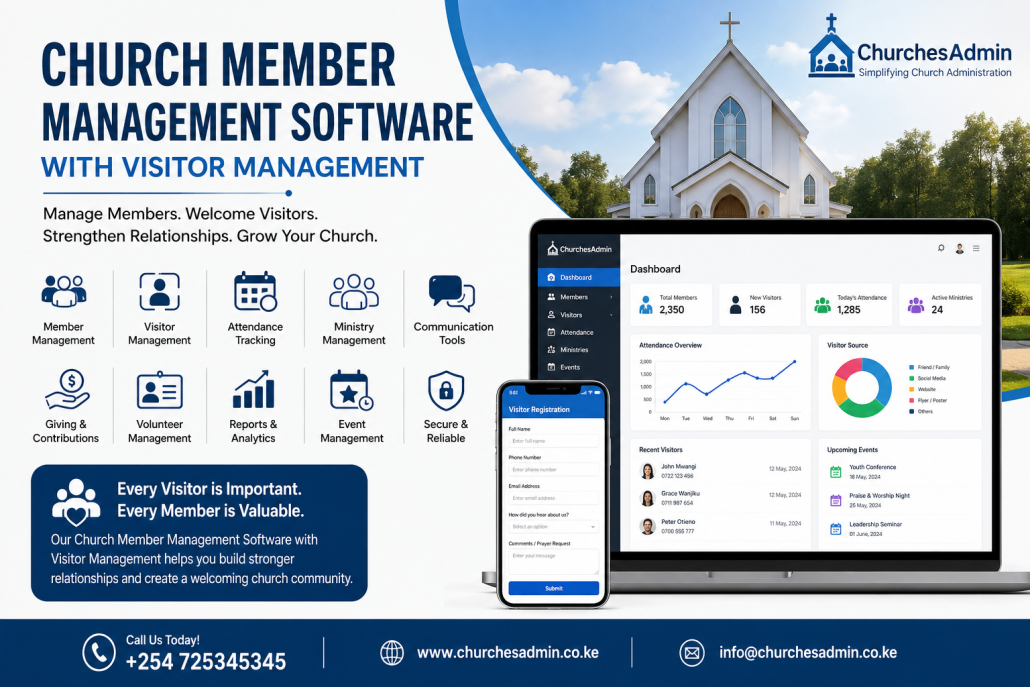
Church Member Management Software with Visitor Management: The Complete Guide for Growing Churches

Church Member Management Software with Visitor Management

Church Member Management Software with Visitor Management

Churches are growing, ministries are expanding, and congregations are becoming more diverse than ever before. While growth is a blessing, it also creates administrative challenges. Keeping track of members, welcoming visitors, managing ministries, recording attendance, and maintaining accurate church records can quickly become overwhelming when handled manually.

This is why Church Member Management Software with Visitor Management has become an essential solution for modern churches. Whether your church has 50 members or 10,000, the right software helps streamline administration, improve communication, strengthen member engagement, and create a welcoming environment for first-time visitors.

At ChurchesAdmin.co.ke, we understand the unique needs of churches across Kenya and Africa. Our powerful Church Member Management Software with Visitor Management enables churches to digitize their operations while focusing more on ministry and less on paperwork.

If you’re looking for a reliable church management solution, call us today at +254 725345345.


What is Church Member Management Software with Visitor Management?

Church Member Management Software with Visitor Management is a digital platform that helps churches organize, store, and manage all information related to members, visitors, ministries, events, attendance, communication, and reporting from one secure system.

Instead of relying on notebooks, Excel sheets, or paper files, churches can manage everything electronically.

The software typically includes:

  • Member registration
  • Visitor management
  • Attendance tracking
  • Small group management
  • Ministry management
  • Event registration
  • Communication tools
  • Prayer request management
  • Giving records
  • Reports and analytics
  • Document management

The visitor management component ensures every guest is welcomed, followed up, and eventually integrated into the church family.


Why Churches Need Church Member Management Software with Visitor Management

Many churches still depend on manual records. While this may work for very small congregations, it becomes inefficient as membership grows.

Common problems include:

  • Lost member records
  • Duplicate registrations
  • Forgotten visitors
  • Poor follow-up
  • Missing attendance records
  • Difficulty locating member information
  • Slow communication
  • Inaccurate reports
  • Poor event planning

Implementing Church Member Management Software with Visitor Management solves these challenges by centralizing all church information into one secure system.


Benefits of Church Member Management Software with Visitor Management

1. Centralized Member Database

The software creates one secure location where all member information is stored.

Church administrators can access:

  • Full names
  • Phone numbers
  • Email addresses
  • Physical addresses
  • Family information
  • Ministry assignments
  • Baptism records
  • Membership status
  • Emergency contacts

This eliminates scattered files and ensures records remain accurate.


2. Efficient Visitor Management

Visitors are the future members of every church.

Without proper visitor follow-up, many guests never return.

With Church Member Management Software with Visitor Management, churches can:

  • Register first-time visitors
  • Record how visitors heard about the church
  • Assign follow-up teams
  • Schedule follow-up calls
  • Send welcome SMS
  • Send welcome emails
  • Monitor return visits
  • Convert visitors into members

No visitor gets forgotten.


3. Faster Registration Process

Instead of filling lengthy paper forms, visitors and members can register digitally using:

  • Tablets
  • Smartphones
  • Church kiosks
  • QR codes
  • Online forms

This significantly improves accuracy while reducing paperwork.


4. Better Communication

Communication is one of the strongest features of modern church software.

Churches can instantly send:

  • SMS
  • Emails
  • Prayer updates
  • Event reminders
  • Service notifications
  • Youth announcements
  • Women’s ministry updates
  • Men’s fellowship messages

Targeted communication ensures the right people receive the right information.


Key Features of Church Member Management Software with Visitor Management

Complete Member Profiles

Every church member has a detailed profile containing:

  • Personal details
  • Family members
  • Membership history
  • Attendance history
  • Giving history
  • Volunteer activities
  • Ministry involvement
  • Leadership roles
  • Spiritual milestones

Everything is available with a single search.


Visitor Registration

Visitor management begins with proper registration.

Churches can capture:

  • Name
  • Phone number
  • Email
  • Home location
  • Age group
  • Gender
  • Occupation
  • Invited by
  • Prayer requests
  • Comments

This information becomes the foundation for effective follow-up.


Attendance Tracking

Attendance provides valuable insights into church growth.

The software allows churches to record attendance for:

  • Sunday services
  • Midweek services
  • Bible study
  • Youth fellowship
  • Children’s ministry
  • Choir practice
  • Prayer meetings
  • Leadership meetings
  • Conferences
  • Special events

Attendance reports help identify members who may require pastoral care.


Ministry Management

Every ministry can maintain its own member list.

Examples include:

  • Youth Ministry
  • Women’s Ministry
  • Men’s Fellowship
  • Choir
  • Ushers
  • Hospitality
  • Children’s Church
  • Evangelism Team
  • Prayer Ministry
  • Media Team

Each ministry leader can access relevant information without exposing confidential church records.


Family Management

Many churches register entire families.

The software links family members together.

Examples include:

  • Parents
  • Children
  • Guardians
  • Married couples
  • Dependents

Family reports become easier to generate.


Visitor Management: Why It Matters

Visitor management is no longer optional.

Studies consistently show that churches with structured visitor follow-up experience higher visitor retention compared to churches without organized systems.

Good visitor management helps churches:

  • Welcome guests professionally
  • Improve first impressions
  • Build relationships
  • Encourage return visits
  • Track follow-up progress
  • Measure visitor conversion
  • Strengthen evangelism

The first visit often determines whether someone returns.


The Visitor Journey

An effective Church Member Management Software with Visitor Management supports every stage of the visitor journey.

Step 1: Visitor Arrives

A visitor is warmly welcomed.

Their details are captured digitally.


Step 2: Instant Registration

The visitor’s information enters the church database immediately.

No paperwork is lost.


Step 3: Welcome Message

The visitor automatically receives:

  • SMS
  • Email
  • Thank-you message

This creates a lasting first impression.


Step 4: Follow-Up Assignment

The software assigns:

  • Pastor
  • Elder
  • Cell leader
  • Hospitality team member

to follow up with the visitor.


Step 5: Return Visit Monitoring

The software tracks whether the visitor returns.

Church leadership can identify:

  • Returning visitors
  • One-time visitors
  • Frequent guests

Step 6: Membership Conversion

Once the visitor joins the church, their profile converts into a permanent member profile.

No information is lost.


Church Attendance Management

Attendance is more than counting people.

It helps leaders understand church health.

With Church Member Management Software with Visitor Management, churches can:

  • Record attendance quickly
  • Generate attendance reports
  • Compare weekly attendance
  • Identify inactive members
  • Monitor ministry participation
  • Measure church growth

Historical attendance reports help church leaders make informed decisions.


Member Engagement

Growing churches focus on engagement rather than simply increasing numbers.

The software helps leaders understand:

  • Who attends regularly
  • Who volunteers
  • Who gives consistently
  • Who serves in ministries
  • Who needs pastoral care
  • Who recently joined
  • Who has become inactive

This enables proactive ministry rather than reactive administration.


Secure Member Records

Security is essential.

Church member information includes confidential data.

ChurchesAdmin.co.ke provides secure storage with features such as:

  • User permissions
  • Role-based access
  • Secure login
  • Encrypted data
  • Automated backups
  • Audit logs

Only authorized users access sensitive information.


Reporting and Analytics

Church leadership requires accurate reports for planning and decision-making.

The software generates reports including:

  • Total members
  • New members
  • First-time visitors
  • Returning visitors
  • Attendance trends
  • Ministry participation
  • Gender distribution
  • Age demographics
  • Family statistics
  • Growth reports

These reports help pastors and administrators understand how the church is growing and where additional attention may be needed.


Why Choose ChurchesAdmin.co.ke?

At ChurchesAdmin.co.ke, we have designed our Church Member Management Software with Visitor Management specifically for churches in Kenya and beyond.

Our solution is:

  • Easy to use
  • Secure and reliable
  • Cloud-based
  • Accessible from anywhere
  • Affordable for churches of all sizes
  • Scalable as your congregation grows
  • Supported by a dedicated local team

Whether you are managing a small congregation or a large multi-campus ministry, our platform simplifies administration while helping your church build stronger relationships with members and visitors.

Contact us today:

📞 +254 725345345

Advanced Features of Church Member Management Software with Visitor Management

As churches continue to grow, administration becomes increasingly complex. Managing hundreds or even thousands of members, visitors, volunteers, events, ministries, and communication channels manually is no longer practical. This is where Church Member Management Software with Visitor Management becomes a vital tool for churches that want to remain organized while focusing on ministry.

At ChurchesAdmin.co.ke, we have developed an all-in-one Church Member Management Software with Visitor Management that empowers churches to manage every aspect of church administration efficiently. From visitor follow-up to member engagement, event registration, reporting, and communication, everything is available in one secure platform.

For more information, contact us today at +254 725345345.


Event Management Made Simple

Churches organize numerous events throughout the year. These may include:

  • Sunday services
  • Revival meetings
  • Youth conferences
  • Leadership seminars
  • Prayer retreats
  • Choir competitions
  • Fundraising events
  • Bible study sessions
  • Couples’ retreats
  • Children’s camps
  • Women’s conferences
  • Men’s fellowships

Managing registrations manually often results in confusion and inaccurate attendance records.

With Church Member Management Software with Visitor Management, churches can create events, invite members, track registrations, monitor attendance, and generate detailed reports. Event organizers can also send reminders before the event and follow-up messages afterward.

This streamlined approach improves planning and ensures every event runs smoothly.


Volunteer Management

Every successful church relies on dedicated volunteers. Coordinating these volunteers manually can be difficult, especially when multiple ministries are involved.

Our Church Member Management Software with Visitor Management allows churches to:

  • Register volunteers
  • Assign ministry roles
  • Track volunteer schedules
  • Monitor participation
  • Record skills and talents
  • Manage availability
  • Send volunteer reminders

Whether someone serves in the choir, media team, hospitality, ushering, or children’s ministry, all volunteer information is organized in one place.


Ministry Coordination

Churches often have multiple ministries serving different groups within the congregation.

Examples include:

  • Youth Ministry
  • Children’s Ministry
  • Women’s Fellowship
  • Men’s Fellowship
  • Couples Ministry
  • Evangelism Team
  • Worship Team
  • Choir
  • Hospitality Team
  • Intercessory Ministry
  • Media Department
  • Missions Department

Each ministry leader can manage members, attendance, meetings, communication, and reports independently while remaining connected to the main church database.

This improves accountability and coordination across the entire church.


Follow-Up Management

Following up with visitors is one of the most important responsibilities of any growing church.

Without an organized process, visitors may never hear from the church again.

The Church Member Management Software with Visitor Management simplifies follow-up by allowing churches to:

  • Assign follow-up teams
  • Schedule visits
  • Record phone conversations
  • Log pastoral visits
  • Record prayer requests
  • Track follow-up progress
  • Set reminders
  • Update visitor status

Leaders always know which visitors have been contacted and which require additional follow-up.


Automated Communication

Communication keeps members connected throughout the week.

Instead of contacting members individually, churches can communicate instantly using:

  • SMS
  • Email
  • Group messaging
  • Event notifications
  • Birthday greetings
  • Anniversary messages
  • Prayer updates
  • Service reminders
  • Meeting invitations

Communication can also be targeted to specific groups such as ministry members, leaders, volunteers, youth, women, or first-time visitors.

This saves significant administrative time while improving member engagement.


Digital Church Directory

Finding member information should never require searching through piles of paperwork.

The digital directory within Church Member Management Software with Visitor Management provides quick access to:

  • Member names
  • Phone numbers
  • Email addresses
  • Family members
  • Ministry involvement
  • Leadership positions
  • Membership status

Authorized church leaders can retrieve information instantly using powerful search features.


Prayer Request Management

Church members frequently submit prayer requests during services, online, or through ministry leaders.

Managing these requests manually can be challenging.

The software allows churches to:

  • Record prayer requests
  • Assign prayer teams
  • Track follow-up
  • Record answered prayers
  • Maintain confidentiality
  • Categorize prayer needs

Pastors and prayer leaders can provide more effective spiritual support while maintaining organized records.


Giving and Contribution Records

Financial transparency is essential for every church.

The software records:

  • Tithes
  • Offerings
  • Building fund contributions
  • Missions giving
  • Special donations
  • Thanksgiving offerings
  • Pledges

Church administrators can generate contribution statements, financial reports, and giving histories for members while maintaining secure financial records.


Multi-Branch Church Management

Many churches operate multiple campuses or branches.

Managing each branch independently often creates duplicate records and inconsistent reporting.

Our Church Member Management Software with Visitor Management supports multi-branch churches by allowing administrators to:

  • Manage all branches from one platform
  • Generate branch-specific reports
  • Compare attendance between branches
  • Assign branch administrators
  • Monitor membership growth across locations

This provides church leadership with a complete overview of the entire ministry.


Mobile Accessibility

Modern church administration requires flexibility.

Church leaders may need access while:

  • Visiting members
  • Attending conferences
  • Traveling
  • Conducting outreach
  • Leading crusades

Cloud-based Church Member Management Software with Visitor Management allows authorized users to access church information securely from smartphones, tablets, laptops, and desktop computers.

This ensures ministry continues regardless of location.


Cloud-Based Security

Data security is critical when handling member information.

ChurchesAdmin.co.ke provides secure cloud hosting with features including:

  • Automatic backups
  • Secure encryption
  • Password protection
  • User authentication
  • Role-based permissions
  • Activity logs
  • Disaster recovery

Church information remains safe even if office computers are damaged or lost.


Reports That Support Better Decision Making

Church leaders need reliable information when planning ministry activities.

The software generates reports such as:

  • Membership growth
  • Visitor statistics
  • Attendance summaries
  • Ministry participation
  • Volunteer engagement
  • Giving reports
  • Age demographics
  • Gender distribution
  • Family reports
  • New member reports
  • Inactive member reports
  • Baptism records

These reports help pastors identify trends, evaluate ministry effectiveness, and make informed decisions.


User Roles and Permissions

Not every church worker requires access to all information.

The software allows different permission levels for:

  • Senior Pastor
  • Associate Pastor
  • Church Administrator
  • Secretary
  • Finance Officer
  • Ministry Leaders
  • Reception Staff
  • Follow-Up Teams
  • Volunteers

Each user only accesses information relevant to their responsibilities, enhancing both security and accountability.


Why Visitor Management Drives Church Growth

Every visitor represents an opportunity to build a lasting relationship.

Churches that consistently welcome and follow up with visitors often experience stronger retention and sustained growth.

With Church Member Management Software with Visitor Management, churches can:

  • Capture visitor details instantly.
  • Send personalized welcome messages.
  • Schedule follow-up calls and visits.
  • Monitor return attendance.
  • Invite visitors to membership classes.
  • Connect visitors with small groups and ministries.

A structured visitor management process transforms first-time guests into active members of the church family.


Best Practices for Using Church Member Management Software with Visitor Management

To maximize the value of your system:

  • Keep member records updated regularly.
  • Train administrators and ministry leaders.
  • Register every first-time visitor immediately.
  • Record attendance consistently.
  • Schedule timely visitor follow-up.
  • Back up data regularly.
  • Review reports monthly.
  • Use communication tools frequently.
  • Assign user permissions carefully.
  • Encourage ministry leaders to maintain accurate records.

Consistent use ensures the software becomes an essential ministry tool rather than just another database.


Why Churches Across Kenya Are Choosing ChurchesAdmin.co.ke

ChurchesAdmin.co.ke understands the unique administrative needs of churches in Kenya. Our Church Member Management Software with Visitor Management is designed to simplify administration while strengthening ministry.

Our platform offers:

  • Comprehensive member management.
  • Powerful visitor management.
  • Attendance tracking.
  • Ministry coordination.
  • Volunteer management.
  • Event management.
  • Communication tools.
  • Giving management.
  • Detailed reporting.
  • Secure cloud storage.
  • Multi-branch support.
  • Easy-to-use interface.
  • Affordable pricing.
  • Reliable local support.

Whether your church is just starting or has thousands of members, our solution grows with your ministry.


Frequently Asked Questions

Is the software suitable for small churches?

Yes. Church Member Management Software with Visitor Management is designed for churches of all sizes, from small congregations to large ministries.


Can multiple church leaders use the software?

Yes. Different users can access the system simultaneously with role-based permissions.


Is member information secure?

Absolutely. The software uses secure authentication, encrypted storage, automatic backups, and user access controls to protect church records.


Can the software manage visitors separately from members?

Yes. Visitor records remain separate until they become members, allowing churches to monitor visitor engagement and follow-up effectively.


Can attendance reports be generated automatically?

Yes. Attendance reports can be generated for services, ministries, events, and other church activities.


Does the software support church growth?

Definitely. By improving organization, communication, visitor retention, reporting, and member engagement, Church Member Management Software with Visitor Management helps churches create stronger relationships and support sustainable growth.


Conclusion

Church administration should never distract from the church’s primary mission of serving God and ministering to people. By adopting Church Member Management Software with Visitor Management, churches can eliminate repetitive administrative tasks, improve communication, strengthen visitor follow-up, and maintain accurate records with confidence.

At ChurchesAdmin.co.ke, we are committed to helping churches embrace modern technology without losing their focus on ministry. Our secure, cloud-based platform combines member management, visitor management, attendance tracking, ministry coordination, volunteer scheduling, communication, reporting, and giving management into one powerful solution.

Whether you are leading a small local congregation, a fast-growing ministry, or a multi-branch church, our Church Member Management Software with Visitor Management provides the tools you need to organize your church, engage your members, welcome visitors effectively, and support long-term growth.

If you are ready to modernize your church administration and provide a better experience for both members and visitors, ChurchesAdmin.co.ke is ready to help.

Contact us today:

📞 +254 725345345

Experience the difference that a reliable Church Member Management Software with Visitor Management can make in your church’s administration and ministry. Let ChurchesAdmin.co.ke partner with you in building a more connected, organized, and thriving church community.

Ministry Administration Platform: A Complete Guide to Streamlining Church and Ministry Operations

Ministry Administration Platform

Ministry Administration Platform

Effective ministry requires more than passionate leadership and committed volunteers. Behind every successful church, denomination, fellowship, or faith-based organization is an efficient administrative system that keeps ministries organized, communication flowing, members engaged, and daily operations running smoothly. As ministries continue to grow across Kenya, managing administrative responsibilities using paper files, spreadsheets, and disconnected systems becomes increasingly difficult. A Ministry Administration Platform provides a centralized digital solution that simplifies administration, improves communication, enhances collaboration, and supports sustainable ministry growth.

Churches today oversee a wide range of administrative responsibilities, including member management, volunteer coordination, event planning, attendance tracking, financial reporting, ministry scheduling, communication, pastoral care, document management, and leadership reporting. Without a centralized system, managing these activities consumes valuable time that could otherwise be devoted to ministry. A modern Ministry Administration Platform brings these essential functions together into one integrated environment that improves efficiency and accountability.

Across Kenya, churches are expanding through multiple branches, community outreach programs, youth ministries, women’s ministries, men’s fellowships, children’s departments, and mission activities. As these ministries grow, leaders require accurate information, organized records, and efficient communication to coordinate activities effectively. A professional Ministry Administration Platform enables church leaders to manage every ministry department from one secure and centralized platform while maintaining visibility into ministry performance and member engagement.

Traditional administrative methods often create duplicate records, communication delays, inconsistent reporting, misplaced documents, and unnecessary manual work. These challenges reduce operational efficiency and make strategic planning more difficult. A comprehensive Ministry Administration Platform automates repetitive administrative processes while providing church leadership with real-time information for informed decision-making.

Ministry administration extends beyond organizing schedules and maintaining records. Church leaders must coordinate volunteers, oversee ministry departments, monitor attendance, manage church events, communicate with members, allocate resources, supervise outreach programs, and evaluate ministry performance. A centralized Ministry Administration Platform integrates all these responsibilities into one scalable solution that supports both small congregations and large multi-campus ministries.

Whether serving independent churches, denominational headquarters, youth ministries, campus fellowships, mission organizations, or regional church networks throughout Kenya, implementing a Ministry Administration Platform enables churches to strengthen administration, improve collaboration, enhance member engagement, and support long-term ministry development.


Table of Contents


Understanding Ministry Administration

Ministry administration involves organizing the daily activities that keep churches and faith-based organizations operating effectively. Ministry Administration Platform centralizes member information, ministry departments, volunteer records, attendance, communication, event planning, reporting, and leadership oversight into one integrated system.

Rather than managing separate spreadsheets, notebooks, and manual files, church leaders gain access to a centralized dashboard where every ministry activity can be monitored in real time. This improves operational efficiency while ensuring information remains accurate and accessible.

As churches continue to grow throughout Kenya, centralized ministry administration becomes increasingly important for maintaining effective leadership and supporting church expansion.


Why Digital Ministry Management Matters

Manual ministry administration often leads to duplicate information, communication delays, inconsistent reporting, and increased administrative workloads. Ministry Administration Platform digitizes administrative operations while improving organization, collaboration, and ministry effectiveness.

Churches benefit through:

  • Better organizational structure
  • Improved communication
  • Faster information access
  • Better ministry coordination
  • Reduced paperwork
  • Improved reporting
  • Enhanced member engagement
  • Greater operational efficiency

Digital administration enables ministry leaders to focus more on serving people rather than managing paperwork.


Core Features of a Ministry Administration Platform

A modern Ministry Administration Platform combines church administration, ministry management, communication, reporting, attendance, and leadership oversight into one centralized solution.

Core features include:

  • Member management
  • Ministry department management
  • Volunteer coordination
  • Attendance tracking
  • Event planning
  • Communication tools
  • Task management
  • Document management
  • Pastoral care records
  • Dashboard analytics
  • Multi-branch church support
  • Role-based permissions
  • Audit logs
  • Mobile accessibility
  • Reporting dashboards

These capabilities improve ministry organization while supporting effective church leadership.


Managing Ministry Operations Efficiently

Churches oversee multiple ministries that require careful coordination. Ministry Administration Platform enables leaders to manage every ministry activity from one integrated dashboard.

Leaders can monitor:

  • Ministry departments
  • Volunteer assignments
  • Church events
  • Attendance
  • Outreach activities
  • Leadership meetings
  • Pastoral visits
  • Member participation
  • Ministry schedules
  • Resource allocation

Centralized management improves collaboration while strengthening ministry performance.


Communication and Ministry Coordination

Strong communication is essential for successful ministry. Ministry Administration Platform centralizes communication between church leadership, ministry teams, volunteers, and congregation members.

Communication capabilities include:

  • Church announcements
  • Ministry updates
  • Volunteer schedules
  • Event invitations
  • Prayer requests
  • Leadership communication
  • Department notices
  • Member follow-up

Consistent communication strengthens ministry coordination and congregation engagement.


Reporting and Leadership Insights

Church leaders require accurate information to evaluate ministry growth and make strategic decisions. Ministry Administration Platform generates comprehensive reports using real-time ministry data.

Reports include:

  • Membership growth
  • Attendance trends
  • Volunteer participation
  • Ministry activity
  • Outreach performance
  • Event participation
  • Department reports
  • Leadership dashboards
  • Church analytics
  • Ministry summaries

These reports support informed leadership while improving long-term ministry planning.


Improving Church Administration

Automation simplifies repetitive administrative work while improving consistency across church operations. Ministry Administration Platform automates many day-to-day administrative processes.

Churches can automate:

  • Member registration
  • Ministry assignments
  • Attendance recording
  • Volunteer scheduling
  • Event registration
  • Communication
  • Report generation
  • Administrative workflows

Automation improves productivity while allowing ministry teams to focus on serving their communities.


Security and Ministry Data Protection

Churches maintain confidential member and ministry information that requires secure management. Ministry Administration Platform includes enterprise-grade security features that protect church records while supporting accountability and responsible administration.

Security capabilities include:

  • Role-based permissions
  • Secure authentication
  • Data encryption
  • Audit logging
  • Backup systems
  • Secure document storage
  • Administrative controls
  • Historical record management

These security measures help churches protect valuable ministry information while maintaining operational confidence.


Applications Across Different Church Ministries

Ministry Administration Platform supports a wide range of ministries across Kenya.

Local churches coordinate members, volunteers, and ministry departments efficiently.

Multi-campus churches manage multiple congregations from one centralized platform.

Youth ministries organize young members, leaders, and outreach activities.

Children’s ministries manage attendance, volunteers, and family engagement.

Mission organizations coordinate field teams, outreach programs, and reporting.

Denominational headquarters oversee regional churches, ministry departments, and leadership activities.

For churches seeking a comprehensive administration solution, ChurchesAdmin provides advanced Ministry Administration Platform capabilities that integrate membership management, ministry coordination, volunteer administration, attendance tracking, communication, event management, pastoral care, reporting, and operational analytics into one centralized church management platform. Churches across Kenya can improve administration, strengthen ministry collaboration, and support sustainable church growth.

Benefits of Ministry Administration Platform for Different Stakeholders

A modern Ministry Administration Platform benefits everyone involved in church leadership and ministry operations. Senior pastors gain greater visibility into church activities, church administrators simplify daily management, ministry leaders coordinate teams more effectively, volunteers receive better organization, and church members experience improved communication and engagement. By centralizing administration, churches strengthen accountability while improving ministry effectiveness.

As churches continue expanding across Kenya, implementing a Ministry Administration Platform enables ministries to manage growing congregations and multiple departments without increasing administrative complexity.

Church Leadership

Church leaders require accurate information to guide ministry growth and make informed decisions. Ministry Administration Platform provides centralized oversight of church operations, ministry activities, member engagement, and leadership reporting.

Key benefits include:

  • Better ministry visibility
  • Improved strategic planning
  • Accurate reporting
  • Stronger pastoral oversight
  • Faster decision-making
  • Improved communication
  • Reduced administrative workload
  • Better ministry growth management

Leadership teams can monitor church performance through real-time dashboards and reports.


Church Administrators

Managing ministry operations manually often results in duplicated work, inconsistent records, and delayed communication. Ministry Administration Platform simplifies administration by organizing all operational activities in one centralized system.

Church administrators can:

  • Manage member records
  • Coordinate ministries
  • Schedule church activities
  • Track attendance
  • Manage church documents
  • Generate reports
  • Organize events
  • Oversee multiple church branches

Automation improves productivity while reducing repetitive administrative work.


Ministry Leaders

Each ministry requires organized planning and effective communication.

Using Ministry Administration Platform, ministry leaders can:

  • Coordinate volunteers
  • Monitor attendance
  • Schedule meetings
  • Manage ministry events
  • Track member participation
  • Assign responsibilities
  • Communicate with teams
  • Review ministry reports

Centralized coordination improves collaboration while supporting ministry growth.


Volunteers

Volunteers serve more effectively when ministry activities are well organized.

Benefits include:

  • Clear ministry schedules
  • Volunteer assignments
  • Event notifications
  • Better communication
  • Ministry updates
  • Training reminders
  • Improved coordination
  • Easier collaboration

Well-organized volunteer management strengthens ministry effectiveness.


Church Members

Church members benefit from improved communication and organized ministry administration.

Advantages include:

  • Better engagement
  • Faster communication
  • Easier event registration
  • Improved pastoral follow-up
  • Ministry participation
  • Accurate member records
  • Timely announcements
  • Better church experience

Professional administration helps members remain connected to church life.


Improving Efficiency Through Automation

Automation reduces repetitive administrative work while improving consistency across ministry operations. Ministry Administration Platform automates essential church management processes.

Automated Member Registration

The platform simplifies the onboarding process for new members.

Automation includes:

  • Member registration
  • Profile creation
  • Family records
  • Ministry assignments
  • Membership updates
  • Contact verification
  • Digital documentation
  • Historical records

Automated registration improves accuracy while reducing paperwork.


Automated Ministry Coordination

The platform streamlines ministry planning through automated workflows.

Automation supports:

  • Volunteer scheduling
  • Ministry calendars
  • Team assignments
  • Leadership notifications
  • Department coordination
  • Resource allocation
  • Event preparation
  • Follow-up activities

Automation helps ministry leaders coordinate activities more efficiently.


Automated Communication

The system automatically delivers important ministry information.

Notifications include:

  • Church announcements
  • Ministry meetings
  • Volunteer reminders
  • Prayer requests
  • Event invitations
  • Department updates
  • Leadership notices
  • Member communication

Automated communication strengthens ministry engagement while reducing manual follow-up.


Automated Reporting

Church leaders can generate reports instantly using real-time ministry information.

Reports include:

  • Membership growth
  • Attendance trends
  • Volunteer participation
  • Ministry performance
  • Event participation
  • Department activity
  • Leadership summaries
  • Church dashboards

Automated reporting supports informed decision-making and long-term ministry planning.


Compliance, Security and Risk Management

Churches manage confidential information that requires responsible protection. Ministry Administration Platform incorporates enterprise-grade security controls that protect ministry records while strengthening accountability.

Role-Based User Permissions

Different church workers require different access levels.

Typical user roles include:

  • Senior Pastors
  • Associate Pastors
  • Church Administrators
  • Ministry Leaders
  • Department Heads
  • Volunteers
  • System Administrators

Role-based permissions ensure sensitive information remains accessible only to authorized users.


Secure Ministry Records

The platform securely stores:

  • Member profiles
  • Ministry records
  • Volunteer information
  • Attendance history
  • Church documents
  • Event records
  • Communication history
  • Administrative reports

Secure record management protects valuable ministry information while maintaining operational integrity.


Audit Trails

Every administrative activity is recorded automatically.

Audit logs include:

  • Member registrations
  • Ministry updates
  • Attendance records
  • User logins
  • Administrative changes
  • Leadership actions

Detailed audit records improve transparency and simplify administrative reviews.


Backup and Disaster Recovery

Reliable ministry administration depends on secure information protection.

Modern platforms provide:

  • Automated backups
  • Secure cloud storage
  • Historical records
  • Disaster recovery procedures
  • Data restoration capabilities

These features ensure church information remains protected against unexpected incidents.


Reducing Administrative Risks

Professional Ministry Administration Platform helps churches reduce risks such as:

  • Duplicate records
  • Communication delays
  • Lost documents
  • Administrative errors
  • Unauthorized access
  • Inconsistent reporting

Centralized ministry management strengthens operational efficiency while supporting sustainable church growth.


Why ChurchesAdmin is the Ideal Ministry Administration Platform

Managing church administration requires more than maintaining membership records. Churches need an integrated platform that combines ministry coordination, volunteer management, attendance tracking, communication, event planning, reporting, pastoral care, and leadership oversight into one centralized solution.

ChurchesAdmin provides a comprehensive Ministry Administration Platform designed specifically for churches, ministries, denominations, mission organizations, and faith-based institutions seeking to modernize administration.

Core capabilities include:

  • Member management
  • Ministry coordination
  • Volunteer administration
  • Attendance tracking
  • Event management
  • Church communication
  • Pastoral care records
  • Dashboard analytics
  • Multi-branch support
  • Role-based access control
  • Audit logging
  • Leadership reporting

Whether serving a local congregation, a regional ministry, or a multi-campus church, ChurchesAdmin provides scalable tools that simplify administration while strengthening ministry collaboration and church growth across Kenya.


Future Trends in Ministry Administration Platform

Church technology continues evolving, and Ministry Administration Platform solutions will increasingly integrate advanced digital technologies that improve ministry effectiveness.

Artificial Intelligence

AI-powered ministry platforms will support:

  • Member engagement analysis
  • Attendance forecasting
  • Automated pastoral follow-up
  • Intelligent reporting
  • Ministry performance insights

Artificial intelligence will help church leaders make more informed ministry decisions.


Member Self-Service Portals

Future platforms will allow members to:

  • Update personal information
  • Register for ministries
  • Volunteer for events
  • Access announcements
  • Receive ministry resources

Self-service capabilities will improve engagement while reducing administrative workloads.


Cloud-Based Church Administration

Cloud technology will provide:

  • Remote administration
  • Multi-campus coordination
  • Secure online access
  • Real-time updates
  • Automatic software upgrades

Cloud-based solutions will improve flexibility while supporting expanding ministries.


Integrated Ministry Ecosystems

Future platforms will integrate seamlessly with:

  • Online giving systems
  • Church websites
  • Live streaming platforms
  • Communication tools
  • Event registration systems

Integrated technologies will strengthen digital ministry experiences.


Greater Automation

Future Ministry Administration Platform solutions will automate:

  • Ministry scheduling
  • Volunteer coordination
  • Attendance reporting
  • Leadership dashboards
  • Administrative workflows

Automation will continue improving efficiency while reducing administrative workloads.


Getting Started with Ministry Administration Platform

Implementing a Ministry Administration Platform begins with reviewing existing administrative processes, member records, ministry structures, volunteer lists, attendance records, communication methods, and leadership reporting. Church administrators should organize ministry departments, member information, event calendars, volunteer assignments, and operational procedures before migrating to a centralized platform.

The next step involves configuring user roles, importing member data, creating ministry departments, establishing communication workflows, enabling attendance tracking, and setting up reporting dashboards. Church staff, ministry leaders, and administrators should receive training on daily platform operations, ministry coordination, reporting, communication tools, and user management to maximize efficiency.

After implementation, church leadership should continuously update ministry records, monitor participation trends, evaluate volunteer engagement, review ministry performance reports, strengthen data security, and optimize administrative workflows as the church grows. For churches throughout Kenya, adopting a Ministry Administration Platform provides a scalable foundation for efficient administration, stronger collaboration, and sustainable ministry development.


Conclusion

Strong administration forms the foundation of an effective and growing ministry. Manual processes often lead to communication gaps, inconsistent records, administrative delays, and reduced visibility into ministry activities. Ministry Administration Platform enables churches to centralize administration, automate routine tasks, improve communication, and strengthen ministry coordination.

By integrating membership management, ministry coordination, volunteer administration, attendance tracking, communication, event planning, reporting, and operational analytics into one centralized platform, churches can improve efficiency while allowing leaders to devote more time to discipleship, outreach, and pastoral care. This strengthens collaboration, improves decision-making, and prepares ministries for long-term growth.

Whether serving local congregations, denominational headquarters, youth ministries, mission organizations, or multi-campus churches, organizations that implement Ministry Administration Platform position themselves for sustainable ministry success. With ChurchesAdmin, churches across Kenya can confidently modernize administration, improve ministry effectiveness, and build stronger, more connected faith communities.

Church Membership Records Software: A Complete Guide to Managing Church Members Efficiently

Church Membership Records Software

Church Membership Records Software

Churches thrive on meaningful relationships, active participation, and effective communication with their members. As congregations continue to grow, managing member information using notebooks, spreadsheets, or paper files becomes increasingly difficult and time-consuming. A Church Membership Records Software solution provides churches with a centralized platform for maintaining accurate member information, tracking participation, improving communication, and supporting ministry growth through organized digital record management.

Across Kenya, churches of every size are embracing technology to improve administration and strengthen member engagement. Whether managing a local congregation, a regional ministry, or a multi-branch church organization, maintaining accurate records is essential for effective pastoral care and church leadership. Church Membership Records Software enables churches to organize member profiles, family records, ministry involvement, attendance, giving history, baptism records, volunteer participation, and communication from one secure platform.

Traditional record-keeping methods often create challenges such as duplicate information, misplaced documents, outdated contact details, and delayed communication. These issues can affect ministry planning, pastoral follow-up, event organization, and member engagement. A modern Church Membership Records Software automates many administrative processes while ensuring that church leaders always have access to current and accurate member information.

Church membership management extends beyond storing names and phone numbers. Church administrators must monitor new member registration, family relationships, ministry assignments, attendance history, spiritual milestones, volunteer participation, event registration, pastoral visitation, and communication preferences. A comprehensive Church Membership Records Software integrates all these functions into one centralized platform, allowing church leaders to focus more on ministry and less on administration.

Whether serving small community churches, growing urban congregations, denominational headquarters, youth ministries, campus fellowships, or multi-campus churches across Kenya, implementing Church Membership Records Software enables ministry leaders to strengthen relationships, improve administration, and support long-term church growth.


Table of Contents


Understanding Church Membership Management

Every church maintains important information about its members. Church Membership Records Software centralizes member profiles, family information, contact details, ministry involvement, attendance records, giving history, volunteer activities, and pastoral notes into one integrated system.

Rather than relying on multiple paper files or disconnected spreadsheets, church leaders can instantly access complete member records from a centralized dashboard. This improves organization while ensuring member information remains accurate and up to date.

As churches continue to expand across Kenya, centralized digital membership management becomes increasingly important for supporting ministry effectiveness and long-term growth.


Why Digital Membership Records Matter

Manual record management often results in incomplete information, duplicate records, delayed communication, and administrative inefficiencies. Church Membership Records Software digitizes church administration while improving accuracy, communication, and ministry coordination.

Churches benefit through:

  • Better member organization
  • Accurate member records
  • Faster information retrieval
  • Improved communication
  • Better ministry planning
  • Reduced paperwork
  • Improved pastoral care
  • Stronger administrative efficiency

Digital member management enables church leaders to serve congregations more effectively.


Core Features of Church Membership Records Software

A modern Church Membership Records Software combines membership management, communication, reporting, attendance, and ministry administration into one centralized solution.

Core features include:

  • Member profile management
  • Family relationship records
  • Contact information management
  • Attendance tracking
  • Ministry assignment management
  • Volunteer records
  • Baptism and membership history
  • Giving history
  • Event registration
  • Communication tools
  • Dashboard analytics
  • Multi-branch church management
  • Role-based permissions
  • Audit logs
  • Mobile accessibility

These capabilities simplify church administration while improving member engagement.


Managing Member Information Efficiently

Member information changes regularly as people join ministries, relocate, update contact details, or become involved in new church activities. Church Membership Records Software enables administrators to maintain complete and accurate member information throughout every stage of church life.

Church administrators can manage:

  • Member profiles
  • Family records
  • Membership status
  • Contact information
  • Attendance history
  • Ministry involvement
  • Volunteer assignments
  • Spiritual milestones
  • Giving records
  • Communication history

Real-time access to member information supports better ministry planning and pastoral care.


Communication and Member Engagement

Effective communication strengthens relationships between church leadership and the congregation. Church Membership Records Software centralizes communication while ensuring members receive important ministry updates.

Communication capabilities include:

  • Church announcements
  • Event invitations
  • Ministry updates
  • Prayer requests
  • Volunteer schedules
  • Membership notifications
  • Follow-up communication
  • Digital messaging

Centralized communication improves engagement while strengthening church unity.


Church Reporting and Ministry Planning

Church leaders require accurate information to plan ministry activities and evaluate church growth. Church Membership Records Software generates detailed reports using real-time membership information.

Reports include:

  • Membership summaries
  • Attendance reports
  • New member reports
  • Ministry participation
  • Volunteer statistics
  • Giving reports
  • Family records
  • Membership growth
  • Leadership dashboards
  • Church analytics

These reports help leaders make informed ministry decisions while supporting long-term church development.


Improving Church Administration

Automation simplifies repetitive administrative work while improving consistency across church operations. Church Membership Records Software automates many routine church management tasks.

Churches can automate:

  • Member registration
  • Attendance recording
  • Ministry assignments
  • Communication
  • Report generation
  • Membership updates
  • Volunteer coordination
  • Event registration

Automation enables church staff to dedicate more time to ministry rather than administrative work.


Security and Member Data Protection

Churches manage confidential member information that requires secure handling. Church Membership Records Software incorporates enterprise-grade security features that protect member records while supporting accountability and responsible data management.

Security features include:

  • Role-based permissions
  • Secure authentication
  • Data encryption
  • Audit logs
  • Digital record history
  • Backup systems
  • Secure document storage
  • Administrative controls

These capabilities help safeguard member information while supporting trusted church administration.


Applications Across Different Church Ministries

Church Membership Records Software supports churches of every size and ministry structure throughout Kenya.

Local churches organize member records, attendance, and ministry participation efficiently.

Multi-campus churches manage congregations across multiple locations using one centralized platform.

Youth ministries coordinate young members, volunteer leaders, and event participation.

Children’s ministries maintain family information and attendance records securely.

Campus fellowships organize student memberships and ministry activities.

Denominational offices manage multiple congregations and regional church administration.

For churches seeking a complete ministry administration solution, ChurchesAdmin provides advanced Church Membership Records Software capabilities that integrate membership management, attendance tracking, ministry coordination, communication, volunteer management, reporting, pastoral care, and operational analytics into one centralized church management platform. Churches across Kenya can improve administration while strengthening member relationships and supporting sustainable ministry growth.

Benefits of Church Membership Records Software for Different Stakeholders

A modern Church Membership Records Software solution benefits every individual involved in church administration and ministry. Church leaders gain better visibility into congregation growth, administrators simplify record management, ministry leaders coordinate members more effectively, volunteers receive improved communication, and church members enjoy more personalized engagement. By centralizing member information, churches improve administration while strengthening ministry relationships.

As churches continue growing across Kenya, implementing Church Membership Records Software enables ministries to manage expanding congregations without increasing administrative complexity.

Church Leaders

Church leaders require accurate member information to provide effective pastoral care and make informed ministry decisions. Church Membership Records Software provides real-time visibility into membership growth, attendance, ministry involvement, and congregation engagement.

Key benefits include:

  • Better member visibility
  • Improved pastoral care
  • Accurate membership records
  • Better ministry planning
  • Faster communication
  • Improved decision-making
  • Reduced administrative workload
  • Stronger church growth management

Centralized information enables leaders to focus more on ministry and discipleship.


Church Administrators

Managing membership records manually often results in duplicate information, outdated records, and time-consuming administrative work. Church Membership Records Software simplifies daily church administration through automation and centralized record management.

Church administrators can:

  • Register new members
  • Update member profiles
  • Manage family records
  • Track attendance
  • Coordinate ministries
  • Generate reports
  • Manage church documents
  • Oversee multiple church branches

Automation improves efficiency while reducing repetitive administrative tasks.


Ministry Leaders

Every ministry depends on organized member information for effective coordination.

Using Church Membership Records Software, ministry leaders can:

  • Monitor ministry participation
  • Coordinate volunteers
  • Track attendance
  • Manage small groups
  • Organize outreach teams
  • Schedule ministry activities
  • Communicate with members
  • Evaluate ministry growth

Reliable information supports stronger ministry planning and member engagement.


Volunteers

Volunteers play a significant role in church activities and benefit from organized communication.

Benefits include:

  • Clear ministry schedules
  • Better communication
  • Volunteer coordination
  • Event notifications
  • Training updates
  • Ministry assignments
  • Faster information sharing
  • Improved collaboration

Efficient coordination allows volunteers to serve more effectively.


Church Members

Church members experience improved engagement through organized administration.

Advantages include:

  • Faster registration
  • Better communication
  • Personalized follow-up
  • Accurate member records
  • Easier event registration
  • Improved pastoral care
  • Stronger ministry connections
  • Better church experience

Professional membership management strengthens relationships between the church and its congregation.


Improving Efficiency Through Automation

Automation reduces repetitive administrative work while improving consistency across church operations. Church Membership Records Software automates many essential ministry processes.

Automated Member Registration

The platform simplifies onboarding for new members.

Automation includes:

  • New member registration
  • Profile creation
  • Family record management
  • Membership classification
  • Ministry assignment
  • Contact verification
  • Document storage
  • Membership history

Automated registration improves accuracy while reducing paperwork.


Automated Communication

The system automatically sends important church information.

Notifications include:

  • Church announcements
  • Event invitations
  • Prayer meetings
  • Ministry schedules
  • Volunteer reminders
  • Membership updates
  • Birthday greetings
  • Follow-up messages

Automated communication strengthens engagement while reducing manual effort.


Automated Attendance Tracking

Attendance can be recorded digitally across various church activities.

Automation supports:

  • Sunday services
  • Midweek fellowships
  • Bible study groups
  • Youth meetings
  • Children’s ministry
  • Choir rehearsals
  • Leadership meetings
  • Special conferences

Digital attendance records provide valuable insights into congregation participation.


Automated Reporting

Church reports are generated automatically using live membership information.

Leadership teams can review:

  • Membership growth
  • Attendance trends
  • Ministry participation
  • Volunteer statistics
  • Giving summaries
  • Family records
  • Event participation
  • Church dashboards

Automated reporting supports informed ministry planning and leadership decisions.


Compliance, Security and Risk Management

Churches manage confidential member information that requires responsible protection. Church Membership Records Software incorporates enterprise-grade security measures that strengthen accountability while safeguarding member records.

Role-Based User Permissions

Different church workers require different levels of access.

Typical user roles include:

  • Senior Pastors
  • Church Administrators
  • Ministry Leaders
  • Department Heads
  • Finance Officers
  • Volunteers
  • System Administrators

Role-based permissions ensure information remains accessible only to authorized users.


Secure Member Records

The platform securely stores:

  • Member profiles
  • Family records
  • Contact information
  • Attendance history
  • Giving records
  • Ministry assignments
  • Communication history
  • Administrative documents

Secure storage protects church records while maintaining long-term data integrity.


Audit Trails

Every important administrative activity is recorded automatically.

Audit logs include:

  • Member registrations
  • Record updates
  • Attendance changes
  • User logins
  • Ministry assignments
  • Administrative actions

Comprehensive audit records improve transparency and accountability.


Backup and Disaster Recovery

Reliable church administration depends on secure information protection.

Modern platforms provide:

  • Automated backups
  • Secure cloud storage
  • Historical records
  • Disaster recovery planning
  • Data restoration capabilities

These features ensure valuable church records remain protected against unexpected incidents.


Reducing Administrative Risks

Professional Church Membership Records Software helps churches reduce risks such as:

  • Duplicate member records
  • Lost information
  • Outdated contact details
  • Communication delays
  • Administrative errors
  • Unauthorized access

Centralized management improves operational reliability while strengthening ministry administration.


Why ChurchesAdmin is the Ideal Church Membership Records Software

Managing church membership requires more than maintaining a contact list. Churches need an integrated platform that combines membership management, attendance tracking, ministry coordination, volunteer administration, communication, reporting, pastoral care, and operational analytics into one centralized solution.

ChurchesAdmin provides a comprehensive Church Membership Records Software platform designed specifically for churches, ministries, denominations, and faith-based organizations seeking to modernize church administration.

Core capabilities include:

  • Member profile management
  • Attendance tracking
  • Ministry management
  • Volunteer coordination
  • Family records
  • Church communication
  • Giving management
  • Event management
  • Dashboard analytics
  • Multi-branch church support
  • Role-based access control
  • Audit logging

Whether serving a local congregation, a growing urban church, a denominational headquarters, or a multi-campus ministry, ChurchesAdmin provides scalable tools that simplify church administration while improving member engagement across Kenya.


Future Trends in Church Membership Records Software

Church technology continues advancing, and Church Membership Records Software will increasingly integrate intelligent solutions that improve ministry effectiveness and member engagement.

Artificial Intelligence

AI-powered church management will support:

  • Member engagement insights
  • Attendance forecasting
  • Automated pastoral follow-up
  • Intelligent reporting
  • Ministry participation analysis

Artificial intelligence will help church leaders make more informed ministry decisions.


Member Self-Service Portals

Future platforms will allow members to:

  • Update personal information
  • Register for events
  • Join ministries
  • View announcements
  • Access church resources

Self-service functionality will improve convenience while reducing administrative workloads.


Cloud-Based Church Management

Cloud technology will enable:

  • Remote administration
  • Multi-campus coordination
  • Real-time data access
  • Secure online records
  • Automatic software updates

Cloud platforms will improve flexibility while supporting church growth.


Integrated Ministry Ecosystems

Future church platforms will integrate with:

  • Online giving systems
  • Live streaming platforms
  • Event registration tools
  • Communication platforms
  • Volunteer scheduling systems

Integration will create a more connected digital ministry environment.


Greater Automation

Future Church Membership Records Software solutions will automate:

  • Member onboarding
  • Ministry assignments
  • Attendance reporting
  • Communication workflows
  • Leadership dashboards

Automation will continue reducing administrative work while strengthening ministry effectiveness.


Getting Started with Church Membership Records Software

Implementing Church Membership Records Software begins with reviewing existing member records, attendance registers, ministry lists, family information, volunteer databases, and communication processes. Church administrators should organize member profiles, contact details, ministry assignments, historical records, and church documentation before migrating to a centralized platform.

The next step involves configuring user roles, importing membership data, establishing ministry departments, enabling communication tools, creating attendance procedures, and setting up reporting dashboards. Church staff and ministry leaders should receive training on member registration, attendance tracking, reporting, communication, and daily system administration to maximize operational efficiency.

After deployment, church leadership should regularly update member records, monitor attendance trends, review ministry participation, evaluate communication effectiveness, strengthen data security, and optimize administrative workflows as the congregation grows. For churches across Kenya, implementing Church Membership Records Software provides a scalable foundation for better church administration, stronger member engagement, and sustainable ministry growth.


Conclusion

Effective membership management is essential for building a connected, organized, and growing church. Manual record-keeping often leads to outdated information, communication challenges, administrative inefficiencies, and limited visibility into congregation growth. Church Membership Records Software enables churches to centralize member records, automate administrative processes, improve communication, and strengthen pastoral care.

By integrating membership management, attendance tracking, ministry coordination, volunteer administration, communication tools, reporting, and operational analytics into one centralized platform, churches can improve efficiency while focusing more on ministry and discipleship. This creates stronger member relationships, supports informed leadership decisions, and prepares churches for long-term growth.

Whether serving local congregations, denominational offices, youth ministries, campus fellowships, or multi-campus churches, organizations that adopt Church Membership Records Software position themselves for sustainable ministry success. With ChurchesAdmin, churches throughout Kenya can confidently modernize administration, improve member engagement, and build stronger, more connected faith communities.

Ministry Volunteer Coordination System: A Complete Guide to Organizing Church Volunteers and Strengthening Ministry Operations

Ministry Volunteer Coordination System

Ministry Volunteer Coordination System

Volunteers are the backbone of every successful church ministry. They serve in worship teams, children’s ministries, youth departments, ushering, hospitality, media, security, outreach programs, and community initiatives. As churches continue to grow, coordinating volunteers manually through paper schedules, messaging groups, and spreadsheets becomes increasingly difficult. A Ministry Volunteer Coordination System provides a centralized digital platform that helps churches organize volunteers, manage ministry assignments, improve communication, and strengthen overall ministry effectiveness.

Across Kenya, churches are expanding their ministries to serve larger congregations and wider communities. This growth brings greater administrative responsibilities, especially when coordinating dozens or even hundreds of volunteers across multiple departments. A Ministry Volunteer Coordination System enables church leaders to manage volunteer records, assign ministry responsibilities, monitor participation, schedule activities, and communicate effectively from one integrated platform.

Volunteer coordination extends beyond creating duty rosters. Church leaders need to identify volunteer skills, monitor availability, track ministry involvement, organize training sessions, recognize faithful service, and ensure that every ministry has adequate support. A modern Ministry Volunteer Coordination System combines these functions into one easy-to-use solution that improves planning while strengthening teamwork throughout the church.

Well-organized volunteer management also contributes to better member engagement and stronger ministry outcomes. Volunteers who receive clear schedules, timely communication, and appropriate support are more likely to remain committed and actively participate in church activities. At the same time, church leaders gain valuable insights into ministry performance and volunteer participation.

Whether serving local churches in Nairobi, regional ministries in Nakuru, growing congregations in Kisumu, community churches in Eldoret, or denominations operating throughout Kenya, implementing a Ministry Volunteer Coordination System helps churches improve organization, strengthen ministry collaboration, and support long-term church growth.


Table of Contents


Understanding Ministry Volunteer Coordination

Church volunteers perform a wide range of responsibilities that keep ministry activities running smoothly. A Ministry Volunteer Coordination System centralizes volunteer records, ministry assignments, schedules, communication, attendance, and service history into one organized platform.

Instead of managing volunteers through multiple spreadsheets or messaging applications, church administrators and ministry leaders can coordinate all volunteer activities from one centralized dashboard. Leaders can view volunteer availability, assign responsibilities, monitor attendance, and review ministry participation whenever needed.

This organized approach simplifies administration while enabling church leaders to devote more attention to discipleship and ministry development.


Why Effective Volunteer Management Matters

Strong volunteer coordination helps churches operate more efficiently while creating positive ministry experiences. Poor scheduling, inconsistent communication, and unclear responsibilities often discourage volunteers and reduce ministry effectiveness. Ministry Volunteer Coordination System technology addresses these challenges by providing structured workflows that improve organization and accountability.

Effective volunteer coordination helps churches:

  • Improve volunteer participation
  • Strengthen ministry organization
  • Enhance communication
  • Reduce scheduling conflicts
  • Improve leadership planning
  • Encourage teamwork
  • Support church growth
  • Improve member engagement

For churches throughout Kenya, organized volunteer management contributes directly to healthier and more effective ministries.


Core Features of Volunteer Coordination Systems

A modern Ministry Volunteer Coordination System includes powerful tools designed specifically for church volunteer management.

Common features include:

  • Volunteer database
  • Ministry assignments
  • Duty scheduling
  • Attendance tracking
  • Team communication
  • Training management
  • Skills tracking
  • Availability management
  • Event coordination
  • Service history
  • Mobile accessibility
  • Automated notifications
  • Reporting dashboards
  • Document management
  • Role-based permissions

These integrated capabilities provide church leaders with complete visibility into volunteer activities across every ministry.


Managing Church Volunteers Efficiently

One of the primary advantages of a Ministry Volunteer Coordination System is maintaining accurate volunteer information within a centralized platform.

Churches can manage:

  • Volunteer profiles
  • Ministry assignments
  • Skills and talents
  • Availability schedules
  • Contact information
  • Service history
  • Leadership roles
  • Training records
  • Team memberships
  • Communication history

Accurate volunteer records help ministry leaders assign responsibilities more effectively while ensuring every ministry is adequately staffed.


Volunteer Scheduling and Ministry Planning

Scheduling volunteers manually often leads to confusion, duplicated assignments, and last-minute changes. A Ministry Volunteer Coordination System simplifies scheduling by allowing leaders to organize volunteer duties well in advance.

Church leaders can schedule volunteers for:

  • Sunday services
  • Worship teams
  • Children’s ministry
  • Youth ministry
  • Ushers
  • Hospitality teams
  • Security teams
  • Media ministry
  • Prayer teams
  • Outreach programs

Well-organized schedules improve reliability while reducing administrative workload.


Communication and Team Collaboration

Effective communication keeps volunteers informed and engaged. Ministry Volunteer Coordination System enables ministry leaders to communicate with volunteers quickly through centralized communication tools.

Church leaders can coordinate:

  • Duty schedules
  • Event reminders
  • Training sessions
  • Prayer meetings
  • Ministry updates
  • Leadership meetings
  • Volunteer appreciation events
  • Outreach activities

Consistent communication strengthens teamwork while improving ministry coordination.


Reporting and Volunteer Insights

Church leaders need accurate information to evaluate ministry performance. Ministry Volunteer Coordination System generates reports that help leaders understand volunteer participation and ministry effectiveness.

Typical reports include:

  • Volunteer participation
  • Ministry attendance
  • Service history
  • Team performance
  • Training completion
  • Event participation
  • Leadership involvement
  • Ministry growth
  • Volunteer demographics
  • Activity summaries

These reports help churches strengthen volunteer engagement while improving ministry planning.


Supporting Leadership Development

Volunteer management also supports leadership development by identifying committed members who demonstrate consistent service and leadership potential. A Ministry Volunteer Coordination System enables church leaders to monitor volunteer growth and encourage leadership development through training, mentorship, and ministry opportunities.

Church leaders can monitor:

  • Volunteer consistency
  • Leadership participation
  • Ministry involvement
  • Training progress
  • Team development
  • Mentorship activities
  • Event leadership
  • Service milestones

These insights help churches build stronger leadership teams while preparing future ministry leaders.


Applications Across Different Church Ministries

A Ministry Volunteer Coordination System supports virtually every church department throughout Kenya.

Worship ministries coordinate musicians, singers, and technical teams.

Children’s ministries organize teachers, caregivers, registration teams, and classroom schedules.

Youth ministries manage mentors, activity leaders, outreach volunteers, and event teams.

Media ministries coordinate camera operators, sound technicians, projection teams, and livestream volunteers.

Hospitality ministries organize ushers, welcome teams, parking attendants, and visitor support.

Outreach ministries coordinate evangelism teams, community service projects, mission activities, and charity programs.

For churches seeking a complete church management solution, ChurchesAdmin naturally integrates volunteer coordination, membership management, ministry administration, attendance tracking, event planning, pastoral care, communication, financial management, and reporting into one centralized platform. This enables church leaders to strengthen volunteer engagement while simplifying ministry administration and supporting sustainable church growth.

Benefits of Ministry Volunteer Coordination System for Different Stakeholders

A modern Ministry Volunteer Coordination System benefits every individual involved in church ministry. From pastors and church administrators to ministry leaders, volunteers, and congregation members, a centralized volunteer management platform improves organization, communication, and participation while supporting effective ministry operations.

As churches across Kenya continue to expand their ministries, digital volunteer coordination enables leaders to organize teams more efficiently while strengthening member involvement and service.

Pastors and Church Leaders

Pastors oversee multiple ministries that rely heavily on dedicated volunteers. A Ministry Volunteer Coordination System provides church leadership with complete visibility into volunteer participation, ministry assignments, schedules, and service history.

Key benefits include:

  • Better ministry oversight
  • Improved volunteer engagement
  • Easier ministry planning
  • Stronger communication
  • Better leadership coordination
  • Improved scheduling
  • Centralized volunteer records
  • Better decision-making

With accurate volunteer information, pastors can focus more on ministry and pastoral care while ensuring every department is adequately supported.


Church Administrators

Church administrators manage many of the day-to-day activities that keep church operations running smoothly. Ministry Volunteer Coordination System simplifies volunteer administration through centralized records and automated coordination.

Administrators can:

  • Manage volunteer profiles
  • Organize ministry schedules
  • Update assignments
  • Generate reports
  • Coordinate church events
  • Track attendance
  • Monitor participation
  • Reduce paperwork

Digital administration improves efficiency while minimizing scheduling errors.


Ministry Leaders

Every church ministry depends on organized volunteer teams. Ministry Volunteer Coordination System helps ministry leaders coordinate volunteers more effectively.

Leaders can:

  • Assign volunteer responsibilities
  • Schedule ministry activities
  • Monitor attendance
  • Communicate with volunteers
  • Organize training sessions
  • Track service history
  • Evaluate participation
  • Strengthen ministry development

Improved organization enables ministry leaders to build stronger and more reliable teams.


Volunteers

Volunteers benefit from clearer communication and better organization.

Using Ministry Volunteer Coordination System, volunteers receive:

  • Duty schedules
  • Event reminders
  • Ministry updates
  • Training notifications
  • Volunteer assignments
  • Team communication
  • Recognition opportunities
  • Easier participation

Well-organized volunteer management creates a more enjoyable and fulfilling ministry experience.


Church Members

Although members may not directly manage volunteer activities, they benefit from better-organized church ministries.

Advantages include:

  • Better church services
  • Improved hospitality
  • Well-organized events
  • Stronger ministry support
  • Better communication
  • More effective outreach
  • Higher service quality
  • Stronger church community

Efficient volunteer coordination contributes to healthier and more active congregations.


Improving Efficiency Through Automation

Automation significantly improves volunteer management by reducing repetitive administrative tasks. Ministry Volunteer Coordination System automates many daily processes while improving communication and scheduling accuracy.

Automated Volunteer Registration

New volunteers can be registered quickly using digital profiles.

The platform stores:

  • Personal information
  • Ministry interests
  • Skills
  • Availability
  • Contact details
  • Training records
  • Service history
  • Leadership roles

Centralized registration improves record accuracy while simplifying volunteer management.


Automated Scheduling

Scheduling volunteers manually often results in confusion and unnecessary workload.

With Ministry Volunteer Coordination System, leaders can automatically generate and manage schedules for:

  • Worship services
  • Children’s ministry
  • Youth programs
  • Prayer meetings
  • Choir practice
  • Outreach events
  • Media ministry
  • Hospitality teams

Automation reduces scheduling conflicts while improving volunteer participation.


Automated Notifications

The platform automatically sends notifications regarding important volunteer activities.

Examples include:

  • Duty reminders
  • Event schedules
  • Ministry meetings
  • Training sessions
  • Volunteer assignments
  • Service updates
  • Appreciation messages
  • Church announcements

Consistent communication keeps volunteers informed and prepared.


Automated Reporting

Preparing volunteer reports manually requires significant administrative effort.

The system automatically generates reports covering:

  • Volunteer participation
  • Attendance records
  • Ministry involvement
  • Leadership development
  • Event participation
  • Service history
  • Team performance
  • Volunteer growth

These reports support informed ministry planning while saving valuable time.


Compliance, Security and Risk Management

Churches maintain personal information about volunteers that should be managed responsibly. Ministry Volunteer Coordination System includes security features that protect volunteer records while improving organizational accountability.

Role-Based User Permissions

Different leaders require different levels of system access.

Typical user roles include:

  • Senior Pastors
  • Church Administrators
  • Ministry Leaders
  • Department Coordinators
  • Volunteers
  • System Administrators

Each user receives permissions appropriate to their responsibilities.


Secure Volunteer Records

The platform securely stores:

  • Volunteer profiles
  • Ministry assignments
  • Training records
  • Attendance history
  • Communication records
  • Service history
  • Leadership information
  • Church documents

Secure digital storage protects valuable ministry information while improving organization.


Audit Trails

Every important activity within Ministry Volunteer Coordination System is recorded automatically.

Audit logs include:

  • User logins
  • Volunteer updates
  • Schedule changes
  • Ministry assignments
  • Administrative actions
  • Communication records

These records improve transparency and simplify church administration.


Backup and Disaster Recovery

Reliable volunteer information should remain protected at all times.

Modern systems provide:

  • Automated backups
  • Secure cloud storage
  • Historical record preservation
  • Disaster recovery planning
  • Data restoration

These capabilities ensure continuity even during unexpected technical issues.


Reducing Administrative Risks

Digital volunteer management helps reduce risks such as:

  • Scheduling conflicts
  • Lost volunteer records
  • Poor communication
  • Missed ministry assignments
  • Attendance inaccuracies
  • Administrative delays

Centralized management strengthens ministry organization while improving reliability.


Why ChurchesAdmin is the Ideal Ministry Volunteer Coordination System

Managing church volunteers successfully requires more than maintaining a list of names. Churches need a complete solution that integrates volunteer management with membership records, ministry coordination, attendance tracking, communication, event management, pastoral care, and reporting.

ChurchesAdmin has been developed specifically to help churches strengthen volunteer coordination while simplifying church administration.

Key capabilities include:

  • Volunteer management
  • Ministry coordination
  • Duty scheduling
  • Attendance tracking
  • Member management
  • Event management
  • Church communication
  • Leadership management
  • Pastoral care
  • Reporting dashboards
  • Financial management
  • Multi-branch church administration

Because ChurchesAdmin supports churches of all sizes, it is suitable for local congregations, regional ministries, denominations, and Christian organizations throughout Kenya. Its centralized platform enables church leaders to organize volunteers efficiently while supporting sustainable ministry growth.


Future Trends in Ministry Volunteer Coordination System

Technology continues transforming church administration, and Ministry Volunteer Coordination System solutions will continue evolving to provide even greater support for volunteer management.

Artificial Intelligence

AI will increasingly help churches:

  • Recommend volunteer assignments
  • Predict volunteer availability
  • Identify leadership potential
  • Improve ministry scheduling
  • Strengthen volunteer engagement

Mobile Volunteer Management

Mobile applications will continue enabling volunteers to:

  • View schedules
  • Accept assignments
  • Receive notifications
  • Register for events
  • Communicate with leaders

Mobile accessibility improves convenience and participation.


Advanced Ministry Analytics

Future systems will provide deeper insights into:

  • Volunteer participation
  • Ministry effectiveness
  • Leadership development
  • Attendance patterns
  • Volunteer retention

These analytics will support stronger ministry planning.


Integration with Digital Ministry Tools

Future Ministry Volunteer Coordination System platforms will integrate with:

  • Church websites
  • Live streaming platforms
  • Event registration systems
  • Online giving platforms
  • Digital learning resources

These integrations will create more connected ministry experiences.


Greater Automation

Future platforms will automate:

  • Volunteer scheduling
  • Ministry reminders
  • Event coordination
  • Attendance reporting
  • Leadership follow-ups

Automation will continue improving efficiency while reducing administrative work.


Getting Started with Ministry Volunteer Coordination System

Successfully implementing a Ministry Volunteer Coordination System begins with organizing volunteer records, ministry structures, leadership roles, and existing schedules. Churches should identify all ministry departments, document volunteer responsibilities, and review current coordination processes before introducing the new system.

The next step involves configuring user roles, creating ministry teams, importing volunteer information, setting up recurring schedules, and enabling automated notifications for ministry meetings, volunteer assignments, training sessions, and church events. Ministry leaders and administrators should receive training to ensure they can manage volunteers effectively and generate meaningful reports.

Regularly reviewing volunteer participation, ministry attendance, leadership development, and service history helps churches improve ministry planning while recognizing committed volunteers. For churches across Kenya, implementing a centralized volunteer coordination platform strengthens teamwork, improves ministry organization, and supports long-term church growth.


Conclusion

Effective volunteer coordination is essential for every growing church. Manual scheduling methods often result in communication gaps, administrative delays, and inconsistent ministry support. Ministry Volunteer Coordination System provides the digital tools needed to organize volunteers efficiently while strengthening communication, participation, and ministry effectiveness.

By integrating volunteer management, scheduling, attendance tracking, communication, ministry coordination, leadership development, and reporting into one centralized platform, churches can simplify administration while creating better opportunities for members to serve. This leads to stronger ministries, improved teamwork, and more effective church operations.

Whether serving local congregations, regional ministries, denominations, or Christian organizations, churches that implement a Ministry Volunteer Coordination System are better equipped to support volunteer engagement and sustainable ministry growth. With a comprehensive solution like ChurchesAdmin, churches throughout Kenya can confidently modernize volunteer management while empowering members to serve faithfully and effectively.

Church Membership Engagement Platform: A Complete Guide to Strengthening Member Participation and Church Growth

Church Membership Engagement Platform

Church Membership Engagement Platform

A thriving church is built on strong relationships, active participation, and meaningful engagement among its members. As congregations continue to grow, managing communication, member involvement, ministry participation, pastoral care, and church activities using manual methods becomes increasingly challenging. A Church Membership Engagement Platform provides a centralized digital solution that helps churches build stronger connections with their members while improving administration and supporting sustainable ministry growth.

Across Kenya, churches of all sizes are embracing digital technology to improve communication and strengthen relationships within their congregations. Whether managing a local assembly, a regional ministry, or a national denomination, church leaders need reliable tools to monitor member participation, organize ministries, coordinate events, and maintain accurate membership records. A Church Membership Engagement Platform brings these functions together into one integrated system, enabling church leaders to focus more on ministry and less on administrative work.

Member engagement extends far beyond attendance tracking. Churches must communicate effectively with members, encourage participation in ministries, monitor spiritual growth, organize discipleship programs, coordinate volunteers, and provide pastoral care. A modern Church Membership Engagement Platform supports these responsibilities by offering real-time access to member information, communication tools, event management, ministry coordination, and reporting features.

Strong engagement also helps churches identify members who may require additional support or encouragement. By monitoring attendance trends, ministry participation, volunteer involvement, and communication history, church leaders can strengthen pastoral care while creating opportunities for greater member involvement.

Whether serving churches in Nairobi, Mombasa, Kisumu, Eldoret, Nakuru, or other parts of Kenya, implementing a Church Membership Engagement Platform enables congregations to improve communication, strengthen relationships, increase participation, and support long-term church growth.

Table of Contents
Understanding Church Membership Engagement
Why Member Engagement Matters
Core Features of Membership Engagement Platforms
Managing Church Members Effectively
Communication and Ministry Coordination
Attendance and Participation Tracking
Reporting and Church Insights
Supporting Spiritual Growth
Applications Across Different Church Organizations
Understanding Church Membership Engagement

Church membership engagement involves creating meaningful connections between members, ministries, leadership, and church activities. A Church Membership Engagement Platform centralizes membership records, communication, attendance, ministry involvement, volunteer coordination, and pastoral care into one system.

Instead of relying on notebooks, spreadsheets, messaging groups, and paper records, church administrators can manage all member information from a single platform. Leaders gain immediate access to attendance history, ministry participation, communication records, family information, and pastoral notes.

This centralized approach improves administration while allowing church leaders to devote more time to serving their congregation.

Why Member Engagement Matters

Healthy churches are built on active participation and meaningful relationships. When members remain engaged, churches experience stronger ministry involvement, improved volunteer participation, better communication, and sustainable growth. Church Membership Engagement Platform technology helps churches maintain these relationships consistently.

Effective member engagement helps churches:

Improve member participation
Strengthen pastoral care
Enhance communication
Increase volunteer involvement
Support discipleship programs
Improve ministry coordination
Encourage church growth
Build stronger church communities

For churches across Kenya, digital engagement strengthens ministry while simplifying church administration.

Core Features of Membership Engagement Platforms

A modern Church Membership Engagement Platform includes comprehensive tools that simplify church management while strengthening member relationships.

Common features include:

Member database
Family profiles
Attendance tracking
Ministry management
Volunteer coordination
Event management
Small group management
Communication tools
Prayer request management
Pastoral care records
Document management
Role-based user permissions
Mobile accessibility
Reporting dashboards
Activity tracking

These integrated features provide church leaders with complete visibility into church membership and ministry activities.

Managing Church Members Effectively

One of the primary advantages of a Church Membership Engagement Platform is maintaining accurate and centralized member records.

Churches can manage:

Member profiles
Family relationships
Baptism records
Membership status
Contact information
Ministry assignments
Volunteer roles
Leadership positions
Spiritual milestones
Communication history

Having all member information available in one location improves administration while supporting personalized pastoral care.

Communication and Ministry Coordination

Effective communication is essential for maintaining active church participation. Church Membership Engagement Platform enables churches to communicate with members quickly and efficiently using integrated communication tools.

Church leaders can coordinate:

Church announcements
Ministry updates
Event invitations
Volunteer schedules
Prayer requests
Bible study groups
Leadership meetings
Ministry activities

Centralized communication ensures members stay informed and connected with church life.

Attendance and Participation Tracking

Monitoring attendance helps church leaders understand member engagement while identifying individuals who may require additional pastoral support. A Church Membership Engagement Platform simplifies attendance management across all church activities.

Attendance can be tracked for:

Sunday services
Midweek services
Bible studies
Youth meetings
Children’s ministry
Prayer meetings
Leadership meetings
Special conferences
Ministry gatherings
Outreach programs

Participation data helps church leaders strengthen discipleship and improve ministry planning.

Reporting and Church Insights

Accurate reporting supports informed leadership decisions. Church Membership Engagement Platform generates reports that help church leaders evaluate ministry performance and member engagement.

Typical reports include:

Membership growth
Attendance trends
Ministry participation
Volunteer involvement
Event attendance
Small group participation
Communication reports
New member reports
Member demographics
Leadership activity

These insights enable churches to strengthen ministries while planning for future growth.

Supporting Spiritual Growth

Beyond administration, a Church Membership Engagement Platform supports discipleship by helping leaders monitor participation in spiritual development activities.

Church leaders can monitor:

Bible study participation
Prayer group involvement
Ministry service
Leadership development
Volunteer engagement
Mentorship programs
Discipleship classes
Church events

These insights help churches nurture spiritual growth while encouraging deeper member involvement.

Applications Across Different Church Organizations

A Church Membership Engagement Platform supports churches of every size and structure throughout Kenya.

Local churches use the platform to manage membership records, attendance, communication, and ministry activities.

Regional church networks coordinate multiple congregations while maintaining centralized reporting.

Denominations manage church-wide membership records, leadership structures, ministry departments, and events.

Youth ministries organize volunteer teams, meetings, outreach activities, and discipleship programs.

Christian organizations oversee member engagement, events, communication, and ministry coordination from one centralized system.

For churches seeking a complete church management solution, ChurchesAdmin naturally integrates membership management, attendance tracking, ministry coordination, pastoral care, event management, communication, financial management, and reporting into one centralized platform. This enables church leaders to strengthen member engagement while simplifying church administration and supporting long-term ministry growth.

Benefits of Church Membership Engagement Platform for Different Stakeholders

A modern Church Membership Engagement Platform creates value for everyone involved in church ministry. From pastors and church administrators to ministry leaders, volunteers, and congregation members, a centralized platform strengthens communication, improves organization, and encourages active participation in church life.

As churches across Kenya continue to grow, managing member relationships digitally enables leaders to provide better pastoral care while creating stronger and more connected congregations.

Pastors and Church Leaders

Pastors require accurate information to shepherd their congregations effectively. A Church Membership Engagement Platform provides a complete view of member participation, attendance, ministry involvement, and communication history.

Key benefits include:

  • Better pastoral oversight
  • Improved member engagement
  • Stronger communication
  • Easier follow-up with members
  • Improved ministry planning
  • Better attendance visibility
  • Centralized member records
  • More informed leadership decisions

Having all membership information in one place allows pastors to spend more time ministering and less time managing paperwork.


Church Administrators

Church administrators handle much of the daily coordination that keeps church activities running smoothly. Church Membership Engagement Platform simplifies administrative responsibilities through centralized management tools.

Administrators can:

  • Manage member records
  • Update family profiles
  • Coordinate church events
  • Track attendance
  • Generate reports
  • Organize ministries
  • Manage communication
  • Reduce administrative workload

Digital administration improves efficiency while reducing manual errors.


Ministry Leaders

Each ministry within the church benefits from better organization and communication.

Using Church Membership Engagement Platform, ministry leaders can:

  • Coordinate volunteers
  • Monitor ministry participation
  • Schedule meetings
  • Communicate with members
  • Track attendance
  • Organize activities
  • Monitor leadership development
  • Strengthen ministry growth

These tools help ministry leaders build active and well-organized teams.


Volunteers

Volunteers form the backbone of many church activities. Church Membership Engagement Platform helps volunteers stay informed and organized.

Benefits include:

  • Clear schedules
  • Better communication
  • Event reminders
  • Ministry assignments
  • Activity updates
  • Volunteer coordination
  • Improved teamwork
  • Easier participation

Well-coordinated volunteers contribute to smoother church operations.


Church Members

Members enjoy a more connected and engaging church experience.

Through Church Membership Engagement Platform, members benefit from:

  • Better communication
  • Event notifications
  • Ministry opportunities
  • Prayer request support
  • Easier participation
  • Stronger community relationships
  • Improved pastoral care
  • Better access to church information

These improvements strengthen relationships within the church while encouraging long-term participation.


Improving Efficiency Through Automation

Automation helps churches reduce repetitive administrative work while improving consistency. Church Membership Engagement Platform automates many routine processes that would otherwise require significant manual effort.

Automated Member Registration

New members can be added quickly with complete digital records.

The system automatically stores:

  • Personal information
  • Family relationships
  • Ministry assignments
  • Membership status
  • Contact details
  • Attendance history
  • Volunteer interests
  • Communication preferences

Centralized registration ensures accurate member records.


Automated Attendance Tracking

Attendance recording becomes much simpler with Church Membership Engagement Platform.

Attendance can be recorded for:

  • Sunday worship services
  • Bible study sessions
  • Youth fellowships
  • Prayer meetings
  • Choir practice
  • Leadership meetings
  • Ministry gatherings
  • Special church events

Automatic attendance reporting helps leaders identify participation trends.


Automated Notifications

The platform automatically sends notifications regarding important church activities.

Examples include:

  • Church announcements
  • Event reminders
  • Ministry meetings
  • Volunteer schedules
  • Prayer meetings
  • Leadership updates
  • Birthday greetings
  • Follow-up messages

Consistent communication helps members remain actively engaged.


Automated Reporting

Preparing church reports manually can consume many hours.

The platform automatically generates reports covering:

  • Membership growth
  • Attendance trends
  • Ministry participation
  • Volunteer involvement
  • Event attendance
  • New member registrations
  • Communication performance
  • Church activity summaries

These reports support better planning and ministry development.


Compliance, Security and Risk Management

Churches manage sensitive personal information that requires appropriate protection. Church Membership Engagement Platform includes security features that safeguard member records while supporting responsible church administration.

Role-Based User Permissions

Different church leaders require different levels of access.

Typical user roles include:

  • Senior Pastors
  • Church Administrators
  • Ministry Leaders
  • Department Heads
  • Volunteers
  • Finance Officers
  • System Administrators

Each role receives access appropriate to its responsibilities.


Secure Member Records

The platform securely stores:

  • Member profiles
  • Family records
  • Attendance history
  • Ministry participation
  • Pastoral care notes
  • Communication history
  • Volunteer information
  • Church documents

Digital record management improves organization while protecting confidential information.


Audit Trails

Every important system activity is recorded automatically.

Audit logs include:

  • User logins
  • Member updates
  • Attendance records
  • Ministry changes
  • Administrative actions
  • Communication activities

These records improve accountability and simplify administration.


Backup and Disaster Recovery

Church information is valuable and should always remain protected.

Modern platforms provide:

  • Automated backups
  • Secure cloud storage
  • Historical record preservation
  • Disaster recovery planning
  • Data restoration

These capabilities help ensure uninterrupted church administration.


Reducing Administrative Risks

Using Church Membership Engagement Platform helps reduce risks such as:

  • Lost member records
  • Duplicate information
  • Missed follow-ups
  • Poor communication
  • Attendance inaccuracies
  • Administrative delays

Digital management improves consistency while supporting effective ministry.


Why ChurchesAdmin is the Ideal Church Membership Engagement Platform

Managing church members effectively requires more than storing contact information. Churches need a complete platform that integrates membership records, attendance tracking, ministry management, communication, pastoral care, event planning, volunteer coordination, and reporting into one centralized system.

ChurchesAdmin has been developed specifically to help churches strengthen member engagement while simplifying church administration.

Key capabilities include:

  • Member management
  • Family profiles
  • Attendance tracking
  • Ministry coordination
  • Volunteer management
  • Event management
  • Prayer request tracking
  • Church communication
  • Pastoral care records
  • Financial management
  • Reporting dashboards
  • Multi-branch church management

Because ChurchesAdmin supports churches of all sizes, it is suitable for local congregations, regional ministries, denominations, and Christian organizations throughout Kenya. Its integrated approach enables leaders to focus more on ministry while improving organizational efficiency.


Future Trends in Church Membership Engagement Platform

Technology continues transforming church administration, and Church Membership Engagement Platform solutions will continue evolving to support more connected congregations.

Artificial Intelligence

AI will increasingly help churches:

  • Identify disengaged members
  • Recommend follow-up activities
  • Forecast attendance trends
  • Improve communication planning
  • Support ministry growth

Mobile Church Engagement

Mobile applications will continue allowing members to:

  • Register for events
  • Receive announcements
  • Submit prayer requests
  • View church calendars
  • Join ministry groups

Mobile access improves convenience and participation.


Advanced Church Analytics

Future platforms will provide deeper insights into:

  • Membership growth
  • Ministry effectiveness
  • Volunteer engagement
  • Attendance patterns
  • Church development

These insights will support stronger leadership decisions.


Integration with Digital Ministry Tools

Future Church Membership Engagement Platform solutions will integrate with:

  • Live streaming platforms
  • Online giving systems
  • Learning resources
  • Digital discipleship programs
  • Church websites

These integrations will create more connected ministry experiences.


Greater Automation

Future platforms will automate:

  • Member follow-ups
  • Event registrations
  • Volunteer scheduling
  • Attendance reporting
  • Ministry communication

Automation will continue reducing administrative work while strengthening member engagement.


Getting Started with Church Membership Engagement Platform

Successfully implementing a Church Membership Engagement Platform begins with organizing existing membership records, family information, ministry structures, attendance history, and communication lists. Churches should review current administrative processes and identify areas where digital workflows can improve efficiency and member engagement.

The next step involves configuring user roles, organizing ministries and departments, importing member records, creating communication groups, and setting up automated notifications for church services, events, ministry meetings, and follow-up activities. Church leaders and administrators should also receive training to ensure they can effectively manage member information, generate reports, and coordinate ministries.

Regularly reviewing attendance trends, ministry participation, volunteer engagement, and communication performance enables church leadership to strengthen pastoral care and make informed ministry decisions. For churches throughout Kenya, implementing a centralized engagement platform creates stronger relationships, improves administration, and supports sustainable church growth.


Conclusion

Building an active and connected congregation requires effective communication, organized ministry coordination, and consistent pastoral care. Manual administration often makes it difficult to maintain accurate member records, monitor participation, and provide timely follow-up. Church Membership Engagement Platform offers the digital tools needed to simplify church administration while strengthening relationships throughout the congregation.

By integrating membership management, attendance tracking, ministry coordination, communication, volunteer management, and reporting into one centralized platform, churches can improve operational efficiency while creating more meaningful opportunities for member involvement. This leads to stronger ministries, better pastoral oversight, and healthier church communities.

Whether serving local congregations, regional church networks, denominations, or Christian organizations, churches that implement a Church Membership Engagement Platform are better equipped to support spiritual growth and long-term ministry development. With a comprehensive solution like ChurchesAdmin, churches across Kenya can confidently modernize member engagement while focusing on their mission of serving people and building vibrant faith communities.

Benefits of Church Membership Engagement Platform for Different Stakeholders

A modern Church Membership Engagement Platform creates value for everyone involved in church ministry. From pastors and church administrators to ministry leaders, volunteers, and congregation members, a centralized platform strengthens communication, improves organization, and encourages active participation in church life.

As churches across Kenya continue to grow, managing member relationships digitally enables leaders to provide better pastoral care while creating stronger and more connected congregations.

Pastors and Church Leaders

Pastors require accurate information to shepherd their congregations effectively. A Church Membership Engagement Platform provides a complete view of member participation, attendance, ministry involvement, and communication history.

Key benefits include:

Better pastoral oversight
Improved member engagement
Stronger communication
Easier follow-up with members
Improved ministry planning
Better attendance visibility
Centralized member records
More informed leadership decisions

Having all membership information in one place allows pastors to spend more time ministering and less time managing paperwork.

Church Administrators

Church administrators handle much of the daily coordination that keeps church activities running smoothly. Church Membership Engagement Platform simplifies administrative responsibilities through centralized management tools.

Administrators can:

Manage member records
Update family profiles
Coordinate church events
Track attendance
Generate reports
Organize ministries
Manage communication
Reduce administrative workload

Digital administration improves efficiency while reducing manual errors.

Ministry Leaders

Each ministry within the church benefits from better organization and communication.

Using Church Membership Engagement Platform, ministry leaders can:

Coordinate volunteers
Monitor ministry participation
Schedule meetings
Communicate with members
Track attendance
Organize activities
Monitor leadership development
Strengthen ministry growth

These tools help ministry leaders build active and well-organized teams.

Volunteers

Volunteers form the backbone of many church activities. Church Membership Engagement Platform helps volunteers stay informed and organized.

Benefits include:

Clear schedules
Better communication
Event reminders
Ministry assignments
Activity updates
Volunteer coordination
Improved teamwork
Easier participation

Well-coordinated volunteers contribute to smoother church operations.

Church Members

Members enjoy a more connected and engaging church experience.

Through Church Membership Engagement Platform, members benefit from:

Better communication
Event notifications
Ministry opportunities
Prayer request support
Easier participation
Stronger community relationships
Improved pastoral care
Better access to church information

These improvements strengthen relationships within the church while encouraging long-term participation.

Improving Efficiency Through Automation

Automation helps churches reduce repetitive administrative work while improving consistency. Church Membership Engagement Platform automates many routine processes that would otherwise require significant manual effort.

Automated Member Registration

New members can be added quickly with complete digital records.

The system automatically stores:

Personal information
Family relationships
Ministry assignments
Membership status
Contact details
Attendance history
Volunteer interests
Communication preferences

Centralized registration ensures accurate member records.

Automated Attendance Tracking

Attendance recording becomes much simpler with Church Membership Engagement Platform.

Attendance can be recorded for:

Sunday worship services
Bible study sessions
Youth fellowships
Prayer meetings
Choir practice
Leadership meetings
Ministry gatherings
Special church events

Automatic attendance reporting helps leaders identify participation trends.

Automated Notifications

The platform automatically sends notifications regarding important church activities.

Examples include:

Church announcements
Event reminders
Ministry meetings
Volunteer schedules
Prayer meetings
Leadership updates
Birthday greetings
Follow-up messages

Consistent communication helps members remain actively engaged.

Automated Reporting

Preparing church reports manually can consume many hours.

The platform automatically generates reports covering:

Membership growth
Attendance trends
Ministry participation
Volunteer involvement
Event attendance
New member registrations
Communication performance
Church activity summaries

These reports support better planning and ministry development.

Compliance, Security and Risk Management

Churches manage sensitive personal information that requires appropriate protection. Church Membership Engagement Platform includes security features that safeguard member records while supporting responsible church administration.

Role-Based User Permissions

Different church leaders require different levels of access.

Typical user roles include:

Senior Pastors
Church Administrators
Ministry Leaders
Department Heads
Volunteers
Finance Officers
System Administrators

Each role receives access appropriate to its responsibilities.

Secure Member Records

The platform securely stores:

Member profiles
Family records
Attendance history
Ministry participation
Pastoral care notes
Communication history
Volunteer information
Church documents

Digital record management improves organization while protecting confidential information.

Audit Trails

Every important system activity is recorded automatically.

Audit logs include:

User logins
Member updates
Attendance records
Ministry changes
Administrative actions
Communication activities

These records improve accountability and simplify administration.

Backup and Disaster Recovery

Church information is valuable and should always remain protected.

Modern platforms provide:

Automated backups
Secure cloud storage
Historical record preservation
Disaster recovery planning
Data restoration

These capabilities help ensure uninterrupted church administration.

Reducing Administrative Risks

Using Church Membership Engagement Platform helps reduce risks such as:

Lost member records
Duplicate information
Missed follow-ups
Poor communication
Attendance inaccuracies
Administrative delays

Digital management improves consistency while supporting effective ministry.

Why ChurchesAdmin is the Ideal Church Membership Engagement Platform

Managing church members effectively requires more than storing contact information. Churches need a complete platform that integrates membership records, attendance tracking, ministry management, communication, pastoral care, event planning, volunteer coordination, and reporting into one centralized system.

ChurchesAdmin has been developed specifically to help churches strengthen member engagement while simplifying church administration.

Key capabilities include:

Member management
Family profiles
Attendance tracking
Ministry coordination
Volunteer management
Event management
Prayer request tracking
Church communication
Pastoral care records
Financial management
Reporting dashboards
Multi-branch church management

Because ChurchesAdmin supports churches of all sizes, it is suitable for local congregations, regional ministries, denominations, and Christian organizations throughout Kenya. Its integrated approach enables leaders to focus more on ministry while improving organizational efficiency.

Future Trends in Church Membership Engagement Platform

Technology continues transforming church administration, and Church Membership Engagement Platform solutions will continue evolving to support more connected congregations.

Artificial Intelligence

AI will increasingly help churches:

Identify disengaged members
Recommend follow-up activities
Forecast attendance trends
Improve communication planning
Support ministry growth
Mobile Church Engagement

Mobile applications will continue allowing members to:

Register for events
Receive announcements
Submit prayer requests
View church calendars
Join ministry groups

Mobile access improves convenience and participation.

Advanced Church Analytics

Future platforms will provide deeper insights into:

Membership growth
Ministry effectiveness
Volunteer engagement
Attendance patterns
Church development

These insights will support stronger leadership decisions.

Integration with Digital Ministry Tools

Future Church Membership Engagement Platform solutions will integrate with:

Live streaming platforms
Online giving systems
Learning resources
Digital discipleship programs
Church websites

These integrations will create more connected ministry experiences.

Greater Automation

Future platforms will automate:

Member follow-ups
Event registrations
Volunteer scheduling
Attendance reporting
Ministry communication

Automation will continue reducing administrative work while strengthening member engagement.

Getting Started with Church Membership Engagement Platform

Successfully implementing a Church Membership Engagement Platform begins with organizing existing membership records, family information, ministry structures, attendance history, and communication lists. Churches should review current administrative processes and identify areas where digital workflows can improve efficiency and member engagement.

The next step involves configuring user roles, organizing ministries and departments, importing member records, creating communication groups, and setting up automated notifications for church services, events, ministry meetings, and follow-up activities. Church leaders and administrators should also receive training to ensure they can effectively manage member information, generate reports, and coordinate ministries.

Regularly reviewing attendance trends, ministry participation, volunteer engagement, and communication performance enables church leadership to strengthen pastoral care and make informed ministry decisions. For churches throughout Kenya, implementing a centralized engagement platform creates stronger relationships, improves administration, and supports sustainable church growth.

Conclusion

Building an active and connected congregation requires effective communication, organized ministry coordination, and consistent pastoral care. Manual administration often makes it difficult to maintain accurate member records, monitor participation, and provide timely follow-up. Church Membership Engagement Platform offers the digital tools needed to simplify church administration while strengthening relationships throughout the congregation.

By integrating membership management, attendance tracking, ministry coordination, communication, volunteer management, and reporting into one centralized platform, churches can improve operational efficiency while creating more meaningful opportunities for member involvement. This leads to stronger ministries, better pastoral oversight, and healthier church communities.

Whether serving local congregations, regional church networks, denominations, or Christian organizations, churches that implement a Church Membership Engagement Platform are better equipped to support spiritual growth and long-term ministry development. With a comprehensive solution like ChurchesAdmin, churches across Kenya can confidently modernize member engagement while focusing on their mission of serving people and building vibrant faith communities.

Church Activity Planner: The Complete Guide to Planning, Organizing, and Managing Church Activities Efficiently

Church activity planner

Church activity planner

Running a thriving church involves much more than conducting weekly worship services. Every ministry, outreach program, fundraising event, youth gathering, prayer meeting, conference, choir practice, leadership seminar, and community outreach requires careful planning and coordination. Without proper organization, churches often experience scheduling conflicts, poor communication, forgotten responsibilities, and low member participation.

This is where a Church activity planner becomes an essential tool. A modern Church activity planner helps churches organize every event, assign responsibilities, monitor progress, improve communication, and ensure every ministry activity runs smoothly. Whether your church is small, medium-sized, or oversees multiple branches, investing in a reliable Church activity planner can transform how your ministry operates.

At ChurchesAdmin.co.ke, we provide an all-in-one Church activity planner designed specifically for churches across Kenya and beyond. Our software helps pastors, administrators, ministry leaders, finance teams, and volunteers coordinate activities from one centralized platform.

Need assistance? Contact us today at +254 725345345.


What Is a Church Activity Planner?

A Church activity planner is a digital management system that enables churches to schedule, organize, coordinate, and monitor all church-related activities. Instead of relying on paper calendars, spreadsheets, WhatsApp messages, or memory, churches can use one centralized platform to manage every ministry event.

A professional Church activity planner includes features such as:

  • Event scheduling
  • Ministry calendars
  • Volunteer coordination
  • Resource booking
  • Attendance tracking
  • Task assignment
  • Notifications
  • Budget planning
  • Activity reporting
  • Multi-department collaboration

Rather than dealing with confusion, churches enjoy organized ministry planning every day.


Why Every Church Needs a Church Activity Planner

Churches today conduct dozens—even hundreds—of activities every year.

Examples include:

  • Sunday services
  • Midweek fellowships
  • Prayer meetings
  • Youth conferences
  • Women’s ministry meetings
  • Men’s fellowship
  • Children’s church
  • Evangelism outreaches
  • Choir rehearsals
  • Leadership training
  • Baptism services
  • Weddings
  • Funerals
  • Community service projects
  • Fundraising events
  • Mission trips

Managing all these manually eventually creates problems.

A Church activity planner eliminates these challenges by giving leaders one platform for planning every ministry activity.


Challenges of Planning Church Activities Manually

Many churches still depend on notebooks, printed calendars, whiteboards, or spreadsheets.

This creates numerous problems.

Double Booking

One ministry schedules an event without knowing another ministry has already reserved the church hall.

Missed Deadlines

Volunteers forget assigned responsibilities.

Poor Communication

Members receive information late.

Conflicting Events

Youth conferences overlap with choir rehearsals.

Budget Confusion

Different departments spend money without proper planning.

Low Attendance

Members simply forget upcoming activities.

A Church activity planner addresses every one of these challenges.


Benefits of Using a Church Activity Planner

Better Organization

Every church activity appears in one calendar.

Pastors immediately know:

  • Upcoming services
  • Meetings
  • Conferences
  • Outreach events
  • Ministry activities

Everything becomes easier to monitor.


Improved Communication

The best Church activity planner automatically notifies:

  • Ministry leaders
  • Volunteers
  • Choir members
  • Ushers
  • Church staff
  • Church members

Everyone stays informed.


Increased Accountability

Each task can be assigned to a specific individual.

Examples include:

  • Decorating the sanctuary
  • Preparing sound equipment
  • Printing church bulletins
  • Arranging transport
  • Preparing refreshments

Everyone knows their responsibilities.


Better Volunteer Coordination

Churches rely heavily on volunteers.

A Church activity planner helps leaders coordinate:

  • Ushers
  • Security teams
  • Choir members
  • Children’s ministry teachers
  • Media teams
  • Hospitality ministry
  • Prayer teams

Assignments become much easier.


Time Management

Planning activities months in advance allows ministries to prepare adequately.

Pastors spend less time solving scheduling conflicts.

Instead, they focus on ministry.


Essential Features of a Church Activity Planner

When selecting a Church activity planner, churches should prioritize software with comprehensive planning capabilities.

Church Calendar Management

A centralized church calendar enables leaders to:

  • Schedule events
  • View monthly activities
  • Track annual programs
  • Avoid scheduling conflicts
  • Plan future ministry events

Everything becomes visible in one dashboard.


Event Scheduling

A quality Church activity planner allows users to schedule:

  • Conferences
  • Worship services
  • Bible studies
  • Evangelism missions
  • Leadership meetings
  • Youth camps
  • Prayer meetings

Every event includes:

  • Date
  • Time
  • Venue
  • Organizer
  • Participants
  • Budget
  • Resources required

Ministry Management

Different ministries often have independent schedules.

Examples include:

  • Youth Ministry
  • Women’s Ministry
  • Men’s Fellowship
  • Choir Ministry
  • Children’s Ministry
  • Hospitality Team
  • Missions Department

A Church activity planner keeps each ministry organized while maintaining one church-wide calendar.


Volunteer Scheduling

Volunteers form the backbone of church operations.

The planner helps assign volunteers to:

  • Worship services
  • Security
  • Media production
  • Cleaning
  • Transport
  • Children’s church
  • Prayer teams

Schedules become transparent.


Resource Allocation

Churches own valuable resources including:

  • Projectors
  • Microphones
  • Church buses
  • Chairs
  • Tents
  • Musical instruments
  • Conference rooms

A Church activity planner prevents multiple groups from booking the same resources simultaneously.


Budget Planning

Every church activity involves expenses.

Examples include:

  • Fuel
  • Food
  • Printing
  • Decorations
  • Guest speakers
  • Venue hire
  • Equipment rental

Planning budgets within the Church activity planner improves financial accountability.


Who Uses a Church Activity Planner?

Different leaders benefit from the software.

Senior Pastors

Pastors monitor all ministry activities.

They see:

  • Upcoming events
  • Ministry progress
  • Church calendar
  • Leadership meetings

Church Administrators

Administrators coordinate all departments.

The Church activity planner becomes their central management system.


Ministry Leaders

Each ministry plans independent activities while remaining connected to the church calendar.


Church Secretaries

Secretaries maintain records of:

  • Meetings
  • Events
  • Attendance
  • Minutes
  • Reports

Everything stays organized.


Volunteers

Volunteers know:

  • Where to serve
  • When to report
  • Assigned responsibilities
  • Event timelines

This improves efficiency.


Types of Activities Managed Using a Church Activity Planner

A professional Church activity planner manages nearly every church function.

Weekly Activities

Examples include:

  • Sunday Worship
  • Prayer Meetings
  • Bible Study
  • Choir Practice
  • Leadership Meetings

Monthly Activities

Examples include:

  • Holy Communion
  • Community Outreach
  • Youth Fellowship
  • Women’s Conference
  • Men’s Breakfast

Quarterly Activities

Examples include:

  • Leadership Retreats
  • Evangelism Campaigns
  • Financial Reviews
  • Department Meetings

Annual Activities

Examples include:

  • Church Anniversary
  • Family Day
  • Christmas Services
  • Easter Celebrations
  • Missions Conferences
  • Annual General Meetings

Church Activity Planner for Multi-Branch Churches

Churches with multiple branches require centralized coordination.

A modern Church activity planner enables headquarters to monitor activities across all branches.

Benefits include:

  • Unified calendar
  • Branch reporting
  • Ministry coordination
  • Event approval
  • Budget oversight
  • Resource sharing

This improves consistency throughout the ministry.


Church Activity Planner and Member Engagement

Member participation increases when communication improves.

Using a Church activity planner, churches can:

  • Notify members early
  • Share event reminders
  • Encourage volunteer registration
  • Promote ministry activities
  • Improve attendance

Members appreciate timely information.


Improving Church Growth Through Better Planning

Growth rarely happens by accident.

Healthy churches plan intentionally.

A Church activity planner enables leaders to organize outreach initiatives, discipleship programs, leadership development, and community engagement more effectively. By reducing administrative burdens, church leaders have more time to focus on shepherding members, mentoring ministry teams, and expanding the church’s impact.

When activities are planned well, members experience fewer disruptions, volunteers serve with confidence, and visitors encounter a welcoming and organized environment. Over time, this consistency builds trust and encourages greater participation in church programs.


Why Choose ChurchesAdmin.co.ke?

At ChurchesAdmin.co.ke, we understand the unique administrative needs of churches. Our Church activity planner is designed specifically for ministry environments, making it simple to coordinate events, manage calendars, assign tasks, and keep every department aligned.

Our solution is ideal for:

  • Small churches
  • Growing congregations
  • Large ministries
  • Multi-campus churches
  • Faith-based organizations

With an easy-to-use interface, secure cloud access, and features tailored for church administration, ChurchesAdmin.co.ke helps your ministry stay organized and focused on its mission.

For demonstrations, pricing, or support, contact us on +254 725345345.

Advanced Church Activity Planner Features, Best Practices, and Why ChurchesAdmin.co.ke Is the Right Solution

A modern Church activity planner goes far beyond simply displaying events on a calendar. Today’s churches need intelligent planning tools that improve collaboration, enhance communication, simplify administration, and ensure every ministry activity is executed successfully. Whether your congregation hosts a handful of activities each month or manages hundreds of events throughout the year, the right planning system becomes an invaluable ministry resource.

With ChurchesAdmin.co.ke, churches gain access to a comprehensive Church activity planner that supports pastors, administrators, ministry leaders, volunteers, finance teams, and members from one centralized platform.


Advanced Church Activity Planner Features

As church operations continue to grow, so do administrative demands. An advanced Church activity planner provides features that simplify complex planning processes.

Smart Event Scheduling

A quality Church activity planner automatically detects scheduling conflicts before they occur.

For example, if the youth ministry attempts to book the sanctuary for a conference while the women’s fellowship has already reserved the venue, the system immediately alerts administrators. This prevents confusion and eliminates last-minute cancellations.

Smart scheduling also allows churches to:

  • Plan recurring weekly services
  • Schedule annual conferences years in advance
  • Reserve ministry rooms
  • Coordinate church vehicles
  • Allocate equipment efficiently
  • Manage multiple simultaneous events

This level of organization significantly improves ministry coordination.


Custom Ministry Calendars

Every ministry has unique responsibilities.

Instead of overwhelming everyone with every event, a Church activity planner can create individual calendars for:

  • Children’s Ministry
  • Youth Ministry
  • Women’s Ministry
  • Men’s Fellowship
  • Choir Department
  • Hospitality Team
  • Prayer Ministry
  • Evangelism Team
  • Church Administration
  • Finance Department
  • Media Team
  • Security Ministry

Each department views activities relevant to them while church leadership maintains visibility over the entire ministry calendar.


Automated Notifications

Communication is often one of the biggest challenges churches face.

A Church activity planner helps by automatically sending reminders before important activities.

Notifications may include:

  • Upcoming church services
  • Volunteer schedules
  • Prayer meetings
  • Leadership meetings
  • Conferences
  • Choir rehearsals
  • Community outreach programs
  • Training sessions
  • Committee meetings

Timely reminders improve attendance while reducing forgotten responsibilities.


Task Management Within Church Activities

Every successful event requires many small tasks.

Instead of relying on verbal instructions, a Church activity planner allows administrators to assign responsibilities directly within each activity.

Tasks may include:

  • Booking guest speakers
  • Printing service programs
  • Cleaning the sanctuary
  • Decorating the venue
  • Arranging flowers
  • Preparing refreshments
  • Testing microphones
  • Setting up projectors
  • Confirming transport
  • Preparing registration desks

Each task can include:

  • Assigned person
  • Deadline
  • Priority level
  • Progress status
  • Completion notes

This improves accountability across the church.


Volunteer Coordination Made Easy

Volunteers are the heart of many church activities.

Without proper scheduling, volunteers may become overwhelmed while others remain underutilized.

A Church activity planner simplifies volunteer management by allowing leaders to:

  • Create volunteer rosters
  • Schedule shifts
  • Assign departments
  • Track attendance
  • Monitor availability
  • Rotate responsibilities fairly
  • Prevent scheduling conflicts

This creates a more balanced ministry environment.


Equipment and Resource Booking

Many churches own valuable resources that are shared across ministries.

Examples include:

  • Church buses
  • Public address systems
  • Musical instruments
  • Projectors
  • Laptops
  • Cameras
  • Stage lighting
  • Tents
  • Plastic chairs
  • Tables
  • Conference rooms

A Church activity planner ensures resources are booked once, preventing double reservations and equipment shortages.


Church Activity Planner for Special Events

Special events often require months of preparation.

Examples include:

Church Conferences

Planning involves:

  • Guest speakers
  • Accommodation
  • Registration
  • Security
  • Hospitality
  • Media coverage
  • Finance
  • Transport
  • Worship teams

A Church activity planner keeps every committee aligned from planning through execution.


Evangelism Campaigns

Evangelism events require coordination between many departments.

Planning includes:

  • Transport
  • Printed materials
  • Prayer teams
  • Sound systems
  • Follow-up teams
  • Publicity
  • Venue preparation

The planner ensures every detail is completed on schedule.


Church Anniversaries

Church anniversaries involve:

  • Invitations
  • Decorations
  • Choir rehearsals
  • Catering
  • Seating arrangements
  • Photography
  • Worship planning

Everything becomes easier when managed through one system.


Youth Camps

Youth camps often include:

  • Registration
  • Accommodation
  • Meals
  • Transportation
  • Games
  • Worship sessions
  • Medical arrangements
  • Security

A Church activity planner helps ministry leaders monitor progress from start to finish.


Church Activity Planner and Financial Planning

Every church activity involves financial planning.

The planner helps estimate costs before activities begin.

Budget categories may include:

  • Food
  • Fuel
  • Venue hire
  • Equipment rental
  • Publicity
  • Guest speaker allowances
  • Accommodation
  • Decorations
  • Printing
  • Transport

Monitoring projected versus actual spending enables church leadership to make informed financial decisions and remain accountable to members and donors.


Improving Collaboration Between Ministries

Many churches experience communication gaps between departments.

For example:

  • Choir plans rehearsals without informing media teams.
  • Hospitality prepares meals without knowing final attendance.
  • Security teams receive schedules too late.
  • Children’s ministry books classrooms already reserved by another group.

A Church activity planner solves these issues by allowing every ministry to work from one coordinated schedule.


Reporting and Analytics

One of the greatest advantages of a digital Church activity planner is reporting.

Church leaders can generate reports showing:

  • Number of activities held
  • Ministry participation
  • Volunteer involvement
  • Event attendance
  • Resource usage
  • Budget performance
  • Department activity levels
  • Upcoming events
  • Completed tasks

These reports assist pastors and church boards in making strategic ministry decisions.


Mobile Access for Church Leaders

Church leadership is rarely confined to an office.

Pastors, administrators, and ministry leaders frequently travel, attend meetings, or visit members.

A cloud-based Church activity planner allows authorized users to:

  • View calendars
  • Approve activities
  • Update schedules
  • Assign tasks
  • Monitor progress
  • Check event details

This flexibility keeps ministry operations moving regardless of location.


Cloud-Based Security

Church information is valuable and should be protected.

A modern Church activity planner provides:

  • Secure cloud backups
  • User permissions
  • Password protection
  • Activity logs
  • Data recovery
  • Secure login authentication

This safeguards important ministry records while ensuring only authorized individuals have access.


Integrating the Church Activity Planner with Other Church Management Functions

Planning activities becomes even more powerful when connected with other administrative functions.

For example, the planner can work alongside systems used for:

  • Member management
  • Attendance tracking
  • Donation recording
  • Financial reporting
  • Communication management
  • Volunteer databases
  • Asset management
  • Visitor follow-up
  • Ministry reporting

By bringing these areas together, churches reduce duplicate work and improve overall efficiency.


Best Practices for Using a Church Activity Planner

Implementing software alone is not enough. Churches should establish good planning habits to maximize its value.

Recommended practices include:

  • Schedule activities as early as possible.
  • Review the master calendar regularly.
  • Assign clear responsibilities.
  • Set realistic deadlines.
  • Communicate updates promptly.
  • Keep ministry calendars current.
  • Record outcomes after every event.
  • Evaluate successes and areas for improvement.
  • Encourage department leaders to use the system consistently.
  • Archive completed activities for future reference.

Consistency ensures that planning becomes part of the church’s culture.


Common Mistakes Churches Should Avoid

Even with a capable Church activity planner, certain mistakes can reduce effectiveness.

Avoid:

  • Waiting until the last minute to schedule events.
  • Assigning responsibilities without confirming availability.
  • Failing to update cancelled or postponed activities.
  • Ignoring scheduling conflicts.
  • Keeping important information in personal notebooks instead of the shared system.
  • Not training ministry leaders on how to use the planner.
  • Forgetting to review event performance after completion.

Addressing these issues helps churches maintain organized and successful ministry operations.


Frequently Asked Questions About Church Activity Planner

Can a small church benefit from a Church activity planner?

Absolutely. Even churches with fewer than 100 members organize worship services, meetings, outreach activities, and special events. A planner helps maintain order regardless of church size.


Is a Church activity planner suitable for large ministries?

Yes. Large churches often coordinate multiple departments, campuses, and ministries simultaneously. A centralized planner improves communication and oversight.


Can multiple users access the planner?

Yes. Authorized pastors, administrators, ministry leaders, and staff members can access the system based on their assigned permissions.


Does the planner reduce paperwork?

Yes. Digital scheduling minimizes reliance on printed calendars, handwritten notes, and scattered spreadsheets.


Can recurring events be scheduled?

Certainly. Weekly services, monthly meetings, annual conferences, and recurring ministry activities can all be planned in advance.


Is training required?

Most users learn quickly because modern systems are designed with intuitive interfaces. Basic orientation is usually enough for administrators and ministry leaders.


Why Churches Across Kenya Are Choosing ChurchesAdmin.co.ke

ChurchesAdmin.co.ke understands the daily operational needs of churches because it is built specifically for ministry administration. Rather than adapting generic business software, churches receive a platform designed around worship services, ministries, volunteers, events, finances, and member engagement.

Benefits include:

  • Easy-to-use dashboard
  • Centralized church calendar
  • Comprehensive Church activity planner
  • Ministry management tools
  • Volunteer coordination
  • Event scheduling
  • Resource allocation
  • Secure cloud storage
  • Reliable support
  • Scalable features for growing churches

Whether your church serves a local community or oversees multiple branches, ChurchesAdmin.co.ke provides the tools needed to plan with confidence and operate efficiently.


The Future of Church Activity Planning

Technology continues to transform how churches manage their ministries. As congregations grow and activities become more diverse, digital planning systems will play an even greater role in supporting effective leadership.

Future developments may include:

  • AI-assisted scheduling suggestions
  • Predictive attendance forecasting
  • Enhanced volunteer matching
  • Advanced reporting dashboards
  • Deeper communication integrations
  • Improved mobile experiences
  • More flexible resource management
  • Enhanced collaboration between church campuses

Churches that embrace digital planning today will be better prepared for tomorrow’s ministry opportunities.


Conclusion

An organized church is better equipped to fulfill its mission. Every worship service, outreach event, leadership meeting, youth program, conference, and ministry activity requires thoughtful preparation and effective coordination. A dependable Church activity planner provides the structure churches need to eliminate scheduling conflicts, improve communication, coordinate volunteers, manage resources, and execute events with excellence.

By adopting a dedicated planning solution, church leaders spend less time resolving administrative challenges and more time serving their congregations, developing ministries, and sharing the Gospel.

If your church is looking for a reliable, easy-to-use, and ministry-focused Church activity planner, ChurchesAdmin.co.ke is ready to help. Our platform is designed to simplify church administration while supporting churches of every size across Kenya and beyond.

Whether you are organizing weekly services, annual conferences, outreach programs, leadership meetings, or multi-branch ministry activities, ChurchesAdmin.co.ke provides the tools needed to plan efficiently and lead confidently.

Contact ChurchesAdmin.co.ke today to schedule a demonstration or learn more about our Church Activity Planner.

Website: churchesadmin.co.ke

Phone: +254 725345345

Take the next step toward better organization, stronger collaboration, and more effective ministry with the trusted Church activity planner from ChurchesAdmin.co.ke.

Donation Tracking System: The Complete Guide for Churches in Kenya

donation tracking system

donation tracking system

Donation Tracking System: Why Every Church Needs One

A donation tracking system has become an essential tool for churches that want to manage finances professionally, improve transparency, and strengthen trust among members. As churches continue to grow, handling donations using notebooks, spreadsheets, or manual records becomes increasingly difficult. A modern donation tracking system simplifies every aspect of recording, monitoring, reporting, and managing church giving.

Whether your church receives tithes, offerings, thanksgiving contributions, building fund donations, missions support, fundraising contributions, or special event giving, a reliable donation tracking system ensures that every contribution is accurately recorded and easily traceable.

At ChurchesAdmin.co.ke, we understand the unique financial management needs of churches in Kenya. Our comprehensive church management platform includes a powerful donation tracking system that helps churches of all sizes improve accountability while saving valuable administrative time.

Contact Us

ChurchesAdmin.co.ke

📞 +254 725345345


What Is a Donation Tracking System?

A donation tracking system is software designed to record, organize, monitor, and report every donation received by a church. Instead of relying on paper records or multiple Excel sheets, churches can store all donation information in one secure digital platform.

A complete donation tracking system allows churches to:

  • Record tithes
  • Record offerings
  • Track donor history
  • Manage fundraising campaigns
  • Monitor church income
  • Generate financial reports
  • Produce donor statements
  • Improve financial accountability
  • Reduce human errors
  • Simplify audits

Unlike manual methods, a digital donation tracking system automatically organizes donation records, making retrieval quick and effortless.


Why Churches Are Moving to Digital Donation Tracking Systems

Churches are experiencing steady growth in membership and financial activities. With growth comes the challenge of managing increasing numbers of financial transactions.

Manual systems often create problems such as:

  • Missing donation records
  • Duplicate entries
  • Calculation errors
  • Lost receipts
  • Difficult audits
  • Poor reporting
  • Time-consuming bookkeeping

A professional donation tracking system eliminates these challenges by automating the entire donation recording process.

Benefits include:

  • Faster data entry
  • Better financial transparency
  • Improved reporting
  • Enhanced donor confidence
  • Secure financial records
  • Better stewardship

Types of Church Donations a Donation Tracking System Can Manage

Every church receives different kinds of financial contributions. A flexible donation tracking system should accommodate all of them.

These include:

Tithes

Weekly or monthly tithes remain the primary source of church income. A donation tracking system records each tithe accurately while maintaining each member’s giving history.

Offerings

Sunday offerings, midweek services, youth meetings, women’s fellowship offerings, and men’s fellowship contributions can all be managed separately.

Building Fund

Construction projects require accurate accounting. A donation tracking system tracks building fund contributions independently from regular offerings.

Missions Giving

Churches supporting missionaries need accurate mission donation reports. A donation tracking system simplifies this process.

Thanksgiving Donations

Members frequently give thanksgiving offerings after testimonies or blessings received.

A donation tracking system categorizes these separately.

Special Projects

Examples include:

  • Church buses
  • School projects
  • Community outreach
  • Children’s ministry
  • Evangelism campaigns
  • Medical missions

Each project can have its own donation account.


Features Every Church Donation Tracking System Should Have

Not all software is created equal. A quality donation tracking system should include several important features.

1. Donor Database

The software should maintain complete donor profiles including:

  • Full name
  • Phone number
  • Email
  • Membership status
  • Family details
  • Giving history

Having a centralized donor database improves communication and reporting.


2. Donation Recording

Every donation should include:

  • Date
  • Amount
  • Donation category
  • Payment method
  • Service attended
  • Notes

Accurate recording forms the foundation of a reliable donation tracking system.


3. Receipt Generation

Members appreciate receiving donation confirmations.

A modern donation tracking system can generate:

  • Printable receipts
  • Email receipts
  • SMS confirmations
  • PDF acknowledgements

4. Donation Reports

Church leaders require regular financial reports.

A donation tracking system should generate:

  • Daily reports
  • Weekly reports
  • Monthly reports
  • Annual reports
  • Department reports
  • Campaign reports

5. Search Functionality

Finding donation records manually can consume hours.

A digital donation tracking system allows users to search using:

  • Donor name
  • Date
  • Amount
  • Receipt number
  • Donation category

Results appear instantly.


6. User Permissions

Financial information should only be accessible to authorized users.

A secure donation tracking system allows administrators to assign different permission levels to:

  • Pastors
  • Treasurers
  • Finance committee
  • Secretaries
  • Accountants

7. Backup and Data Security

Church financial records are valuable.

A quality donation tracking system automatically protects data through:

  • Cloud backups
  • Password protection
  • Encryption
  • User authentication
  • Activity logs

How a Donation Tracking System Improves Church Accountability

Financial accountability builds trust.

Members are more willing to contribute when they know their donations are properly managed.

A donation tracking system promotes accountability by:

  • Recording every transaction
  • Eliminating unauthorized edits
  • Providing complete audit trails
  • Producing accurate reports
  • Maintaining permanent records

Transparency strengthens confidence among church members and leadership.


Common Challenges Without a Donation Tracking System

Many churches still depend on manual bookkeeping.

Unfortunately, this often results in:

Lost Records

Paper records can easily disappear.

Duplicate Entries

The same donation may be entered twice.

Human Errors

Manual calculations increase the likelihood of mistakes.

Slow Reporting

Preparing monthly reports may take several days.

Poor Financial Visibility

Church leaders struggle to understand actual income trends.

Audit Difficulties

Auditors spend unnecessary time verifying records.

A digital donation tracking system removes these obstacles.


Donation Tracking System for Small Churches

Small churches often believe they do not need software.

However, even churches with fewer than 100 members benefit greatly.

A donation tracking system helps small churches:

  • Build organized financial records
  • Prepare for future growth
  • Improve accountability
  • Save administrative time
  • Produce professional reports

Starting early creates better financial management habits.


Donation Tracking System for Large Churches

Large churches handle hundreds or thousands of donations every week.

Manual systems become impossible to maintain.

A comprehensive donation tracking system supports:

  • Multiple branches
  • Thousands of donor records
  • Numerous ministries
  • Multiple giving categories
  • Staff access controls
  • Detailed reporting

Large churches gain tremendous efficiency through automation.


Managing Online Giving with a Donation Tracking System

Many churches now receive donations digitally.

These include:

  • Mobile Money
  • Bank transfers
  • Online payment gateways
  • Standing orders
  • Card payments

A modern donation tracking system records both physical and online contributions within one centralized platform.

This eliminates fragmented financial records.


Benefits of Automated Donation Tracking

Automation reduces repetitive work.

Instead of spending hours updating spreadsheets, church staff can focus on ministry.

Automation enables:

  • Instant calculations
  • Automatic totals
  • Immediate reports
  • Scheduled backups
  • Fast receipt generation
  • Real-time financial updates

These efficiencies improve church administration significantly.


Building Trust Through Accurate Financial Records

One of the greatest strengths of a donation tracking system is its ability to build trust.

Church members appreciate transparency.

When accurate records are maintained:

  • Financial questions are answered quickly.
  • Annual reports become more reliable.
  • Leadership makes informed financial decisions.
  • Donors feel confident that their giving is handled responsibly.
  • Church boards receive timely financial updates.

Trust encourages continued generosity and strengthens long-term stewardship.


ChurchesAdmin.co.ke Donation Tracking System

At ChurchesAdmin.co.ke, we have developed a comprehensive donation tracking system specifically for churches in Kenya.

Our solution helps churches:

  • Record all donations accurately
  • Track donor giving history
  • Generate detailed financial reports
  • Produce donor statements
  • Manage multiple donation categories
  • Improve accountability
  • Reduce paperwork
  • Secure church financial records
  • Save administrative time
  • Support church growth

Whether your church has 50 members or 5,000 members, our donation tracking system is designed to simplify financial management while maintaining the highest standards of transparency and accuracy.

Contact ChurchesAdmin.co.ke Today

📞 +254 725345345

🌐 Website: churchesadmin.co.ke

Donation Tracking System: The Complete Guide for Churches in Kenya

Best Practices for Managing Church Donations

Having software in place is only one part of good financial stewardship. Churches also need clear processes and policies that ensure every contribution is handled with integrity. A combination of technology and sound governance creates confidence among members and church leadership.

Some best practices include:

  • Count offerings with at least two authorized people present.
  • Reconcile physical cash with recorded amounts immediately after services.
  • Deposit funds into the church bank account as soon as possible.
  • Keep digital records of every contribution.
  • Perform monthly financial reviews.
  • Conduct annual audits.
  • Restrict access to financial information based on user roles.
  • Train finance committee members on proper record management.

When these practices become routine, financial management becomes more efficient and transparent.


Managing Multiple Church Funds

Most churches collect money for different purposes throughout the year. Keeping these funds separate helps leaders understand where resources are coming from and how they are being used.

Examples of church funds include:

  • General Offering
  • Tithe
  • Building Fund
  • Missions Support
  • Children’s Ministry
  • Youth Ministry
  • Women’s Ministry
  • Men’s Fellowship
  • Evangelism
  • Community Outreach
  • Education Sponsorship
  • Special Thanksgiving
  • Conferences
  • Charity Projects
  • Church Development

Maintaining separate categories makes reporting easier and reduces confusion during financial reviews.


Improving Donor Relationships

Giving is an important part of ministry, and churches should value every contributor regardless of the amount donated.

Building stronger relationships with donors involves:

Acknowledging Contributions

Members appreciate knowing that their gifts have been received. Timely acknowledgements demonstrate professionalism and gratitude.

Providing Annual Giving Statements

Many members like to review their yearly contributions. Providing organized statements also helps those who keep personal financial records.

Maintaining Accurate Contact Information

Keeping phone numbers, email addresses, and home addresses updated improves communication with members.

Protecting Privacy

Financial giving should remain confidential. Churches should only allow authorized personnel to access donor information.


Reporting That Supports Better Decision Making

Church leadership depends on accurate financial information to make informed decisions. Well-prepared reports help pastors, elders, finance committees, and boards understand the financial health of the ministry.

Useful reports may include:

  • Weekly income summaries
  • Monthly contribution reports
  • Annual financial summaries
  • Ministry-specific income reports
  • Fundraising campaign performance
  • Individual donor histories
  • Giving trends over time
  • Comparative monthly income reports
  • Budget versus actual income
  • Branch financial summaries

These reports provide valuable insights that support planning for future ministry activities.


Fundraising Campaign Management

Churches regularly organize fundraising initiatives to support various projects.

These may include:

  • Sanctuary construction
  • Land purchases
  • Church renovations
  • Mission trips
  • Children’s homes
  • School fees sponsorship
  • Medical outreach
  • Disaster relief
  • Community feeding programs
  • Equipment purchases

Proper tracking ensures every contribution is allocated to the intended purpose and progress can be communicated to the congregation.


Supporting Church Growth Through Better Financial Management

As churches expand, administrative responsibilities also increase. Growth often brings:

  • More members
  • Additional services
  • Multiple departments
  • New ministry programs
  • Increased giving
  • More volunteers
  • Additional staff
  • Expanded outreach activities

Without organized financial systems, administration can quickly become overwhelming.

An efficient management platform allows leaders to spend less time on paperwork and more time focusing on ministry, discipleship, and community impact.


Integration with Other Church Management Functions

Financial management works best when connected with other administrative tools.

For example, churches can integrate donation records with:

Member Records

Linking giving history to member profiles provides a complete picture of engagement.

Attendance Records

Understanding attendance patterns alongside financial trends can assist leadership planning.

Event Management

Special conferences, seminars, and fundraising dinners often involve unique financial activities that can be monitored separately.

Communication Tools

Churches can send announcements, appreciation messages, newsletters, and event reminders to members using updated contact information.

Volunteer Management

Departments coordinating volunteers may also manage ministry budgets and event expenses more effectively when information is centralized.


Reducing Administrative Work

Church administrators often spend many hours every week performing repetitive tasks.

Digital tools reduce the need for:

  • Manual calculations
  • Rewriting paper records
  • Searching through filing cabinets
  • Preparing reports from scratch
  • Correcting spreadsheet errors
  • Re-entering duplicated information

The time saved can instead be invested in serving members and supporting ministry programs.


Financial Transparency Builds Confidence

Transparency is one of the strongest foundations of a healthy church.

Members are generally more willing to contribute consistently when they know:

  • Financial records are accurate.
  • Church resources are managed responsibly.
  • Leadership values accountability.
  • Reports are available when required.
  • Donations reach their intended purpose.

Open financial practices strengthen trust between church leadership and the congregation.


Data Security Matters

Church financial information should be protected from unauthorized access, accidental loss, or system failure.

Good security practices include:

  • Strong passwords
  • Multi-user permissions
  • Regular backups
  • Secure cloud storage
  • Activity logs
  • Encrypted connections
  • Routine software updates
  • Antivirus protection
  • Disaster recovery planning

Protecting sensitive information demonstrates responsible stewardship.


Preparing for Audits

Whether conducted internally or externally, audits become much simpler when records are well organized.

Preparation includes:

  • Maintaining complete transaction histories.
  • Keeping supporting documentation.
  • Reconciling bank statements regularly.
  • Recording adjustments transparently.
  • Reviewing reports before year-end.

Well-maintained financial records reduce stress during audit periods and improve confidence in the church’s financial processes.


Training Church Staff and Volunteers

Even the best software delivers maximum value only when users understand how to use it effectively.

Training should cover:

  • Recording contributions
  • Correcting mistakes
  • Running reports
  • Managing user accounts
  • Backing up data
  • Printing statements
  • Maintaining confidentiality
  • Following internal financial procedures

Regular refresher training ensures consistency even when new volunteers join the finance team.


Choosing the Right Solution for Your Church

Every church has unique administrative needs. Before selecting a financial management platform, consider factors such as:

  • Church size
  • Number of weekly services
  • Number of branches
  • Budget
  • Ease of use
  • Customer support
  • Security features
  • Reporting capabilities
  • Scalability
  • Cloud accessibility
  • Local support availability

Choosing software that can grow alongside your ministry is a long-term investment.


Why Churches Across Kenya Are Embracing Digital Administration

Technology has transformed the way organizations operate, and churches are no exception.

Digital administration provides:

  • Faster access to information
  • Improved accuracy
  • Better record organization
  • Enhanced communication
  • Reduced paperwork
  • Simplified reporting
  • Greater accountability
  • Improved planning

These advantages allow church leaders to focus on serving people instead of managing paperwork.


Why Choose ChurchesAdmin.co.ke?

ChurchesAdmin.co.ke is built specifically for churches, ministries, and Christian organizations in Kenya. Rather than adapting generic accounting software, our platform is designed around the day-to-day realities of church administration.

Our solution helps churches:

  • Manage member records
  • Record attendance
  • Track contributions
  • Organize ministries
  • Generate financial reports
  • Produce donor statements
  • Monitor church growth
  • Manage events
  • Improve communication
  • Strengthen financial accountability

Whether you are a small congregation beginning your digital transformation or a large multi-branch ministry seeking a centralized management platform, ChurchesAdmin.co.ke provides practical tools that simplify administration while supporting effective stewardship.


Frequently Asked Questions

Is this suitable for small churches?

Yes. Churches of every size can benefit from organized financial records and automated reporting.

Can it support multiple branches?

Yes. Multi-branch churches can maintain separate records while allowing centralized oversight.

Is historical data available?

Yes. Authorized users can retrieve previous financial records whenever needed.

Can reports be generated anytime?

Absolutely. Financial summaries can be produced whenever leadership requires them.

Is donor information secure?

Yes. User permissions and security controls help protect confidential member information.

Is the system easy to learn?

The platform is designed with an intuitive interface that allows church administrators and finance teams to become productive quickly with minimal training.


The Future of Church Financial Management

Church administration continues to evolve as technology advances. Digital record keeping is no longer a luxury but an essential part of responsible stewardship.

Future developments are likely to include:

  • Enhanced analytics
  • Improved mobile accessibility
  • Faster reporting
  • Greater automation
  • Seamless payment integrations
  • Advanced security features
  • Real-time dashboards
  • Improved communication tools
  • AI-assisted financial insights

Churches that embrace digital transformation today position themselves for more efficient administration in the years ahead.


Conclusion

Managing church finances requires accuracy, transparency, and accountability. Relying on manual processes can lead to unnecessary errors, delays, and administrative challenges that consume valuable ministry time. By adopting modern technology, churches can streamline financial operations, improve reporting, safeguard donor information, and strengthen trust within the congregation.

A well-organized financial management solution also supports better planning, informed leadership decisions, and long-term ministry growth. Whether your church is collecting weekly offerings, managing multiple fundraising projects, or preparing annual financial reports, having reliable records makes every task simpler and more efficient.

If your church is ready to modernize its administration, improve accountability, and save valuable time, ChurchesAdmin.co.ke is ready to help.

Contact ChurchesAdmin.co.ke Today

Website: churchesadmin.co.ke

Phone: +254 725345345

Our team is committed to helping churches across Kenya simplify administration, strengthen financial stewardship, and build sustainable systems that support ministry growth for years to come.

Ministry Event Management Platform: The Complete Guide to Organizing Successful Church Events and Ministry Programs in Kenya

Ministry Event Management Platform

Ministry Event Management Platform

A Ministry Event Management Platform has become an essential solution for churches, ministries, and Christian organizations that organize conferences, seminars, youth camps, prayer meetings, crusades, retreats, leadership training sessions, and community outreach programs. As ministry activities continue to expand, managing events manually using spreadsheets, paper registration forms, messaging groups, and disconnected communication channels often creates unnecessary challenges, delays, and administrative burdens.

Church events require careful planning and coordination. Organizers must manage registrations, communicate with attendees, assign volunteers, schedule speakers, prepare venues, coordinate worship teams, monitor budgets, organize accommodation where necessary, and evaluate event outcomes. Handling all these responsibilities manually becomes increasingly difficult as attendance grows.

A modern Ministry Event Management Platform centralizes every aspect of event planning into one secure digital system. Church leaders can create events, register participants, assign volunteers, communicate updates, monitor attendance, coordinate logistics, manage resources, and generate event reports from a single dashboard.

Across Kenya, churches continue organizing thousands of ministry events each year. From local fellowship meetings and county-wide conferences to national conventions in Nairobi, Mombasa, Kisumu, Eldoret, Nakuru, and other regions, ministry leaders require reliable digital tools that improve organization while enhancing the experience of attendees.

A comprehensive Ministry Event Management Platform integrates event registration, attendance management, volunteer coordination, communication, scheduling, reporting, financial monitoring, and ministry analytics into one centralized church management solution.

Churches implementing a Ministry Event Management Platform often experience improved planning, stronger volunteer coordination, higher attendance, better communication, reduced administrative workload, and more successful ministry events.


Table of Contents


Understanding Ministry Event Management Platform

A Ministry Event Management Platform provides a centralized system for planning, coordinating, and managing every stage of church events.

Instead of using multiple disconnected tools, the platform keeps all event information in one secure location.

The platform helps churches manage:

  • Event creation
  • Online registrations
  • Attendance records
  • Volunteer assignments
  • Speaker schedules
  • Venue management
  • Event communication
  • Resource allocation
  • Budget tracking
  • Event reports

Centralizing event administration allows church leaders to coordinate activities more efficiently while improving communication among organizers, volunteers, and participants.


Why Digital Event Management Matters

Successful ministry events require organization, communication, and accountability.

A Ministry Event Management Platform simplifies event coordination by reducing manual processes and improving visibility throughout the planning cycle.

Without a digital platform, churches often experience:

  • Manual registrations
  • Poor attendance tracking
  • Volunteer coordination challenges
  • Communication delays
  • Lost participant information
  • Scheduling conflicts
  • Limited reporting
  • Increased administrative workload

As churches across Kenya continue expanding their outreach programs, digital event management helps ensure ministry activities remain organized and impactful.


Key Features of a Ministry Event Management Platform

A modern Ministry Event Management Platform provides comprehensive tools for organizing ministry programs.

Event Creation and Scheduling

Church leaders can create events that include:

  • Conferences
  • Crusades
  • Leadership seminars
  • Prayer meetings
  • Youth camps
  • Bible studies
  • Evangelism outreaches
  • Worship nights

Each event can include dates, venues, speakers, capacity limits, and registration details.


Online Registration

Participants can register digitally for ministry events.

The platform stores:

  • Participant details
  • Contact information
  • Ministry affiliations
  • Registration status
  • Attendance records

This simplifies participant management while reducing paperwork.


Volunteer Coordination

A Ministry Event Management Platform enables churches to assign volunteers based on ministries, departments, or responsibilities.

Volunteer activities may include:

  • Ushers
  • Registration teams
  • Worship teams
  • Security
  • Hospitality
  • Technical support
  • Media teams
  • Prayer teams

Volunteer scheduling improves coordination and accountability.


Communication Management

Organizers can communicate with attendees through:

  • Event announcements
  • Reminder notifications
  • Schedule updates
  • Venue changes
  • Emergency notices
  • Follow-up messages

Consistent communication improves attendance and participant engagement.


Attendance Tracking

The platform records attendance during:

  • Conferences
  • Training sessions
  • Workshops
  • Prayer meetings
  • Retreats
  • Youth events

Attendance reports help evaluate ministry participation and event success.


Reporting and Analytics

Church leaders can generate reports covering:

  • Registration numbers
  • Attendance statistics
  • Volunteer participation
  • Budget summaries
  • Event feedback
  • Ministry engagement

These reports support future planning and continuous improvement.


Common Ministry Event Challenges

Churches organizing events manually often encounter several operational challenges.

Common challenges include:

  • Last-minute registrations
  • Volunteer scheduling conflicts
  • Poor communication
  • Manual attendance recording
  • Limited reporting
  • Budget tracking difficulties
  • Paper registration forms
  • Incomplete participant records

A Ministry Event Management Platform addresses these challenges through automation, centralized management, and real-time communication.


Churches and Ministries That Benefit

A Ministry Event Management Platform supports many types of Christian organizations.

Local Churches

Organize weekly and special ministry events.

Multi-Branch Churches

Coordinate events across multiple campuses.

Christian Ministries

Manage conferences, seminars, and outreach programs.

Bible Colleges

Coordinate student ministry events and leadership training.

Youth Ministries

Organize camps, fellowships, and discipleship programs.

Mission Organizations

Coordinate regional and national ministry activities.


How a Ministry Event Management Platform Works

A Ministry Event Management Platform connects organizers, volunteers, ministry leaders, and participants through one centralized system.

The typical workflow includes:

  1. Create an event.
  2. Configure registration.
  3. Register participants.
  4. Assign volunteers.
  5. Schedule activities.
  6. Communicate updates.
  7. Track attendance.
  8. Generate reports.
  9. Evaluate event outcomes.

This structured process improves organization while reducing manual administrative work.


Choosing the Right Ministry Event Solution

Choosing the right Ministry Event Management Platform requires evaluating both current ministry activities and future church growth.

Important considerations include:

  • Event registration
  • Volunteer management
  • Communication tools
  • Attendance tracking
  • Reporting capabilities
  • Mobile accessibility
  • Security
  • Cloud access
  • Scalability
  • Ease of use

For churches and ministries across Kenya, selecting software that integrates event management with overall church administration provides long-term ministry value.

ChurchesAdmin offers a comprehensive Ministry Event Management Platform that integrates event planning, member management, volunteer coordination, attendance tracking, communication, giving management, ministry reporting, and leadership dashboards into one centralized church management solution.

This enables churches to organize impactful ministry events while improving operational efficiency and member engagement.

Benefits for Different Stakeholders

A Ministry Event Management Platform provides value to everyone involved in planning, organizing, and participating in church events. Senior pastors, ministry leaders, church administrators, volunteers, finance teams, guest speakers, and attendees all benefit from a centralized system that improves coordination, communication, and accountability.

As churches and Christian organizations across Kenya continue expanding their ministries, digital event management helps deliver well-organized, impactful, and spiritually enriching events while reducing administrative complexity.


Benefits for Senior Pastors and Church Leadership

Church leaders oversee conferences, worship services, outreach programs, leadership seminars, and discipleship events throughout the year.

A Ministry Event Management Platform gives church leadership complete visibility into every event, making it easier to monitor planning, attendance, volunteer participation, and overall ministry effectiveness.

Church leaders benefit through:

  • Better event planning
  • Improved ministry coordination
  • Centralized event information
  • Faster communication
  • Better attendance visibility
  • Easier leadership oversight
  • Improved reporting
  • Stronger strategic planning

Rather than depending on multiple spreadsheets and messaging groups, leaders can access accurate event information from one centralized dashboard.

For churches with multiple campuses or branches across Kenya, centralized event management improves consistency and accountability.


Benefits for Church Administrators

Church administrators coordinate many of the operational tasks that ensure ministry events run successfully.

A Ministry Event Management Platform simplifies these responsibilities by organizing registrations, schedules, communications, and reporting within one system.

Church administrators can:

  • Create ministry events
  • Manage registrations
  • Assign volunteers
  • Coordinate venues
  • Monitor attendance
  • Send event notifications
  • Generate reports
  • Archive event records

These capabilities reduce paperwork while improving operational efficiency and organization.


Benefits for Ministry Leaders

Every ministry department plays an important role in church events.

A Ministry Event Management Platform enables ministry leaders to coordinate their teams more effectively.

Ministry leaders benefit through:

  • Volunteer scheduling
  • Team communication
  • Task assignment
  • Attendance monitoring
  • Department coordination
  • Activity planning
  • Event preparation
  • Performance evaluation

Having organized schedules and real-time updates enables ministry teams to work together more effectively before, during, and after every event.


Benefits for Volunteers

Volunteers are the backbone of many successful church events.

A Ministry Event Management Platform helps volunteers understand their responsibilities while keeping them informed throughout the planning process.

Volunteers benefit from:

  • Clear schedules
  • Task assignments
  • Instant notifications
  • Team communication
  • Role confirmations
  • Event updates
  • Attendance records
  • Better coordination

This improves confidence, reduces confusion, and helps volunteers serve more effectively.


Benefits for Event Participants

Attendees expect clear communication before and during ministry events.

A Ministry Event Management Platform improves the participant experience by making event information easily accessible.

Participants benefit through:

  • Simple online registration
  • Event reminders
  • Updated schedules
  • Venue directions
  • Session notifications
  • Speaker information
  • Attendance confirmation
  • Better communication

An organized registration and communication process helps participants focus on worship, learning, and fellowship rather than administrative concerns.


Improving Ministry Efficiency Through Automation

Automation allows churches to organize ministry events more efficiently while reducing repetitive administrative work.

A Ministry Event Management Platform automates many routine processes, including:

  • Event registration
  • Confirmation messages
  • Reminder notifications
  • Volunteer assignments
  • Attendance recording
  • Schedule updates
  • Participant communication
  • Event reporting
  • Follow-up communication
  • Feedback collection

Automation reduces manual data entry while ensuring important event activities happen consistently and on time.

As ministries grow, automation enables churches to organize larger events without significantly increasing administrative staff.


Strengthening Ministry Collaboration

Church events require cooperation between pastors, ministry leaders, volunteers, musicians, media teams, ushers, and hospitality departments.

A Ministry Event Management Platform strengthens collaboration by providing one centralized communication and coordination system.

The platform supports:

  • Department coordination
  • Volunteer collaboration
  • Leadership communication
  • Resource planning
  • Schedule management
  • Task tracking
  • Team accountability
  • Event progress monitoring

Improved collaboration allows every department to work together toward delivering successful ministry programs.


Security, Compliance and Church Governance

Church event information includes participant records, volunteer details, financial information, and ministry schedules that require secure management.

A Ministry Event Management Platform protects this information using professional security controls.

Security features include:

  • Secure user authentication
  • Role-based user permissions
  • Data encryption
  • Audit logs
  • Cloud backups
  • Secure document storage
  • Activity monitoring
  • Controlled administrative access

These safeguards protect church information while supporting transparency and responsible governance.

For churches operating across multiple locations in Kenya, centralized security also improves consistency in managing event data.


Reporting and Ministry Analytics

Successful ministry planning depends on reliable information.

A Ministry Event Management Platform generates reports covering:

  • Registration numbers
  • Attendance statistics
  • Volunteer participation
  • Department performance
  • Event costs
  • Participant engagement
  • Ministry growth
  • Feedback summaries

These reports help church leadership evaluate ministry effectiveness and improve future events.

Analytics also assist in identifying attendance trends and planning resources more effectively.


Why ChurchesAdmin is the Ideal Solution

Managing ministry events separately from membership records, attendance, communication, and volunteer coordination often creates unnecessary duplication and inefficiency.

ChurchesAdmin provides a fully integrated Ministry Event Management Platform that connects every major church management function into one centralized solution.

The platform includes:

  • Event planning
  • Online registration
  • Volunteer management
  • Attendance tracking
  • Member management
  • Church communication
  • Ministry coordination
  • Giving management
  • Leadership dashboards
  • Reporting and analytics

ChurchesAdmin is ideal for:

  • Local churches
  • Multi-campus churches
  • Christian ministries
  • Mission organizations
  • Youth ministries
  • Bible colleges
  • Denominational offices
  • Faith-based organizations

By integrating event management with overall church administration, ChurchesAdmin helps churches improve organization, strengthen ministry collaboration, and deliver impactful events.


Future Trends in Ministry Event Technology

Technology continues transforming how churches organize and deliver ministry events.

Future Ministry Event Management Platform solutions are expected to include:

  • Artificial intelligence event planning
  • Automated volunteer scheduling
  • Smart attendance verification
  • Mobile-first event applications
  • Digital event check-in
  • AI-powered communication assistants
  • Integrated livestream management
  • Predictive attendance analytics
  • Intelligent resource planning
  • Advanced ministry dashboards

These innovations will enable churches to organize events more efficiently while creating better experiences for attendees.

Churches that embrace digital technology will be better equipped to serve growing congregations and expanding ministry programs.


Getting Started

Implementing a Ministry Event Management Platform begins with evaluating the church’s event management processes and ministry goals.

Church leaders should assess:

  • Number of annual events
  • Volunteer teams
  • Registration requirements
  • Communication methods
  • Attendance tracking needs
  • Reporting requirements
  • Budget management
  • Future ministry growth

A successful implementation generally follows these steps:

  1. Review existing event processes
  2. Configure event categories
  3. Import ministry and member information
  4. Set up registration workflows
  5. Train church staff and volunteers
  6. Launch the platform
  7. Begin managing events digitally
  8. Monitor performance and collect feedback
  9. Continuously improve event management processes

Churches implementing digital event management often experience:

  • Better event organization
  • Improved volunteer coordination
  • Increased attendance
  • Faster communication
  • Reduced administrative workload
  • Stronger ministry impact

Conclusion

A Ministry Event Management Platform is an essential solution for churches and Christian organizations seeking to organize successful ministry programs while improving communication, volunteer coordination, and administrative efficiency.

By combining event planning, registration, attendance tracking, communication, reporting, automation, and analytics, churches gain complete visibility into every ministry event while reducing manual administrative work.

For churches and ministries across Kenya, ChurchesAdmin provides a comprehensive Ministry Event Management Platform that integrates event management with membership administration, volunteer coordination, attendance tracking, financial management, communication, and ministry reporting into one powerful church management solution.

As ministry activities continue to grow, investing in a modern event management platform will help churches strengthen organization, improve collaboration, and maximize the impact of every conference, seminar, outreach program, and worship event.