Worship Service Attendance Tracking – Complete Guide for Churches and Ministries
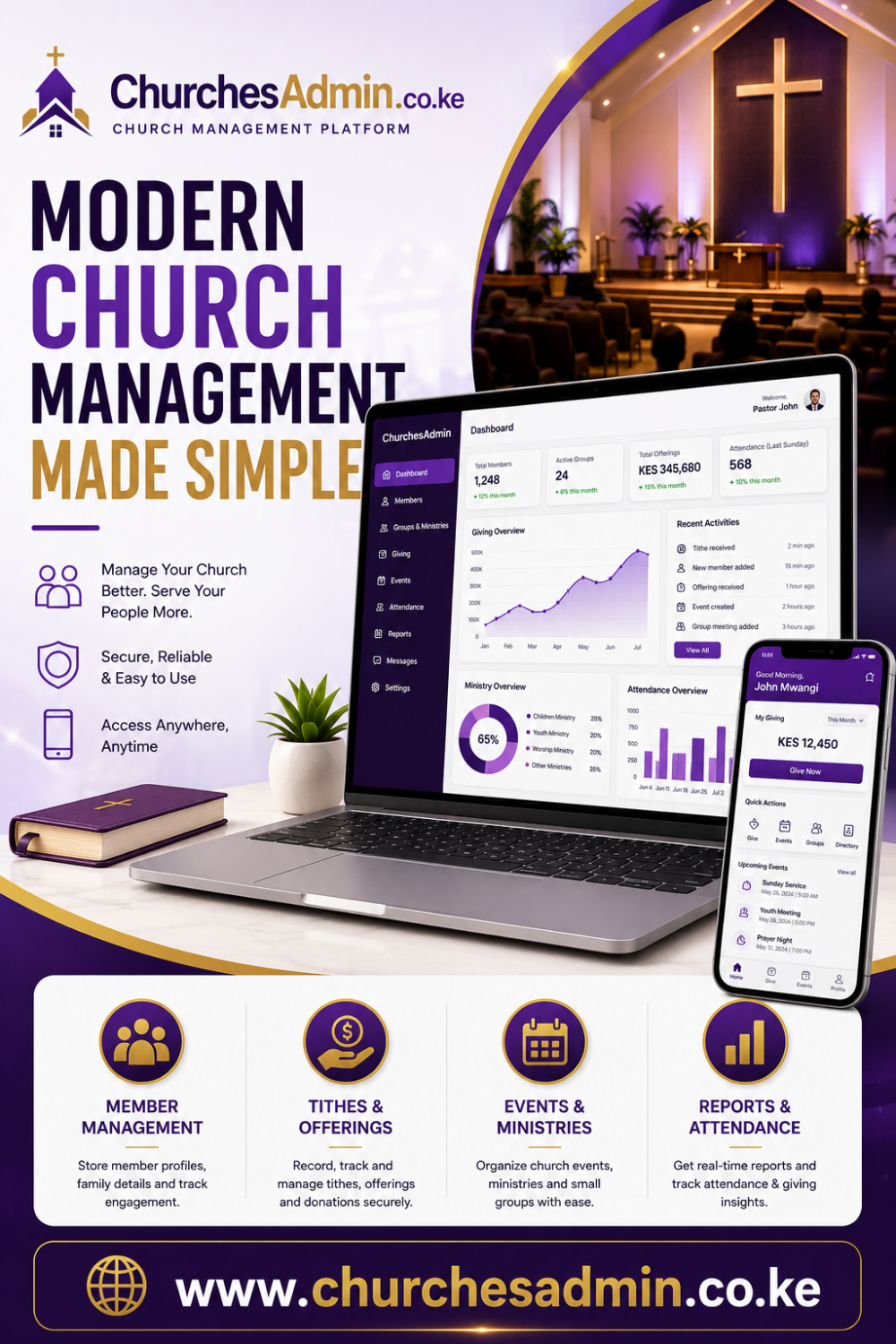
Worship Service Attendance Tracking

Worship Service Attendance Tracking is an essential process for churches, ministries, denominations, and faith-based organizations seeking to monitor participation, improve member engagement, and strengthen pastoral care.

As congregations grow, tracking attendance manually becomes increasingly challenging. Church leaders need accurate information about worship participation, member involvement, visitor attendance, and congregation trends to make informed ministry decisions.

A modern Worship Service Attendance Tracking system enables churches to record, monitor, and analyze attendance across services, events, ministries, and multiple campuses. Rather than relying on paper registers, spreadsheets, or manual counting methods, churches can centralize attendance records and gain valuable insights into congregational engagement.

For churches throughout Kenya, where congregations continue to expand and ministry activities become more diverse, Worship Service Attendance Tracking provides the structure needed to manage attendance efficiently while supporting long-term ministry growth.


Table of Contents

  • Understanding Worship Service Attendance Tracking
  • Why Worship Service Attendance Tracking Matters
  • Core Features of Worship Service Attendance Tracking
  • Worship Attendance Recording and Monitoring
  • Visitor Tracking and Follow-Up Management
  • Ministry Participation and Engagement Analysis
  • Reporting and Church Leadership Insights
  • Challenges of Traditional Methods

Understanding Worship Service Attendance Tracking

Worship Service Attendance Tracking refers to the process of recording, organizing, and analyzing attendance information for church services and ministry activities.

Attendance data helps church leaders understand participation patterns, identify engagement opportunities, monitor church growth, and strengthen pastoral oversight. Accurate attendance records provide valuable information that supports ministry planning and decision-making.

Traditionally, churches relied on paper attendance books, manual headcounts, or basic spreadsheets to track worship attendance. While these methods may work for smaller congregations, they often become inefficient as attendance volumes increase.

A digital Worship Service Attendance Tracking system centralizes attendance records and makes them accessible to authorized church leaders and administrators. This creates greater visibility into congregation participation while reducing administrative burdens.

The system can record attendance for Sunday services, midweek services, prayer meetings, conferences, youth programs, children’s ministry activities, and special events.

For churches in Kenya, where ministry outreach continues to expand across urban and rural communities, effective attendance tracking provides important insights that support healthy church growth.


Why Worship Service Attendance Tracking Matters

Church leaders require accurate information to understand how effectively their ministries are serving their congregations.

Worship Service Attendance Tracking helps churches identify attendance trends and measure overall engagement levels. Leaders can quickly determine whether participation is increasing, declining, or remaining stable over time.

Attendance information also supports pastoral care efforts. Members who stop attending regularly can be identified and contacted before they become disconnected from the church community.

Another important benefit is improved planning. Understanding attendance patterns helps churches prepare adequately for services, events, staffing requirements, seating arrangements, and ministry activities.

Worship Service Attendance Tracking also supports accountability by providing measurable data regarding ministry participation and growth.

As churches expand their programs and outreach efforts, attendance tracking becomes increasingly important for maintaining visibility across multiple ministries and campuses.

Organizations that implement structured attendance tracking often achieve better engagement, stronger follow-up processes, and improved ministry effectiveness.


Core Features of Worship Service Attendance Tracking

A comprehensive Worship Service Attendance Tracking solution includes several features designed to simplify attendance management and improve reporting.

Attendance recording tools allow church staff and ministry leaders to capture participation quickly and accurately during services and events.

Member identification capabilities help churches associate attendance records with individual members and families.

Visitor management tools allow churches to record guest attendance and support follow-up activities.

Service categorization features enable attendance tracking across multiple worship services, departments, ministries, and events.

Mobile accessibility allows attendance information to be captured using smartphones, tablets, or computers.

Reporting dashboards provide visibility into attendance trends, growth patterns, participation rates, and engagement metrics.

Multi-campus support helps churches manage attendance records across different locations within a centralized platform.

Together, these features make Worship Service Attendance Tracking an important component of modern church administration.


Worship Attendance Recording and Monitoring

Accurate attendance recording is the foundation of effective church engagement management.

Worship Service Attendance Tracking enables churches to record attendance consistently across all worship gatherings. Attendance can be captured by individual members, families, ministry groups, or service categories.

Church leaders gain visibility into attendance levels for Sunday services, prayer meetings, Bible studies, youth programs, and special events.

Digital attendance tracking eliminates many of the errors associated with paper-based systems while improving record accuracy.

Attendance histories can be maintained automatically, allowing churches to monitor long-term participation patterns and identify meaningful trends.

For growing congregations, centralized attendance monitoring provides valuable information that supports ministry planning and operational decision-making.

Worship Service Attendance Tracking ensures attendance data remains organized, accessible, and useful for church leadership.


Visitor Tracking and Follow-Up Management

Visitors represent an important opportunity for church growth and community outreach.

Worship Service Attendance Tracking helps churches record visitor attendance and maintain organized records for follow-up activities.

Guest information can be captured during worship services and linked to future interactions with the church.

Church leaders and follow-up teams can identify first-time visitors, returning guests, and individuals interested in becoming members.

Structured follow-up processes help churches build stronger relationships with visitors and improve retention.

Accurate visitor tracking also provides insight into the effectiveness of evangelism efforts, outreach programs, and community engagement initiatives.

For churches seeking to grow their congregations, effective visitor management is a critical component of ministry success.

Worship Service Attendance Tracking helps ensure that no visitor is overlooked during the follow-up process.


Ministry Participation and Engagement Analysis

Attendance tracking extends beyond worship services alone.

Worship Service Attendance Tracking helps churches monitor participation across ministries, departments, volunteer teams, small groups, and special programs.

Leaders can evaluate engagement levels within various church activities and identify opportunities to strengthen participation.

Participation data provides valuable insight into which ministries are growing, which require additional support, and where resources may need to be allocated.

Church administrators can monitor involvement across different age groups, ministry categories, and congregation segments.

These insights help leaders make informed decisions regarding ministry development and community engagement strategies.

Worship Service Attendance Tracking transforms attendance information into meaningful data that supports ministry effectiveness and long-term growth.


Reporting and Church Leadership Insights

Reliable reporting is essential for informed church leadership.

Worship Service Attendance Tracking provides detailed reports that help leaders understand attendance trends and ministry performance.

Attendance reports can highlight weekly participation, monthly growth patterns, seasonal fluctuations, and ministry engagement levels.

Leadership teams gain visibility into congregation health and can identify areas requiring additional attention.

Operational dashboards provide real-time access to attendance statistics, visitor activity, and participation trends.

Historical attendance records support strategic planning and long-term ministry evaluation.

For churches operating multiple campuses or ministries, centralized reporting creates a unified view of attendance performance across the organization.

Worship Service Attendance Tracking provides the information leaders need to make data-driven decisions that support ministry growth and member engagement.


Challenges of Traditional Methods

Many churches continue to rely on paper registers, manual counting methods, and spreadsheets to track attendance.

While these approaches may appear simple, they often become difficult to manage as congregations grow.

Manual attendance recording can result in inaccurate counts, incomplete records, and inconsistent reporting.

Paper records may be misplaced, damaged, or difficult to analyze effectively.

Church leaders often spend significant time compiling attendance reports manually rather than focusing on ministry activities.

Visitor follow-up can also become inconsistent when attendance information is scattered across multiple records and systems.

Reporting limitations make it difficult to identify attendance trends, engagement levels, and ministry performance accurately.

As churches expand, these challenges become increasingly significant.

Worship Service Attendance Tracking addresses these issues by centralizing attendance records, improving accuracy, streamlining reporting, enhancing visitor follow-up, and providing valuable insights that support healthy church growth and effective ministry management.

Benefits for Church Leaders

Worship Service Attendance Tracking provides significant benefits for pastors, ministry leaders, elders, and church leadership teams seeking greater visibility into congregational engagement.

One of the most important advantages is access to accurate attendance information. Church leaders can monitor participation trends and gain a clearer understanding of how members engage with worship services and ministry activities.

The system helps identify growth opportunities by revealing attendance patterns across services, departments, and programs.

Worship Service Attendance Tracking also supports better pastoral oversight. Leaders can quickly identify members whose attendance has declined and initiate appropriate follow-up efforts.

Attendance reports provide valuable insights that support strategic planning, resource allocation, and ministry development.

Church leaders benefit from improved decision-making because attendance data is organized, accessible, and available in real time.

As congregations grow, Worship Service Attendance Tracking helps leadership teams maintain visibility and accountability across the church.

Organizations that implement structured attendance management often experience stronger engagement and more effective ministry planning.


Benefits for Church Administrators

Church administrators play a critical role in maintaining accurate records and ensuring smooth church operations.

Worship Service Attendance Tracking simplifies administrative tasks by automating attendance recording, record maintenance, reporting, and participation monitoring.

Administrators no longer need to rely on paper attendance sheets, manual counting, or spreadsheet-based systems.

The platform centralizes attendance information, making it easier to access, update, and analyze records.

Worship Service Attendance Tracking also improves reporting efficiency by generating attendance summaries automatically.

Administrative teams can monitor attendance across multiple services, ministries, departments, and campuses from a single platform.

The system reduces manual workloads while improving record accuracy and consistency.

For churches throughout Kenya, these efficiencies help administrative teams support growing congregations without increasing operational complexity.

Worship Service Attendance Tracking enables church administrators to focus more on ministry support and less on manual data management.


Benefits for Church Members

Church members benefit from the improved organization and engagement made possible through Worship Service Attendance Tracking.

Accurate attendance records help churches provide better pastoral care and member support.

When attendance patterns change, church leaders can reach out proactively to offer encouragement, support, and assistance.

Worship Service Attendance Tracking also helps members become more connected to church life by supporting participation in services, ministries, events, and outreach activities.

The system improves communication because churches have better visibility into member involvement and engagement levels.

Members benefit from stronger relationships with ministry leaders and more personalized follow-up efforts.

Attendance information also helps churches recognize active participation and identify opportunities for deeper involvement.

For congregations seeking stronger community connections, Worship Service Attendance Tracking contributes to a more engaged and supportive church environment.

These improvements enhance the overall worship experience and strengthen long-term member retention.


Improving Ministry Through Automation

Automation is transforming how churches manage attendance and engagement.

Traditional attendance tracking often involves paper forms, manual counting, spreadsheets, and repetitive administrative tasks.

These methods consume time and increase the likelihood of errors.

Worship Service Attendance Tracking automates attendance recording, reporting, participation analysis, and engagement monitoring.

The system maintains accurate records automatically while reducing administrative workloads.

Automated attendance management helps ensure consistency across worship services, ministries, departments, and campuses.

Worship Service Attendance Tracking also supports faster reporting and real-time access to participation data.

Church staff can spend less time managing records and more time focusing on ministry, discipleship, outreach, and member care.

As churches continue to grow, automation becomes increasingly important for maintaining operational efficiency and ministry effectiveness.

Worship Service Attendance Tracking transforms attendance management into a reliable and scalable process that supports long-term ministry success.


Compliance, Accountability, and Ministry Stewardship

Accurate records contribute to transparency, accountability, and responsible church administration.

Worship Service Attendance Tracking helps churches maintain organized attendance histories and participation records that support ministry oversight.

The platform provides detailed records of service attendance, visitor participation, ministry involvement, and congregation engagement.

These records support reporting, strategic planning, and leadership reviews.

Worship Service Attendance Tracking also improves accountability by ensuring attendance information remains consistent and accessible.

Historical attendance data helps churches evaluate ministry effectiveness and measure progress toward engagement goals.

The system reduces risks associated with missing records, inaccurate reporting, and fragmented information.

For churches managing multiple ministries and campuses, centralized attendance tracking improves operational visibility and governance.

These capabilities support responsible stewardship while strengthening overall church administration.


Why ChurchesAdmin Is the Ideal Solution

ChurchesAdmin is designed specifically to help churches, ministries, denominations, and faith-based organizations manage operations efficiently.

Worship Service Attendance Tracking becomes significantly more effective when integrated with member management, visitor tracking, communication tools, ministry administration, financial management, and reporting capabilities.

ChurchesAdmin combines all these functions within a single platform.

The system allows churches to record attendance, monitor participation, track visitors, manage ministries, and generate detailed reports from one centralized solution.

ChurchesAdmin helps leadership teams gain deeper visibility into congregation engagement while reducing administrative workloads.

Worship Service Attendance Tracking powered by ChurchesAdmin supports churches of all sizes, from small congregations to multi-campus ministries.

For churches throughout Kenya, ChurchesAdmin provides a scalable platform capable of supporting growth while maintaining operational efficiency.

By centralizing attendance management and ministry administration, ChurchesAdmin helps churches improve engagement, strengthen follow-up efforts, and support sustainable ministry growth.


Future Trends

The future of Worship Service Attendance Tracking will be shaped by automation, mobile technology, artificial intelligence, and advanced analytics.

Mobile attendance recording will continue becoming more common as churches seek faster and more convenient methods for capturing participation data.

Artificial intelligence may help churches identify attendance trends, predict engagement challenges, and recommend follow-up strategies.

Cloud-based systems will continue gaining popularity because they provide secure access to attendance records from any location.

Advanced analytics tools will offer deeper insights into congregation growth, ministry effectiveness, and member engagement.

Integration between attendance systems and broader church management platforms will continue expanding.

As churches throughout Kenya continue to grow and modernize, leaders will increasingly rely on data-driven insights to guide ministry decisions.

Worship Service Attendance Tracking will remain a critical component of effective church administration and congregational care.

Organizations that adopt modern attendance management technologies will be better positioned to improve engagement and support long-term ministry success.


Getting Started

Implementing Worship Service Attendance Tracking begins with evaluating current attendance management processes and identifying opportunities for improvement.

Church leaders should assess how attendance is currently recorded, reported, and analyzed across services and ministries.

The next step involves selecting a centralized platform capable of supporting attendance management, member engagement, visitor tracking, and ministry reporting.

Organizations should establish attendance procedures, reporting standards, and ministry objectives before implementation.

Staff and volunteer training is also important to ensure consistent attendance recording and system adoption.

Worship Service Attendance Tracking delivers the greatest value when integrated with broader church administration and member engagement strategies.

For churches seeking a complete solution, ChurchesAdmin provides integrated capabilities that support attendance management, member records, visitor follow-up, communication, ministry coordination, financial management, and reporting.

By implementing Worship Service Attendance Tracking, churches can improve engagement, strengthen pastoral care, enhance ministry effectiveness, streamline administration, and create a scalable foundation for long-term growth.
Church Member Engagement System – Complete Guide for Churches and Ministries

Church Member Engagement System

Church Member Engagement System is an essential solution for churches, ministries, denominations, and faith-based organizations seeking to strengthen relationships with members, improve participation, and foster a more connected church community.

Member engagement is one of the most important aspects of church growth and ministry effectiveness. Churches thrive when members actively participate in worship services, ministry activities, small groups, volunteer programs, outreach initiatives, and community events.

As congregations grow, maintaining meaningful connections with members becomes increasingly challenging. Church leaders must communicate effectively, monitor participation, follow up with visitors, coordinate ministries, and ensure members remain engaged in church life.

Many churches still rely on manual processes, spreadsheets, messaging groups, and paper records to manage member interactions. These methods often make it difficult to maintain consistent communication and monitor engagement levels.

A modern Church Member Engagement System centralizes communication, participation tracking, ministry involvement, and member management within a single platform. This enables churches to build stronger relationships while improving ministry coordination and congregation growth.

For churches throughout Kenya, where congregations continue expanding and technology adoption is increasing, implementing a Church Member Engagement System provides a powerful foundation for long-term ministry success.


Table of Contents


Understanding Church Member Engagement System

A Church Member Engagement System is a software platform designed to help churches build stronger relationships with members through organized communication, participation tracking, ministry involvement management, and engagement monitoring.

Churches interact with members through various activities including worship services, prayer meetings, Bible studies, volunteer opportunities, outreach programs, ministry events, and pastoral care initiatives.

Managing these interactions manually becomes increasingly difficult as membership grows.

A Church Member Engagement System provides a centralized environment where churches can monitor member activity, maintain communication records, coordinate follow-up efforts, and track participation across ministries.

The platform helps leaders identify engagement trends, support member development, and strengthen community relationships.

Many systems integrate member management, attendance tracking, communication tools, volunteer coordination, and reporting capabilities.

For growing churches, Church Member Engagement System solutions provide the structure needed to maintain personal connections while supporting congregation expansion.

The software enables churches to improve retention, strengthen ministry involvement, and foster deeper member engagement.


Why Church Member Engagement System Matters

Church growth depends on more than increasing membership numbers.

Long-term success requires active participation, meaningful relationships, and consistent engagement among congregation members.

A Church Member Engagement System helps churches create these connections while improving ministry effectiveness.

One of the primary benefits is improved communication. Churches can share announcements, event information, prayer requests, ministry opportunities, and updates more consistently.

The platform also helps leaders identify members who may need additional support, encouragement, or follow-up.

Church Member Engagement System solutions improve visibility into participation patterns, helping churches understand how members interact with ministries and church activities.

Another important advantage is member retention. Consistent engagement often leads to stronger relationships and long-term commitment.

For churches throughout Kenya, maintaining strong member connections is increasingly important as congregations become larger and more diverse.


Core Features of Church Member Engagement System

A comprehensive Church Member Engagement System includes a variety of tools designed to strengthen member relationships and ministry participation.

Member profile management enables churches to maintain detailed records including contact information, family relationships, ministry involvement, communication history, and attendance records.

Communication tools support SMS messaging, email campaigns, announcements, newsletters, and event invitations.

Attendance tracking capabilities help monitor participation in services, small groups, classes, and ministry programs.

Volunteer management features support ministry assignments and engagement opportunities.

Visitor follow-up tools help churches nurture relationships with guests and new members.

Pastoral care management assists church leaders in tracking member needs, visits, counseling activities, and support programs.

Reporting and analytics provide insights into participation levels, retention trends, and congregation engagement.

Together, these features make Church Member Engagement System solutions essential for modern church growth strategies.


Member Communication and Relationship Management

Effective communication is central to member engagement.

Church Member Engagement System software helps churches maintain consistent communication with members through centralized communication tools.

Leaders can send announcements, event reminders, ministry updates, prayer requests, and important notifications efficiently.

The platform maintains communication histories, enabling church staff to monitor interactions and follow-up activities.

Church Member Engagement System solutions also support personalized communication strategies based on member interests, ministry involvement, and participation history.

Strong communication helps members remain informed, connected, and involved in church activities.

For growing congregations, centralized communication management significantly improves outreach effectiveness and relationship building.

These capabilities help churches strengthen community connections while supporting ministry objectives.


Participation Tracking and Ministry Involvement

Member participation provides valuable insight into church engagement and spiritual growth.

Church Member Engagement System software enables churches to monitor attendance, volunteer activities, ministry participation, event involvement, and group engagement.

The platform helps leaders identify active members, emerging leaders, and individuals who may require additional encouragement.

Participation tracking supports more effective ministry planning and volunteer coordination.

Church Member Engagement System solutions also help churches match members with ministries and service opportunities that align with their interests and gifts.

By encouraging greater involvement, churches can strengthen engagement and foster deeper relationships within the congregation.

As ministries expand, participation tracking becomes increasingly important for maintaining effective member support and ministry development.


Visitor Follow-Up and Member Retention

First impressions play an important role in church growth and member retention.

Church Member Engagement System software helps churches manage visitor follow-up processes and nurture relationships with new attendees.

Visitor information can be recorded centrally and integrated into structured follow-up workflows.

Church leaders can track communication efforts, meeting invitations, ministry involvement opportunities, and membership progression.

The platform helps ensure that visitors receive timely attention and support.

Church Member Engagement System solutions also improve retention by helping churches identify members whose participation levels may be declining.

Proactive engagement helps strengthen relationships and reduce member disengagement.

For churches throughout Kenya, effective follow-up and retention strategies contribute significantly to sustainable congregation growth.


Reporting and Congregation Insights

Church leaders require accurate information to understand congregation health and ministry effectiveness.

Church Member Engagement System software provides reporting tools that transform participation data into actionable insights.

Attendance reports help leaders monitor engagement trends and service participation.

Communication reports provide visibility into outreach effectiveness and member responsiveness.

Volunteer reports help churches assess ministry involvement and staffing needs.

Retention reports support efforts to strengthen member relationships and improve engagement outcomes.

For churches operating multiple ministries or campuses, centralized reporting provides a comprehensive view of congregation activity.

Church Member Engagement System solutions enable leaders to make informed decisions based on reliable data and meaningful insights.

These capabilities support strategic ministry planning and long-term church growth.


Challenges of Traditional Methods

Many churches still rely on spreadsheets, notebooks, paper records, and messaging groups to manage member engagement activities.

While these approaches may work for smaller congregations, they often become increasingly difficult to manage as churches grow.

Communication records may become fragmented across multiple systems.

Attendance tracking and participation monitoring often require significant manual effort.

Visitor follow-up processes may be inconsistent, leading to missed engagement opportunities.

Reporting becomes challenging because information is scattered across different sources.

Traditional methods also make it difficult to identify engagement trends and provide personalized member support.

As congregations expand, these limitations can negatively affect member retention and ministry effectiveness.

Church Member Engagement System solutions address these challenges by centralizing communication, participation tracking, visitor follow-up, reporting, and member management activities.

For churches, ministries, denominations, and faith-based organizations throughout Kenya, adopting a Church Member Engagement System is becoming increasingly important for strengthening relationships, improving participation, enhancing retention, and supporting sustainable ministry growth. ChurchesAdmin helps organizations achieve these goals by combining member management, attendance tracking, communication tools, volunteer coordination, pastoral care management, reporting, and ministry administration capabilities within a single integrated platform designed for modern church engagement.

Benefits for Church Leaders

Church Member Engagement System provides significant advantages for pastors, ministry leaders, church boards, and leadership teams seeking to strengthen congregation relationships and improve ministry effectiveness.

One of the primary benefits is improved visibility into member participation and engagement levels. Church leaders can monitor attendance trends, ministry involvement, volunteer participation, communication activities, and member retention through centralized dashboards and reports.

The platform helps leaders identify opportunities to strengthen relationships with members who may require additional support, encouragement, or pastoral care.

Church Member Engagement System also enables leadership teams to make more informed decisions by providing accurate engagement data and congregation insights.

Improved member engagement often leads to stronger ministry participation, increased volunteer involvement, and healthier church growth.

The software reduces administrative burdens by automating communication, follow-up activities, and engagement tracking processes.

For churches throughout Kenya, Church Member Engagement System provides the operational structure needed to support growing congregations while maintaining meaningful personal connections.


Benefits for Church Administrators

Church administrators play a vital role in coordinating communication, managing records, supporting ministries, and maintaining member engagement activities.

Church Member Engagement System simplifies these responsibilities by centralizing engagement management within a single platform.

Administrators can maintain member profiles, track attendance, monitor ministry involvement, coordinate follow-up efforts, and manage communication campaigns efficiently.

The software reduces reliance on spreadsheets, notebooks, paper records, and disconnected communication tools.

Church Member Engagement System improves data accuracy by maintaining organized and centralized member information.

Automated workflows help reduce repetitive administrative tasks while ensuring engagement activities remain consistent and effective.

Administrators also benefit from improved reporting capabilities that provide visibility into participation trends and congregation activity.

For churches managing multiple ministries or campuses, centralized engagement management significantly improves operational efficiency and coordination.

These capabilities help administrative teams support church growth while maintaining organized and effective member communication.


Benefits for Church Members

Church members benefit greatly from the personalized communication and stronger relationships created by Church Member Engagement System solutions.

Members receive timely information regarding services, ministry activities, events, volunteer opportunities, prayer meetings, and community programs.

The platform helps ensure that communication remains consistent and relevant.

Church Member Engagement System also improves member experiences by helping church leaders provide more personalized support and follow-up.

Members feel more connected when their participation, interests, and ministry involvement are recognized and supported.

The software helps create stronger relationships between members and church leadership.

Visitors and new members benefit from structured onboarding and follow-up processes that help them integrate into church life more effectively.

For congregations throughout Kenya, these capabilities contribute to improved member satisfaction, stronger engagement, and deeper community involvement.


Improving Ministry Through Automation

Automation is becoming increasingly important for churches seeking to strengthen member engagement while maintaining operational efficiency.

Traditional engagement management often involves manual attendance tracking, spreadsheets, phone calls, messaging groups, and paper records.

These methods require significant administrative effort and may lead to inconsistencies.

Church Member Engagement System automates many engagement activities including communication distribution, attendance monitoring, follow-up scheduling, volunteer coordination, and reporting.

The platform helps ensure that engagement processes remain consistent across ministries and departments.

Automated workflows improve efficiency while reducing the risk of missed follow-ups and communication gaps.

Church Member Engagement System also helps churches scale engagement efforts as congregations grow.

Ministry leaders can focus more on spiritual development, discipleship, outreach, and pastoral care rather than administrative tasks.

For churches throughout Kenya, automation supports sustainable growth while improving member experiences and ministry effectiveness.


Compliance, Accountability, and Financial Stewardship

Strong accountability and accurate records are essential for effective church administration.

Church Member Engagement System helps churches maintain organized records of member activities, attendance history, ministry involvement, volunteer participation, communication interactions, and pastoral care activities.

The platform provides detailed reporting and audit capabilities that support leadership oversight and strategic planning.

Church Member Engagement System improves accountability by creating centralized records that document member engagement activities consistently.

Leadership teams can access historical information and monitor congregation health with greater confidence.

Accurate engagement data also supports resource allocation, ministry planning, and community outreach initiatives.

The software reduces risks associated with fragmented information, incomplete records, and inconsistent follow-up processes.

For churches throughout Kenya, effective engagement management contributes to stronger governance, improved member trust, and healthier ministry development.

Church Member Engagement System provides the foundation for organized and accountable church growth strategies.


Why ChurchesAdmin Is the Ideal Solution

ChurchesAdmin is specifically designed to help churches, ministries, denominations, and faith-based organizations manage operations and strengthen congregation engagement.

Church Member Engagement System becomes significantly more powerful when integrated with membership management, attendance tracking, volunteer coordination, communication tools, pastoral care management, financial administration, and reporting capabilities.

ChurchesAdmin combines these capabilities within a single platform.

The system enables churches to maintain member records, track participation, manage communications, coordinate ministries, support volunteer programs, and monitor engagement levels from one centralized environment.

ChurchesAdmin helps reduce administrative workloads while improving relationship management and ministry effectiveness.

The platform supports churches of all sizes, from small congregations to large multi-campus ministries.

For churches throughout Kenya, ChurchesAdmin provides a scalable solution capable of supporting growing memberships while maintaining meaningful member engagement.

By centralizing engagement management and automating routine processes, ChurchesAdmin helps churches improve participation, strengthen relationships, and support long-term ministry growth.


Future Trends

The future of church engagement will be influenced by automation, cloud technology, mobile communication, artificial intelligence, and advanced analytics.

Church Member Engagement System solutions are expected to become increasingly intelligent through predictive engagement analysis and personalized communication capabilities.

Artificial intelligence may help churches identify members at risk of disengagement and recommend proactive outreach strategies.

Mobile engagement tools will continue growing in importance as members expect real-time communication and convenient access to church information.

Cloud-based platforms will remain popular because they provide flexibility, scalability, and centralized access.

Advanced reporting capabilities will offer deeper insights into participation trends, ministry effectiveness, and congregation health.

As churches throughout Kenya continue embracing digital transformation, demand for integrated engagement solutions is expected to increase.

Church Member Engagement System will remain a critical component of modern church growth and member retention strategies.

Organizations that adopt these technologies early will gain important advantages in ministry effectiveness and congregation engagement.


Getting Started

Implementing Church Member Engagement System begins with evaluating existing member engagement processes and identifying opportunities for improvement.

Churches should assess communication workflows, attendance tracking practices, visitor follow-up procedures, ministry participation monitoring, volunteer coordination processes, and reporting requirements.

The next step involves centralizing engagement information within a structured digital platform.

Leadership teams should establish clear engagement strategies, communication standards, follow-up procedures, and participation tracking policies.

Staff and ministry leaders should also receive training to ensure successful adoption and effective use of the system.

Church Member Engagement System delivers the greatest value when integrated with broader church administration and ministry management functions.

For churches seeking a comprehensive solution, ChurchesAdmin provides integrated capabilities that support membership management, attendance tracking, communication, volunteer coordination, pastoral care, financial administration, reporting, and engagement management.

By implementing Church Member Engagement System, churches can strengthen relationships, improve participation, enhance member retention, streamline operations, and create a scalable foundation for sustainable ministry growth.


Digital Church Administration Software – Complete Guide for Churches and Ministries

Digital Church Administration Software

Digital Church Administration Software is an essential solution for churches, ministries, denominations, and faith-based organizations seeking to modernize operations, improve efficiency, and streamline church management processes.

As churches grow, administrative responsibilities become increasingly complex. Church leaders must manage member records, attendance tracking, volunteer coordination, communication, financial administration, ministry activities, events, and reporting while continuing to focus on spiritual leadership and community engagement.

Many churches still rely on paper records, spreadsheets, notebooks, and disconnected systems to manage daily operations. While these methods may work for smaller congregations, they often become difficult to maintain as membership and ministry activities expand.

Digital Church Administration Software centralizes administrative functions within a single platform. It enables churches to organize information, automate routine processes, improve communication, and maintain accurate records across all ministries and departments.

For churches throughout Kenya, where technology adoption continues to increase, Digital Church Administration Software provides a scalable foundation for effective church management and sustainable ministry growth.


Table of Contents


Understanding Digital Church Administration Software

Digital Church Administration Software is a comprehensive software platform designed to help churches manage administrative activities, maintain member records, coordinate ministries, monitor attendance, manage finances, and support church leadership.

Church administration involves numerous responsibilities that require accurate information and efficient workflows. These responsibilities often include member registration, visitor follow-up, volunteer management, event planning, donation tracking, communication management, and reporting.

Managing these activities manually can become time-consuming and inefficient as congregations grow.

Digital Church Administration Software simplifies administration by creating a centralized environment where church leaders and administrators can access and manage information efficiently.

The platform integrates various church functions into a single system, reducing duplication and improving visibility across departments.

For churches operating multiple ministries or campuses, Digital Church Administration Software provides the coordination and structure needed to support growth.

The software enables churches to improve operational efficiency while enhancing member engagement and ministry effectiveness.


Why Digital Church Administration Software Matters

Churches today face increasing administrative demands as congregations expand and ministry activities become more diverse.

Digital Church Administration Software helps churches meet these challenges through automation, organization, and centralized management.

One of the primary benefits is improved efficiency. Administrative tasks that previously required significant manual effort can be automated and managed more effectively.

The software also improves data accuracy by maintaining centralized records and reducing duplicate information.

Digital Church Administration Software enhances communication between church leaders, staff, volunteers, and members.

Another important advantage is visibility. Church leadership can access real-time information regarding membership growth, attendance trends, ministry participation, and financial performance.

The platform also supports accountability by maintaining detailed records of church activities and administrative processes.

For churches throughout Kenya, implementing Digital Church Administration Software helps improve operational effectiveness while creating a stronger foundation for ministry growth.


Core Features of Digital Church Administration Software

A comprehensive Digital Church Administration Software solution includes a variety of tools designed to support church operations.

Member management features allow churches to maintain detailed congregational records including contact information, family relationships, ministry involvement, and communication history.

Attendance tracking tools help monitor participation during services, events, classes, and ministry activities.

Volunteer management capabilities support scheduling, ministry assignments, and volunteer coordination.

Financial administration tools assist with donation tracking, tithes, offerings, reporting, and stewardship management.

Communication features enable churches to send announcements, reminders, newsletters, SMS messages, and email updates.

Event management capabilities support conferences, seminars, outreach programs, and ministry gatherings.

Reporting tools provide leadership teams with valuable insights into church performance and engagement.

Together, these capabilities make Digital Church Administration Software a critical component of modern church management.


Member Management and Congregation Records

Accurate member information forms the foundation of effective church administration.

Digital Church Administration Software enables churches to maintain organized and up-to-date member records within a centralized database.

Member profiles can include contact details, family information, baptism records, ministry participation, volunteer activities, attendance history, and communication preferences.

Church leaders can access information quickly whenever needed.

The platform helps eliminate duplicate records and improves consistency across departments.

Digital Church Administration Software also supports visitor tracking and follow-up activities, helping churches strengthen member engagement and retention.

As congregations grow, centralized member management becomes increasingly important for maintaining organization and delivering personalized ministry support.

These capabilities help churches build stronger relationships with members while improving administrative efficiency.


Attendance Tracking and Ministry Coordination

Attendance data provides valuable insights into church engagement and ministry effectiveness.

Digital Church Administration Software helps churches record attendance accurately for worship services, small groups, ministry meetings, classes, and special events.

The platform simplifies attendance collection and reporting processes.

Church leaders can identify participation trends, monitor ministry growth, and evaluate engagement levels more effectively.

Ministry coordination tools support volunteer scheduling, department management, and activity planning.

Digital Church Administration Software improves collaboration across ministries by ensuring leaders have access to accurate and timely information.

For churches operating multiple programs and departments, centralized coordination significantly improves efficiency and accountability.

The software helps ensure ministry activities remain organized and adequately supported.


Communication and Engagement Management

Effective communication is essential for building strong church communities.

Digital Church Administration Software provides communication tools that help churches engage members consistently and efficiently.

Church leaders can distribute announcements, event invitations, prayer requests, ministry updates, and important notifications through centralized channels.

The platform supports SMS messaging, email communication, newsletters, and member outreach initiatives.

Digital Church Administration Software also improves engagement by maintaining communication histories and member interaction records.

These capabilities help churches strengthen relationships with members and encourage greater participation in ministry activities.

For growing congregations, centralized communication management significantly improves outreach effectiveness and member engagement.

The software helps churches remain connected with their communities while reducing administrative workloads.


Reporting and Church Oversight

Church leaders require accurate information to support effective decision-making and ministry planning.

Digital Church Administration Software provides reporting tools that transform church data into meaningful insights.

Attendance reports help leaders monitor participation trends and ministry engagement.

Membership reports provide visibility into growth, retention, visitor follow-up activities, and demographic information.

Financial reports support stewardship, budgeting, and resource allocation decisions.

Volunteer reports help churches monitor ministry staffing and participation levels.

For churches managing multiple campuses or ministries, centralized reporting creates a comprehensive view of church operations.

Digital Church Administration Software enables leadership teams to make informed decisions based on accurate and timely information.

These insights contribute to stronger ministry planning and long-term organizational growth.


Challenges of Traditional Methods

Many churches continue to rely on paper records, spreadsheets, notebooks, and disconnected software systems to manage administration.

While these methods may be sufficient during the early stages of growth, they often become inefficient as congregations expand.

Manual processes can lead to duplicate records, communication delays, reporting challenges, and administrative errors.

Member information may become fragmented across multiple systems, making it difficult to maintain accuracy and consistency.

Attendance tracking and ministry coordination often require significant manual effort.

Financial reporting can also become time-consuming due to the need for manual data consolidation and reconciliation.

As church operations become more complex, these limitations can negatively impact ministry effectiveness and member experiences.

Digital Church Administration Software addresses these challenges by centralizing church information, automating administrative workflows, improving communication, enhancing reporting capabilities, and supporting scalable ministry operations.

For churches, ministries, denominations, and faith-based organizations throughout Kenya, adopting Digital Church Administration Software is becoming increasingly important for maintaining efficiency, accountability, and sustainable growth. ChurchesAdmin helps organizations achieve these objectives by combining member management, attendance tracking, financial administration, volunteer coordination, communication tools, ministry oversight, and reporting capabilities within a single integrated platform designed for modern church management.

Benefits for Church Leaders

Digital Church Administration Software provides significant advantages for pastors, bishops, ministry directors, church boards, and leadership teams seeking to improve oversight and ministry effectiveness.

One of the primary benefits is centralized visibility into church operations. Leaders can access information regarding membership growth, attendance trends, ministry activities, volunteer participation, financial performance, and church events from a single platform.

The software reduces administrative burdens by automating routine tasks that would otherwise consume valuable leadership time.

Digital Church Administration Software also supports strategic planning by providing accurate data and reporting tools that help leaders make informed decisions.

Church leaders benefit from improved coordination across ministries and departments, ensuring activities remain aligned with the church’s vision and objectives.

The platform enhances accountability by maintaining organized records of church operations and ministry activities.

For growing churches throughout Kenya, Digital Church Administration Software provides the operational structure necessary to support sustainable ministry growth while maintaining effective leadership oversight.


Benefits for Church Administrators

Church administrators are responsible for managing a wide range of operational activities including member records, attendance tracking, communication, event coordination, volunteer management, and reporting.

Digital Church Administration Software simplifies these responsibilities by centralizing administrative functions within a single system.

Administrators can manage member information, update records, coordinate events, monitor attendance, and generate reports more efficiently.

The software reduces dependence on paper files, spreadsheets, and disconnected systems.

Digital Church Administration Software improves data accuracy by maintaining consistent records and reducing duplicate information.

Automated workflows reduce repetitive administrative tasks and help ensure information remains current and accessible.

Administrators also benefit from improved communication tools that streamline interactions with members, volunteers, and ministry leaders.

For churches operating multiple ministries or campuses, centralized administration significantly improves efficiency and coordination.

These capabilities enable administrators to support church operations more effectively while reducing workload and complexity.


Benefits for Church Members

Church members benefit from the improved organization and communication provided by Digital Church Administration Software.

Accurate member records help ensure that important information remains current and accessible.

Members receive timely updates regarding services, events, ministry activities, prayer meetings, conferences, and community outreach programs.

Digital Church Administration Software also supports better engagement by helping churches maintain consistent communication with their congregations.

Members benefit from improved follow-up processes, stronger ministry coordination, and enhanced participation opportunities.

The platform helps create a more connected church experience by enabling leaders to respond more effectively to member needs.

For visitors and new members, organized administration contributes to a more welcoming and professional church environment.

As churches continue to grow, Digital Church Administration Software helps maintain strong relationships between leadership and congregation members.

These improvements contribute significantly to member satisfaction and engagement.


Improving Ministry Through Automation

Automation is transforming how churches manage administrative operations.

Traditional church administration often involves repetitive tasks such as updating records, preparing reports, managing attendance lists, coordinating volunteers, and sending communications.

These processes can consume significant time and increase the likelihood of human error.

Digital Church Administration Software automates many of these activities through centralized workflows and integrated management tools.

The platform can automatically organize records, generate reports, track attendance, manage communications, and support ministry coordination.

Automated processes improve consistency while reducing administrative workloads.

Digital Church Administration Software also helps churches respond more quickly to changing operational requirements.

As congregations grow, automation becomes increasingly important for maintaining efficiency and service quality.

Ministry leaders can focus more on spiritual development, outreach programs, and member care rather than administrative tasks.

For churches throughout Kenya, automation supports sustainable ministry expansion and operational excellence.


Compliance, Accountability, and Financial Stewardship

Churches require accurate records, transparent processes, and strong accountability practices to support responsible ministry administration.

Digital Church Administration Software helps churches maintain organized records of membership activities, attendance data, donations, volunteer participation, ministry programs, and operational activities.

The platform provides detailed reporting capabilities that support oversight and decision-making.

Digital Church Administration Software also creates audit trails that improve accountability and transparency.

Leadership teams can access historical information and monitor operational performance with confidence.

Accurate records help support budgeting, planning, resource allocation, and stewardship initiatives.

The software reduces risks associated with missing documentation, inconsistent record keeping, and fragmented information systems.

For churches throughout Kenya, effective administrative management contributes to stronger governance and improved trust among congregation members.

Digital Church Administration Software provides the foundation for organized, accountable, and sustainable church operations.


Why ChurchesAdmin Is the Ideal Solution

ChurchesAdmin is designed specifically to help churches, ministries, denominations, and faith-based organizations manage operations efficiently.

Digital Church Administration Software becomes significantly more valuable when integrated with member management, attendance tracking, volunteer coordination, financial administration, communication tools, ministry management, and reporting capabilities.

ChurchesAdmin combines all these functions within a single platform.

The system enables churches to manage member records, track attendance, coordinate ministries, oversee volunteers, monitor giving, communicate with congregations, and generate reports from one centralized environment.

ChurchesAdmin helps reduce administrative workloads while improving organizational efficiency and ministry effectiveness.

The platform supports churches of all sizes, from small congregations to large multi-campus ministries.

For churches throughout Kenya, ChurchesAdmin provides a scalable solution capable of supporting growth while maintaining accountability and operational excellence.

By centralizing church administration and automating routine processes, ChurchesAdmin helps organizations improve member engagement, strengthen oversight, and support long-term ministry success.


Future Trends

The future of church administration will be shaped by cloud technology, automation, artificial intelligence, mobile accessibility, and advanced analytics.

Digital Church Administration Software is expected to become increasingly intelligent through predictive reporting, automated workflows, and enhanced member engagement capabilities.

Artificial intelligence may assist churches with communication planning, ministry forecasting, attendance analysis, and volunteer coordination.

Cloud-based platforms will continue gaining popularity because they provide accessibility, scalability, and centralized management.

Mobile functionality will become increasingly important as church leaders require real-time access to information from any location.

Advanced reporting tools will provide deeper insights into membership growth, ministry participation, volunteer engagement, and financial performance.

As churches throughout Kenya continue embracing digital transformation, demand for integrated administration platforms is expected to increase.

Digital Church Administration Software will remain a critical component of effective church management and ministry growth.

Organizations that adopt these technologies early will be better positioned to improve efficiency, engagement, and operational excellence.


Getting Started

Implementing Digital Church Administration Software begins with evaluating existing administrative processes and identifying areas that can benefit from automation.

Churches should assess member management procedures, attendance tracking methods, communication workflows, financial administration practices, ministry coordination requirements, and reporting needs.

The next step involves centralizing information within a structured digital platform.

Leadership teams should establish clear policies regarding data management, communication standards, reporting procedures, and ministry oversight.

Staff training is also essential to ensure successful adoption and effective system utilization.

Digital Church Administration Software delivers the greatest value when implemented as part of a broader strategy focused on ministry effectiveness and operational improvement.

For churches seeking a comprehensive solution, ChurchesAdmin provides integrated capabilities that support membership management, attendance tracking, volunteer coordination, communication, donation management, ministry administration, and reporting.

By implementing Digital Church Administration Software, churches can improve efficiency, strengthen accountability, enhance member engagement, streamline operations, and create a scalable foundation for sustainable ministry growth.

Church Giving Management Platform – Complete Guide for Churches and Ministries

Church Giving Management Platform

Church Giving Management Platform is an essential solution for churches, ministries, denominations, and faith-based organizations seeking to manage donations, tithes, offerings, fundraising activities, and financial stewardship more effectively.

Giving is a foundational aspect of church operations. Donations support ministry programs, outreach initiatives, community projects, facility maintenance, missions, staff operations, and long-term church growth. As congregations expand, managing financial contributions manually becomes increasingly challenging.

Many churches still rely on paper records, manual receipt books, spreadsheets, and disconnected financial systems to track contributions. These methods can create administrative burdens, increase the risk of errors, and limit financial visibility.

A modern Church Giving Management Platform centralizes donation management into a single system. It enables churches to record contributions, manage donor information, generate reports, issue receipts, monitor giving trends, and maintain accurate financial records.

For churches throughout Kenya, where digital giving channels continue to grow in popularity, implementing a Church Giving Management Platform helps improve accountability, transparency, and operational efficiency.


Table of Contents


Understanding Church Giving Management Platform

A Church Giving Management Platform is a software solution designed to help churches manage financial contributions, donor information, giving campaigns, receipts, and financial reporting within a centralized system.

Churches receive contributions through multiple channels including tithes, offerings, special donations, fundraising campaigns, building projects, missions support, and community initiatives.

Managing these contributions manually can become difficult as church membership and financial activity increase.

A Church Giving Management Platform simplifies contribution management by maintaining accurate donor records, tracking transactions, organizing giving categories, and supporting transparent financial administration.

The system provides church leaders with a structured environment for recording donations and monitoring financial performance.

Many platforms also integrate with accounting systems, member databases, communication tools, and digital payment channels.

For churches experiencing growth, Church Giving Management Platform solutions provide the operational foundation necessary to manage finances effectively while maintaining accountability.

The software helps churches improve stewardship practices and build trust through accurate and transparent financial management.


Why Church Giving Management Platform Matters

Financial stewardship is one of the most important responsibilities within any church organization.

Church members expect their contributions to be managed responsibly, accurately, and transparently.

A Church Giving Management Platform helps churches meet these expectations while reducing administrative complexity.

One of the primary benefits is improved accuracy. Donations can be recorded consistently and linked directly to donor profiles and designated funds.

The platform also enhances transparency by providing detailed financial records and reporting capabilities.

Church Giving Management Platform solutions reduce the risk of lost records, duplicate entries, and reporting inconsistencies commonly associated with manual systems.

Another important advantage is efficiency. Administrative teams spend less time processing contributions and more time supporting ministry activities.

The software also supports better donor engagement by maintaining complete giving histories and communication records.

For churches throughout Kenya, digital financial management is becoming increasingly important as congregations adopt electronic payment methods and demand greater accountability.


Core Features of Church Giving Management Platform

A comprehensive Church Giving Management Platform includes a wide range of tools designed to support church financial operations.

Donation management features allow churches to record and categorize contributions accurately.

Donor management capabilities maintain detailed records of member giving histories, contact information, and engagement activities.

Fund management tools help churches track contributions designated for specific ministries, projects, missions, or development programs.

Digital giving integration supports mobile payments, online donations, and other electronic contribution channels.

Receipt generation capabilities provide donors with accurate records of their contributions.

Reporting tools deliver insights into giving trends, donor participation, fund balances, and financial performance.

Communication features help churches engage donors through acknowledgments, updates, and stewardship communications.

Together, these capabilities make Church Giving Management Platform solutions essential for modern church administration.


Donation Recording and Donor Management

Accurate contribution tracking begins with effective donor management.

Church Giving Management Platform software enables churches to maintain organized donor records within a centralized database.

Each donor profile can include contact information, contribution history, ministry involvement, communication preferences, and engagement records.

Donations can be recorded quickly and assigned to specific funds, campaigns, or ministry activities.

The system helps eliminate duplicate records and improves overall data accuracy.

Church leaders can access donor histories instantly when preparing reports, conducting stewardship reviews, or communicating with members.

Church Giving Management Platform solutions also simplify contribution reconciliation and record maintenance.

As congregations grow, centralized donor management becomes increasingly valuable for maintaining organization and accountability.

The platform helps churches build stronger relationships with members while improving financial administration.


Tithes, Offerings, and Fund Management

Churches often manage multiple categories of giving simultaneously.

These may include regular tithes, weekly offerings, building funds, missions support, benevolence programs, youth ministry initiatives, and special fundraising campaigns.

A Church Giving Management Platform helps organize these contributions through structured fund management tools.

Contributions can be allocated accurately according to donor intentions and church policies.

Fund balances can be monitored continuously, providing leadership teams with visibility into ministry resources and financial performance.

The platform also supports budgeting and planning by providing historical giving data and contribution trends.

Church Giving Management Platform software helps ensure that designated funds remain properly tracked and managed.

These capabilities strengthen stewardship practices while improving financial oversight across the church.


Digital Giving and Payment Processing

Digital giving has become increasingly important for modern churches.

Many members prefer contributing through mobile money platforms, online payment systems, bank transfers, and other electronic channels.

A Church Giving Management Platform supports these preferences by integrating digital payment processing into church operations.

Contributions can be recorded automatically, reducing manual data entry and reconciliation workloads.

The platform provides real-time visibility into donation activity and payment confirmations.

Digital giving also improves convenience for members, making it easier to support church initiatives consistently.

For churches throughout Kenya, where mobile payment adoption continues to grow, digital giving capabilities have become an important component of effective financial management.

Church Giving Management Platform solutions help churches embrace these trends while maintaining accurate financial records.


Reporting and Financial Oversight

Effective decision-making depends on access to accurate financial information.

Church Giving Management Platform software provides reporting tools that transform contribution data into actionable insights.

Financial reports help church leaders monitor giving trends, donor participation, campaign performance, and fund balances.

Contribution summaries provide visibility into revenue sources and ministry funding levels.

Leadership teams can use these insights to support budgeting, planning, stewardship initiatives, and resource allocation decisions.

The platform also improves transparency by maintaining detailed transaction records and audit trails.

For churches operating multiple ministries, campuses, or projects, centralized reporting creates a unified view of financial performance.

Church Giving Management Platform solutions help churches strengthen accountability while supporting responsible financial management.


Challenges of Traditional Methods

Many churches continue to manage contributions using paper records, manual receipt books, spreadsheets, and disconnected financial systems.

While these methods may work for smaller congregations, they become increasingly difficult to manage as financial activity grows.

Manual contribution tracking often results in data entry errors, delayed reporting, and administrative inefficiencies.

Donor records may become fragmented across multiple systems, making it difficult to maintain accurate giving histories.

Financial reporting can require significant time and effort due to the need for manual reconciliation and data consolidation.

Traditional methods also create challenges related to transparency, accountability, and record security.

As churches expand their ministries and donor bases, these limitations become more significant.

Church Giving Management Platform solutions address these challenges by centralizing contribution management, automating record keeping, improving reporting capabilities, supporting digital giving, and strengthening financial oversight.

For churches, ministries, denominations, and faith-based organizations throughout Kenya, adopting a Church Giving Management Platform is becoming increasingly important for maintaining effective stewardship, improving accountability, and supporting sustainable ministry growth. ChurchesAdmin helps organizations achieve these goals by combining donation management, member records, financial reporting, communication tools, ministry administration, and church management capabilities within a single integrated platform.

Benefits for Church Leaders

Church Giving Management Platform provides significant advantages for pastors, church boards, finance committees, treasurers, and ministry leaders seeking to improve stewardship, accountability, and financial oversight.

One of the primary benefits is increased visibility into church giving activities. Leaders can monitor donation trends, fund balances, contribution patterns, and ministry funding performance through centralized dashboards and reports.

The platform simplifies financial administration by automating contribution recording, receipt generation, donor management, and reporting processes.

Church Giving Management Platform also supports strategic planning by providing accurate financial data that helps leadership teams make informed decisions regarding ministry programs, outreach initiatives, facility improvements, and resource allocation.

Improved transparency strengthens trust within the congregation by ensuring contributions are tracked accurately and reported consistently.

As churches grow, centralized giving management helps leadership teams maintain financial control without significantly increasing administrative workloads.

For churches throughout Kenya, effective donation management supports sustainable ministry growth and stronger stewardship practices.


Benefits for Church Administrators

Church administrators often spend significant time processing donations, maintaining donor records, preparing reports, and reconciling financial transactions.

Church Giving Management Platform simplifies these responsibilities by centralizing all contribution-related activities within a single system.

Administrators can record donations quickly, manage donor profiles, generate receipts, monitor fund balances, and prepare financial reports efficiently.

The platform reduces dependence on paper records, spreadsheets, and manual filing systems.

Church Giving Management Platform also improves accuracy by minimizing duplicate records, calculation errors, and data inconsistencies.

Automated workflows reduce repetitive administrative tasks while ensuring financial information remains organized and up to date.

Administrators benefit from improved operational efficiency and better visibility into church financial activities.

For churches managing multiple ministries, projects, or campuses, centralized giving management significantly improves coordination and reporting consistency.

These capabilities allow administrative teams to focus more on supporting ministry activities and member engagement.


Benefits for Church Members

Church members benefit from greater transparency, convenience, and confidence when churches implement Church Giving Management Platform solutions.

Members receive accurate contribution records and donation receipts that provide visibility into their giving activities.

The platform helps ensure contributions are allocated correctly according to designated funds and ministry purposes.

Church Giving Management Platform also supports modern giving preferences through digital contribution options and electronic payment channels.

Members appreciate the convenience of being able to contribute through methods that fit their lifestyles.

Accurate record keeping helps eliminate confusion regarding contribution histories and donation acknowledgments.

The system also improves communication between church leadership and donors by providing better visibility into giving campaigns and ministry initiatives.

For congregations throughout Kenya, these capabilities contribute to stronger trust, engagement, and participation in church activities.


Improving Ministry Through Automation

Automation is transforming financial management within churches.

Traditional contribution management often involves manual data entry, paper receipts, spreadsheet tracking, and labor-intensive reporting processes.

These methods consume valuable time and increase the likelihood of administrative errors.

Church Giving Management Platform automates many of these activities through centralized workflows and integrated financial management tools.

The platform can automatically record transactions, update donor histories, generate receipts, track fund balances, and produce reports.

Automated donation processing improves accuracy while reducing administrative workloads.

Church Giving Management Platform also streamlines financial reconciliation by maintaining consistent records across contribution channels.

As churches grow and donation volumes increase, automation becomes increasingly important for maintaining operational efficiency.

Ministry teams can spend less time on administrative work and more time serving congregations and communities.

For churches throughout Kenya, automation supports scalability, accountability, and sustainable ministry growth.


Compliance, Accountability, and Financial Stewardship

Responsible stewardship requires accurate financial records, transparency, and accountability.

Church Giving Management Platform helps churches strengthen governance by maintaining organized records of contributions, donor activity, fund allocations, and financial transactions.

The platform creates detailed audit trails that support reporting requirements and financial reviews.

Church leaders can access historical contribution data and monitor fund performance with confidence.

Church Giving Management Platform also improves consistency by standardizing donation management procedures across ministries and departments.

Accurate records support budgeting, financial planning, and compliance with organizational policies.

The software helps reduce risks associated with missing documentation, reporting errors, and fragmented financial information.

For churches throughout Kenya, effective financial management contributes to stronger member confidence and improved ministry credibility.

Church Giving Management Platform provides the foundation for responsible stewardship and transparent financial administration.


Why ChurchesAdmin Is the Ideal Solution

ChurchesAdmin is designed specifically to help churches, ministries, denominations, and faith-based organizations manage operations effectively.

Church Giving Management Platform becomes significantly more powerful when integrated with membership management, financial reporting, communication tools, attendance tracking, ministry administration, and event management.

ChurchesAdmin combines these capabilities within a single platform.

The system enables churches to manage donations, track giving histories, organize donor records, monitor financial performance, and generate comprehensive reports from one centralized environment.

ChurchesAdmin helps reduce administrative workloads while improving transparency and operational efficiency.

The platform supports churches of all sizes, from small congregations to large multi-campus ministries.

For churches throughout Kenya, ChurchesAdmin provides a scalable solution capable of supporting growing membership bases and increasing donation volumes.

By centralizing financial administration and automating giving management processes, ChurchesAdmin helps churches strengthen stewardship, improve accountability, and support long-term ministry growth.


Future Trends

The future of church giving management will be shaped by digital transformation, automation, mobile technology, and advanced analytics.

Church Giving Management Platform solutions are expected to provide increasingly sophisticated donor engagement tools and financial insights.

Mobile giving will continue expanding as members seek more convenient contribution methods.

Artificial intelligence may help churches identify giving trends, forecast donation patterns, and improve stewardship initiatives.

Cloud-based platforms will continue gaining popularity because they provide flexibility, accessibility, and scalability.

Advanced reporting tools will offer deeper visibility into donor engagement, campaign performance, and ministry funding effectiveness.

As churches throughout Kenya continue adopting digital solutions, demand for integrated giving management platforms is expected to increase.

Church Giving Management Platform will remain a critical component of modern church administration and financial stewardship.

Organizations that embrace these innovations early will be better positioned to improve efficiency, transparency, and member engagement.


Getting Started

Implementing Church Giving Management Platform begins with evaluating current donation management processes and identifying opportunities for improvement.

Churches should assess contribution workflows, donor record management practices, reporting requirements, payment methods, and stewardship objectives.

The next step involves centralizing financial information within a structured digital platform.

Leadership teams should establish clear policies regarding donation recording, fund allocation, receipt management, reporting, and financial oversight.

Staff training is also important to ensure successful adoption and effective system utilization.

Church Giving Management Platform delivers the greatest value when integrated with broader church administration functions.

For churches seeking a comprehensive solution, ChurchesAdmin provides integrated capabilities that support donation management, member records, attendance tracking, financial reporting, communication, ministry administration, and operational oversight.

By implementing Church Giving Management Platform, churches can improve stewardship, strengthen accountability, streamline financial operations, enhance donor engagement, and create a scalable foundation for sustainable ministry growth.

Church Volunteer Scheduling Software – Complete Guide for Churches and Ministries

Church Volunteer Scheduling Software

Church Volunteer Scheduling Software is an essential solution for churches, ministries, denominations, and faith-based organizations seeking to organize volunteer assignments, improve ministry coordination, and streamline scheduling processes.

Volunteers play a vital role in church operations. From ushers and worship teams to children’s ministry workers, media teams, security personnel, hospitality teams, and event coordinators, churches depend on volunteers to support ministry activities and create meaningful worship experiences.

As congregations grow, managing volunteer schedules manually becomes increasingly difficult. Church leaders often rely on spreadsheets, phone calls, messaging groups, and paper schedules, which can lead to scheduling conflicts, communication challenges, volunteer burnout, and administrative inefficiencies.

Church Volunteer Scheduling Software centralizes volunteer management and scheduling within a single platform. It enables church administrators to organize teams, assign responsibilities, track availability, coordinate events, and communicate effectively with volunteers.

For churches throughout Kenya and beyond, implementing Church Volunteer Scheduling Software helps improve ministry effectiveness while creating a better volunteer experience.


Table of Contents


Understanding Church Volunteer Scheduling Software

Church Volunteer Scheduling Software is a digital platform designed to help churches manage volunteer teams, coordinate ministry assignments, organize schedules, and maintain accurate volunteer records.

Churches often depend on multiple volunteer groups to support weekly services, ministry activities, outreach programs, conferences, and special events. Coordinating these volunteers manually can become time-consuming and difficult as ministry activities expand.

Church Volunteer Scheduling Software provides a centralized system where administrators can manage volunteer profiles, track participation, organize schedules, and communicate assignments efficiently.

The platform helps ministry leaders ensure that the right volunteers are assigned to the appropriate roles while maintaining balanced workloads and preventing scheduling conflicts.

Many systems also integrate volunteer records with attendance tracking, ministry management, communication tools, and church administration functions.

For churches experiencing growth, Church Volunteer Scheduling Software provides the structure needed to maintain organization while supporting expanding ministry programs.

The software improves operational efficiency and enables ministry leaders to focus more on serving people rather than managing administrative tasks.


Why Church Volunteer Scheduling Software Matters

Volunteers are one of the most valuable resources within any church.

Without proper scheduling and coordination, churches may encounter missed assignments, insufficient staffing, volunteer fatigue, and communication breakdowns.

Church Volunteer Scheduling Software helps eliminate these challenges through automation and centralized management.

One of the primary benefits is improved organization. Volunteer schedules can be created, updated, and distributed quickly without relying on manual processes.

The software also enhances communication by ensuring volunteers receive timely notifications regarding upcoming assignments, schedule changes, and ministry activities.

Another important advantage is volunteer engagement. Well-organized scheduling processes help volunteers feel valued, informed, and connected to ministry activities.

Church Volunteer Scheduling Software also supports accountability by providing visibility into volunteer participation and assignment completion.

As churches grow and ministry programs become more complex, scheduling software becomes increasingly important for maintaining effective operations.

For churches throughout Kenya, efficient volunteer coordination contributes significantly to ministry success and member engagement.


Core Features of Church Volunteer Scheduling Software

A comprehensive Church Volunteer Scheduling Software solution includes a variety of tools designed to support ministry operations and volunteer management.

Volunteer profile management allows churches to maintain detailed records of volunteer information, skills, ministry interests, availability, and participation history.

Team management features help administrators organize volunteers into departments such as worship, ushering, hospitality, children’s ministry, media, security, and outreach.

Scheduling tools enable leaders to create assignments, allocate responsibilities, manage rotations, and coordinate ministry coverage.

Availability tracking helps ensure volunteers are assigned based on their preferred schedules and commitments.

Communication tools support SMS, email, and notification delivery for schedule reminders and ministry updates.

Attendance tracking capabilities help churches monitor volunteer participation and ministry engagement.

Reporting tools provide insights into volunteer activity, scheduling effectiveness, ministry coverage, and team performance.

Together, these capabilities make Church Volunteer Scheduling Software an essential tool for modern church administration.


Volunteer Registration and Team Management

Effective volunteer management begins with maintaining accurate and organized volunteer records.

Church Volunteer Scheduling Software simplifies volunteer registration by allowing churches to capture important information about each volunteer.

This may include contact details, ministry interests, skills, certifications, availability, training history, and preferred service areas.

Volunteers can be assigned to specific ministries and departments according to their gifts, experience, and interests.

The platform also helps ministry leaders identify staffing needs and manage volunteer capacity more effectively.

As volunteer teams expand, centralized management ensures information remains accurate, accessible, and easy to update.

Church Volunteer Scheduling Software creates a structured environment where churches can manage volunteer resources efficiently while supporting ministry growth.


Scheduling and Assignment Coordination

Scheduling volunteers is one of the most important functions of Church Volunteer Scheduling Software.

Church leaders can create recurring schedules for weekly services, ministry meetings, outreach programs, conferences, and special events.

Assignments can be distributed automatically based on availability, ministry roles, and scheduling rules.

The software helps prevent scheduling conflicts by providing visibility into volunteer commitments and service histories.

Ministry leaders can make adjustments quickly whenever unexpected changes occur.

Automated reminders help volunteers stay informed about upcoming assignments, reducing absenteeism and last-minute staffing challenges.

Church Volunteer Scheduling Software improves consistency while reducing the administrative burden associated with manual scheduling processes.

These capabilities help ensure that ministry activities remain fully staffed and well organized.


Communication and Volunteer Engagement

Strong communication is essential for maintaining active and engaged volunteer teams.

Church Volunteer Scheduling Software provides communication tools that help churches keep volunteers informed and connected.

Administrators can send schedule updates, ministry announcements, event reminders, and important notifications through centralized communication channels.

Volunteers receive timely information regarding assignments, reducing confusion and improving preparedness.

The platform also supports stronger volunteer engagement by providing greater visibility into ministry opportunities and participation schedules.

Consistent communication helps volunteers feel appreciated and involved in the mission of the church.

For churches managing multiple ministries and volunteer teams, centralized communication significantly improves coordination and operational efficiency.

Church Volunteer Scheduling Software strengthens relationships between church leaders and volunteers while supporting effective ministry execution.


Reporting and Ministry Oversight

Data and reporting play an important role in volunteer management and ministry planning.

Church Volunteer Scheduling Software provides reporting tools that help leaders monitor volunteer participation, scheduling performance, and ministry coverage.

Volunteer activity reports can identify highly engaged individuals, participation trends, and areas requiring additional recruitment.

Scheduling reports provide visibility into assignment completion, attendance patterns, and ministry staffing levels.

Leadership teams can use these insights to improve volunteer management strategies and optimize ministry operations.

For churches operating multiple campuses or departments, centralized reporting provides a comprehensive view of volunteer engagement across the organization.

Church Volunteer Scheduling Software transforms volunteer data into actionable insights that support informed decision-making and long-term ministry growth.


Challenges of Traditional Methods

Many churches still rely on spreadsheets, printed schedules, messaging groups, and manual coordination methods to manage volunteers.

While these approaches may work for smaller congregations, they often become difficult to maintain as volunteer numbers and ministry activities increase.

Manual scheduling can result in double bookings, missed assignments, communication delays, and inconsistent record keeping.

Volunteer information may become scattered across multiple documents and communication channels.

Administrative workloads increase as leaders spend significant time creating schedules, sending reminders, and resolving conflicts.

Reporting and participation tracking also become more challenging without centralized systems.

As churches expand their ministries, these limitations can affect volunteer satisfaction and operational effectiveness.

Church Volunteer Scheduling Software addresses these challenges by centralizing volunteer management, automating scheduling processes, improving communication, enhancing reporting, and supporting scalable ministry operations.

For churches, ministries, denominations, and faith-based organizations throughout Kenya, adopting Church Volunteer Scheduling Software is becoming increasingly important for maintaining organized, effective, and sustainable volunteer programs. ChurchesAdmin helps churches achieve these goals by combining volunteer management, ministry coordination, communication tools, attendance tracking, reporting, and church administration capabilities within a single platform designed for modern ministry operations.

Benefits for Church Leaders

Church Volunteer Scheduling Software provides significant advantages for pastors, ministry leaders, church boards, and leadership teams seeking to improve ministry coordination and volunteer engagement.

One of the primary benefits is improved visibility into volunteer activities across the church. Leaders can easily monitor ministry coverage, volunteer participation, upcoming schedules, and staffing requirements from a centralized platform.

The software reduces administrative burdens by automating scheduling tasks that would otherwise consume valuable leadership time.

Church Volunteer Scheduling Software also helps leaders ensure that ministry responsibilities are distributed fairly among volunteers, reducing the risk of volunteer burnout.

Better scheduling coordination enables church leaders to focus more on discipleship, ministry growth, and member engagement rather than administrative management.

The platform provides valuable reporting insights that support informed decision-making and long-term ministry planning.

For growing churches throughout Kenya, Church Volunteer Scheduling Software creates the operational structure necessary to support expanding ministries efficiently.

As volunteer teams increase in size, centralized scheduling becomes essential for maintaining organization and ministry effectiveness.


Benefits for Church Administrators

Church administrators are often responsible for coordinating volunteer activities, communicating schedules, and ensuring ministries remain adequately staffed.

Church Volunteer Scheduling Software simplifies these responsibilities by centralizing volunteer information and automating scheduling processes.

Administrators can create schedules quickly, manage volunteer availability, assign ministry roles, and distribute updates from a single system.

The software reduces reliance on spreadsheets, paper schedules, phone calls, and multiple messaging groups.

Church Volunteer Scheduling Software also improves record accuracy by maintaining detailed volunteer profiles and assignment histories.

Automated reminders reduce no-shows and improve attendance consistency across ministries.

Administrative teams benefit from streamlined communication, improved organization, and reduced manual workloads.

For churches operating multiple ministries or campuses, centralized scheduling significantly improves operational efficiency and coordination.

These capabilities allow administrators to support ministry activities more effectively while reducing stress and workload.


Benefits for Church Members

Volunteers and church members benefit greatly from the convenience and transparency provided by Church Volunteer Scheduling Software.

Members receive timely notifications regarding upcoming assignments, schedule updates, ministry meetings, and special events.

The software helps eliminate confusion about responsibilities and service dates.

Church Volunteer Scheduling Software also allows volunteers to communicate availability more effectively, ensuring schedules align with personal commitments.

Members can participate more confidently when they have clear visibility into ministry responsibilities and expectations.

The platform helps create a positive volunteer experience by reducing scheduling conflicts and improving communication.

Volunteers feel more connected and valued when church leadership provides organized scheduling and effective coordination.

For worship teams, ushers, children’s ministry workers, hospitality teams, security volunteers, media teams, and outreach workers, these improvements contribute to a smoother ministry experience.

Church Volunteer Scheduling Software supports stronger engagement and long-term volunteer retention.


Improving Ministry Through Automation

Automation is transforming how churches manage volunteer operations.

Traditional scheduling methods often require repetitive administrative tasks including schedule preparation, assignment tracking, volunteer follow-ups, and reminder distribution.

These processes consume time and increase the risk of scheduling errors.

Church Volunteer Scheduling Software automates many of these tasks through intelligent scheduling workflows and centralized volunteer management.

The platform can automatically distribute schedules, send reminders, track participation, and update volunteer records.

Automated notifications help ensure volunteers remain informed without requiring constant manual communication.

Church Volunteer Scheduling Software also improves ministry consistency by standardizing scheduling processes across departments and teams.

As churches grow, automation becomes increasingly important for maintaining operational efficiency.

Ministry leaders can spend less time managing schedules and more time supporting spiritual growth, outreach initiatives, and community engagement.

For churches throughout Kenya, automation supports sustainable ministry expansion while improving volunteer experiences.


Compliance, Accountability, and Financial Stewardship

Churches require accurate records and accountability to support responsible ministry management.

Church Volunteer Scheduling Software helps maintain detailed records of volunteer participation, ministry assignments, attendance history, and operational activities.

These records improve transparency and support ministry oversight.

The platform creates accountability by documenting volunteer schedules, assignment completion, and participation trends.

Church Volunteer Scheduling Software also helps churches maintain consistency in volunteer management policies and procedures.

Accurate records support reporting requirements and leadership reviews.

For ministries involving children’s programs, security teams, and specialized volunteer roles, centralized record management provides additional operational oversight.

The software helps reduce risks associated with incomplete documentation, communication gaps, and inconsistent scheduling practices.

By improving accountability and organization, Church Volunteer Scheduling Software contributes to stronger ministry governance and stewardship.


Why ChurchesAdmin Is the Ideal Solution

ChurchesAdmin is designed specifically to help churches, ministries, denominations, and faith-based organizations manage operations efficiently.

Church Volunteer Scheduling Software becomes significantly more powerful when integrated with membership management, attendance tracking, communication tools, ministry administration, event management, and reporting capabilities.

ChurchesAdmin combines these functions within a single platform.

The system enables churches to manage volunteer records, create schedules, coordinate ministry teams, communicate effectively, and monitor participation from one centralized environment.

ChurchesAdmin helps reduce administrative workloads while improving ministry organization and volunteer engagement.

The platform supports churches of all sizes, from small congregations to multi-campus ministries.

For churches throughout Kenya, ChurchesAdmin provides a scalable solution capable of supporting growing volunteer teams and expanding ministry programs.

By centralizing church operations and automating scheduling processes, ChurchesAdmin helps churches improve efficiency, strengthen volunteer engagement, and support long-term ministry growth.


Future Trends

The future of volunteer management will be shaped by automation, mobile technology, cloud platforms, and advanced analytics.

Church Volunteer Scheduling Software is expected to become increasingly intelligent through the use of artificial intelligence and predictive scheduling capabilities.

Future systems may automatically recommend volunteer assignments based on skills, availability, participation history, and ministry needs.

Mobile accessibility will continue to improve, allowing volunteers to manage schedules and receive updates from anywhere.

Advanced analytics will provide deeper insights into volunteer engagement, ministry performance, and staffing requirements.

Cloud-based solutions will continue gaining popularity because they offer flexibility, scalability, and centralized access.

As churches throughout Kenya continue embracing digital transformation, demand for advanced volunteer scheduling solutions is expected to grow.

Church Volunteer Scheduling Software will remain a critical component of effective ministry administration and volunteer engagement.

Organizations that adopt modern technologies early will be better positioned to support growth and improve ministry effectiveness.


Getting Started

Implementing Church Volunteer Scheduling Software begins with evaluating current volunteer management processes and identifying areas that can benefit from automation.

Churches should assess volunteer numbers, ministry structures, scheduling requirements, communication workflows, and reporting needs.

The next step involves centralizing volunteer information and establishing consistent scheduling procedures.

Ministry leaders should define volunteer roles, assignment rules, communication standards, and participation tracking processes before deployment.

Staff and ministry leaders should also receive training to ensure successful adoption and effective use of the platform.

Church Volunteer Scheduling Software delivers the greatest value when integrated with broader church administration processes.

For churches seeking a comprehensive solution, ChurchesAdmin provides integrated capabilities that support volunteer scheduling, membership management, attendance tracking, ministry coordination, communication, financial management, and reporting.

By implementing Church Volunteer Scheduling Software, churches can improve ministry coordination, strengthen volunteer engagement, reduce administrative workloads, and create a scalable foundation for sustainable ministry growth.

Ministry Operations Management System – Complete Guide for Modern Church Administration

Ministry Operations Management System

Ministry Operations Management System is an essential solution for churches, ministries, denominations, and faith-based organizations seeking to streamline administration, improve coordination, strengthen member engagement, and enhance operational efficiency.

As ministries grow, managing church operations manually becomes increasingly complex. Church leaders and administrators must coordinate members, volunteers, departments, ministry activities, events, attendance, communication, finances, and reporting while ensuring everything remains organized and accountable.

A modern Ministry Operations Management System centralizes these responsibilities into a single platform. Instead of relying on spreadsheets, paper records, manual processes, and disconnected tools, churches can automate workflows and gain complete visibility into ministry activities.

For churches throughout Kenya, effective ministry operations are critical for supporting spiritual growth, improving administration, and ensuring sustainable ministry development.

Ministry Operations Management System provides the foundation needed to manage ministry activities efficiently while strengthening organizational effectiveness and member engagement.


Table of Contents


Understanding Ministry Operations Management System

A Ministry Operations Management System is a software platform designed to help churches and ministries manage their daily operations, administrative activities, member engagement, ministry coordination, and organizational processes.

Modern churches often operate multiple ministries, departments, programs, outreach initiatives, events, and volunteer teams. Managing these activities manually can create administrative challenges and limit organizational efficiency.

A Ministry Operations Management System centralizes operational information and provides a structured environment where church leaders can coordinate activities effectively.

The platform helps churches organize ministry departments, maintain member records, coordinate volunteers, manage events, track attendance, facilitate communication, and generate reports.

By consolidating these functions into a single system, churches improve visibility, accountability, and operational control.

For growing churches across Kenya, Ministry Operations Management System provides the infrastructure necessary to support expanding ministry activities and congregation growth.

The system enables leaders to focus more on ministry impact while reducing administrative burdens.


Why Ministry Operations Management System Matters

Effective ministry operations are essential for achieving church goals and fulfilling ministry objectives.

A Ministry Operations Management System helps churches maintain organization, improve communication, and coordinate ministry activities more efficiently.

One of the primary benefits is centralized management. Church leaders can access information related to ministries, departments, volunteers, events, attendance, and members from a single platform.

The software also improves accountability by providing visibility into ministry performance, participation levels, and operational activities.

Communication becomes more effective because churches can coordinate announcements, ministry updates, schedules, and event information efficiently.

A Ministry Operations Management System supports growth by helping churches manage increasing administrative demands without creating operational bottlenecks.

The platform also improves consistency by standardizing workflows across ministries and departments.

As churches throughout Kenya continue expanding their activities and outreach programs, effective operational management becomes increasingly important.

A Ministry Operations Management System provides the tools needed to support sustainable ministry growth and organizational excellence.


Core Features of Ministry Operations Management System

A comprehensive Ministry Operations Management System includes a wide range of features designed to support church administration and ministry coordination.

Member management tools help churches maintain detailed records of individuals, families, volunteers, and ministry participants.

Department management capabilities enable leaders to organize ministries, groups, committees, and operational teams.

Attendance tracking supports monitoring participation in worship services, ministry meetings, training sessions, and events.

Communication tools facilitate SMS, email, and notification management for congregation engagement.

Volunteer coordination features help churches organize service schedules, assignments, and ministry responsibilities.

Event management capabilities support planning, registration, scheduling, and coordination of church activities.

Reporting and analytics provide visibility into membership growth, ministry performance, attendance trends, and operational effectiveness.

Together, these features make Ministry Operations Management System an essential tool for modern church administration.


Ministry Administration and Department Management

Managing multiple ministries and departments requires structured processes and clear visibility.

A Ministry Operations Management System helps churches organize ministries such as youth departments, women’s ministries, men’s fellowships, worship teams, outreach programs, children’s ministries, and leadership groups.

Church leaders can maintain records of ministry activities, schedules, leadership assignments, goals, and participation levels.

The platform supports collaboration by allowing departments to operate within a centralized environment.

Ministry administration becomes more efficient because information remains organized and accessible.

A Ministry Operations Management System also improves accountability by providing leaders with clear visibility into departmental activities and ministry performance.

For churches managing numerous programs and initiatives, centralized administration significantly enhances operational effectiveness.

The software helps ensure ministries remain aligned with the overall mission and objectives of the church.


Member Engagement and Volunteer Coordination

Strong member engagement is essential for healthy church growth and ministry success.

A Ministry Operations Management System helps churches monitor participation and coordinate volunteer activities effectively.

The platform maintains records of member involvement across ministries, events, groups, and service opportunities.

Volunteer management tools help churches schedule assignments, track participation, and coordinate responsibilities.

Church leaders can identify highly engaged members and encourage greater involvement in ministry activities.

A Ministry Operations Management System also supports follow-up processes for visitors, new members, and inactive participants.

By improving engagement visibility, churches can strengthen relationships and increase participation throughout the congregation.

For ministries throughout Kenya, volunteer coordination and member engagement play a critical role in achieving ministry goals.

The software provides the structure needed to support these efforts efficiently.


Communication and Event Management

Effective communication is essential for successful ministry operations.

A Ministry Operations Management System provides tools that help churches communicate with members, volunteers, ministry leaders, and congregation groups consistently.

Churches can distribute announcements, event invitations, schedules, reminders, ministry updates, and important notices through centralized communication channels.

Event management capabilities support the planning and coordination of conferences, seminars, crusades, retreats, leadership meetings, training programs, and church celebrations.

The platform helps maintain organized schedules and improves participation management.

Communication histories provide visibility into member interactions and engagement efforts.

A Ministry Operations Management System strengthens organizational coordination and improves communication effectiveness throughout the church.

For churches with active ministry calendars, centralized communication and event management significantly improve operational efficiency.


Reporting and Leadership Oversight

Church leaders require reliable information to guide ministry planning and decision-making.

A Ministry Operations Management System includes reporting tools that provide visibility into church operations, ministry activities, attendance patterns, volunteer participation, and member engagement.

Membership reports help leaders monitor growth trends and congregation development.

Attendance reports provide insights into participation across services, ministries, and events.

Volunteer reports help evaluate ministry involvement and operational support.

Administrative dashboards offer real-time visibility into church performance and ministry activities.

These insights support strategic planning and improve leadership oversight.

For churches operating multiple ministries, campuses, or branches, centralized reporting provides valuable organizational intelligence.

A Ministry Operations Management System transforms operational data into actionable insights that support ministry effectiveness and long-term growth.


Challenges of Traditional Methods

Many churches continue to rely on paper records, spreadsheets, notebooks, and manual administrative processes to manage ministry operations.

While these methods may work for smaller congregations, they become increasingly difficult to maintain as churches grow.

Manual record keeping often results in fragmented information, inconsistent reporting, and administrative inefficiencies.

Volunteer coordination becomes more challenging when schedules and assignments are managed manually.

Communication may become inconsistent because member information is scattered across multiple systems.

Ministry leaders may struggle to access the information needed to coordinate activities effectively.

Reporting and performance monitoring become more difficult because data is distributed across various sources.

A Ministry Operations Management System addresses these challenges by centralizing operations, improving communication, supporting ministry coordination, enhancing reporting capabilities, and automating administrative processes.

For churches, ministries, denominations, and faith-based organizations throughout Kenya, implementing a Ministry Operations Management System is becoming increasingly essential for maintaining effective administration, strengthening ministry operations, and supporting sustainable organizational growth.

Benefits for Church Leaders

Ministry Operations Management System provides significant advantages for pastors, bishops, ministry directors, church boards, and leadership teams seeking to improve operational oversight and strengthen ministry effectiveness.

One of the primary benefits is centralized visibility into ministry activities. Church leaders can access information about departments, ministries, members, volunteers, attendance, events, and communication activities from a single platform.

The system supports better decision-making by providing accurate and up-to-date information regarding ministry performance and congregation engagement.

Ministry Operations Management System also improves strategic planning by helping leaders monitor participation levels, evaluate ministry outcomes, and identify opportunities for growth.

Church leaders can oversee multiple ministries more effectively while maintaining alignment with the church’s mission and objectives.

The platform reduces administrative burdens and enables leadership teams to dedicate more time to spiritual guidance, discipleship, outreach, and pastoral responsibilities.

As churches continue expanding throughout Kenya, Ministry Operations Management System becomes an increasingly valuable leadership and administration tool.

Organizations that implement modern ministry management systems often experience stronger coordination, improved accountability, and more effective ministry outcomes.


Benefits for Church Administrators

Church administrators are responsible for coordinating daily operations and ensuring ministry activities remain organized and efficient.

Ministry Operations Management System helps administrators streamline workflows while maintaining accurate records and operational visibility.

The platform centralizes information related to members, volunteers, ministries, departments, attendance, events, and communication activities.

Administrators can manage registrations, schedules, ministry assignments, and reporting requirements more efficiently.

Ministry Operations Management System also improves communication between church departments by providing shared access to operational information.

Automated processes reduce repetitive administrative tasks while minimizing errors and inconsistencies.

The system improves organizational efficiency and supports collaboration across ministries and leadership teams.

For churches managing multiple departments, branches, or ministry programs, centralized administration significantly enhances operational effectiveness.

Ministry Operations Management System helps administrators maintain organized and reliable church operations while supporting ministry growth.


Benefits for Church Members

Church members benefit from improved organization, stronger communication, and more effective ministry coordination when churches implement Ministry Operations Management System.

One of the most important advantages is enhanced engagement.

The platform helps churches coordinate ministries, events, volunteer opportunities, and programs more effectively, creating greater opportunities for participation.

Members receive timely communication regarding church activities, ministry schedules, announcements, and special events.

Ministry Operations Management System also supports better pastoral care by helping church leaders maintain visibility into member involvement and engagement.

Churches can respond more effectively to member needs and strengthen relationships throughout the congregation.

Accurate records and organized ministry processes contribute to a smoother and more enjoyable church experience.

For congregations throughout Kenya, these improvements help foster stronger church communities and greater member satisfaction.

The software helps create an environment where members can connect, serve, grow, and participate more effectively.


Improving Ministry Through Automation

Automation is one of the most valuable components of Ministry Operations Management System.

Traditional ministry administration often involves manual record keeping, spreadsheets, paper forms, attendance sheets, and repetitive administrative activities.

These processes consume significant time and increase the risk of operational errors.

Ministry Operations Management System automates ministry coordination, member management, attendance tracking, volunteer scheduling, communication activities, event administration, and reporting workflows.

The platform ensures information remains organized, accessible, and synchronized across departments.

Automated processes improve consistency while reducing administrative workloads.

Church leaders and administrators can focus more on ministry impact and less on routine operational tasks.

As churches continue growing throughout Kenya, automation becomes increasingly important for maintaining efficiency and organizational effectiveness.

Ministry Operations Management System transforms ministry administration into a structured and scalable process that supports long-term church growth.


Compliance, Accountability, and Financial Stewardship

Maintaining organized records and operational transparency is essential for responsible church administration.

Ministry Operations Management System helps churches improve accountability by centralizing ministry information and maintaining detailed operational records.

The platform stores attendance histories, ministry participation records, volunteer activities, communication logs, event records, and administrative information in a secure environment.

These records support leadership oversight, ministry reviews, strategic planning, and governance requirements.

Ministry Operations Management System also improves transparency by providing reliable reporting and operational visibility.

Access controls help protect sensitive member and ministry information while maintaining appropriate accountability.

Centralized information management reduces the risk of lost records, inconsistent reporting, and administrative inefficiencies.

For churches throughout Kenya, maintaining accurate records contributes significantly to effective governance and responsible ministry management.

Ministry Operations Management System provides the foundation needed to support accountability, stewardship, and sustainable church operations.


Why ChurchesAdmin Is the Ideal Solution

ChurchesAdmin is specifically designed to help churches, ministries, denominations, and faith-based organizations manage their operations effectively.

Ministry Operations Management System becomes significantly more powerful when integrated with member management, attendance tracking, communication tools, donation management, volunteer coordination, event administration, and reporting capabilities.

ChurchesAdmin combines all these functions within a single platform.

The system supports ministry management, congregation administration, attendance monitoring, communication, visitor tracking, donation management, event coordination, and leadership reporting.

ChurchesAdmin helps church leaders maintain operational visibility while reducing administrative workloads and improving ministry effectiveness.

Ministry Operations Management System powered by ChurchesAdmin enables churches to strengthen coordination, improve engagement, and support sustainable growth.

For churches throughout Kenya, ChurchesAdmin provides a scalable solution capable of supporting both small congregations and large multi-campus ministries.

By centralizing operations and automating administrative processes, ChurchesAdmin helps organizations improve efficiency, accountability, communication, and ministry performance.


Future Trends

The future of Ministry Operations Management System will be shaped by cloud technology, artificial intelligence, mobile accessibility, advanced analytics, and digital ministry innovation.

Cloud-based platforms will continue gaining popularity because they provide secure and flexible access to ministry information from any location.

Artificial intelligence may assist churches with volunteer planning, engagement analysis, attendance forecasting, ministry performance evaluation, and communication optimization.

Advanced analytics tools will provide deeper insights into ministry effectiveness, member participation, and church growth trends.

Mobile applications will become increasingly important as church leaders, volunteers, and members seek real-time access to church information and ministry activities.

Integration with digital communication tools, online giving platforms, and virtual ministry solutions will continue expanding.

As churches throughout Kenya continue embracing technology, demand for intelligent ministry management solutions will increase.

Ministry Operations Management System will remain a critical component of effective church administration and ministry leadership.

Organizations that adopt modern technologies early will be better positioned to improve efficiency, strengthen engagement, and support sustainable ministry growth.


Getting Started

Implementing Ministry Operations Management System begins with evaluating existing ministry administration processes and identifying opportunities for improvement.

Church leaders should assess how ministries, departments, volunteers, attendance records, communication activities, events, and operational information are currently managed.

The next step involves centralizing operational data within a structured digital platform.

Churches should establish clear procedures for ministry administration, volunteer management, communication workflows, attendance tracking, event coordination, and reporting.

Training church staff, ministry leaders, and administrators is important to ensure successful adoption and effective platform usage.

Ministry Operations Management System delivers the greatest value when integrated with broader church management functions including member management, attendance tracking, visitor administration, communication, donation tracking, event coordination, and leadership reporting.

For churches seeking a complete solution, ChurchesAdmin provides integrated capabilities that support ministry operations, member management, communication, donations, attendance monitoring, reporting, and organizational oversight.

By implementing Ministry Operations Management System, churches can improve administration, strengthen ministry coordination, enhance member engagement, increase accountability, and create a scalable foundation for long-term ministry growth.

Congregation Management Platform – Complete Guide for Modern Church Administration

Congregation Management Platform

Congregation Management Platform is an essential solution for churches seeking to manage members, strengthen communication, improve ministry coordination, and streamline administrative operations.

As churches grow, managing congregation information manually becomes increasingly challenging. Church leaders and administrators must oversee member records, attendance tracking, ministry participation, communication activities, pastoral care initiatives, and church events while ensuring information remains accurate and accessible.

A modern Congregation Management Platform centralizes these responsibilities into a single system. Instead of relying on spreadsheets, paper records, and disconnected tools, churches can automate administrative processes, improve engagement, and maintain complete visibility into congregation activities.

For churches throughout Kenya, effective congregation management is critical for supporting ministry growth, improving member relationships, and ensuring efficient church administration.

Congregation Management Platform provides the foundation needed to manage church communities effectively while strengthening ministry impact.


Table of Contents


Understanding Congregation Management Platform

A Congregation Management Platform is a software solution designed to help churches organize, manage, and maintain information related to members, ministries, attendance, communication, and church activities.

Churches often manage large and diverse congregations consisting of families, ministry groups, volunteers, leaders, and visitors. Maintaining accurate records manually can become difficult as membership grows.

A Congregation Management Platform centralizes information into a structured digital environment where church leaders can access and manage congregation data efficiently.

The platform helps churches maintain member profiles, track attendance, manage ministries, coordinate communication, and monitor church activities from a single location.

By consolidating church operations into one system, churches improve efficiency and reduce administrative complexity.

For churches across Kenya, where congregations continue to expand and ministry activities become more diverse, effective congregation management has become increasingly important.

A Congregation Management Platform provides the organizational framework needed to support church growth and effective ministry delivery.


Why Congregation Management Platform Matters

Strong congregation management plays a critical role in the success of every church.

A Congregation Management Platform helps church leaders maintain accurate information, improve communication, and strengthen engagement across the congregation.

One of the primary benefits is centralized information management. Church leaders can access member records, attendance information, ministry participation data, and communication history from a single platform.

The software also supports pastoral care by helping leaders identify members who may require follow-up, counseling, visitation, or additional support.

Communication becomes more effective because churches can maintain updated contact information and engage members consistently.

A Congregation Management Platform also improves operational efficiency by automating administrative processes and reducing manual workloads.

As congregations continue growing throughout Kenya, churches require scalable systems capable of supporting larger memberships and more complex ministry operations.

A Congregation Management Platform provides the tools necessary to meet these demands while maintaining strong member relationships.


Core Features of Congregation Management Platform

A comprehensive Congregation Management Platform includes several features designed to support church administration and ministry operations.

Member management tools allow churches to maintain detailed profiles for individuals and families.

Attendance tracking capabilities help monitor participation in worship services, meetings, ministries, and special events.

Communication tools support SMS, email, and notification management for announcements and member engagement.

Ministry management features enable churches to organize departments, volunteer teams, small groups, and ministry programs.

Visitor management tools help churches track guests and manage follow-up activities.

Reporting and analytics provide insights into membership growth, engagement levels, attendance trends, and ministry performance.

Event management capabilities support the planning and coordination of church activities.

Together, these features make Congregation Management Platform an essential component of modern church administration.


Member Registration and Congregation Records

Accurate member records form the foundation of effective congregation management.

A Congregation Management Platform simplifies member registration by providing structured processes for collecting and maintaining information.

Church administrators can capture member details including names, contact information, family relationships, membership status, ministry involvement, and demographic information.

The platform maintains centralized profiles that can be updated whenever information changes.

Family grouping capabilities allow churches to manage households more effectively and improve communication efforts.

A Congregation Management Platform also supports categorization based on ministries, departments, age groups, regions, or leadership roles.

As congregations grow, centralized record management becomes increasingly important for maintaining organizational efficiency.

The software helps ensure member information remains accurate, organized, and accessible.


Attendance Tracking and Engagement Management

Attendance data provides valuable insights into congregation participation and engagement.

A Congregation Management Platform enables churches to record attendance for worship services, Bible studies, conferences, prayer meetings, and ministry activities.

Church leaders can monitor attendance patterns and identify opportunities to improve member engagement.

The platform also helps churches track participation across various ministries and church programs.

Historical attendance data provides visibility into growth trends and member involvement over time.

A Congregation Management Platform supports informed decision-making by providing reliable engagement metrics.

These insights help church leaders strengthen discipleship efforts and improve ministry effectiveness.

For churches throughout Kenya, attendance tracking contributes significantly to understanding congregation health and growth.


Communication and Ministry Coordination

Effective communication is essential for building strong church communities.

A Congregation Management Platform provides tools that help churches communicate with members consistently and efficiently.

Church leaders can distribute announcements, event invitations, ministry updates, reminders, and important notices through integrated communication channels.

The platform also supports ministry coordination by helping churches organize volunteers, departments, leaders, and ministry teams.

Communication histories help ensure continuity across church leadership and administrative teams.

A Congregation Management Platform improves collaboration and helps maintain strong connections throughout the congregation.

For churches managing multiple ministries and programs, centralized communication significantly improves organizational effectiveness.

The software supports stronger engagement and more efficient ministry operations.


Reporting and Church Administration

Modern churches increasingly rely on data to support planning and decision-making.

A Congregation Management Platform includes reporting tools that provide visibility into membership growth, attendance patterns, ministry participation, and congregation engagement.

Membership reports help leaders understand demographic trends and growth performance.

Attendance reports provide insights into participation across services and events.

Ministry reports help evaluate program effectiveness and volunteer involvement.

Administrative dashboards offer real-time visibility into church operations and congregation activities.

These insights support strategic planning and help church leaders allocate resources more effectively.

For churches operating multiple branches or campuses, centralized reporting provides valuable organizational visibility.

A Congregation Management Platform transforms congregation data into actionable information that supports ministry growth and operational excellence.


Challenges of Traditional Methods

Many churches still rely on notebooks, paper files, and spreadsheets to manage congregation information.

While these methods may work initially, they become increasingly difficult to maintain as congregations grow.

Manual record keeping often results in incomplete information, duplicate records, and administrative inefficiencies.

Attendance tracking may require significant manual effort and produce inconsistent results.

Communication processes become more challenging when member information is scattered across multiple systems.

Ministry coordination may also become difficult when leaders lack access to centralized information.

Reporting and planning become less effective because data is fragmented and difficult to analyze.

A Congregation Management Platform addresses these challenges by centralizing records, automating administrative processes, improving communication, enhancing reporting capabilities, and supporting ministry coordination.

For churches, ministries, and faith-based organizations throughout Kenya, implementing a Congregation Management Platform is becoming increasingly essential for maintaining effective church administration, strengthening congregation engagement, and supporting sustainable ministry growth.

Benefits for Church Leaders

Congregation Management Platform provides significant advantages for pastors, bishops, ministry leaders, elders, and church leadership teams seeking to strengthen oversight, improve engagement, and support effective ministry operations.

One of the primary benefits is centralized visibility into congregation activities. Church leaders can access accurate information about members, attendance patterns, ministry involvement, volunteer participation, and communication activities from a single platform.

The system supports better pastoral care by helping leaders identify members who may require follow-up, counseling, visitation, prayer support, or additional ministry engagement.

Congregation Management Platform also improves strategic planning by providing reliable data that supports church growth initiatives and ministry development programs.

Leaders can evaluate attendance trends, monitor membership growth, assess ministry participation, and make informed decisions based on accurate information.

The platform reduces administrative burdens and allows church leaders to dedicate more time to discipleship, preaching, outreach, mentoring, and spiritual leadership.

As congregations continue growing throughout Kenya, Congregation Management Platform becomes an increasingly valuable ministry management solution.

Churches that implement modern congregation management systems often experience stronger engagement, improved administration, and more effective ministry outcomes.


Benefits for Church Administrators

Church administrators play a critical role in maintaining organized church operations and accurate congregation records.

Congregation Management Platform helps administrators streamline administrative workflows while improving efficiency and accuracy.

The platform centralizes member records, attendance information, ministry assignments, communication history, and church activities within a single system.

Administrators can update member profiles quickly, generate reports efficiently, and maintain organized records without relying on multiple spreadsheets or paper files.

Congregation Management Platform also simplifies communication management by providing access to current member contact information and communication tools.

Automated processes reduce duplication, minimize errors, and improve consistency across church operations.

For churches managing multiple ministries, departments, branches, or campuses, centralized administration significantly enhances operational effectiveness.

Congregation Management Platform helps administrators maintain accurate information while supporting the broader mission of the church.


Benefits for Church Members

Church members benefit from stronger communication, better engagement opportunities, and improved ministry support when churches implement Congregation Management Platform.

One of the most important advantages is improved connectivity between members and church leadership.

Churches can communicate announcements, event invitations, ministry updates, and important information more effectively through centralized communication systems.

Congregation Management Platform also helps ensure members receive timely follow-up and pastoral care when needed.

The system supports greater participation by helping churches organize ministries, small groups, volunteer opportunities, and church programs more effectively.

Members benefit from improved coordination and a more organized church experience.

Accurate records help ensure that families, ministries, and church groups remain connected and engaged.

For congregations throughout Kenya, these improvements contribute to stronger church communities and enhanced member satisfaction.

Congregation Management Platform helps churches create a more welcoming, organized, and supportive environment for members.


Improving Ministry Through Automation

Automation is one of the most valuable aspects of Congregation Management Platform.

Traditional congregation management often involves manual record keeping, attendance sheets, paper forms, spreadsheets, and repetitive administrative tasks.

These activities consume significant time and increase the likelihood of errors.

Congregation Management Platform automates member registration, attendance tracking, communication management, ministry coordination, reporting, and administrative workflows.

The platform ensures information remains updated and accessible across church departments and leadership teams.

Automated processes improve consistency while reducing administrative workloads.

Church leaders can spend less time managing records and more time focusing on ministry, discipleship, outreach, and community impact.

As churches continue expanding throughout Kenya, automation supports scalability without increasing administrative complexity.

Congregation Management Platform transforms church administration into a structured and efficient process that supports long-term ministry growth.


Compliance, Accountability, and Financial Stewardship

Maintaining accurate and secure congregation records is essential for responsible church administration.

Congregation Management Platform helps churches improve accountability by centralizing member information and maintaining detailed activity histories.

The platform stores attendance records, communication logs, ministry participation information, volunteer activities, and administrative records in a secure environment.

These records support leadership oversight, ministry planning, organizational reviews, and church governance requirements.

Congregation Management Platform also strengthens data security by controlling access to sensitive member information.

Centralized information management reduces the risk of lost records, incomplete data, and inconsistent reporting.

For churches throughout Kenya, maintaining organized records contributes significantly to transparency, accountability, and operational reliability.

Congregation Management Platform provides the structure needed to support effective governance and responsible ministry administration.


Why ChurchesAdmin Is the Ideal Solution

ChurchesAdmin is specifically designed to help churches, ministries, denominations, and faith-based organizations manage their operations effectively.

Congregation Management Platform becomes significantly more powerful when integrated with attendance management, visitor tracking, communication tools, giving management, event coordination, volunteer management, and reporting capabilities.

ChurchesAdmin combines these functions within a single platform.

The system supports member registration, congregation management, attendance tracking, ministry administration, communication, donation management, event coordination, and church reporting.

ChurchesAdmin helps church leaders maintain accurate congregation records while reducing administrative workloads and improving organizational visibility.

Congregation Management Platform powered by ChurchesAdmin enables churches to strengthen engagement, improve ministry coordination, and support sustainable growth.

For churches throughout Kenya, ChurchesAdmin provides a scalable solution capable of supporting both small congregations and large multi-campus ministries.

By centralizing operations and automating administrative processes, ChurchesAdmin helps churches improve efficiency, accountability, communication, and member care.


Future Trends

The future of Congregation Management Platform will be influenced by cloud technology, artificial intelligence, mobile accessibility, advanced analytics, and digital ministry tools.

Cloud-based church management systems will continue expanding because they provide secure and flexible access to congregation information from any location.

Artificial intelligence may assist with engagement analysis, ministry planning, attendance forecasting, communication optimization, and member retention strategies.

Advanced reporting tools will provide deeper insights into congregation growth, participation patterns, volunteer engagement, and ministry effectiveness.

Mobile applications will become increasingly important as church leaders and members seek convenient access to church services and information.

Integration with communication platforms, digital giving solutions, and online ministry tools will continue growing.

As churches throughout Kenya continue embracing technology, demand for intelligent congregation management solutions will increase.

Congregation Management Platform will remain a critical component of effective church administration and ministry leadership.

Organizations that adopt modern technologies early will be better positioned to strengthen engagement, improve efficiency, and support sustainable ministry growth.


Getting Started

Implementing Congregation Management Platform begins with evaluating existing congregation management processes and identifying opportunities for improvement.

Church leaders should assess how member records, attendance information, ministry participation, communication activities, and church administration are currently managed.

The next step involves centralizing congregation information within a structured digital platform.

Churches should establish clear procedures for member registration, attendance tracking, ministry management, communication workflows, and reporting requirements.

Training church staff, administrators, and ministry leaders is important to ensure successful adoption and effective platform usage.

Congregation Management Platform delivers the greatest value when integrated with broader church management functions including attendance management, visitor tracking, communication, event management, giving administration, and ministry coordination.

For churches seeking a complete solution, ChurchesAdmin provides integrated capabilities that support congregation management, member records, attendance tracking, communication, donations, ministry administration, reporting, and operational oversight.

By implementing Congregation Management Platform, churches can improve administration, strengthen engagement, enhance pastoral care, increase accountability, and create a scalable foundation for long-term ministry growth.

Church Membership Database Software – Complete Guide for Modern Church Administration

Church Membership Database Software

Church Membership Database Software is an essential solution for churches seeking to organize member information, improve communication, strengthen pastoral care, and streamline administrative operations.

As churches grow, managing member records manually becomes increasingly difficult. Church leaders and administrators must maintain accurate information about members, families, attendance, giving, ministry involvement, and communication activities while ensuring information remains accessible and secure.

A modern Church Membership Database Software platform centralizes these responsibilities into a single system. Instead of relying on spreadsheets, paper files, and disconnected tools, churches can automate administrative processes and maintain complete visibility into their congregation.

For churches throughout Kenya, effective member management plays a critical role in supporting ministry growth, improving engagement, and enhancing church administration.

Church Membership Database Software provides the foundation needed to manage congregations efficiently while strengthening relationships between church leaders and members.


Table of Contents


Understanding Church Membership Database Software

Church Membership Database Software is a digital platform designed to help churches organize, maintain, and manage information related to church members and congregation activities.

Churches often maintain records for hundreds or even thousands of members. These records may include personal details, family information, contact information, attendance history, ministry involvement, giving records, and communication history.

When managed manually, these records can become difficult to maintain and update accurately. Important information may be lost, duplicated, or become inaccessible when needed.

Church Membership Database Software centralizes member information and provides church leaders with a reliable system for managing congregation data.

The platform enables churches to store member records securely while ensuring authorized staff and ministry leaders can access information efficiently.

For growing churches in Kenya, maintaining organized member records is essential for effective ministry planning, pastoral care, and congregation engagement.

Church Membership Database Software helps churches create a structured environment that supports both administrative efficiency and ministry effectiveness.


Why Church Membership Database Software Matters

Strong church administration depends on accurate and accessible member information.

Church Membership Database Software helps churches maintain complete visibility into their congregation while improving operational efficiency.

One of the primary benefits is organization. All member records are maintained in a centralized database, eliminating the need for scattered spreadsheets and paper files.

The software also improves communication by ensuring church leaders have access to up-to-date contact information and member details.

Pastoral care becomes more effective because leaders can track member engagement, attendance patterns, ministry participation, and follow-up activities.

Church Membership Database Software supports church growth by making it easier to manage increasing membership without creating administrative bottlenecks.

The platform also improves accuracy by reducing duplicate records and minimizing manual data entry errors.

As churches continue expanding throughout Kenya, effective member management becomes increasingly important for maintaining strong relationships and supporting ministry goals.

Church Membership Database Software provides the tools needed to achieve these objectives consistently.


Core Features of Church Membership Database Software

A comprehensive Church Membership Database Software solution includes several features designed to support church administration and congregation management.

Member profile management allows churches to maintain detailed records of individuals and families.

Attendance tracking helps leaders monitor participation in worship services, events, and ministry activities.

Communication tools support SMS, email, and notification management for church announcements and member engagement.

Ministry management capabilities help churches organize groups, departments, volunteers, and ministry teams.

Giving and contribution tracking can be integrated to provide visibility into donations and financial participation.

Reporting tools provide insights into membership growth, attendance trends, engagement levels, and church performance.

Document storage features allow churches to maintain important records and member-related information securely.

Together, these capabilities make Church Membership Database Software an essential tool for modern church administration.


Member Registration and Profile Management

Accurate member records form the foundation of effective church administration.

Church Membership Database Software simplifies member registration by providing structured processes for collecting and storing information.

Church administrators can capture details such as names, contact information, family relationships, baptism records, membership status, ministry involvement, and other relevant data.

Once registered, member profiles remain centralized and easily accessible.

The platform allows churches to update records efficiently whenever information changes.

Family grouping capabilities help churches maintain accurate household relationships and improve communication strategies.

Church Membership Database Software also supports member categorization based on departments, ministries, age groups, or other organizational structures.

For churches experiencing membership growth, centralized profile management significantly improves administrative efficiency.

The software ensures member information remains accurate, organized, and readily available whenever needed.


Attendance Tracking and Congregation Engagement

Attendance monitoring plays an important role in understanding congregation participation and engagement.

Church Membership Database Software helps churches record attendance for services, meetings, conferences, and ministry activities.

Attendance data provides valuable insights into member involvement and participation trends.

Church leaders can identify members who may require follow-up or additional pastoral support.

The platform also helps churches evaluate the effectiveness of programs, events, and ministry initiatives.

By maintaining attendance records over time, churches gain a clearer understanding of congregation growth and engagement patterns.

Church Membership Database Software supports informed decision-making by providing reliable participation data.

These insights help church leaders strengthen member engagement and improve ministry effectiveness.


Communication and Member Follow-Up

Effective communication is essential for building strong relationships within the church community.

Church Membership Database Software provides tools that help churches communicate with members more efficiently.

Church administrators can send announcements, event notifications, reminders, and ministry updates through integrated communication channels.

The platform helps ensure important messages reach the appropriate audiences.

Member follow-up processes can also be organized more effectively.

Church leaders can track visitor follow-ups, pastoral visits, counseling activities, and member care initiatives.

Communication histories help maintain continuity across ministry teams and administrative staff.

For churches throughout Kenya, consistent communication contributes significantly to member engagement and community development.

Church Membership Database Software provides the structure needed to maintain meaningful connections with members.


Reporting and Church Administration

Data-driven decision-making is becoming increasingly important in modern church administration.

Church Membership Database Software includes reporting tools that transform congregation data into actionable insights.

Membership reports provide visibility into growth trends, new registrations, and demographic information.

Attendance reports help church leaders evaluate participation levels and engagement patterns.

Ministry reports support the management of departments, volunteer programs, and church activities.

Administrative dashboards provide real-time visibility into church operations and member information.

These reports help leaders identify opportunities for ministry growth and operational improvement.

For churches managing multiple ministries, branches, or campuses, centralized reporting creates greater organizational visibility.

Church Membership Database Software supports effective planning, accountability, and long-term ministry development.


Challenges of Traditional Methods

Many churches continue to manage member information using paper files, notebooks, and spreadsheets.

While these methods may work initially, they become increasingly difficult to maintain as congregations grow.

Manual record keeping often results in incomplete information, duplicate records, and administrative inefficiencies.

Important member data may become difficult to locate when needed.

Communication processes can become fragmented because contact information is stored across multiple systems.

Attendance tracking and reporting may require significant manual effort.

Pastoral care initiatives can also become more challenging when member information is not centralized.

Without organized systems, church leaders may struggle to maintain visibility into congregation engagement and growth.

Church Membership Database Software addresses these challenges by centralizing member records, improving communication, supporting attendance management, enhancing reporting capabilities, and streamlining church administration.

For churches, ministries, and faith-based organizations throughout Kenya, implementing Church Membership Database Software is becoming increasingly essential for maintaining effective administration, supporting ministry growth, and strengthening member relationships.

Benefits for Church Leaders

Church Membership Database Software provides significant advantages for pastors, church leaders, bishops, ministry directors, and church management teams seeking to strengthen congregation oversight and improve ministry effectiveness.

One of the primary benefits is improved visibility into church membership. Leaders can access accurate and up-to-date information about members, families, attendance patterns, ministry involvement, and engagement levels from a centralized system.

The platform supports better pastoral care by helping leaders identify members who may require follow-up, counseling, visitation, or spiritual support.

Church Membership Database Software also improves strategic planning by providing reliable data that supports ministry development and church growth initiatives.

Leaders can monitor membership trends, evaluate ministry participation, and make informed decisions based on accurate information.

The system reduces administrative burdens and allows church leaders to dedicate more time to preaching, discipleship, outreach, and pastoral responsibilities.

As congregations continue to grow throughout Kenya, Church Membership Database Software becomes an increasingly valuable ministry management tool.

Organizations that implement modern member management systems often experience stronger engagement, improved administration, and more effective ministry outcomes.


Benefits for Church Administrators

Church administrators are responsible for maintaining accurate records and ensuring smooth day-to-day church operations.

Church Membership Database Software helps administrators organize member information efficiently while reducing manual workloads.

The platform centralizes records, making it easier to manage registrations, updates, attendance records, communication activities, and ministry assignments.

Administrators benefit from faster access to member information and improved record accuracy.

Church Membership Database Software also simplifies reporting by automatically generating membership summaries, attendance reports, and engagement analytics.

Communication becomes more effective because contact information remains updated and easily accessible.

The software reduces duplication, minimizes data entry errors, and improves operational consistency.

For churches managing large congregations or multiple branches, centralized administration significantly enhances efficiency.

Church Membership Database Software helps administrators maintain organized, accurate, and reliable church records while supporting overall ministry operations.


Benefits for Church Members

Church members benefit from improved communication, better engagement, and enhanced pastoral support when churches implement Church Membership Database Software.

One of the key advantages is more personalized ministry care.

Church leaders can maintain accurate information about members and respond more effectively to their needs.

Church Membership Database Software also improves communication by helping churches deliver announcements, event notifications, ministry updates, and important information consistently.

Members experience smoother registration processes for church activities, events, ministries, and programs.

The platform supports stronger community connections because churches can maintain accurate records of families, groups, and ministry participation.

Church Membership Database Software also helps ensure that members remain connected and engaged within the church community.

For congregations throughout Kenya, these improvements contribute to a more organized, responsive, and welcoming church experience.

The software helps strengthen relationships between church leadership and the congregation.


Improving Ministry Through Automation

Automation plays a major role in the effectiveness of Church Membership Database Software.

Traditional member management often involves paper forms, spreadsheets, manual attendance tracking, and repetitive administrative tasks.

These processes consume valuable time and increase the risk of errors.

Church Membership Database Software automates member registration, record updates, attendance tracking, communication management, and reporting activities.

The platform ensures information remains organized and synchronized across all church departments.

Automated workflows reduce administrative workloads while improving consistency and accuracy.

Church leaders and administrators can spend less time managing records and more time focusing on ministry, discipleship, outreach, and community engagement.

For growing churches throughout Kenya, automation supports scalability while maintaining operational quality.

Church Membership Database Software transforms member administration into a structured and efficient process that supports long-term church growth.


Compliance, Accountability, and Financial Stewardship

Maintaining accurate records is essential for responsible church administration and accountability.

Church Membership Database Software helps churches improve transparency by centralizing member information and maintaining detailed activity records.

The platform stores attendance histories, membership records, communication logs, ministry participation information, and administrative activities in a secure environment.

These records support internal reviews, leadership oversight, ministry planning, and organizational accountability.

Church Membership Database Software also improves data security by controlling access to sensitive member information.

Centralized record management reduces the risk of lost files, incomplete records, and inconsistent information.

For churches throughout Kenya, maintaining organized and secure records contributes to stronger governance and operational reliability.

Church Membership Database Software provides the structure needed to support responsible church administration and long-term ministry sustainability.


Why ChurchesAdmin Is the Ideal Solution

ChurchesAdmin is designed specifically to help churches, ministries, religious organizations, and faith-based institutions manage their operations efficiently.

Church Membership Database Software becomes significantly more powerful when integrated with attendance management, communication tools, giving management, event coordination, ministry administration, and reporting capabilities.

ChurchesAdmin combines these functions within a single platform.

The system supports member registration, attendance tracking, visitor management, communication, ministry coordination, donation management, reporting, and church administration.

ChurchesAdmin helps churches maintain accurate member records while reducing administrative workloads and improving organizational visibility.

Church Membership Database Software powered by ChurchesAdmin enables church leaders to strengthen member engagement and improve ministry effectiveness.

For churches throughout Kenya, ChurchesAdmin provides a scalable solution capable of supporting both small congregations and large multi-campus ministries.

By centralizing church operations and automating repetitive processes, ChurchesAdmin helps churches improve efficiency, accountability, communication, and member care.


Future Trends

The future of Church Membership Database Software will be shaped by cloud technology, artificial intelligence, mobile accessibility, and advanced analytics.

Cloud-based church management systems will continue gaining popularity because they provide secure access to church information from any location.

Artificial intelligence may assist churches with member engagement analysis, attendance forecasting, communication optimization, and ministry planning.

Advanced reporting tools will provide deeper insights into congregation growth, participation trends, and ministry effectiveness.

Mobile applications will become increasingly important as church leaders and members seek convenient access to information and church services.

Integration between church management platforms and digital communication tools will continue expanding.

As churches throughout Kenya continue to grow and modernize, demand for intelligent membership management solutions will increase.

Church Membership Database Software will remain a critical component of effective church administration and ministry management.

Organizations that embrace modern technology early will be better positioned to strengthen engagement, improve efficiency, and support sustainable ministry growth.


Getting Started

Implementing Church Membership Database Software begins with evaluating existing member management processes and identifying opportunities for improvement.

Church leaders should assess how membership records, attendance information, communication activities, ministry participation, and administrative data are currently managed.

The next step involves centralizing information within a structured digital platform.

Churches should establish clear procedures for member registration, record updates, attendance tracking, communication management, and reporting.

Staff and ministry leaders should receive training to ensure successful adoption and effective system usage.

Church Membership Database Software delivers the greatest value when integrated with broader church management functions including attendance tracking, visitor management, communication, giving management, and ministry administration.

For churches seeking a comprehensive solution, ChurchesAdmin provides integrated capabilities that support member management, attendance tracking, communication, donations, ministry coordination, reporting, and operational oversight.

By implementing Church Membership Database Software, churches can improve administration, strengthen member engagement, enhance pastoral care, increase accountability, and create a scalable foundation for long-term ministry growth.


Church Event Registration System: 10 Smart Things Buyers Should Compare in 2026

Church Event Registration System: 10 Smart Things Buyers Should Compare in 2026

Church Event Registration System is a strong buyer-intent keyword because the visitor is usually comparing providers, prices, features, timelines, and proof before making a decision.

Church Event Registration System is one of the fresh buyer-focused topics ChurchesAdmin should publish around today because it matches what serious buyers are searching before they request a demo, quote, rollout plan, or implementation support.

For buyers, students, business owners, managers, administrators, founders, and decision makers looking for a practical solution, the real problem is manual work, unclear communication, weak records, missed deadlines, poor visibility, and difficulty comparing trusted providers. A useful article should answer the questions that serious buyers ask before they contact a provider or request a quotation.

Table of Contents

  • Church Event Registration System
  • Church Event Registration System service
  • Church Event Registration System provider
  • Church Event Registration System company
  • best Church Event Registration System

Why Church Event Registration System Matters

This search usually comes from a person who already feels the pain. They may be losing enquiries, wasting time with manual work, struggling with deadlines, missing records, or comparing suppliers before paying.

The right content should make the decision easier. It should explain the problem clearly, show the features that matter, reduce fear, and give the visitor a simple next step.

ChurchesAdmin can use this topic to attract qualified visitors who are closer to buying because they are searching around a real need.

Important Features Buyers Should Expect

  • clear onboarding – helps buyers get a clearer, faster, and more reliable outcome.
  • secure records – helps buyers get a clearer, faster, and more reliable outcome.
  • fast communication – helps buyers get a clearer, faster, and more reliable outcome.
  • mobile access – helps buyers get a clearer, faster, and more reliable outcome.
  • reports and updates – helps buyers get a clearer, faster, and more reliable outcome.
  • support after delivery – helps buyers get a clearer, faster, and more reliable outcome.
  • clear process – buyers should understand what happens before, during, and after delivery.
  • mobile friendly experience – users should be able to access the service or platform comfortably on phones.
  • useful reports or updates – clients should see progress, records, or results without repeated follow-up.
  • reliable support – the provider should support improvements after launch or delivery.

How to Compare Providers

Start with workflow fit. The provider should understand the exact users, tasks, deadlines, records, communication channels, payments, and reports involved.

Next, compare trust. Look for clear service pages, examples, practical explanations, realistic promises, visible contacts, and content that answers real questions.

Then compare long-term value. The best option is not always the lowest quote. The right provider should save time, reduce confusion, improve experience, and make future growth easier.

Mistakes to Avoid

Choosing Only by Price

Cheap work can become expensive if it creates weak design, unclear communication, poor support, missing features, or repeated revisions.

Ignoring the Real User

A solution must work for the people who use it daily. If users find it confusing, the project loses value quickly.

Publishing Thin Content

SEO pages should not only repeat keywords. They should answer buyer questions and explain the next step clearly.

How to Get Started

Write down the exact result you want. Include the users, current problem, documents, deadlines, records, payments, reports, and the main action you want visitors or customers to take.

Then contact a provider with a clear request. Share the pain points and ask for a practical plan, timeline, and support process.

Why Choose ChurchesAdmin?

ChurchesAdmin helps churches manage members, giving, attendance, events, groups, communication, and reports with less manual work.

Frequently Asked Questions

Who needs Church Event Registration System?

Church Event Registration System is useful for buyers, students, business owners, managers, administrators, founders, and decision makers looking for a practical solution, especially when the current process is manual, unclear, slow, or hard to scale.

What should buyers compare first?

Compare workflow fit, support, examples, communication, features, timelines, and whether the provider understands the real problem.

Can the solution be customized?

Yes. A serious provider should shape the solution around users, records, reports, content, communication, and growth plans.

Conclusion

Church Event Registration System is worth targeting because it connects to real buying intent. The best content should educate the visitor, build confidence, and make the next enquiry easy.

More Practical Buyer Guidance

Before making a decision, buyers should separate must-have requirements from nice-to-have extras. The must-have items are the features that protect revenue, save time, improve communication, or prevent operational confusion.

It is also important to think about future growth. A good solution should allow more users, more records, more requests, more services, and better reports without forcing the business to start again from zero.

Strong content supports both trust and rankings. When a page answers real questions, uses the focus keyword naturally, includes helpful links, and shows a clear next step, visitors are more likely to enquire.

More Practical Buyer Guidance

Before making a decision, buyers should separate must-have requirements from nice-to-have extras. The must-have items are the features that protect revenue, save time, improve communication, or prevent operational confusion.

It is also important to think about future growth. A good solution should allow more users, more records, more requests, more services, and better reports without forcing the business to start again from zero.

Strong content supports both trust and rankings. When a page answers real questions, uses the focus keyword naturally, includes helpful links, and shows a clear next step, visitors are more likely to enquire.

More Practical Buyer Guidance

Before making a decision, buyers should separate must-have requirements from nice-to-have extras. The must-have items are the features that protect revenue, save time, improve communication, or prevent operational confusion.

It is also important to think about future growth. A good solution should allow more users, more records, more requests, more services, and better reports without forcing the business to start again from zero.

Strong content supports both trust and rankings. When a page answers real questions, uses the focus keyword naturally, includes helpful links, and shows a clear next step, visitors are more likely to enquire.

More Practical Buyer Guidance

Before making a decision, buyers should separate must-have requirements from nice-to-have extras. The must-have items are the features that protect revenue, save time, improve communication, or prevent operational confusion.

It is also important to think about future growth. A good solution should allow more users, more records, more requests, more services, and better reports without forcing the business to start again from zero.

Strong content supports both trust and rankings. When a page answers real questions, uses the focus keyword naturally, includes helpful links, and shows a clear next step, visitors are more likely to enquire.

More Practical Buyer Guidance

Before making a decision, buyers should separate must-have requirements from nice-to-have extras. The must-have items are the features that protect revenue, save time, improve communication, or prevent operational confusion.

It is also important to think about future growth. A good solution should allow more users, more records, more requests, more services, and better reports without forcing the business to start again from zero.

Strong content supports both trust and rankings. When a page answers real questions, uses the focus keyword naturally, includes helpful links, and shows a clear next step, visitors are more likely to enquire.

More Practical Buyer Guidance

Before making a decision, buyers should separate must-have requirements from nice-to-have extras. The must-have items are the features that protect revenue, save time, improve communication, or prevent operational confusion.

It is also important to think about future growth. A good solution should allow more users, more records, more requests, more services, and better reports without forcing the business to start again from zero.

Strong content supports both trust and rankings. When a page answers real questions, uses the focus keyword naturally, includes helpful links, and shows a clear next step, visitors are more likely to enquire.

More Practical Buyer Guidance

Before making a decision, buyers should separate must-have requirements from nice-to-have extras. The must-have items are the features that protect revenue, save time, improve communication, or prevent operational confusion.

It is also important to think about future growth. A good solution should allow more users, more records, more requests, more services, and better reports without forcing the business to start again from zero.

Strong content supports both trust and rankings. When a page answers real questions, uses the focus keyword naturally, includes helpful links, and shows a clear next step, visitors are more likely to enquire.

More Practical Buyer Guidance

Before making a decision, buyers should separate must-have requirements from nice-to-have extras. The must-have items are the features that protect revenue, save time, improve communication, or prevent operational confusion.

It is also important to think about future growth. A good solution should allow more users, more records, more requests, more services, and better reports without forcing the business to start again from zero.

Strong content supports both trust and rankings. When a page answers real questions, uses the focus keyword naturally, includes helpful links, and shows a clear next step, visitors are more likely to enquire.

More Practical Buyer Guidance

Before making a decision, buyers should separate must-have requirements from nice-to-have extras. The must-have items are the features that protect revenue, save time, improve communication, or prevent operational confusion.

It is also important to think about future growth. A good solution should allow more users, more records, more requests, more services, and better reports without forcing the business to start again from zero.

Strong content supports both trust and rankings. When a page answers real questions, uses the focus keyword naturally, includes helpful links, and shows a clear next step, visitors are more likely to enquire.

More Practical Buyer Guidance

Before making a decision, buyers should separate must-have requirements from nice-to-have extras. The must-have items are the features that protect revenue, save time, improve communication, or prevent operational confusion.

It is also important to think about future growth. A good solution should allow more users, more records, more requests, more services, and better reports without forcing the business to start again from zero.

Strong content supports both trust and rankings. When a page answers real questions, uses the focus keyword naturally, includes helpful links, and shows a clear next step, visitors are more likely to enquire.

More Practical Buyer Guidance

Before making a decision, buyers should separate must-have requirements from nice-to-have extras. The must-have items are the features that protect revenue, save time, improve communication, or prevent operational confusion.

It is also important to think about future growth. A good solution should allow more users, more records, more requests, more services, and better reports without forcing the business to start again from zero.

Strong content supports both trust and rankings. When a page answers real questions, uses the focus keyword naturally, includes helpful links, and shows a clear next step, visitors are more likely to enquire.

More Practical Buyer Guidance

Before making a decision, buyers should separate must-have requirements from nice-to-have extras. The must-have items are the features that protect revenue, save time, improve communication, or prevent operational confusion.

It is also important to think about future growth. A good solution should allow more users, more records, more requests, more services, and better reports without forcing the business to start again from zero.

Strong content supports both trust and rankings. When a page answers real questions, uses the focus keyword naturally, includes helpful links, and shows a clear next step, visitors are more likely to enquire.

More Practical Buyer Guidance

Before making a decision, buyers should separate must-have requirements from nice-to-have extras. The must-have items are the features that protect revenue, save time, improve communication, or prevent operational confusion.

It is also important to think about future growth. A good solution should allow more users, more records, more requests, more services, and better reports without forcing the business to start again from zero.

Strong content supports both trust and rankings. When a page answers real questions, uses the focus keyword naturally, includes helpful links, and shows a clear next step, visitors are more likely to enquire.

More Practical Buyer Guidance

Before making a decision, buyers should separate must-have requirements from nice-to-have extras. The must-have items are the features that protect revenue, save time, improve communication, or prevent operational confusion.

It is also important to think about future growth. A good solution should allow more users, more records, more requests, more services, and better reports without forcing the business to start again from zero.

Strong content supports both trust and rankings. When a page answers real questions, uses the focus keyword naturally, includes helpful links, and shows a clear next step, visitors are more likely to enquire.

More Practical Buyer Guidance

Before making a decision, buyers should separate must-have requirements from nice-to-have extras. The must-have items are the features that protect revenue, save time, improve communication, or prevent operational confusion.

It is also important to think about future growth. A good solution should allow more users, more records, more requests, more services, and better reports without forcing the business to start again from zero.

Strong content supports both trust and rankings. When a page answers real questions, uses the focus keyword naturally, includes helpful links, and shows a clear next step, visitors are more likely to enquire.

Church Branch Reporting Software: 10 Smart Things Buyers Should Compare in 2026

Church Branch Reporting Software: 10 Smart Things Buyers Should Compare in 2026

Church Branch Reporting Software is a strong buyer-intent keyword because the visitor is usually comparing providers, prices, features, timelines, and proof before making a decision.

Church Branch Reporting Software is one of the fresh buyer-focused topics ChurchesAdmin should publish around today because it matches what serious buyers are searching before they request a demo, quote, rollout plan, or implementation support.

For buyers, students, business owners, managers, administrators, founders, and decision makers looking for a practical solution, the real problem is manual work, unclear communication, weak records, missed deadlines, poor visibility, and difficulty comparing trusted providers. A useful article should answer the questions that serious buyers ask before they contact a provider or request a quotation.

Table of Contents

  • Church Branch Reporting Software
  • Church Branch Reporting Software service
  • Church Branch Reporting Software provider
  • Church Branch Reporting Software company
  • best Church Branch Reporting Software

Why Church Branch Reporting Software Matters

This search usually comes from a person who already feels the pain. They may be losing enquiries, wasting time with manual work, struggling with deadlines, missing records, or comparing suppliers before paying.

The right content should make the decision easier. It should explain the problem clearly, show the features that matter, reduce fear, and give the visitor a simple next step.

ChurchesAdmin can use this topic to attract qualified visitors who are closer to buying because they are searching around a real need.

Important Features Buyers Should Expect

  • clear onboarding – helps buyers get a clearer, faster, and more reliable outcome.
  • secure records – helps buyers get a clearer, faster, and more reliable outcome.
  • fast communication – helps buyers get a clearer, faster, and more reliable outcome.
  • mobile access – helps buyers get a clearer, faster, and more reliable outcome.
  • reports and updates – helps buyers get a clearer, faster, and more reliable outcome.
  • support after delivery – helps buyers get a clearer, faster, and more reliable outcome.
  • clear process – buyers should understand what happens before, during, and after delivery.
  • mobile friendly experience – users should be able to access the service or platform comfortably on phones.
  • useful reports or updates – clients should see progress, records, or results without repeated follow-up.
  • reliable support – the provider should support improvements after launch or delivery.

How to Compare Providers

Start with workflow fit. The provider should understand the exact users, tasks, deadlines, records, communication channels, payments, and reports involved.

Next, compare trust. Look for clear service pages, examples, practical explanations, realistic promises, visible contacts, and content that answers real questions.

Then compare long-term value. The best option is not always the lowest quote. The right provider should save time, reduce confusion, improve experience, and make future growth easier.

Mistakes to Avoid

Choosing Only by Price

Cheap work can become expensive if it creates weak design, unclear communication, poor support, missing features, or repeated revisions.

Ignoring the Real User

A solution must work for the people who use it daily. If users find it confusing, the project loses value quickly.

Publishing Thin Content

SEO pages should not only repeat keywords. They should answer buyer questions and explain the next step clearly.

How to Get Started

Write down the exact result you want. Include the users, current problem, documents, deadlines, records, payments, reports, and the main action you want visitors or customers to take.

Then contact a provider with a clear request. Share the pain points and ask for a practical plan, timeline, and support process.

Why Choose ChurchesAdmin?

ChurchesAdmin helps churches manage members, giving, attendance, events, groups, communication, and reports with less manual work.

Frequently Asked Questions

Who needs Church Branch Reporting Software?

Church Branch Reporting Software is useful for buyers, students, business owners, managers, administrators, founders, and decision makers looking for a practical solution, especially when the current process is manual, unclear, slow, or hard to scale.

What should buyers compare first?

Compare workflow fit, support, examples, communication, features, timelines, and whether the provider understands the real problem.

Can the solution be customized?

Yes. A serious provider should shape the solution around users, records, reports, content, communication, and growth plans.

Conclusion

Church Branch Reporting Software is worth targeting because it connects to real buying intent. The best content should educate the visitor, build confidence, and make the next enquiry easy.

More Practical Buyer Guidance

Before making a decision, buyers should separate must-have requirements from nice-to-have extras. The must-have items are the features that protect revenue, save time, improve communication, or prevent operational confusion.

It is also important to think about future growth. A good solution should allow more users, more records, more requests, more services, and better reports without forcing the business to start again from zero.

Strong content supports both trust and rankings. When a page answers real questions, uses the focus keyword naturally, includes helpful links, and shows a clear next step, visitors are more likely to enquire.

More Practical Buyer Guidance

Before making a decision, buyers should separate must-have requirements from nice-to-have extras. The must-have items are the features that protect revenue, save time, improve communication, or prevent operational confusion.

It is also important to think about future growth. A good solution should allow more users, more records, more requests, more services, and better reports without forcing the business to start again from zero.

Strong content supports both trust and rankings. When a page answers real questions, uses the focus keyword naturally, includes helpful links, and shows a clear next step, visitors are more likely to enquire.

More Practical Buyer Guidance

Before making a decision, buyers should separate must-have requirements from nice-to-have extras. The must-have items are the features that protect revenue, save time, improve communication, or prevent operational confusion.

It is also important to think about future growth. A good solution should allow more users, more records, more requests, more services, and better reports without forcing the business to start again from zero.

Strong content supports both trust and rankings. When a page answers real questions, uses the focus keyword naturally, includes helpful links, and shows a clear next step, visitors are more likely to enquire.

More Practical Buyer Guidance

Before making a decision, buyers should separate must-have requirements from nice-to-have extras. The must-have items are the features that protect revenue, save time, improve communication, or prevent operational confusion.

It is also important to think about future growth. A good solution should allow more users, more records, more requests, more services, and better reports without forcing the business to start again from zero.

Strong content supports both trust and rankings. When a page answers real questions, uses the focus keyword naturally, includes helpful links, and shows a clear next step, visitors are more likely to enquire.

More Practical Buyer Guidance

Before making a decision, buyers should separate must-have requirements from nice-to-have extras. The must-have items are the features that protect revenue, save time, improve communication, or prevent operational confusion.

It is also important to think about future growth. A good solution should allow more users, more records, more requests, more services, and better reports without forcing the business to start again from zero.

Strong content supports both trust and rankings. When a page answers real questions, uses the focus keyword naturally, includes helpful links, and shows a clear next step, visitors are more likely to enquire.

More Practical Buyer Guidance

Before making a decision, buyers should separate must-have requirements from nice-to-have extras. The must-have items are the features that protect revenue, save time, improve communication, or prevent operational confusion.

It is also important to think about future growth. A good solution should allow more users, more records, more requests, more services, and better reports without forcing the business to start again from zero.

Strong content supports both trust and rankings. When a page answers real questions, uses the focus keyword naturally, includes helpful links, and shows a clear next step, visitors are more likely to enquire.

More Practical Buyer Guidance

Before making a decision, buyers should separate must-have requirements from nice-to-have extras. The must-have items are the features that protect revenue, save time, improve communication, or prevent operational confusion.

It is also important to think about future growth. A good solution should allow more users, more records, more requests, more services, and better reports without forcing the business to start again from zero.

Strong content supports both trust and rankings. When a page answers real questions, uses the focus keyword naturally, includes helpful links, and shows a clear next step, visitors are more likely to enquire.

More Practical Buyer Guidance

Before making a decision, buyers should separate must-have requirements from nice-to-have extras. The must-have items are the features that protect revenue, save time, improve communication, or prevent operational confusion.

It is also important to think about future growth. A good solution should allow more users, more records, more requests, more services, and better reports without forcing the business to start again from zero.

Strong content supports both trust and rankings. When a page answers real questions, uses the focus keyword naturally, includes helpful links, and shows a clear next step, visitors are more likely to enquire.

More Practical Buyer Guidance

Before making a decision, buyers should separate must-have requirements from nice-to-have extras. The must-have items are the features that protect revenue, save time, improve communication, or prevent operational confusion.

It is also important to think about future growth. A good solution should allow more users, more records, more requests, more services, and better reports without forcing the business to start again from zero.

Strong content supports both trust and rankings. When a page answers real questions, uses the focus keyword naturally, includes helpful links, and shows a clear next step, visitors are more likely to enquire.

More Practical Buyer Guidance

Before making a decision, buyers should separate must-have requirements from nice-to-have extras. The must-have items are the features that protect revenue, save time, improve communication, or prevent operational confusion.

It is also important to think about future growth. A good solution should allow more users, more records, more requests, more services, and better reports without forcing the business to start again from zero.

Strong content supports both trust and rankings. When a page answers real questions, uses the focus keyword naturally, includes helpful links, and shows a clear next step, visitors are more likely to enquire.

More Practical Buyer Guidance

Before making a decision, buyers should separate must-have requirements from nice-to-have extras. The must-have items are the features that protect revenue, save time, improve communication, or prevent operational confusion.

It is also important to think about future growth. A good solution should allow more users, more records, more requests, more services, and better reports without forcing the business to start again from zero.

Strong content supports both trust and rankings. When a page answers real questions, uses the focus keyword naturally, includes helpful links, and shows a clear next step, visitors are more likely to enquire.

More Practical Buyer Guidance

Before making a decision, buyers should separate must-have requirements from nice-to-have extras. The must-have items are the features that protect revenue, save time, improve communication, or prevent operational confusion.

It is also important to think about future growth. A good solution should allow more users, more records, more requests, more services, and better reports without forcing the business to start again from zero.

Strong content supports both trust and rankings. When a page answers real questions, uses the focus keyword naturally, includes helpful links, and shows a clear next step, visitors are more likely to enquire.

More Practical Buyer Guidance

Before making a decision, buyers should separate must-have requirements from nice-to-have extras. The must-have items are the features that protect revenue, save time, improve communication, or prevent operational confusion.

It is also important to think about future growth. A good solution should allow more users, more records, more requests, more services, and better reports without forcing the business to start again from zero.

Strong content supports both trust and rankings. When a page answers real questions, uses the focus keyword naturally, includes helpful links, and shows a clear next step, visitors are more likely to enquire.

More Practical Buyer Guidance

Before making a decision, buyers should separate must-have requirements from nice-to-have extras. The must-have items are the features that protect revenue, save time, improve communication, or prevent operational confusion.

It is also important to think about future growth. A good solution should allow more users, more records, more requests, more services, and better reports without forcing the business to start again from zero.

Strong content supports both trust and rankings. When a page answers real questions, uses the focus keyword naturally, includes helpful links, and shows a clear next step, visitors are more likely to enquire.

More Practical Buyer Guidance

Before making a decision, buyers should separate must-have requirements from nice-to-have extras. The must-have items are the features that protect revenue, save time, improve communication, or prevent operational confusion.

It is also important to think about future growth. A good solution should allow more users, more records, more requests, more services, and better reports without forcing the business to start again from zero.

Strong content supports both trust and rankings. When a page answers real questions, uses the focus keyword naturally, includes helpful links, and shows a clear next step, visitors are more likely to enquire.