Church Anniversary Souvenirs: 6 Useful Ideas to Price and Proof

A bookmark with the wrong anniversary year is still wrong after five hundred copies. Before comparing church anniversary souvenirs, decide exactly what the gift should help someone remember. A small printed item with one good story can be more meaningful than an expensive object chosen because a supplier happened to have it in stock.

This guide compares six ideas and takes a committee through quantities, quotations, proofs and distribution. The worked figures illustrate the arithmetic; they are not market prices or a spending recommendation. Use current quotations and the church’s own approval process before ordering. Most importantly, decide whether an item is a gift, a sale or an optional extra before anyone announces it from the front.
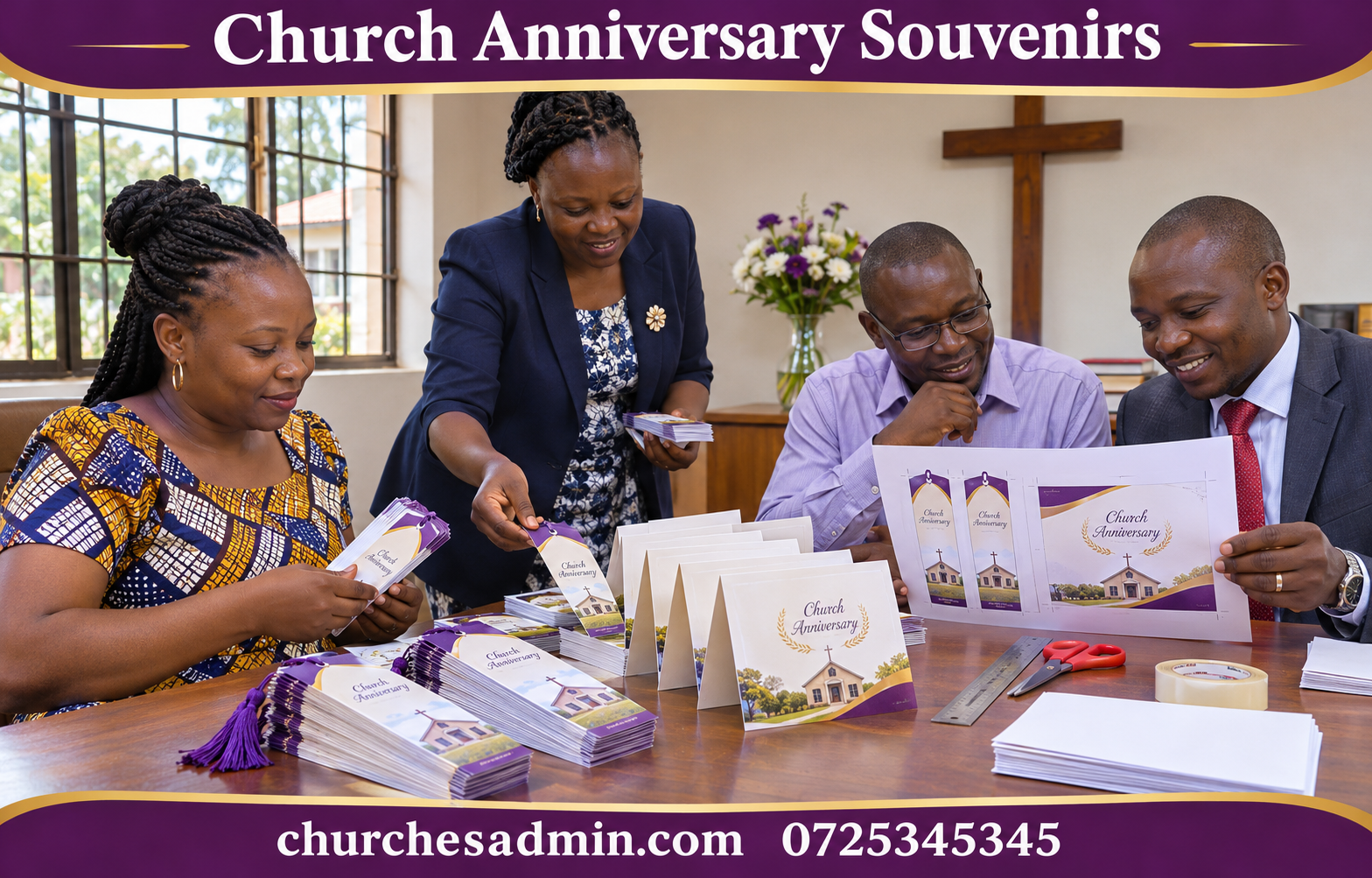
church anniversary souvenirs planning illustration
Church Anniversary Souvenirs | churchesadmin.com | 0725345345

1. Bookmarks as church anniversary souvenirs

Choose a bookmark when the intended message fits into a few lines. One side might carry the church name, the milestone and a simple illustration. The reverse can explain one verified moment from the church’s history. If you include a scripture reference, check it with the service leader and compare the final proof with the approved wording.

Ask the printer to show the finished size, not only an enlarged image on a screen. A long name can look elegant at monitor size and be unreadable in a book. Print a sample on ordinary paper, cut it out and put it inside a book. Does the important text sit too near the edge? Does the item still work without a tassel or decorative finish?

A bookmark can be easy to distribute individually, but a single design need not carry every committee message. Put detailed event information in the service programme. Keep the bookmark useful after Sunday by avoiding an instruction that expires immediately, such as a temporary parking direction. An anniversary date remains meaningful; the time of the refreshments usually does not.

2. A folded card that tells a short story

Among church anniversary souvenirs, a folded card gives you room for a photograph and a concise caption. Use it when there is one story worth taking home. The cover might show the original meeting place, with a sentence inside explaining what changed after the move. Name the source and verify the date rather than relying on the filename attached to a forwarded image.

Agree permission for the intended print run and any online edition. An image lent for a display inside the church is not automatically available for a permanent public download. Keep the approved caption beside the approved image so that a later change of layout does not introduce a different crop or spelling without review.

Consider distribution by household if the card is designed to be displayed at home. Explain that decision in advance and allow for people who attend alone or guests who are not on a membership list. The church anniversary records used in annual reports can help the editor distinguish a verified story from an attractive but uncertain recollection.

3. A timeline leaflet with fewer, better dates

Timeline leaflets work well as church anniversary souvenirs when the congregation wants to explain the difference between its founding, a move, a new ministry and the present building. Select a few milestones that represent different parts of church life. A list of construction projects alone may make it seem that the people who worshipped and served in those buildings were incidental.

For each entry, record a year, an event and a short explanation of why it mattered. If the year is approximate, say so. Do not create false precision to make the layout look balanced. Where two accounts differ, either confirm the date from a reliable record or write a broader statement that both accounts support.

Fold a proof and read the timeline in its physical order. A three-panel design may place the final event before the first when folded incorrectly. Give the proof to somebody who has never seen the draft and ask them to tell the story back. Their answer will show whether the souvenir communicates a sequence or merely presents several attractive boxes.

4. Reusable church anniversary souvenirs with a short inscription

A mug, cloth bag or notebook may suit a church that wants something used regularly. Compare the exact item, material, printing method, packaging and delivery terms. A supplier’s photograph does not show how a handle feels, whether an inscription remains legible on a curved surface or how a bag looks when filled. Ask to see a representative sample.

Keep the inscription short. A long theme and a full list of leaders can become difficult to read on a small object. A name, milestone and year may be enough. Decide whether the item should be offered to everyone or ordered by those who want it. Do not describe a product as a free keepsake if a contribution is required to receive it.

Check the practical implications of the choice. Where will cartons be stored? Who counts fragile items on arrival? How will a guest carry the item home? A lower unit quote can be a poor choice if breakages, bulky packaging or an extra collection trip make the overall arrangement expensive and inconvenient. Include these tasks in the decision, not just the purchase price.

5. A photo print with an accurate caption

Photographs can make good church anniversary souvenirs. A carefully captioned print suits a congregation with a strong visual archive. Choose an image that readers can interpret and explain who or what it shows. Check the original resolution before committing to an enlargement. A small messaging-app copy can look acceptable on a phone but lose detail when printed.

Ask the people responsible for the archive to identify anyone who should not be pictured publicly and to confirm the intended use. A group photograph can reveal more than the committee realises. If permission or identification is uncertain, use a building, an object or a different image with a clear history instead of relying on an assumption.

Order a single proof on the proposed stock. Look at it under ordinary room lighting. Verify that faces and lettering remain visible, the caption is in the right place and the printer has not trimmed an essential detail. Keep that approved proof for comparison with the delivered batch. Once many copies exist, a small caption error becomes much harder to correct.

6. A digital keepsake with an offline alternative

Digital church anniversary souvenirs can carry a longer story without printing a full copy for every person. Provide a stable access route and assign someone responsibility for maintaining it. If you print a QR code, include a readable alternative such as a short address or a way to request a copy from the office. A QR code that points to a private editing folder is not a usable souvenir.

Open the file on a phone using an ordinary reader’s access. Check the file size, headings and captions. Ask whether the first page identifies the church and milestone without depending on the accompanying message. Once forwarded, the booklet should still make sense. Remove internal proofing notes, draft comments and details that were meant only for the committee.

Offer an alternative to people who cannot use the digital edition. A small printed card can carry the essential story while the longer booklet remains optional. This avoids spending heavily on full-colour printing and allows people to choose a format they can actually use. The decision should follow the congregation’s circumstances rather than a blanket assumption that everyone prefers paper or a phone.

Count church anniversary souvenirs by the distribution rule

Suppose the committee expects seventy households, fifteen visiting representatives and twelve contributors who are already included among those households. A household gift plus one gift per visiting representative implies eighty-five planned gifts, not ninety-seven. Counting the contributors again would inflate the order unless the committee explicitly approves a separate presentation item for that group.

Now compare an individual bookmark. If one hundred and sixty people are expected, one bookmark per person begins with one hundred and sixty, regardless of the number of households. Add an explicitly agreed reserve and explain why. Do not quietly add the reserve once at the department level and again to the overall order. Keep separate lines for archive copies and supplier samples when they are needed.

Review the illustration alongside your church budget plan. Request a quote showing unit cost, setup, artwork, delivery, packaging, applicable charges and any minimum quantity. Compare totals for the same specification. A quotation for one hundred items cannot be fairly compared with one for one hundred and twenty without accounting for the difference in quantity and finish.

Sign off a proof that the printer can reproduce

Write a one-page order specification. Include the exact name, milestone, approved spelling, final size, number of sides, colours, material, quantity, delivery destination and deadline. Attach the named proof file and record who approved it. A message saying “looks good” is not useful if the designer has sent three different versions that afternoon.

Choose two proofreaders with different jobs. One checks history, names and dates; the other checks production details, fold, trim and readability. Compare the approved proof with the actual delivered item before accepting the full batch as ready for distribution. If a sample differs, record the difference and ask the supplier about the agreed remedy. Do not promise a replacement date to the congregation until it is confirmed.

Use church meeting minutes to record the approved choice and owner. Name who can authorise a substitution if a product is unavailable. A supplier offering a different colour on the delivery morning should not force a volunteer to make an unapproved decision alone while a service is about to begin.

Make a handout plan for church anniversary souvenirs

Choose the distribution point and time. Handing items out near the main entrance may obstruct arrivals; putting them beside refreshments may work only if everyone is invited into that room. Walk the route with the church usher team and decide what they should say when someone asks whether the item is per person or per household.

Prepare a small separate allocation for the people explicitly included in the approved plan, labelled by purpose rather than displayed as a special privilege. Decide how absent members can request an available copy. Record quantities issued, damaged and left over without collecting personal information that is irrelevant to the distribution. A straightforward count is often sufficient for a low-cost paper item.

After the service, return remaining stock to a named place. Preserve a clean archive example and the approved artwork. If the church uses ChurchesAdmin for planning, keep a note of the decision and the outcome with the activity record. Next time, the committee can see whether people valued a particular item, whether the count was realistic and what they would change before commissioning another print run.

## How to compare two quotes without guessing

Imagine supplier A quotes KSh 60 per bookmark for one hundred copies plus KSh 800 for delivery. Supplier B quotes KSh 68 per bookmark for the same quantity with delivery included. On those fictional figures both totals are KSh 6,800. A decision based only on the unit figure would miss that. Ask whether both quotes include the same paper, print sides, finishing and proof, and whether any additional charge applies.

Now change the requirement to one hundred and fifteen copies. Do not multiply the earlier unit rate and treat the result as the new quote without checking the supplier’s quantity rules. Some suppliers price by batches or have a minimum order. Ask for the actual revised total and delivery date in writing. The cheaper option is not useful if it arrives after the anniversary.

Save the two quotations with the approved production sample. When the committee reviews the event, compare the number actually distributed with the number ordered. That evidence helps next year’s team judge an appropriate reserve without assuming either that every remaining item was wasted or that running out would have been acceptable.

Label the archive sample with the occasion, date and printer’s proof reference. The next committee can then compare its proposal with a real finished object instead of relying on a photograph that hides the scale.

Other websites to explore

Additional websites: prim.co.ke, zama.co.ke, vega.co.ke, awasa.co.ke, saseni.com, jaat.co.ke, tas.co.ke, dereva.co.ke, zes.co.ke.
Church Program Templates: 3 Free Layouts You Can Copy

Church program templates save time when they tell the right person the right thing. A visitor needs to know what comes next. A sound technician needs to know when to open a microphone. Give both people the same densely annotated document and the visitor sees backstage instructions while the technician hunts for a cue buried in the welcome message.

These three free church program templates are text layouts you can copy into your church’s usual document editor. They are samples, not prescribed orders of worship. Replace the bracketed fields, remove unused sections and follow the arrangements approved by your church. A good template should spare the coordinator repeated formatting while leaving the leader free to plan the actual service.

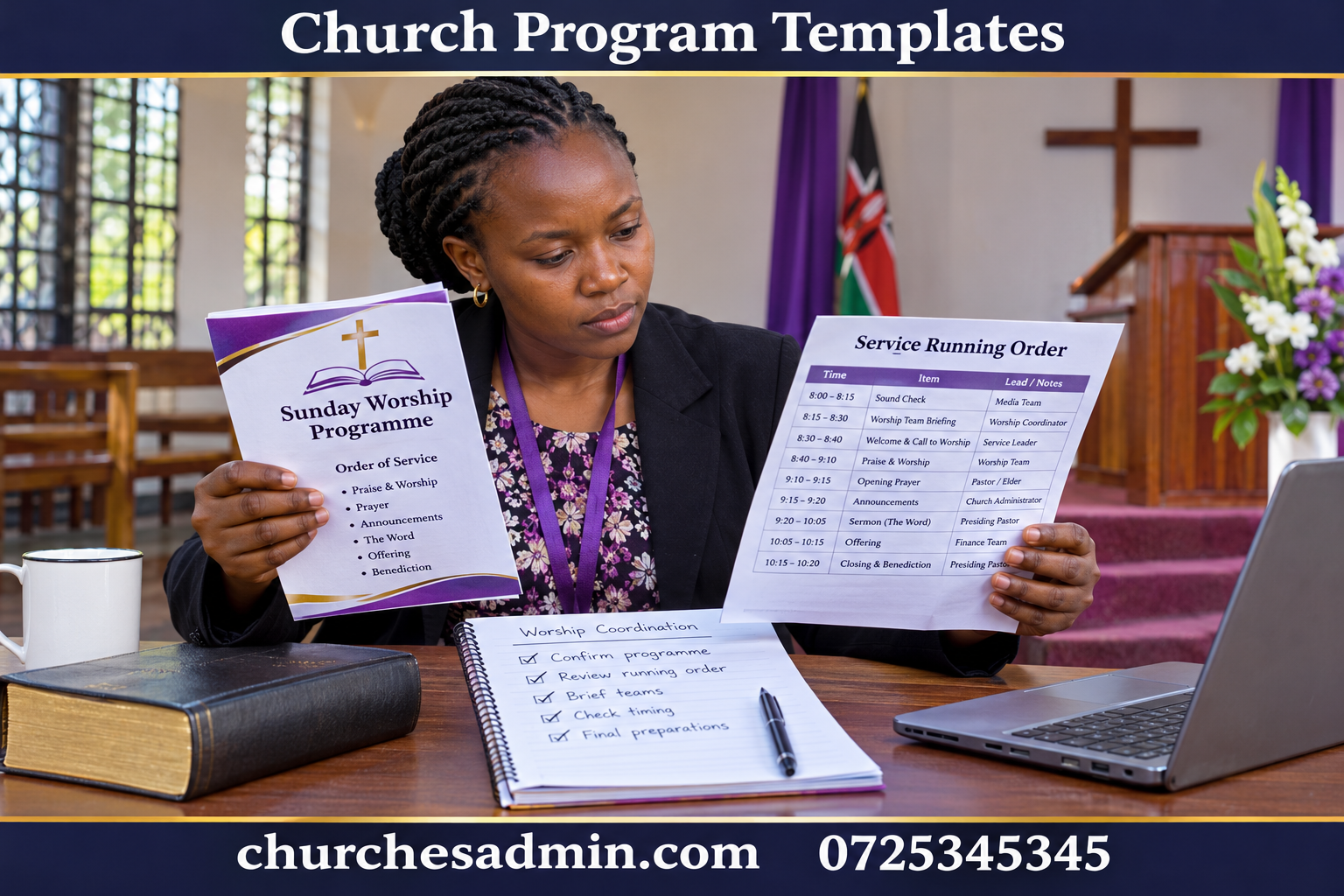
church program templates planning illustration
Church Program Templates | churchesadmin.com | 0725345345

Template 1: A one-page programme for the congregation

Copy this opening block: “[Church name and branch] | [service or occasion] | [day, full date and start time] | [venue]. Welcome: [one sentence explaining the occasion].” Use a date that remains clear if someone receives a forwarded copy later. Include the branch even if the usual members know where the service takes place.

Copy the sequence: “Welcome and opening prayer — [leader]. Congregational worship — [item or reference]. Reading — [passage]. Message — [title and speaker]. Response — [instruction approved for the service]. Closing — [item]. After the service — [location and contact for the next activity].” Replace this sample order with your own; delete an item rather than leaving an empty heading on the printed page.

Finish with a visitor note: “If you would like directions to [location] or need a copy in another available format, please ask [welcome role].” Include only services the team has prepared to offer. Avoid printing a volunteer’s personal contact details when an office contact or an identifiable role will do. If the programme is also shared publicly, check it as a public document rather than assuming it remains within the building.

One way to test public-facing church program templates is to show the page to a person who does not attend regularly. Can they tell which item they are expected to participate in and where the service ends? If not, add a small instruction beside the relevant item. Resist the temptation to explain the entire service in a long introductory paragraph that the visitor has to remember throughout worship.

Template 2: A running order for the working team

Copy this header: “Working copy | [service date and venue] | version [number] issued [day and time] | coordinator [role] | change authority [role].” The distinction between coordinator and change authority matters. The person preparing the file may not be the person who decides whether to shorten an item or change the sequence during the service.

Create one row per element with these fields: “Start | minutes | element | person leading | cue to begin | material needed | what follows.” Example: “10:12 | 4 min | reading | assigned reader | service leader introduces reading | lectern microphone and confirmed passage | reader returns to seat while leader introduces message.” Use your own timing and equipment. The example is there to show how the fields work together.

Try writing a row for an unfamiliar guest contribution. Name who introduces the guest, where the guest waits beforehand, who brings the microphone and what cue tells the technical team to display a photograph. If the answer to several fields is “someone will do it,” the problem is not the template. A real person or role needs to accept the task.

Check the running order against the church service planning guide. A useful running order shows transitions as well as visible elements. It does not need to list confidential pastoral information or every conversation from the planning meeting. Volunteers should be able to find their next cue while paying attention to the service.

Template 3: A workshop programme with a learning outcome

Copy this header: “[Workshop name] | [date, times, room] | for [participants] | by the end, participants should be able to [observable task]. Bring [materials]. Questions before arrival: [contact].” An outcome such as “prepare a usable volunteer handover” helps the facilitator choose an exercise. “Have a successful training” does not tell participants what they will practise.

Use this sequence as a starting point: “Welcome and purpose; demonstration; guided practice; short break; paired exercise; questions; agreed next action.” Give each part a duration and a facilitator. Include a room-change instruction if the group works in smaller rooms. State whether participants should bring a printed handout or whether one will be supplied.

For a fictional ninety-minute workshop, allocate ten minutes for welcome, fifteen for a demonstration, twenty for guided practice, ten for a break, twenty for paired exercises, ten for questions and five to record next actions. The total is ninety minutes. If registration and refreshments happen before the workshop, list them separately so that a ninety-minute session does not silently become a two-hour commitment.

Use the church room booking guide to confirm the setup and clear-up periods. A facilitator who arrives at the public start time cannot also arrange tables before participants enter. The public programme can say when the doors open; the team running order should say who has access earlier and who releases the room afterwards.

How to keep the three church program templates connected

For all three church program templates, use one approved source for the date, venue, public start and main sequence. Give the public copy fewer fields, not different facts. The workshop facilitator may need a detailed exercise instruction, while the participants need a plain description of what they will do. Both versions should show the same starting time and identify the same room.

Decide which information is fixed across services and which must be supplied afresh. A template can retain the heading “Reading,” but should not retain last week’s passage as though it were current. Make uncertain fields conspicuous during preparation and remove every bracketed placeholder before release. A search for an opening bracket is a useful last check; it will not catch all stale facts, so also read the dates and names.

Store blank church program templates separately from completed programmes. If the most convenient starting file is a previous service, clear names, dates, references, guests and attachment names before drafting. A clean master costs a little time once and prevents a string of weekly errors. The church office handover guide helps a second coordinator find the right master when the usual editor is away.

Timing test: follow the clock across a transition

Suppose a service starts at ten and the opening segment is scheduled for twelve minutes. The speaker expects to finish at 10:12 and the next reader expects to start at 10:12. Who walks to the lectern, changes the slide and introduces the reading? Either those actions occur inside the twelve minutes or they need their own allowance. Decide which rather than counting the same minute twice.

Practise the transition with the real arrangement and adjust the working order. Do not publish precise minute-by-minute promises to the congregation unless those times genuinely help them participate. A brief sequence usually serves visitors better than a timetable that appears to guarantee the length of every prayer or reflection.

For workshops, distinguish teaching time from participant time. An exercise that takes the facilitator three minutes to demonstrate may take a new participant ten minutes to complete. Trial it with somebody unfamiliar with the task. Use what you learn to adjust the duration or reduce the number of exercises. The programme should support learning rather than force people to abandon a useful exercise halfway through.

Make church program templates readable in print and on phones

Print the programme at its intended size and check the longest name and item title. A line break should not hide the relationship between a person and their contribution. Keep contrast strong in ordinary black-and-white printing and use clear headings. When a larger-print copy is needed, allow more pages rather than merely enlarging a small image that becomes fuzzy.

Prepare a single-column text version for phones. Avoid sending only a photograph of a two-page spread. A reader should be able to scroll straight down, find the service sequence and see the next action. If the phone version links to a handout, test the link with an account that does not already have editing access. An organiser’s successful test may conceal a permission problem for guests.

Keep the programme distinct from the weekly church newsletter. A programme answers what happens here and what comes next. A newsletter can cover last month’s work, tell a longer story or introduce a ministry. Moving that content to the right publication can improve readability more than changing a typeface or adding another panel.

What to do when the plan changes after printing

First establish who approved the change and whether it affects the congregation, the working team or both. A different technician may require only an internal handover. A venue change affects every attendee and needs public communication. Mark the revised team copy clearly and identify what changed near the top. Reissuing an entire file without an explanation invites people to overlook the important correction.

For a printed public programme, brief the welcome and service teams on the exact wording they should provide. If the change affects a later workshop, correct the digital version and notify the participants through the agreed route. Do not leave two undated files with the same title in circulation and expect volunteers to remember which file arrived last.

Keep a short correction note with the issued programme. At the next review, ask whether the cause was a late decision, a missed update or a template that carried forward old information. Those causes need different responses. A better naming convention will not fix a missing approval; a shorter deadline will not fix a public copy that was never updated from the final source.

A practical handover for the next coordinator

Prepare three files: the blank master, the approved programme and a note of changes worth carrying forward. In the note, identify which fields caused confusion and which transitions took longer than planned. Keep private working details out of any version that will be shared with guests. An archive is useful only when the next person can tell which file was actually issued.

If your team works with ChurchesAdmin, show the next coordinator where to find the confirmed activity details before opening the template. Software and a well-designed document do different jobs: one holds the current arrangements, the other presents the right subset to a reader. By keeping those jobs distinct, you can reuse church program templates without repeating last week’s mistakes.

## A change note for church program templates

Use this short form whenever a revised working copy is released: “Service or workshop: [name and date]. Replaces: [previous version]. Changed item: [specific row or heading]. New arrangement: [what will happen]. Affected roles: [roles]. Public notice needed: [yes or no, and route]. Approved by: [authorised role]. Issued by: [coordinator].” Keep it alongside the revised plan rather than circulating the note without the file people need to use.

For example, changing a workshop from the side hall to the main hall affects participants, ushers, setup and the person opening the building. Changing the microphone assigned to a reader generally affects fewer people. In both cases the coordinator should ask whether an older printed programme creates a conflicting instruction. If so, decide how the difference will be explained at the door.

After a few uses, remove fields that nobody can connect to a decision and add fields only when an actual omission caused confusion. A template succeeds when a new volunteer can use it with an ordinary briefing. If every row requires a separate explanation from the person who designed it, simplify the language and test the revised master with a colleague before the next service.

When comparing church program templates, ask a second volunteer to prepare a sample week without assistance. Watch which fields they leave blank and which old details they carry forward. Clarify those fields in the master rather than adding a long instruction manual. A well-labelled template transfers knowledge even when the usual coordinator is unavailable, and it gives the reviewer a short list of facts to confirm before publication.

Other websites to explore

Additional websites: prim.co.ke, zama.co.ke, vega.co.ke, awasa.co.ke, saseni.com, jaat.co.ke, tas.co.ke, dereva.co.ke, zes.co.ke.
Church Invitation Letter: 5 Examples With Clear RSVP Wording

A church invitation letter should leave the receiving secretary able to answer three questions without phoning back: who is invited, what are they being asked to do, and how should they respond? Addressing a pastor politely is easy. Distinguishing a request to attend from a request to preach, sing, send delegates or announce an event to the congregation takes more care.

Here are five examples for different invitations, with notes on what to change before sending. All the dates, venues and church names in the examples are placeholders. Replace the brackets, check the day against the date and have the appropriate leader approve the finished letter. One accurate invitation is worth more than a beautifully printed card that leaves everyone guessing about their role.

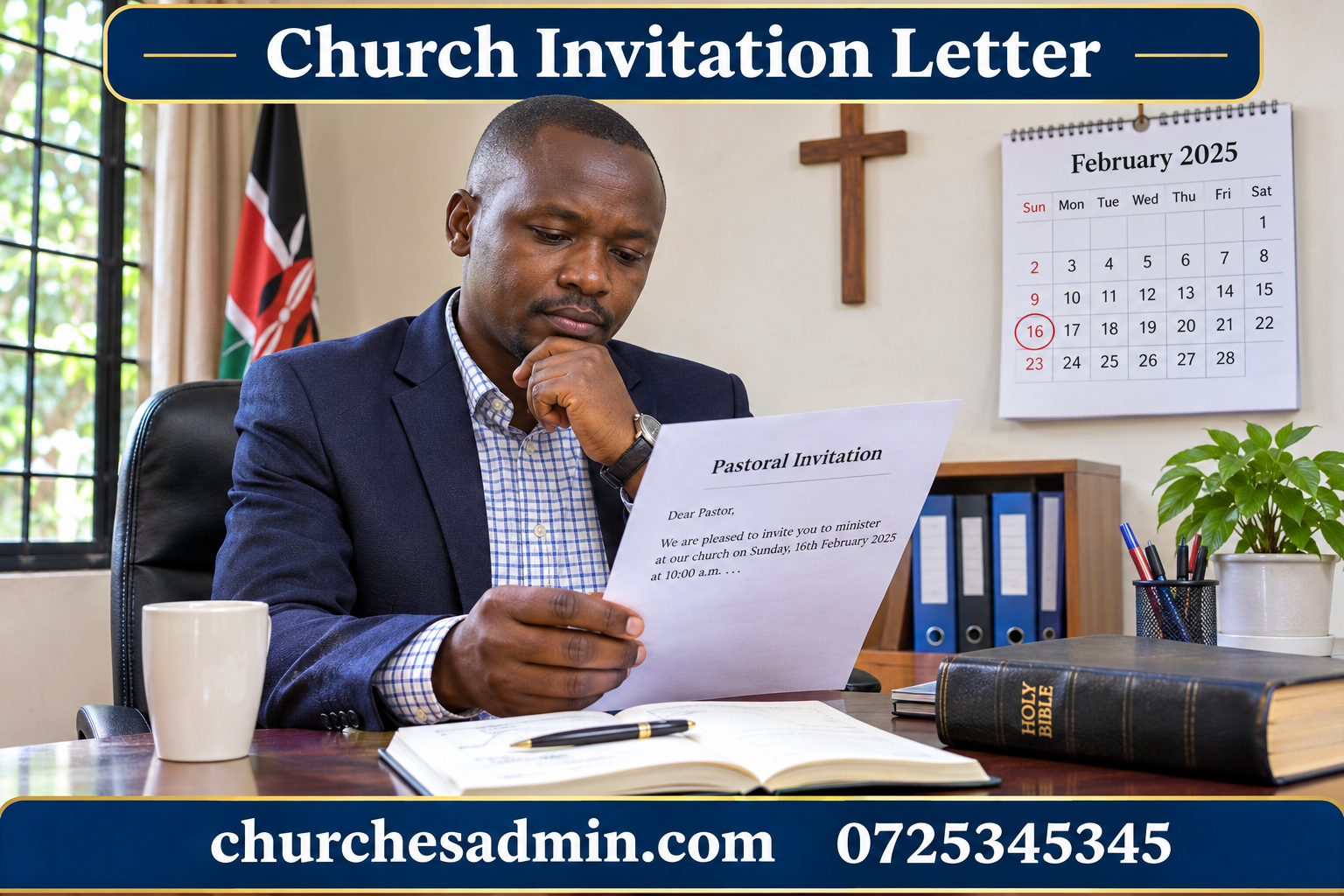
church invitation letter planning illustration
Church Invitation Letter | churchesadmin.com | 0725345345

What belongs in a church invitation letter to other churches?

Put the event, date and request in the subject line. “Invitation: two delegates for the community workshop on [date]” gives the receiving office a much easier filing decision than “Special invitation.” Open with the relationship between the churches or the reason for the invitation. A warm sentence is enough; a full history of the organising committee usually delays the information the reader needs.

Write the venue as someone outside the host congregation would understand it. The name of a hall may mean nothing to a visiting choir. Include the locality, a recognisable entrance or landmark if useful, and the contact for directions. If the arrival time for participants differs from the public start, show both and label them. Never assume that a poster attachment explains a detail missing from the letter.

End with an action and a deadline. Ask the recipient to reply with the information you actually need. A headcount may be enough for hospitality. A contribution to the service may require the name of a contact and a discussion about duration. Give one office contact for the response, and identify who can answer practical questions if that is a different person.

Example 1: A church invitation letter for a congregation

Subject: Invitation to the thanksgiving service at [host church], [day and date]

Dear [pastor or office contact], On behalf of [host church], we invite the members of [guest church] to join our thanksgiving service on [day and date] at [time]. We will meet at [venue and locality]. You are welcome to attend as our guests; we are not requesting a formal contribution to the programme. If a group plans to come, please let [office contact] know the approximate number by [date] so that our welcome team can prepare. We would be glad to worship together. [Name and authorised role]

The sentence about a formal contribution matters. A pastor may otherwise wonder whether to prepare remarks, while a choir leader may assume that the invitation includes a performance. If you would welcome a greeting but have not planned it, say so in a separate conversation. Do not let a first invitation silently commit either church to a role.

For an open service, avoid making an estimated headcount sound like a condition of entry unless it really is. Distinguish “please help us plan seating” from “places must be confirmed in advance.” Give the church usher team the same instructions, so guests who arrive individually are welcomed consistently with the letter.

Example 2: Ask a choir to contribute a named item

Subject: Choir invitation: one item during [service] on [date]

Dear [choir coordinator], [Host church] would be glad to invite your choir to contribute [type of item] at our [occasion]. The service begins at [time]; if your choir accepts, we propose a sound check at [earlier time] at [venue]. We have allowed [duration] for the item. Please let [coordinator] know by [date] whether this is workable and who should discuss accompaniment and equipment with us. We will confirm the final arrangements together before naming the choir in the public programme. [Signature]

Notice that this church invitation letter requests acceptance before publicity. Printing a choir’s name can make a courteous invitation look like an obligation. If the group cannot attend, a published poster will create more work for both churches. Keep the draft programme internal until the choir confirms its participation and the host accepts the details.

Separate the choir’s arrival from that of the congregation. A leader needs to know where instruments can be unloaded, who will be present at the sound check and whether a rehearsal space is available. Do not promise transport, meals or equipment without the host’s approval. Follow the service planning guide to transfer agreed details from correspondence into the working order for the day.

Example 3: Request delegates for a workshop

Subject: Request for [number] delegates: [workshop topic], [date]

Dear [secretary], We are organising a workshop on [specific topic] for people responsible for [relevant work]. We invite [guest church] to nominate up to [number] participants for [day, time and venue]. The session will include [brief practical activity]. Please reply by [date] with the expected number and the name of one coordinator. We will send joining instructions to the confirmed group. [Explain any approved fee, materials or meal arrangement here.] Thank you for considering the invitation. [Signature]

A church invitation letter for delegates is not an invitation to advertise indefinitely. If the room holds a limited number, explain the allocation before a church shares the notice with a wider group. State whether a proposed replacement can be accepted if a nominated person becomes unavailable. A clear process avoids turning someone away at the entrance because an old name remains on a list.

Match the information requested to its purpose. To reserve chairs, you may need only a number; to issue a named certificate, you may need the spelling of a name. Avoid collecting identity documents, private histories or unrelated information simply because a spreadsheet has spare columns. Use the church event registration guide to distinguish an invitation, a nomination and a confirmed registration.

Example 4: Invite a former leader to an anniversary

Subject: Invitation to share a short recollection at our anniversary

Dear [name], As [host church] prepares to mark [milestone] on [date], we would value your recollection of [specific period or activity]. Would you be willing to share a reflection of approximately [duration] during [service or gathering]? If attending in person is difficult, please tell us whether another arrangement would suit you. We will agree the content and any recording or publication separately. Please reply to [contact] by [date]. With thanks for your part in the church’s life, [signature].

Make the church invitation letter personal by naming a contribution you can verify. Avoid assigning a title from memory or suggesting the person has endorsed the whole event. Give them a straightforward way to decline. Someone may be willing to attend privately without speaking publicly, and the invitation should leave that possibility open.

Attendance, speaking, photography and later publication are different decisions. A guest who agrees to speak has not necessarily agreed to appear in a website video. Discuss the intended audience directly and record what was agreed. The committee can still honour the person’s contribution even if they do not wish their story to be recorded or shared outside the room.

Example 5: Arrange a meeting between two churches

Subject: Proposed planning meeting about [shared activity]

Dear [office contact], Following our discussion about [activity], we propose a planning meeting on [day and time] at [venue or agreed call arrangement]. The purpose is to decide [specific question]. We suggest that each church send [relevant roles] and bring [short preparation item]. Please confirm by [date] whether the time and proposed agenda suit your team. This meeting is for planning; neither church is being asked to commit funds or announce an event before the agreed approvals. [Signature]

Give the receiving team enough context to send the right person. A logistical meeting needs someone who knows the venue and timetable. A meeting about whether to proceed may need someone authorised to represent the church in a decision. Mixing those purposes can produce an enthusiastic discussion with nobody present who can approve the next step.

At the meeting, use church meeting minutes to distinguish decisions from suggestions and record who will reply to whom. Send the agreed action record to both offices. If dates remain provisional, label them that way when sharing the minutes. A pencilled-in date can quickly become a public commitment when passed between groups without its original context.

The church invitation letter RSVP test

Read the letter as if you were the other church’s secretary. Could you send a useful response without composing a second letter of your own? A practical closing might read: “Please reply with: attending or declining; estimated number; and one contact for final directions.” If you only need a yes or no, do not request three additional details out of habit.

Keep one reply record at the host office. Note the date sent, contact role, request, response deadline and current status. Use separate labels for invited, provisionally accepted, confirmed and declined. A phone conversation that ends with “we will discuss it on Sunday” is not confirmation. Make a dated note of the promised next step and wait for the decision.

When several churches are invited, personalise the greeting without changing essential facts. Prepare one approved event-information block and reuse it. If the venue changes, identify each recipient who received the earlier version. A corrected letter should name the changed detail near the top, rather than expecting the reader to compare two similar pages line by line.

A proofread that catches more than spelling

Ask somebody who did not organise the event to find the role, date, time, place and reply instruction in thirty seconds. If they point to different times and cannot explain the difference, rewrite the labels. If they cannot tell whether the invitation is private or can be announced publicly, add one clear sentence about distribution.

Check the form of address directly when uncertain. Confirm the signatory is authorised and reachable through the contact information given. Print one copy if the letter will be delivered on paper. A signature block that slips onto a second sheet or a faint telephone number at the footer can make an otherwise carefully drafted letter less useful.

Retain a copy of the approved letter with the response record. Explore ChurchesAdmin if your office needs a more organised way to manage church activities and contacts, and check the relevant features against your own process. The important outcome is simple: the guest church knows precisely what is being requested, the host knows what has been accepted, and both can prepare without guessing.

## Follow-up wording when the reply is still pending

A useful follow-up to a church invitation letter refers to the original request and gives the recipient an easy way to answer. Example: “Dear [contact], we are checking the arrangements for [occasion] on [date]. Our earlier letter invited [specific group or person] to [specific role]. Could you let us know by [deadline] whether the invitation can be accepted, declined or is still under discussion? If you need a particular detail before deciding, please tell [office contact]. Thank you.” Send this only through the appropriate office route and at a sensible interval after the first letter.

Notice what the example avoids: it does not announce the guest, suggest that silence means consent or imply that a delayed reply is discourteous. When an answer arrives, acknowledge the actual decision. “Thank you for confirming attendance by two delegates” is clearer than “Thank you for your support,” which could mean attendance, speaking or financial support.

When the church declines, thank the office and close the record. When it requests more time, agree whether the host can keep the invitation open and record the new response date. That simple distinction prevents an invitation marked pending from remaining on a seating plan after the guest has already declined.

A final church invitation letter check is to remove the attachment and read the message alone. If the recipient cannot identify the occasion or reply without opening a flyer, add the missing fact to the letter itself. That makes the invitation usable even when the receiving office prints only the message.

Other websites to explore

Additional websites: prim.co.ke, zama.co.ke, vega.co.ke, awasa.co.ke, saseni.com, jaat.co.ke, tas.co.ke, dereva.co.ke, zes.co.ke.
Church Bulletin Design: 7 Checks Before You Print on Friday

The quickest test of church bulletin design is to hand a folded copy to someone who missed the planning meeting. Ask them where the children’s activity starts, which notice needs a response this week and whom to ask about transport. If they have to read every paragraph before answering, the bulletin may contain the right information in the wrong order.

A weekly bulletin has a different job from a church newsletter. Church bulletin design should help people follow this service and make their immediate next decisions. The newsletter can tell a longer story. Separating those jobs frees space for clearer type, better headings and fewer late corrections. This guide uses a four-page folded sheet, but the same tests work for one sheet or a phone edition.

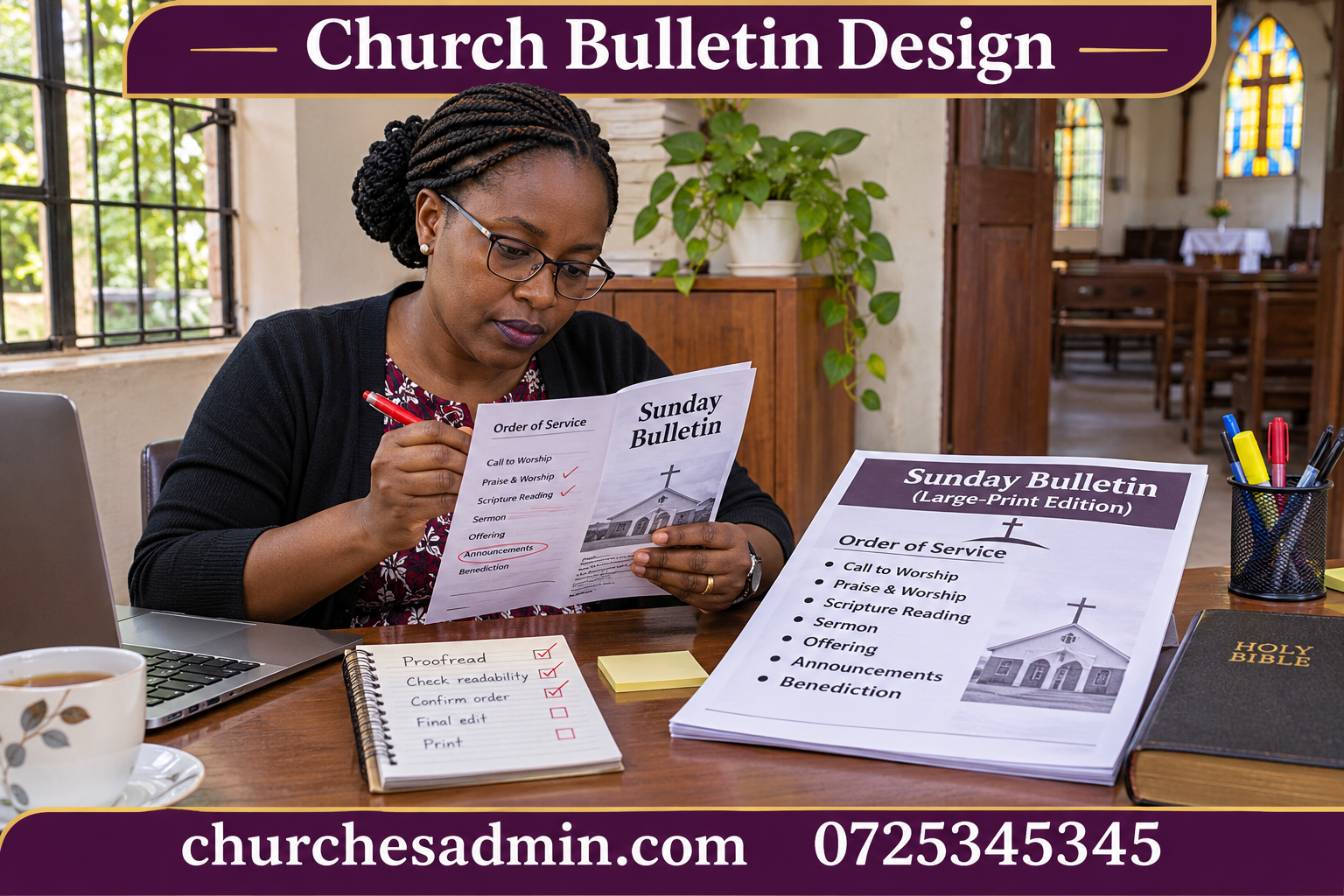
church bulletin design planning illustration
Church Bulletin Design | churchesadmin.com | 0725345345

1. Start church bulletin design with a question for each panel

Fold a blank sheet before opening the design software. Number the pages in reading order. On the cover write: where am I and what is happening today? Inside left: how do I follow the service? Inside right: what needs my attention next? On the back: where do I find help or further information? Change these questions to suit your service, but do not begin with four equal boxes simply because the template offers them.

For a sheet printed on both sides and folded once, the outside spread commonly places the back beside the front; the inside spread holds the second and third pages together. Printer settings and fold direction matter. Make a physical dummy and run one test sheet through the actual printer. A church bulletin design viewed as four separate digital pages can conceal an upside-down reverse side or an incorrect panel order.

Give the cover enough information to identify this particular issue. Include the service date and site or branch if the church meets at more than one location. A visitor picking up last week’s copy should be able to recognise it immediately. A decorative photograph is optional; a readable date is not. Avoid printing a large theme line while hiding the location in small text below it.

2. Write notices for someone who has to act

Good church bulletin design gives each notice a clear purpose. A useful notice names the activity, audience, date, time, location, next action and contact. It does not need all seven fields when a field is irrelevant. A change to the meeting room may need only the affected group, date and new room. A workshop requiring registration needs the deadline and a route to register. Structure the sentence around what the reader must do.

Compare these two fictional notices. Before: “All members are reminded about the upcoming meeting and are encouraged to attend in good time.” After: “Choir rehearsal moves to the side hall this Thursday at 6 pm. Singers should bring the current music folder. If you cannot attend, tell the choir coordinator before Thursday afternoon.” The second version names the change and the people affected. Add the actual calendar date before publication so the notice remains understandable if someone forwards it later.

Ask the submitting ministry to check the revised wording. An editor can make a sentence clearer, but cannot authorise a new deadline or imply everyone is welcome if places are limited. Keep an approved copy of each time-sensitive notice. The church communication plan helps define who checks information and who sends corrections when details change.

3. Make the order of service easy to scan

Use the names and sequence approved by the service leader. Avoid filling the public bulletin with backstage cues. “Reading: [reference]” is useful to the congregation. A reminder to a technician about a microphone belongs in the team’s working copy. Decide when identifying a reader or leader helps and confirm permission and spelling before listing a name.

Consistent church bulletin design uses the same visual pattern for repeated items. An item heading can be bold, the reading reference plain and an instruction to the congregation clearly distinguished. Do not use three colours as the only way to explain three actions; the difference may vanish in a black-and-white copy. Test a photocopy if that is how many readers will receive the bulletin.

A long item title should wrap without making the next item look like part of the same instruction. Print one difficult example, such as a reading with a long reference and an unfamiliar speaker name. If the layout fails on that example, shorten or reorganise the text first. Reducing all the type to squeeze in one line makes every reader pay for a single editing problem.

4. Use church bulletin design to show priority

Choose one principal action for the week. It might be confirming attendance at a workshop before bookings close. Put that action near the top of the notices page with a short heading and the exact response route. An event several months away can sit in a short calendar list. Equal visual weight for both notices makes the urgent one easy to miss.

Agree with ministries how much space is available and when copy must arrive. Give a useful alternative when an announcement is too long. A bulletin can carry the date and essential action while the church newsletter provides the story behind the project. This protects the bulletin’s readability without telling a ministry that its work does not matter.

Before printing, cross-check upcoming items against the church calendar. A committee may approve a draft announcement before the room is confirmed. A repeated item may still use last term’s time. Ask the contact person to confirm the current facts; do not rely on the fact that identical wording appeared in an earlier issue.

5. Adapt church bulletin design for phones

A folded print sheet often becomes difficult to read when shared as a single image. Small text that looks fine on paper may require repeated zooming on a phone. Create a text version or a single-column page containing the same date, service outline and priority notices. Put headings in a sensible reading order rather than asking the reader to move between columns.

Keep the alternatives in sync by preparing one approved text source first. Build both editions from that source. If the workshop moves from one room to another, change the source and check both outputs. Two independently maintained versions create a predictable error: the printed bulletin says one thing, while the message sent on Saturday still contains the earlier location.

If you use a QR code, also print a usable alternative such as an office contact or short web address. Test the code on a real printout at its intended size. Ask where it leads, whether that page is current and whether a visitor must sign in unexpectedly. A code is useful when it saves effort; it should not become the only way to find information needed during the service.

6. Produce large print without simply enlarging a screenshot

Use the approved text to make a more spacious edition. Increase type size, allow lines to wrap naturally, use strong contrast and preserve the headings that help people find their place. Accept that the edition may need another page. Enlarging a photograph of the regular bulletin can produce fuzzy text without improving the reading order.

Offer the alternative in a way that lets people choose it comfortably. Tell ushers where copies are kept and how to identify the current version. Some people may prefer the phone text; others may prefer a printed copy with fewer items on each page. Ask a reader who uses the format what worked. A helpful answer might be as specific as “the time is easy to see, but I cannot find which hall.”

Use the church usher duties guide to connect the publication with the welcome at the door. An excellent large-print edition does little good if it stays in a locked office or if nobody knows it exists. Give the welcome team enough information to offer it without asking the visitor to explain a personal need publicly.

7. Run the Friday proof with two readers

Give the first reader a factual checklist: date, service time, venue, room, names, references, contact route and response deadline. Give the second reader a printed copy without that checklist. Ask them to find the main action and follow the service outline. The two readers test different things. A factually correct bulletin can still be hard to use.

Mark each correction against the approved source and produce a new proof. Do not make a last-minute edit on the print version alone. If the correction affects a phone edition or a public notice already scheduled, update those as well. Identify the person who releases the final version so that the printer does not receive two files both labelled final.

Keep a copy of the issued bulletin and its source with a clear date. For the next issue, copy the empty template rather than duplicating last week’s finished file whenever possible. If you must start from the previous issue, clear all dates and expired announcements first. This small habit prevents a surprising number of errors that otherwise survive a quick proofread.

A worked example: four panels for an ordinary Sunday

Imagine the cover contains the church name, branch, date, service time and a short welcome. Inside left contains the agreed order, with one reading reference and a short explanation for visitors. Inside right begins with the registration deadline for a training evening and follows with two confirmed activities. The back has office contact information and a note explaining where to find the phone edition.

Now a ministry submits a full page of highlights from last month. The editor offers a short line pointing readers to the longer newsletter feature. Another ministry sends a time change for an event already on the calendar. The editor gives that correction a more prominent position than the highlight because it changes what people need to do this week.

A visitor tries the proof and cannot tell whether the training evening is for everyone. The organiser clarifies that it is for current team leaders. The editor changes the heading to “Team leaders: register for Thursday training” and checks the phone edition. No extra panel is needed. The design improves because a more precise heading does the work that another paragraph would otherwise have done.

Review the issue after it reaches people

At the end of the service, ask the welcome team which questions they still had to answer. Separate questions caused by unclear wording from questions about information nobody supplied. If many people ask where the side hall is, a landmark may be more useful than a longer announcement. If people ask whether registration is required, rewrite the action line rather than enlarging the event title.

For teams coordinating dates and notices through ChurchesAdmin, identify the approved record from which the editor takes the final details. Keep publication dates and responsibility clear even if several volunteers take turns editing. The aim of church bulletin design is not to make every issue look different. It is to help someone arrive, participate and know what to do next without needing an insider to explain the page.

## A five-minute church bulletin design test

Take the final paper proof to the entrance where people normally receive it. Read the cover in the available light, unfold it while holding a bag and try to find the main notice without putting the sheet on a table. Then fold it back and check which contact details remain visible. A layout that reads comfortably on a designer’s large screen can behave quite differently in somebody’s hands.

Record one useful observation with the template: for example, “keep the registration deadline away from the centre fold,” or “put the branch name above the service date.” A specific note helps the next volunteer preserve a decision without having to rediscover the reason for it. Review these notes occasionally. If the printer, building or audience changes, the test matters more than preserving an old convention.

Keep the approved issue beside its print proof until Sunday has passed. If a visitor points out a discrepancy, the editor can establish whether the source, the printed copy or a later announcement needs correcting.

Other websites to explore

Additional websites: prim.co.ke, zama.co.ke, vega.co.ke, awasa.co.ke, saseni.com, jaat.co.ke, tas.co.ke, dereva.co.ke, zes.co.ke.

Church Anniversary: 7 Practical Steps for a Meaningful Service

A church anniversary can begin with a surprisingly difficult question: which birthday are we celebrating? The first prayer meeting, the first public service and the dedication of the present building may have happened in different years. Decide what the number on the banner means before ordering the banner. That decision gives the occasion a story worth telling.

A meaningful anniversary does not require every former leader to speak or every department to perform. Pick one memory the congregation should carry home and one way a newcomer can join in without knowing the church’s history. The following plan takes a committee from its first conversation to a useful record for the next anniversary.

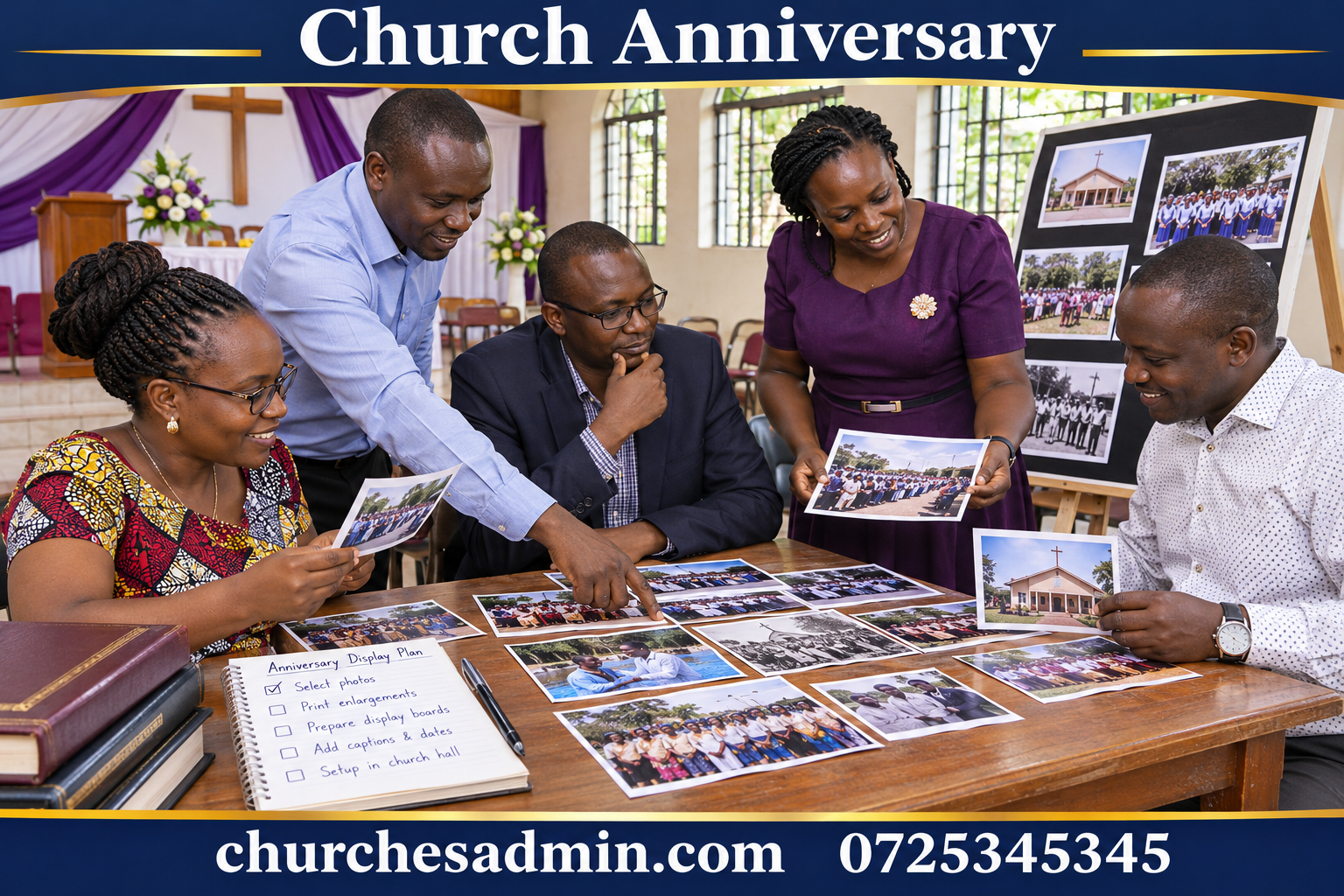
church anniversary planning illustration
Church Anniversary | churchesadmin.com | 0725345345

1. Define the church anniversary milestone in one sentence

Write a factual sentence with a subject, an event and a date. For example: “This year marks forty years since the first Sunday service at this location.” That is a different claim from “our congregation is forty years old.” If the congregation met elsewhere for ten years before moving, both parts of the history deserve their own dates.

Check older records and ask long-serving members what they remember. A dated programme, a minute book and a photograph with a known occasion can help distinguish two similar events. When memories disagree, do not settle the matter by choosing the account that makes a neater speech. Use wording the evidence supports, such as “members recall meeting in this area before the hall opened,” and leave the precise year open until it can be verified.

Keep a source note beside each item in the working timeline. The public display need not include an editor’s full notebook, but someone should be able to trace a date or spelling later. Use the church annual report examples for ways of distinguishing documented figures from recollections. A church anniversary is also an opportunity to leave better records for those who come after you.

2. Give the church anniversary a theme people can recognise

A church anniversary theme works when it helps the committee choose what belongs. If the theme is service across generations, a photograph of the first children’s class and a present-day volunteer’s reflection may speak to each other. A long list of building projects may be less useful unless it shows how those rooms changed the church’s work.

Bring three candidate moments to the church anniversary planning meeting. For each, ask: what happened, who can verify it, and why would someone who joined last month care? A memory that nobody outside the original committee can understand may need one sentence of context. For instance, explain that the kitchen was added so volunteers could prepare food on site, rather than merely recording the year it opened.

If a scripture reading will shape the occasion, ask the appropriate church leader to choose the passage in context and confirm the translation and reading arrangements. A popular verse on a search results page is not a substitute for that decision. Once the reading is agreed, use the same reference in the programme, slides and speaker notes. A rehearsal should catch discrepancies before the congregation sees them.

3. Choose the scale of the church anniversary before promising hospitality

List the people who are welcome to attend, the people you plan to invite personally and the people who have been asked to contribute. These groups overlap, but they are not interchangeable. Being invited to a service does not automatically mean someone has agreed to give an address, stay for a meal or appear in a recording.

Create a modest version of the event that you know you can deliver. Start with a service, one historical reflection and a place for conversation afterwards. Price additions separately: a display, a printed booklet, refreshments or transport arrangements. For each proposed addition, name a responsible person and the deadline after which the idea is too late to do well.

Use the church budget guide to separate an estimate from an approved commitment. If the committee is comparing refreshments for eighty or one hundred and twenty people, record both assumptions. Ask suppliers what happens if the confirmed number changes. Avoid promising a meal in the invitation until the venue, provider and approval are in place.

4. Build a church anniversary display from five strong objects

Choose a small set of objects that tell different parts of the story. A handwritten register, an early hymn sheet, a photograph of a meeting place, a volunteer’s badge and a recent programme can make a richer display than fifty images without captions. Use copies where handling or light could damage originals, and agree with the owners how borrowed items will be returned.

Write captions that answer four questions: what is it, approximately when is it from, who supplied it, and why does it matter? Keep uncertain dates visibly approximate. If a photograph includes identifiable people, agree the intended use and whether it may appear online as well as in the hall. A relative lending a photograph for Sunday has not necessarily agreed to permanent public distribution.

Arrange the items so visitors can browse without blocking the entrance. Test captions from the distance people will actually stand. Invite someone unfamiliar with the church to read the display without explanation. Ask which object they remember and what question remains. A simple caption revision can make the collection more welcoming than buying another display board.

5. Invite speakers with a defined contribution

Tell each speaker why you are asking them, the subject, the approximate time available and how their contribution fits the wider service. A former member may be delighted to share one specific recollection and uneasy about being asked to summarise decades of history. A clear request lets them decide comfortably.

Agree whether they will read, speak freely or be interviewed. For an interview, give the questions in advance. Ask one question about a concrete scene: what did you see on your first Sunday in the new room? Follow with one about its meaning. Avoid prompting the speaker to reveal personal information or speak for someone else who is not present.

Name a backup for each essential role. If a guest becomes unavailable, the backup need not imitate their contribution. The leader could read an approved short note or move directly to the next element. Use the church service planning guide to ensure the technical team knows which version is current and who will give the signal on the day.

6. Make a timetable that includes the transitions

Here is an illustrative thirty-minute anniversary segment within a longer service: four minutes to introduce the milestone; six for a short historical account; five for a reading and reflection; five for a guest recollection; four for a present ministry contribution; three for thanks and the next invitation; and three held for transitions. Those minutes total thirty. They are an example, not a prescribed order of worship.

Try speaking the introductions aloud and moving the microphone between contributors. A printed segment that appears to last six minutes can take nine when a guest walks from the back and a photograph needs to appear on screen. If the timetable overruns in rehearsal, decide what can be shortened. Do not expect the last speaker to discover on the day that their whole contribution must disappear.

Tell the welcome team when arrivals are expected and where guests should go after the service. Have someone available to guide a visitor to the display or the next room. The church room booking guide is useful when a reception, children’s activity and another congregation share the building. A smooth transition depends on the second space being ready, not merely appearing in the programme.

7. Decide what remains after the church anniversary

Assign someone to collect the final programme, approved display captions, permissions and any agreed recording. Ask the owners of borrowed objects to confirm their return. Avoid storing personal contact details alongside material intended for public use. A small, clearly labelled archive is easier to maintain than one folder containing originals, drafts and unapproved photographs.

Thank people for specific contributions. A short note recognising the person who traced the date of a photograph can mean more than an identical message sent to every volunteer. If a guest travelled or lent an item, check that the relevant arrangements were completed. These tasks deserve owners even after the event is no longer on the weekly agenda.

At the next committee meeting, ask three questions: What did a new member understand about the church’s history? Which part of the programme took longer than expected? What information would have saved the team a week of searching? Record the answers while people still remember. Keep one copy with the history file so a future committee benefits from the work.

Worked example: a small church with two possible anniversary dates

Imagine a congregation whose earliest available minutes describe a meeting in a home in 1987. The current hall was opened in 1996. In 2026 some people propose a banner announcing forty years of worship in the hall. The dates do not support that claim: 2026 minus 1996 is thirty, and 2026 minus 1987 is thirty-nine. The committee can celebrate the hall’s thirtieth year without erasing the earlier gathering.

Instead of arguing over which event is more important, the committee writes two captions. The first explains how the earliest documented meeting took place in a home. The second explains what changed when the hall opened. They invite a member who remembers the move to describe one practical difference and a newer member to explain how the hall serves the community today.

The result is a more precise celebration and a more interesting story. People can recognise both the beginnings of the fellowship and the milestone of the building. The committee keeps a note that an earlier date may yet be documented, so a future discovery can improve the record without undermining this year’s programme.

The final check before announcing the date

One person should be able to read the public notice and answer: what milestone is being marked, when does the service begin, where should a visitor arrive, what follows, and who can answer a question? Check those answers against the calendar, not against a message written before the venue was confirmed. Confirm the final spelling of guest names independently of the design proof.

If you use ChurchesAdmin to coordinate activities, show the team where the current date, working programme and outstanding responsibilities are recorded. Keep the public invitation shorter than the internal plan. The congregation needs a clear welcome and an honest story. The committee needs enough detail to deliver both, then preserve what it learned for the next generation.

## A decision sheet for the church anniversary committee

Put one row on the sheet for each item still capable of delaying the occasion. A row might read: “Archive photograph; caption confirmed; permission for hall display received; online use not requested; return original to lender on Monday.” Another might read: “Guest reflection; accepted for four minutes; guest requests no recording; service leader informed.” These are fictional examples, but the format makes the important difference visible: an object being available does not mean every proposed use of it has been approved.

Read the rows aloud at the last meeting. If an item has no owner, assign one or remove it. If a promised contribution remains uncertain, tell the person preparing the programme what to print instead. Give the announcement editor a short list of confirmed facts rather than the entire sheet. A working record can contain a provisional option or a private preference that has no place in the public invitation.

Finally, choose the date of the brief post-event review before the team disperses. That small decision protects an easily forgotten part of the project. It gives the archivist time to collect borrowed items and gives the coordinator a natural point at which to finish the work, rather than leaving every loose end to whichever volunteer happens to remember it.

Other websites to explore

Additional websites: prim.co.ke, zama.co.ke, vega.co.ke, awasa.co.ke, saseni.com, jaat.co.ke, tas.co.ke, dereva.co.ke, zes.co.ke.