Church Member Engagement Software – Improve Participation and Strengthen Church Growth

Church Member Engagement Software

Church Member Engagement Software helps churches, ministries, faith organizations, and multi-campus churches improve member participation, strengthen communication, increase ministry involvement, simplify follow-up, improve operational visibility, and support sustainable church growth.

Member engagement is one of the strongest indicators of healthy ministry growth. Churches thrive when members actively participate in worship services, ministry programs, discipleship initiatives, volunteer opportunities, events, and community activities.

As churches grow, maintaining meaningful engagement becomes increasingly difficult when using manual processes.

Many ministries continue relying on spreadsheets, notebooks, messaging groups, paper attendance sheets, and disconnected systems to coordinate communication and engagement.

Without structured engagement systems, churches often struggle with inconsistent follow-up, reduced participation, limited ministry visibility, and administrative inefficiencies.

Modern ministries require connected systems that help churches build stronger relationships while improving operational coordination.

Churches Admin helps churches centralize member engagement, communication, reporting, ministry coordination, and operational management into one connected platform.


Table of Contents

  1. Understanding Modern Church Participation
  2. Why Member Engagement Matters
  3. Core Features That Strengthen Ministry Participation
  4. Improving Communication and Connection
  5. Managing Church Activities Effectively
  6. Tracking Participation and Ministry Growth
  7. Reporting and Ministry Visibility
  8. Supporting Different Ministry Structures
  9. Benefits of Connected Engagement Operations
  10. Choosing the Right Platform
  11. Future Direction of Church Technology
  12. Getting Started

Understanding Modern Church Participation

Member engagement supports healthy ministry development.

A modern Church Member Engagement Software solution helps churches improve relationships, coordinate communication, and strengthen participation visibility.

Churches commonly manage:

  • Member records
  • Attendance tracking
  • Ministry involvement
  • Communication workflows
  • Events participation
  • Volunteer coordination
  • Engagement activities
  • Reporting visibility
  • Ministry planning
  • Growth initiatives

Centralized engagement management supports stronger ministry outcomes.


Why Member Engagement Matters

Church growth becomes stronger when members remain connected.

Without connected engagement systems, churches often experience:

  • Reduced participation
  • Communication delays
  • Member inactivity
  • Administrative inefficiencies
  • Limited visibility
  • Follow-up challenges
  • Engagement gaps
  • Operational complexity

Using Church Member Engagement Software helps ministries improve communication and create stronger member experiences.


Core Features That Strengthen Ministry Participation

A modern engagement platform should support complete ministry visibility.

Member Management

Manage:

  • Member profiles
  • Participation history
  • Communication records
  • Engagement visibility

Communication Coordination

Support:

  • Ministry announcements
  • Member updates
  • Notifications
  • Follow-up activities

Participation Monitoring

Improve visibility.


Reporting Insights

Track engagement outcomes.

These capabilities make Church Member Engagement Software valuable for growing ministries.


Improving Communication and Connection

Communication strengthens member relationships.

A centralized Church Member Engagement Software solution supports:

Better Communication

Keep members informed.


Improved Participation

Encourage involvement.


Faster Follow-Up

Improve ministry responsiveness.


Stronger Member Experiences

Increase engagement.

Connected communication improves church relationships.


Managing Church Activities Effectively

Church activities influence engagement outcomes.

Track:

  • Event participation
  • Service attendance
  • Ministry involvement
  • Volunteer activity
  • Engagement outcomes

A connected Church Member Engagement Software platform improves operational visibility.

Participation Monitoring

Measure:

  • Attendance patterns
  • Ministry involvement
  • Communication effectiveness
  • Church growth indicators

Better visibility supports informed decisions.


Tracking Participation and Ministry Growth

Engagement data supports stronger ministry planning.

Monitor:

  • Member activity
  • Attendance consistency
  • Ministry participation
  • Communication outcomes
  • Engagement trends

A modern Church Member Engagement Software environment improves understanding.

Ministry Analytics

Measure:

  • Participation indicators
  • Engagement outcomes
  • Member growth
  • Operational effectiveness

Insights strengthen ministry execution.


Reporting and Ministry Visibility

Church decisions improve when supported by accurate information.

Generate reports for:

  • Attendance visibility
  • Participation activity
  • Communication performance
  • Ministry engagement
  • Event outcomes

Track:

  • Engagement trends
  • Ministry growth
  • Member activity
  • Operational visibility

A reporting-driven Church Member Engagement Software approach supports stronger planning.


Supporting Different Ministry Structures

Different churches require flexible engagement management.

Worship Ministries

Improve participation tracking.


Small Groups

Strengthen engagement.


Youth Ministries

Improve communication.


Outreach Programs

Coordinate involvement.


Multi-Campus Churches

Centralize engagement operations.

Technology supports scalable ministry growth.


Benefits of Connected Engagement Operations

Using Church Member Engagement Software helps churches:

Improve Member Participation

Increase involvement.


Strengthen Communication

Keep members connected.


Improve Visibility

Track ministry outcomes.


Improve Coordination

Reduce administration.


Strengthen Reporting

Support better decisions.


Support Long-Term Growth

Build sustainable ministry systems.


Choosing the Right Platform

Before selecting software, evaluate:

Ease of Use

Support quick onboarding.


Engagement Features

Improve member participation.


Reporting Capabilities

Generate meaningful insights.


Communication Tools

Strengthen relationships.


Scalability

Support church expansion.

Churches Admin combines member engagement, communication, ministry coordination, reporting, and operational visibility into one connected platform.


Future Direction of Church Technology

Church technology continues evolving.

Future trends include:

  • Automated engagement workflows
  • Participation analytics
  • Mobile accessibility
  • Connected communication
  • Real-time reporting
  • Digital ministry coordination

Churches adopting connected systems improve future readiness.


Getting Started

If your church still relies on spreadsheets, paper records, messaging groups, and disconnected engagement processes, now is the right time to modernize.

Church Member Engagement Software helps ministries improve communication, strengthen participation, optimize engagement, simplify operations, and support sustainable church growth.

Churches Admin provides churches with one place to manage engagement, communication, ministry coordination, reporting, and long-term growth.

Digital Congregation Management System – Simplify Church Administration and Improve Engagement

Digital Congregation Management SystemDigital Congregation Management System helps churches, ministries, faith organizations, and multi-campus ministries centralize member management, improve communication, strengthen ministry coordination, simplify administration, increase operational visibility, and support long-term church growth.

Managing a growing congregation involves more than maintaining attendance records. Churches coordinate member engagement, communication, ministry participation, service schedules, follow-up activities, reporting, events, and administration every day.

As congregations expand, relying on spreadsheets, notebooks, messaging groups, and disconnected systems creates operational limitations.

Church leaders require better visibility across ministry activities and member interactions.

Members expect timely communication, organized engagement opportunities, easier participation, and better ministry experiences.

Modern churches require connected platforms that support administration while strengthening ministry effectiveness.

Churches Admin helps ministries centralize member records, communication, engagement, reporting, ministry operations, and administration into one connected platform.


Table of Contents

  1. Understanding Modern Church Administration
  2. Why Centralized Member Coordination Matters
  3. Core Features That Support Ministry Operations
  4. Improving Member Engagement
  5. Managing Church Activities Effectively
  6. Communication and Ministry Coordination
  7. Reporting and Church Visibility
  8. Supporting Different Ministry Structures
  9. Benefits of Connected Church Operations
  10. Choosing the Right Platform
  11. Future Direction of Church Technology
  12. Getting Started

Understanding Modern Church Administration

Church administration influences ministry effectiveness and member experiences.

A modern Digital Congregation Management System helps ministries organize church operations while improving visibility and coordination.

Churches commonly manage:

  • Member records
  • Attendance tracking
  • Ministry participation
  • Communication workflows
  • Service schedules
  • Volunteer coordination
  • Events management
  • Operational reporting
  • Ministry planning
  • Growth initiatives

Centralized administration supports stronger ministry outcomes.


Why Centralized Member Coordination Matters

Member engagement improves when administration becomes organized.

Without connected systems, churches often experience:

  • Lost member information
  • Communication delays
  • Administrative inefficiencies
  • Limited visibility
  • Participation gaps
  • Scheduling challenges
  • Reporting difficulties
  • Reduced engagement

Using Digital Congregation Management System helps churches improve coordination and strengthen ministry operations.

Core Features That Support Ministry Operations

A modern church platform should support complete ministry visibility.

Member Management

Manage:

  • Member profiles
  • Participation records
  • Household information
  • Engagement history

Church Scheduling

Support:

  • Service planning
  • Ministry calendars
  • Event coordination
  • Activity visibility

Communication Management

Improve engagement.


Reporting Visibility

Monitor ministry outcomes.

These capabilities make Digital Congregation Management System valuable for growing ministries.


Improving Member Engagement

Engagement strengthens healthy church growth.

A centralized Digital Congregation Management System solution supports:

Better Participation

Encourage ministry involvement.


Improved Visibility

Understand member activity.


Faster Coordination

Reduce administrative work.


Stronger Church Experiences

Improve ministry effectiveness.

Consistent engagement supports sustainable growth.


Managing Church Activities Effectively

Church operations involve multiple moving parts.

Track:

  • Service participation
  • Event attendance
  • Ministry involvement
  • Communication activity
  • Engagement outcomes

A connected Digital Congregation Management System improves operational visibility.

Activity Monitoring

Measure:

  • Participation levels
  • Ministry engagement
  • Scheduling performance
  • Church outcomes

Better visibility supports informed decisions.


Communication and Ministry Coordination

Communication supports ministry effectiveness.

A Digital Congregation Management System platform supports:

  • Member notifications
  • Service reminders
  • Ministry announcements
  • Event communication
  • Group engagement
  • Church updates

Benefits include:

Better Communication

Keep members connected.


Improved Participation

Strengthen engagement.


Better Coordination

Improve ministry execution.


Better Experiences

Support long-term ministry relationships.


Reporting and Church Visibility

Church decisions improve with visibility.

Generate reports for:

  • Member engagement
  • Attendance activity
  • Ministry participation
  • Event outcomes
  • Communication performance

Track:

  • Participation trends
  • Ministry growth
  • Engagement indicators
  • Operational visibility

A reporting-driven Digital Congregation Management System strategy supports stronger ministry planning.


Supporting Different Ministry Structures

Different churches require flexible administration.

Worship Ministries

Improve member coordination.


Small Groups

Strengthen engagement.


Youth Ministries

Improve participation visibility.


Community Outreach

Coordinate activities.


Multi-Campus Churches

Centralize operations.

Technology supports scalable ministry growth.


Benefits of Connected Church Operations

Using Digital Congregation Management System helps churches:

Improve Administration

Reduce manual processes.


Strengthen Engagement

Increase participation.


Improve Communication

Keep members informed.


Increase Visibility

Monitor ministry performance.


Improve Coordination

Strengthen operations.


Support Long-Term Growth

Build sustainable ministry systems.


Choosing the Right Platform

Before selecting software, evaluate:

Ease of Use

Support quick onboarding.


Member Management Features

Improve administration.


Reporting Capabilities

Generate meaningful insights.


Communication Tools

Strengthen engagement.


Scalability

Support church expansion.

Churches Admin combines member management, communication, reporting, scheduling, and ministry coordination into one connected platform.


Future Direction of Church Technology

Church technology continues evolving.

Future trends include:

  • Automated church workflows
  • Engagement analytics
  • Mobile accessibility
  • Connected communication
  • Real-time reporting
  • Digital ministry operations

Churches adopting connected systems improve future readiness.


Getting Started

If your church still relies on spreadsheets, notebooks, messaging groups, and disconnected administration processes, now is the right time to modernize.

Digital Congregation Management System helps ministries simplify administration, improve engagement, strengthen communication, optimize operations, and support sustainable church growth.

Churches Admin provides churches with one place to manage members, ministry operations, communication, reporting, and long-term growth.

Church Discipleship Management Platform – Strengthen Member Growth and Ministry Engagement

Church Discipleship Management Platform

Church Discipleship Management Platform helps churches, ministries, faith organizations, and multi-campus ministries organize discipleship programs, strengthen member engagement, improve ministry coordination, track spiritual growth journeys, simplify communication, and support long-term ministry development.

Discipleship is one of the most important responsibilities within church ministry. Beyond weekly services, churches invest in helping members grow spiritually through structured learning, mentorship, participation, community involvement, and ministry engagement.

As churches expand, managing discipleship activities manually becomes increasingly difficult.

Many ministries still depend on spreadsheets, notebooks, messaging applications, printed attendance sheets, and disconnected systems to coordinate discipleship programs.

Without centralized management, churches often experience reduced visibility, inconsistent follow-up, communication gaps, and limited understanding of member participation.

Modern churches require connected systems that support discipleship workflows and create stronger ministry experiences.

Churches Admin helps churches centralize member engagement, ministry coordination, discipleship activities, reporting, communication, and operational visibility into one connected platform.


Table of Contents

  1. Understanding Modern Spiritual Growth Programs
  2. Why Structured Member Development Matters
  3. Core Features That Support Ministry Growth
  4. Improving Participation and Engagement
  5. Managing Groups and Learning Journeys
  6. Communication and Ministry Coordination
  7. Reporting and Ministry Visibility
  8. Supporting Different Ministry Structures
  9. Benefits of Connected Ministry Operations
  10. Choosing the Right Platform
  11. Future Direction of Church Technology
  12. Getting Started

Understanding Modern Spiritual Growth Programs

Member development supports healthy church growth.

A modern Church Discipleship Management Platform helps churches organize discipleship journeys while improving ministry visibility and engagement.

Churches commonly manage:

  • Member participation
  • Discipleship groups
  • Ministry involvement
  • Communication workflows
  • Attendance visibility
  • Learning activities
  • Team coordination
  • Progress monitoring
  • Ministry planning
  • Growth initiatives

Centralized ministry management supports stronger discipleship outcomes.


Why Structured Member Development Matters

Church growth depends on consistent engagement.

Without connected systems, churches often experience:

  • Limited follow-up
  • Participation gaps
  • Communication delays
  • Inconsistent member experiences
  • Reduced ministry visibility
  • Administrative inefficiencies
  • Difficult progress tracking
  • Operational challenges

Using Church Discipleship Management Platform helps ministries improve engagement and strengthen member development.


Core Features That Support Ministry Growth

A modern discipleship platform should support complete ministry visibility.

Member Journey Management

Manage:

  • Participation records
  • Group involvement
  • Engagement history
  • Ministry interactions

Program Coordination

Support:

  • Learning pathways
  • Group scheduling
  • Session planning
  • Progress visibility

Ministry Administration

Improve coordination.


Reporting Visibility

Monitor participation outcomes.

These capabilities make Church Discipleship Management Platform valuable for growing ministries.


Improving Participation and Engagement

Member engagement strengthens ministry outcomes.

A centralized Church Discipleship Management Platform solution supports:

Better Participation

Encourage involvement.


Improved Visibility

Understand member activity.


Faster Coordination

Reduce manual administration.


Stronger Ministry Experiences

Improve engagement.

Consistent participation supports church growth.


Managing Groups and Learning Journeys

Discipleship often happens through structured ministry experiences.

Track:

  • Group participation
  • Session attendance
  • Member engagement
  • Ministry activity
  • Development milestones

A connected Church Discipleship Management Platform improves ministry visibility.

Growth Monitoring

Measure:

  • Participation levels
  • Group activity
  • Engagement indicators
  • Ministry outcomes

Better visibility supports ministry planning.


Communication and Ministry Coordination

Communication improves ministry experiences.

A Church Discipleship Management Platform supports:

  • Member notifications
  • Program updates
  • Group communication
  • Session reminders
  • Ministry announcements
  • Engagement initiatives

Benefits include:

Better Communication

Keep members informed.


Improved Participation

Increase involvement.


Stronger Coordination

Improve ministry execution.


Better Experiences

Support long-term engagement.


Reporting and Ministry Visibility

Ministry decisions improve with stronger visibility.

Generate reports for:

  • Member engagement
  • Participation activity
  • Ministry programs
  • Session performance
  • Communication outcomes

Track:

  • Growth indicators
  • Participation trends
  • Ministry outcomes
  • Operational visibility

A reporting-driven Church Discipleship Management Platform strategy supports informed ministry decisions.


Supporting Different Ministry Structures

Different ministries require flexible discipleship coordination.

Small Groups

Improve participation tracking.


Leadership Development

Strengthen visibility.


Bible Study Programs

Coordinate engagement.


Youth Ministries

Improve communication.


Multi-Campus Churches

Centralize discipleship operations.

Technology supports scalable ministry growth.


Benefits of Connected Ministry Operations

Using Church Discipleship Management Platform helps churches:

Improve Member Engagement

Strengthen participation.


Improve Ministry Visibility

Track outcomes.


Improve Communication

Keep ministries connected.


Improve Coordination

Reduce administration.


Strengthen Reporting

Support decisions.


Support Long-Term Growth

Build sustainable ministry systems.


Choosing the Right Platform

Before selecting software, evaluate:

Ease of Use

Support quick adoption.


Member Management Features

Improve ministry coordination.


Reporting Capabilities

Generate meaningful insights.


Communication Tools

Strengthen engagement.


Scalability

Support future ministry growth.

Churches Admin combines member management, discipleship coordination, communication, reporting, and ministry visibility into one connected platform.


Future Direction of Church Technology

Church technology continues evolving.

Future trends include:

  • Digital discipleship workflows
  • Ministry analytics
  • Mobile accessibility
  • Automated communication
  • Real-time reporting
  • Connected engagement

Churches adopting connected systems improve future readiness.


Getting Started

If your church still relies on spreadsheets, manual follow-up, disconnected communication, and traditional discipleship administration, now is the right time to modernize.

Church Discipleship Management Platform helps ministries simplify discipleship coordination, improve member engagement, strengthen communication, optimize ministry operations, and support sustainable church growth.

Churches Admin provides churches with one place to manage discipleship journeys, communication, reporting, ministry coordination, and operational growth.

Church Volunteer Management Software – Simplify Coordination and Improve Ministry Operations

Church Volunteer Management Software

Church Volunteer Management Software helps churches, ministries, faith organizations, and multi-campus ministries organize volunteer activities, simplify scheduling, improve communication, strengthen engagement, increase operational visibility, and support sustainable ministry growth.

Volunteers play an essential role in church operations. From welcoming visitors and supporting worship services to coordinating events, administration, outreach, children’s ministry, media teams, and pastoral support, volunteers contribute significantly to church success.

As ministries grow, managing volunteers manually becomes increasingly difficult.

Many churches continue relying on spreadsheets, notebooks, messaging groups, verbal coordination, and disconnected systems that create scheduling challenges and reduce visibility.

Without centralized volunteer management, churches may experience communication gaps, missed assignments, inconsistent participation, and limited operational planning.

Modern churches require connected systems that simplify volunteer coordination and improve ministry execution.

Churches Admin helps ministries centralize volunteer records, schedules, communication, ministry activities, reporting, and operational management into one connected platform.


Table of Contents

  1. Understanding Modern Volunteer Coordination
  2. Why Organized Ministry Support Matters
  3. Core Features for Volunteer Administration
  4. Improving Engagement and Participation
  5. Managing Service Schedules Effectively
  6. Communication and Team Coordination
  7. Reporting and Ministry Visibility
  8. Supporting Different Ministry Structures
  9. Benefits of Connected Volunteer Operations
  10. Choosing the Right Platform
  11. Future Direction of Church Technology
  12. Getting Started

Understanding Modern Volunteer Coordination

Volunteers help ministries operate consistently and create meaningful church experiences.

A modern Church Volunteer Management Software solution helps churches coordinate ministry activities while improving visibility and engagement.

Churches commonly manage:

  • Volunteer records
  • Service schedules
  • Ministry assignments
  • Team coordination
  • Communication workflows
  • Attendance visibility
  • Event participation
  • Operational reporting
  • Ministry planning
  • Growth initiatives

Centralized volunteer management supports stronger ministry outcomes.


Why Organized Ministry Support Matters

Volunteer coordination affects ministry effectiveness.

Without structured systems, churches often experience:

  • Missed schedules
  • Communication delays
  • Volunteer burnout
  • Limited visibility
  • Assignment conflicts
  • Administrative inefficiencies
  • Reduced participation
  • Operational challenges

Using Church Volunteer Management Software helps churches improve coordination and strengthen ministry experiences.


Core Features for Volunteer Administration

A modern ministry platform should support complete volunteer visibility.

Volunteer Registration

Manage:

  • Volunteer profiles
  • Ministry participation
  • Team allocation
  • Activity records

Schedule Management

Support:

  • Service planning
  • Volunteer assignments
  • Availability tracking
  • Ministry calendars

Ministry Coordination

Improve execution.


Reporting Visibility

Monitor participation.

These capabilities make Church Volunteer Management Software valuable for growing ministries.


Improving Engagement and Participation

Volunteer engagement supports healthy church growth.

A centralized Church Volunteer Management Software solution supports:

Better Participation

Encourage involvement.


Improved Visibility

Understand volunteer activity.


Faster Coordination

Reduce manual effort.


Stronger Ministry Experiences

Improve engagement.

Consistent coordination improves ministry outcomes.


Managing Service Schedules Effectively

Scheduling supports ministry consistency.

Track:

  • Volunteer availability
  • Team participation
  • Service assignments
  • Ministry calendars
  • Engagement outcomes

A connected Church Volunteer Management Software platform improves operational visibility.

Ministry Planning

Measure:

  • Volunteer participation
  • Service coverage
  • Scheduling performance
  • Ministry outcomes

Better visibility supports church growth.


Communication and Team Coordination

Communication improves volunteer experiences.

A Church Volunteer Management Software platform supports:

  • Volunteer notifications
  • Service reminders
  • Ministry updates
  • Assignment communication
  • Event coordination
  • Team engagement

Benefits include:

Better Communication

Keep volunteers informed.


Improved Participation

Strengthen engagement.


Stronger Ministry Coordination

Improve execution.


Better Experiences

Support healthy ministry culture.


Reporting and Ministry Visibility

Ministry decisions improve with visibility.

Generate reports for:

  • Volunteer participation
  • Ministry activity
  • Schedule performance
  • Service coordination
  • Engagement outcomes

Track:

  • Team growth
  • Volunteer trends
  • Participation indicators
  • Operational visibility

A reporting-driven Church Volunteer Management Software strategy supports informed ministry decisions.


Supporting Different Ministry Structures

Different churches require flexible volunteer coordination.

Worship Ministries

Coordinate serving schedules.


Children Ministries

Improve team visibility.


Outreach Teams

Strengthen participation.


Administration Teams

Improve operational coordination.


Multi-Campus Churches

Centralize volunteer operations.

Technology supports scalable ministry growth.


Benefits of Connected Volunteer Operations

Using Church Volunteer Management Software helps churches:

Improve Coordination

Reduce administrative workload.


Strengthen Volunteer Engagement

Increase participation.


Improve Communication

Keep teams connected.


Increase Visibility

Monitor ministry activity.


Improve Scheduling

Coordinate ministry operations.


Support Long-Term Growth

Build sustainable ministry systems.


Choosing the Right Platform

Before selecting software, evaluate:

Ease of Use

Support quick onboarding.


Volunteer Management Features

Improve ministry coordination.


Reporting Capabilities

Generate useful insights.


Communication Tools

Strengthen engagement.


Scalability

Support church growth.

Churches Admin combines volunteer coordination, communication, reporting, scheduling, and ministry management into one connected platform.


Future Direction of Church Technology

Church technology continues evolving.

Future trends include:

  • Automated ministry workflows
  • Volunteer analytics
  • Mobile accessibility
  • Real-time reporting
  • Connected communication
  • Digital ministry coordination

Churches adopting connected systems improve future readiness.


Getting Started

If your church still relies on spreadsheets, manual schedules, messaging groups, and disconnected volunteer processes, now is the right time to modernize.

Church Volunteer Management Software helps ministries simplify coordination, improve communication, strengthen participation, optimize scheduling, and support sustainable ministry growth.

Churches Admin provides churches with one place to manage volunteers, ministry operations, reporting, communication, and church growth.

Church Engagement Platform – Improve Member Participation and Build Stronger Church Communities

Church Engagement Platform

Church Engagement Platform helps churches, ministries, worship centers, and faith-based organizations improve member participation, strengthen communication, increase involvement, coordinate ministries, support relationship building, and create healthier church communities through connected digital experiences.

Churches thrive through relationships. Whether serving a small congregation or managing a growing ministry, engagement remains one of the most important factors influencing church health and long-term growth.

Attendance alone no longer provides a complete picture of church participation. Leaders increasingly focus on communication quality, ministry involvement, volunteer participation, event engagement, follow-up processes, member retention, and community building.

Traditional engagement methods such as paper lists, manual outreach, spreadsheets, and disconnected messaging tools often create operational challenges.

Modern churches require connected platforms that help maintain meaningful interactions and strengthen participation across every ministry.

A structured engagement system enables leaders to focus less on administration and more on ministry impact.


Table of Contents

  1. Understanding Modern Church Participation
  2. Why Engagement Matters for Ministry Success
  3. Core Capabilities and Platform Functions
  4. Strengthening Member Relationships
  5. Participation Tracking and Visibility
  6. Communication and Community Building
  7. Events and Ministry Coordination
  8. Reporting and Leadership Insights
  9. Supporting Different Church Models
  10. Benefits of Connected Church Experiences
  11. Choosing the Right Digital Solution
  12. Future Direction of Church Technology
  13. Getting Started

Understanding Modern Church Participation

Church participation extends beyond attendance.

A modern Church Engagement Platform helps churches build stronger relationships by creating structured interaction opportunities and improving communication across church communities.

Churches commonly coordinate:

  • Member communication
  • Ministry participation
  • Event involvement
  • Volunteer engagement
  • Attendance visibility
  • Follow-up processes
  • Leadership communication
  • Group coordination
  • Community initiatives
  • Outreach activities

Centralized engagement creates stronger church communities.


Why Engagement Matters for Ministry Success

Engagement influences church growth and ministry effectiveness.

Without structured engagement systems, churches often experience:

  • Reduced participation
  • Communication gaps
  • Low event attendance
  • Limited follow-up
  • Volunteer challenges
  • Disconnected communities
  • Administrative inefficiencies
  • Reduced visibility

Using Church Engagement Platform solutions helps churches strengthen relationships and improve ministry outcomes.


Core Capabilities and Platform Functions

A modern engagement platform should support complete church interaction management.

Member Administration

Manage:

  • Member profiles
  • Participation history
  • Communication records
  • Household information

Communication Tools

Support:

  • Announcements
  • Notifications
  • Ministry updates
  • Engagement campaigns

Ministry Coordination

Coordinate:

  • Activities
  • Teams
  • Schedules
  • Community involvement

Centralized Visibility

Access participation information from one place.


Strengthening Member Relationships

Strong churches build meaningful connections.

A centralized Church Engagement Platform supports:

Better Follow-Up

Maintain regular communication.


Improved Member Experiences

Deliver consistent engagement.


Relationship Development

Build stronger community connections.


Personalized Participation

Support meaningful involvement.

Relationship-driven ministry improves retention and participation.


Participation Tracking and Visibility

Church leaders benefit from participation insights.

Track:

  • Attendance trends
  • Ministry involvement
  • Event participation
  • Volunteer activities
  • Community engagement

Visibility improves decision-making.

Engagement Monitoring

Measure:

  • Participation frequency
  • Growth indicators
  • Community activity
  • Retention trends

These insights support ministry planning.


Communication and Community Building

Communication strengthens engagement.

A Church Engagement Platform supports:

  • Church announcements
  • Event reminders
  • Ministry communication
  • Leadership updates
  • Community discussions
  • Member outreach

Benefits include:

Faster Communication

Deliver information effectively.


Better Participation

Increase involvement.


Stronger Communities

Build lasting relationships.


Improved Coordination

Align church activities.


Events and Ministry Coordination

Events create opportunities for participation.

Manage:

  • Registrations
  • Attendance
  • Volunteer schedules
  • Ministry involvement
  • Community initiatives

Better coordination strengthens engagement.

Event Visibility

Monitor:

  • Participation levels
  • Engagement activity
  • Attendance outcomes
  • Volunteer support

Events contribute to healthier church communities.


Reporting and Leadership Insights

Leadership teams require visibility into engagement outcomes.

Generate reports for:

  • Participation trends
  • Communication performance
  • Event activity
  • Ministry effectiveness
  • Member involvement

Dashboard Monitoring

Track:

  • Engagement indicators
  • Participation outcomes
  • Community activity
  • Growth metrics

Reporting improves ministry decisions.


Supporting Different Church Models

Different church environments require flexible engagement approaches.

Local Churches

Strengthen community relationships.


Growing Congregations

Improve participation visibility.


Ministry Departments

Coordinate engagement activities.


Outreach Programs

Increase community involvement.


Multi-Campus Churches

Maintain centralized engagement.

Technology supports stronger ministry experiences.


Benefits of Connected Church Experiences

Using Church Engagement Platform helps churches:

Increase Participation

Improve involvement.


Strengthen Communication

Deliver updates consistently.


Improve Visibility

Understand engagement trends.


Build Stronger Communities

Create healthier relationships.


Reduce Administrative Work

Improve efficiency.


Support Sustainable Growth

Scale engagement activities.


Choosing the Right Digital Solution

Before selecting software, evaluate:

Ease of Use

Support fast adoption.


Communication Features

Strengthen engagement.


Participation Tracking

Provide meaningful visibility.


Reporting Capabilities

Support leadership decisions.


Scalability

Support future ministry growth.

Selecting the right solution improves church outcomes.


Future Direction of Church Technology

Church engagement continues evolving.

Future trends include:

  • Automated communication
  • Real-time participation visibility
  • Mobile accessibility
  • Digital ministry experiences
  • Personalized engagement
  • Centralized church administration

Churches adopting digital systems today improve future readiness.


Getting Started

If your church still relies on spreadsheets, manual follow-ups, paper records, and disconnected communication channels, now is the right time to modernize.

Church Engagement Platform helps churches improve participation, strengthen communication, coordinate ministries, increase visibility, and support sustainable church growth.

Build stronger relationships and create more connected church communities through modern engagement technology.


Church Workflow Automation – Streamline Church Processes and Improve Ministry Efficiency

Church Workflow Automation

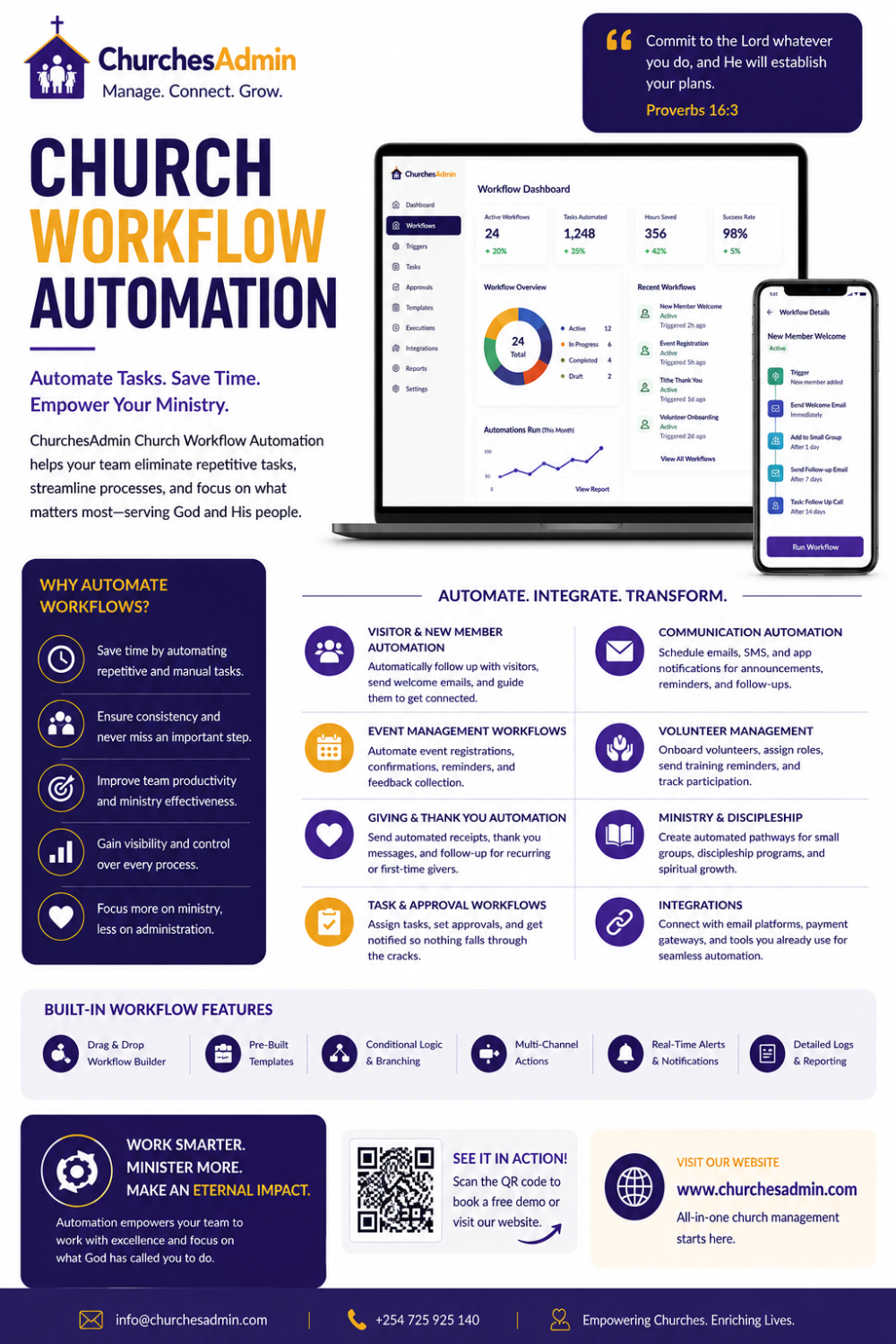
Church Workflow Automation helps churches, ministries, worship centers, and faith-based organizations automate administrative tasks, improve coordination, streamline communication, simplify approvals, organize ministry activities, reduce manual work, and strengthen operational efficiency.

Churches manage a wide range of recurring activities every day. From member registration and attendance tracking to volunteer coordination, ministry scheduling, communication, reporting, event administration, and follow-up activities, operational demands continue increasing as congregations grow.

Many churches still rely on manual processes including spreadsheets, paper forms, messaging groups, email chains, and repetitive administrative tasks. While these methods may work for small operations, they often become difficult to maintain as ministry activities expand.

Modern churches require connected operational systems that automate repetitive work and allow leaders to focus more on ministry and member engagement.

Automation creates consistency, reduces delays, and improves church administration.


Table of Contents

  1. Understanding Modern Church Process Management
  2. Why Automation Matters
  3. Core Automation Capabilities
  4. Improving Administrative Efficiency
  5. Participation and Activity Coordination
  6. Communication and Operational Workflows
  7. Reporting and Process Visibility
  8. Supporting Different Ministry Structures
  9. Benefits of Automated Operations
  10. Selecting the Right Automation Platform
  11. Future Direction of Digital Ministry
  12. Getting Started

Understanding Modern Church Process Management

Church administration consists of multiple connected processes.

A modern Church Workflow Automation approach helps churches reduce repetitive tasks while improving visibility and coordination.

Churches commonly manage:

  • Member onboarding
  • Attendance administration
  • Volunteer scheduling
  • Event coordination
  • Ministry communication
  • Reporting activities
  • Approval workflows
  • Registration processes
  • Leadership coordination
  • Administrative tasks

Automation creates consistency and improves execution.


Why Automation Matters

Manual operations become difficult to scale.

Without structured workflows, churches often experience:

  • Administrative delays
  • Communication gaps
  • Duplicate work
  • Missed follow-ups
  • Reporting challenges
  • Volunteer coordination issues
  • Limited visibility
  • Reduced efficiency

Using Church Workflow Automation helps churches simplify operations and improve ministry execution.


Core Automation Capabilities

A modern automation platform should simplify recurring activities.

Process Automation

Automate:

  • Administrative workflows
  • Notifications
  • Assignments
  • Approvals

Member Coordination

Manage:

  • Registration workflows
  • Follow-ups
  • Participation tracking
  • Communication schedules

Ministry Scheduling

Coordinate:

  • Events
  • Volunteer schedules
  • Ministry calendars
  • Operational timelines

Workflow Monitoring

Track process execution centrally.


Improving Administrative Efficiency

Automation reduces administrative workload.

A centralized Church Workflow Automation solution supports:

Faster Execution

Reduce delays in church operations.


Reduced Manual Work

Minimize repetitive tasks.


Better Coordination

Improve alignment across ministries.


Consistent Processes

Standardize church activities.

Efficient operations support ministry growth.


Participation and Activity Coordination

Church engagement depends on organized workflows.

Track and coordinate:

  • Attendance activities
  • Ministry participation
  • Volunteer assignments
  • Event registration
  • Community programs

Participation visibility improves church planning.

Engagement Monitoring

Measure:

  • Attendance patterns
  • Participation activity
  • Volunteer involvement
  • Ministry outcomes

Insights support operational improvement.


Communication and Operational Workflows

Communication becomes stronger through automation.

A Church Workflow Automation strategy supports:

  • Event notifications
  • Ministry updates
  • Member reminders
  • Volunteer coordination
  • Leadership communication
  • Administrative updates

Benefits include:

Faster Communication

Improve message delivery.


Better Engagement

Increase member responsiveness.


Stronger Coordination

Improve operational execution.


Improved Visibility

Track communication effectiveness.


Reporting and Process Visibility

Leadership teams require operational transparency.

Generate reports for:

  • Workflow performance
  • Participation activity
  • Process completion
  • Ministry coordination
  • Administrative outcomes

Operational Dashboards

Monitor:

  • Efficiency indicators
  • Participation trends
  • Activity completion
  • Ministry performance

Reporting improves decision-making.


Supporting Different Ministry Structures

Different churches operate differently.

Local Churches

Improve administrative efficiency.


Growing Congregations

Support expanding operations.


Ministry Departments

Coordinate activities efficiently.


Outreach Programs

Improve workflow visibility.


Multi-Location Churches

Maintain centralized operations.

Technology supports scalable ministry administration.


Benefits of Automated Operations

Using Church Workflow Automation helps churches:

Improve Efficiency

Reduce repetitive tasks.


Strengthen Coordination

Improve ministry alignment.


Improve Reporting

Increase visibility.


Enhance Communication

Improve engagement.


Support Growth

Scale operations effectively.


Improve Member Experience

Create smoother church interactions.


Selecting the Right Automation Platform

Before selecting software, evaluate:

Ease of Use

Ensure quick adoption.


Automation Features

Support recurring workflows.


Communication Capabilities

Improve coordination.


Reporting Tools

Generate useful insights.


Scalability

Support future expansion.

Selecting the right platform strengthens church administration.


Future Direction of Digital Ministry

Church technology continues evolving.

Future trends include:

  • Intelligent automation
  • Real-time workflows
  • Mobile accessibility
  • Digital engagement
  • Automated communication
  • Centralized administration

Churches adopting automation today improve future readiness.


Getting Started

If your church still relies on spreadsheets, paper forms, repetitive administration, and disconnected operational processes, now is the right time to modernize.

Church Workflow Automation helps churches simplify administration, automate recurring activities, strengthen communication, improve reporting, and support sustainable ministry growth.

Build a more efficient and connected church environment through automation.

Church Growth Software – Strengthen Member Engagement and Support Sustainable Church Expansion

Church Growth Software

Church Growth Software helps churches, ministries, worship centers, and faith-based organizations improve member engagement, strengthen communication, organize church activities, monitor participation, support ministry expansion, and create sustainable church growth through connected administration.

Church growth is more than increasing attendance. Sustainable growth involves building stronger member relationships, improving engagement, supporting ministries, organizing operations, and maintaining visibility across church activities.

As churches expand, leadership teams often face increasing challenges managing communication, attendance, administration, volunteers, ministry coordination, reporting, and member participation.

Traditional methods such as spreadsheets, manual records, paper attendance lists, and disconnected communication channels often limit growth and create administrative inefficiencies.

Modern churches require centralized systems that help leaders understand participation patterns, improve operational visibility, and create stronger church communities.

Digital church administration enables leaders to focus more on ministry and less on manual processes.


Table of Contents

  1. Understanding Sustainable Church Expansion
  2. Why Structured Growth Matters
  3. Core Capabilities and Features
  4. Managing Member Engagement Effectively
  5. Participation and Attendance Visibility
  6. Communication and Community Building
  7. Reporting and Leadership Insights
  8. Supporting Different Ministry Models
  9. Benefits of Digital Church Development
  10. Choosing the Right Solution
  11. Future Direction of Church Technology
  12. Getting Started

Understanding Sustainable Church Expansion

Church development requires intentional planning, engagement, and operational visibility.

A modern Church Growth Software solution helps churches centralize information while supporting stronger member relationships and ministry effectiveness.

Churches commonly manage:

  • Member records
  • Attendance tracking
  • Ministry participation
  • Volunteer involvement
  • Communication workflows
  • Event coordination
  • Leadership activities
  • Administrative reporting
  • Community outreach
  • Church engagement initiatives

Centralized administration improves consistency and supports sustainable growth.


Why Structured Growth Matters

Growth becomes difficult to sustain without organized systems.

Churches operating manually often experience:

  • Communication delays
  • Participation visibility challenges
  • Administrative inefficiencies
  • Limited reporting
  • Volunteer coordination issues
  • Reduced engagement
  • Operational inconsistencies
  • Slower ministry expansion

Using Church Growth Software helps churches strengthen engagement and improve ministry effectiveness.


Core Capabilities and Features

A modern platform should support end-to-end church administration.

Member Administration

Manage:

  • Member profiles
  • Family records
  • Participation history
  • Ministry involvement

Attendance Monitoring

Track:

  • Service attendance
  • Program participation
  • Event engagement
  • Volunteer activity

Ministry Coordination

Coordinate:

  • Departments
  • Schedules
  • Teams
  • Church activities

Administrative Visibility

Maintain centralized operational information.


Managing Member Engagement Effectively

Member engagement drives church development.

A centralized Church Growth Software platform supports:

Better Communication

Deliver updates consistently.


Relationship Building

Strengthen member connections.


Ministry Participation

Increase involvement.


Member Visibility

Understand engagement patterns.

Stronger engagement supports sustainable expansion.


Participation and Attendance Visibility

Attendance insights support informed decisions.

Track:

  • Worship participation
  • Ministry involvement
  • Event attendance
  • Volunteer contributions
  • Community engagement

Participation visibility strengthens church planning.

Growth Monitoring

Measure:

  • Attendance trends
  • Engagement levels
  • Membership activity
  • Community participation

Data improves church development strategies.


Communication and Community Building

Strong communication supports healthy church communities.

A Church Growth Software platform supports:

  • Church announcements
  • Event reminders
  • Leadership updates
  • Ministry communication
  • Volunteer coordination
  • Member engagement initiatives

Benefits include:

Faster Communication

Improve information delivery.


Stronger Participation

Increase engagement.


Better Coordination

Align ministry activities.


Improved Relationships

Build connected communities.


Reporting and Leadership Insights

Leadership teams require visibility into growth activities.

Generate reports for:

  • Membership activity
  • Attendance performance
  • Participation trends
  • Ministry effectiveness
  • Operational outcomes

Leadership Monitoring

Track:

  • Growth indicators
  • Community engagement
  • Participation patterns
  • Ministry outcomes

Reporting supports better planning.


Supporting Different Ministry Models

Different church structures require flexible solutions.

Local Churches

Improve member engagement.


Growing Congregations

Support expansion initiatives.


Ministry Departments

Improve coordination.


Outreach Programs

Track participation.


Multi-Location Churches

Maintain operational visibility.

Technology supports scalable church administration.


Benefits of Digital Church Development

Using Church Growth Software helps churches:

Improve Member Engagement

Build stronger relationships.


Strengthen Communication

Keep communities informed.


Improve Reporting

Support informed leadership.


Increase Participation

Improve ministry involvement.


Strengthen Operations

Reduce administrative effort.


Support Sustainable Growth

Scale effectively.


Choosing the Right Solution

Before selecting software, evaluate:

Ease of Use

Ensure rapid adoption.


Administration Features

Support church operations.


Communication Capabilities

Improve engagement.


Reporting Visibility

Generate meaningful insights.


Scalability

Support future expansion.

Selecting the right technology supports long-term success.


Future Direction of Church Technology

Church administration continues evolving.

Future trends include:

  • Workflow automation
  • Mobile accessibility
  • Real-time reporting
  • Engagement analytics
  • Centralized administration
  • Improved collaboration

Churches adopting digital systems today improve future readiness.


Getting Started

If your church still relies on spreadsheets, paper records, manual attendance processes, and disconnected communication channels, now is the right time to modernize.

Church Growth Software helps churches improve engagement, strengthen reporting, organize ministry operations, coordinate participation, and support sustainable church expansion.

Build a more connected and growing church through modern administration tools.


Church Operations Platform – Centralize Administration and Strengthen Church Management

Church Operations Platform

Church Operations Platform helps churches, ministries, worship centers, and faith-based organizations manage daily operations, centralize administration, improve communication, coordinate ministries, strengthen reporting, manage participation, and support sustainable church growth.

As churches continue expanding their ministries and serving larger congregations, operational management becomes increasingly complex. Church leaders must coordinate members, ministries, volunteers, communication, attendance, planning, reporting, and leadership activities while maintaining consistency across church operations.

Traditional methods such as spreadsheets, paper files, manual workflows, and disconnected communication channels often create inefficiencies that limit growth and reduce operational visibility.

Modern churches require connected systems that simplify administration while supporting effective ministry execution.

A centralized operational approach allows churches to improve efficiency and strengthen member engagement.


Table of Contents

  1. Understanding Modern Church Administration
  2. Why Structured Operations Matter
  3. Core Platform Capabilities
  4. Managing Church Activities Efficiently
  5. Participation and Attendance Visibility
  6. Communication and Ministry Coordination
  7. Reporting and Leadership Oversight
  8. Supporting Different Church Structures
  9. Benefits of Connected Administration
  10. Selecting the Right Technology
  11. Future Direction of Church Management
  12. Getting Started

Understanding Modern Church Administration

Church administration involves coordinating people, ministries, communication, and operational activities.

A modern Church Operations Platform provides centralized visibility into church administration while improving efficiency and reducing manual processes.

Churches commonly manage:

  • Member information
  • Ministry coordination
  • Attendance activities
  • Volunteer scheduling
  • Event administration
  • Communication workflows
  • Leadership responsibilities
  • Reporting processes
  • Operational planning
  • Community engagement

Centralized administration improves consistency and supports church growth.


Why Structured Operations Matter

Growing churches require stronger operational structures.

Without organized systems, churches often experience:

  • Administrative delays
  • Communication challenges
  • Attendance visibility issues
  • Duplicate records
  • Limited reporting
  • Volunteer coordination difficulties
  • Operational inefficiencies
  • Reduced engagement

Using Church Operations Platform solutions helps churches improve organization and strengthen ministry execution.


Core Platform Capabilities

A modern solution should support end-to-end church administration.

Centralized Member Administration

Manage:

  • Member profiles
  • Family records
  • Participation history
  • Ministry assignments

Ministry Coordination

Coordinate:

  • Programs
  • Teams
  • Schedules
  • Leadership activities

Attendance Management

Track:

  • Services
  • Events
  • Community programs
  • Volunteer activities

Operational Visibility

Access information through centralized administration tools.


Managing Church Activities Efficiently

Church activities require structured coordination.

A centralized Church Operations Platform helps support:

Administrative Workflows

Reduce manual effort.


Department Coordination

Improve collaboration.


Scheduling Processes

Maintain organized church calendars.


Activity Monitoring

Track operational performance.

Structured workflows improve execution.


Participation and Attendance Visibility

Church participation data supports informed decisions.

Track:

  • Worship attendance
  • Ministry participation
  • Volunteer involvement
  • Event engagement
  • Community interaction

Attendance visibility strengthens ministry planning.

Participation Monitoring

Measure:

  • Growth trends
  • Member engagement
  • Ministry involvement
  • Attendance activity

Insights improve church management.


Communication and Ministry Coordination

Communication supports connected church communities.

A Church Operations Platform supports:

  • Ministry communication
  • Event updates
  • Leadership coordination
  • Volunteer announcements
  • Member notifications
  • Operational updates

Benefits include:

Improved Coordination

Keep teams aligned.


Better Engagement

Improve member participation.


Faster Communication

Deliver updates consistently.


Stronger Collaboration

Improve ministry effectiveness.


Reporting and Leadership Oversight

Church leaders require operational visibility.

Generate reports for:

  • Attendance performance
  • Participation trends
  • Ministry outcomes
  • Leadership oversight
  • Administrative activities

Dashboard Visibility

Monitor:

  • Growth performance
  • Ministry activity
  • Operational outcomes
  • Participation indicators

Centralized reporting supports informed leadership decisions.


Supporting Different Church Structures

Different church environments require flexible operations.

Local Churches

Improve administration and engagement.


Growing Congregations

Strengthen operational oversight.


Multi-Location Churches

Centralize administration.


Ministry Departments

Improve coordination and reporting.


Community Programs

Track participation and activities.

Technology supports operational excellence.


Benefits of Connected Administration

Using Church Operations Platform helps churches:

Improve Efficiency

Reduce repetitive administration.


Strengthen Visibility

Access centralized operational information.


Improve Communication

Increase engagement.


Enhance Reporting

Improve decision-making.


Support Growth

Scale church operations efficiently.


Improve Collaboration

Strengthen ministry coordination.


Selecting the Right Technology

Before selecting software, evaluate:

Ease of Use

Support quick adoption.


Administration Features

Support church workflows.


Communication Tools

Enable effective engagement.


Reporting Capabilities

Provide meaningful insights.


Scalability

Support future growth.

Selecting the right platform improves long-term operational success.


Future Direction of Church Management

Church operations continue evolving.

Future trends include:

  • Workflow automation
  • Real-time reporting
  • Mobile accessibility
  • Digital engagement
  • Centralized administration
  • Collaboration tools

Churches investing in operational technology today improve future readiness.


Getting Started

If your church still relies on spreadsheets, manual coordination, disconnected communication channels, and paper records, now is the right time to modernize.

Church Operations Platform helps churches streamline administration, improve communication, strengthen reporting, coordinate ministries, and support sustainable growth.

Build a more organized and connected church environment through modern operations management.


Church Reporting Software – Improve Visibility, Reporting Accuracy, and Church Administration

Church Reporting Software

Church Reporting Software helps churches, ministries, worship centers, and faith-based organizations collect operational data, generate reports, improve decision-making, monitor church activities, strengthen accountability, and simplify administration through centralized reporting.

As churches continue expanding their ministries and serving larger congregations, reporting becomes increasingly important. Church leaders need accurate information to evaluate growth, monitor participation, understand ministry performance, oversee attendance, review financial activities, and improve planning.

Many churches still depend on spreadsheets, paper records, disconnected databases, and manual calculations to generate reports. While these methods may work initially, they become difficult to manage as church operations grow.

Modern churches require connected reporting systems that provide visibility across all areas of ministry and administration.

A centralized reporting approach enables church leaders to make informed decisions and support sustainable ministry growth.


Table of Contents

  1. Understanding Church Data and Visibility
  2. Why Reporting Matters for Ministry Growth
  3. Core Reporting Capabilities
  4. Tracking Operational Performance
  5. Attendance and Participation Insights
  6. Communication and Engagement Analytics
  7. Leadership Dashboards and Monitoring
  8. Supporting Different Church Structures
  9. Benefits of Digital Reporting
  10. Choosing the Right Reporting Solution
  11. Future Direction of Church Analytics
  12. Getting Started

Understanding Church Data and Visibility

Churches generate valuable information every day.

A modern Church Reporting Software solution helps leadership teams convert church activities into meaningful insights that support planning and growth.

Churches commonly report on:

  • Membership activity
  • Attendance records
  • Ministry participation
  • Volunteer involvement
  • Event performance
  • Financial activities
  • Communication engagement
  • Leadership oversight
  • Department operations
  • Church growth indicators

Centralized reporting improves visibility and operational awareness.


Why Reporting Matters for Ministry Growth

Church growth requires measurable information.

Without structured reporting systems, churches often experience:

  • Limited visibility
  • Delayed decisions
  • Inconsistent records
  • Administrative inefficiencies
  • Reporting inaccuracies
  • Attendance uncertainty
  • Communication gaps
  • Reduced operational insight

Using Church Reporting Software helps leaders make better decisions using reliable data.


Core Reporting Capabilities

A modern reporting platform should simplify access to information.

Membership Reporting

Generate insights for:

  • Membership growth
  • New registrations
  • Participation trends
  • Retention activity

Attendance Reporting

Track:

  • Service attendance
  • Event participation
  • Ministry engagement
  • Community activities

Ministry Performance Reporting

Monitor:

  • Department activity
  • Volunteer engagement
  • Program execution
  • Participation outcomes

Operational Dashboards

Access centralized church information.


Tracking Operational Performance

Performance measurement supports church growth.

A centralized Church Reporting Software solution helps churches monitor:

Administrative Activity

Track church operations effectively.


Ministry Effectiveness

Evaluate participation and outcomes.


Volunteer Coordination

Measure service contributions.


Growth Trends

Monitor church expansion over time.

Performance reporting supports better planning.


Attendance and Participation Insights

Attendance reporting helps churches understand engagement.

Track:

  • Worship attendance
  • Event participation
  • Group activity
  • Ministry attendance
  • Volunteer involvement

Participation visibility strengthens ministry planning.

Engagement Analytics

Measure:

  • Member activity
  • Attendance patterns
  • Program participation
  • Engagement trends

These insights improve leadership decisions.


Communication and Engagement Analytics

Communication performance affects church engagement.

A Church Reporting Software platform supports analysis of:

  • Announcement reach
  • Notification effectiveness
  • Event communication
  • Ministry updates
  • Member engagement

Benefits include:

Better Communication Decisions

Understand engagement outcomes.


Improved Participation

Increase church involvement.


Stronger Ministry Coordination

Improve communication effectiveness.


Increased Visibility

Track church communication performance.


Leadership Dashboards and Monitoring

Church leaders require quick access to information.

Generate leadership insights for:

  • Attendance trends
  • Membership activity
  • Ministry performance
  • Financial visibility
  • Operational outcomes

Dashboard Monitoring

Track:

  • Church growth
  • Department activity
  • Volunteer performance
  • Participation indicators

Centralized dashboards improve decision-making.


Supporting Different Church Structures

Different churches require different reporting approaches.

Local Churches

Improve operational visibility.


Multi-Campus Churches

Centralize reporting across locations.


Ministries

Track participation and performance.


Worship Centers

Improve engagement visibility.


Outreach Programs

Measure ministry outcomes.

Technology supports better oversight.


Benefits of Digital Reporting

Using Church Reporting Software helps churches:

Improve Visibility

Access centralized reporting.


Strengthen Decision-Making

Use data to guide ministry planning.


Increase Accuracy

Reduce reporting errors.


Improve Accountability

Strengthen operational oversight.


Support Growth

Monitor expansion effectively.


Reduce Administrative Work

Automate reporting processes.


Choosing the Right Reporting Solution

Before selecting software, evaluate:

Ease of Use

Enable quick adoption.


Reporting Flexibility

Support different church needs.


Dashboard Visibility

Provide meaningful insights.


Data Accessibility

Ensure fast access to reports.


Scalability

Support future church growth.

Selecting the right solution improves operational effectiveness.


Future Direction of Church Analytics

Church reporting continues evolving.

Future trends include:

  • Automated reporting
  • Real-time dashboards
  • Predictive insights
  • Mobile accessibility
  • Digital engagement analytics
  • Centralized reporting environments

Churches adopting reporting technology today improve future readiness.


Getting Started

If your church still relies on spreadsheets, paper records, disconnected reports, and manual data collection, now is the right time to modernize.

Church Reporting Software helps churches centralize reporting, improve visibility, strengthen leadership oversight, monitor participation, and support sustainable ministry growth.

Build a more informed and connected church through modern reporting systems.

Multi Campus Church Software – Centralize Operations and Strengthen Multi-Location Church Management

Multi Campus Church Software

Multi Campus Church Software helps churches operating across multiple locations manage administration, centralize member information, improve communication, coordinate ministries, track attendance, strengthen leadership visibility, and streamline church operations from one connected platform.

As churches expand into multiple campuses, managing operations becomes increasingly complex. Church leaders must maintain consistency while supporting local ministry execution across different locations.

Multi-campus churches often coordinate attendance, member engagement, volunteer activities, communication, events, leadership oversight, reporting, and ministry operations simultaneously.

Traditional methods such as spreadsheets, disconnected databases, manual reporting, and separate communication channels often create inefficiencies and reduce operational visibility.

Modern churches require centralized systems that support both local flexibility and organization-wide oversight.

A digital approach allows church leadership teams to improve collaboration while maintaining consistency across every campus.


Table of Contents

  1. Understanding Multi-Location Administration
  2. Why Centralized Oversight Matters
  3. Core Platform Capabilities
  4. Managing Members Across Locations
  5. Attendance and Participation Visibility
  6. Communication and Leadership Coordination
  7. Reporting and Organizational Insights
  8. Supporting Different Ministry Structures
  9. Benefits of Connected Church Operations
  10. Selecting the Right Technology
  11. Future Direction of Connected Ministry
  12. Getting Started

Understanding Multi-Location Administration

Operating multiple church campuses introduces additional administrative complexity.

A modern Multi Campus Church Software solution helps churches maintain operational consistency while empowering local leadership.

Churches commonly manage:

  • Multiple congregations
  • Shared member records
  • Attendance tracking
  • Volunteer coordination
  • Ministry administration
  • Leadership reporting
  • Event management
  • Communication workflows
  • Department collaboration
  • Operational oversight

Centralized systems improve visibility and consistency.


Why Centralized Oversight Matters

As church locations increase, fragmented systems become difficult to manage.

Without structured administration, churches may experience:

  • Duplicate member records
  • Communication delays
  • Inconsistent reporting
  • Limited visibility across campuses
  • Administrative inefficiencies
  • Ministry coordination challenges
  • Disconnected operational processes

Using Multi Campus Church Software creates stronger alignment across locations.


Core Platform Capabilities

A modern solution should support centralized and local operations simultaneously.

Unified Member Administration

Manage:

  • Member records
  • Household profiles
  • Participation history
  • Campus assignments

Campus-Level Administration

Support individual campus operations while maintaining organizational visibility.


Ministry Coordination

Coordinate:

  • Programs
  • Leadership teams
  • Departments
  • Events

Operational Visibility

Monitor activity across locations.


Managing Members Across Locations

Membership visibility is critical for growing churches.

A centralized Multi Campus Church Software platform supports:

Shared Member Records

Maintain one source of truth.


Campus Assignment

Associate members with specific locations.


Family Management

Track households across campuses.


Member Engagement Tracking

Monitor participation trends.

Better visibility supports stronger engagement.


Attendance and Participation Visibility

Attendance data supports informed leadership decisions.

Track:

  • Service attendance
  • Ministry participation
  • Event engagement
  • Volunteer activity
  • Group involvement

Participation insights improve planning.

Engagement Monitoring

Measure:

  • Campus growth
  • Attendance trends
  • Ministry activity
  • Community participation

This improves operational awareness.


Communication and Leadership Coordination

Communication becomes increasingly important across locations.

A Multi Campus Church Software solution supports:

  • Leadership communication
  • Campus announcements
  • Ministry updates
  • Event coordination
  • Volunteer notifications
  • Administrative communication

Benefits include:

Faster Coordination

Keep leadership aligned.


Consistent Messaging

Maintain communication standards.


Better Collaboration

Strengthen ministry execution.


Stronger Engagement

Improve member experiences.


Reporting and Organizational Insights

Church leaders require complete operational visibility.

Generate reports for:

  • Membership growth
  • Campus performance
  • Attendance activity
  • Ministry effectiveness
  • Volunteer participation

Reporting improves strategic planning.

Leadership Dashboards

Monitor:

  • Growth metrics
  • Campus activity
  • Operational performance
  • Participation insights

Data supports informed decisions.


Supporting Different Ministry Structures

Multi-location churches often support diverse ministry models.

Central Leadership Teams

Maintain organization-wide visibility.


Independent Campuses

Enable local administration.


Shared Ministries

Coordinate activities across locations.


Community Programs

Track outreach participation.


Department Collaboration

Improve cross-campus coordination.

Technology strengthens ministry alignment.


Benefits of Connected Church Operations

Using Multi Campus Church Software helps churches:

Improve Operational Consistency

Standardize administration.


Strengthen Communication

Maintain alignment across locations.


Improve Reporting

Access centralized insights.


Increase Member Visibility

Track engagement effectively.


Support Growth

Scale operations confidently.


Improve Leadership Oversight

Monitor performance across campuses.


Selecting the Right Technology

Before selecting software, evaluate:

Ease of Use

Support rapid adoption.


Multi-Location Features

Enable centralized administration.


Communication Tools

Improve collaboration.


Reporting Capabilities

Provide meaningful insights.


Scalability

Support future expansion.

Selecting the right platform supports sustainable growth.


Future Direction of Connected Ministry

Church administration continues evolving.

Future trends include:

  • Real-time reporting
  • Automated workflows
  • Mobile accessibility
  • Digital engagement
  • Centralized administration
  • Enhanced collaboration tools

Churches adopting connected systems today improve future readiness.


Getting Started

If your church currently manages locations using spreadsheets, disconnected databases, separate communication systems, and manual reporting processes, now is the right time to modernize.

Multi Campus Church Software helps churches centralize operations, improve communication, strengthen reporting, coordinate ministries, and support sustainable multi-location growth.

Build a more connected and organized church network through modern administration.