Ministry Management Software – Simplify Administration and Strengthen Ministry Growth

Ministry Management Software

Ministry Management Software helps churches, ministries, worship centers, and faith-based organizations organize ministry operations, manage members, improve communication, coordinate volunteers, track attendance, streamline administration, and strengthen long-term ministry growth.

As churches continue expanding their programs and departments, managing ministry activities manually becomes increasingly difficult. Ministry leaders often coordinate communication, attendance, volunteer teams, events, outreach programs, member engagement, leadership responsibilities, and operational reporting simultaneously.

Traditional processes such as spreadsheets, notebooks, paper records, messaging groups, and disconnected communication channels create administrative inefficiencies and limit ministry effectiveness.

Modern churches require centralized systems that improve visibility, simplify operations, and create stronger engagement across ministries.

A structured digital approach allows ministries to operate more efficiently while supporting sustainable growth.


Table of Contents

  1. Understanding Digital Ministry Administration
  2. Why Structured Operations Matter
  3. Core Capabilities and Functions
  4. Organizing Ministry Activities Efficiently
  5. Managing Participation and Attendance
  6. Communication and Collaboration Workflows
  7. Reporting and Leadership Visibility
  8. Supporting Different Ministry Structures
  9. Benefits of Digital Ministry Operations
  10. Choosing the Right Platform
  11. Future Direction of Ministry Technology
  12. Getting Started

Understanding Digital Ministry Administration

Ministry administration involves more than organizing meetings and maintaining records.

A modern Ministry Management Software solution helps churches centralize operations while improving ministry coordination and member engagement.

Ministries regularly manage:

  • Member records
  • Attendance tracking
  • Volunteer activities
  • Leadership coordination
  • Ministry communication
  • Events and outreach programs
  • Scheduling and assignments
  • Department collaboration
  • Administrative reporting
  • Community engagement

Centralized administration creates consistency and supports ministry effectiveness.


Why Structured Operations Matter

Ministry growth creates additional operational demands.

Without organized systems, churches often experience:

  • Communication gaps
  • Administrative delays
  • Poor attendance visibility
  • Volunteer coordination issues
  • Reporting limitations
  • Reduced engagement
  • Duplicate records
  • Limited operational oversight

Using Ministry Management Software helps leadership teams improve organization and strengthen ministry execution.


Core Capabilities and Functions

A modern platform should support end-to-end ministry operations.

Member Administration

Manage:

  • Member records
  • Contact information
  • Ministry participation
  • Leadership assignments

Volunteer Coordination

Organize:

  • Service schedules
  • Team assignments
  • Participation tracking
  • Volunteer activities

Ministry Scheduling

Coordinate:

  • Ministry calendars
  • Events
  • Meetings
  • Service plans

Centralized Administration

Improve visibility across all ministry operations.


Organizing Ministry Activities Efficiently

Ministry coordination becomes easier through structured workflows.

A centralized Ministry Management Software solution supports:

Ministry Planning

Coordinate programs and activities.


Department Collaboration

Improve alignment across church teams.


Workflow Management

Reduce manual coordination.


Program Visibility

Track ministry execution and outcomes.

This creates stronger operational control.


Managing Participation and Attendance

Participation data supports ministry growth.

Track:

  • Worship attendance
  • Group participation
  • Volunteer involvement
  • Ministry engagement
  • Event attendance

Attendance visibility improves decision-making.

Engagement Monitoring

Measure:

  • Participation levels
  • Team involvement
  • Activity trends
  • Community engagement

Insights support stronger ministry development.


Communication and Collaboration Workflows

Communication strengthens ministry relationships.

A Ministry Management Software platform supports:

  • Ministry announcements
  • Event reminders
  • Volunteer communication
  • Leadership updates
  • Group coordination
  • Program communication

Benefits include:

Faster Coordination

Keep teams aligned.


Improved Engagement

Maintain active member participation.


Better Collaboration

Improve ministry execution.


Stronger Communication

Build connected church communities.


Reporting and Leadership Visibility

Church leaders require operational visibility.

Generate reports for:

  • Participation trends
  • Ministry performance
  • Attendance activity
  • Volunteer engagement
  • Program effectiveness

Reporting improves planning.

Leadership Insights

Track:

  • Growth trends
  • Ministry performance
  • Operational efficiency
  • Engagement outcomes

Data supports informed decisions.


Supporting Different Ministry Structures

Different ministries operate differently.

Youth Ministries

Improve coordination and participation.


Worship Ministries

Organize schedules and service activities.


Outreach Programs

Coordinate volunteers and community engagement.


Leadership Teams

Improve planning and communication.


Multi-Department Churches

Maintain centralized visibility.

Technology supports efficient ministry operations.


Benefits of Digital Ministry Operations

Using Ministry Management Software helps churches:

Improve Administration

Reduce manual effort.


Strengthen Engagement

Increase participation.


Improve Communication

Deliver updates consistently.


Enhance Reporting

Improve visibility and accountability.


Support Ministry Growth

Scale operations efficiently.


Improve Collaboration

Strengthen team coordination.


Choosing the Right Platform

Before selecting software, evaluate:

Ease of Use

Ensure teams can adopt quickly.


Administration Features

Support ministry operations fully.


Communication Tools

Keep engagement simple.


Reporting Capabilities

Access meaningful insights.


Scalability

Support future ministry expansion.

Selecting the right solution strengthens ministry performance.


Future Direction of Ministry Technology

Church administration continues evolving.

Future trends include:

  • Workflow automation
  • Mobile accessibility
  • Real-time reporting
  • Digital engagement
  • Ministry analytics
  • Centralized collaboration

Churches adopting digital systems today improve long-term ministry success.


Getting Started

If your ministry still relies on spreadsheets, paper records, messaging groups, and disconnected administration processes, now is the right time to modernize.

Ministry Management Software helps churches simplify administration, improve communication, organize ministry activities, strengthen reporting, increase engagement, and support sustainable growth.

Build a more connected and effective ministry through digital administration.

Church Member Database – Centralize Membership Information and Strengthen Church Administration

Church Member Database

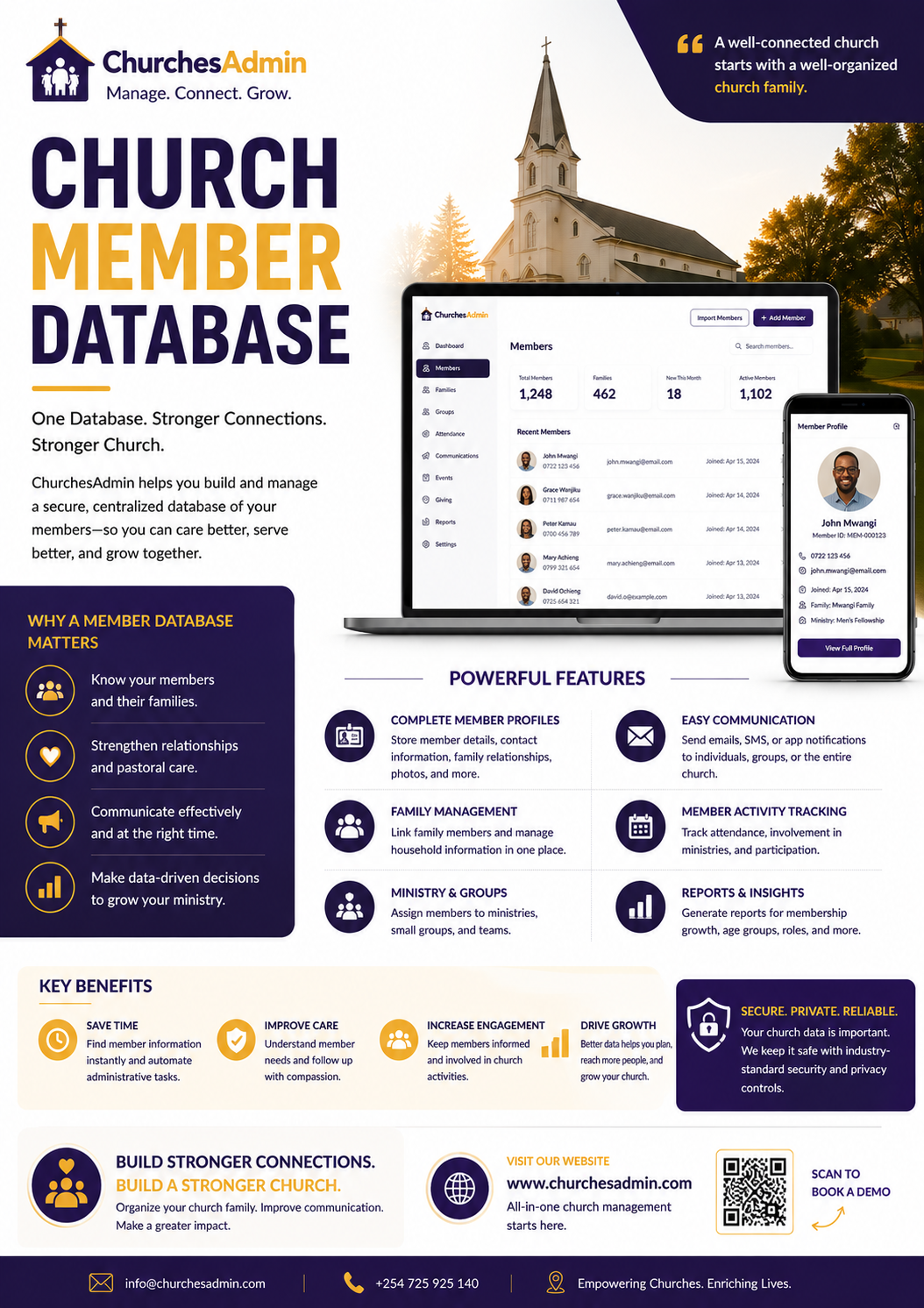
Church Member Database helps churches, ministries, worship centers, and faith-based organizations organize member information, improve communication, strengthen engagement, simplify administration, track participation, and support long-term church growth.

Managing church membership is one of the most important responsibilities within church administration. Every growing church needs reliable access to accurate member information to support ministry activities, improve engagement, coordinate communication, and strengthen community relationships.

As congregations expand, manual methods such as paper records, spreadsheets, notebooks, and disconnected communication systems become difficult to maintain. Churches often struggle with duplicate records, outdated contact information, attendance visibility challenges, and limited reporting capabilities.

A centralized church membership system helps leaders maintain accurate records while improving ministry effectiveness and member experiences.

Modern churches increasingly require digital tools that provide visibility, organization, and scalability.


Table of Contents

  1. Understanding Modern Membership Administration
  2. Why Organized Records Matter
  3. Core Functions and Capabilities
  4. Managing Membership Information Efficiently
  5. Attendance and Participation Tracking
  6. Communication and Engagement Workflows
  7. Reporting and Administrative Visibility
  8. Supporting Different Church Structures
  9. Benefits of Digital Administration
  10. Choosing the Right Solution
  11. Future Direction of Church Technology
  12. Getting Started

Understanding Modern Membership Administration

Church membership management extends beyond storing names and contact information.

A modern Church Member Database provides a structured environment where church leadership teams can manage member profiles, participation history, communication records, ministry involvement, and operational reporting.

Churches regularly manage:

  • Member registration
  • Family records
  • Attendance history
  • Ministry participation
  • Volunteer involvement
  • Communication updates
  • Event engagement
  • Leadership assignments
  • Contribution history
  • Membership growth reporting

Centralized administration supports better organization.


Why Organized Records Matter

Accurate records improve ministry operations.

Without structured systems, churches often experience:

  • Duplicate information
  • Missing records
  • Poor communication
  • Administrative delays
  • Attendance uncertainty
  • Reduced member engagement
  • Reporting limitations
  • Coordination challenges

Using Church Member Database software creates a stronger operational foundation.


Core Functions and Capabilities

A modern membership platform should simplify administration.

Member Registration

Capture and manage:

  • Member profiles
  • Contact details
  • Family information
  • Membership categories

Profile Management

Maintain visibility across:

  • Ministry participation
  • Service history
  • Attendance records
  • Volunteer involvement

Centralized Records

Store and access information securely.


Administrative Access

Enable authorized leadership teams to manage records efficiently.


Managing Membership Information Efficiently

Managing church information manually becomes difficult as congregations grow.

A centralized Church Member Database supports:

Accurate Records

Maintain updated member profiles.


Family Grouping

Organize households efficiently.


Member Classification

Track:

  • New members
  • Active members
  • Volunteers
  • Ministry leaders

Historical Information

Maintain complete participation history.

This improves administration and member support.


Attendance and Participation Tracking

Attendance insights support ministry growth.

Track:

  • Worship services
  • Prayer meetings
  • Conferences
  • Bible studies
  • Ministry gatherings
  • Community events

Attendance visibility improves decision-making.

Participation Insights

Measure:

  • Service attendance
  • Event engagement
  • Volunteer activity
  • Ministry involvement

This supports stronger member relationships.


Communication and Engagement Workflows

Communication strengthens church communities.

A Church Member Database supports better engagement through organized communication.

Manage:

  • Announcements
  • Service reminders
  • Ministry updates
  • Event invitations
  • Community notices

Benefits include:

Faster Communication

Deliver information consistently.


Better Engagement

Members remain informed.


Improved Participation

Increase ministry involvement.


Stronger Relationships

Build deeper church connections.


Reporting and Administrative Visibility

Church leaders require meaningful insights.

Generate reports for:

  • Membership growth
  • Attendance trends
  • Participation levels
  • Volunteer engagement
  • Operational activity

Reporting improves strategic planning.

Performance Visibility

Track:

  • Growth trends
  • Member retention
  • Ministry activity
  • Community engagement

Data supports informed decisions.


Supporting Different Church Structures

Different churches require different administration approaches.

Local Churches

Improve membership visibility.


Multi-Campus Churches

Manage records centrally.


Ministries

Coordinate participation efficiently.


Worship Centers

Improve engagement and communication.


Community Programs

Track involvement effectively.

Digital administration supports growth.


Benefits of Digital Administration

Using Church Member Database technology helps churches:

Improve Organization

Access centralized records.


Reduce Manual Work

Automate repetitive tasks.


Improve Communication

Deliver updates consistently.


Strengthen Engagement

Improve participation visibility.


Increase Reporting Accuracy

Support better decision-making.


Support Church Growth

Scale administration efficiently.


Choosing the Right Solution

Before selecting software, evaluate:

Ease of Use

Teams should adopt the platform quickly.


Membership Features

Support complete member records.


Communication Capabilities

Keep engagement simple.


Reporting Tools

Provide actionable insights.


Scalability

Support future church growth.

Selecting the right platform improves long-term success.


Future Direction of Church Technology

Church administration continues evolving.

Future trends include:

  • Automated workflows
  • Real-time reporting
  • Mobile accessibility
  • Digital engagement
  • Improved analytics
  • Member self-service tools

Churches adopting technology today improve future readiness.


Getting Started

If your church still relies on paper files, spreadsheets, manual registers, and disconnected communication tools, now is the right time to modernize.

Church Member Database helps churches centralize member information, improve communication, strengthen reporting, increase participation, and support sustainable ministry growth.

Build a more organized and connected church community through modern membership management.


Church Event Management Software – Simplify Planning and Strengthen Church Event Coordination

Church Event Management Software

Church Event Management Software helps churches, ministries, worship centers, and religious organizations organize events, coordinate teams, manage attendance, improve communication, streamline registrations, and create better experiences for members and visitors.

Church events play an important role in strengthening engagement, building community, supporting ministry activities, and encouraging participation. Churches regularly organize worship services, conferences, outreach programs, youth gatherings, leadership meetings, training sessions, prayer events, and community initiatives.

As church activities increase, manual coordination becomes difficult. Administrators often rely on spreadsheets, messaging groups, paper lists, emails, and disconnected tools to manage events.

Modern churches require digital systems that improve organization and simplify event execution.


Table of Contents

  1. Understanding Modern Event Administration
  2. Why Organized Coordination Matters
  3. Essential Platform Capabilities
  4. Registration and Participation Processes
  5. Communication and Team Coordination
  6. Attendance and Participation Insights
  7. Managing Different Types of Church Activities
  8. Benefits for Ministry Teams
  9. Selecting the Right Solution
  10. Future Direction of Digital Ministry Events
  11. Getting Started

Understanding Modern Event Administration

Church events require planning, communication, scheduling, and execution.

A modern Church Event Management Software platform helps organize event workflows while reducing manual administrative work.

Churches frequently coordinate:

  • Worship services
  • Conferences
  • Community outreach
  • Youth gatherings
  • Leadership meetings
  • Volunteer schedules
  • Training programs
  • Ministry events
  • Seasonal celebrations
  • Registration activities

Centralized management creates consistency and improves execution.


Why Organized Coordination Matters

Successful church events depend on effective coordination.

Without structured event systems, churches may experience:

  • Communication delays
  • Registration challenges
  • Attendance uncertainty
  • Scheduling conflicts
  • Volunteer coordination issues
  • Administrative overload

Using Church Event Management Software helps leadership teams improve visibility and deliver better experiences.


Essential Platform Capabilities

A modern platform should support the complete event lifecycle.

Event Planning

Organize:

  • Event schedules
  • Venues
  • Session planning
  • Team responsibilities

Registration Management

Manage:

  • Participant sign-ups
  • Capacity planning
  • Attendance lists
  • Registration confirmations

Volunteer Coordination

Coordinate:

  • Teams
  • Roles
  • Assignments
  • Event schedules

Event Communication

Send:

  • Invitations
  • Notifications
  • Updates
  • Event reminders

Administration Dashboard

Track activities from one centralized location.


Registration and Participation Processes

Church registration processes become easier through automation.

Manage:

  • Online registrations
  • Attendance confirmations
  • Guest participation
  • Ministry sign-ups
  • Event records

Better registration processes improve participation.


Communication and Team Coordination

Event communication keeps everyone aligned.

Coordinate:

  • Volunteers
  • Ministry leaders
  • Members
  • Speakers
  • Event organizers

Communication improves execution and reduces confusion.


Attendance and Participation Insights

Visibility supports better ministry decisions.

Track:

  • Attendance trends
  • Event performance
  • Participation rates
  • Engagement levels
  • Ministry involvement

Reporting improves future planning.


Managing Different Types of Church Activities

Different events require different workflows.

Worship Events

Improve planning and attendance.


Conferences

Manage schedules and registrations.


Youth Programs

Improve participation and communication.


Community Outreach

Coordinate teams effectively.


Leadership Meetings

Improve scheduling and organization.


Benefits for Ministry Teams

Using Church Event Management Software helps churches:

Improve Event Planning

Reduce administrative workload.


Increase Participation

Improve member engagement.


Improve Communication

Deliver updates consistently.


Strengthen Coordination

Keep teams aligned.


Improve Reporting

Gain visibility into outcomes.


Selecting the Right Solution

Before selecting software, evaluate:

Ease of Use

Staff and volunteers should adopt it quickly.


Event Coordination Features

Support planning and execution.


Registration Capabilities

Enable simple participant management.


Reporting Tools

Access useful event insights.


Scalability

Support future ministry growth.


Future Direction of Digital Ministry Events

Future event management trends include:

  • Workflow automation
  • Real-time updates
  • Attendance analytics
  • Mobile accessibility
  • Communication automation
  • Improved engagement tools

Churches adopting digital systems today will improve long-term event management.


Getting Started

If your church still relies on spreadsheets, manual registration, scattered communication channels, and paper-based event coordination, now is the right time to modernize.

Church Event Management Software helps churches organize events, improve attendance, streamline communication, strengthen ministry coordination, and support sustainable growth.

Build more organized and engaging church experiences through connected event management.

Church Communication Platform – Improve Member Engagement and Strengthen Church Communication

Church Communication Platform

Church Communication Platform helps churches, ministries, worship centers, religious institutions, and faith-based organizations improve communication, engage members, coordinate ministries, distribute announcements, automate updates, and strengthen church relationships through centralized communication management.

As churches continue growing, communication becomes one of the most important parts of successful ministry operations. Churches must communicate with members across worship services, ministries, events, volunteer programs, prayer groups, outreach initiatives, and leadership teams.

Traditional communication methods such as paper notices, multiple messaging groups, spreadsheets, phone calls, and disconnected platforms often create confusion, delays, and inconsistent engagement.

Modern churches require connected communication systems that improve responsiveness while keeping members informed and involved.

EstateAdmin provides a comprehensive Church Communication Platform designed to help churches centralize communication, improve engagement, strengthen ministry coordination, and support sustainable church growth.


Table of Contents

  1. Why Church Communication Platform is Important
  2. What is Church Communication Platform
  3. The Growing Need for Church Communication Platform
  4. Key Features of Church Communication Platform
  5. Challenges Solved by Church Communication Platform
  6. Benefits of Using Church Communication Platform
  7. How Church Communication Platform Improves Member Engagement
  8. Communication Workflows for Different Ministries
  9. How to Choose the Right Church Communication Platform
  10. Why Choose EstateAdmin
  11. Future Trends in Church Communication Platform
  12. Get Started with Church Communication Platform

Why Church Communication Platform is Important

Effective communication supports healthy church growth.

Churches regularly communicate:

  • Service announcements
  • Event schedules
  • Prayer requests
  • Ministry updates
  • Volunteer schedules
  • Leadership messages
  • Outreach activities
  • Community notices
  • Emergency updates
  • Church initiatives

Without a centralized Church Communication Platform, churches often experience:

  • Missed announcements
  • Communication delays
  • Member disengagement
  • Administrative inefficiencies
  • Fragmented communication channels
  • Limited visibility into engagement

A connected platform improves consistency and member participation.


What is Church Communication Platform

Church Communication Platform is a centralized digital solution that helps churches communicate with members, ministries, volunteers, and leadership teams through one integrated system.

Instead of using multiple disconnected tools, churches manage communication workflows through one platform.

Core capabilities include:

  • Member messaging
  • Church announcements
  • Event notifications
  • Automated reminders
  • Ministry communication
  • Group messaging
  • Communication reporting
  • Member engagement tracking
  • Notifications management
  • Administrative communication tools

This improves communication efficiency across the church.


The Growing Need for Church Communication Platform

Church communication expectations continue changing.

Several factors are increasing adoption.

Growing Church Membership

Larger congregations require better communication structures.


Digital Engagement Expectations

Members expect fast and accessible updates.


Increased Ministry Activities

Churches manage more events and departments than ever before.


Administrative Efficiency Goals

Church leaders need systems that reduce manual coordination.


Key Features of Church Communication Platform

A modern church platform should simplify every communication process.

Member Communication Management

EstateAdmin helps churches manage:

  • Member notifications
  • Updates and announcements
  • Group communication
  • Service reminders
  • Department messaging

Centralization improves consistency.


Automated Notifications

Automation helps churches communicate efficiently.

Manage:

  • Event reminders
  • Service notifications
  • Ministry updates
  • Registration confirmations
  • Schedule updates

Automation reduces administrative effort.


Ministry Communication Tools

Support communication across:

  • Youth ministry
  • Children’s ministry
  • Worship teams
  • Leadership groups
  • Volunteer teams
  • Outreach departments

Better coordination improves participation.


Event Communication

Churches frequently organize events.

Manage:

  • Invitations
  • Registration updates
  • Event reminders
  • Follow-up communication

This improves attendance and engagement.


Communication Analytics

Measure communication performance.

Track:

  • Engagement trends
  • Notification activity
  • Communication effectiveness
  • Member interaction

Reporting supports better decisions.


Challenges Solved

Communication Delays

Automation improves delivery speed.


Member Disconnection

Consistent communication strengthens relationships.


Administrative Burden

Centralized communication reduces manual work.


Event Coordination Challenges

Structured communication improves attendance.


Ministry Coordination Difficulties

Connected workflows improve collaboration.


Benefits

Improve Member Engagement

Build stronger relationships through communication.


Increase Administrative Efficiency

Reduce repetitive communication work.


Improve Ministry Coordination

Keep departments aligned.


Strengthen Church Visibility

Ensure important messages reach members.


Improve Event Participation

Increase awareness and attendance.


Support Church Growth

Maintain communication quality as membership expands.


How it Improves Member Engagement

Communication directly impacts member experience.

Software improves engagement through:

Faster Updates

Members receive information quickly.


Better Participation

Members remain aware of church activities.


Stronger Relationships

Consistent communication builds connection.


Improved Ministry Involvement

Members participate more actively.

This strengthens community engagement.


Communication Workflows for Different Ministries

Different ministries require different communication approaches.

Youth Ministry

Manage youth updates and event notices.


Worship Teams

Coordinate schedules and service preparation.


Outreach Programs

Communicate with volunteers and participants.


Leadership Teams

Improve decision coordination.


Community Groups

Strengthen local church relationships.


How to Choose this

Before selecting software, evaluate:

Ease of Use

Communication should remain simple.


Automation Features

Reduce repetitive messaging.


Engagement Tracking

Measure communication performance.


Ministry Support

Ensure support for multiple departments.


Scalability

Choose a platform that supports growth.

EstateAdmin combines these capabilities in one centralized solution.


Why Choose EstateAdmin

EstateAdmin helps churches simplify communication and strengthen engagement.

Key advantages include:

  • Centralized communication
  • Member messaging
  • Ministry coordination
  • Event notifications
  • Reporting dashboards
  • Communication automation
  • Cloud accessibility

Church teams can spend less time coordinating and more time serving members.


Future Trends

Future communication technology will focus on:

  • Automated engagement
  • Personalized communication
  • Real-time notifications
  • Mobile accessibility
  • Communication analytics
  • Integrated ministry workflows

Churches investing in communication technology today will improve long-term engagement.


Get Started with Church Communication Platform

If your church still relies on scattered messaging groups, manual announcements, spreadsheets, and disconnected communication channels, now is the right time to modernize.

 Church Communication Platform helps churches improve communication, strengthen member engagement, streamline ministry coordination, and support sustainable growth.

Build a more connected church community wit

Church Management Software Kenya: Best Solution for Church Administration

Church Management Software Kenya is becoming an important solution for churches that want to manage administration, members, offerings, attendance, ministries, communication, events, and reports in a more organized way. As churches continue to grow in Kenya, manual records are no longer enough. Churches need smart digital tools that make ministry work easier, faster, and more accountable.

Many churches still depend on notebooks, Excel sheets, WhatsApp messages, paper registers, and manual receipts. These methods may work for a small fellowship, but they become difficult when the church has many members, several departments, regular events, online giving, and different leaders handling different responsibilities.

A good Church Management Software Kenya helps the church bring order to its operations. It allows pastors, administrators, treasurers, secretaries, ushers, ministry leaders, and group leaders to work from one organized system. This makes church administration easier and allows leaders to focus more on ministry, prayer, discipleship, and serving people.

What Is Church Management Software Kenya?

Church Management Software Kenya is a digital system created to help churches manage their daily, weekly, and monthly activities. It brings together important church functions such as member records, visitor follow-up, attendance tracking, giving management, ministry groups, church events, announcements, communication, and reporting.

Instead of having information scattered in different books and phones, the church can store everything in one secure platform. This gives leaders a clear view of what is happening in the church.

Church management software can be used by:

Pastors
Church admins
Secretaries
Treasurers
Accountants
Ushers
Department leaders
Fellowship leaders
Youth leaders
Women’s ministry leaders
Men’s ministry leaders
Media team members
Event coordinators

Each user can be given access based on their role. This means the treasurer can access financial records, the secretary can update member details, and the pastor can view reports without everyone seeing everything.

Why Churches  Kenya Need Church Management Software

Churches in Kenya are growing in membership, branches, departments, programs, and digital engagement. Many churches now have online services, WhatsApp groups, online giving, livestreams, small groups, welfare programs, and different ministry departments.

With this growth, administration becomes more demanding. If records are not properly managed, the church can face confusion.

For example, a church may struggle to know:

How many active members it has.
Who attended Sunday service.
Which visitors need follow-up.
Who gave towards a project.
Which members belong to each department.
Which events are coming up.
Who has not attended fellowship for some time.
How much was received in offerings and tithes.
Which ministry is growing.
Which leaders need updated member lists.

A Church Management Software Kenya helps answer these questions quickly.

The Problem With Manual Church Records

Manual records can create many challenges. A church may have one notebook for members, another book for offerings, a separate Excel file for events, WhatsApp messages for announcements, and handwritten lists for attendance.

This creates problems such as:

Lost records
Duplicate member names
Wrong phone numbers
Missing giving records
Poor visitor follow-up
Hard-to-read attendance lists
Delayed reports
Financial confusion
Lack of accountability
Overdependence on one person
Difficulty tracking church growth

When information is scattered, leaders spend more time searching for records instead of serving people.

How Church Management Software Kenya Solves These Problems

A good Church Management Software Kenya brings everything into one system. It gives the church a central place to manage people, money, events, communication, and reports.

Instead of asking different people for different records, the pastor or admin can log in and view updated information. Instead of guessing attendance, the church can track it. Instead of manually preparing reports, the system can generate summaries.

This improves accuracy, accountability, and efficiency.

Key Features of Church Management Software Kenya

A strong church management software should have features that match the needs of churches in Kenya. It should be simple, secure, mobile-friendly, and easy for church workers to use.

1. Member Management

Member management is the heart of church administration. The software should allow the church to register members and store their details securely.

A member profile can include:

Full name
Phone number
Email address
Gender
Location
Date joined
Membership status
Family details
Baptism status
Department
Small group or fellowship
Occupation
Emergency contact
Birthday
Anniversary
Pastoral notes
Follow-up history

This helps the church understand its members better and care for them properly.

2. Visitor Management

Visitors are very important in church growth. Every visitor should be welcomed, recorded, and followed up.

With Church Management Software Kenya, the church can record visitor details such as name, phone number, location, invited by, prayer request, and service attended. After the service, the church can send a welcome message or assign a leader to follow up.

This creates a warm and professional visitor experience.

3. Attendance Tracking

Attendance tracking helps the church understand participation. The software can record attendance for Sunday services, midweek services, fellowships, prayer meetings, youth meetings, women’s meetings, men’s meetings, children’s church, choir practice, and leadership meetings.

Attendance reports can help leaders know:

Who is active
Who has missed church
Which services are growing
Which departments are active
Which fellowship groups need support
How attendance changes over time

Attendance is not just about counting people. It helps the church care for members better.

4. Giving and Contribution Management

Churches receive different types of giving. This may include tithes, offerings, thanksgiving, welfare support, missions, building projects, pledges, event payments, and special contributions.

Church Management Software Kenya helps the finance team record and organize giving clearly.

The software can help track:

Tithes
Offerings
Pledges
Welfare contributions
Project giving
Mission support
Thanksgiving
Event payments
Member contributions
Branch collections

This improves financial accountability and makes reporting easier.

5. Online Giving Records

Many churches in Kenya now receive giving through mobile money. Members may send money for tithes, offerings, welfare, projects, or pledges.

Church management software can help record online giving and organize it under the right category. This helps the church know what was received, when it was received, and what purpose it was for.

6. Ministry and Department Management

Churches have many departments and ministries. These can include:

Youth ministry
Women’s ministry
Men’s ministry
Children’s ministry
Choir
Media team
Ushering team
Security team
Intercessory team
Evangelism team
Welfare team
Home fellowships
Bible study groups

The software helps organize members into these groups. Leaders can manage their teams, track attendance, send communication, and prepare reports.

7. Church Event Management

Churches hold many events throughout the year. These may include conferences, keshas, worship nights, crusades, retreats, baptisms, weddings, youth events, women’s meetings, fundraising events, and leadership trainings.

Church Management Software Kenya can help manage:

Event registration
Event attendance
Event payments
Event reminders
Volunteer lists
Event reports
Guest records
Follow-up after events

This makes church events easier to plan and manage.

8. Communication Tools

Communication is very important in ministry. Members need to receive updates about services, meetings, events, giving, projects, and announcements.

Church management software can support communication through SMS, email, or WhatsApp depending on the setup.

The church can send messages to:

All members
Visitors
Youth group
Women’s ministry
Men’s ministry
Choir members
Department leaders
Home fellowship members
Event attendees
Church workers

This helps the church communicate faster and more effectively.

9. Reports and Analytics

Reports help church leaders make informed decisions. Instead of guessing, leaders can see real information.

The software can generate reports such as:

Membership reports
Attendance reports
Giving reports
Visitor reports
Department reports
Event reports
Pledge reports
Growth reports
Communication reports

These reports help leaders plan better and understand church progress.

10. Role-Based Access

Not every user should access all church records. Some information is sensitive, especially financial records, member notes, and personal details.

A good Church Management Software Kenya should have role-based access. This allows the church to control who can view, add, edit, or delete information.

For example:

Pastor can view full reports.
Treasurer can manage giving records.
Secretary can manage member records.
Department leader can manage their department.
Usher can record attendance.
Admin can manage system settings.

This protects church data.

11. Birthday and Anniversary Reminders

Churches can use the software to remember members’ birthdays, wedding anniversaries, and important dates. This helps the church show care and build stronger relationships.

A simple birthday message can make a member feel valued.

12. Prayer Request Management

Members may submit prayer requests to the church. The system can help record, organize, and follow up prayer requests.

This is useful for pastors, intercessory teams, and pastoral care teams.

Benefits of Church Management Software Kenya

Better Organization

The church becomes more organized because all records are stored in one place. Leaders can easily find member details, attendance records, giving records, and reports.

Improved Member Care

The software helps leaders know who needs follow-up, who is new, who is absent, and who belongs to which group. This improves pastoral care.

Stronger Financial Accountability

Giving records become clearer. The finance team can prepare reports faster and reduce mistakes.

Faster Communication

Announcements can be sent quickly to the right members or groups.

Reduced Paperwork

The church reduces notebooks, paper registers, and manual forms.

Better Decision-Making

Reports help pastors and leaders make better decisions based on real data.

Time Saving

Church workers save time because the system automates many manual tasks.

Improved Church Growth Tracking

The church can track membership growth, attendance growth, giving patterns, and event participation.

How Church Management Software Helps Pastors

Pastors need to understand the condition of the church. They need to know who is growing, who needs help, who is absent, and which departments need attention.

Church Management Software Kenya helps pastors access reports and member information easily. This supports better spiritual care and leadership.

A pastor can know:

Active members
New visitors
Absent members
Giving trends
Department performance
Attendance trends
Upcoming events
Members needing follow-up

This helps the pastor lead with clarity.

How It Helps Church Administrators

Church administrators handle many tasks. They update records, prepare reports, communicate with members, plan events, and support leaders.

The software helps administrators work faster and avoid confusion. It also makes handover easier when a new admin joins.

How It Helps Treasurers and Finance Teams

Treasurers need accurate financial records. Manual records can lead to errors, missing entries, and delayed reports.

Church management software helps the finance team record giving, categorize contributions, track pledges, and prepare summaries.

This improves trust and accountability.

How It Helps Department Leaders

Department leaders can manage their groups better. They can know who belongs to their ministry, who attends meetings, and what activities are coming up.

This helps ministries become more organized.

How It Helps Members

Members benefit because the church communicates better, follows up better, organizes events better, and provides easier giving options.

A well-managed church creates a better experience for members.

Church Management Software for Small Churches

Small churches may think they do not need software. However, starting early is better. Even a small church can benefit from organized member records, attendance tracking, giving records, and communication.

The church can begin with simple features and expand later.

Church Management Software for Medium Churches

Medium-sized churches need stronger administration. As membership grows, departments increase, and giving becomes more active, the church needs better systems.

Church Management Software Kenya helps medium churches manage growth without confusion.

Church Management Software for Large Churches

Large churches need advanced organization. They may have multiple services, branches, departments, staff, and many events.

Software helps large churches manage complexity, generate reports, and coordinate teams effectively.

Cloud-Based Church Management Software

A cloud-based system allows authorized users to access church records from anywhere. This is useful for pastors, admins, and leaders who may need to work remotely.

A cloud-based system can be accessed using a phone, tablet, or computer.

Mobile-Friendly Church Software

Many church workers use phones more than computers. That is why church software should be mobile-friendly. Users should be able to register members, record attendance, send messages, and view reports on mobile devices.

Security in Church Management Software

Church data is sensitive. It contains member contacts, family information, giving records, prayer requests, and pastoral notes.

Security should include:

Secure login
User permissions
Backups
Activity tracking
Data protection
Strong hosting
Limited access by role

A church should choose software that protects member information.

Choosing the Best Church Management Software Kenya

When choosing church software, consider the following:

Is it easy to use?
Can it manage members?
Can it track attendance?
Can it manage giving?
Can it support communication?
Can it generate reports?
Can users have different roles?
Is it secure?
Can it grow with the church?
Is support available?
Can it work well for Kenyan churches?

The best software is not always the most complicated. It is the one your church can use properly.

Why Local Church Management Software Matters

A Kenyan church needs a solution that understands local needs. Churches in Kenya may need mobile money giving records, SMS communication, WhatsApp updates, welfare tracking, fellowship groups, branch support, and simple reports.

A local system can also offer better support and customization.

How to Introduce Church Management Software in Your Church

Introducing software should be done step by step.

Start by explaining the benefits to church leaders.
Collect and clean member records.
Choose the main features to start with.
Train admins and department leaders.
Upload member data.
Start tracking attendance.
Start recording giving.
Use reports for leadership meetings.
Improve the system gradually.

This helps the church adopt the software smoothly.

Common Mistakes Churches Should Avoid

Churches should avoid choosing software without understanding their needs. They should also avoid overcomplicating the process.

Common mistakes include:

Buying software that is too complicated
Failing to train users
Not cleaning member data
Giving too many people admin access
Not backing up records
Ignoring security
Not using reports
Trying to digitize everything in one day

A simple, gradual approach works best.

Church Management Software and Ministry Growth

Church growth requires order. As the church grows, more people need care, more activities need coordination, and more records need management.

Church Management Software Kenya supports growth by helping leaders manage people and activities better.

It helps the church grow without losing control of important information.

Church Software and Accountability

Accountability is important in church leadership. Members trust leaders with offerings, tithes, welfare contributions, and project support.

Software helps improve accountability by keeping clear records and making reports easier.

Church Software and Communication

A church that communicates well is easier to manage. Members know when events are happening, when meetings are scheduled, and what announcements matter.

Church software makes communication more targeted and organized.

Church Software and Discipleship

Good records can support discipleship. Leaders can know new converts, baptism status, class attendance, fellowship participation, and spiritual growth programs.

This helps the church disciple members more intentionally.

Church Software and Welfare Support

Many churches support members through welfare groups. The software can help record welfare contributions, needs, support given, and follow-up.

This improves transparency and care.

Church Software and Youth Ministry

Youth ministries are active and need proper communication. The system can help track youth members, events, attendance, and activities.

Church Software and Women’s Ministry

Women’s ministry leaders can manage member lists, meetings, contributions, and events more easily.

Church Software and Men’s Ministry

Men’s ministry can use the system to manage meetings, attendance, welfare, and development programs.

Church Software and Children’s Ministry

Children’s ministry can record children, parents, classes, attendance, and special needs. This improves child safety and care.

Frequently Asked Questions

What is Church Management Software Kenya?

Church Management Software Kenya is a digital system that helps churches manage members, attendance, giving, visitors, ministries, events, communication, and reports.

Why should a church use management software?

A church should use management software to become more organized, improve accountability, save time, communicate better, and care for members more effectively.

Can small churches use church management software?

Yes. Small churches can use simple features such as member records, attendance, giving, and communication.

Can the software track tithes and offerings?

Yes. Church management software can record tithes, offerings, pledges, welfare contributions, and project giving.

Can the software manage church departments?

Yes. It can manage ministries such as youth, women, men, choir, ushers, media, children’s ministry, and fellowship groups.

Is church management software secure?

A good system should have secure login, user roles, permissions, backups, and data protection.

Can the software help with visitor follow-up?

Yes. The church can record visitors and follow up through calls, SMS, WhatsApp, or email.

Can leaders get reports?

Yes. Pastors and leaders can view reports on members, attendance, giving, visitors, events, and departments.

Conclusion

Church Management Software Kenya is a powerful solution for churches that want to improve administration, accountability, communication, and member care. It helps churches move away from scattered manual records and start managing ministry work from one organized platform.

With the right software, churches can manage members, track attendance, record giving, organize departments, follow up visitors, plan events, send messages, and generate reports with ease.

As churches in Kenya continue to grow, digital administration will become more important. A church that uses proper software can serve members better, manage resources better, and grow with order.

For any church looking for better administration, stronger accountability, and improved ministry coordination, investing in Church Management Software Kenya is a smart and timely step.

Church Management System Kenya: Complete Guide for Modern Churches
 Church Management System KenyaChurch Management System Kenya is becoming one of the most important tools for churches that want to manage ministry work professionally, serve members better, and grow with order. Many churches in Kenya are expanding, but their administration is still handled using notebooks, Excel sheets, WhatsApp groups, manual registers, paper receipts, and scattered files. While these methods can work for a small fellowship, they become difficult when the church grows.

A modern church needs more than Sunday services. It needs proper member records, attendance tracking, visitor follow-up, giving management, ministry coordination, event planning, communication, and reporting. A Church Management System Kenya brings all these activities into one organized digital platform.

Church leaders are called to focus on ministry, prayer, teaching, discipleship, pastoral care, and community impact. However, without a proper system, they may spend too much time looking for records, confirming payments, checking attendance, following up members manually, and handling administrative confusion. This is where a church management system becomes helpful.

A good church management system helps pastors, church secretaries, treasurers, administrators, ushers, department leaders, and ministry workers manage church operations from one central place. It gives the church better control, better communication, better accountability, and better planning.

What Is a Church Management System Kenya?

A Church Management System Kenya is a digital platform designed to help churches manage their daily, weekly, monthly, and yearly operations. It is built to support church administration by organizing important information such as members, visitors, offerings, tithes, events, groups, ministries, attendance, reports, and communication.

Instead of storing member information in a book or Excel file, the church can use a secure system where authorized users can access updated records. Instead of manually checking who attended service, leaders can record attendance digitally. Instead of struggling to calculate contributions, the finance team can use the system to track giving and generate reports.

The system can be used by different church departments depending on access levels. For example, the pastor may see overall reports, the treasurer may manage giving records, the secretary may manage members, group leaders may manage their fellowship groups, and the admin may manage events and communication.

Why Churches in Kenya Need a Church Management System

Churches in Kenya are not just places of worship. They are also communities, support systems, teaching centers, welfare networks, event organizers, and spiritual families. Every week, churches deal with people, programs, money, communication, and records.

Without a proper system, church administration can become disorganized. Some members may not be followed up. Visitors may come once and disappear because no one recorded their details. Giving records may be hard to reconcile. Attendance may be estimated instead of accurately tracked. Department leaders may not have clear reports. Pastors may not know which members need support.

A Church Management System Kenya helps solve these problems by giving the church a structured way to manage information.

Main Problems Churches Face Without a System

Many churches face common administrative challenges. These challenges are not always caused by lack of commitment. Sometimes they happen because the church does not have the right tools.

Some common problems include:

Manual member records that are hard to update.
Lost visitor information.
Poor follow-up for new members.
Unclear attendance records.
Difficulty tracking tithes, offerings, pledges, and welfare contributions.
Poor communication between leaders and members.
No proper reports for decision-making.
Confusion in event registration.
Difficulty managing ministries and departments.
Lack of accountability in financial records.
Too much dependence on one person for information.

A church may be spiritually strong but administratively weak. A Church Management System Kenya helps the church bring order to administration while still focusing on ministry.

Key Features of a Church Management System Kenya

A strong church management system should have practical features that match how churches operate. It should be simple enough for church workers to use, but powerful enough to support growth.

Important features include:

1. Member Registration and Profiles

Member management is one of the most important parts of church administration. The system should allow the church to register members and store their details safely.

A member profile may include:

Full name
Phone number
Email address
Location
Family details
Membership status
Date joined
Baptism status
Department or ministry
Small group or fellowship
Emergency contact
Notes for follow-up
Birthday and anniversary information

This helps the church know its members better. It also helps leaders care for people in a more organized way.

2. Visitor Follow-Up

Visitors are important to every church. When someone visits a church for the first time, the church should be able to record their details and follow up kindly.

A Church Management System Kenya can help record visitor names, phone numbers, location, prayer needs, who invited them, and service attended. After the service, the church can send a thank-you message, invite them again, or assign someone to follow up.

Good visitor follow-up helps people feel welcomed and valued.

3. Attendance Tracking

Attendance tracking helps the church understand participation. It helps leaders know who attended Sunday service, midweek fellowship, youth meetings, women’s meetings, men’s meetings, choir practice, and other church activities.

Attendance records can help answer important questions:

Who has missed service for several weeks?
Which fellowship is growing?
Which department needs support?
Which events had high attendance?
Are new members becoming consistent?

With a Church Management System Kenya, attendance can be tracked digitally and reports can be generated easily.

4. Tithes, Offerings, and Giving Records

Churches handle different types of giving, including tithes, offerings, thanksgiving, pledges, welfare contributions, missions support, building projects, and special donations.

A church management system can help record giving in an organized way. This helps the treasurer prepare reports and improves financial accountability.

The system can show:

Total giving received
Giving by category
Monthly giving trends
Project contribution progress
Pledge balances
Member contribution history where applicable
Finance reports for leaders

This makes church financial management more transparent and professional.

5. Ministry and Department Management

Most churches have several ministries and departments. These may include youth ministry, women’s ministry, men’s ministry, children’s ministry, choir, ushers, media team, intercessors, evangelism team, welfare team, and home fellowships.

A Church Management System Kenya can help organize members by department. Leaders can know who belongs to each ministry, who is active, and what activities are planned.

This improves coordination and avoids confusion.

6. Church Event Management

Churches hold many events such as conferences, crusades, seminars, keshas, youth meetings, weddings, baptisms, fundraisers, worship nights, and leadership meetings.

The system can help manage event registration, attendance, payments, reminders, and reporting. This makes church events more organized.

7. Communication Tools

Communication is key in church leadership. Members need updates about services, meetings, prayers, events, contributions, and announcements.

A good church management system may support SMS, email, or WhatsApp communication. The church can send messages to all members or specific groups.

For example, the women’s ministry can receive women’s meeting updates. The choir can receive practice reminders. Leaders can receive meeting notices. Visitors can receive welcome messages.

8. Reports and Analytics

Reports help church leaders make better decisions. Instead of guessing, leaders can use data to understand what is happening.

Useful reports include:

Membership growth reports
Attendance reports
Giving reports
Visitor reports
Department reports
Event reports
Pledge reports
Follow-up reports

These reports help pastors and administrators plan better.

9. Role-Based Access

Not everyone should access everything in the church system. A good Church Management System Kenya should allow role-based access.

For example:

Pastor can view general reports.
Treasurer can manage giving records.
Secretary can manage member records.
Department leader can manage their group.
Admin can manage system settings.
Usher can record attendance.

This protects sensitive information and keeps the system organized.

Benefits of a Church Management System Kenya

A church management system gives many benefits to the church, leaders, members, and administration team.

Better Organization

The system keeps church information in one place. This reduces confusion and makes records easier to find.

Improved Member Care

When leaders know their members, they can care for them better. The system helps identify absent members, new members, visitors, and members who need follow-up.

Stronger Accountability

Financial records, attendance, and member data become easier to track. This improves trust and accountability.

Faster Communication

The church can communicate with members faster using SMS, email, or WhatsApp integration.

Better Planning

Reports help leaders plan services, events, budgets, outreach, and ministry activities.

Less Manual Work

The system reduces paperwork and saves time for church workers.

Better Growth Tracking

The church can track membership growth, giving growth, attendance growth, and ministry participation.

How a Church Management System Helps Pastors

Pastors carry many responsibilities. They preach, teach, counsel, visit members, pray, lead leaders, guide families, and oversee the church. A church management system helps pastors by giving them access to important information.

A pastor can know:

How many members are active
Which members need follow-up
Which visitors came recently
Which groups are growing
How attendance is changing
How giving is progressing
Which departments need support

This helps the pastor lead with better understanding.

How It Helps Church Administrators

Church administrators handle records, communication, events, and office operations. Without a system, this work can become overwhelming.

A Church Management System Kenya helps administrators manage records faster, send messages, prepare reports, update member details, and coordinate activities.

How It Helps Church Treasurers

Treasurers need clear financial records. They need to track giving, expenses, pledges, projects, and reports.

A church management system helps treasurers organize giving records, prepare summaries, and reduce errors.

How It Helps Members

Members also benefit from a well-organized church. They receive better communication, easier giving options, proper follow-up, and improved service experience.

Church Management System for Small Churches

Small churches may think they do not need a system. However, starting early helps avoid future confusion. Even a church with 50 members can benefit from digital records.

A small church can start with basic features such as member records, attendance, giving, and communication. As the church grows, more features can be added.

Church Management System for Growing Churches

Growing churches need structure. When membership increases, manual systems become difficult. A growing church needs proper follow-up, department management, financial tracking, and reports.

A Church Management System Kenya gives growing churches the foundation they need for long-term order.

Church Management System for Large Churches

Large churches require strong administration. They may have multiple services, branches, departments, staff, groups, projects, and events. A digital system helps large churches manage complexity.

Large churches can use the system for branch management, advanced reporting, online giving, member segmentation, and communication.

Online Giving and Church Management

Online giving is becoming important in Kenya. Members now use mobile money and digital payments more often. A church management system can support digital giving records and help churches track contributions more clearly.

Online giving can be used for:

Tithes
Offerings
Pledges
Welfare
Projects
Missions
Events
Special contributions

When giving is connected to the church system, reports become easier.

Church Attendance and Spiritual Care

Attendance is not just about numbers. It helps leaders care for people. If someone stops attending, the church can follow up and find out whether they are sick, discouraged, relocated, or in need of support.

A Church Management System Kenya helps the church notice these patterns early.

Visitor Management and Evangelism

Every visitor is an opportunity for ministry. When visitors are recorded properly, the church can welcome them, pray with them, invite them again, and help them connect to a fellowship.

Poor visitor follow-up can make people feel forgotten. A system helps avoid that.

Church Groups and Fellowships

Many churches use small groups, home fellowships, or assemblies to care for members. A church management system can help organize these groups and track participation.

Group leaders can know their members, attendance, needs, and growth.

Data Security in Church Management

Church records are sensitive. They include names, phone numbers, family information, giving records, and prayer needs. A good system should protect this information.

Security features may include:

Secure login
Role-based access
Data backups
User permissions
Activity logs
Protected hosting

Churches should take data protection seriously.

Choosing the Best Church Management System Kenya

When choosing a church management system, a church should consider:

Ease of use
Member management features
Giving management
Attendance tracking
Communication tools
Reports
Security
Support
Cost
Scalability
Local payment support
Training

The best system is one that matches how your church operates.

Why a Kenyan Church System Is Better for Local Churches

A system built for Kenya understands local needs better. Kenyan churches may need M-Pesa support, SMS communication, WhatsApp communication, local giving categories, fellowship groups, welfare contributions, and simple mobile-friendly access.

A local solution can also provide easier support and customization.

Common Mistakes Churches Make in Management

Some churches delay digitizing because they feel the current method is enough. Others buy complicated systems that members and staff cannot use. Some churches do not train users properly. Others fail to back up data.

The best approach is to choose a simple, practical system and introduce it step by step.

How to Start Using a Church Management System

A church can start with these steps:

First, collect and clean member records.
Second, define user roles.
Third, upload member data into the system.
Fourth, train church admins and leaders.
Fifth, begin with attendance and giving records.
Sixth, add communication and reports.
Seventh, review progress and improve.

The church does not need to digitize everything in one day. It can start small and grow.

Church Management System and Future Ministry Growth

The future of church administration is digital. Churches that embrace systems early will be better prepared for growth. They will communicate better, manage resources better, care for members better, and plan better.

A Church Management System Kenya is not meant to replace spiritual leadership. It supports leadership by reducing administrative stress.

Frequently Asked Questions

What is a Church Management System Kenya?

A Church Management System Kenya is a digital platform that helps churches manage members, attendance, giving, events, communication, reports, and church administration.

Why does a church need a management system?

A church needs a management system to organize records, improve follow-up, track giving, manage attendance, communicate with members, and prepare reports.

Can small churches use a church management system?

Yes. Small churches can start with basic features like member records, attendance, giving, and communication.

Can the system manage tithes and offerings?

Yes. A good church management system can help record tithes, offerings, pledges, welfare contributions, and project giving.

Can church leaders access different sections?

Yes. The system can have role-based access so pastors, treasurers, secretaries, admins, and department leaders only access what they are allowed to see.

Can the system help with visitor follow-up?

Yes. Visitors can be recorded and followed up through calls, SMS, WhatsApp, or email.

Is a church management system secure?

A good system should have secure login, permissions, backups, and data protection measures.

Conclusion

A Church Management System Kenya is a powerful tool for modern churches that want to grow with order, accountability, and better member care. It helps churches manage members, visitors, attendance, giving, events, communication, ministries, and reports from one organized platform.

Churches in Kenya are growing, and administration must grow with them. Manual records may work for a season, but as the church expands, a digital system becomes necessary. With the right church management system, leaders can spend less time struggling with records and more time serving people.

For any church that wants better organization, stronger accountability, improved communication, and professional administration, investing in a Church Management System Kenya is a wise step.

ministry work professionally, serve members better, and grow with order. Many churches in Kenya are expanding, but their administration is still handled using notebooks, Excel sheets, WhatsApp groups, manual registers, paper receipts, and scattered files. While these methods can work for a small fellowship, they become difficult when the church grows.

A modern church needs more than Sunday services. It needs proper member records, attendance tracking, visitor follow-up, giving management, ministry coordination, event planning, communication, and reporting. A Church Management System Kenya brings all these activities into one organized digital platform.

Church leaders are called to focus on ministry, prayer, teaching, discipleship, pastoral care, and community impact. However, without a proper system, they may spend too much time looking for records, confirming payments, checking attendance, following up members manually, and handling administrative confusion. This is where a church management system becomes helpful.

A good church management system helps pastors, church secretaries, treasurers, administrators, ushers, department leaders, and ministry workers manage church operations from one central place. It gives the church better control, better communication, better accountability, and better planning.

What Is a Church Management System Kenya?

A Church Management System Kenya is a digital platform designed to help churches manage their daily, weekly, monthly, and yearly operations. It is built to support church administration by organizing important information such as members, visitors, offerings, tithes, events, groups, ministries, attendance, reports, and communication.

Instead of storing member information in a book or Excel file, the church can use a secure system where authorized users can access updated records. Instead of manually checking who attended service, leaders can record attendance digitally. Instead of struggling to calculate contributions, the finance team can use the system to track giving and generate reports.

The system can be used by different church departments depending on access levels. For example, the pastor may see overall reports, the treasurer may manage giving records, the secretary may manage members, group leaders may manage their fellowship groups, and the admin may manage events and communication.

Why Churches in Kenya Need a Church Management System

Churches in Kenya are not just places of worship. They are also communities, support systems, teaching centers, welfare networks, event organizers, and spiritual families. Every week, churches deal with people, programs, money, communication, and records.

Without a proper system, church administration can become disorganized. Some members may not be followed up. Visitors may come once and disappear because no one recorded their details. Giving records may be hard to reconcile. Attendance may be estimated instead of accurately tracked. Department leaders may not have clear reports. Pastors may not know which members need support.

A Church Management System Kenya helps solve these problems by giving the church a structured way to manage information.

Main Problems Churches Face Without a System

Many churches face common administrative challenges. These challenges are not always caused by lack of commitment. Sometimes they happen because the church does not have the right tools.

Some common problems include:

Manual member records that are hard to update.
Lost visitor information.
Poor follow-up for new members.
Unclear attendance records.
Difficulty tracking tithes, offerings, pledges, and welfare contributions.
Poor communication between leaders and members.
No proper reports for decision-making.
Confusion in event registration.
Difficulty managing ministries and departments.
Lack of accountability in financial records.
Too much dependence on one person for information.

A church may be spiritually strong but administratively weak. A Church Management System Kenya helps the church bring order to administration while still focusing on ministry.

Key Features of a Church Management System Kenya

A strong church management system should have practical features that match how churches operate. It should be simple enough for church workers to use, but powerful enough to support growth.

Important features include:

1. Member Registration and Profiles

Member management is one of the most important parts of church administration. The system should allow the church to register members and store their details safely.

A member profile may include:

Full name
Phone number
Email address
Location
Family details
Membership status
Date joined
Baptism status
Department or ministry
Small group or fellowship
Emergency contact
Notes for follow-up
Birthday and anniversary information

This helps the church know its members better. It also helps leaders care for people in a more organized way.

2. Visitor Follow-Up

Visitors are important to every church. When someone visits a church for the first time, the church should be able to record their details and follow up kindly.

A Church Management System Kenya can help record visitor names, phone numbers, location, prayer needs, who invited them, and service attended. After the service, the church can send a thank-you message, invite them again, or assign someone to follow up.

Good visitor follow-up helps people feel welcomed and valued.

3. Attendance Tracking

Attendance tracking helps the church understand participation. It helps leaders know who attended Sunday service, midweek fellowship, youth meetings, women’s meetings, men’s meetings, choir practice, and other church activities.

Attendance records can help answer important questions:

Who has missed service for several weeks?
Which fellowship is growing?
Which department needs support?
Which events had high attendance?
Are new members becoming consistent?

With a Church Management System Kenya, attendance can be tracked digitally and reports can be generated easily.

4. Tithes, Offerings, and Giving Records

Churches handle different types of giving, including tithes, offerings, thanksgiving, pledges, welfare contributions, missions support, building projects, and special donations.

A church management system can help record giving in an organized way. This helps the treasurer prepare reports and improves financial accountability.

The system can show:

Total giving received
Giving by category
Monthly giving trends
Project contribution progress
Pledge balances
Member contribution history where applicable
Finance reports for leaders

This makes church financial management more transparent and professional.

5. Ministry and Department Management

Most churches have several ministries and departments. These may include youth ministry, women’s ministry, men’s ministry, children’s ministry, choir, ushers, media team, intercessors, evangelism team, welfare team, and home fellowships.

A Church Management System Kenya can help organize members by department. Leaders can know who belongs to each ministry, who is active, and what activities are planned.

This improves coordination and avoids confusion.

6. Church Event Management

Churches hold many events such as conferences, crusades, seminars, keshas, youth meetings, weddings, baptisms, fundraisers, worship nights, and leadership meetings.

The system can help manage event registration, attendance, payments, reminders, and reporting. This makes church events more organized.

7. Communication Tools

Communication is key in church leadership. Members need updates about services, meetings, prayers, events, contributions, and announcements.

A good church management system may support SMS, email, or WhatsApp communication. The church can send messages to all members or specific groups.

For example, the women’s ministry can receive women’s meeting updates. The choir can receive practice reminders. Leaders can receive meeting notices. Visitors can receive welcome messages.

8. Reports and Analytics

Reports help church leaders make better decisions. Instead of guessing, leaders can use data to understand what is happening.

Useful reports include:

Membership growth reports
Attendance reports
Giving reports
Visitor reports
Department reports
Event reports
Pledge reports
Follow-up reports

These reports help pastors and administrators plan better.

9. Role-Based Access

Not everyone should access everything in the church system. A good Church Management System Kenya should allow role-based access.

For example:

Pastor can view general reports.
Treasurer can manage giving records.
Secretary can manage member records.
Department leader can manage their group.
Admin can manage system settings.
Usher can record attendance.

This protects sensitive information and keeps the system organized.

Benefits of a Church Management System Kenya

A church management system gives many benefits to the church, leaders, members, and administration team.

Better Organization

The system keeps church information in one place. This reduces confusion and makes records easier to find.

Improved Member Care

When leaders know their members, they can care for them better. The system helps identify absent members, new members, visitors, and members who need follow-up.

Stronger Accountability

Financial records, attendance, and member data become easier to track. This improves trust and accountability.

Faster Communication

The church can communicate with members faster using SMS, email, or WhatsApp integration.

Better Planning

Reports help leaders plan services, events, budgets, outreach, and ministry activities.

Less Manual Work

The system reduces paperwork and saves time for church workers.

Better Growth Tracking

The church can track membership growth, giving growth, attendance growth, and ministry participation.

How a Church Management System Helps Pastors

Pastors carry many responsibilities. They preach, teach, counsel, visit members, pray, lead leaders, guide families, and oversee the church. A church management system helps pastors by giving them access to important information.

A pastor can know:

How many members are active
Which members need follow-up
Which visitors came recently
Which groups are growing
How attendance is changing
How giving is progressing
Which departments need support

This helps the pastor lead with better understanding.

How It Helps Church Administrators

Church administrators handle records, communication, events, and office operations. Without a system, this work can become overwhelming.

A Church Management System Kenya helps administrators manage records faster, send messages, prepare reports, update member details, and coordinate activities.

How It Helps Church Treasurers

Treasurers need clear financial records. They need to track giving, expenses, pledges, projects, and reports.

A church management system helps treasurers organize giving records, prepare summaries, and reduce errors.

How It Helps Members

Members also benefit from a well-organized church. They receive better communication, easier giving options, proper follow-up, and improved service experience.

Church Management System for Small Churches

Small churches may think they do not need a system. However, starting early helps avoid future confusion. Even a church with 50 members can benefit from digital records.

A small church can start with basic features such as member records, attendance, giving, and communication. As the church grows, more features can be added.

Church Management System for Growing Churches

Growing churches need structure. When membership increases, manual systems become difficult. A growing church needs proper follow-up, department management, financial tracking, and reports.

A Church Management System Kenya gives growing churches the foundation they need for long-term order.

Church Management System for Large Churches

Large churches require strong administration. They may have multiple services, branches, departments, staff, groups, projects, and events. A digital system helps large churches manage complexity.

Large churches can use the system for branch management, advanced reporting, online giving, member segmentation, and communication.

Online Giving and Church Management

Online giving is becoming important in Kenya. Members now use mobile money and digital payments more often. A church management system can support digital giving records and help churches track contributions more clearly.

Online giving can be used for:

Tithes
Offerings
Pledges
Welfare
Projects
Missions
Events
Special contributions

When giving is connected to the church system, reports become easier.

Church Attendance and Spiritual Care

Attendance is not just about numbers. It helps leaders care for people. If someone stops attending, the church can follow up and find out whether they are sick, discouraged, relocated, or in need of support.

A Church Management System Kenya helps the church notice these patterns early.

Visitor Management and Evangelism

Every visitor is an opportunity for ministry. When visitors are recorded properly, the church can welcome them, pray with them, invite them again, and help them connect to a fellowship.

Poor visitor follow-up can make people feel forgotten. A system helps avoid that.

Church Groups and Fellowships

Many churches use small groups, home fellowships, or assemblies to care for members. A church management system can help organize these groups and track participation.

Group leaders can know their members, attendance, needs, and growth.

Data Security in Church Management

Church records are sensitive. They include names, phone numbers, family information, giving records, and prayer needs. A good system should protect this information.

Security features may include:

Secure login
Role-based access
Data backups
User permissions
Activity logs
Protected hosting

Churches should take data protection seriously.

Choosing the Best Church Management System Kenya

When choosing a church management system, a church should consider:

Ease of use
Member management features
Giving management
Attendance tracking
Communication tools
Reports
Security
Support
Cost
Scalability
Local payment support
Training

The best system is one that matches how your church operates.

Why a Kenyan Church System Is Better for Local Churches

A system built for Kenya understands local needs better. Kenyan churches may need M-Pesa support, SMS communication, WhatsApp communication, local giving categories, fellowship groups, welfare contributions, and simple mobile-friendly access.

A local solution can also provide easier support and customization.

Common Mistakes Churches Make in Management

Some churches delay digitizing because they feel the current method is enough. Others buy complicated systems that members and staff cannot use. Some churches do not train users properly. Others fail to back up data.

The best approach is to choose a simple, practical system and introduce it step by step.

How to Start Using a Church Management System

A church can start with these steps:

First, collect and clean member records.
Second, define user roles.
Third, upload member data into the system.
Fourth, train church admins and leaders.
Fifth, begin with attendance and giving records.
Sixth, add communication and reports.
Seventh, review progress and improve.

The church does not need to digitize everything in one day. It can start small and grow.

Church Management System and Future Ministry Growth

The future of church administration is digital. Churches that embrace systems early will be better prepared for growth. They will communicate better, manage resources better, care for members better, and plan better.

A Church Management System Kenya is not meant to replace spiritual leadership. It supports leadership by reducing administrative stress.

Frequently Asked Questions

What is a Church Management System Kenya?

A Church Management System Kenya is a digital platform that helps churches manage members, attendance, giving, events, communication, reports, and church administration.

Why does a church need a management system?

A church needs a management system to organize records, improve follow-up, track giving, manage attendance, communicate with members, and prepare reports.

Can small churches use a church management system?

Yes. Small churches can start with basic features like member records, attendance, giving, and communication.

Can the system manage tithes and offerings?

Yes. A good church management system can help record tithes, offerings, pledges, welfare contributions, and project giving.

Can church leaders access different sections?

Yes. The system can have role-based access so pastors, treasurers, secretaries, admins, and department leaders only access what they are allowed to see.

Can the system help with visitor follow-up?

Yes. Visitors can be recorded and followed up through calls, SMS, WhatsApp, or email.

Is a church management system secure?

A good system should have secure login, permissions, backups, and data protection measures.

Conclusion

A Church Management System Kenya is a powerful tool for modern churches that want to grow with order, accountability, and better member care. It helps churches manage members, visitors, attendance, giving, events, communication, ministries, and reports from one organized platform.

Churches in Kenya are growing, and administration must grow with them. Manual records may work for a season, but as the church expands, a digital system becomes necessary. With the right church management system, leaders can spend less time struggling with records and more time serving people.

For any church that wants better organization, stronger accountability, improved communication, and professional administration, investing in a Church Management System Kenya is a wise step.
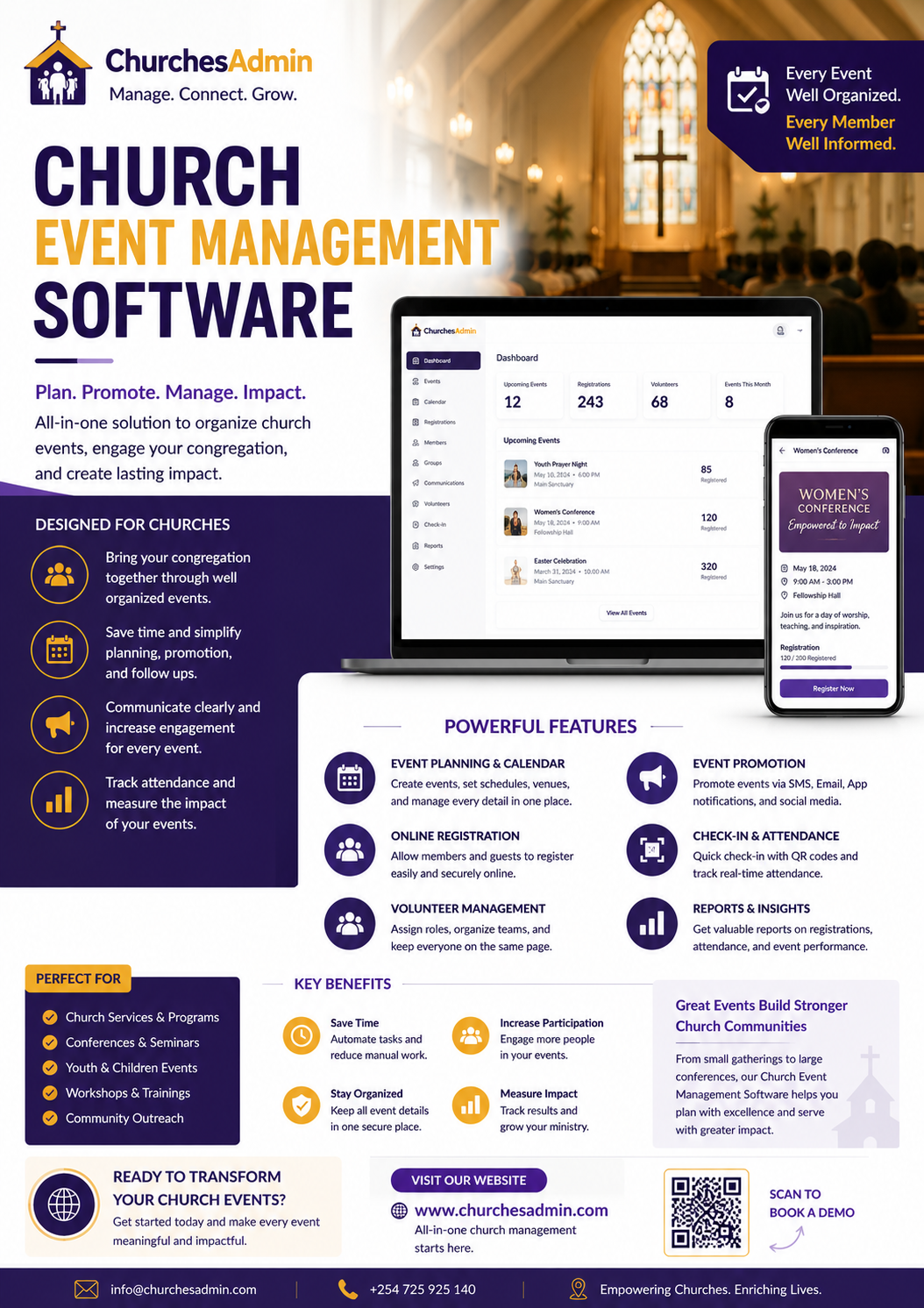
Church Member Management Software – Strengthen Member Engagement and Simplify Church Administration

Church Member Management Software

Church Member Management Software helps churches, ministries, worship centers, faith-based organizations, and religious institutions manage member records, improve communication, track attendance, coordinate ministries, organize volunteer activities, and strengthen member engagement from a centralized platform.

As churches continue to grow, managing member information manually becomes increasingly difficult. Church administrators often handle hundreds or even thousands of member records while coordinating communication, ministry involvement, attendance tracking, contributions, events, and pastoral care activities.

Many churches still rely on paper records, spreadsheets, manual registration books, and disconnected communication systems. While these methods may work for smaller congregations, they often create data inconsistencies, administrative burdens, communication gaps, and limited visibility as membership grows.

Modern churches require digital solutions that help leaders understand, engage, and serve their members more effectively.

EstateAdmin provides a powerful Church Member Management Software solution designed to help churches organize member information, automate administrative tasks, improve engagement, and support long-term ministry growth.


Why Church Member Management Software is Important

Members are the foundation of every church community.

Church leaders need accurate information to effectively serve, support, and engage members.

Churches commonly manage:

  • Member profiles
  • Family records
  • Attendance records
  • Volunteer participation
  • Ministry involvement
  • Contact information
  • Contribution history
  • Event participation
  • Leadership assignments
  • Pastoral care records

Without effective Church Member Management Software, churches often experience:

  • Inaccurate member records
  • Communication challenges
  • Attendance tracking difficulties
  • Administrative inefficiencies
  • Limited member visibility
  • Volunteer coordination issues
  • Reporting limitations
  • Reduced member engagement

A centralized member management system helps churches create stronger relationships while improving operational efficiency.


What is Church Member Management Software?

Church Member Management Software is a digital platform that helps churches manage membership information, engagement activities, communication, attendance, ministry participation, and church administration from one centralized system.

Instead of maintaining multiple spreadsheets and paper files, churches can access all member information from a single platform.

Core capabilities include:

  • Member registration
  • Membership database management
  • Attendance tracking
  • Ministry participation tracking
  • Volunteer management
  • Communication tools
  • Family record management
  • Contribution tracking
  • Reporting and analytics
  • Church administration tools

This allows church leaders to maintain accurate records while improving engagement.


The Growing Need for Church Member Management Software

Churches today face increasing administrative responsibilities.

Several factors are driving demand for church membership technology.

Growing Congregations

As membership grows, maintaining accurate records becomes more challenging.

Digital systems improve organization and scalability.


Increased Focus on Member Engagement

Churches want stronger relationships with members.

Technology helps leaders communicate more effectively.


Need for Better Data Management

Member information must remain accessible and accurate.

Centralized databases improve information management.


Ministry Expansion

Growing ministries require greater visibility into member participation and involvement.


Key Features of Church Member Management Software

A modern church platform should simplify member administration.

Member Profile Management

Every member should have a complete and accurate profile.

EstateAdmin helps churches manage:

  • Full names
  • Contact information
  • Family details
  • Membership status
  • Ministry involvement
  • Leadership roles
  • Participation history

Centralized profiles improve administration and engagement.


Family Record Management

Churches often serve entire families rather than individuals.

Manage:

  • Household records
  • Family relationships
  • Family participation
  • Shared contact information

Family visibility strengthens pastoral care.


Attendance Tracking with Church Member Management Software

Attendance data helps churches understand engagement trends.

Track:

  • Worship attendance
  • Small group participation
  • Bible study attendance
  • Ministry meetings
  • Special events

Attendance insights support ministry planning and outreach.


Ministry Participation Management

Understanding member involvement helps strengthen engagement.

Track participation in:

  • Worship teams
  • Youth ministry
  • Children’s ministry
  • Men’s fellowship
  • Women’s fellowship
  • Outreach programs
  • Volunteer activities

Visibility improves ministry coordination.


Volunteer Management

Volunteers support church operations and ministry activities.

Manage:

  • Volunteer profiles
  • Service schedules
  • Team assignments
  • Leadership roles
  • Participation records

This improves ministry organization.


Communication Management

Communication is critical for member engagement.

Send:

  • Church announcements
  • Event reminders
  • Prayer updates
  • Ministry information
  • Service schedules
  • Community notices

Consistent communication strengthens church relationships.


Contribution and Giving Records

Financial stewardship requires accurate contribution tracking.

Manage:

  • Donations
  • Tithes
  • Offerings
  • Giving histories
  • Contribution reports

This supports accountability and transparency.


Event Registration and Participation Tracking

Churches organize numerous events throughout the year.

Track participation in:

  • Conferences
  • Retreats
  • Training programs
  • Community outreach events
  • Worship gatherings

This improves planning and engagement.


Reporting and Analytics

Church leaders require meaningful insights.

Generate reports for:

  • Membership growth
  • Attendance trends
  • Ministry participation
  • Volunteer involvement
  • Communication effectiveness
  • Contribution activity

Analytics support informed decision-making.


Challenges Solved by Church Member Management Software

Manual Record Keeping

Automation reduces administrative burdens.


Inaccurate Member Information

Centralized databases improve accuracy.


Communication Gaps

Digital communication strengthens engagement.


Attendance Tracking Difficulties

Automated tracking improves visibility.


Volunteer Coordination Challenges

Workflow tools improve organization.


Limited Reporting Capabilities

Real-time reporting improves leadership visibility.


Growth Management Issues

Technology supports expanding congregations.


Benefits of Using Church Member Management Software

Improve Member Engagement

Build stronger relationships through better communication.


Increase Administrative Efficiency

Reduce manual work and paperwork.


Improve Attendance Visibility

Understand participation trends more effectively.


Strengthen Ministry Coordination

Manage departments and volunteers efficiently.


Enhance Pastoral Care

Access member information quickly when needed.


Improve Financial Accountability

Track contributions accurately.


Support Church Growth

Scale membership management effectively.


How Church Member Management Software Improves Church Growth

Church growth depends on effective member engagement and retention.

Software supports growth through:

Better Member Communication

Keep members informed and connected.


Increased Participation

Encourage involvement in church activities.


Improved Follow-Up

Track new members and visitors effectively.


Stronger Community Building

Build meaningful relationships across the congregation.


Enhanced Leadership Visibility

Church leaders gain deeper insights into congregation needs.

This creates a healthier and more connected church community.


How Church Member Management Software Improves Pastoral Care

Pastoral care requires visibility into member needs and involvement.

Software helps by providing:

Complete Member Histories

Access member information instantly.


Family Visibility

Understand household relationships.


Participation Tracking

Monitor ministry involvement.


Communication Records

Maintain engagement history.

This enables more personalized ministry support.


Church Member Management Software for Local Churches

Local churches benefit through:

  • Membership administration
  • Attendance tracking
  • Communication management
  • Volunteer coordination
  • Reporting visibility

Operations become more efficient.


Church Member Management Software for Multi-Campus Churches

Multi-campus churches require centralized oversight.

Software supports:

  • Shared membership databases
  • Unified reporting
  • Consistent communication
  • Ministry coordination

Growth becomes easier to manage.


Church Member Management Software for Ministries

Ministries improve:

  • Member engagement
  • Volunteer management
  • Event coordination
  • Communication workflows

Technology strengthens ministry effectiveness.


Church Member Management Software for Religious Organizations

Faith-based organizations benefit through:

  • Community engagement
  • Membership visibility
  • Operational reporting
  • Program administration

Administration becomes more effective.


Organizations That Benefit from Church Member Management Software

Churches

Improve member administration.


Ministries

Strengthen member engagement.


Worship Centers

Enhance congregation management.


Faith-Based Organizations

Improve operational visibility.


Religious Institutions

Support sustainable growth.


Community Outreach Programs

Improve participation tracking.


Why Church Member Management Software is Essential for Modern Churches

Modern churches require better visibility into membership activities and engagement.

Without software, churches often face:

  • Administrative burdens
  • Data inconsistencies
  • Communication challenges
  • Limited reporting
  • Reduced member engagement

Technology provides the structure needed to support healthy church growth.


How to Choose the Right Church Member Management Software

Before selecting software, evaluate:

Ease of Use

Church staff and volunteers should adopt it quickly.


Membership Database Features

Information should remain organized and accessible.


Communication Capabilities

Engagement should remain simple and effective.


Attendance Tracking Tools

Participation data should be easy to capture.


Reporting Features

Access meaningful insights quickly.


Scalability

Choose software that supports future church growth.

EstateAdmin combines all these capabilities within one centralized platform.


Why Choose EstateAdmin?

EstateAdmin helps churches strengthen member relationships while simplifying administration.

Key advantages include:

  • Member management
  • Attendance tracking
  • Volunteer coordination
  • Communication tools
  • Ministry management
  • Contribution tracking
  • Reporting dashboards
  • Cloud accessibility

Church leaders can spend less time managing records and more time serving people.


Future Trends in Church Member Management Software

The future of church membership technology will focus on:

  • Member self-service portals
  • Mobile engagement tools
  • Automated communication
  • Real-time reporting
  • Ministry analytics
  • Digital onboarding

Churches embracing technology today will be better prepared for future growth.


Get Started with Church Member Management Software

If your church still relies on paper records, spreadsheets, manual attendance registers, and fragmented communication systems, now is the ideal time to modernize.

EstateAdmin Church Member Management Software helps churches organize membership records, improve communication, strengthen engagement, enhance reporting, and support sustainable ministry growth.

Build a more connected, organized, and growing church community with EstateAdmin.

Ministry Management System – Streamline Church Ministries and Improve Member Engagement

Ministry Management System

Ministry Management System helps churches, ministries, faith-based organizations, religious institutions, worship centers, and church leadership teams manage members, coordinate ministry activities, automate administration, improve communication, track attendance, manage volunteers, and strengthen ministry operations.

As churches continue growing and expanding their outreach programs, managing ministry operations manually becomes increasingly difficult. Church leaders often oversee multiple ministries, departments, volunteers, events, members, financial activities, and communication channels simultaneously.

Traditional management methods such as spreadsheets, paper records, notebooks, and disconnected communication tools often lead to inefficiencies, poor coordination, limited reporting, and administrative burdens.

Modern ministries require technology that centralizes operations while improving visibility, accountability, and member engagement.

EstateAdmin provides a comprehensive Ministry Management System that helps churches simplify administration, improve communication, strengthen leadership oversight, and support long-term ministry growth.


Why Ministry Management System is Important

Ministries involve multiple activities that require coordination and structure.

Church leaders commonly manage:

  • Member records
  • Ministry departments
  • Attendance tracking
  • Volunteer management
  • Event planning
  • Communication workflows
  • Contribution tracking
  • Leadership reporting
  • Community outreach
  • Ministry performance

Without a centralized Ministry Management System, churches often experience:

  • Administrative inefficiencies
  • Communication gaps
  • Poor volunteer coordination
  • Attendance tracking challenges
  • Reporting limitations
  • Member engagement issues
  • Financial visibility concerns
  • Ministry growth difficulties

A modern ministry platform helps churches operate more effectively while strengthening member participation.


What is a Ministry Management System?

A Ministry Management System is a digital solution designed to help churches organize, automate, and manage ministry operations from one centralized platform.

Instead of relying on multiple disconnected tools, church leaders can manage ministry activities through one integrated system.

Core features typically include:

  • Member management
  • Attendance tracking
  • Volunteer coordination
  • Ministry administration
  • Event management
  • Communication tools
  • Contribution tracking
  • Leadership reporting
  • Department management
  • Church operations oversight

This creates a more organized and efficient ministry environment.


The Growing Need for Ministry Management System Solutions

Churches are increasingly adopting technology to support ministry growth.

Several factors are driving this transformation.

Growing Congregations

Larger congregations generate more administrative responsibilities.

Managing information manually becomes challenging.


Expanding Ministry Programs

Churches often operate multiple ministries simultaneously.

Centralized systems improve coordination.


Increased Need for Member Engagement

Members expect better communication and accessibility.

Technology improves engagement and participation.


Accountability and Transparency Requirements

Church leaders require accurate reporting and visibility into ministry operations.


Key Features of Ministry Management System

A modern platform should simplify every aspect of ministry management.

Member Management with Ministry Management System

Member information should remain centralized and accessible.

EstateAdmin helps churches manage:

  • Member profiles
  • Family records
  • Contact information
  • Membership history
  • Ministry involvement
  • Leadership assignments

Centralized member records improve efficiency.


Ministry Department Management

Churches often operate multiple departments.

Manage:

  • Youth ministry
  • Children’s ministry
  • Women’s ministry
  • Men’s fellowship
  • Worship teams
  • Outreach ministries
  • Leadership groups

This improves oversight and accountability.


Attendance Tracking

Attendance data provides insights into member engagement.

Track:

  • Worship services
  • Ministry meetings
  • Small groups
  • Bible studies
  • Conferences
  • Outreach activities

Attendance reporting supports ministry planning.


Volunteer Management

Volunteers play a critical role in ministry success.

Manage:

  • Volunteer records
  • Team assignments
  • Service schedules
  • Participation tracking
  • Leadership responsibilities

Improved coordination strengthens ministry effectiveness.


Church Communication Management

Communication helps maintain engagement.

Share:

  • Announcements
  • Event invitations
  • Ministry updates
  • Prayer requests
  • Community notices

Effective communication improves member participation.


Event and Program Management

Churches organize various programs throughout the year.

Manage:

  • Conferences
  • Retreats
  • Training sessions
  • Worship services
  • Outreach programs
  • Community events

Centralized planning improves organization.


Contribution and Giving Management

Financial stewardship remains essential.

Manage:

  • Tithes
  • Offerings
  • Donations
  • Giving records
  • Contribution history

Automation improves accountability and transparency.


Leadership Reporting and Analytics

Church leaders require visibility into ministry performance.

Generate reports for:

  • Attendance trends
  • Ministry participation
  • Volunteer activity
  • Financial performance
  • Member engagement

Reporting supports strategic decision-making.


Challenges Solved by Ministry Management System

Manual Administration

Automation reduces repetitive tasks.


Communication Challenges

Digital communication improves engagement.


Volunteer Coordination Difficulties

Workflow tools improve organization.


Attendance Tracking Issues

Centralized records improve visibility.


Reporting Limitations

Automated reports improve decision-making.


Ministry Growth Challenges

Technology supports expansion.


Benefits of Using Ministry Management System

Improve Administrative Efficiency

Reduce paperwork and manual processes.


Strengthen Member Engagement

Improve communication and participation.


Enhance Ministry Coordination

Manage departments more effectively.


Improve Volunteer Management

Coordinate teams efficiently.


Strengthen Financial Accountability

Track giving and ministry expenses accurately.


Improve Reporting Visibility

Access meaningful ministry insights.


Support Church Growth

Manage larger congregations successfully.


How Ministry Management System Improves Ministry Effectiveness

Ministry success depends on organization and engagement.

Software improves effectiveness through:

Better Organization

Church information remains centralized.


Improved Communication

Members stay informed and connected.


Faster Administrative Processes

Automation reduces manual work.


Stronger Accountability

Leadership gains better visibility into ministry activities.


Better Decision-Making

Accurate reporting supports strategic planning.

This allows ministry leaders to focus more on serving people and advancing their mission.


How Ministry Management System Improves Member Experience

Member engagement is essential for healthy church growth.

Software improves experiences through:

Timely Communication

Members receive updates quickly.


Improved Event Participation

Members stay informed about ministry activities.


Better Ministry Coordination

Programs become more organized.


Stronger Community Connections

Members remain connected to the church family.

Engaged members contribute to stronger ministries.


Ministry Management System for Local Churches

Local churches benefit through:

  • Member management
  • Attendance tracking
  • Communication tools
  • Volunteer administration
  • Ministry reporting

Operations become more organized.


Ministry Management System for Youth Ministries

Youth ministries improve:

  • Attendance visibility
  • Event coordination
  • Volunteer management
  • Communication workflows

Technology strengthens engagement.


Ministry Management System for Outreach Programs

Outreach teams benefit through:

  • Program coordination
  • Volunteer tracking
  • Reporting visibility
  • Community engagement

This improves ministry effectiveness.


Ministry Management System for Multi-Campus Churches

Multi-campus churches require centralized oversight.

Software supports:

  • Shared databases
  • Unified reporting
  • Ministry coordination
  • Consistent communication

Growth becomes easier to manage.


Ministry Management System for Religious Organizations

Faith-based organizations benefit through:

  • Community engagement
  • Leadership visibility
  • Financial accountability
  • Program administration

Operations become more efficient.


Organizations That Benefit from Ministry Management System

Churches

Improve ministry administration.


Ministries

Strengthen coordination and engagement.


Religious Organizations

Improve operational efficiency.


Worship Centers

Enhance member experiences.


Faith-Based Institutions

Support sustainable growth.


Community Outreach Programs

Improve visibility and reporting.


Why Ministry Management System is Essential for Modern Churches

Modern churches require systems that support growth, engagement, and accountability.

Without software, ministries often experience:

  • Administrative burdens
  • Communication challenges
  • Reporting limitations
  • Volunteer coordination difficulties
  • Growth constraints

Technology provides the structure needed for effective ministry management.


How to Choose the Right Ministry Management System

Before selecting software, evaluate:

Ease of Use

Church teams should adopt the platform quickly.


Member Management Features

Information should remain organized and accessible.


Communication Tools

Member engagement should remain simple.


Reporting Capabilities

Access meaningful insights easily.


Ministry Coordination Features

Departments should operate efficiently.


Scalability

Choose software that supports future ministry growth.

EstateAdmin combines all these capabilities in one centralized platform.


Why Choose EstateAdmin?

EstateAdmin helps churches simplify ministry administration and strengthen operational effectiveness.

Key advantages include:

  • Member management
  • Attendance tracking
  • Volunteer coordination
  • Contribution management
  • Event administration
  • Ministry oversight
  • Financial reporting
  • Cloud accessibility

Church leaders can focus more on ministry and less on administration.


Future Trends in Ministry Management System Technology

The future of ministry management will focus on:

  • Workflow automation
  • Digital engagement
  • Real-time reporting
  • Ministry analytics
  • Mobile accessibility
  • Enhanced communication platforms

Churches investing in technology today will be better positioned for future growth.


Get Started with Ministry Management System

If your church still relies on spreadsheets, paper records, manual attendance tracking, and disconnected communication channels, now is the ideal time to modernize.

EstateAdmin Ministry Management System helps churches automate administration, improve communication, strengthen accountability, enhance member engagement, and support sustainable ministry growth.

Build a smarter, more connected, and more effective ministry with EstateAdmin.

Church Operations Software – Simplify Administration, Improve Ministry Coordination, and Strengthen Church Growth

Church Operations Software

Church Operations Software helps churches, ministries, worship centers, faith-based organizations, and religious institutions streamline administration, improve member engagement, automate workflows, manage finances, coordinate ministries, and enhance overall church operations.

As churches continue growing and expanding their ministries, operational management becomes increasingly complex. Church leaders are responsible for overseeing member records, attendance tracking, financial contributions, volunteer coordination, communication, event planning, ministry activities, and reporting while ensuring smooth day-to-day operations.

Many churches still rely on spreadsheets, paper records, manual registers, and disconnected communication channels. While these methods may work for smaller congregations, they often create inefficiencies, reporting challenges, communication gaps, and administrative burdens as the church grows.

Modern ministry requires technology that supports operational excellence while allowing pastors, administrators, and ministry leaders to focus more on serving people and advancing the church’s mission.

EstateAdmin provides a comprehensive Church Operations Software solution that helps churches automate administrative processes, improve communication, strengthen accountability, and support sustainable ministry growth.


Why Church Operations Software is Important

Church operations involve numerous responsibilities that must work together effectively.

Most churches manage:

  • Member information
  • Attendance records
  • Contributions and giving
  • Volunteer coordination
  • Ministry departments
  • Church communications
  • Event planning
  • Financial administration
  • Leadership reporting
  • Community outreach activities

Without a centralized system, churches often experience:

  • Administrative inefficiencies
  • Poor communication
  • Inaccurate records
  • Delayed reporting
  • Volunteer coordination challenges
  • Financial visibility limitations
  • Event management difficulties
  • Reduced member engagement

Implementing Church Operations Software helps churches create organized workflows that improve efficiency and ministry effectiveness.


What is Church Operations Software?

Church Operations Software is a digital platform designed to centralize and automate church administration, ministry management, communication, and reporting.

Instead of managing operations through multiple disconnected systems, churches can oversee everything from one integrated platform.

Core capabilities include:

  • Member management
  • Attendance tracking
  • Contribution management
  • Financial reporting
  • Volunteer management
  • Event coordination
  • Communication tools
  • Ministry administration
  • Leadership reporting
  • Church workflow automation

The result is improved efficiency and stronger operational visibility.


The Growing Need for Church Operations Software

The church landscape continues evolving.

Several factors are increasing demand for church management technology.

Growing Congregations

As churches attract more members, administrative complexity increases.

Managing information manually becomes unsustainable.


Increased Communication Expectations

Members expect timely updates and easy access to information.

Technology improves engagement and communication.


Greater Accountability Requirements

Church leadership requires accurate reporting and financial transparency.

Software strengthens accountability.


Ministry Expansion

Growing ministries require scalable systems capable of supporting multiple programs and departments.


Key Features of Church Operations Software

A modern church platform should simplify every aspect of church administration.

Member Management with Church Operations Software

Churches require organized member records.

EstateAdmin helps churches manage:

  • Member profiles
  • Family records
  • Contact information
  • Membership history
  • Ministry involvement
  • Leadership assignments

Centralized member records improve administration.


Attendance Tracking

Attendance provides valuable insights into church engagement.

Track:

  • Sunday services
  • Midweek services
  • Small groups
  • Prayer meetings
  • Conferences
  • Ministry events

Attendance analytics support ministry planning.


Contribution and Giving Management

Financial stewardship is essential for sustainable ministry.

Manage:

  • Tithes
  • Offerings
  • Donations
  • Giving history
  • Contribution records
  • Financial reporting

Automation improves transparency and accountability.


Church Communication Management

Communication keeps members connected.

Send:

  • Church announcements
  • Service reminders
  • Event notifications
  • Prayer updates
  • Ministry information
  • Emergency notices

Consistent communication strengthens engagement.


Volunteer Management

Volunteers are critical to church operations.

Manage:

  • Volunteer profiles
  • Team assignments
  • Service schedules
  • Ministry participation
  • Leadership responsibilities

Improved coordination increases ministry effectiveness.


Ministry and Department Management

Churches often operate through various departments.

Manage:

  • Worship teams
  • Children’s ministry
  • Youth ministry
  • Outreach programs
  • Men’s fellowship
  • Women’s fellowship
  • Leadership groups

Centralized administration improves oversight.


Event Management

Churches organize numerous events throughout the year.

Coordinate:

  • Conferences
  • Retreats
  • Crusades
  • Seminars
  • Community outreach programs
  • Training sessions

Event management tools simplify planning and execution.


Financial Reporting and Administration

Church leadership requires accurate financial visibility.

Generate reports for:

  • Contributions
  • Ministry expenses
  • Budget performance
  • Operational costs
  • Financial summaries

Reporting supports informed decision-making.


Workflow Automation

Automation reduces repetitive administrative work.

Examples include:

  • Attendance recording
  • Contribution tracking
  • Event registration
  • Communication workflows
  • Reporting processes

Automation improves efficiency and consistency.


Challenges Solved by Church Operations Software

Manual Administration

Automation reduces paperwork and repetitive tasks.


Communication Gaps

Digital communication tools improve engagement.


Attendance Tracking Difficulties

Centralized records improve visibility.


Volunteer Coordination Challenges

Workflow tools improve scheduling and management.


Financial Reporting Delays

Automated reporting improves accountability.


Ministry Growth Limitations

Technology supports expansion and scalability.


Benefits of Using Church Operations Software

Improve Administrative Efficiency

Reduce manual work and improve productivity.


Strengthen Member Engagement

Improve communication and participation.


Enhance Financial Transparency

Track giving and expenditures effectively.


Improve Volunteer Coordination

Manage ministry teams efficiently.


Strengthen Ministry Operations

Support effective ministry execution.


Improve Reporting Visibility

Access accurate church data quickly.


Support Church Growth

Manage larger congregations effectively.


How Church Operations Software Improves Ministry Effectiveness

Churches exist to serve people and advance ministry goals.

Software improves effectiveness through:

Better Organization

Church information remains centralized and accessible.


Improved Communication

Members remain informed and engaged.


Faster Administrative Processes

Routine tasks require less manual effort.


Stronger Accountability

Leadership gains visibility into church operations.


Improved Decision-Making

Accurate reporting supports strategic planning.

This allows leaders to focus more on ministry impact.


How Church Operations Software Improves Member Experience

Member satisfaction contributes to church growth.

Software improves experiences through:

Better Communication

Members receive updates quickly.


Easier Event Participation

Members stay informed about activities and programs.


Improved Ministry Coordination

Church activities become more organized.


Enhanced Community Engagement

Members remain connected to the church community.

Engaged members contribute to stronger congregations.


Church Operations Software for Local Churches

Local churches benefit through:

  • Member management
  • Attendance tracking
  • Volunteer administration
  • Communication tools
  • Financial reporting

Operations become more efficient.


Church Operations Software for Ministries

Ministries improve:

  • Program administration
  • Team coordination
  • Member engagement
  • Reporting visibility

Technology supports ministry growth.


Church Operations Software for Multi-Campus Churches

Multi-campus churches require centralized management.

Software supports:

  • Unified reporting
  • Shared member databases
  • Consistent communication
  • Ministry coordination

Expansion becomes easier to manage.


Church Operations Software for Religious Organizations

Faith-based organizations benefit through:

  • Community engagement
  • Financial administration
  • Program management
  • Leadership reporting

Operations become more effective.


Church Operations Software for Worship Centers

Worship centers improve:

  • Service planning
  • Attendance tracking
  • Volunteer management
  • Communication workflows

Technology strengthens administration.


Organizations That Benefit from Church Operations Software

Churches

Improve daily administration.


Ministries

Strengthen operational efficiency.


Faith-Based Organizations

Improve accountability and reporting.


Worship Centers

Enhance member experiences.


Religious Institutions

Support long-term growth.


Community Outreach Programs

Improve coordination and visibility.


Why Church Operations Software is Essential for Modern Churches

Modern churches require systems that support growth, engagement, and accountability.

Without software, churches often face:

  • Administrative burdens
  • Communication challenges
  • Financial visibility limitations
  • Volunteer management difficulties
  • Growth constraints

Technology provides the foundation for efficient and sustainable ministry operations.


How to Choose the Right Church Operations Software

Before selecting software, evaluate:

Ease of Use

Church staff and volunteers should onboard quickly.


Member Management Features

Information should remain organized.


Communication Capabilities

Engagement tools should be easy to use.


Reporting and Analytics

Access meaningful operational insights.


Financial Management Features

Track contributions and expenses effectively.


Scalability

Choose software that supports future ministry growth.

EstateAdmin combines all these capabilities within one powerful platform.


Why Choose EstateAdmin?

EstateAdmin helps churches simplify operations and strengthen ministry effectiveness.

Key advantages include:

  • Member management
  • Attendance tracking
  • Contribution management
  • Volunteer coordination
  • Event administration
  • Financial reporting
  • Ministry management
  • Cloud accessibility

Church leaders can spend less time on administration and more time serving their communities.


Future Trends in Church Operations Software

The future of church management technology will focus on:

  • Workflow automation
  • Digital engagement
  • Real-time reporting
  • Ministry analytics
  • Mobile accessibility
  • Enhanced communication tools

Churches investing in technology today will be better prepared for future growth.


Get Started with Church Operations Software

If your church still relies on spreadsheets, paper records, manual attendance tracking, and fragmented communication systems, now is the ideal time to modernize.

EstateAdmin Church Operations Software helps churches automate administration, improve communication, strengthen financial accountability, enhance ministry coordination, and support sustainable growth.

Build a smarter, more connected, and more efficient church with EstateAdmin.

Church Management Platform – Transform Church Administration and Strengthen Member Engagement

Church Management Platform

Church Management Platform solutions help churches, ministries, faith-based organizations, worship centers, and religious institutions manage members, streamline administration, improve communication, track attendance, oversee contributions, coordinate ministries, and strengthen operational efficiency.

As churches continue to grow and expand their ministries, managing operations manually becomes increasingly challenging. Church leaders must oversee member records, financial contributions, ministry activities, attendance tracking, volunteer coordination, communication, event planning, and reporting while maintaining transparency and accountability.

Traditional administration methods such as paper records, spreadsheets, manual registers, and fragmented communication channels often lead to inefficiencies, data inaccuracies, communication gaps, and administrative burdens.

Modern churches require centralized technology that simplifies administration and empowers leaders to focus on ministry rather than paperwork.

EstateAdmin provides a comprehensive Church Management Platform that helps churches digitize operations, improve member engagement, strengthen financial oversight, and support sustainable ministry growth.


Why a Church Management Platform is Important

Church administration involves multiple responsibilities that require organization and visibility.

Church leadership teams commonly manage:

  • Member records
  • Attendance tracking
  • Contributions and giving
  • Volunteer coordination
  • Ministry departments
  • Church events
  • Communication
  • Financial reporting
  • Small groups
  • Community outreach programs

Without a centralized Church Management Platform, churches often experience:

  • Administrative inefficiencies
  • Poor communication
  • Data duplication
  • Attendance tracking difficulties
  • Financial visibility challenges
  • Volunteer management issues
  • Limited reporting capabilities
  • Reduced member engagement

A modern platform helps churches streamline operations while improving ministry effectiveness.


What is a Church Management Platform?

A Church Management Platform is a centralized digital solution designed to manage church operations from one system.

The platform enables church leaders and administrators to organize information, automate workflows, improve communication, and maintain accurate records.

Core capabilities include:

  • Member management
  • Attendance management
  • Contribution tracking
  • Communication tools
  • Event management
  • Volunteer management
  • Ministry administration
  • Reporting and analytics
  • Financial oversight
  • Church operations management

This creates greater efficiency throughout the organization.


The Growing Demand for Church Management Platform Solutions

Churches are increasingly adopting technology to support ministry growth.

Several factors contribute to this trend.

Growing Congregations

As churches expand, managing member information manually becomes difficult.

Digital systems improve organization and scalability.


Need for Better Communication

Members expect timely updates and convenient communication channels.

Technology helps churches stay connected.


Increased Accountability Requirements

Church leadership requires accurate financial and operational reporting.

Software improves transparency.


Ministry Expansion

Growing ministries require systems that support multiple departments and activities.


Key Features of a Church Management Platform

The right platform helps churches manage operations efficiently.

Member Management with a Church Management Platform

Member information should remain organized and accessible.

EstateAdmin helps churches manage:

  • Member profiles
  • Family records
  • Contact information
  • Membership history
  • Ministry involvement
  • Leadership assignments

Centralized records improve administration.


Attendance Tracking

Attendance data helps leaders understand engagement levels.

Track:

  • Sunday services
  • Midweek services
  • Small groups
  • Ministry meetings
  • Special events

Attendance insights support ministry planning.


Contribution and Giving Management

Financial stewardship is essential for church growth.

Manage:

  • Offerings
  • Tithes
  • Donations
  • Giving records
  • Contribution history

Automation improves accountability and reporting.


Communication Management

Strong communication strengthens church engagement.

Share:

  • Announcements
  • Event invitations
  • Prayer updates
  • Ministry information
  • Church notices

Effective communication improves member participation.


Event Management

Churches regularly organize activities and programs.

Manage:

  • Conferences
  • Worship services
  • Retreats
  • Outreach events
  • Training programs

Centralized event management improves coordination.


Volunteer Management

Volunteers play a critical role in church operations.

Track:

  • Volunteer records
  • Ministry assignments
  • Service schedules
  • Team participation

Better coordination improves ministry effectiveness.


Ministry and Department Administration

Churches often operate multiple departments.

Manage:

  • Youth ministries
  • Children’s ministries
  • Worship teams
  • Outreach departments
  • Leadership groups

Centralized oversight improves accountability.


Financial Reporting and Analytics

Church leaders require visibility into financial performance.

Generate reports for:

  • Contributions
  • Expenses
  • Budget performance
  • Ministry spending
  • Financial summaries

Data-driven reporting supports informed decision-making.


Challenges Solved by a Church Management Platform

Manual Record Keeping

Automation reduces administrative workload.


Communication Gaps

Digital communication improves engagement.


Financial Reporting Difficulties

Automated reporting improves visibility.


Attendance Tracking Challenges

Centralized attendance records improve monitoring.


Volunteer Coordination Issues

Workflow tools improve organization.


Growth Management Challenges

Technology supports ministry expansion.


Benefits of Using a Church Management Platform

Improve Administrative Efficiency

Reduce manual paperwork and repetitive tasks.


Strengthen Member Engagement

Improve communication and participation.


Enhance Financial Transparency

Track contributions and expenditures effectively.


Improve Event Coordination

Manage activities more efficiently.


Support Ministry Growth

Scale church operations effectively.


Improve Volunteer Management

Coordinate ministry teams efficiently.


Strengthen Reporting and Accountability

Access accurate operational data.


How a Church Management Platform Improves Member Engagement

Member engagement is essential for church growth.

The platform improves engagement through:

Better Communication

Members receive important updates quickly.


Increased Participation

Event and ministry information becomes more accessible.


Improved Member Records

Accurate information supports personalized engagement.


Stronger Community Connections

Digital communication strengthens relationships.

Engaged members contribute to healthier church communities.


How a Church Management Platform Improves Financial Management

Financial accountability is critical for trust and sustainability.

Software improves financial management through:

Contribution Tracking

Monitor giving activity accurately.


Financial Visibility

Track church finances in real time.


Reporting Automation

Generate financial reports instantly.


Accountability Improvements

Maintain complete financial records.

This strengthens stewardship and transparency.


Church Management Platform for Local Churches

Local churches benefit through:

  • Member management
  • Attendance tracking
  • Communication tools
  • Financial reporting
  • Event coordination

Operations become more organized.


Church Management Platform for Ministries

Ministries improve:

  • Volunteer management
  • Program administration
  • Member engagement
  • Operational visibility

Technology supports ministry effectiveness.


Church Management Platform for Multi-Campus Churches

Multi-campus churches require centralized oversight.

The platform supports:

  • Shared member databases
  • Unified reporting
  • Consistent communication
  • Ministry coordination

Expansion becomes easier to manage.


Church Management Platform for Religious Organizations

Faith-based organizations benefit through:

  • Community engagement
  • Program administration
  • Financial management
  • Reporting visibility

Operations become more efficient.


Organizations That Benefit from a Church Management Platform

Churches

Improve administration and engagement.


Ministries

Strengthen coordination and communication.


Religious Organizations

Improve operational efficiency.


Worship Centers

Enhance member experiences.


Community Outreach Programs

Improve organization and visibility.


Faith-Based Institutions

Support sustainable growth.


Why a Church Management Platform is Essential for Modern Ministry

Modern ministry requires efficient systems and strong communication.

Without software, churches often experience:

  • Administrative burdens
  • Communication challenges
  • Limited reporting
  • Financial visibility issues
  • Growth constraints

Technology provides the structure needed to support ministry success.


How to Choose the Right Church Management Platform

Before selecting software, evaluate:

Ease of Use

Church teams should adopt the system quickly.


Member Management Features

Information should remain organized and accessible.


Communication Tools

Engagement should remain simple and effective.


Reporting Capabilities

Access meaningful insights easily.


Scalability

Choose a platform that supports future growth.

EstateAdmin combines all these capabilities in one centralized solution.


Why Choose EstateAdmin?

EstateAdmin helps churches simplify administration and strengthen ministry operations.

Key advantages include:

  • Member management
  • Attendance tracking
  • Contribution management
  • Volunteer coordination
  • Event administration
  • Financial reporting
  • Communication tools
  • Cloud accessibility

Church leaders can focus more on ministry and less on administrative work.


Future Trends in Church Management Platform Technology

The future of church administration will focus on:

  • Automation
  • Digital member engagement
  • Real-time reporting
  • Centralized communication
  • Ministry analytics
  • Mobile accessibility

Churches embracing technology today will be better positioned for future growth.


Get Started with a Church Management Platform

If your church still relies on spreadsheets, paper records, manual attendance tracking, and fragmented communication channels, now is the ideal time to modernize.

EstateAdmin Church Management Platform helps churches automate administration, improve member engagement, strengthen financial accountability, enhance communication, and support long-term ministry growth.

Build a smarter, more connected, and more effective church with EstateAdmin.